
Contents
Black Slip is a name shared by two Cypriot wares that have nothing to do with each other. The first is a handmade Bronze Age ware of the Middle Cypriot period and the first phase of the Late Cypriot: buff clay under a dark slip, usually with incised or ribbed decoration, made mostly as jugs, juglets, bowls, tankards and amphorae. The second is Einar Gjerstad's wheelmade Iron Age Black Slip, which the Swedish Cyprus Expedition defined in 1948 and numbered I to VI, from the Cypro-Geometric through the Cypro-Archaic to the start of the Cypro-Classical period [2, pp. 76–79]. Both systems use Roman numerals, and the numerals do not line up: a Bronze Age "Black Slip II" juglet and an Iron Age "Black Slip II" jug are separated by seven or eight centuries. This entry covers both, with the Bronze Age family first, the small Chalcolithic-to-Early Cypriot fabric called Black Slip and Combed in its own section, and the Iron Age family after it. You can see all Bronze Age Black Slip in the catalogue or all Iron Age Black Slip in the catalogue.
Identifying Bronze Age Black Slip
Paul Åström's description of Black Slip III from his excavation at Kalopsidha in eastern Cyprus is the clearest short definition of the ware: "The clay is homogeneous buff, sometimes soft, usually hard. The slip is matt black, toning to red. The pots were hand-made." The decoration is incised: parallel lines, parallel zigzags, encircling lines, network, short oblique strokes and chevrons [1, p. 64]. The phrase "toning to red" matters. The colour of the slip depends on firing, and Åström found the difference between black and red slips so slight that he named a separate Red Slip (III) Hand-made ware which "differs from Black Slip III only in the red colour of the slip"; he had already hesitated, in his Middle Cypriot volume, over juglets that were red with black patches [1, p. 80].
The range of colour and fabric is wide. Desmond Morris, quoting Åström's 1972 Swedish Cyprus Expedition volume, lists slips that may be "light or dark brown, reddish black or black" or "mottled red-(brown) and black", matt or lustrous, over clays from light brown and pinkish buff to grey or greenish. He concluded that Black Slip is "a rag-bag group of vessels, probably not a true type", the product of "the general decay of the Red Polished tradition" [4, p. 29]. Morris wrote as a collector rather than an excavator, but the difficulty he describes is real. Jennifer Webb characterises Middle Cypriot III as "a period of ceramic hybridisation", in which Red Polished IV, Drab Polished, Red Slip and Black Slip share aspects of form, fabric and decoration and "are often difficult to distinguish" [5]. In late Middle Cypriot II the multiple incising tool came into use, and potters used it "to work more quickly with relatively crude results in Red Polished IV, Black Slip and Red Slip" [5, p. 32].
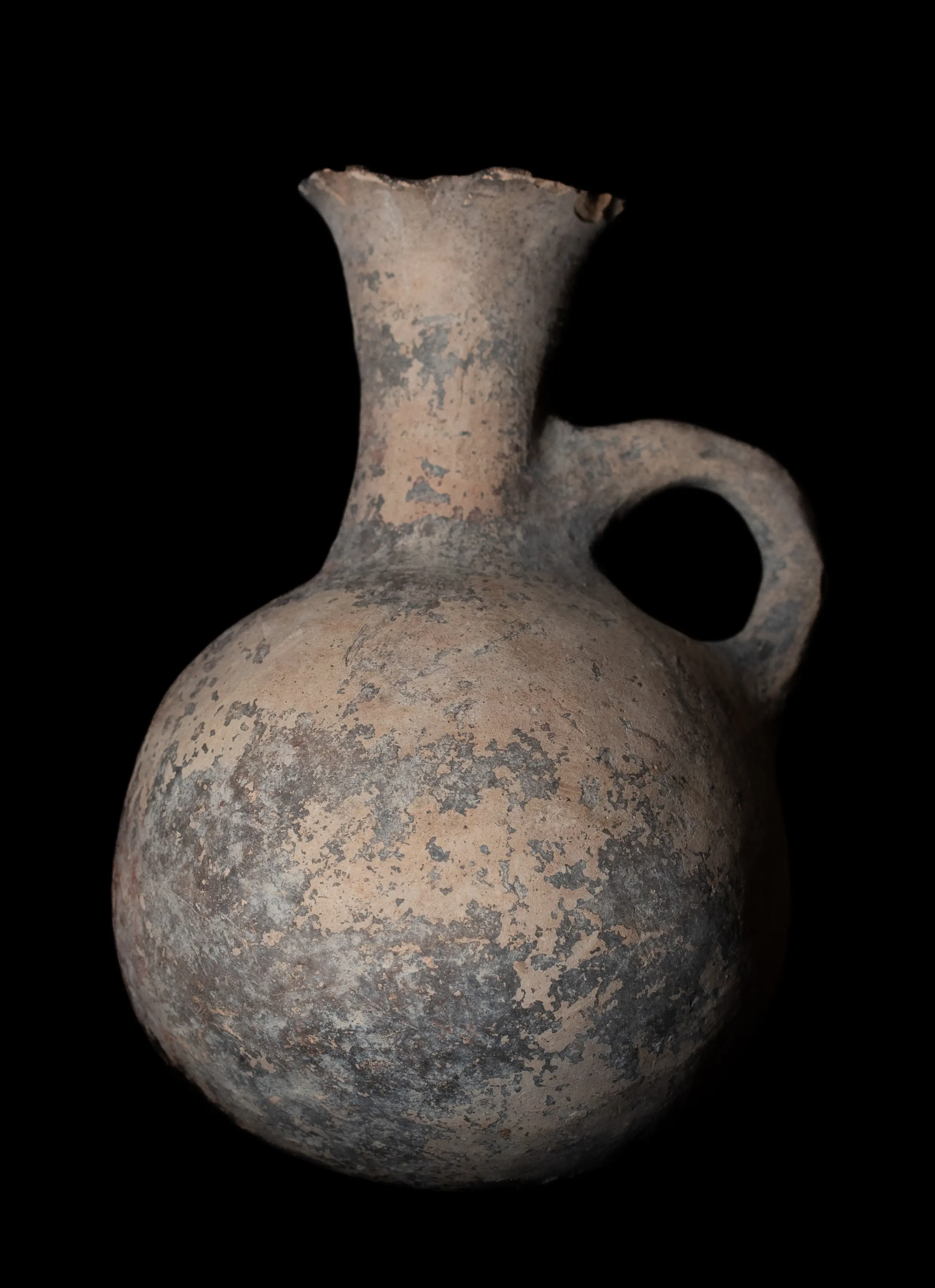
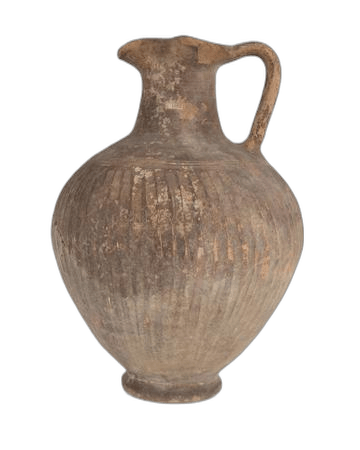
In practice a Bronze Age Black Slip pot is handmade, has a light-firing body under a slip that is black where it fired black and red or brown where it did not, and carries incised or relief decoration rather than paint. The Drakopoulos jug shown here fits that description in its patchy grey-black coat over pinkish buff clay; its attribution remains "probably Black Slip" until the base and the method of manufacture can be checked. The Plain White ware entry describes the Kissonerga-Skalia fabric work on the ware and its relationship to Plain White; the shapes are those of the other Middle Cypriot monochrome wares.
| Class | Date | Main shapes | Notes |
|---|---|---|---|
| Black Slip I | Early Middle Cypriot (MC I?) | Jugs or amphorae | Rare; well polished brown to black slip |
| Black Slip II | Middle Cypriot, survives into LC I | Jugs, bowls, tankards, amphorae, juglets | The common Middle Cypriot class |
| Black Slip III | Late MC to LC I | Juglets; plastic vases | Incised; red version is Red Slip (III) |
| Black Slip IV | Late Cypriot I | As Black Slip II | Late Cypriot examples of Black Slip II |
| Black Slip V | Late Cypriot I | Juglets | Late Cypriot examples of Black Slip III |
| Black Slip Wheel-made | Late Cypriot | Bowls, large jugs | Common in settlements, rare in tombs |
| Black Slip and Combed | Philia phase | Sherds | Combed through black to red; also at Tarsus |
| Iron Age Black Slip I–VI | CG I to CC I | Bowls, jugs, amphorae, bottles | Wheelmade; Gjerstad's types, unrelated |
Black Slip I
Black Slip I is the earliest and rarest of the Bronze Age classes, and the least documented. At Kalopsidha Åström recorded only scattered sherds. One, found immediately above virgin soil, had a "well polished brownish black slip" over grey clay and came from a jug or amphora [1, p. 47]. A handle fragment picked up on the surface in 1959, now in Lund, had buff clay with a grey core and a slip "partly brown partly black", well polished; Åström dated it, with a question mark, to Middle Cypriot I [1, p. 168]. Black Slip I appears once in his corpus of pot-marks, beside about fifty marked Black Slip II jugs [1, p. 190]. The polish sets it apart from the matt Black Slip II and III that followed, and suggests a ware still close to the polished Red Polished tradition. The catalogue holds one example, a small Black Slip I jug with beaked mouth in the Ashmolean Museum; see Black Slip I in the catalogue.
Black Slip II
Black Slip II is the common handmade Middle Cypriot class, and in settlement deposits it can be one of the most frequent wares. Åström's trench counts at Kalopsidha include layers with 95 and 58 Black Slip II sherds, among them fragments of jugs and bowls and the semicircular spout of a wide bowl [1, pp. 145–146]. The shapes are jugs with round or pinched spouts, hemispherical bowls, tankards, amphorae and juglets. Datable tomb examples include a jug and a tankard from Lapithos Tomb 702 and a 32 cm amphora from Dhenia Tomb 6, all of Middle Cypriot III [1, p. 151].
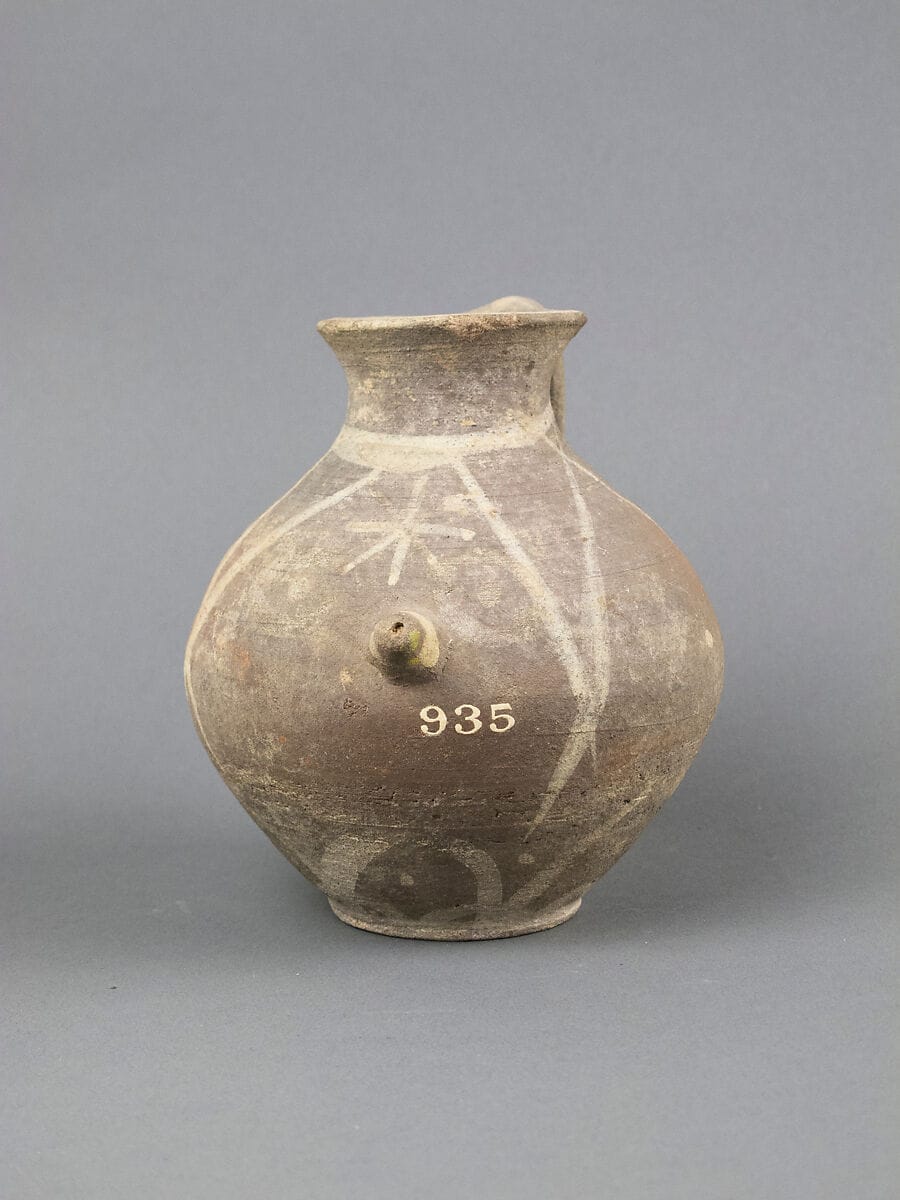
The ware outlived the Middle Cypriot period. In the Kazaphani tomb, used from Late Cypriot IA to IIB, Black Slip II Handmade made up 5 per cent of the pottery, against 28.95 per cent Base Ring I [6, pp. 23, 59]. Among the Kazaphani pieces is a sack-shaped tankard with a pierced lug at the base of the neck, a handle with a downturned thumb-piece, and incised groups of rings and wavy bands [6, p. 11]. A Black Slip tankard in the Pierides Museum, Larnaca belongs to the same family of shapes. Some potters combined wares on a single pot: Åström records a Composite Ware with a Black Slip II exterior and a White Painted IV interior [1, p. 39], and the catalogue's black-slipped string-hole flask in the Ashmolean is catalogued as composite ware.
Three different things have been called "Black Slip II". The first is the plain Middle Cypriot class. The second is Black Slip II (Reserved Slip), a sandy buff fabric whose black slip leaves a reserved zone on the shoulder with a thick wavy line; J. R. Stewart and J. B. Hennessy coined the name, and complete jugs came from Akhera, Dhenia Tomb 6 and Enkomi Tomb 110 [1, p. 63]. The third is the Late Cypriot Black Slip II, which Åström later renamed Black Slip IV (see below). Museum examples of the plain class include a juglet from Nicosia-Ayia Paraskevi given by John Myres to the Ashmolean Museum (AN1964.478), and a juglet from Kalopsidha excavated by Myres in 1894 (AN1896-1908.C.27). See Black Slip II in the catalogue.
Black Slip III
Black Slip III is the class of small incised juglets defined at Kalopsidha (above): 40 sherds there, all from juglets, with narrow tapering necks, handles from neck to shoulder, pinched mouths and perhaps bell rims [1, p. 64]. Åström noted that the soft-fabric juglets "occur already in Middle Cypriote III" [1, p. 62], so the class spans the end of the Middle Cypriot period and the start of the Late. Its red twin is Red Slip (III) Hand-made [1, p. 80].
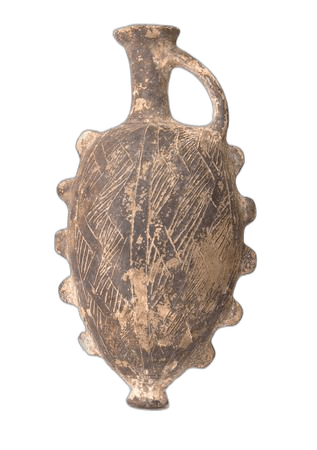
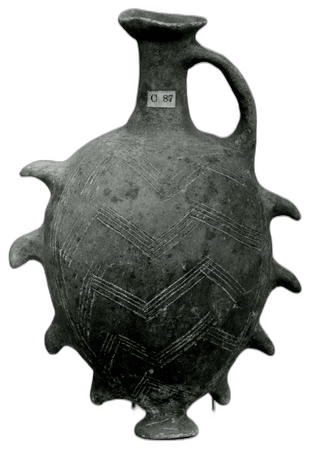
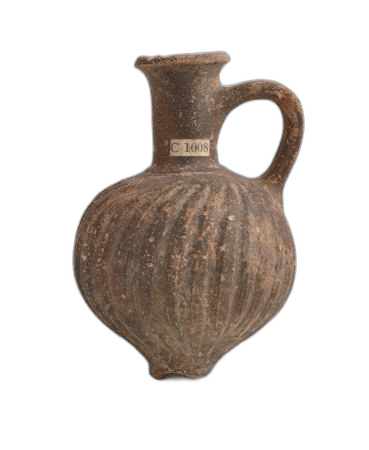
The Kalopsidha material is a settlement assemblage, and it gives too narrow a picture of the shapes. The British Museum's Black Slip III group in the catalogue includes a double jug, an animal vase, a bottle and a flask, which show that Black Slip potters also made the plastic and composite vases of the late Middle Cypriot repertoire. Morris illustrates a Black Slip vessel with what he calls an "incipient base ring" and a metallic finish [4, pp. 29, 36]. See Black Slip III in the catalogue.
Black Slip IV
Black Slip IV and V are not new wares. They are the names Åström gave, in the Swedish Cyprus Expedition volume on the Middle Cypriot Bronze Age, to Late Cypriot examples of the two Middle Cypriot classes. In his Kalopsidha report he explained that Late Cypriot Black Slip II "of the Late Cypriote period" would be described as Black Slip IV, and Late Cypriot Black Slip III as Black Slip V [1, Addenda]. Several Kalopsidha juglets were singled out in advance as "Late Cypriote types" that "will be classified as Black Slip IV", along with fragments of "buff or greenish soft clay, matt brown to reddish brown slip" [1, p. 63]. The two published statements do not agree exactly on which numeral goes with which Middle Cypriot class, and the excavators of Kazaphani themselves catalogued a biconical jug as "Black Slip IV(?) Handmade ware", query and all [6, p. 11]. The Kazaphani tomb gives Black Slip IV a share of 1.25 per cent [6, p. 59]. The catalogue currently holds no object classed as Black Slip IV; see the Black Slip IV term page.
Black Slip V
Black Slip V is the Late Cypriot I continuation of the incised juglet class, and it made up 1.66 per cent of the Kazaphani tomb pottery [6, p. 59]. The catalogue has three examples, all juglets in the British Museum, among them a Black Slip V juglet. See Black Slip V in the catalogue.
Late Cypriot Black Slip also shows the ware's link with Base Ring. At Kalopsidha Åström described five handmade fragments of "Black Slip Ware of Base-ring I Types", buff soft clay with matt black slip toning to red, with ridges and relief on bowls and juglets. He left open "whether these sherds were imitations of Base-ring Ware or actual prototypes for it" [1, p. 64]. At Kazaphani the excavators catalogued a juglet as "Proto-Base-Ring ware in Black Slip fabric (?)", with three vertical relief bands on the body and a black slip [6, p. 34]. Morris saw Black Slip as providing "the precursors to the important Base Ring Ware" [4, p. 29]; fabric analysis at Kissonerga-Skalia, discussed in the Plain White entry, has since separated the two materials. The relationship remains debated.
A wheelmade Black Slip was also made in the Late Cypriot period, mostly as large jugs and some bowls in a yellow, greenish or buff clay with mica and grit. Åström found that "this fabric is very rare in tombs, while it is common in settlements", and that the Kalopsidha potters, "conservative", preferred handmade vases [1, p. 64]. A miniature amphora from Myrtou-Pigadhes, catalogued by the Ashmolean as Black Slip (bucchero) (AN1952.466), shows how the Late Cypriot Black Slip and Bucchero labels overlap in museum records.
Black Slip and Combed
Black Slip and Combed shares a name with the Middle Cypriot ware and little else. It is a fabric named by Porphyrios Dikaios at Philia-Drakos site B in the Ovgos valley, where the potter used a comb-shaped tool to remove part of the black slip and expose a red undercoat in parallel bands [8, p. 35]. It belongs to the Philia phase, the threshold between the Chalcolithic and the Early Bronze Age, and occurs with Red Polished pottery of early Early Cypriot shapes at Kyra-Alonia. The same fabric was identified at Tarsus in Cilicia in Early Bronze II contexts, which gave Dikaios a chronological check on the start of the Early Bronze Age in Cyprus [7]. Karageorghis took the Tarsus find, cautiously, as possible support for an Anatolian origin of the newcomers [8, p. 35]. The Tarsus sherds were later shown to match the Kyra material, showing the ware to be a Cypriot product [9]. The catalogue holds no example; see the Black Slip and Combed term page. It is listed with the Bronze Age Black Slip family only for convenience.
Iron Age Black Slip
Gjerstad's Iron Age Black Slip is wheelmade and has no technical descent from the Bronze Age ware. Black Slip I, of Cypro-Geometric I, has "buff or brown clay, well silted, with a black, mat or occasionally very slightly lustrous slip", and "most of the vases have parallel, vertical furrows round the body, imitating the ribbed surface of the metal models" [2, p. 77]. Its shapes are hemispherical bowls with a base-ring and two string-holes, jugs with low foot and round or pinched mouth (the same shapes as White Painted I), lenticular bottles and amphorae [2, p. 77]. Gjerstad's numerals are chronological types: Black Slip I to VI run in step with the other Iron Age wares, so that a Type III vessel of any ware belongs to Cypro-Geometric III (the Iron Age White Painted entry explains the system).
| Gjerstad type | Period | Fabric and surface | Shapes |
|---|---|---|---|
| Black Slip I | CG I | Buff or brown, well silted; mat black slip; vertical furrows | Bowls, jugs, bottles, amphorae |
| Black Slip II | CG II | Often brown, less well silted; greyish-black mat slip; careless furrows | Pinched-rim jugs, amphorae |
| Black Slip III | CG III | Reddish-brown, or soft light-brown or greenish; usually plain | Pinched-rim jugs, amphorae |
| Black Slip IV | CA I | Always the softer clay; body plain | Bowls, ovoid jugs, amphorae |
| Black Slip V | CA II | Buff soft or brown harder; slip often flakes | Bowls, jugs |
| Black Slip VI | CC I | Pale buff, rather coarse; mat black slip | Bowls, kylix-like bowls, jugs |
The sequence is one of gradual simplification. In Black Slip II the furrows are "more carelessly drawn"; by Black Slip III the surface is usually plain, "only occasionally" furrowed with shallow grooves; in Black Slip IV the body is always plain [2, pp. 78–79]. Black Slip VI, of Cypro-Classical I, has a "pale, buff clay, rather coarse" and a mat black slip that "easily flakes off", and its one- and two-handled bowls "imitate Attic one-handled bowls and kylikes" [2, p. 79]. In Gjerstad's tabulation Black Slip begins to decline during Cypro-Archaic I and is absent from groups of his Type VII [2].
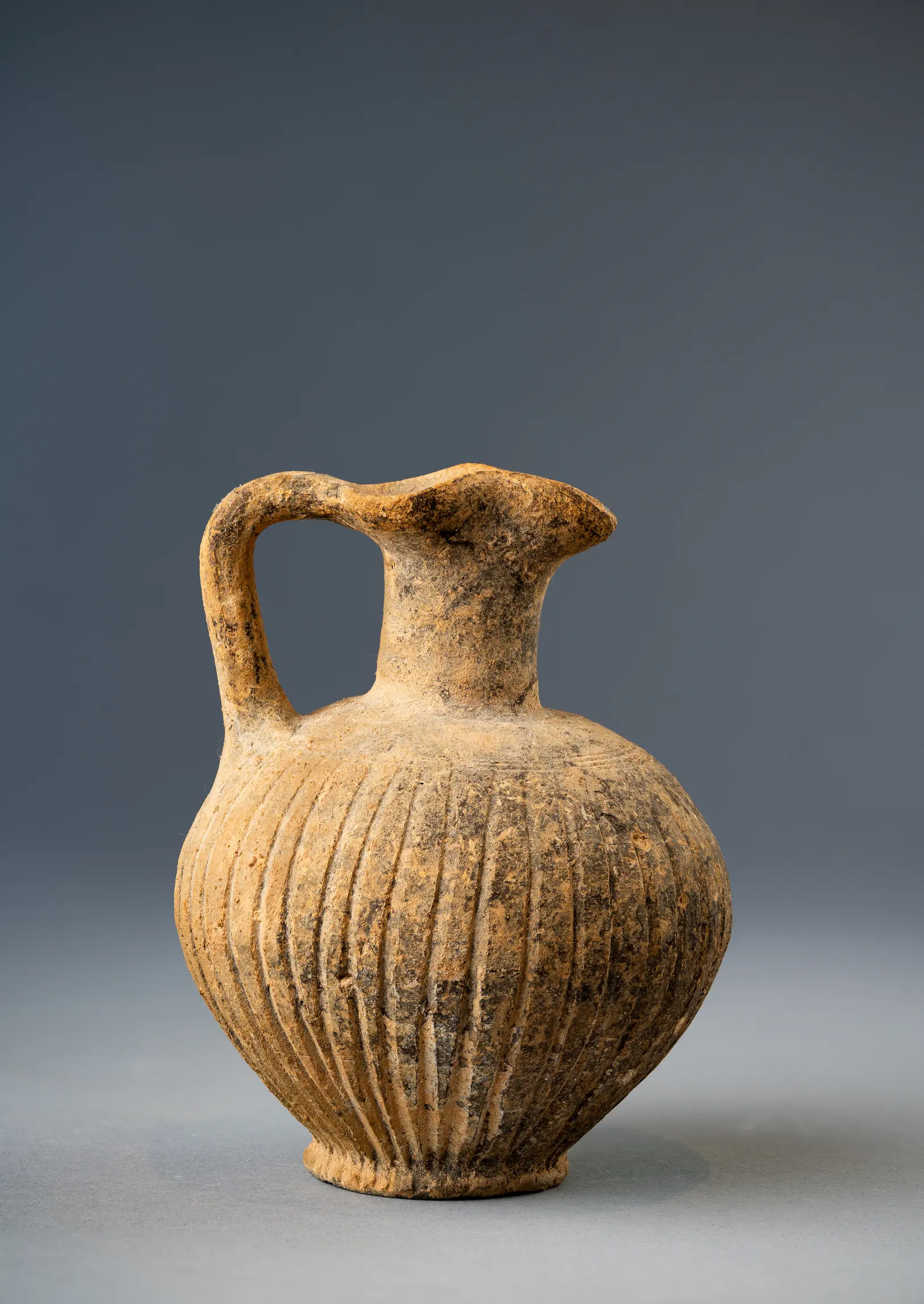
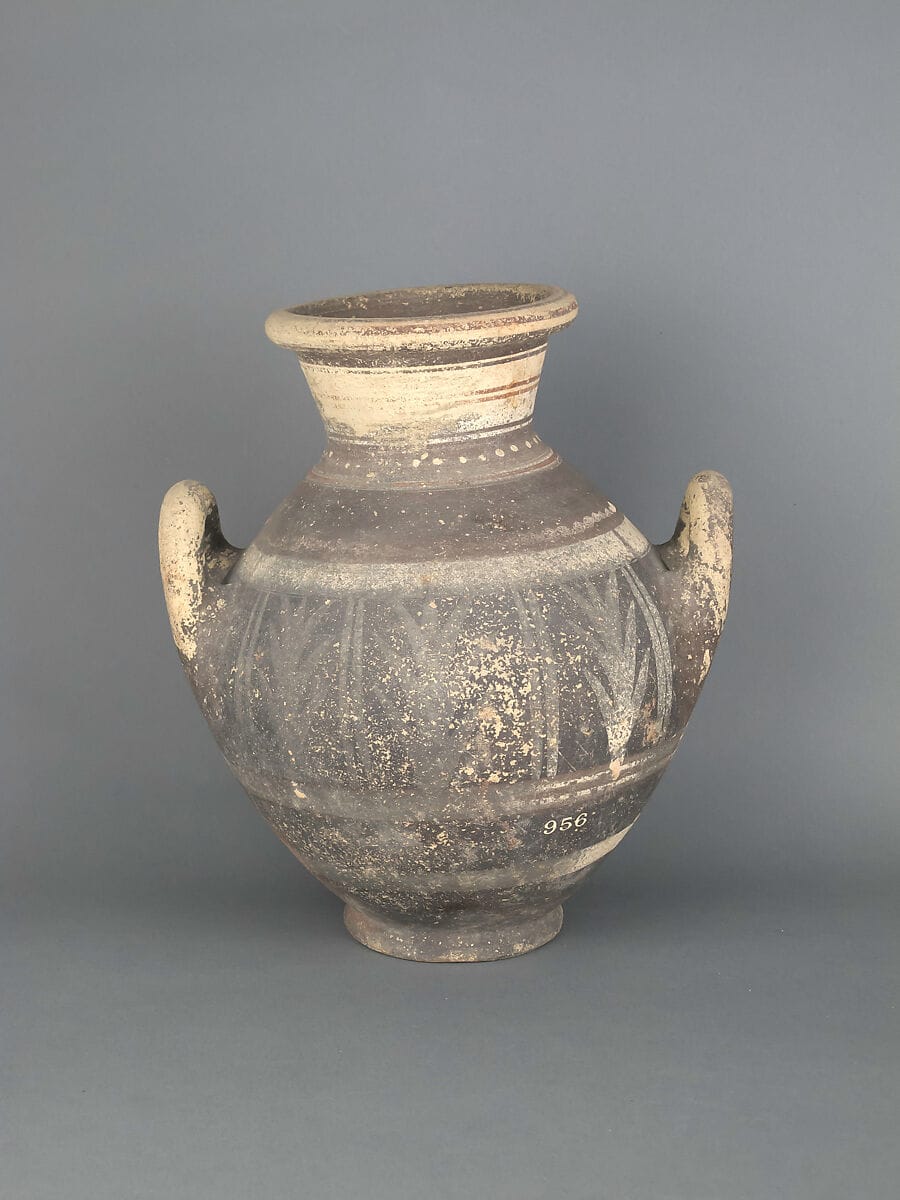
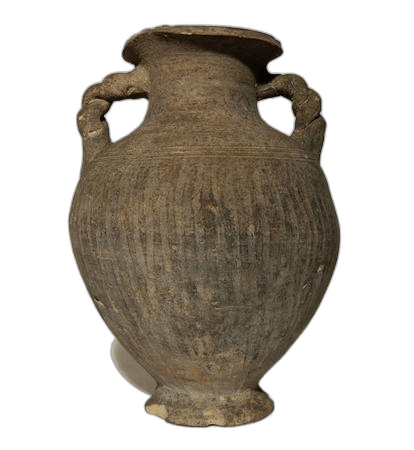
Karageorghis describes the grooved pottery of the early series as "probably inspired by Late Bronze Age metallic prototypes" and produced throughout the Cypro-Geometric period; his example is a grooved Black Slip I amphora of Cypro-Geometric I in the Metropolitan Museum (74.51.637, H. 25.3 cm) [10, p. 98]. The grooved and fluted jugs of this group are often called Black Slip Bucchero, and the Drakopoulos trefoil jug with fluted body belongs to it. A trefoil-mouthed jug with fluted body from Tamassos, excavated by Max Ohnefalsch-Richter, is catalogued as Black Slip I by the Museum of Archaeology and Anthropology, Cambridge (D 1953.74), although the record dates it to the Cypro-Classical period, a date at odds with Gjerstad's placing of Black Slip I. The Ashmolean holds grooved and incised Black Slip I jug fragments from Myrtou-Pigadhes (AN1949.812).
The name was disputed from the start. In 1937 J. F. Daniel kept the older name Pseudo-Bucchero for the ware, because "Black Slip Ware" would "lead to confusion with the Black Slip ware of the Bronze Age, with which it has no connection", and because in his view the surface was painted, not slipped [3, p. 19]. He also held that it was made only in the Late Bronze Age and early Geometric period [3, p. 19], a view that Gjerstad's classification of Black Slip through to Cypro-Classical I replaced.
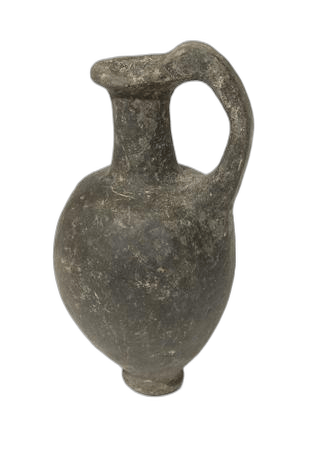
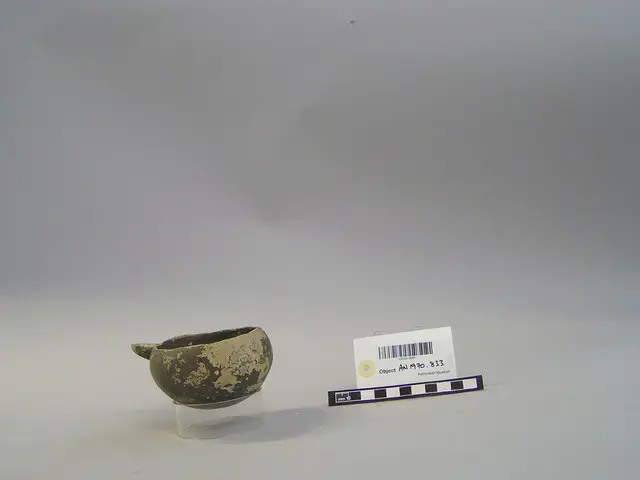
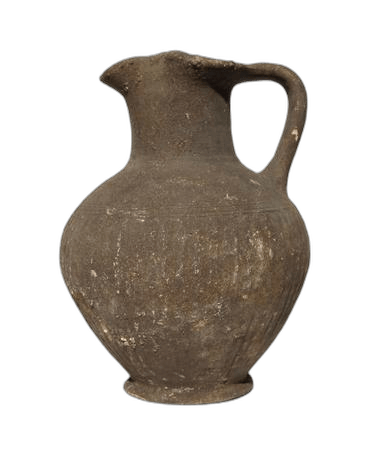
The catalogue has examples of the Iron Age types I, III and IV: Black Slip I jugs in the British Museum and Vienna, four Black Slip III jugs in Liverpool, among them this jug, and a Black Slip IV hemispherical bowl in the British Museum. No objects are yet classed as Black Slip II, V or VI. Term pages: Black Slip I, II, III, IV, V and VI.
Black Slip Painted and Black Slip Bichrome
Gjerstad also defined two painted variants of the Iron Age ware. Black Slip Painted is wheelmade, with clay and slip as Black Slip I and II and ornament painted in black as in White Painted I and II. Its shapes are bowls with horizontal handles, bowls on a low foot and amphorae, and the decoration is confined to one zone (the bottom of bowls, the shoulder of footed bowls, the shoulder or neck of amphorae), the rest being covered in black slip [2, p. 76]. The Bronze to Iron Age transition entry places it in Cypro-Geometric I. The catalogue holds one example, a jar in the Larnaca District Museum; see Black Slip Painted in the catalogue.
Black Slip Bichrome has the same clay and slip, painted in black with supplementary red, and in 1948 "only dishes and shallow bowls" were known [2, pp. 76–77]. A wishbone-handled plate in the British Museum fits that description. A second British Museum piece, catalogued as a "Black Slip Bichrome" flask, is a closed shape outside Gjerstad's original list. See Black Slip Bichrome in the catalogue, and the Bichrome entry for the related painted wares.
Classification and its problems
Most of the difficulty with Black Slip comes from the labels, not the pots. In the Bronze Age the classes are fabric groups whose boundaries with Red Slip, Red Polished and Drab Polished blur in Middle Cypriot III, whose colour depends on firing, and whose numbers were reassigned between Åström's publications. In the Iron Age the numerals are Gjerstad's chronological types, unrelated to the Bronze Age ones. A "Black Slip" label only makes sense once its system is fixed: handmade or wheelmade, Middle or Late Cypriot, or Cypro-Geometric and later. For the wider family of wares see the pottery types overview and the Pottery Production in Bronze Age Cyprus article.
Objects on this page
- Jug with Flaring Neck, probably Black Slip WareMiddle Bronze Age II · 1850–1600 BC
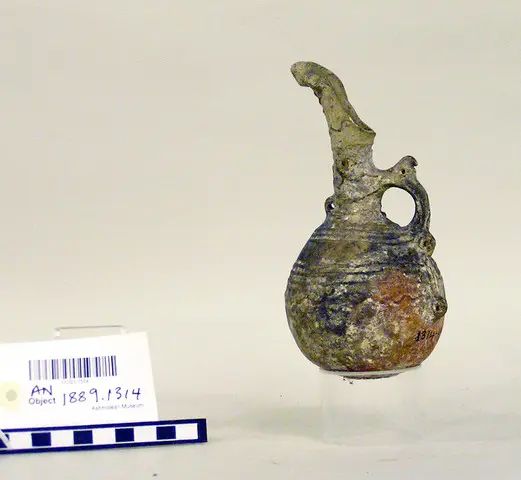 Small Black Slip I jug with beaked mouthMiddle Bronze Age II · 1850–1750 BC
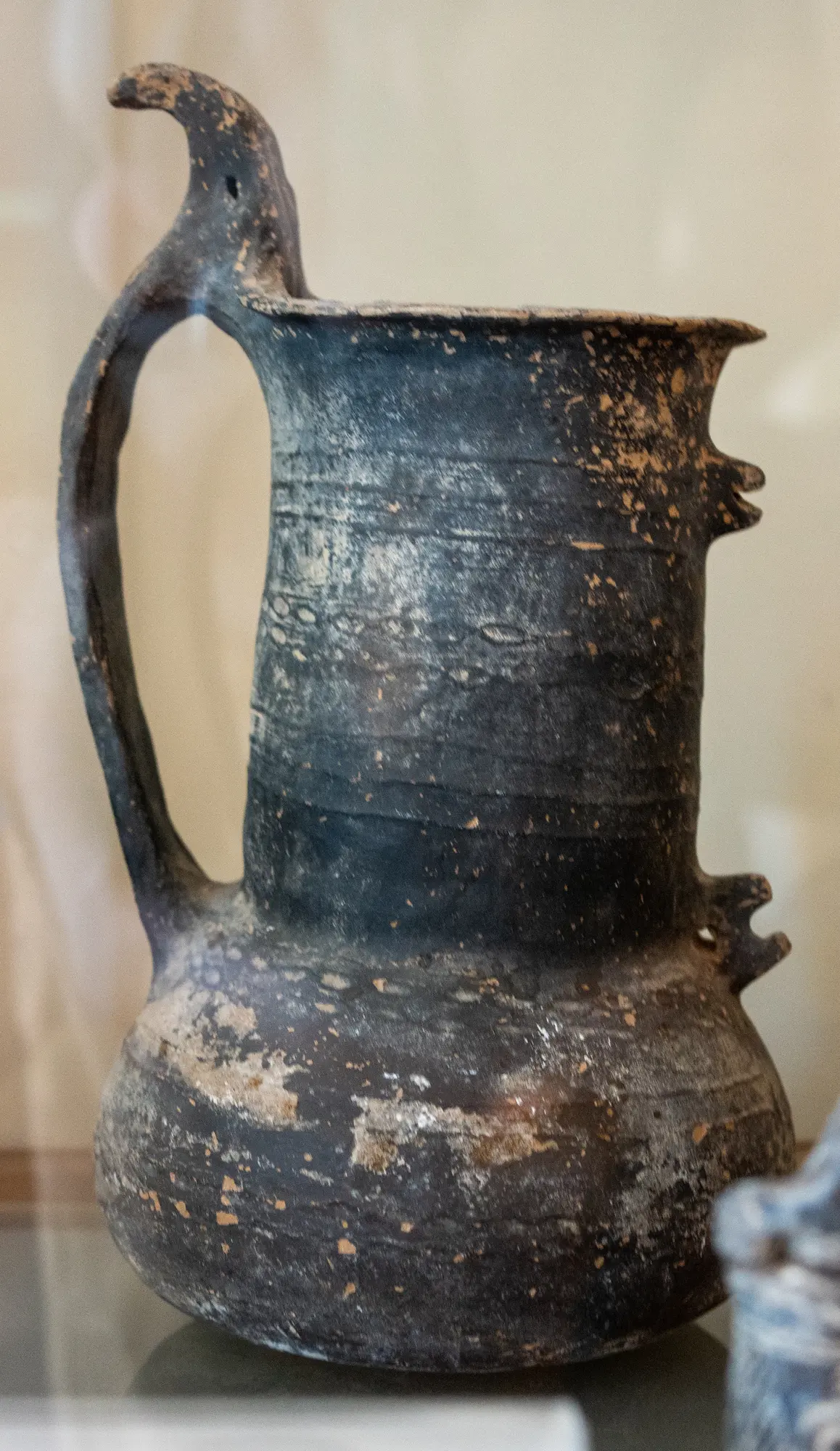 Black Slip Ware TankardMiddle Bronze Age III · 1800–1600 BC
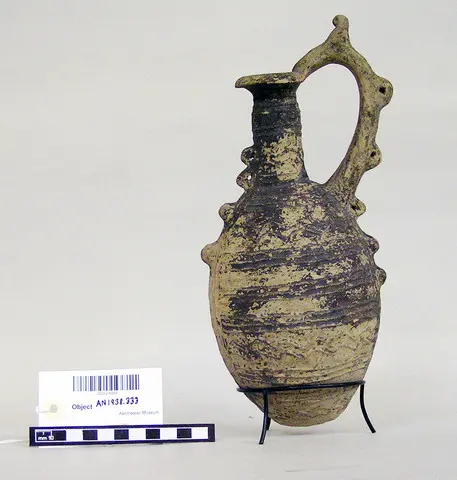 Black slipped string-hole style composite ware flaskMiddle Bronze Age II · 1850–1650 BC
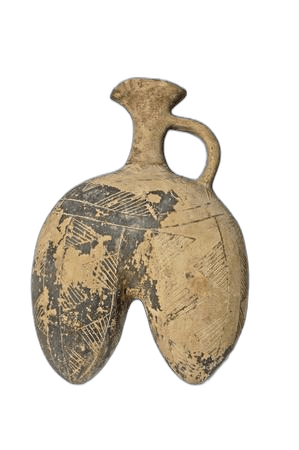 Black Slip III Double JugMiddle Bronze Age III · 1750–1550 BC
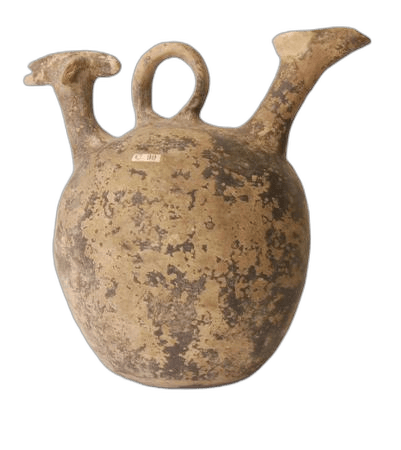 Black Slip Animal VaseMiddle Bronze Age III · 1750–1550 BC
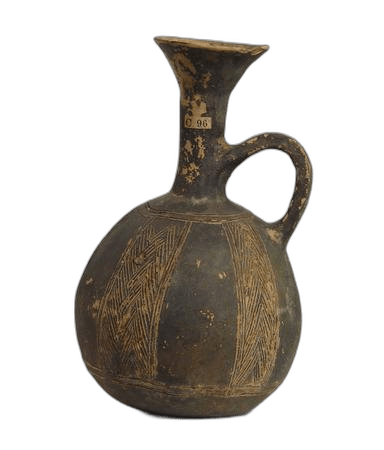 Black Slip V JugletLate Bronze Age I · 1650–1450 BC
- Black Slip Bucchero Jug with Trefoil Mouth and Fluted BodyGeometric I · 1050–850 BC
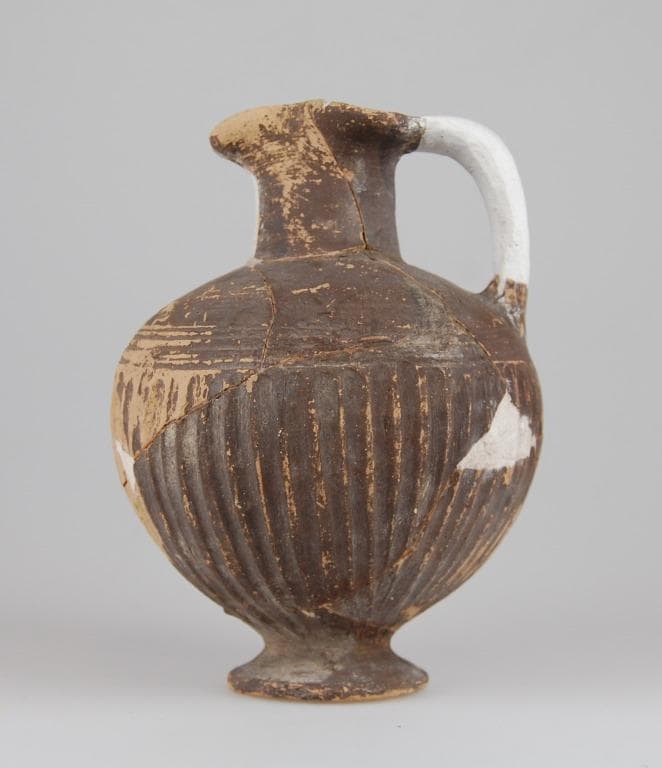 JugGeometric II · 900–750 BC
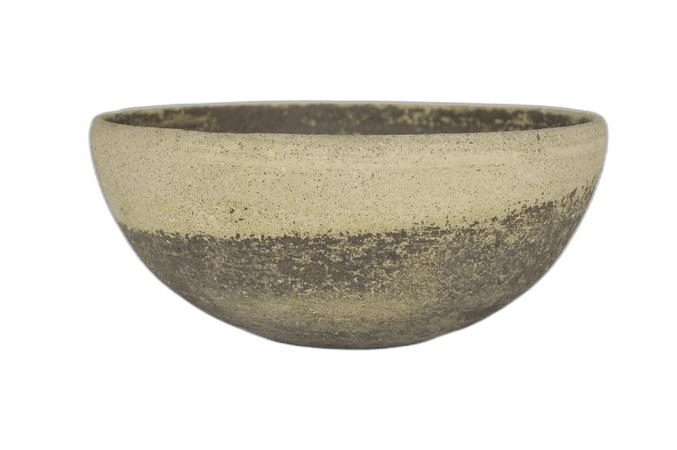 Black Slip/PW Hemispherical BowlArchaic I · 750–600 BC
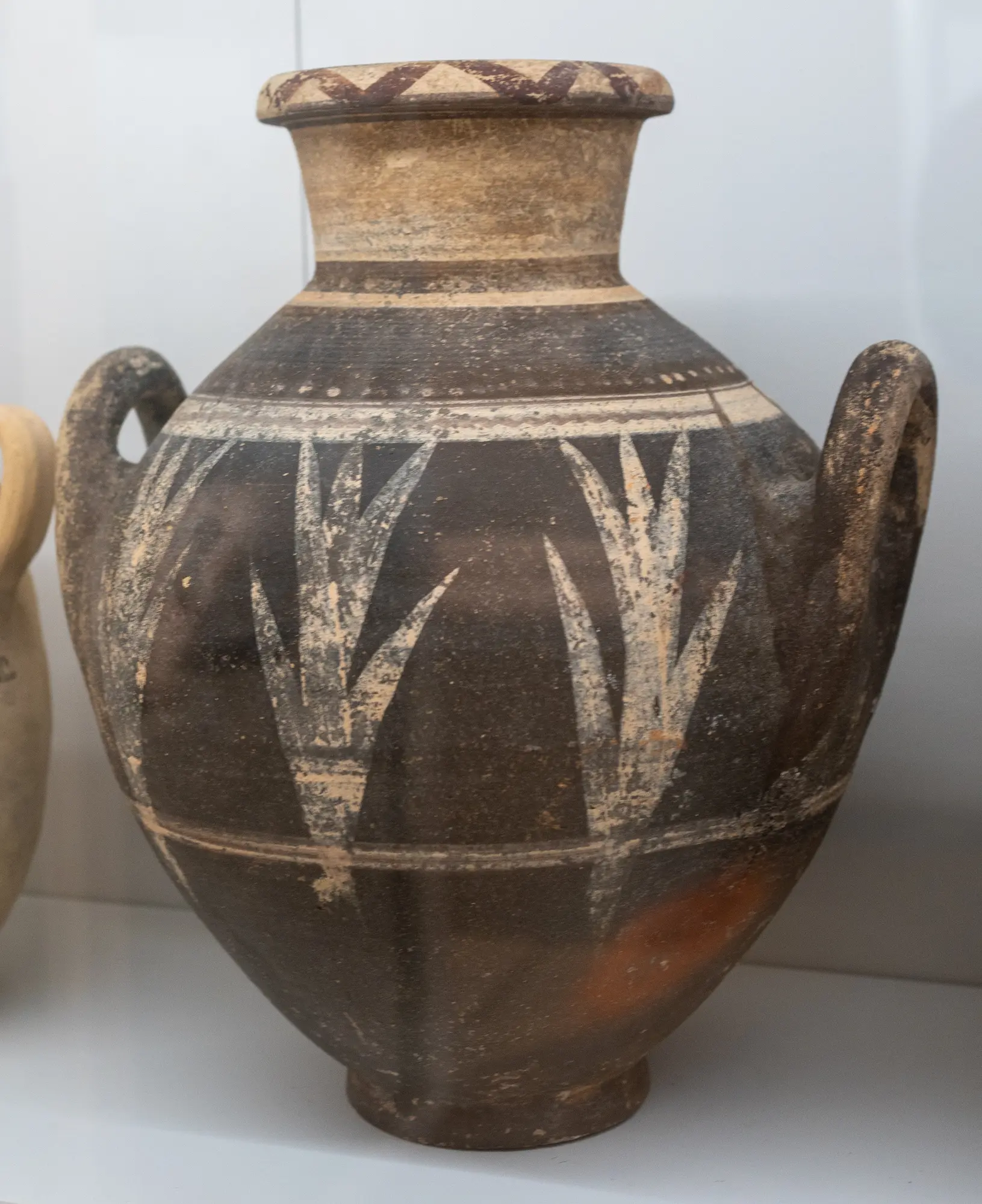 JarGeometric · 1050–600 BC
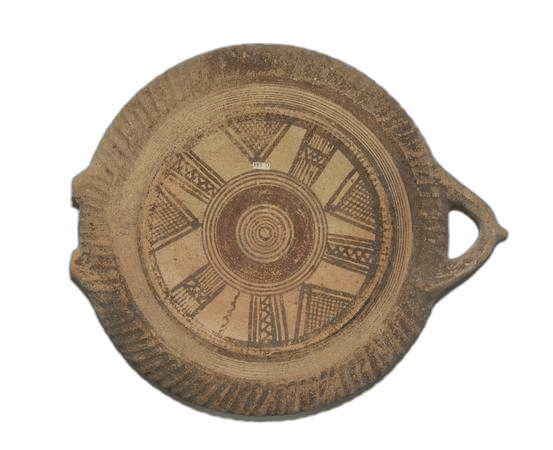 Black Bichrome Wishbone PlateGeometric II · 950–750 BC
In the catalogue
).webp)
References
- 1.Åström, P. (1966). Excavations at Kalopsidha and Ayios Iakovos in Cyprus (Studies in Mediterranean Archaeology 2). Lund: Carl Bloms Boktryckeri.
- 2.Gjerstad, E. (1948). The Swedish Cyprus Expedition, Vol. IV, Part 2: The Cypro-Geometric, Cypro-Archaic and Cypro-Classical Periods. Stockholm: The Swedish Cyprus Expedition.
- 3.Daniel, J. F. (1937). Two Late Cypriote III tombs from Kourion. Philadelphia (reprinted Piscataway: Gorgias Press, 2019).
- 4.Morris, D. (1985). The art of ancient Cyprus, with a check-list of the author's collection. Oxford: Phaidon.
- 5.Webb, J. M. (2009). Deneia: A Middle Cypriot site in its regional and historical context. In I. Hein (Ed.), The formation of Cyprus in the 2nd millennium B.C.: Studies in regionalism during the Middle and Late Bronze Ages (Denkschriften der Gesamtakademie 52, pp. 27–38). Vienna: Austrian Academy of Sciences.
- 6.Nicolaou, I., & Nicolaou, K. (1989). *Kazaphani: A Middle/Late Cypriot tomb at Kazaphani-Ayios Andronikos, T.2A, B*. Nicosia: Department of Antiquities, Cyprus.
- 7.Karageorghis, V. (1982). Cyprus from the Stone Age to the Romans. London: Thames and Hudson.
- 8.Karageorghis, V. (1981). Ancient Cyprus: 7,000 years of art and archaeology. Baton Rouge: Louisiana State University Press.
- 9.Gagné, L. A. C. (2012). Middle Cypriot White Painted Ware: A study of pottery production and distribution in Middle Bronze Age Cyprus [Doctoral dissertation, University of Toronto].
- 10.Karageorghis, V. (2000). Ancient art from Cyprus: The Cesnola Collection in the Metropolitan Museum of Art. New York: The Metropolitan Museum of Art.