
Contents
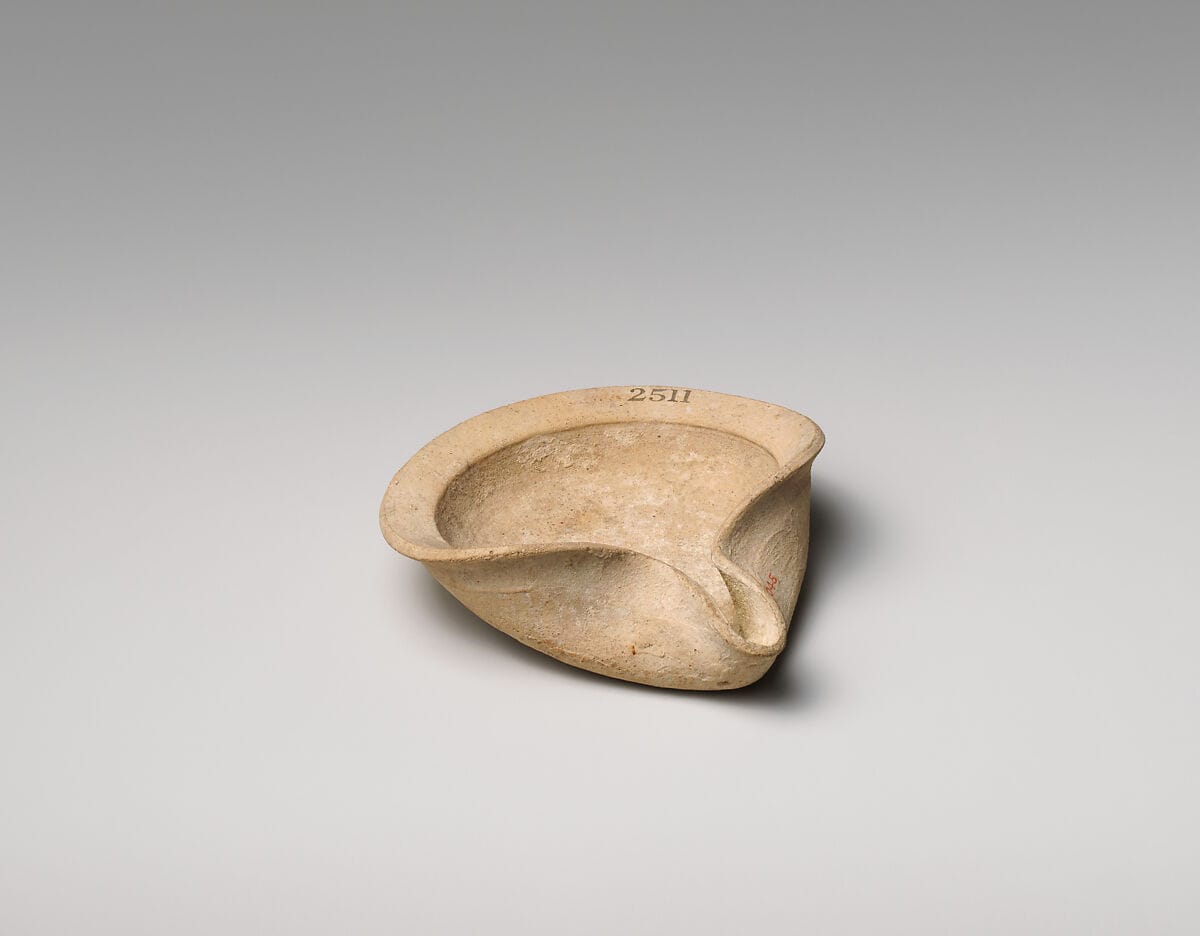
A Cypriot lamp is a small vessel that burned fuel on a wick to give light, small enough to sit in the palm of the hand. Two quite different forms followed each other on the island. The first is the open saucer lamp: a shallow wheel-made bowl with the rim pinched or folded in at one point to hold the wick. It was in use from the Late Bronze Age to at least the fourth century BC, and changed so little in that time that a single example is very hard to date. The second is the closed lamp, with a covered reservoir, a filling hole and a nozzle, which took over in the Hellenistic period and, in its mold-made Roman form, became one of the commonest objects on the island. Most surviving lamps come from tombs, and most of those in museums outside Cyprus came through Luigi Palma di Cesnola. The examples on this page are from his collection in the Metropolitan Museum of Art; there is no lamp in the Drakopoulos collection. You can see all lamps in the catalogue, or only the clay lamps classed as a pottery shape.
Definition and identification
The terracotta lamps of the ancient Mediterranean are, in Christopher Lightfoot's description, "small, portable, and personal objects that fit comfortably into the palm of the hand"; most have no handle and were carried in the hand. Soot is found only around the nozzle, which shows that they were lit and used [1, p. 11]. Two families are found in Cyprus.
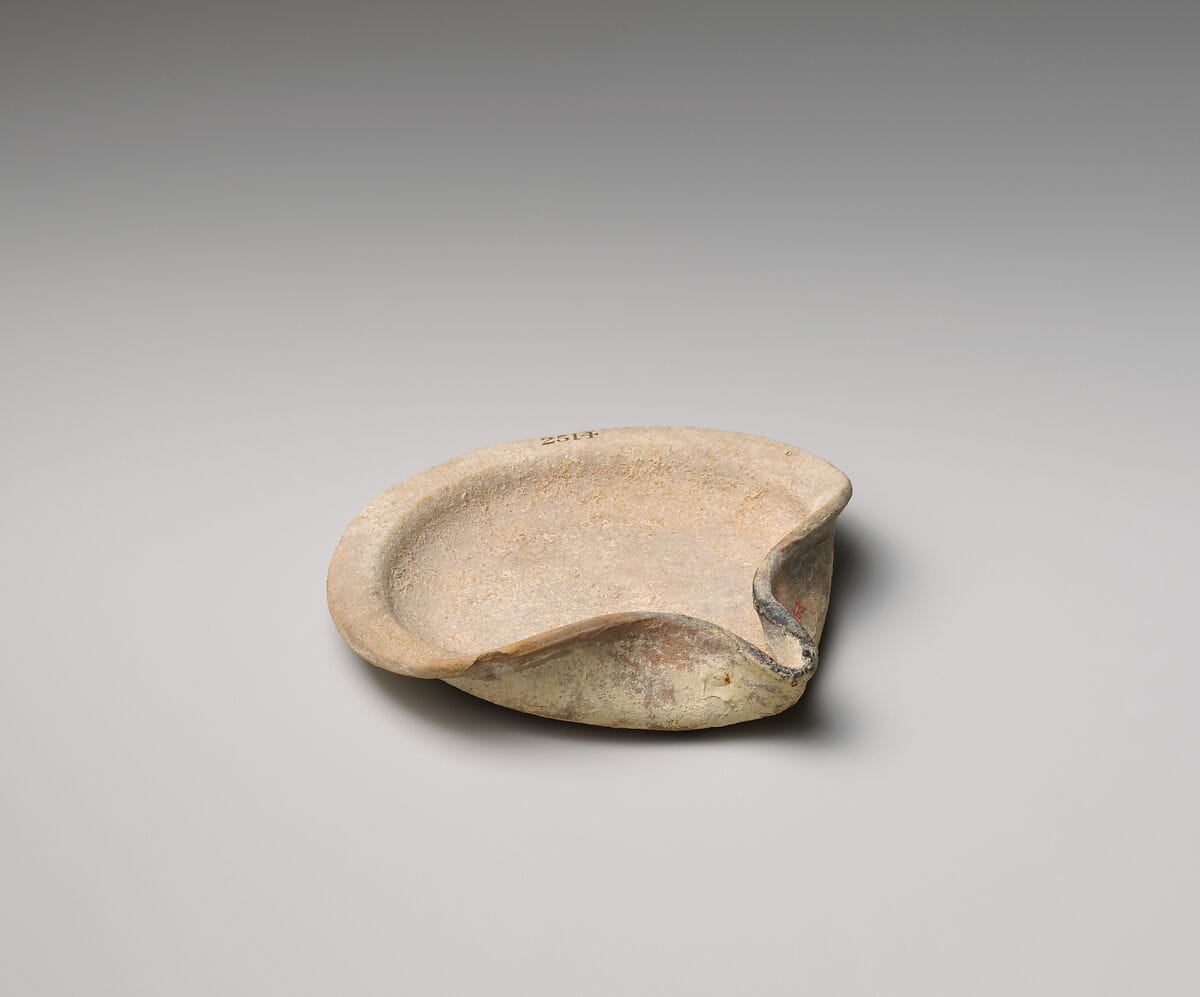
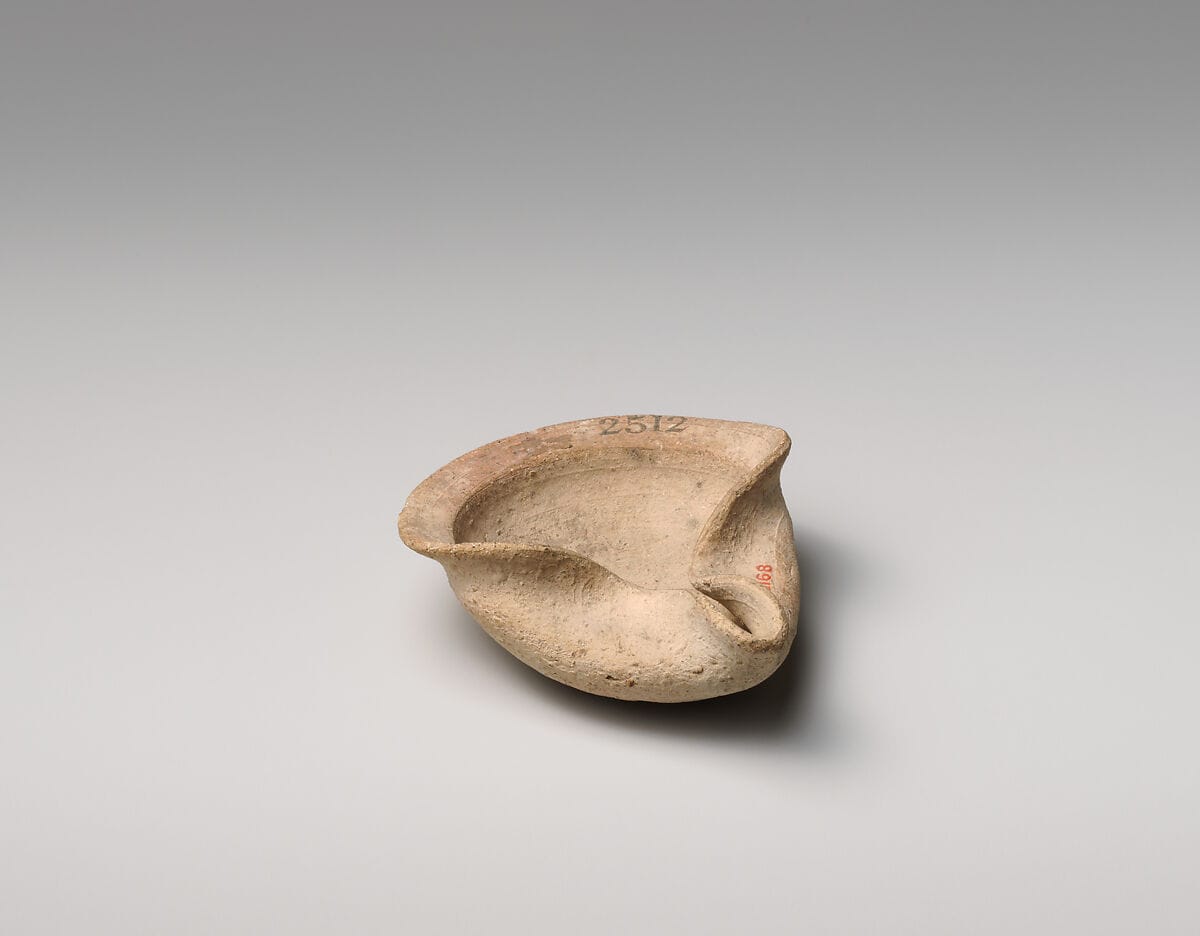
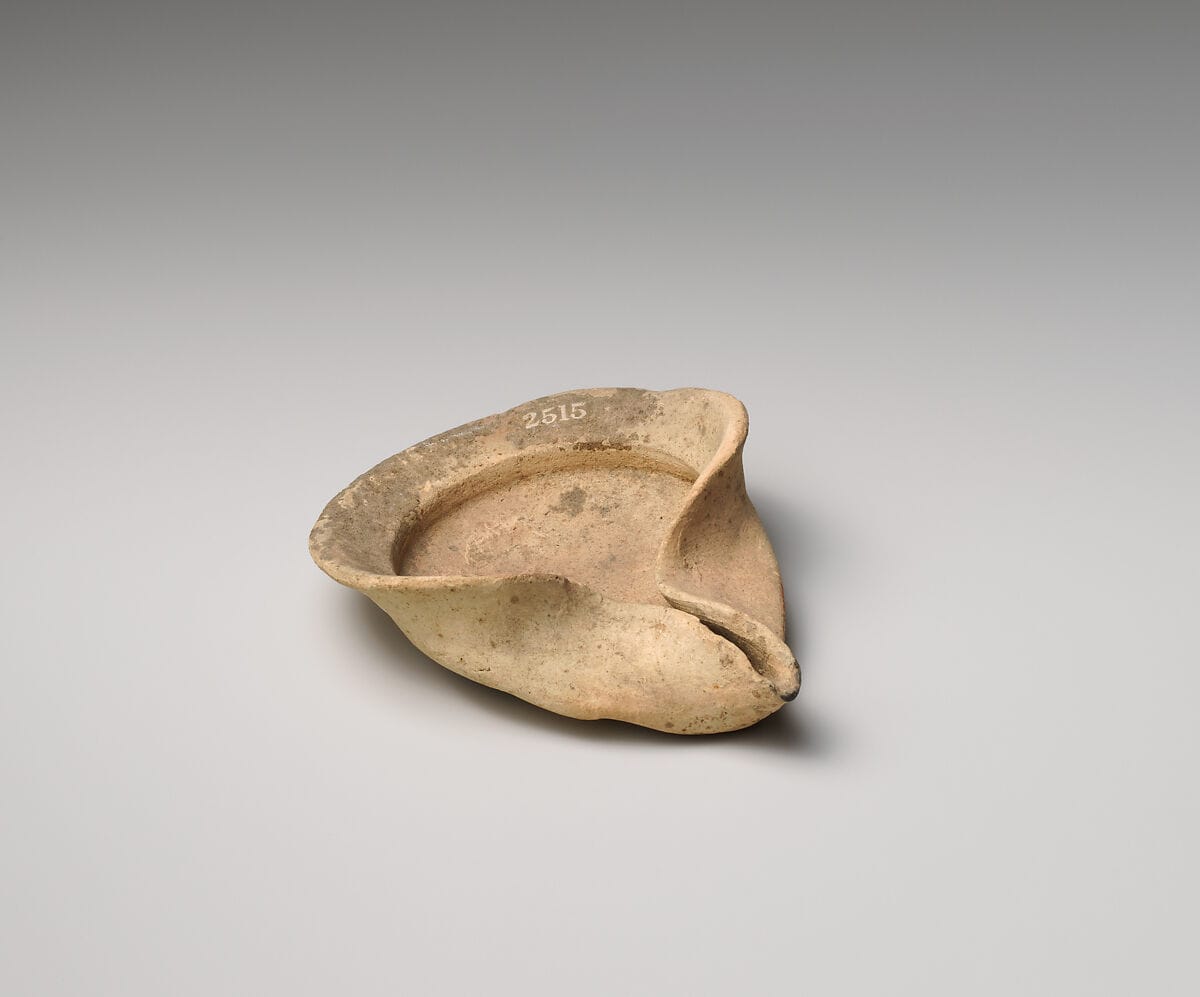
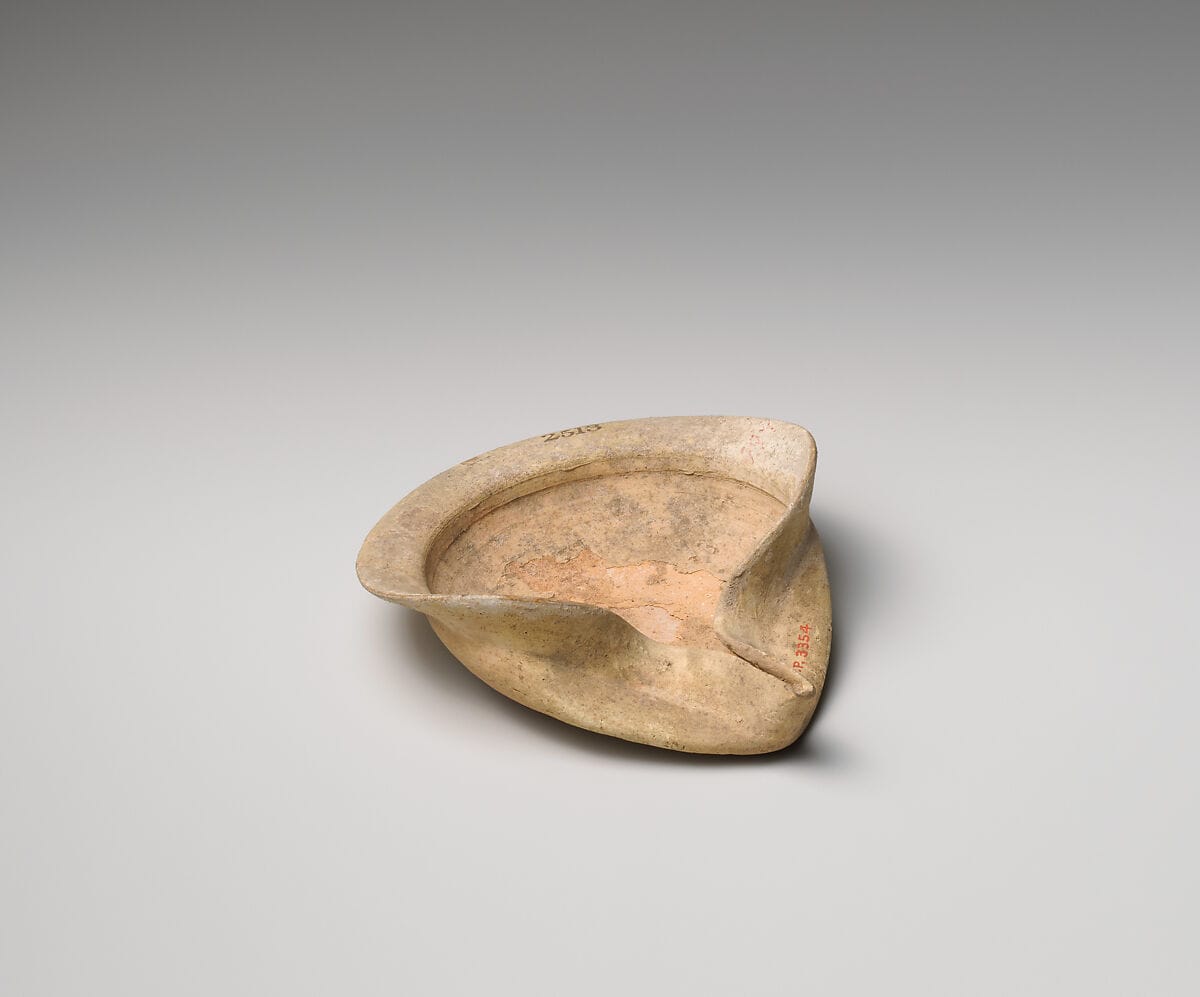
The saucer lamp is wheel-made and open. The Metropolitan's catalogue describes a typical example, 74.51.1819, as "wheel-made with edge folded in to form a narrow wick rest; horizontal rim with rounded lip; broad, shallow, open body; undefined, flat base"; it is 13.3 cm long, with soot around the nozzle [1, Cat. 1]. Others have a broad horizontal rim pinched into a narrow projecting nozzle rather than folded over [1, Cat. 4–5]. These lamps are classed as Vessberg Type 1 and are sometimes called "Canaanite" lamps [1, p. 32]. The type numbers are not used consistently: the Panayia Ematousa report places its saucer lamps in Vessberg's Types 2 and 3 [2, p. 339].
The closed lamp encloses the fuel. Mold-made lamps were made in a two-part mold: a plain lower half that formed the reservoir and an upper half carrying the discus, shoulder, nozzle and often the handle. Filling holes were pierced in the discus before firing, a fiber wick sat in the nozzle and drew the oil up, and more oil was poured in through the filling hole. This was "the standard form of the terracotta oil lamps used throughout the Hellenistic and Roman world from the second century B.C. through the seventh century A.D." [1, p. 17].
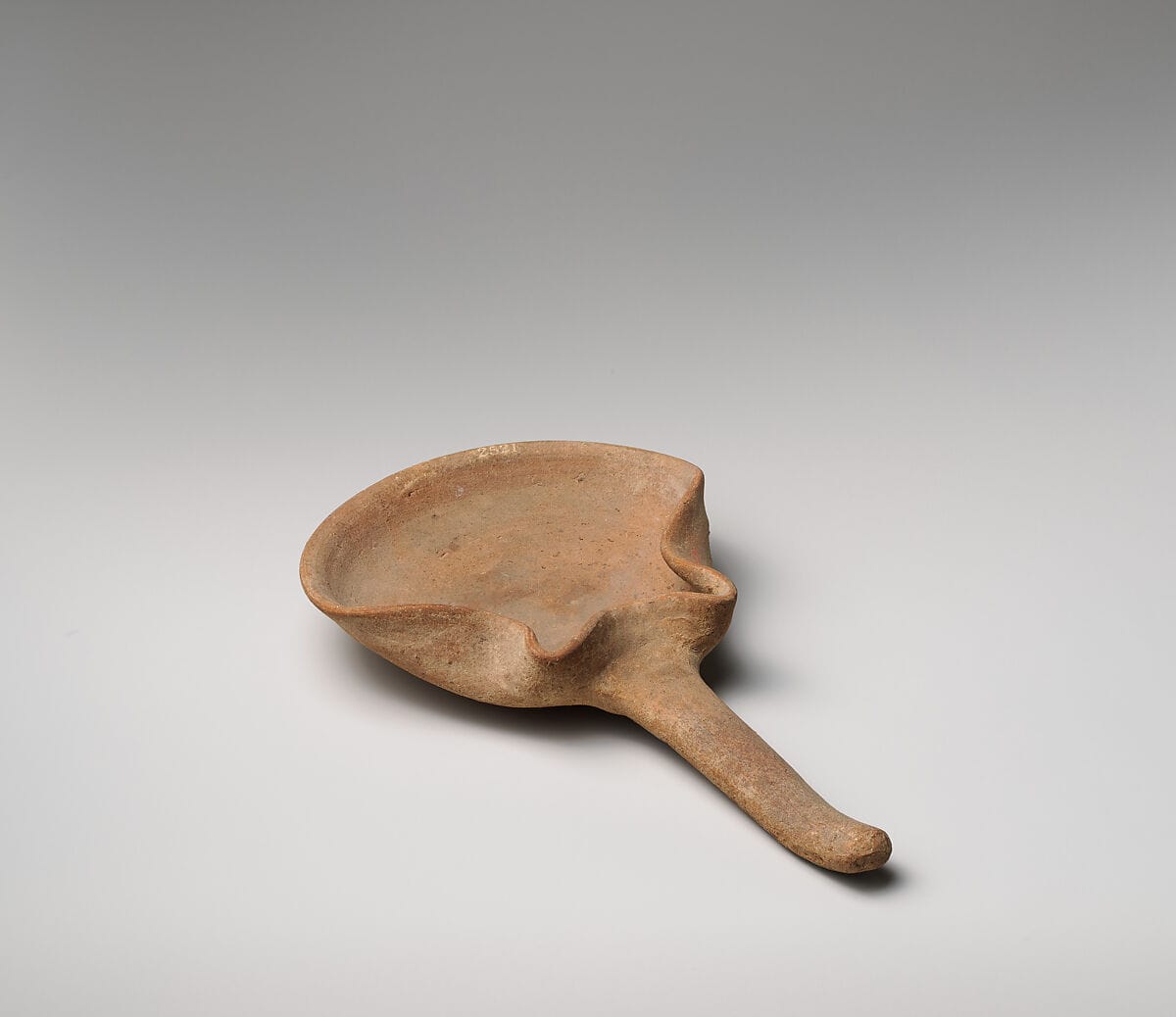
Lightfoot lists the drawbacks of the open form. The oil could spill when the lamp was carried, moths and other insects fell into the lit lamp, and the edible fuel drew rodents when the lamp stood unused. He also suggests, as a possibility only, that the fuel may have been a solid animal fat or wax rather than olive oil, and notes that there has been "little, if any, scholarly discussion" of the question [1, p. 32]. Among the shapes on this site the saucer lamp is closest to the bowl and the dish, from which it differs by its wick rest.
Bronze Age beginnings
The Bronze Age evidence for Cypriot lamps is thin, and much of it survives only as brief notices. Lightfoot states that the saucer form "had a long tradition of use in Cyprus, extending from the Late Bronze Age until at least the Late Classical period" [1, p. 32]. The Ashmolean Museum records fourteen saucer lamps from Cyprus dated from the Middle Bronze Age (c. 1900 to 1600 BC) to the Hellenistic period [1, p. 33]. Lamps appear among Late Cypriot Plain White Handmade shapes (see Plain White ware), and a lamp stood with libation vessels in a sunken ceremonial room in a Late Cypriot town, described under Late Bronze Age village life. Danielle Parks traced the custom of putting lamps in Cypriot tombs back to the Late Bronze Age [3]. Two Late Cypriot metal lamps in the British Museum, from Maroni Tomb 21 and Enkomi Tomb 66, show that bronze versions were already being made [1, p. 33].
Saucer lamps of the Iron Age
The saucer lamp is the lamp of the Cypriot kingdoms, from the Cypro-Geometric through the Cypro-Classical period. An early dated example, now in the World Museum, Liverpool (56.218.84), was found in Evreti Tomb 3A at Palaepaphos and is dated to Cypro-Geometric III (900 to 750 BC) [1, p. 33]. A single lamp lay among the grave goods of a Cypro-Archaic I (650 to 600 BC) chamber tomb at Mari, and saucer lamps are known from the Archaic cemetery at Tamassos. Groups from Tsambres and Aphendrika run from about the fifth to the mid-fourth century BC; several Late Archaic and Classical tombs at Agioi Omologites in Nicosia held several saucer lamps each; and "a large number" came from fifth-century tombs at Kition-Pervolia. Earlier excavations at Kition found many more, mostly Archaic and Classical, and about twenty are recorded from Salamis [1, p. 32].
That list is the dating problem. Olof Vessberg argued that the type lasted into Hellenistic times, citing tombs at Kontoura Trachonia "definitely dated in the third century B.C." Lightfoot concludes that it is "impossible to date the saucer lamps in the Cesnola Collection with any great precision": the shape is simple, the method of manufacture never changed, and the tombs that contain them were often disturbed or reused from the Archaic to the Hellenistic period [1, p. 32]. At Kition-Pervolia, Tomb 396 held six lamps of both the open and the closed type together on the chamber floor, so the two forms overlapped for a time [1, p. 32].
The origin of the form is a second question. Cesnola wrote that the saucer lamps he illustrated "were all found in early Phoenician tombs." Lightfoot treats them as derived from Near Eastern models and as possible evidence of Phoenician influence on Cyprus; similar lamps occur across the Near East, and 78 fragments from Tel Anafa in Israel were assigned to the Achaemenid period [1, p. 32]. A Late Bronze Age start on the island sits awkwardly with a purely Phoenician origin, and the question is open. The Panayia Ematousa excavators judged their own saucer lamps "probably of Cypriot make" [2, p. 339].
The British Museum has a fifth-century BC Cypriot open lamp, 12.5 cm long, from the Salamis area, and a smaller one of the fourth or third century BC, made in Cyprus and found at Salamis, 8.6 cm long. The largest group in any one museum is in the Medelhavsmuseet, Stockholm: eighty saucer lamps, forty-six of them from Vouni. The National Museum in Nicosia has at least thirty-two [1, p. 32].
Variants of the saucer lamp
Beside the ordinary single-nozzle lamp, Cypriot potters and metalworkers made several variants. Some are clearly lamps; for others the use is uncertain.
| Variant | Description | Examples and date |
|---|---|---|
| Two-nozzle lamp | Saucer with two wick rests | Parallels in the National Museum, Nicosia; a fragment from Salamis |
| Copper-alloy lamp | Metal saucer, often with two nozzles | Four in the Cesnola Collection; Deneia Tomb 12; a Stockholm lamp with suspension chain |
| Lamp with central stem | Tubular projection rising from the floor of the saucer | Two in the Cesnola Collection, Late Cypro-Classical; purpose unknown |
| Long-handled lamp | Two pinched spouts with a solid handle between them | At least eight known from Cyprus; Late Bronze Age to Cypro-Classical |
| Multi-nozzle lamp | Saucer with six or seven nozzles | Idalion, sanctuary of Apollo; Amathus (1979); rare |
| Torch holder | Saucer with a flaring cup at the center | Two in the Cesnola Collection, c. 600 to 400 BC |
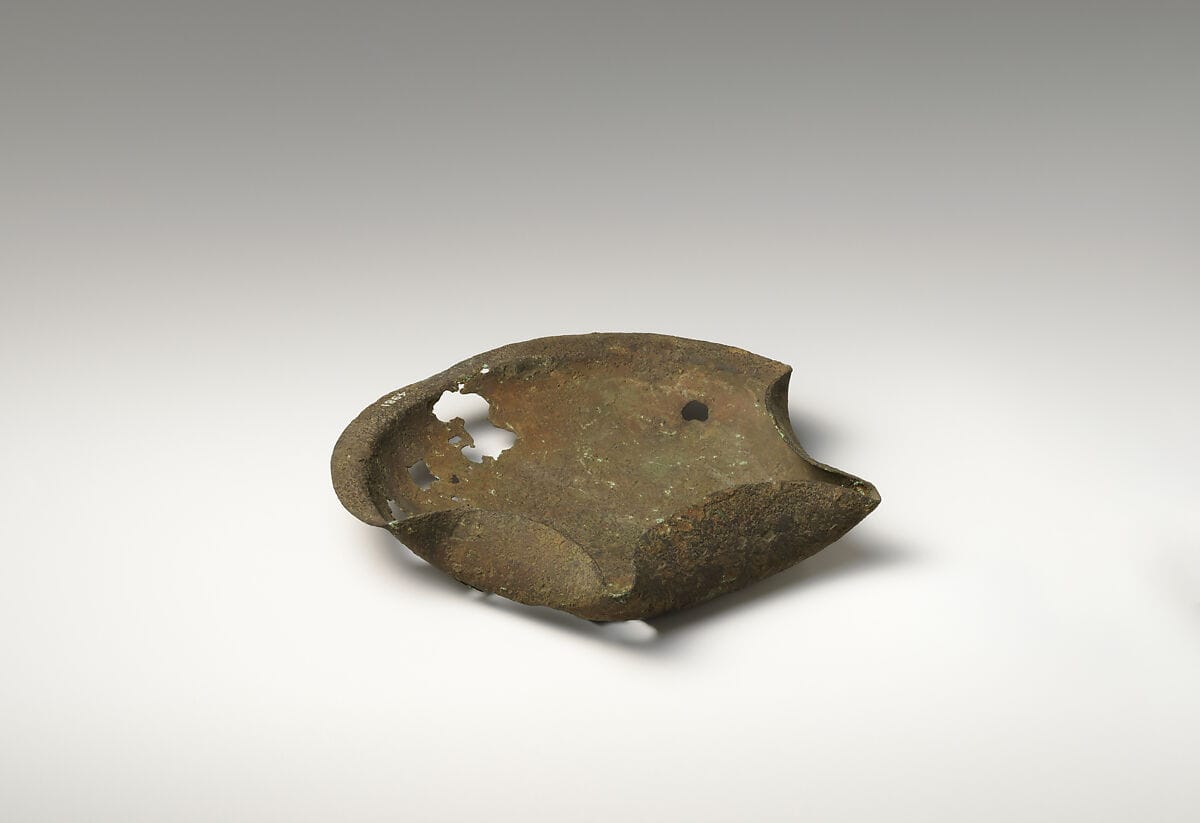
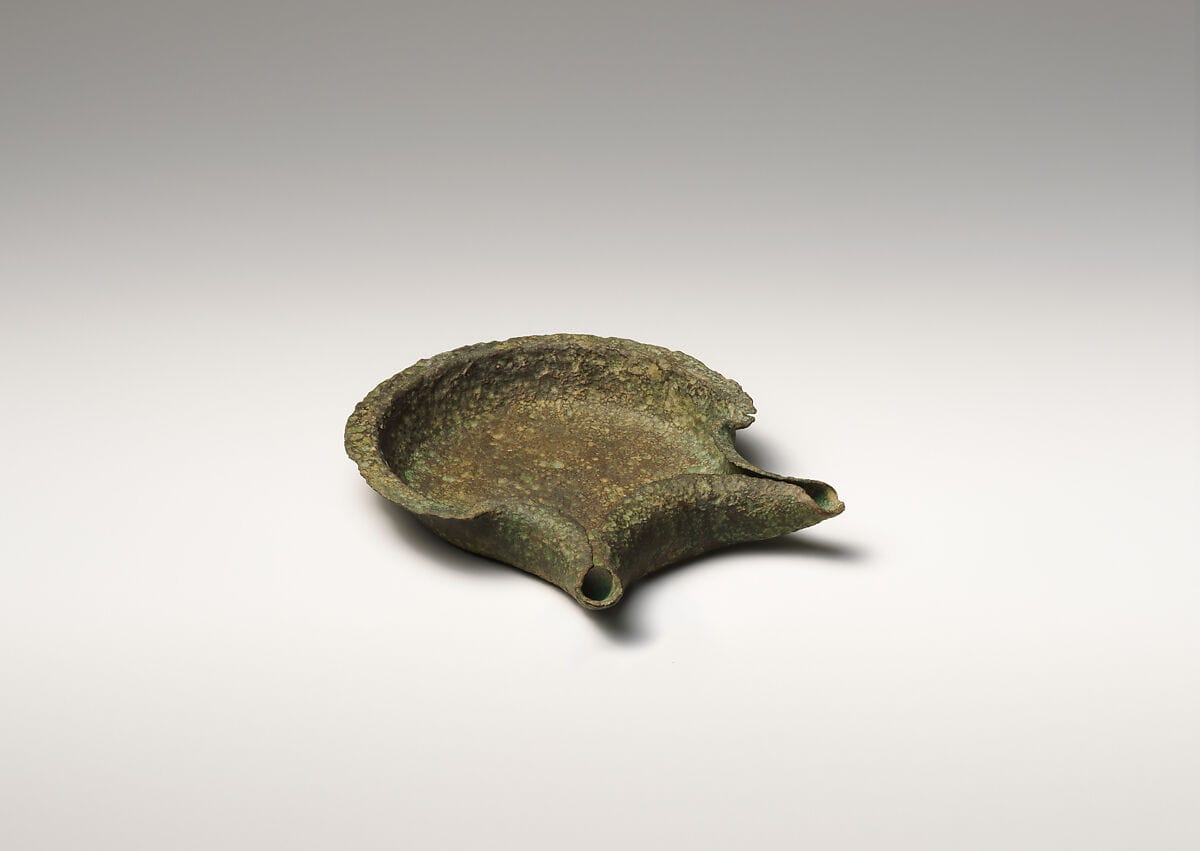
The metal lamps follow the clay shape. The Cesnola Collection has four copper-alloy saucer lamps with two nozzles, among them 74.51.5651; single-nozzle bronze lamps are known too, one from Tomb 12 at Deneia, found with an Attic clay lamp, and one in Stockholm with chain attachments for hanging. Lightfoot observes that a metal saucer would have been harder to pick up than a clay one, because the heat of the wick passed into the whole body [1, p. 33].
The lamp with a central stem is represented by 74.51.1814 (Met record), a fourth-century saucer 13.4 cm long with a pinched wick rest and "a central tubular projection with flaring mouth," the base pierced through from the tube [1, Cat. 22]. Lightfoot calls the purpose of the stem "not fully understood" [1, p. 33].
The long-handled lamp is the most debated. 74.51.1890, shown above, is 28.3 cm long, with two wick rests and "a solid handle, tapering slightly and upturned at rounded end" between them [1, Cat. 18]. Thérèse Oziol counted at least eight from Cyprus, and excavated examples from Myrtou-Pigadhes, Paleokastro, Idalion, Vouni and Salamis date from the Late Bronze Age to the Cypro-Classical period. Oziol recorded traces of oil and soot on their edges but admitted that their use for lighting is not certain. Others have called them "ladles" or "shovels" with a ritual function, and Lightfoot suggests they may have been incense burners [1, pp. 33–34].
Multi-nozzle lamps are rare: one from the sanctuary of Apollo at Idalion is in the British Museum, and one with seven nozzles was found at Amathus in 1979. The two torch holders in the Cesnola Collection each have a flaring cup rising from the center of the saucer and are dated to about 600 to 400 BC [1, p. 34].
The Cesnola Collection also holds two small limestone saucer lamps, 74.51.5145 and 74.51.5144. Stone lamps are little discussed in the literature on Cypriot lamps, and how these two were used is not known.
Attic imports and the Hellenistic closed lamp
Closed lamps reached Cyprus first as Greek imports, and they were scarce. Attic black-glaze lamps are rare on the island although Attic pottery is common. The Cesnola Collection has one, of the fifth century BC; others come from the undisturbed Cypro-Classical Tomb 12 at Deneia, from Salamis and Marion, and seven of the fifth and fourth centuries from Kition [1, p. 51]. At Panayia Ematousa, near Aradippou, lamps in a pale brown fabric are local imitations of the Attic type, with parallels at Kition-Bamboula dated from the end of the second quarter of the fourth century to the second quarter of the third century BC [2, p. 343].
After Alexander the change was rapid. Hellenistic lamps in Cyprus date from the end of the fourth to the late first century BC and fall into two groups, wheel-made and mold-made. In Lightfoot's words, "these closed lamps quickly and completely supplanted the traditional saucer lamps, a visible sign of the Hellenization of the island after the time of Alexander the Great," although it is not certain that every wheel-made lamp is earlier than every mold-made one [1, p. 52].
The wheel-made lamps were mostly made on the island. Oziol catalogued more than fifty in the National Museum, Nicosia, and twenty-seven from Kition, of which she judged twenty local and dated them to the fourth and third centuries BC; the Panayia Ematousa examples were all locally made. Imports came too: Tomb 12 at Episkopi held two wheel-made lamps from Rhodes. A Ptolemaic tomb at Ayii Omoloyitadhes, of the second half of the third century BC, contained twenty-five lamps [1, p. 52].
The mold-made Hellenistic lamps "appear largely to be imports," with Ephesian lamps common. They were copied: the upper half of a clay mold for an Ephesian-type lamp was found in the House of Dionysos at Paphos, and Donald Bailey held that mold-made lamps were produced in Cyprus as early as anywhere else in the Greek Mediterranean [1, p. 52]. At Panayia Ematousa the mold-made lamps fall into two fabrics: a reddish-yellow or beige clay with a reddish slip, possibly local, and a grey clay with a grey-black slip, thought to have been made on the Phoenician coast; lamps of this kind are known from Salamis, Kition, Soli and Nea Paphos [2, p. 346].
Roman and Late Roman lamps
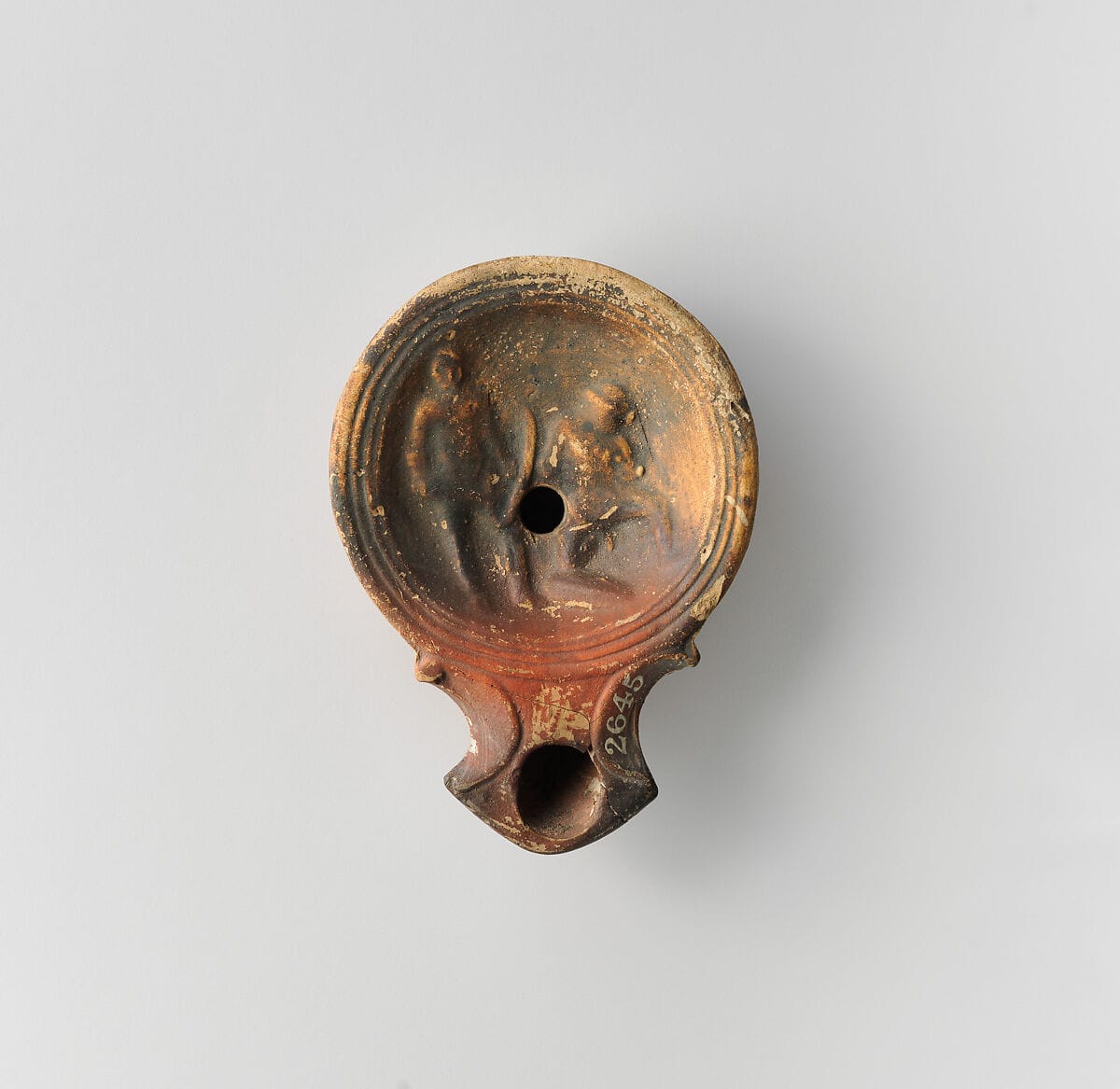
The Roman lamp is mold-made, and its decorated discus is, for Lightfoot, a Roman innovation. Bailey argued that the fashion began in Italy, noting that "the same scenes often appear on examples made at each end of the Empire." Italian lamps were imported into Cyprus in large numbers in the first century AD, and local workshops copied their designs [1, p. 12]. 74.51.1845 is a Loeschcke Type 1B lamp of the late first century BC or early first century AD, 9.2 cm long, with two gladiators on the discus: the victor standing with shield and sword, the loser kneeling with his shield on the ground [1, Cat. 297]. A lamp with a bird on a branch, in the Royal Ontario Museum, is shown on the Roman period page (ROM 965.114.188; catalogue entry).
Not every Roman type reached the island. The plain Firmalampen of Loeschcke Types 9 and 10, common in the western provinces, are absent from Cyprus [1, p. 17]. Bailey's British Museum catalogue counts 262 lamps that he regarded as made in Cyprus, and another seventy-nine imported from elsewhere in the empire [1, pp. 14–15].
The industry depended on cheap olive oil shipped in bulk. "As the Roman Empire disintegrated and collapsed during the fifth through seventh century A.D., so did these two industries" [1, p. 13]. Lamps of Vessberg's Types 19 and 20, of the fifth and sixth centuries AD, are found in both Cyprus and Syria, and where they were made is not known [2, p. 339]. Metal lamps were kept for a long time: two copper-alloy lamps lay in the debris of the earthquake of AD 365 at Kourion and are regarded as heirlooms [1, p. 13]. The latest lamps from the island are Middle Byzantine wheel-made lamps, of which the National Museum, Nicosia, has at least six, and as many as eighteen clay lanterns are known from Cyprus [1, p. 14].
Lamps in tombs, houses and sanctuaries
Most intact lamps come from graves. Lightfoot calls them "one of the most plentiful finds in Hellenistic and Roman graves" [1, p. 12], and one saucer lamp at Kition-Pervolia (K02-123) was thought by its excavators to have been placed in the hand of the dead [1, p. 32]. They were household objects first. Saucer lamps were found in the drains of fourth-century BC houses at Kition, and the agora at Paphos produced ten intact lamps and 302 fragments in three seasons [1, pp. 12, 32]. In sanctuaries, a Classical limestone altar from Ayios Photios in the Cesnola Collection has a recess with a saucer lamp carved in it [1, p. 32].
Parks's study of Hellenistic and Roman tomb lamps, summarized by J. M. Gordon in his publication of the lamps from the Mağara Tepeşi tombs near Athienou, found that the dead were given the same locally made lamps that were used in settlements. There were no special funerary types, and no discus design was preferred for burial. Parks classed lamps as "objects linked to funerary ritual" rather than personal possessions of the dead, and proposed three uses for them: a vigil or a light for the way to the afterlife, lighting at anniversary feasts at the tomb, and plain light for mourners and those preparing the body [3]. These are proposals; nothing in the tombs decides between them.
Classification and collections
Cypriot lamps have been sorted by several competing systems; the Getty Museum's lamp catalogue lists as many as nine [1, p. 16]. Olof Vessberg's 1953 typology, built on the Swedish Cyprus Expedition's material in Stockholm, divides Cypriot lamps into twenty-one groups. Lightfoot calls it "rather inadequate and inaccurate since it was based on a relatively small sample," and Bailey rejected it, though it is still used [1, p. 16]. Lightfoot himself uses Siegfried Loeschcke's system for Hellenistic and Roman types and Vessberg's for Late Roman and Early Byzantine ones [1, pp. 16–17]. Thérèse Oziol's catalogue of the lamps in the Cyprus Museum (1977) and her volume on Kition (2003), and Bailey's four-volume British Museum catalogue (1975 to 1996), are the main references [1, pp. 12, 52; 3]. For the expedition behind Vessberg's material, see the Swedish Cyprus Expedition.
Lamps were long treated as too ordinary for study. Dietrich von Bothmer of the Metropolitan held that Roman pottery and lamps should not be regarded as works of art; Lightfoot answers that mold-made lamps "brought art into the lives of ordinary people" [1, p. 13]. Cesnola's own holdings show both the numbers involved and how they were scattered. The Metropolitan now records 454 terracotta lamps from the Cesnola Collection. Seventy clay lamps and one bronze lamp went to the Museum of Fine Arts, Boston, in 1872, fifty-nine went to his friend Hiram Hitchcock, 185 were sold to Leland Stanford in the 1880s and six went to Toledo in 1916. Lightfoot estimates the original total at upward of 850 [1, pp. 13–14]. The Lawrence-Cesnola Collection held more than a thousand lamps, mostly from Salamis, dispersed in four sales at Sotheby's in London between 1883 and 1892, and twenty-three lamps have been published from the collection of Alessandro Palma di Cesnola [1, p. 14].
Summary
The Cypriot lamp has two histories. The open saucer lamp lasted more than a thousand years with almost no change of form, which makes it a poor dating tool and leaves its origin, local or Near Eastern, unsettled. The closed lamp arrived as a Greek import, replaced the saucer within a few generations of Alexander, and in its Roman mold-made form became a mass-produced object whose discus scenes show what ordinary people in Roman Cyprus chose to look at. Both are known above all from tombs, but the soot on their nozzles shows that they were used before they were buried.
Objects on this page
 Terracotta saucer-shaped lampClassical · 399–300 BC
 Bronze saucer-shaped lampArchaic II · 599–400 BC
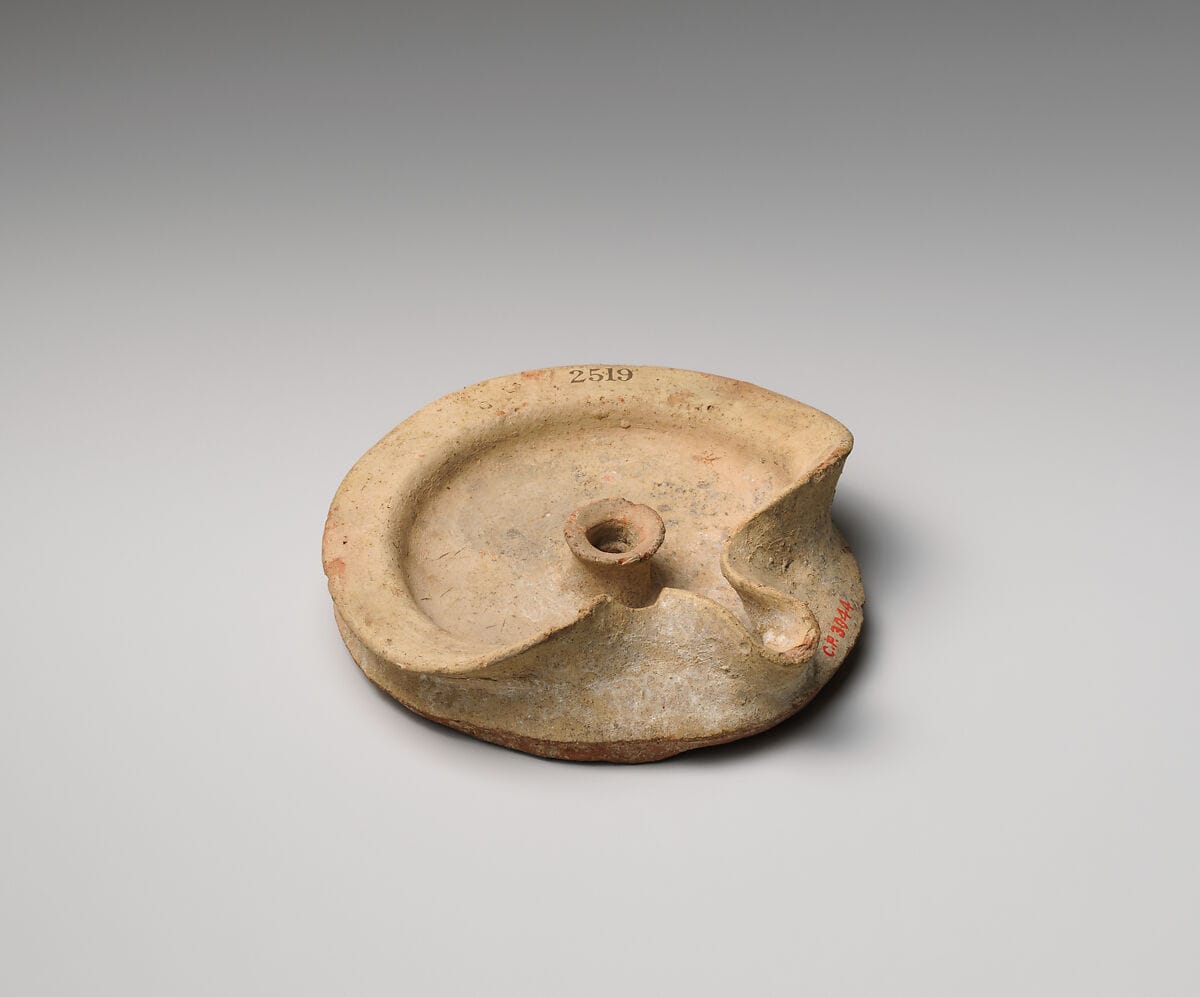 Terracotta saucer-shaped lampClassical · 399–300 BC
- Terracotta handled saucer-shaped oil lampClassical · 399–300 BC
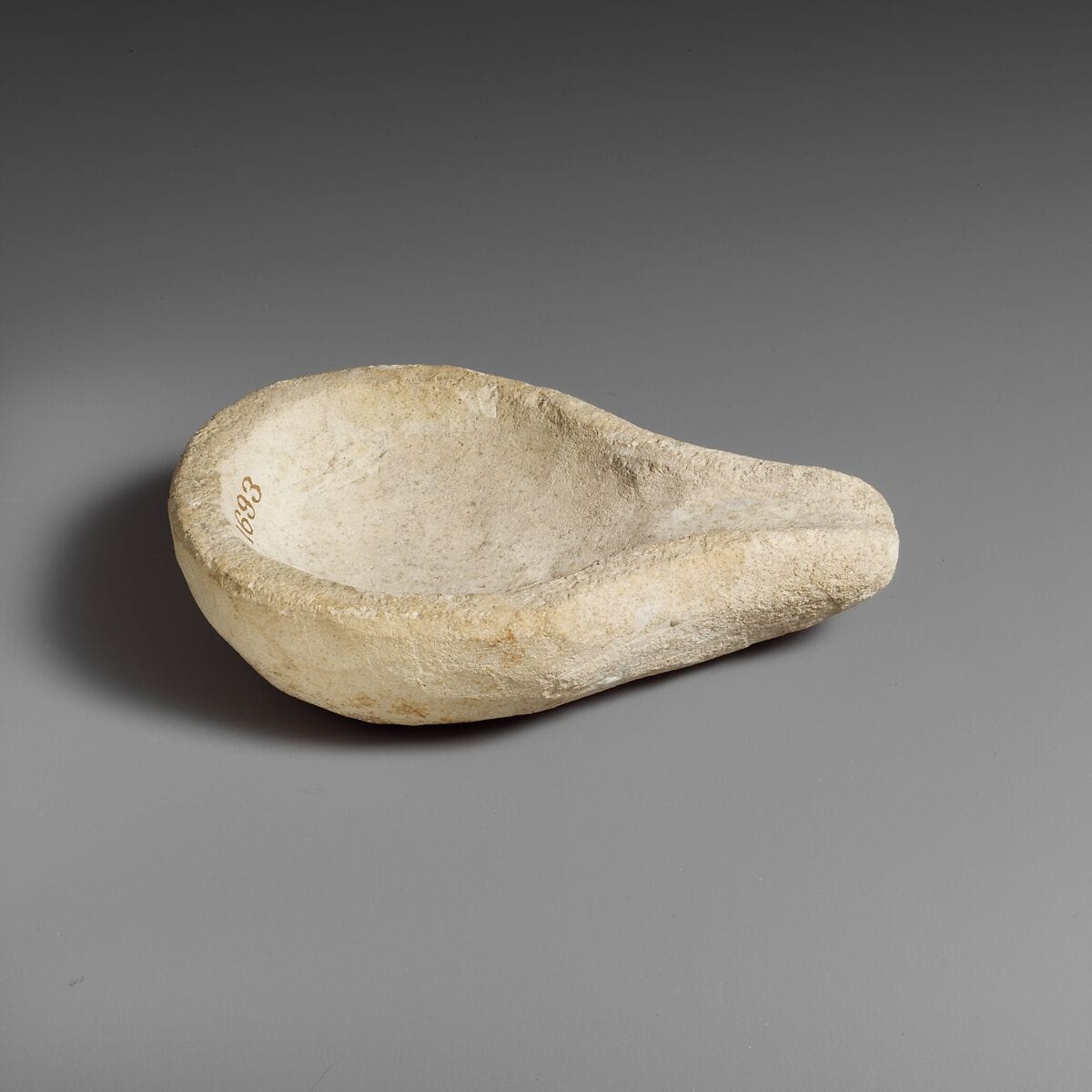 Limestone saucer lampClassical · 500–401 BC
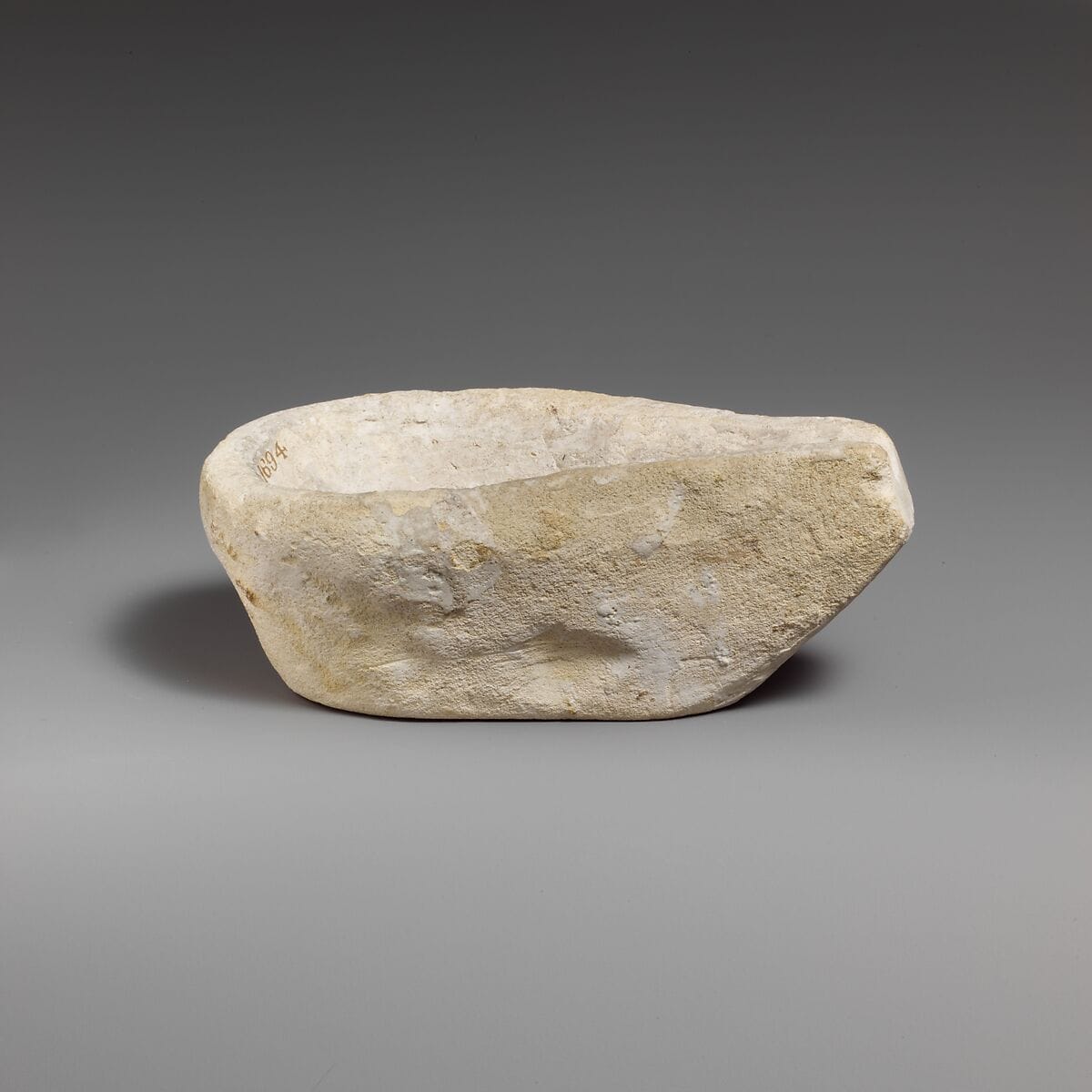 Limestone saucer lampClassical · 500–401 BC
- Terracotta oil lampRoman · 99 BC–99 AD
 Oil lamp with a bird on a branch motifRoman · 75–125 AD
In the catalogue
References
- 1.Lightfoot, C. S. (2021). The Cesnola Collection of Cypriot Art: Terracotta Oil Lamps. New York: The Metropolitan Museum of Art. https://www.metmuseum.org/met-publications
- 2.Sørensen, L. W., & Jacobsen, K. W. (Eds.). (2006). Panayia Ematousa I: A Rural Site in South-Eastern Cyprus. Aarhus and Athens.
- 3.Gordon, J. M. Lux Aeterna: The terracotta lamps from the Hellenistic and Roman tombs at Athienou-Mağara Tepeşi. In M. K. Toumazou, P. N. Kardulias, & D. B. Counts (Eds.), Crossroads and Boundaries: The Archaeology of Past and Present in the Malloura Valley, Cyprus (pp. 191–202). Boston: American Schools of Oriental Research.