
The Swedish Cyprus Expedition and What It Left Behind
Between 1927 and 1931 four Swedes led by Einar Gjerstad excavated some 21 sites across Cyprus and took about two-thirds of nearly 18,000 finds to Stockholm. At Lapithos, Enkomi, Nitovikla, Ayia Irini and Vouni they found rich Bronze Age tombs, a fort, a sanctuary crowded with terracotta figures and a hilltop palace, and the sites and finds have fared very differently since.

Alexis Drakopoulos
March 27, 2025·History·13 min read


Share


Alexis Drakopoulos is a Greek Cypriot Machine Learning Engineer working in Financial Crimes. He is passionate about Archeology and making it accessible to everyone. About Me.
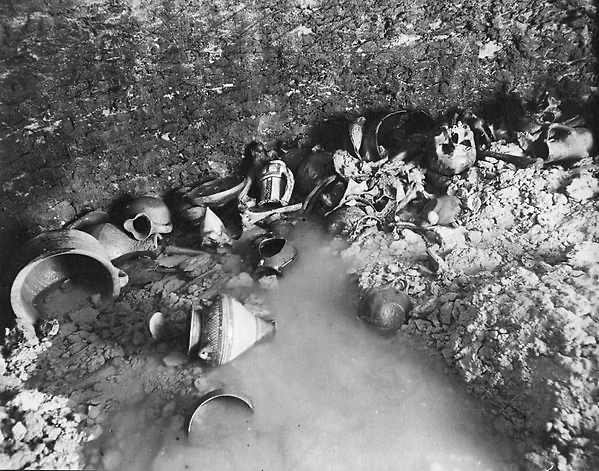
In September 1927 four young Swedes began opening rock-cut tombs on the shore west of the village of Lapithos, on the north coast of Cyprus. Their leader was Einar Gjerstad, who had already dug on the island in 1923 and 1924 for his Uppsala dissertation; with him were two archaeologists, Erik Sjöqvist and Alfred Westholm, and an architect, John Lindros [2, p. 399]. By the time they sailed for home in March 1931, the Swedish Cyprus Expedition (SCE) had excavated 21 sites by Kristian Göransson's count, or some 25 if every locality is counted separately, most of them in the north and between them covering every period from the Neolithic to Roman times [2, pp. 399, 412; 1, p. 191].
Cyprus had been dug for half a century before them, much of it by foreign diplomats who sold what they found, and museum storerooms in Europe and America had filled with Cypriot antiquities that came with no recorded context [1, pp. 191-192]. The Swedes dug to build a chronology, and they kept their tomb groups and deposits together. When the finds were divided in 1930, with the agreement of the British colonial authorities, the rule was that no tomb group or deposit would be split and that Sweden would receive a representative series from every period. On those terms about two-thirds of the nearly 18,000 finds went to Sweden: some 12,000 objects, with 5,000 boxes of sherds [2, pp. 410-412]. They are the core of the Cyprus collections in the Medelhavsmuseet, the Museum of Mediterranean and Near Eastern Antiquities in Stockholm, which also keeps the expedition's archive [2, p. 416].
Twenty-three tombs at Vrysi tou Barba
The cemetery the Swedes opened first, Vrysi tou Barba, lies west of modern Lapta, the old Lapithos, and was used in the Early and Middle Cypriot Bronze Age [1, p. 192]. Sjöqvist excavated 23 tombs there in September and October 1927 [2, p. 405]. Each had a dromos, an entrance passage cut down into the rock, leading to one or more cave-like chambers closed with a large stone slab [1, p. 192].
The tombs belonged to well-off families and were full. Most of the pottery is Red Polished, in shapes that recall gourds, and on some large vessels the relief bands take the form of snakes, which Marie-Louise Winbladh, who worked for many years with the collection in Stockholm, reads as guardians of the dead and their belongings [1, pp. 192-193]. She takes the gourd-shaped jugs, with their parallels in Anatolia, as a sign of newcomers who changed local craft; the earlier Philia material of Cyprus has close affinities with Early Bronze II Anatolia [1, p. 192].
The metal made the cemetery famous among specialists. The tombs produced tools, toggle pins, tweezers, rings, and long swords, daggers and knives with rat-tail tangs, cast in red arsenical copper and in yellow bronze [1, p. 192]. Bronze is harder than copper, but it needs tin, which Cyprus had to import; on Winbladh's account smiths began alloying the two around 1700 BC. Lead isotope analysis traces 67 per cent of the copper-based artefacts analysed from Cypriot sites to Cypriot ore [1, p. 192].
Until 2016 the area around Vrysi tou Barba was used as a rubbish dump, unfenced and unmarked, with nothing of the excavation visible. When the mayor was told that Swedish groups visit it regularly, the rubbish was cleared away [1, p. 193]. In Stockholm, meanwhile, a reconstructed Lapithos family tomb was one of the most popular displays of the Cyprus gallery opened in 1989. The tomb it reproduces had two chambers, six burials in one of them, and grave goods that originally numbered 81 Red Polished vessels with daggers, a knife, tweezers, pins, spindle whorls and a ring [1, pp. 201, 216].
Mycenaean pots at Enkomi
Enkomi, east of the village of Tuzla/Enkomi near Famagusta, was one of the main towns of Late Bronze Age Cyprus, 400 by 350 metres inside a monumental wall of the late 13th century BC [1, p. 193]. The Swedes never found the town. Its cemetery had been dug before them and heavily looted, and Byzantine buildings had cut through many of the tombs, so in the summer of 1930 Sjöqvist worked with trial trenches until he reached an undisturbed area, where he excavated 22 rock-cut tombs [2, p. 403]. Most date to Late Cypriot II, about 1450 to 1200 BC, and several held large amounts of Mycenaean pottery [2, p. 403]. Among it were Pictorial Style vases of Mycenaean IIIB, painted with people and animals, made on the Greek mainland around 1300 to 1250 BC and often marked with signs in the Cypro-Minoan script on the handles or base [1, p. 193].
That pottery has carried a political load. The first archaeologists to publish Enkomi, Winbladh argues, read it through the colonial and nationalist ideas of their time, and its Mycenaean finds have since been presented in history textbooks as proof that Cyprus became Greek, and civilised, when Mycenaeans arrived [1, pp. 193-194]. Her verdict: "The Mycenaean colonization of Cyprus was, however, neither Mycenaean nor colonization" [1, p. 194]. Ioannis Voskos and Bernard Knapp set the question as a choice between crisis and colonization on one side and continuity and hybridization on the other, and argued for the second [11].
The site itself is not set up for visitors. No signs lead to it, visitors have to walk on the eroded baulks between the trenches, the excavated rooms are overgrown, and the tombs have no information [1, p. 194].
The fort at Nitovikla
On the Karpas peninsula, near the village of Kuruova/Korovia, Sjöqvist began in the autumn of 1929 with a small cemetery, where twelve tombs had been robbed and three intact ones dated to Middle Cypriot III. He then turned to the fortress beside it, a square building of Cyclopean masonry with towers at three of its corners and flanking the entrance [2, p. 406]. Rooms opened onto a central court, and the flat roofs could serve as walkways for soldiers on the walls; Winbladh compares the plan to Hittite fortresses in Anatolia [1, p. 194].
The expedition dated the fort to Middle Cypriot III and Late Cypriot I, about 1725 to 1450 BC [2, p. 406]. Decades later Gunnel Hult went back through the plans, drawings and sherds in Stockholm, an "excavation of an excavation" as she called it, and redated it: built in Late Cypriot IB, about 1550 to 1450 BC, and rebuilt in Late Cypriot IIA, about 1450 to 1375 BC, perhaps against raids from the sea [10; 2, p. 418; 1, pp. 194, 197].
The priest's field at Ayia Irini
Late in the autumn of 1929 Papa Prokopius, the priest of Ayia Irini (now Akdeniz) in the north-west, showed the expedition the field where he had been finding statuettes [1, p. 212]. Sjöqvist dug it that winter [1, p. 195; 2, p. 401]. Under the field lay an open-air sanctuary: a court with a temenos wall and smaller buildings, around a limestone altar topped with an oval stone. Around the altar, in concentric semicircles, stood more than 2,000 terracotta figures [2, p. 401]. Many were still where they had been set up, which makes the deposit a rare primary context for an Archaic Cypriot sanctuary [1, p. 195].
The sanctuary was built over a Late Cypriot settlement. Sjöqvist distinguished seven periods of use, from the end of Late Cypriot III to about 480 BC, the most important between about 700 and 500 BC; floods from a nearby stream covered the site again and again, it was abandoned in the fifth century BC, and it saw a brief revival in the first century BC [2, p. 401; 1, p. 195]. The figures are mostly male. With them are horse-drawn war chariots, riders, ring dancers, bulls and "minotaurs", part man and part bull [1, p. 195]. No inscription names the god. Bulls, armed men and chariots point to a deity of fertility who also gave success in war [2, p. 401]. Nothing of the sanctuary survives above ground; the priest's small white church still stands near the spot [1, p. 195].
The Ayia Irini figures were the one great exception to the rule against splitting a deposit: there were so many that they were divided between Nicosia and Stockholm [2, p. 411]. The Swedish share, about 1,000 figures, has been the centrepiece of every Cyprus display in Stockholm, from the first exhibition at the Liljevalch Art Gallery in 1933 to the A.G. Leventis Gallery opened in 2009, where well over 900 of them stand together in one purpose-built case [2, pp. 413, 416]. In the 1989 gallery the case had a blue background, meant to recall the sky over an open-air sanctuary [1, p. 201].
Vouni on its hill
The building the Swedes called a palace stands near the top of a rock rising almost 270 metres out of the sea west of Soloi, looking across to the islet of Petra tou Limniti. Westholm excavated it from spring 1928 to autumn 1929 [2, p. 408; 1, p. 195]. The excavators distinguished two main phases, roughly 500 to 450 and 450 to 380 BC [2, pp. 408-409]. In the first, rooms were grouped around an open court, reached by a staircase of seven steps, and the entrance led to the state apartments. In the second the plan was turned round, with a new entrance through a vestibule on the north-west, and an upper storey was added [1, pp. 195-196]. The hill has no spring, so a cistern in the middle of the court collected rainwater from the roofs. In the northern part was a hot bath with a sweat room, heated through hollow walls from a chamber below, and there were latrines in two parts of the building [1, pp. 195-196]. Most of the sculpture found was limestone statuettes of young women [1, p. 195].
The building was destroyed, probably in a conflict, and before it fell someone hid a treasure in a jar under a staircase: gold and silver jewellery, silver bowls and 252 gold and silver coins [2, p. 409]. Two pairs of solid-gold bracelets end in goats' heads and in calves' heads, in a Persian style [1, p. 196].
What the building was is now disputed. The excavators read it as a palace, and it is still often described as a fortified royal summer residence connected with Soloi [2, p. 408; 1, p. 195]. Pontus Hellström has argued that it was an Achaemenid fortress, whose history began and ended abruptly after about a century and which was never rebuilt. He also reopens the date of its end. Gjerstad's 380 BC rested on coins of Demonikos found in the hoard, then thought to be a king of Kition; they are now assigned to Demonikos II of Lapethos, whose dates are uncertain, and Hellström puts the destruction as easily around 390 BC [9].
Vouni is in better shape, with small signs naming the rooms, but weeds are breaking up the limestone blocks of rooms such as the wine cellar [1, p. 196].
Three volumes, then a fourth in parts
The excavation reports came out quickly: three volumes, each in a text part and a plates part, about 2,000 pages and 600 plates, published in Stockholm between 1934 and 1937 [4; 2, pp. 412-413]. The fourth volume, the synthesis, came out in parts over the next 35 years and was finished in 1972 [2, p. 413]. Gjerstad's own Part 2 (1948) covers the Cypro-Geometric, Cypro-Archaic and Cypro-Classical periods [5]. Part 1A (1962), by Porphyrios Dikaios and James Stewart, covers the Stone Age and the Early Bronze Age [6], and the Middle and Late Cypriot parts of 1972 are largely the work of Paul Åström [7; 8].
Those volumes fixed the terms Cypriot archaeology still uses. In his 1926 dissertation Gjerstad had already numbered the Bronze Age pottery classes and divided the period into Early, Middle and Late Cypriot, each with sub-phases, while warning that "this chronological scheme is not definitely fixed" [3, p. 263]. A museum label that reads "Red Polished III" or "Bichrome IV" is using the system the expedition built on that start.
Work on the finds has gone on ever since. Scholars have used the Stockholm material to study the pottery, the sculpture and the Lapithos metalwork; to trace social hierarchy in Late Bronze Age Cyprus through differences in tomb building and grave goods; to sample iron objects for the beginnings of iron metallurgy on the island; and to run lead isotope analyses on most of the Bronze Age copper and bronze in the collection [1, pp. 196-197].
Salt, damp and the Priest
The worst damage the Stockholm collection has suffered came in 1977, during an exhibition called After the Flood. The terracottas in the permanent display were wrapped in plastic against dust, and in front of the large Ayia Irini figures a wall was built from lightweight concrete blocks that had been stored outside for weeks, soaking up water. Condensation formed under the plastic, and no one saw it until the sheeting came off half a year later. The figure known as the Priest was ruined: slip and paint lifted in big blisters, mostly on the face. Conservators held the surface with Japanese tissue for two years, but it could never be restored [1, pp. 198-199].
Salt is the usual enemy. Pottery buried in Cypriot soil carries soluble salts that dissolve when the air is damp and crystallise again as it dries, and each cycle flakes the surface a little more; affected pots have to be soaked in repeated baths of deionised water until the water's conductivity shows the salts are out [1, pp. 197-198]. Winbladh recommends keeping pottery and terracottas between 45 and 55 per cent relative humidity, with swings of no more than 5 per cent, and metal on display below 30 per cent, because damp drives bronze disease, a chloride corrosion that can destroy any copper alloy [1, pp. 198-199]. In the 1989 Stockholm gallery a humidity-control system in the storeroom below was piped into the Ayia Irini case, and the case of Lapithos weapons had a box of silica gel underneath that could be taken out and dried in an oven [1, p. 201].
She found the conditions she warns against on both sides of the island and in London. At the museum of the St Barnabas Monastery near Salamis, where she put the humidity at around 60 to 70 per cent, salts show on the pottery, the bronzes have bronze disease, and the doors slam with every visitor, shaking the pots. At the Güzelyurt/Morphou museum large jars stand on open metal tripods within reach of visitors [1, pp. 199-200]. In the British Museum stores, terracottas from Salamis and other sites had been laid on foam rubber, which holds moisture; when a bearded male figure from Salamis was lifted, all the paint on its back stayed stuck to the foam [1, p. 200].
Five thousand boxes of sherds
Not everything the expedition dug was published, and some sites remain unpublished. The 5,000 boxes of sherds in Stockholm all come from stratified deposits at the major sites, and Hult's redating of Nitovikla came out of them [2, p. 418]. In 2011 the Medelhavsmuseet began a research programme on the sherd collection, with two postdoctoral scholars and a first focus on the sherds from Ayia Irini [2, p. 418]. The site that made the expedition famous for its figures is now being studied through its broken pots.
References
- 1.Winbladh, M.-L. (2023). From Excavation to Exhibition: Problems in the Conservation of Archaeological Objects from Excavations in Cyprus. In L. Summerer, M. Kiessel and H. Kaba (eds), New Approaches toward Recording, Preserving and Studying Cultural Heritage in Divided Cyprus: Problems & Opportunities (conference, Kyrenia, September 2019), pp. 191-218. Kyrenia: ARUCAD Press.
- 2.Göransson, K. (2012). The Swedish Cyprus Expedition: The Cyprus collections in Stockholm and the Swedish excavations after the SCE. Cahiers du Centre d'Études Chypriotes 42, pp. 399-421.
- 3.Gjerstad, E. (1926). Studies on Prehistoric Cyprus. Uppsala.
- 4.Gjerstad, E., Lindros, J., Sjöqvist, E. and Westholm, A. (1934-1937). The Swedish Cyprus Expedition: Finds and Results of the Excavations in Cyprus 1927-1931, Vols I-III. Stockholm: The Swedish Cyprus Expedition.
- 5.Gjerstad, E. (1948). The Swedish Cyprus Expedition, Vol. IV, Part 2: The Cypro-Geometric, Cypro-Archaic and Cypro-Classical Periods. Stockholm: The Swedish Cyprus Expedition.
- 6.Dikaios, P. and Stewart, J. R. (1962). The Swedish Cyprus Expedition, Vol. IV, Part 1A: The Stone Age and the Early Bronze Age in Cyprus. Lund: The Swedish Cyprus Expedition.
- 7.Åström, P. (1972). The Swedish Cyprus Expedition, Vol. IV, Part 1B: The Middle Cypriote Bronze Age. Lund: The Swedish Cyprus Expedition.
- 8.Åström, P. (1972). The Swedish Cyprus Expedition, Vol. IV, Part 1C: The Late Cypriote Bronze Age. Architecture and Pottery. Lund: The Swedish Cyprus Expedition.
- 9.Hellström, P. (2009). The Palace of Vouni Revisited. In Medelhavsmuseet: Focus on the Mediterranean 4 (Papers from the International Seminar: A Cyprus Day in the Medelhavsmuseet), pp. 28-42. Stockholm.
- 10.Hult, G. (1992). Nitovikla Reconsidered. Medelhavsmuseet Memoir 8. Stockholm.
- 11.Voskos, I. and Knapp, A. B. (2008). Cyprus at the End of the Late Bronze Age: Crisis and Colonization or Continuity and Hybridization? American Journal of Archaeology 112, pp. 659-684.