
Contents
Monochrome is the name given to the plain, handmade, slipped pottery of Late Bronze Age Cyprus: vessels in red, brown or buff tones carrying no painted decoration, of which the best known is a small carinated bowl with a "wishbone" handle under the rim. It appears at the opening of the Late Cypriot period, alongside Base Ring and White Slip, and it travelled with them to the Levant and Egypt. The name is also a trap. Over eighty years it has been stretched to cover several undecorated fabrics of different dates and regions, and much of the modern literature on the ware is an argument about how many wares the one word really hides [2; 3].
You can see all Monochrome ware in the catalogue.
Definition and identification
The ware was first defined by Sjöqvist in 1940, working mainly from the Enkomi tombs. He described a clay "buff or reddish in colour, sometimes brick-red and in a few cases pink or grey", comparable to the thicker vases of Base Ring I, and two main shapes: the bowl with a wishbone handle and carinated rim, and the jug with a globular or biconical body and a pinched lip; larger kraters also occur [2]. Russell later summed up Sjöqvist's ware as a thin-walled buff ware common in LC I and LC IIA [2].
Paul Åström enlarged the definition in 1972 in the Swedish Cyprus Expedition volume on the Late Cypriot Bronze Age. His Monochrome has hard or very hard clay, brown to red, with an uneven surface that often shows vertical paring or trimming with a tool, and a much wider range of shapes [2]. He also separated an earlier Proto Monochrome, with "medium thick" walls, from Monochrome proper, with "thin or medium thin" walls [1, p. 48], and created a third class, Coarse Monochrome, for thicker pottery that will be met again below [2].
Seen from outside Cyprus, the fabric is easy to recognise. At Tel Dor on the Carmel coast, the excavators describe Handmade Monochrome as a "very distinctive brick-red" fabric, dense and hard, with no zoning, many small rounded limestone inclusions, a few black inclusions and small voids. The bowls are slipped and burnished red or orange, some with a dark brown streaky slip inside and out, and the surface is often abraded [4]. The same report gives the practical test for telling it from Base Ring: Monochrome has a uniform red, slightly porous, limestone-rich fabric, while Base Ring is zoned grey and red, dense and "metallic". Monochrome jugs and bowls have sometimes been wrongly published as Base Ring [4].
That confusion is easy to make, because the wishbone handle is shared. Lindy Crewe lists wishbone handles among the new features of Proto Base Ring [1, p. 48], and conical Base Ring bowls with wishbone handles are common in museum collections. The Manchester Museum's red wishbone bowl 1977.84, with its indented base, is a Monochrome piece that its own record calls "base ring ware". Fabric, not handle form, decides the ware.
Shapes
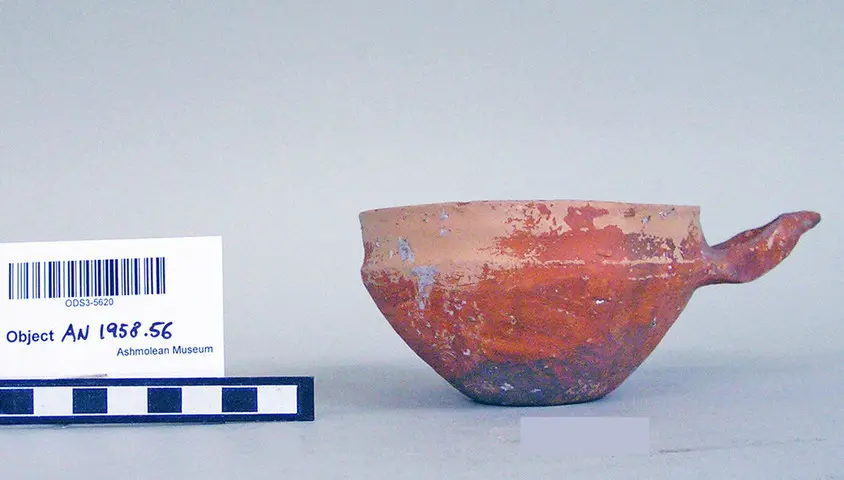
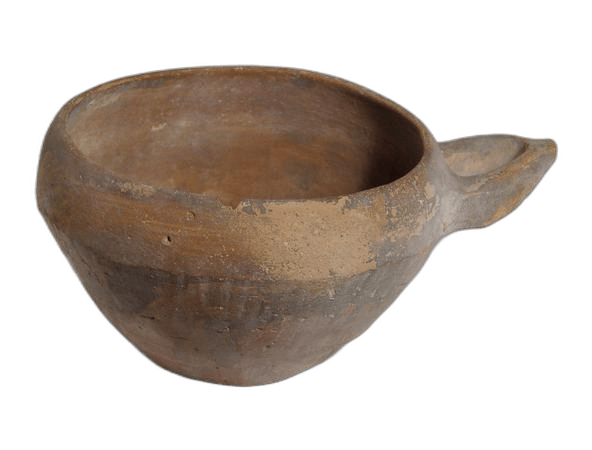
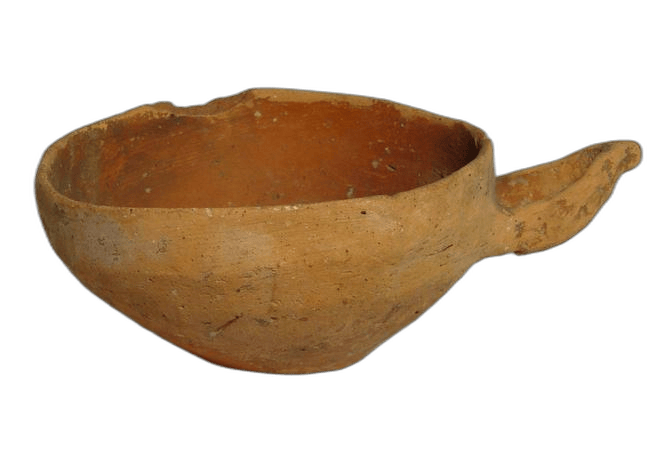
The signature shape is the small, shallow carinated bowl with a horizontal wishbone handle set below a plain in-turned rim, sitting on a concave base. At Dor these are Åström's types 1Jb–c; Åström also distinguished a deep bowl or krater (his type III) and a wide ring-based bowl (type IV, subdivided by handle form) [4]. Leonard Woolley, publishing the bowls found at Alalakh in north Syria, noted that their "umbilical" base has no counterpart among Middle Cypriot bowls, though the wishbone handle does [5, p. 196].
A small example in the Ashmolean Museum (AN1958.56) shows the type at its most typical: a Monochrome wishbone-handled cup from French Tomb II at Enkomi, given to the museum by Claude Schaeffer in 1958, 5.5 cm high and 13.1 cm across including the handle (Ashmolean record). The British Museum holds others, including two wishbone bowls of the same form. The Ashmolean also has Monochrome bowl sherds from Akaki (AN1953.1192.b–c), from Hala Sultan Tekke (AN1953.1192.n, dated LC II) and from Nicosia-Ayia Paraskevi (AN1953.1194.b, dated LC I), and the Yale Peabody Museum has a red wishbone bowl on a ring base, 15.1 cm wide (34-169-40/2616).
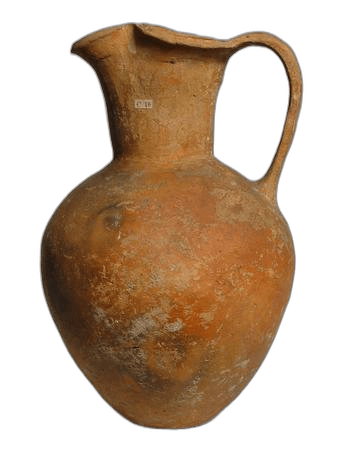
Jugs are the second Sjöqvist shape. The British Museum's trefoil jug from Enkomi (1897,0401.1172), excavated with the Turner Bequest, is 20.4 cm high, with a concave base and a mottled red, brown and black slip burnished to a low lustre; the mottling points to an open, uncontrolled firing. In the Levant jugs are rare: at Dor the Monochrome is almost all bowls, with a few sherds that may come from trefoil jugs [4].
The British Museum's so-called Painted Monochrome Bowl (1884,1210.3) shows how far the label stretches. It is a deep, two-handled carinated bowl 20.7 cm high in a fairly coarse hard fabric with a reddish-brown slip and white dotted patterns, catalogued as "Apliki A" ware. That places it in the coarser, later tradition discussed below, a long way from Sjöqvist's thin buff bowls.
Dates and phases
Crewe, following Robert Merrillees, treats Monochrome as a signifier of LC IA1, the first phase of the Late Bronze Age [1, p. 48]. Surveys of the LC IA horizon list Proto Monochrome and Monochrome among its defining wares, with White Painted VI, Black Slip IV–V, Bichrome Wheelmade, Proto White Slip and Proto Base Ring [8]. The Dor report puts the first appearance in Cyprus in LC I, about 1650 BCE [4].
Early Monochrome stayed in use from LC IA to LC IIA [3]. At Enkomi the eastern variant begins in LC IA and peaks in LC IIA, according to Despina Pilides' regional study as reported by Crewe; later in LC II the regional variants disappear and a restricted range of fabrics from the north-west and centre of the island spreads across Cyprus [1, pp. 48–49]. Russell's Monochrome A, which corresponds to Sjöqvist's ware, "dates mainly to the LC I and IIA periods" and was plentiful in the Enkomi tombs [2].
The undecorated pottery of LC IIC (13th century BCE) is a different fabric again. At Arediou-Vouppes, Louise Steel and Carole McCartney describe it as thin-walled, a few millimetres thick, gritty and brick-red to brown, smoothed rather than burnished and fired in mottled shades from deep yellow to black; its typical form is the jug [3].
| Phase | Monochrome | Evidence |
|---|---|---|
| LC IA (from c. 1650 BCE) | Proto Monochrome and Monochrome appear | Enkomi tombs; MB IIC contexts in the Levant |
| LC IB to LC IIA | Monochrome A at its peak at Enkomi; widely exported | Enkomi; Dor; Lachish |
| LC II | Regional variants fade; north-western and central fabrics spread | Pilides' regional study |
| LC IIC (13th century BCE) | Gritty, smoothed, mottled jug fabric; Coarse Monochrome | Apliki; Kalavasos; Arediou-Vouppes |
Distribution and exports
Inside Cyprus, Åström mapped "much Proto Monochrome" at Pendavia, Dhenia and Akhera in the north-west, and "much Monochrome" at Kantara, Milia, Enkomi, Kalopsidha and Dhekelia in the east and the Karpas [1, p. 48]. At Kalopsidha, the settlement excavated by Åström, Monochrome was the second commonest ware, with 23,202 sherds, behind Plain White Handmade [6, p. 141]. At Episkopi-Bamboula (see Kourion), Benson separated at least eight fabrics under the Monochrome heading, among them the hard grey Fused Temper ware, and none matched Sjöqvist's types [1, p. 48; 2].
Abroad, Monochrome was one of the regular Cypriot exports to the Levant. It is known there as early as Middle Bronze IIC, and early Monochrome bowls have been argued to be the only Late Cypriot fabric found in a secure Middle Bronze II context in Palestine; a bowl from Lachish Tomb 501 is the latest of that series [4; 9, p. 174]. At Dor the 60 sherds, mostly small, tie with Base Ring as the second largest group of Cypriot imports in Phases 12 and 11, behind White Slip; the bowls there date from the 14th to the mid-13th century, the jugs perhaps from the 15th to 14th [4]. Export is generally thought to end around the turn of the 14th and 13th centuries, though pots kept circulating into the 13th, as at Tell Abu Hawam [4]. Carinated Monochrome bowls also reached Marsa Matruh on the coast of western Egypt [2].
Origins
Most scholars derive the ware from local predecessors. Åström and Russell trace it to Red Polished, and Pilides adds a possible Black Slip contribution [1, p. 48]. Åström himself observed that Monochrome can be hard to tell from Red Polished V [7].
Where it started is less clear. Merrillees identified at least two distinct local types of Proto Monochrome, one in the north-west and one around Kazaphani in the north, which he saw as the source of the Enkomi type. Clay studies by Bernard Knapp and Cherry, however, group Monochrome from Kalopsidha and Tell Mevorakh with Red-on-Black and Black Slip of the Karpas, and Crewe concludes that an independent development in the Karpas is the more likely origin for Enkomi's Monochrome. She also warns that the distribution maps and first-appearance dates need to be read cautiously [1, pp. 48–49].
The older debate ran on different lines. Sjöqvist argued that the wishbone handle, unknown in Middle Bronze Age Syria and Palestine but found in Cyprus, tied the ware to the island. Woolley rejected this from Alalakh and claimed that the Late Cypriot wares had "no parentage in the island" [5, p. 196]. Later work on Cypriot fabrics has not supported Woolley's view.
Classification history and debates
The modern discussion starts with Russell's work at Kalavasos-Ayios Dhimitrios. There she found three distinct undecorated wares in one settlement, and argued that "Monochrome" had been applied indiscriminately to a number of quite distinct fabrics, so that there were more wares than terms [2; 3]. Her solution was to keep Monochrome as a family name and give each member a letter (A, B, C and so on), defined narrowly by fabric and a limited range of shapes, published with profile drawings and fabric descriptions, and named without any reference to date or region [2]. Monochrome A is Sjöqvist's thin buff ware of LC I–IIA; Monochrome B is the hard, bluish-grey fabric with a matte dark slip, related to Benson's Fused Temper ware, found mostly as carinated bowls [3].
Coarse Monochrome is a separate problem. At Apliki, Taylor noted that Monochrome was barely represented and had been replaced by a coarser, handmade red ware with a stroke-burnished surface. Åström then folded this "Apliki Ware" into Coarse Monochrome [2]. At Kalopsidha it has thicker walls, hard brick-red or grey clay and a matte brown slip, usually scratch-burnished [7]. Despina Pilides, in a study of handmade burnished wares, argued for clearer classes in this coarse group [7]. The British Museum's Apliki A bowl belongs here.
Three questions remain open. The first is lumping against splitting: whether a single family name with lettered members is enough, or whether the coarse and LC IIC fabrics should leave the Monochrome name altogether. The second is where Proto Monochrome began, in the north-west, the north or the Karpas. The third is practical: how many published "Base Ring" bowls and jugs are in fact Monochrome, and the reverse.
The word also turns up elsewhere in Cypriot ceramics, with no connection to this ware. Chalcolithic specialists speak of Red Monochrome and Monochrome White beside Red-on-White, and the handmade burnished pottery of the 12th century BCE is a separate class again [7]. On this site, "Monochrome ware" means the Late Cypriot family only.
In the catalogue
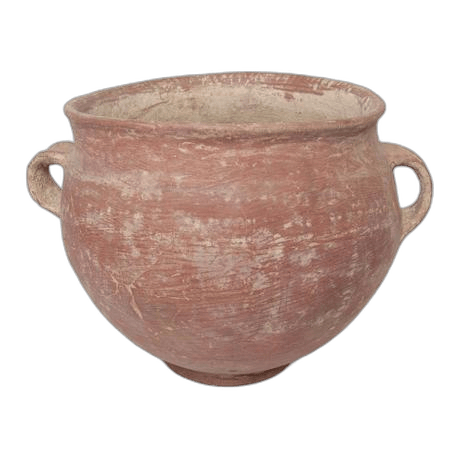
The catalogue holds a small group of Monochrome pieces, all from British and Oxford collections and mostly from Enkomi. The wishbone bowls and the Ashmolean cup represent Sjöqvist's original definition; the trefoil jug represents its second shape; and the Apliki A bowl shows the later, coarser tradition that the name came to absorb. Compare them with the Base Ring and Plain White pages for the wares most often confused with them, and with the pottery overview for where Monochrome sits in the wider sequence. For identifying a piece in hand, see How to Identify Ancient Cypriot Pottery.
Objects on this page
In the catalogue
References
- 1.Crewe, L. (2007). Early Enkomi: Regionalism, trade and society at the beginning of the Late Bronze Age on Cyprus (BAR International Series 1706). Archaeopress.
- 2.Russell, P. (1991). The pot calls the kettle reddish brown (5YR 3/4): Distinguishing among Late Cypriot Monochrome wares. In J. A. Barlow, D. L. Bolger, & B. Kling (Eds.), Cypriot ceramics: Reading the prehistoric record (University Museum Monograph 74, pp. 131–137). The University Museum, University of Pennsylvania.
- 3.Steel, L., & McCartney, C. Survey at Arediou Vouppes (Lithosouros), a Late Bronze Age agricultural settlement on Cyprus: A preliminary analysis of the material culture assemblages. Bulletin of the American Schools of Oriental Research. https://www.jstor.org/stable/25609284
- 4.Gilboa, A., Sharon, I., Zorn, J. R., & Matskevich, S. (Eds.). Excavations at Dor, final report, volume IIB. Area G, the Late Bronze and Iron Ages: Pottery, artifacts, ecofacts and other studies (Qedem Reports 11), chapter 17: The local and imported pottery. Institute of Archaeology, The Hebrew University of Jerusalem.
- 5.Woolley, L. (1955). Alalakh: An account of the excavations at Tell Atchana in the Hatay, 1937–1949. Society of Antiquaries.
- 6.Åström, P. (1966). Excavations at Kalopsidha and Ayios Iakovos in Cyprus (Studies in Mediterranean Archaeology 2). Lund.
- 7.Pilides, D. (1991). Handmade burnished wares of the Late Bronze Age: Toward a clearer classification system. In J. A. Barlow, D. L. Bolger, & B. Kling (Eds.), Cypriot ceramics: Reading the prehistoric record (University Museum Monograph 74, pp. 139–150). The University Museum, University of Pennsylvania.
- 8.Jeffra, C. D. (2011). The archaeological study of innovation: An experimental approach to the pottery wheel in Bronze Age Crete and Cyprus [Doctoral dissertation, University of Exeter].
- 9.Palestine in the Bronze and Iron Ages: Papers in honour of Olga Tufnell. Institute of Archaeology, London.