
Contents
Ships appear in Cypriot pottery in two ways. Potters modelled them in clay, as freestanding boats and sometimes as hollow vessels, and painters drew them on the bodies of jugs and amphorae. The models run, with gaps, from the end of the Middle Bronze Age to the Cypro-Archaic period, and they cluster in two groups: three large Late Cypriot merchant ships and a much larger Iron Age series centred on Amathus. Painted ships are rarer and almost all Iron Age. This page treats the ship as a pottery subject; for the wider evidence of boats, harbours, graffiti and wrecks see Seafaring and Ships. You can see all ships in the catalogue.
Identification
A "ship" in the catalogue sense covers four kinds of object. The commonest is the clay model: a hand-made hull, usually with both stems raised above the gunwale, sometimes with a mast socket, cross-beams, painted eyes or small figures of crew. The second is the painted scene, a ship drawn on the shoulder or body of a jug or amphora. The third is the relief, like a limestone fragment in the Metropolitan Museum showing the curved stern of a boat with a pilot at the helm, said to come from the sanctuary of Ayios Photios at Golgoi and dated to the early Hellenistic period (fragment of a limestone votive relief with a boat). The fourth is the engraved image on a seal, discussed below.
The basic reference for the models is K. Westerberg's Cypriote Ships from the Bronze Age to c. 500 BC (1983), which numbers the corpus and is cited in nearly every later catalogue entry [2]. Shelley Wachsmann's Seagoing Ships and Seamanship in the Bronze Age Levant (1998) re-examined the Bronze Age pieces against Egyptian, Levantine and Aegean ship images [1].
Middle and Late Bronze Age models
The earliest candidates are doubtful. Wachsmann describes a White Painted IV model of Middle Cypriot III date with a rounded hull, net-like painted decoration, pairs of piercings on four sides and one seated human figure inside. Dussaud read it as a merchant ship, Basch as a round coracle; Wachsmann himself judged it "so schematic" that little can be learned from it [1]. White Painted IV sherds from Politiko-Lambertis, which Westerberg reconstructed as a ship with five figures along the sheer, and a largely restored Red Polished III vessel with an incised hull and deck are, in his view, possible watercraft at best [1].
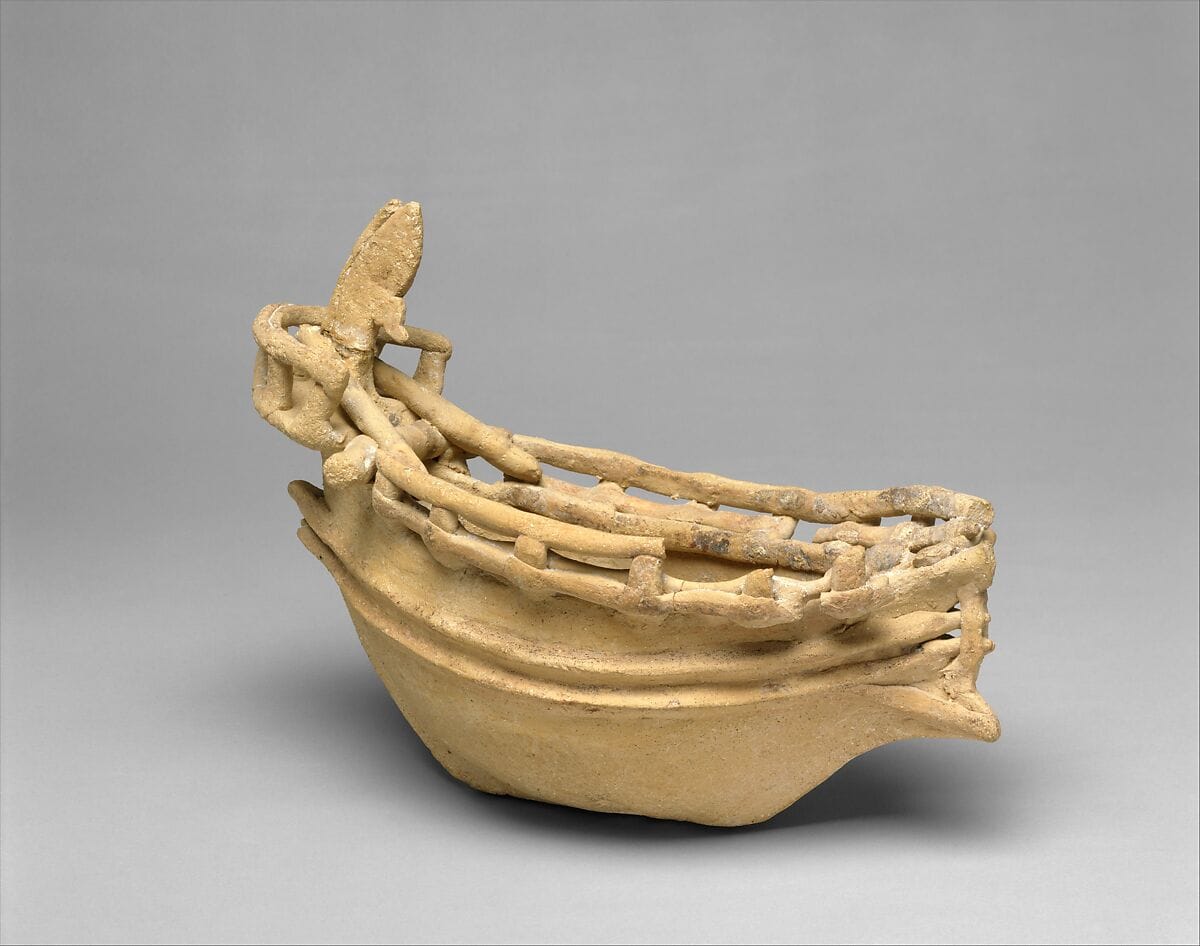
The first secure group is Late Cypriot I to II and is made in Plain White Handmade ware. Three models are known: one from Kazaphani-Ayios Andronikos Tomb 2B and two from Maroni, Site A Tombs 1 and 7 [1, pp. 63–65]. The Kazaphani ship, now in the Cyprus Museum, is the most elaborate. It is 45 cm long and 23 cm high, with a deep, rounded hull, a flat-topped incurving gunwale, a line of 37 to 38 holes pierced just beneath it, a circular mast step and seven small plastic "buttons" on the inside of one stem [3, cat. 77]. One of the Maroni models has two tall prongs curving inward at the stern [1].
.](https://cdn.ancientcyprus.com/britishmuseum/4653-bichrome-merchant-ship-model.png)
Wachsmann thought the three so alike that "they may have originated in the same workshop"; their beam-to-keel ratio falls between 1:2.19 and 1:2.71, which he took as the proportions of a beamy merchant ship [1, p. 66]. He considered the forked stern a seat for a single steering oar, or an imitation of a bird's tail. The rows of holes remain unexplained. R. S. Merrillees read them as "elaborate provisions for sails and rigging"; Wachsmann preferred an open bulwark of perishable material lashed to the hull [1, p. 66]. The 2012 Nicosia catalogue states the two options as skin-covered hulls or a Cypriot class of spacious seagoing merchant ships, and notes that the type has no parallels outside the island [3, cat. 77].
Late Cypriot and Cypro-Geometric transition
Between the Late Bronze Age and the Iron Age the evidence thins to single pieces. Wachsmann lists a cylinder seal of the end of the Late Cypriot period engraved with a crescent-shaped ship, two crew handling the steering oars, and a mast with a crow's nest, set among horned animals and ingot-shaped objects. A Proto-White Painted amphora from Vathyrkakas carries on its shoulder a crescent hull with two rowers and a fish beneath, too schematic, in his words, "to tell anything more" [1]. Proto-White Painted askoi in ship form from Lapithos have a bird-head stem turned inward, which he regards as a key clue in tracing the bird-head ornament from Aegean and Sea Peoples galleys to Greek Geometric ships [1].
Wachsmann also questioned the Late Bronze Age date that had been given to two models found in the sea off Amathus. Their closest parallel is a merchantman of the ninth or eighth century BCE, and he suggested they be dated accordingly [1]. A model without context can be placed only by its shape.
Cypro-Geometric and Cypro-Archaic models
The Iron Age series is far larger. The 2012 Nicosia catalogue counts 53 ship models from the Cypro-Geometric to Cypro-Archaic periods, of which at least 33 come from the Amathus area, and observes that most were found in tombs [3, cat. 78–79]. The examples below are hand-made, mostly painted in Bichrome style, and range from plain canoe-shaped hulls to detailed cargo ships and warships.
| Object | Date | Find place | Length | Features |
|---|---|---|---|---|
| Kazaphani merchant ship, Cyprus Museum T 2B/249+377 | Late Cypriot I–II | Kazaphani, Tomb 2B | 45 cm | Row of holes under gunwale, mast step, plastic bosses [3, cat. 77] |
| Boat with rower, Cyprus Museum Sal. T. 104/5 | Cypro-Archaic I | Salamis-Cellarka, Tomb 104 | 10.5 cm | One seated figure with hands on gunwale [3, cat. 78] |
| Small ship, Limassol District Museum LM 1143 | Cypro-Archaic | Amathus, Tomb 521 | 14.4 cm | Identical inward-curving stems, painted waterline [3, cat. 79] |
| Merchant ship, British Museum 1894,1101.182 | Cypro-Archaic II | Amathus, Tomb 84 | 31 cm | Raised poop deck, cross-beams, iron rudder fragment [5] |
| War-ship, British Museum 1894,1101.258 | Cypro-Archaic | Amathus | 15.8 cm | Projecting ram flanked by painted eyes |
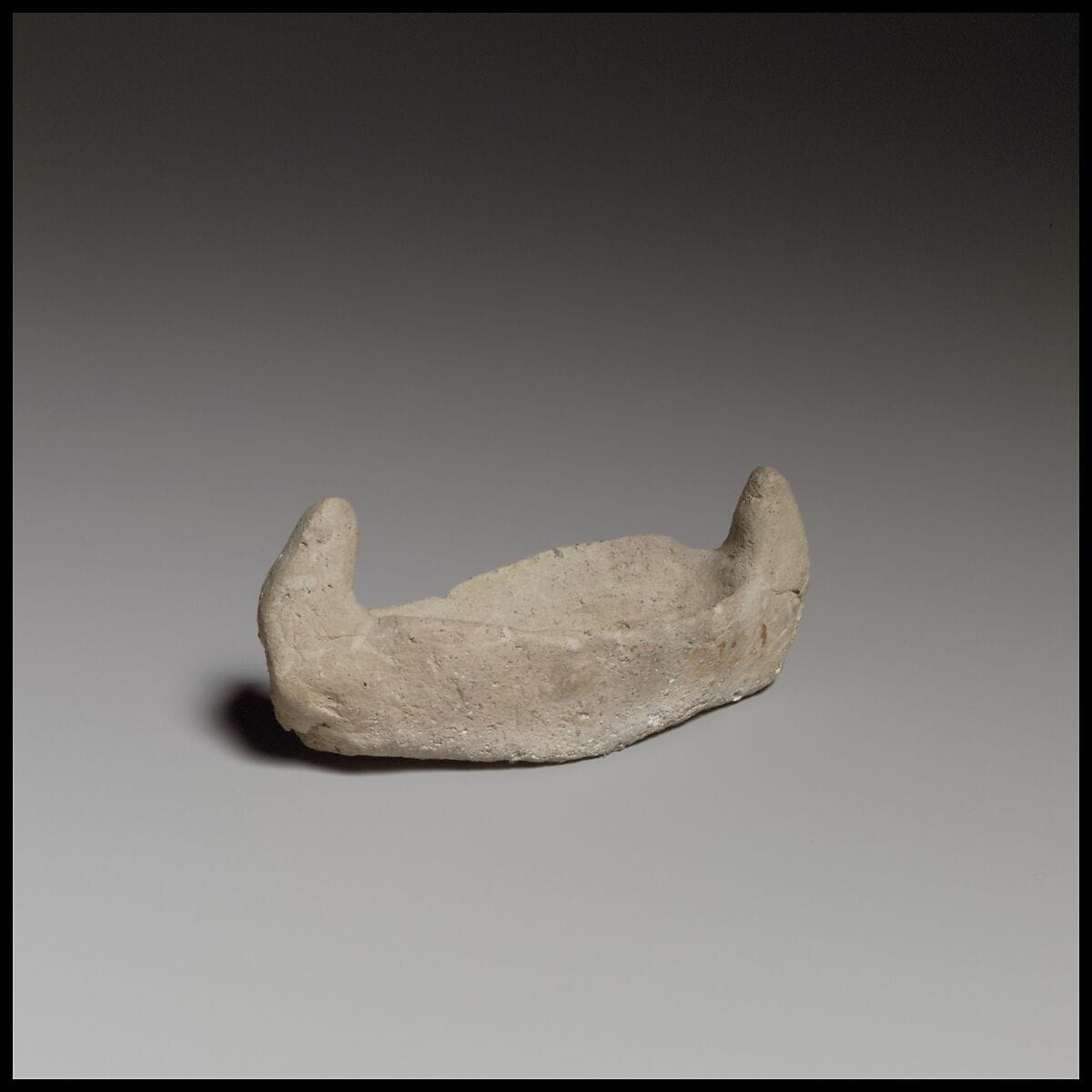
A typical Amathus model is the small ship from Western Necropolis Tomb 521, now in the Limassol District Museum: a shallow canoe-like hull with two identical inward-curving stems tipped in red, black bands at the base of the stems and a black line around the hull that probably marks the waterline. At least seven similar models came from other Amathus tombs [3, cat. 79]. The Smithsonian catalogue calls it a merchant ship and notes that such models were "relatively usual in funerary contexts of Amathus" [4, cat. 114]. The same entry states that terracotta ship models appear "already from the Middle Cypriot period" and continue to the Cypro-Classical period [4, cat. 114].
The most detailed example is the Bichrome merchant ship model from Amathus Tomb 84, excavated with the Turner Bequest funds of 1893 to 1894 and now in the British Museum. It is 31 cm long and has an elevated poop deck with evidence of a lower floor, cross-beams over the cargo area, a line of holes along the side (for oars, or a feature of hull construction), bosses at the bow that may be eyes, a mast socket and a fragment of iron that was probably the rudder [5]. Thomas Kiely compares it with Levantine ships on Assyrian reliefs and treats Westerberg's late sixth-century date, based on Attic black-figure parallels, as uncertain; the tomb was disturbed and held several more boat models [5].
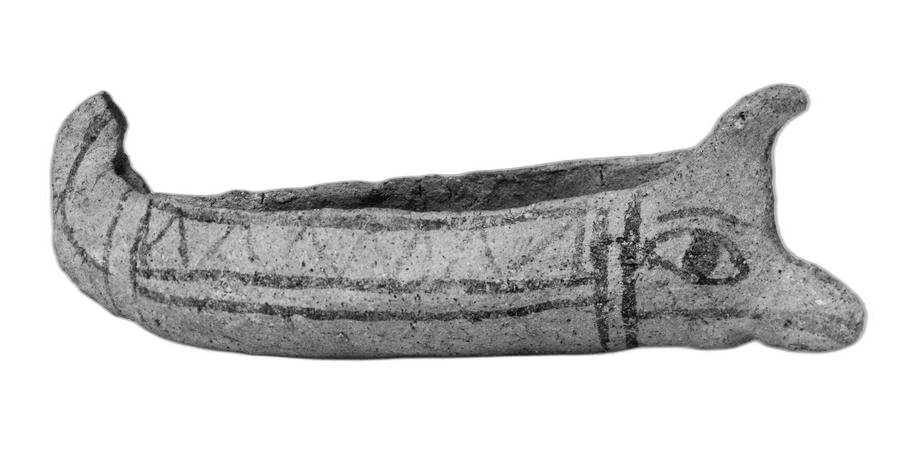
Other Amathus models in the British Museum show the range. A second Bichrome merchant ship has a tall bulwark or poop deck rising over the stern. A war-ship model, 15.8 cm long, has a projecting ram with a large painted eye on each side and oblique strokes on the hull that may stand for oars. A round-bottomed Bichrome model is only 12.5 cm long, with tall upright stems (British Museum record), and a Bichrome sailing ship with tall stems, a mast socket and cross-beams at each end is 17.5 cm long (British Museum record). The Metropolitan Museum holds a large Cypro-Archaic II ship model from the Cesnola Collection.
Crewed boats form a smaller group. Six Archaic boat models with human figures are known, all from the eastern half of the island (Larnaca, Salamis, Yialousa); the one from Salamis-Cellarka Tomb 104 has a single figure, perhaps a rower, seated amidships with his hands on the gunwale, and is probably a fishing boat [3, cat. 78].
Ships painted on vessels
.](https://cdn.ancientcyprus.com/single-artifacts/74.51.511.jpg)
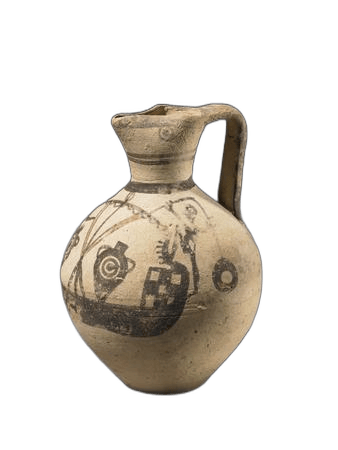
Painted ships belong to the Iron Age figural repertoire and are rare. On a Cypro-Archaic I jug in the Metropolitan Museum, said to have been found at Ormidhia, the ship has a mast, a furled sail, a pair of steering oars and a bird's head at the stern. The museum's label traces the bird-head stern to the prehistoric Aegean and adds that "we do not know if the ship is Cypriot or foreign". The jug is one of the Cesnola pieces in the Met.
The fullest scene is on a late Bichrome wheel-made jug said to come from the Karpas peninsula, now in the British Museum (Bichrome ware merchant ship jug). The ship is drawn in cutaway: two amphorae with bull's-eye decoration sit in the hold on either side of the mast, one sailor stands on the poop deck holding what looks like a round anchor, another works the oars or helm, and a large fish follows the stern. Schreiber cites it as part of the "limited iconographic evidence from the Iron Age showing pottery travelling by ship" [6]. A single ship set alone on the vase belongs with the other single-subject compositions of free-field painting.
Interpretation and debates
Four questions run through the literature.
Realism. Mark Dolan notes that the models form a distinct subset of Cypriot terracottas and have been used either as direct evidence for naval architecture (Westerberg 1983, Johnston 1985, Basch 1999) or as a basis for religious readings (Carbillet 2005, 2011), yet "remain poorly understood" [7]. He stresses their uneven distribution and high variability, and their three kinds of context: tombs, sanctuaries and the sea [7]. Wachsmann was more cautious with the Middle Cypriot pieces, though he accepted the three Late Cypriot models as images of "an indigenous class of spacious Late Cypriot seagoing merchant ship" [1]. The rows of holes on those three, and the bird-head stems of the later series, are still read in different ways.
Function. Kiely lists the possibilities for the Iron Age models: straightforward images of ships, objects for instruction or entertainment, children's toys, or symbols of the sea or of the journey to the afterlife. Their frequency in tombs "hints at some sort of eschatological significance", and finds in shrines near the sea suggest votives from sailors and merchants, but "we know next to nothing about their use outside of the specific contexts" [5]. The Smithsonian entry prefers votive offerings of sailors and seamen [4, cat. 114]; the Nicosia catalogue thinks the tombs belonged to seamen or people involved in maritime work [3, cat. 78].
Date. Models found in the sea or bought without context, such as the pair from off Amathus, can only be dated by comparison, and Wachsmann moved them from the Late Bronze Age to the ninth or eighth century BCE [1]. Westerberg's dates for the Amathus tomb models are also questioned [5].
Origin of the ship type. The bird-head stem links the Cypriot pieces to Aegean and Levantine shipbuilding, and the Met jug's ship may be foreign. The Kazaphani group, by contrast, has no parallels outside Cyprus [3, cat. 77].
Related pages
For graffiti, wrecks and harbours, see Seafaring and Ships and the article on simulating ancient seafaring voyages. The Amathus models are best read alongside the ancient city of Amathus and the Cypro-Geometric and Late Bronze Age period pages. Other figural subjects on vessels are collected under Motifs, and the full list of ship objects is in the catalogue.
Objects on this page
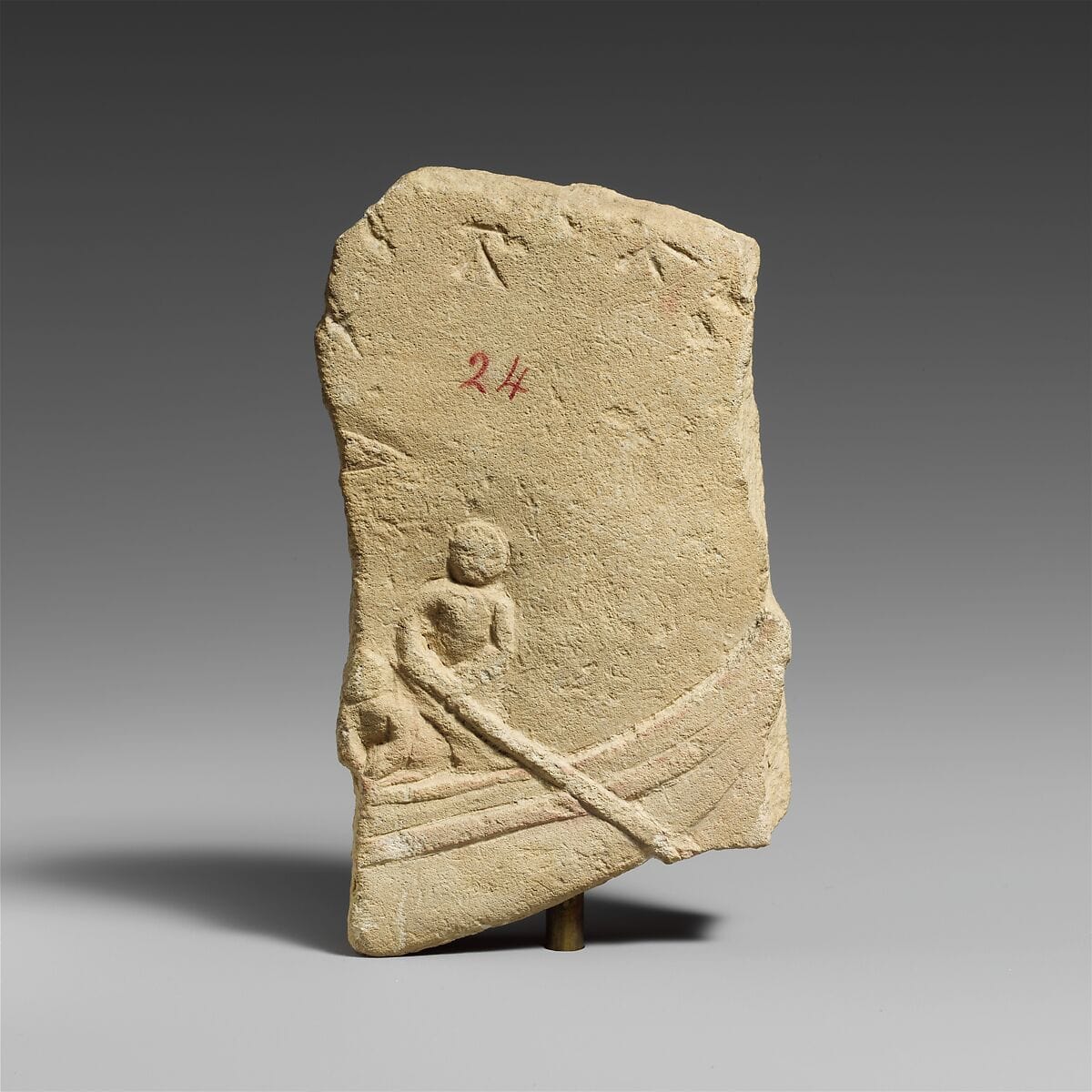 Fragment of a limestone votive relief with a boatHellenistic · 300–250 BC
- Bichrome Merchant Ship ModelArchaic I · 750–500 BC
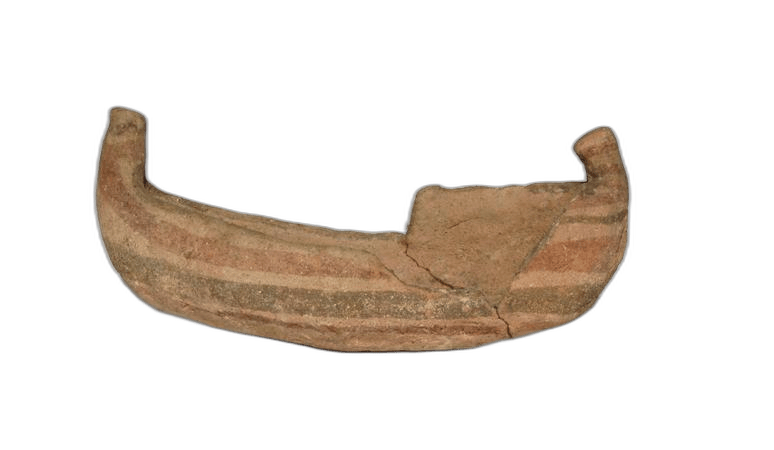 Bichrome Merchant Ship ModelArchaic II · 600–500 BC
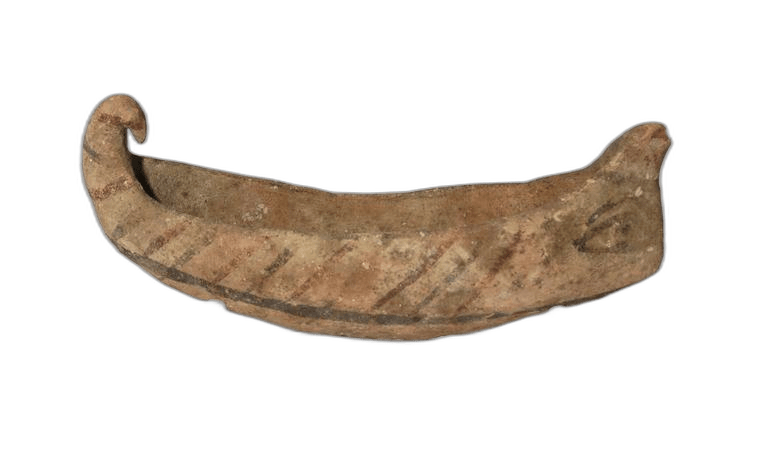 Terracotta War-Ship ModelArchaic II · 600–500 BC
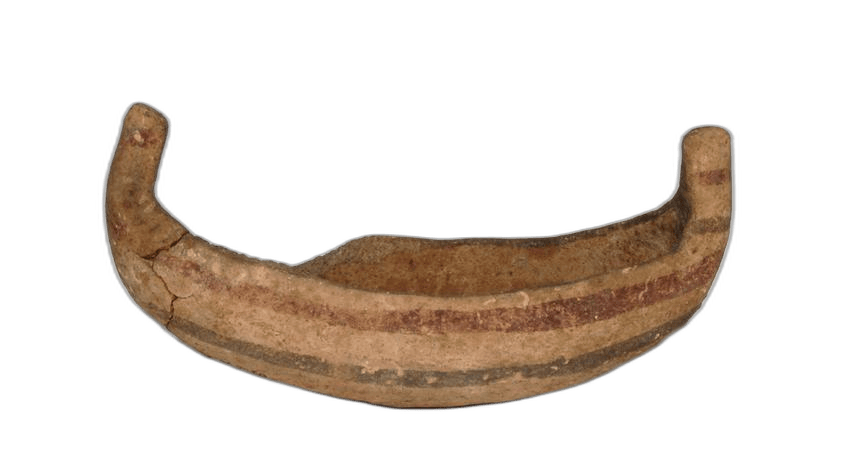 Bichrome Model ShipArchaic I · 750–500 BC
 Terracotta model of a shipArchaic II · 600–480 BC
- Terracotta jugArchaic I · 750–600 BC
 Bichrome Ware Merchant Ship JugArchaic I · 750–600 BC
In the catalogue
References
- 1.Wachsmann, S. (1998). Seagoing ships and seamanship in the Bronze Age Levant. London.
- 2.Westerberg, K. (1983). Cypriote ships from the Bronze Age to c. 500 BC Göteborg.
- 3.Pilides, D., & Papadimitriou, N. (Eds.). (2012). Ancient Cyprus: Cultures in dialogue (exhibition catalogue). Nicosia: Department of Antiquities, Cyprus.
- 4.Hadjisavvas, S. (Ed.). (2010). Cyprus: Crossroads of civilizations (exhibition catalogue). Washington, DC: National Museum of Natural History, Smithsonian Institution; Nicosia: Department of Antiquities, Cyprus.
- 5.Kiely, T. (n.d.). Model of a merchant ship, British Museum GR 1894,1101.182 (cat. 115). In Cyprus: Crossroads of civilizations (exhibition catalogue).
- 6.Schreiber, N. (2002). The Cypro-Phoenician pottery of the Iron Age (Culture and History of the Ancient Near East). Leiden: Brill.
- 7.Dolan, M. Shipshape: Re-examining the role of terracotta boat models in Late Bronze and Iron Age Cyprus (conference abstract).