
Contents
The great Iron Age wares of Cyprus are White Painted, Bichrome, Black-on-Red and Plain White. Alongside them, Einar Gjerstad's classification of the Swedish Cyprus Expedition material defined a handful of smaller wares that turn up in tombs in modest numbers. This page covers three of them: Grey and Black Polished, a dark burnished ware of the late Cypro-Geometric and Cypro-Archaic periods; Stroke Polished, a red-slipped ware of the Cypro-Classical period whose shapes copy Greek pots; and Polychrome, Gjerstad's name for selected painted vessels carrying three or more colours [1]. All three are wheel-made, and all three are rare enough that a single museum may hold only a handful of examples.
How Gjerstad numbered the wares
Gjerstad gave every Iron Age ware a series number and, in brackets, a "Type" number that ties it to his period scheme. Type I belongs to Cypro-Geometric I, Type II to Cypro-Geometric II, Type III to Cypro-Geometric III, Type IV to Cypro-Archaic I, Type V to Cypro-Archaic II, Type VI to Cypro-Classical I and Type VII to Cypro-Classical II [1]. A name such as "Grey and Black Polished II (IV)" therefore means the second series of that ware, which is Gjerstad's Type IV and belongs to Cypro-Archaic I. "Stroke Polished I (VI)" is the first series of a ware that only begins in the Classical period, so its first series already carries Type number VI.
Gjerstad's absolute dates for these periods were: Cypro-Geometric III about 850 to 700 BC, Cypro-Archaic I about 700 to 600, Cypro-Archaic II about 600 to 475, Cypro-Classical I about 475 to 400 and Cypro-Classical II about 400 to 325 [1]. The site's catalogue uses rounder boundaries for its ware terms (850, 750, 600, 480 and 310 BC), so the dates given below for each series are approximate and should be read as Gjerstad's periods first and as calendar years second. The scheme rests on the stratified tomb groups the Swedish expedition dug at sites such as Lapithos, Marion, Ajia Irini, Vouni and Kition, and on the relative frequency of each Type within those groups [1].
| Series | Gjerstad Type | Period | Approx. date | Shapes Gjerstad lists |
|---|---|---|---|---|
| Grey and Black Polished I (III) | III | Cypro-Geometric III | c. 850–750 BC | Bowl with two pierced handles; two juglet types; amphorae |
| Grey and Black Polished II (IV) | IV | Cypro-Archaic I | c. 750–600 BC | Shallow bowls; handle-ridge juglets; amphora |
| Grey and Black Polished III (V) | V | Cypro-Archaic II | c. 600–480 BC | One biconical juglet type |
| Stroke Polished I (VI) | VI | Cypro-Classical I | c. 480–400 BC | Bowl, squat jar, jugs, askos |
| Stroke Polished II (VII) | VII | Cypro-Classical II | c. 400–310 BC | Plates, Attic-type bowls, jugs, amphora |
| Polychrome White and Red | I–VII (White); V–VII (Red) | Geometric to Classical | Catalogue: c. 750–310 BC | Jugs, amphorae, pilgrim bottles, craters |
Grey and Black Polished ware
Grey and Black Polished is the darkest of the Iron Age fine wares. Gjerstad's definition of the first series, Grey and Black Polished I (III), is brief: the vessels are "wheel-made; the clay is well silted, grey in colour, covered with a grey or black, polished slip" [1, p. 82]. A British Museum juglet of this family, said to come from Salamis or Kition, is described in the museum record as "burnished and fired to a grey colour throughout", which is the look a collector should expect: a small, dense vessel that is grey in the break as well as on the surface (British Museum 1881,0824.74). The name "Black Polished" also belongs to an Early Bronze Age handmade ware; the two have nothing to do with each other beyond the colour.
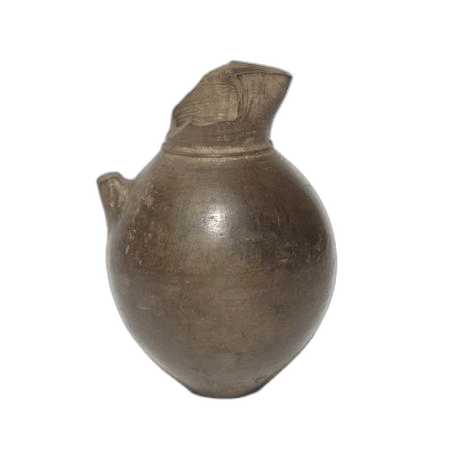
Grey Polished juglet, from Amathus, Turner Bequest, now in the British Museum. Ovoid body, flat base, a ridge at the neck and a trefoil mouth; height 7.5 cm. It fits Gjerstad's second series, Grey and Black Polished II (IV), of Cypro-Archaic I.
Grey and Black Polished I (III), of Cypro-Geometric III (about 850 to 750 BC in the catalogue's terms), has three groups of shapes in Gjerstad's account. There is a hemispherical bowl on a base-ring with two pierced horizontal handles at the rim. There are two juglet types: one with a flat base, a funnel mouth and a handle from neck to shoulder, the same form as the contemporary Black-on-Red I (III) juglet, and one with a low foot, a depressed body, a short concave neck, a pinched rim and a handle from rim to shoulder. Finally there are amphorae with handles either on the shoulder or from rim to shoulder, close to White Painted III and Bichrome III amphorae [1, p. 82].
A small juglet in the Cyprus Museum at Jacksonville, catalogued here as a Cypro-Geometric polished grey juglet and dated by its former dealers to about 850 to 750 BC, has the pinched spout of the second juglet type and is probably an example of this first series (Cyprus Museum, Jacksonville). The attribution rests on shape alone, since its record does not name a series.
Grey and Black Polished II (IV), of Cypro-Archaic I (about 750 to 600 BC), has a grey or grey-black clay that is sometimes less well silted than in the earlier series, and a slip that is usually grey-black. Gjerstad noted that the burnishing is more careful than in Type III, though often worn away. The repertoire grows: five types of shallow bowl, including one with a horizontal wavy handle, one whose handles are topped by lotus flowers and a hemispherical bowl with two vertical handles in the shape of quadrupeds, which in his words "clearly imitates a metal prototype". There are handle-ridge juglets with globular or sack-shaped bodies and pinched rims, like Black-on-Red II (IV), and an amphora with a low foot, a depressed body and handles from rim to shoulder, similar to Black Slip IV [1, p. 83]. The British Museum juglet from Amathus illustrated above belongs to this series.
Grey and Black Polished III (V), of Cypro-Archaic II (about 600 to 480 BC), was known to Gjerstad from a single juglet type: biconical, with a flat base, a narrow short concave neck, a swollen rim and a handle from rim to shoulder, the same shape as Black-on-Red III (V) and Bichrome Red II (V) juglets [1, p. 83].
In Gjerstad's tomb statistics Grey Polished enters with Black-on-Red and Red Slip as one of the new wares of Cypro-Geometric III, with forerunners at the end of Cypro-Geometric II. It never becomes common. He summed it up as "represented by a few specimens from the end of Cypro-Geometric II to the beginning of Cypro-Classic I" [1]. See all Grey and Black Polished ware in the catalogue, or the individual series: I (III), II (IV) and III (V).
Stroke Polished ware
Stroke Polished is a red ware, despite sharing a "polished" name with the grey family. Gjerstad defined the first series, Stroke Polished I (VI), as "wheel-made; reddish-brown clay, covered with a red slip, polished in vertical strokes" [1, p. 84]. The vertical burnishing strokes, left visible on the surface, give the ware its name.
Stroke Polished I (VI) belongs to Cypro-Classical I (about 480 to 400 BC). Gjerstad recorded a single bowl type of medium depth, with a flat base, convex sides, a swollen drooping rim and two projections on the body; a squat jar with two horizontal shoulder handles and a raised, splayed rim; jugs with either a bowl-shaped mouth (on a globular or rounded-square body with a short concave neck and inturned rim) or a funnel mouth; and an askos with a funnel mouth and a basket handle [1, p. 84].
Stroke Polished II (VII) belongs to Cypro-Classical II (about 400 to 310 BC). The clay and slip are the same, but the shapes look further towards Greece. Gjerstad listed a plate with a broad rim pierced by two suspension holes; a shallow bowl on a base-ring with an incurved rim, imitating the Attic Black Glazed bowl; a depressed bowl with a rounded base and a concave raised rim, imitating a metal vessel; and shallow one-handled and deep two-handled bowls copying Attic types. Jugs continue the earlier forms with a more oval body, and there is an amphora with an oval body, a concave neck and handles from neck to shoulder [1, p. 84]. In his discussion of foreign influence Gjerstad pointed out that the jugs and askoi with cup-like mouths imitate Greek prototypes, and that the skyphoi and bowls copy Attic Black Glazed and Red Figured shapes [1].
Gjerstad called Stroke Polished "altogether a Cypro-Classical ware". It grows markedly in Cypro-Classical II, when it becomes the most common ware of his "coloured" class, the group of slipped and polished fabrics that also includes Black Slip [1]. Anna Georgiadou's survey of Iron Age pottery describes it as a ware that appears "in the beginning of the CC period ... under Aegean influence", adding that it "is not a common technique", that its use is "restricted to a range of shapes that have Greek counterparts", and that it seems "better represented in the western part of Cyprus" [2, p. 8].
A comparandum outside Stockholm is the Ashmolean's Plain White Stroke Polished I jug (AN1948.145), 20.5 cm high, given by Henry Balfour in 1948. The museum dates it to the Hellenistic period, which does not agree with Gjerstad's placing of Stroke Polished I in Cypro-Classical I; the label and the date cannot both follow his scheme, and the object would need to be seen to decide which is wrong. The site's catalogue holds no Stroke Polished vessel at present, so its term pages are empty for now: Stroke Polished ware in the catalogue, with series pages for I (VI) and II (VII).
Polychrome ware
Gjerstad did not treat Polychrome as a ware family with its own fabric. He defined Polychrome White as "a variety of Bichrome I–VII: some selected specimens are painted in black and supplementary red, white, yellow, green, and blue colours" [1], and Polychrome Red, in the same way, as a variety of Bichrome Red II–IV (V–VII), with black paint and supplementary white, red, yellow, green and violet [1]. In other words, a Polychrome vessel is a Bichrome or Bichrome Red pot on which the painter used more than two colours. Gjerstad also observed that one variety of Bichrome V carries white paint over black ornament and is "actually a polychrome fabric reduced to a two-coloured ware" [1]. The catalogue's "Polychrome ware" family, which gathers Polychrome Red, Polychrome White and Polychrome urns under one heading, is an editorial grouping built on his varieties; its catalogue scope is the Archaic and Classical material, although Gjerstad's Polychrome White series starts in the Geometric period.
The shapes are those of the parent wares: jugs, amphorae, pilgrim bottles and craters. Several polychrome amphorae in the British Museum appear among Gjerstad's figures of Bichrome V [1].

Polychrome spouted jug from Kourion, British Museum 1982,0729.350, transferred from the Victoria and Albert Museum. Ovoid body on a broad pedestal foot, a double strap handle with a flat thumb-grip copying metal, and a spout in the form of a small jug with a handmade figurine attached. Red-brown clay under a white to cream slip; the paint was applied after firing and is mostly lost. Height 24.4 cm; Polychrome (VII), Cypro-Classical II.
The best documented late examples come from the Swedish excavations at Marion. Two Cypro-Classical II jugs from Marion Tombs 43 and 57, now in the Medelhavsmuseet in Stockholm, are classified as Polychrome VII; they stand 35 and 40 cm high, and the second carries a figurine on the jug (Medelhavsmuseet M. 043:024; M. 057:006). They belong to the same Classical fashion for jugs with modelled figures as the British Museum spouted jug from Kourion. At the other end of the range, a jug from Lapithos Tomb 417 in the same museum is labelled "Polychrome White I (Foreign Ware)" and is 21.9 cm high (Medelhavsmuseet L. 417:086).
Two cautions apply. On the Kourion jug the paint was added after firing and has largely flaked away, so the colours a vessel carried when new are not always the colours it shows now. And the word "polychrome" is also used for painted sculpture, a separate subject covered under limestone polychromy. See all Polychrome ware in the catalogue.
Distribution and find contexts
All three wares are known mainly from tombs. Gjerstad's evidence came from the cemeteries the Swedish expedition dug, and the museum examples cited on this page come from tombs or old collections at Salamis, Kition, Amathus, Kourion, Lapithos and Marion [1]. Grey and Black Polished appears from the late Geometric period with the other new wares of Cypro-Geometric III, and its juglet shapes follow Black-on-Red closely. Stroke Polished is a Classical ware with Greek shapes and, in Georgiadou's reading, a western bias in its distribution [2, p. 8]. Polychrome vessels are selected pieces within the Bichrome and Bichrome Red production, made in the same shapes and found in the same graves.
Open questions
Each of these wares is defined almost entirely by Gjerstad's 1948 typology, and later work has kept his names while using period labels (CG III, CA I and so on) instead of his Type numbers. The catalogue's round-number boundaries differ slightly from his absolute dates, and the exact calendar span of each series depends on which chronology is followed. The grey family's firing, the production centres of all three wares and the reasons Polychrome stayed a small, selective variety are not settled. For Stroke Polished, the mismatch between museum labels and Gjerstad's dates, as with the Ashmolean jug, shows how loosely the series names can be applied once vessels leave their tomb groups.
Related pages
- Periods: Cypro-Geometric, Cypro-Archaic, Cypro-Classical
- Parent and neighbouring wares: Bichrome, Bichrome Red, Black-on-Red, Plain White, Iron Age White Painted
- Shapes: jug, amphora, bowl
- All pottery types
Objects on this page
In the catalogue
References
- 1.Gjerstad, E. (1948). The Cypro-Geometric, Cypro-Archaic and Cypro-Classical Periods (The Swedish Cyprus Expedition, Vol. IV, Part 2). The Swedish Cyprus Expedition.
- 2.Georgiadou, A. P. (2016, February 2). Pottery of Geometric, Archaic and Classical periods in Cyprus. In G. Bourogiannis & C. Panagiotopoulou (Eds.), Kyprios Character: History, Archaeology & Numismatics of Ancient Cyprus. kyprioscharacter.eie.gr/en/t/A0