
Contents
White Painted Wheelmade (WPWm) is the name for a family of wheel-thrown, pale-bodied, dark-painted Cypriot wares of the Late Bronze Age, and in practice almost every modern use of it means one class: White Painted Wheelmade III, the locally made pottery of Aegean inspiration that became the island's standard tableware at the end of the thirteenth and during the twelfth century BC. Artemis Georgiou defines WPWm III as "locally made fine-ware ceramics of both open and closed forms, which largely draw inspiration from Aegean shapes and/or decoration, but also integrate characteristics from the repertoire of local Cypriot ceramics", dated to the end of Late Cypriot IIC and to LC IIIA [1, p. 79]. The term exists to replace half a dozen older labels, most of them Aegean, that had turned a question about pots into an answer about people. This entry covers the three numbered WPWm classes, the terminology problem that made the third one necessary, what the pottery looks like, and how it hands over to Proto-White Painted in the eleventh century.
Names and classification
One ware, many names
Before 1972 the same body of pottery was sorted into categories that implied different dates, origins and populations. Barbara Kling, who wrote her doctoral dissertation on the material, listed them in 1991: "matte-painted Levanto-Helladic ware; Rude or Pastoral Style; Late Mycenaean IIIB and Mycenaean IIIB:2; Mycenaean IIIC, or IIIC:1, or IIIC:1b; and Submycenaean or Debased Levanto-Helladic, later renamed Decorated Late Cypriot III ware" [2, p. 181]. Georgiou adds "Quasi-Mycenaean Linear", "Local Mycenaean IIIC:1b" and "Painted 'Submycenaean'" to the list, calling them "mere additions to the already perplexed state of research" [1, p. 80].
The most consequential name was "Mycenaean IIIC:1b". Arne Furumark introduced it to Cypriot archaeology for the pottery he excavated at Sinda, and Porphyrios Dikaios adopted it for his Areas I and III at Enkomi [1, p. 80]. At Enkomi, Dikaios used it for the Aegean-style fine ware of his Level IIIA, the beginning of LC IIIA, which he read as the rebuilding of the town by Mycenaean populations after the destruction of Level IIB; the deep bowl, or skyphos, became the marker of the class, and similar pottery already present in Level IIB was filed separately as "Late Mycenaean IIIB" [1, p. 80]. The pictorial kraters were a third category. Furumark called them "Rude Style" to signal their inferiority to Mainland work, and Vermeule and Vassos Karageorghis later renamed them "Pastoral Style" after their grazing and fighting bulls [1, pp. 80–81].
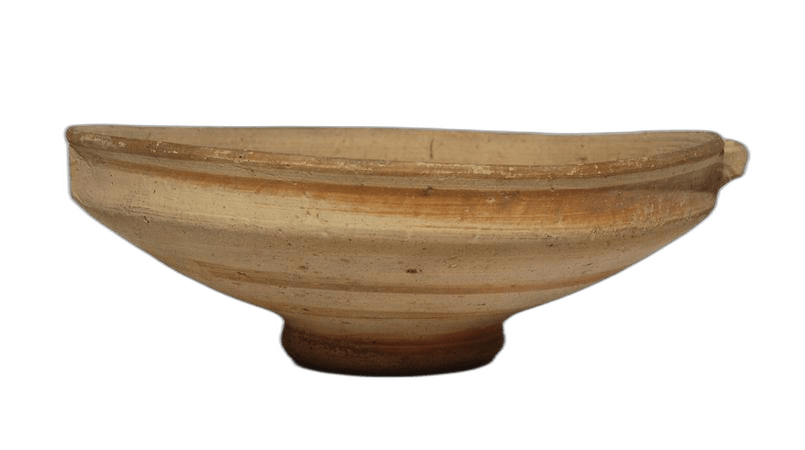
Kling's central observation is that these groups cannot be separated on the pottery itself. Levanto-Helladic or Late Mycenaean IIIB shallow bowls are "indistinguishable from most varieties of bowls called Decorated Late Cypriot III", and amphoroid kraters, strainer jugs and skyphoi appear in both "Mycenaean IIIC" and "Decorated Late Cypriot III" [2, p. 181]. The result, in her phrase, was "the situation in which one man's Decorated Late Cypriot III is another man's Mycenaean IIIC": the Swedish excavators at Idalion in the 1930s reported no Mycenaean IIIC, yet P. Ålin's restudy found types identical to those others called by that name [2, p. 181]. A bowl from Episkopi-Bamboula in the British Museum, now classed as White Painted Wheelmade III, imitates a Late Helladic IIIB shape. Her explanation is historical. Because LC IIC was equated with Late Helladic IIIB, Mycenaean-style pottery from LC IIC contexts was called IIIB; pottery of the next period, believed to reflect a new culture, was called IIIC; and "once assigned on the basis of these historical interpretations, the pottery classifications then served to confirm them" [2, p. 182].
| Older label | Used for | Implied reading |
|---|---|---|
| Late Mycenaean IIIB / Mycenaean IIIB:2 | Local Aegean-style bowls in LC IIC contexts (Enkomi Level IIB) | A limited local production before the 'disasters' |
| Mycenaean IIIC:1b | Skyphoi and related shapes of Enkomi Level IIIA and Sinda | Pottery of Aegean settlers after c. 1200 BC |
| Decorated Late Cypriot III | Painted wheelmade ware at Kourion, Idalion and elsewhere | A local style of the surviving Cypriot population |
| Rude Style / Pastoral Style | Pictorial amphoroid and bell kraters with bulls and birds | Provincial imitations of Mainland pictorial kraters |
| White Painted Wheelmade III | All of the above (Åström 1972, Kling 1991) | One local ware spanning LC IIC and IIIA |
Åström's series: WPWm I, II and III
The replacement term came from Paul Åström, who introduced White Painted Wheelmade III in 1972, first to replace "Decorated Late Cypriot III" and then, as others adopted it, to cover every class sharing the same technical features [2, p. 183]. It was one member of a numbered series in the Swedish Cyprus Expedition volumes, and Åström's own definitions show how he saw the sequence. White Painted Wheelmade I "is mainly a monochrome, contemporary variety of Bichrome Wheel-made Ware"; White Painted Wheelmade II "is essentially a painted version of the local Plain White Wheel-made I Ware"; and White Painted Wheelmade III "was locally made in Cyprus and is a further, local development of White Painted Wheel-made II Ware with Mycenaean and Syro-Palestinian influences" [3, pp. 748–749].
The first two classes are rare and belong to the earliest wheelmade production on the island. The potter's wheel reached Cyprus only around 1650 BC, and in Late Cypriot I just a handful of wares were thrown on it: Plain White, Bichrome, White Painted and the Red and Black Slip wares, most of them also made by hand in identical shapes [4, pp. 185–186]. In LC IIA–B the wheel retreated further: the feasting set passed to handmade Base Ring and White Slip bowls and to imported Mycenaean kraters, though White Painted Wheelmade and a few other wares stayed on the wheel in small numbers [4, p. 186].
The Roman numeral caused an argument almost at once. In the discussion at the symposium published as Cypriot Ceramics in 1991, Karageorghis objected that "III" still implies a date in LC III. Åström replied that the numeral follows WPWm I and II, which precede it in earlier Late Cypriot phases; Kling added that no scholar using the term confined it to LC III, and that its value lay in covering both LC IIC and LC IIIA [2, p. 183]. The objection has not gone away. Georgiou, who uses the term for the Evreti material, still calls the "III" misleading "since it imposes an erroneous exclusive association with the Late Cypriot III period", citing Peter Fischer and Reinhard Jung to the same effect [1, p. 81].
| Class | Main context (conventional dates) | Åström's definition / current use |
|---|---|---|
| White Painted Wheelmade I | LC I (c. 1650–1450 BC) | Mainly monochrome variety of Bichrome Wheel-made |
| White Painted Wheelmade II | LC IA2 (Enkomi settlement) or LC IB (tombs) to LC IIC | Painted version of Plain White Wheel-made I |
| White Painted Wheelmade III | LC IIC–IIIA (c. 1325–1100 BC) | Local development with Mycenaean and Syro-Palestinian influences; umbrella for all matt-painted wheelmade ware of the period |
| Proto-White Painted | LC IIIB (c. 1100–1050 BC) | The standardised successor that merges the LC IIIA painted wares |
The absolute dates in the table follow Georgiou's 2018 chronology (LC I 1650–1450, LC IIA–B 1450–1325, LC IIC 1325–1200, LC IIIA 1200–1100, LC IIIB 1100–1050 BC) [4, p. 178]; the attribution of WPWm I and II to particular phases rests on Åström's tomb and settlement lists [3, pp. 681, 688–689].
The three classes
White Painted Wheelmade I
White Painted Wheelmade I (WPWm I) is the earliest and rarest of the three classes. Åström defined it as "mainly a monochrome, contemporary variety of Bichrome Wheel-made Ware" [3, pp. 748–749], which makes it the one-colour partner of the wheelmade Bichrome of Late Cypriot I (c. 1650–1450 BC). Lindy Crewe, working on Dikaios's settlement sherds from Enkomi, found that the label covers "a range of painted wheelmade wares" too rare to subdivide. Some sherds are in the sandy Plain White fabric, others in "a much finer, harder fabric with few inclusions" like fine Bichrome, and a few have paint laid on in different thicknesses for a "two-toned effect" [5, p. 126]. Areas III and I produced only 82 and 10 sherds, nearly four-fifths of them from closed vessels such as jugs, jars and tankards [5, p. 127].
The decoration is the best guide. Giorgos Georgiou notes that WPWm I is painted in lines (framed zigzags, multiple zigzags, cross-hatched triangles), which ties it to the handmade White Painted tradition, whereas wheelmade Bichrome fills its bands and surfaces with solid red [6]. Together with Bichrome it brought in shapes unknown in the Middle Cypriot period: ring bases, carinated forms, kraters and pilgrim flasks [5, p. 46]. The ware was probably made only in eastern Cyprus. At Enkomi its deposition fits a lifespan of LC IA–B, and it had gone out of use by Level IIA [5, pp. 127, 140]. Crewe adds that although WPWm I is one of only two wares treated as markers of LC IA, it is too rare in settlement deposits to date them on its own [5, p. 51].
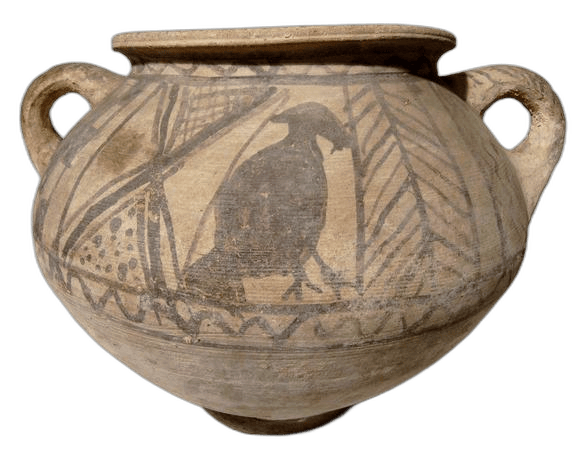
The one catalogued example is a carinated krater in the British Museum (1927,1213.1), 23 cm high, with a flat everted rim, loop handles at the shoulder and a field of silhouette birds between lattice triangles and chevrons, in brown-black paint on a buff to cream fabric (museum record). See all White Painted Wheelmade I in the catalogue.
White Painted Wheelmade II
Åström described White Painted Wheelmade II (WPWm II) as "essentially a painted version of the local Plain White Wheel-made I Ware" (Plain White), with parallels at Ras Shamra and kraters comparable to vases from Megiddo [3, pp. 748–749]. In his tomb lists single WPWm II vases appear in LC IB groups such as Enkomi Swedish Tomb 8 [3, p. 681], and in the LC IIC levels of Enkomi it is among the older wares surviving "in small quantities" while the Rude Style and WPWm III "appear on the scene" [3, p. 689]. Crewe's settlement evidence from Enkomi Area III puts its start earlier, in LC IA2, and gives production a span of at least 150 years [5, p. 127].
At Enkomi "virtually all WPWM II comes from large jugs", and the class shows "extraordinary homogeneity in fabric, form and decoration" [5, p. 127]. The jugs carry a matt white self slip and are painted in diluted matt purple-brown with "thick, calligraphic-style brush strokes": horizontal bands at the neck and vertical or diagonal lines down the body. Many bases were visibly patched [5, p. 127]. The painting follows the handmade White Painted VI jugs [5, p. 47]. Crewe reads WPWm II as a decorated but largely utilitarian subset of Plain White Wheelmade, "peculiar to Enkomi", that grew more popular over time, reaching 8 to 9 per cent of the Area III pottery, and was rarely exported; a few sherds are known from Nitovikla and Kalopsidha [5, pp. 127, 140].
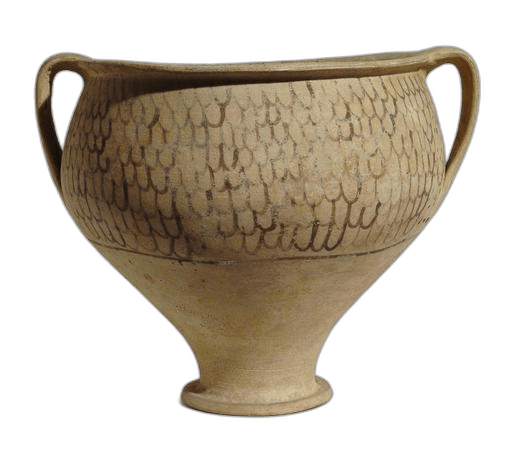
Åström's kraters represent the open side of the class, which the Enkomi settlement jugs do not show. The catalogue's example is a krater from the Turner Bequest excavations at Enkomi in the British Museum (1897,0401.1103), 31.3 cm across, with a scale pattern on each side and birds flanking one handle; the museum dates it to LC IIA–B (museum record). See all White Painted Wheelmade II in the catalogue.
White Painted Wheelmade III
White Painted Wheelmade III (WPWm III) is the class most of this entry describes and the one most catalogue records use. Åström called it "locally made in Cyprus" and "a further, local development of White Painted Wheel-made II Ware with Mycenaean and Syro-Palestinian influences" [3, pp. 748–749]; Georgiou's definition, quoted above, adds the combination of Aegean shapes and decoration with local Cypriot features [1, p. 79]. It runs from late LC IIC through LC IIIA, c. 1325–1100 BC, and most of the pieces in the catalogue belong to the twelfth century, c. 1200–1100 BC. Older publications and museum records file the same pottery as Mycenaean IIIC:1b, Late Helladic IIIC, Decorated Late Cypriot III or, for the pictorial kraters, Pastoral or Rude Style (see the table above). In Crewe's account of Enkomi, LC IIC–IIIA saw handmade finewares replaced by "a complex of decorated wheelmade wares", the end of a gradual standardisation already visible in the Plain White Wheelmade bowls and jugs of late LC IIB [5, p. 74].
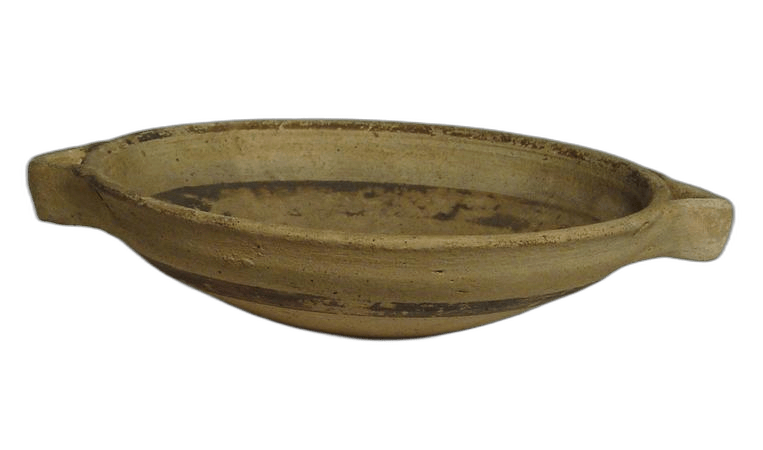
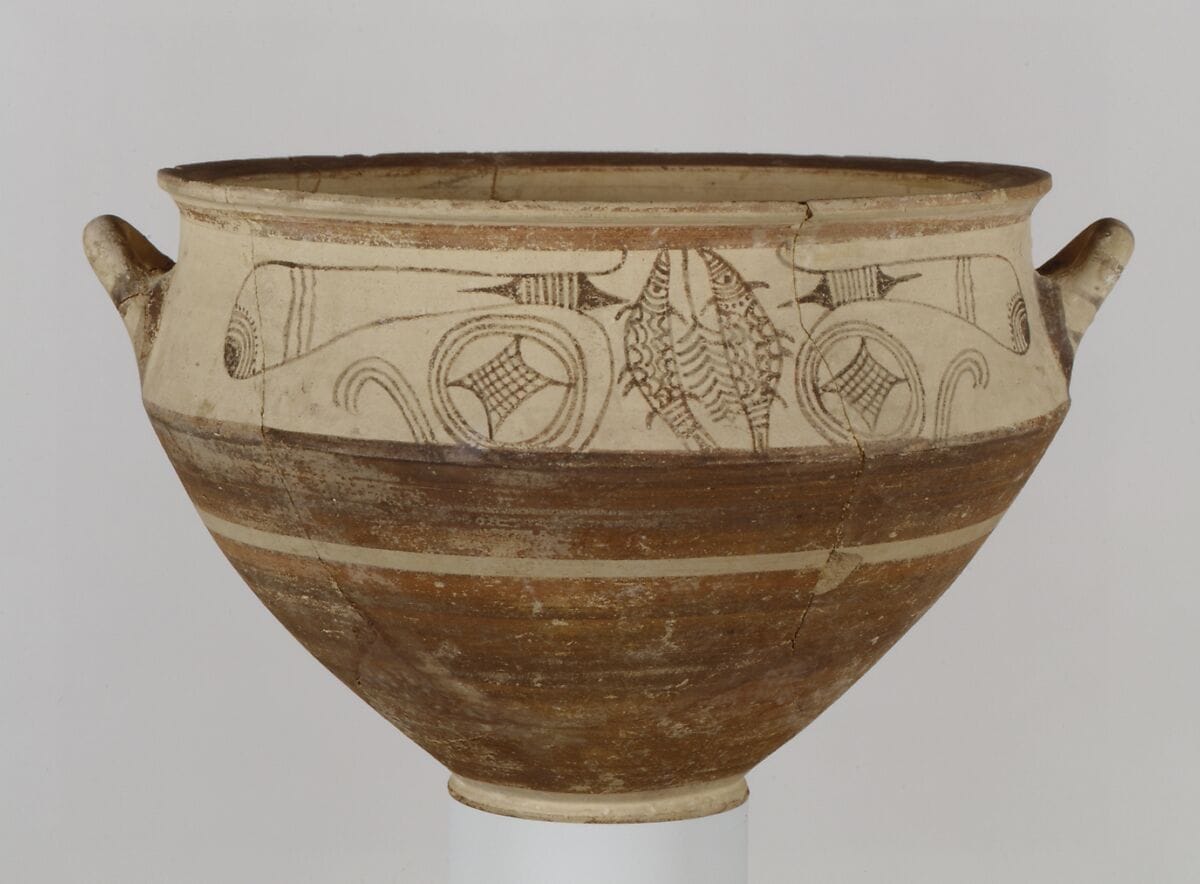
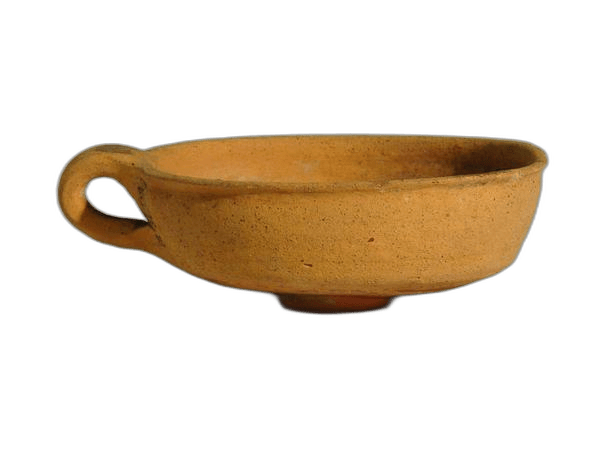
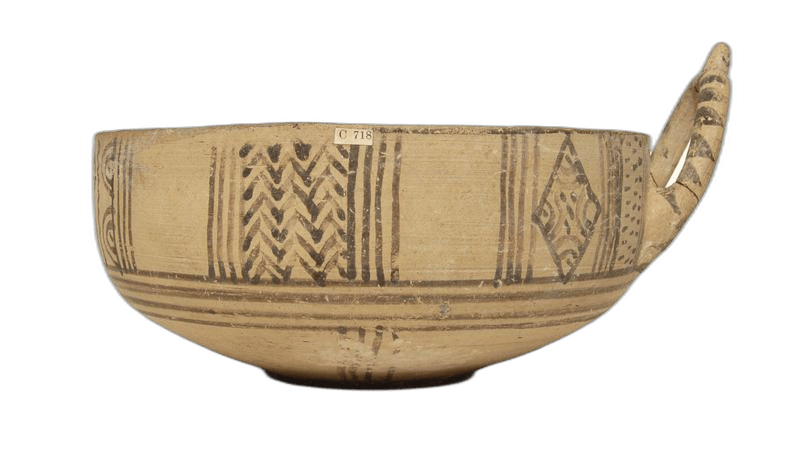
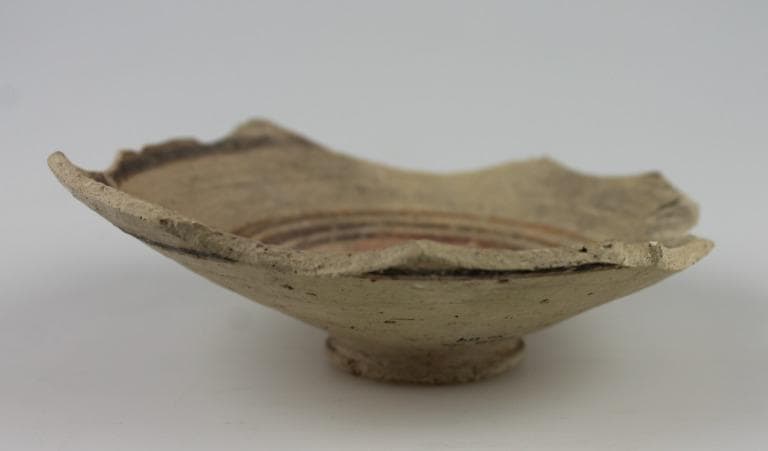
Typical pieces have thin walls, a light buff fabric with a thin slip, and matt paint from orange-red to black. The commonest shapes are the deep bowl with antithetic spirals in the handle zone, the shallow carinated bowl with two strap handles, kraters and strainer jugs; the sections below give the detail. Enkomi, Palaepaphos-Evreti, Sinda and Kition are the key sites. Catalogue examples include a krater in the Metropolitan Museum, and from the British Museum a cup, a pedestal bowl, a conical bowl and a shallow bowl with two loop handles, all from Enkomi. See all White Painted Wheelmade III in the catalogue.
Identification and dating
What WPWm III looks like
Kling's summary is still the working definition: "All of this pottery is wheelmade in a light colored fabric and decorated in a matt paint, although there is a great range of technical quality, even on the same shapes found together at the same site" [7, p. 282]. Open shapes predominate (cups, stemmed and shallow bowls, the deep bowl or skyphos, and kraters), while jugs with tubular or strainer spouts are "less common but typical"; decoration runs from simple banding to spirals, zigzags, chevrons, triangles and lozenges, with a small figural set of birds, fish, bulls and plants [7, p. 282].
Georgiou's catalogue of the two wells TE III and TE VIII at Evreti, in Palaepaphos, gives the fullest single-site description. The vessels are thin-walled, 0.3 to 0.6 cm, with a thin slip "in practically all cases lighter than the colour of the clay"; the commonest fabric is light pinkish or brownish buff and hard-fired [1, p. 81]. The paint "varies from light orange/red to dark brown to black, occasionally shaded", and it is generally matt, though some pieces have a more lustrous surface; colour variation on a single vase is a firing effect, with only three deliberate attempts at "bichromity" among hundreds of pieces [1, p. 82]. Deep bowls are the majority shape. Their handle zone usually carries curve-stemmed antithetic spirals, less often a horizontal zigzag or wavy band, a running "quirk" motif, vertical panels or, rarely, a bird [1, pp. 82–85]. Shallow carinated bowls with two strap handles occur "at practically every Late Cypriot site of the end of the 13th and/or the beginning of the 12th century BC", from Enkomi and Hala Sultan Tekke to Alassa, Episkopi-Bamboula and Sinda [1, p. 86]. Closed shapes include jugs, stirrup jars, hydriae and feeding bottles; the last carry vertical bands, a treatment foreign to Aegean feeding bottles and probably inherited from earlier Cypriot practice [1, pp. 97–98].
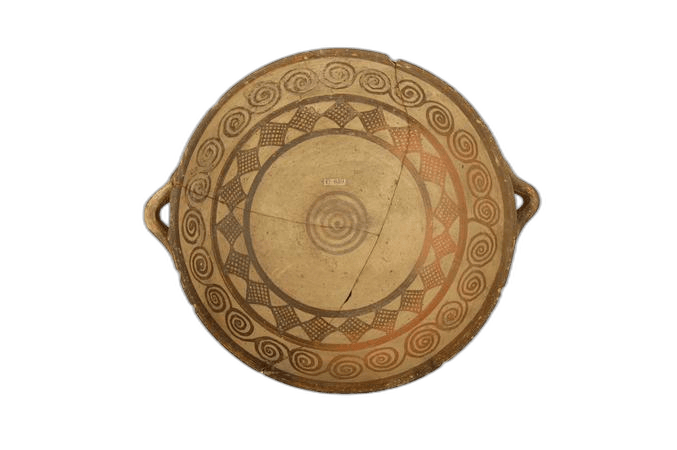
Several features have no Aegean pedigree at all. At Evreti Georgiou found one-handled bowls, hemispherical bowls with flattened bases, wheelmade versions of White Slip shapes and Base Ring bowls, and a handmade juglet of Base Ring shape in WPWm III fabric [1, p. 99]. Sherratt had seen the same "unclassifiable horrors", wheelmade Base Ring bowls and White Painted Wheelmade bowls with pure White Slip II decoration, in pieces from F.-G. Maier's Evreti excavations [8, p. 187]. Kling traced the elaborately painted strainer jugs to two groups: globular Aegean-shaped jugs in the "Sinda" style of tightly packed spirals, and tall ovoid jugs closer to local Cypriot forms, such as those from Alassa [7, p. 282]. A strainer jug from Kouklia combines LH IIIC-style birds with Cypriot Rude Style bulls on the same pot [2, p. 183]. Examples in the British Museum from Enkomi include a strainer jug and a conical bowl with spirals and latticed lozenges.
Technically, WPWm III marks the moment Cypriot potters adopted wheel-throwing wholesale. Georgiou notes rilling, parallel striations and compression ridges on the Aegean-style finewares, which denote throwing with rotative kinetic energy, while large jugs, amphorae and hydriae show coil seams from a mixed coil-and-wheel method; she stresses that these are macroscopic observations awaiting laboratory study [4, p. 186]. Her wider point is that the wheel had been available for four centuries, so the technology alone cannot explain its sudden prevalence around 1200 BC, and the explanation has to be social and economic [4, pp. 177, 191].
Chronology and the LC IIC/IIIA problem
The pottery was once the main instrument for dividing LC IIC from LC IIIA, and that is exactly where it failed. In the older view, Kling wrote in 2000, LC IIIA saw "a sharp ceramic break" in which handmade Late Cypriot wares were "completely replaced" by Aegean-style wheelmade pottery, coinciding with an island-wide horizon of destruction and the arrival of Aegean newcomers [7, p. 287]. Neither premise survived. Virtually identical types occur in contexts of both periods, and the disruptions at different sites were not synchronous [7, p. 287].
Sherratt traced the unravelling. Karageorghis's 1965 publication of the Palaepaphos-Mantissa tombs showed traditional LC II tombs with many "Late Mycenaean IIIB" bowls and a skyphos; Hala Sultan Tekke Tomb 1 and Kition Tomb 9 told the same story; and Kition Floor IV produced fragments of local skyphoi before its abandonment [8, p. 186]. Åström's own 1972 lists already recorded occasional WPWm III in LC IIB and nine WPWm III vases among several hundred sherds and pots from the later part of Sinda Period I, dated LC IIC [3, pp. 688–689]. Karageorghis and Demas responded by creating an LC IIC:2 phase, defined by small numbers of skyphoi in still-used LC II tombs and ended by a horizon of destruction; Sherratt objected that the scheme depends on assuming that events at different sites were contemporary and causally linked [8, pp. 187–189], and Kling that no stratigraphy shows such a phase [7, p. 288].
Sherratt's own conclusion is the one most later work follows: there is "no single point in the middle where a clear overall division between two separate periods can be drawn", and WPWm III is best read as "the steady but gradual development, over a prolonged Late Cypriot IIC-IIIA time span, of a comprehensive painted wheelmade ware" suited to centralised mass production [8, p. 191]. Its growth can be measured. By Enkomi Level III and Kition Floor III, White Painted Wheelmade pottery made up almost half of the associated pottery, and its repertoire now covered functions once served by many local and imported wares [8, p. 192].
Production and interpretation
Workshops, imports and exports
Chemical analysis settles where the pottery was made. Kling noted in 2000 that the limited analyses available showed clay compositions "consistent with production at several different sites in Cyprus" [7, p. 282]. The larger neutron activation programme by Penelope Mountjoy and Hans Mommsen, as summarised by Georgiou, located a significant group of specimens to the Kouklia area and showed that Paphian wheelmade finewares reached Enkomi, Kition, Hala Sultan Tekke, Alassa, Kalavasos and Apliki, and overseas Tarsus, Acco, Ashkelon and Megiddo [1, p. 99].
The class also has a prehistory in Mycenaean imports. Cypriots imported Mycenaean vessels "by the hundreds" from the fifteenth to the thirteenth century, closed containers for their contents and drinking sets including pictorial kraters [4, p. 187]. From the late fifteenth or early fourteenth century, local workshops began copying a few Aegean shapes, and "the earliest Mycenaean forms reproduced by the Cypriot workshops were the small three-handled piriform jars", mostly used in the tombs of Enkomi; in the thirteenth century the local range grew to Pastoral Style amphoroid and bell kraters, shallow bowls, jugs and stirrup jars [4, p. 187]. Sherratt reads the Pastoral kraters as among the first steps, perhaps as early as the Amarna period, with drinking vessels copied before containers [8, p. 192]. Yet Georgiou found piriform jars rare in the later WPWm III corpus at Evreti, although the shape had been imported from Mycenaean Greece "in great quantities" [1, p. 98], and Sherratt noted how few Aegean container shapes WPWm III reproduced at all [8, p. 194]. Åström warned in 1972 that some Mycenaean IIIA2 vases in Enkomi tombs had been "tentatively attributed to White Painted Wheel-made III Ware, but analysis of the clay is needed" [3, p. 688].
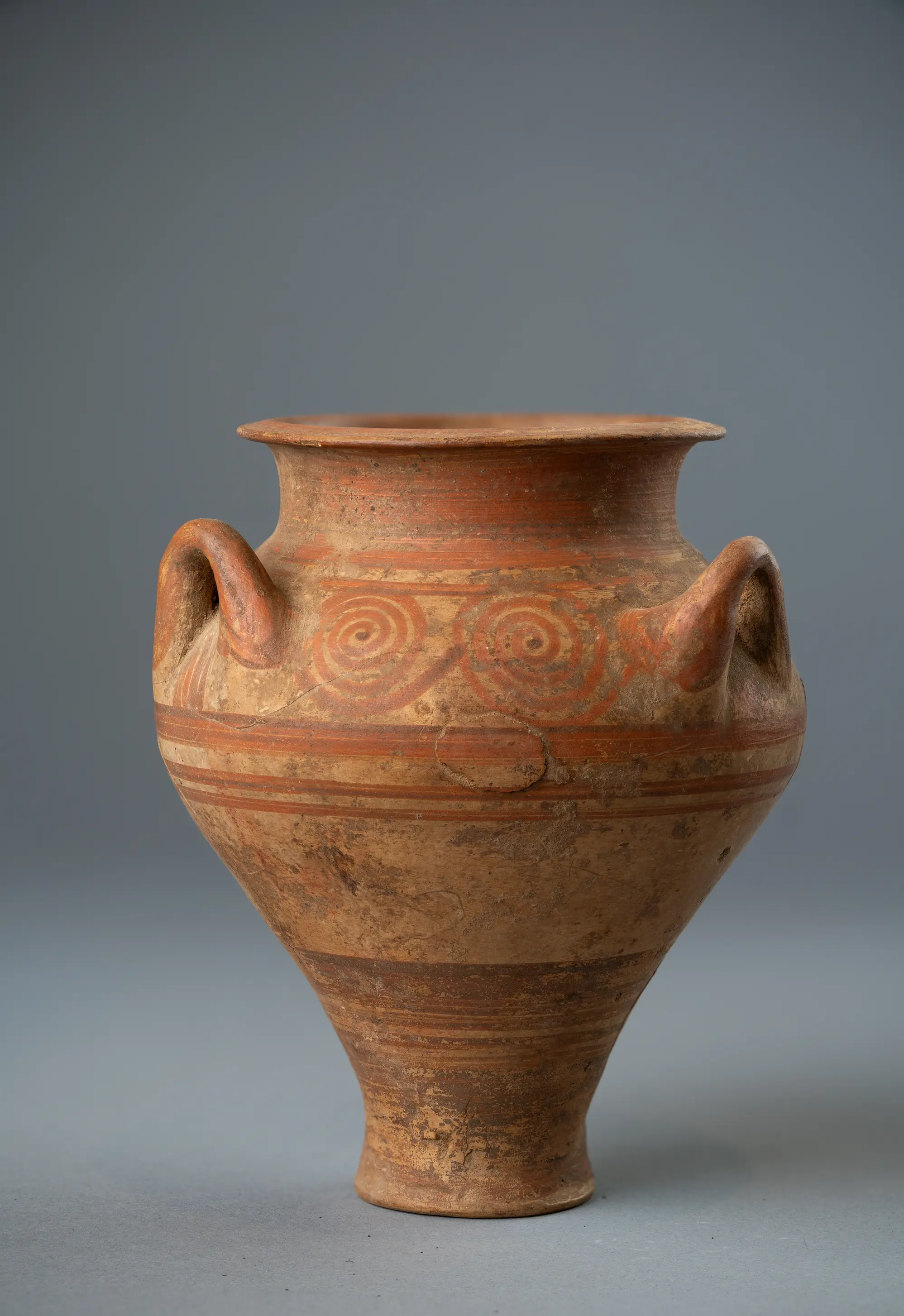
The Drakopoulos collection's three-handled jar in the Mycenaean style is one of these early Cypriot copies, made on the island in Late Cypriot IIA–IIB, about 1375 to 1300 BC. It has a conical-piriform body on a tall, splaying foot, three small handles set high on the shoulder, and a frieze of linked running spirals above bands, painted in matt orange-red to brown; imported Mycenaean jars of the shape carry a lustrous paint. Close parallels include a three-handled jar from Enkomi in the British Museum, and the Aegean shape they follow is represented by a pithoid jar of LH IIIA1–IIIA2 early in the Metropolitan Museum. The jar is a century or more older than most WPWm III. The article Cypriot Connections and Aegean Styles in the Late Bronze Age discusses it further.
Beyond the island, Gunnar Lehmann places WPWm III in the latest Late Bronze Age layer at Ugarit and, as "Mycenaean IIIC:1", among the vessels imported to Syria, Lebanon and Palestine, where it overlaps with locally produced "IIIC:1b"; he notes that in Cyprus "the earliest appearance of White-Painted Wheelmade III predates the assumed arrival of Mycenaean settlers" [9]. The overlap with the pottery of the Philistines and of the northern Levant is why the terminology matters outside Cyprus as well.
Pots and people
The WPWm III label was coined to separate description from interpretation, and the interpretation is still argued. Karageorghis's position, restated through the 1990s, associates the appearance of skyphoi in LC IIC:2 and their mass appearance in LC IIIA with Mycenaean settlers, supported by hearths, fortifications, weapons, handmade burnished ware, bathtubs and religious iconography [7, p. 288]. Sherratt's alternative ties the ware to urbanisation and administrative centralisation in LC IIC, the conditions under which industrial mass production of pottery might begin, much as palace control had produced the standardised LH IIIA and IIIB export wares of the Greek Mainland [8, p. 191]. Kling found the stylistic sources too many to fit a single migration: the Aegean links run to the Cyclades, the Dodecanese, east Attica and Crete, and the best-painted Cypriot pieces combine them "into unique Cypriote styles" [7, p. 282].
Georgiou's 2018 synthesis keeps both strands in view. A migration of Greek speakers in the twelfth century "can be corroborated by the shift in the island's language", but the island's material culture "resists a straightforward or linear association" between those arrivals and the change in pottery [4, p. 187]. On this reading WPWm III is a Cypriot industry that answered the loss of Mycenaean imports and the collapse of older markets, made by potters whose ethnicity the pots cannot reveal. For the wider argument see the Mycenaean entry and Maria Iacovou's case against a Cypriot Dark Age.
Successor ware and museum examples
Into Proto-White Painted
WPWm III ends in LC IIIB, when Maria Iacovou's Proto-White Painted replaces it. Her definition treats the successor as the resolution of the WPWm III problem: "The polymorphy of the painted pottery of LC IIIA that tortures us in search of a common term ... is put to rest once Proto-White Painted appears. Its appearance marks the coming together of all the earlier painted wares of LC IIIA", and it "could not have been suddenly imported to Cyprus by newcomers; it was the result of a local amalgamation" [10, p. 204]. Lehmann's table places the Wavy-Line or Granary Style and Proto-White Painted together in LC IIIB, contemporary with LH IIIC Late and Submycenaean in the Aegean [9]. Proto-White Painted in turn leads to the White Painted I of the Cypro-Geometric period, described in the White Painted ware entry.
Museum examples
The British Museum holds a Pastoral Style bell-krater fragment with two birds from Enkomi and, from Maroni, a WPWm III Pastoral Style bell-krater rim with the heads of two stags or goats, catalogued under Furumark type FS 281; on this site see also a complete Pastoral Style bell krater from Enkomi (see British Museum). The older names survive in museum catalogues: the Ashmolean Museum still lists a rim fragment from Denia-Kafkalla, presented by Hector Catling in 1953, as "Decorated Late Cypriot III ware". The label keeps the pre-1972 classification; the sherd belongs to the ware that Åström's term now covers.
WPWm III is also well published from Kourion. On the scholar behind the term, see Paul Åström and Cypriot archaeology; on potting generally, Pottery Production in Bronze Age Cyprus.
Objects on this page
- White Painted Spiral BowlLate Bronze Age III · 1250–1150 BC
 White Painted KraterLate Bronze Age I · 1650–1450 BC
 White Painted KraterLate Bronze Age II · 1400–1340 BC
 Terracotta kraterLate Bronze Age III · 1150–1100 BC
 White Painted CupLate Bronze Age III · 1340–1100 BC
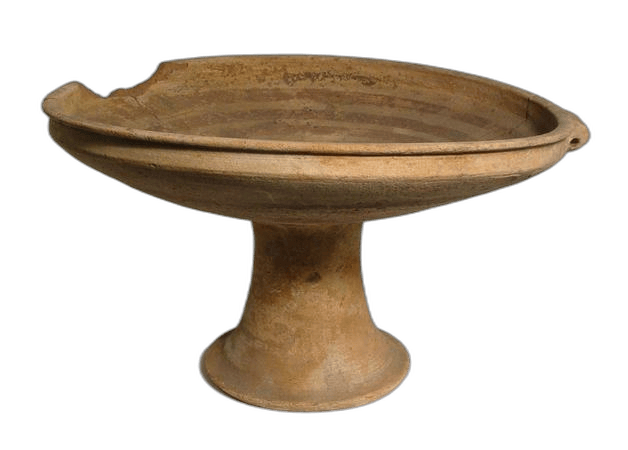 White Painted Pedestal BowlLate Bronze Age III · 1340–1050 BC
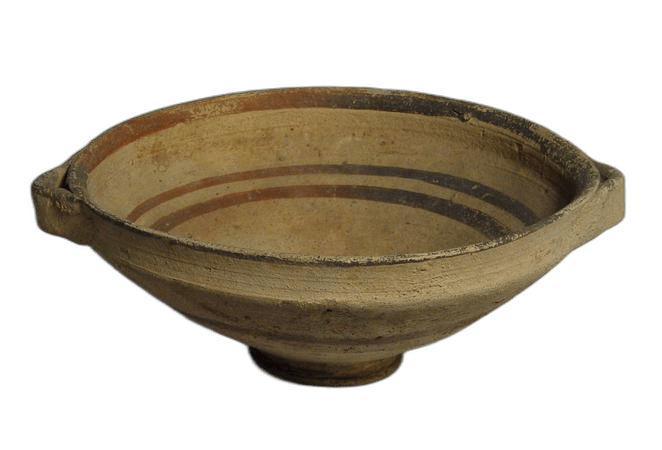 White Painted Conical BowlLate Bronze Age III · 1340–1050 BC
- White Painted Wheelmade BowlLate Bronze Age III · 1340–1050 BC
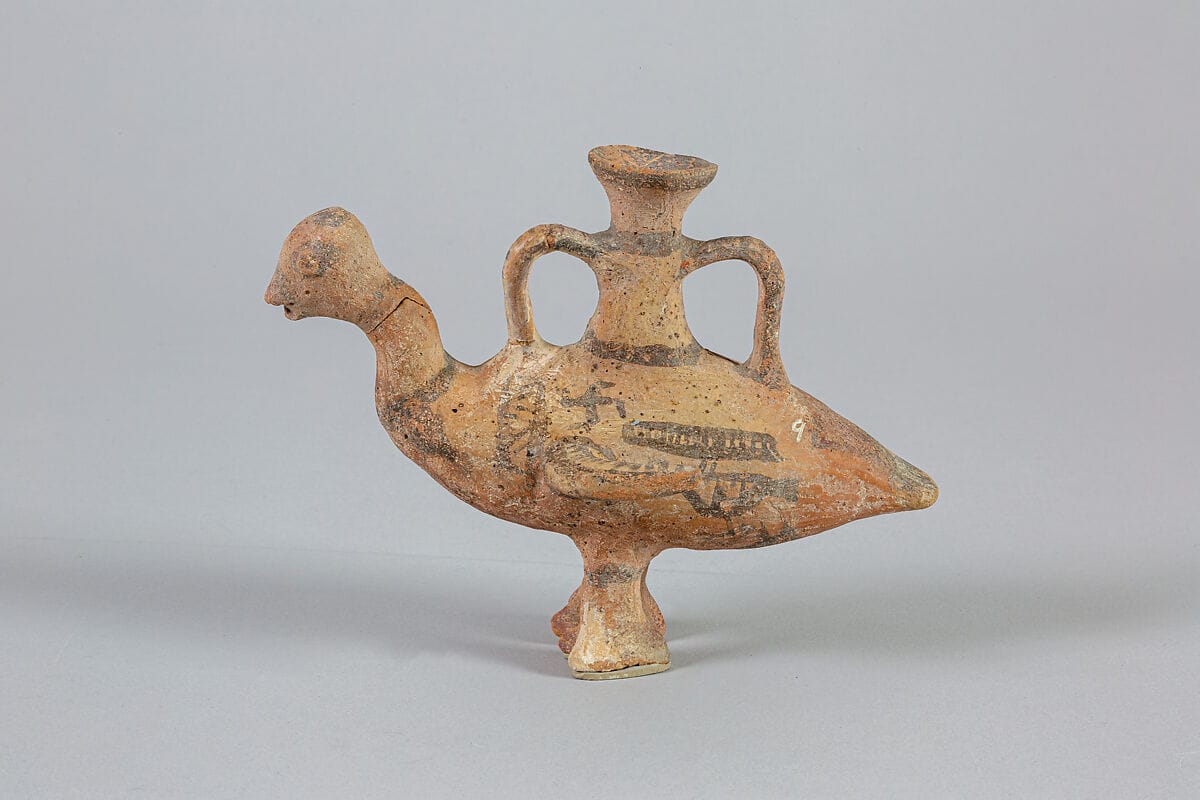
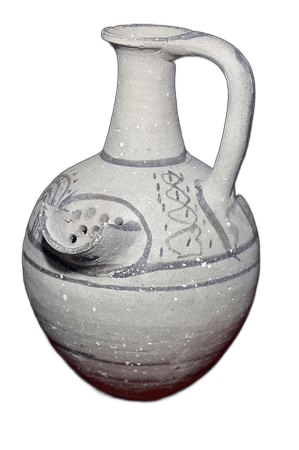 White Painted Strainer JugLate Bronze Age III · 1200–1100 BC
- White Painted Conical BowlLate Bronze Age III · 1250–1150 BC
- Cypriot Three-Handled Jar in the Mycenaean Style with Running SpiralsLate Bronze Age II · 1375–1300 BC
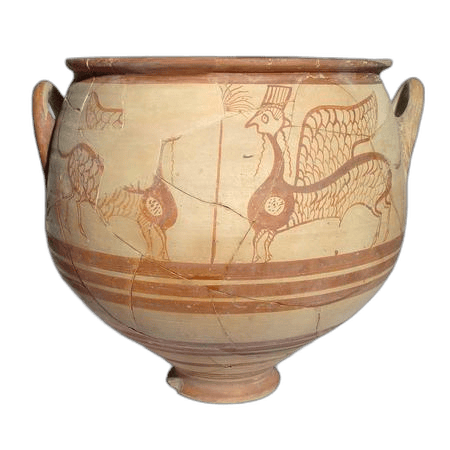 Pastoral Style Bell KraterLate Bronze Age II · 1250–1200 BC
In the catalogue
References
- 1.Georgiou, A. (2016). The "White Painted Wheelmade III" ware from the Evreti wells. In C. von Rüden, A. Georgiou, A. Jacobs, & P. Halstead, Feasting, craft and depositional practice in Late Bronze Age Palaepaphos: The well fillings of Evreti (Bochumer Forschungen zur Ur- und Frühgeschichtlichen Archäologie 8, pp. 79–182). Verlag Marie Leidorf.
- 2.Kling, B. (1991). A terminology for the matte-painted, wheelmade pottery of Late Cypriot IIC–IIIA. In J. A. Barlow, D. L. Bolger, & B. Kling (Eds.), Cypriot ceramics: Reading the prehistoric record (pp. 181–184). The University Museum, University of Pennsylvania.
- 3.Åström, P. (1972). Relative and absolute chronology, foreign relations, historical conclusions. In L. Åström & P. Åström, The Swedish Cyprus Expedition, Vol. IV, Part 1D: The Late Cypriote Bronze Age. Other arts and crafts; Relative and absolute chronology, foreign relations, historical conclusions. The Swedish Cyprus Expedition.
- 4.Georgiou, A. (2018). From the hand to the wheel: Revisiting the transformations of the Late Cypriot ceramic industry of finewares during the 13th-to-12th c. BC transition. In I. Caloi & C. Langohr (Eds.), Technology in crisis: Technological changes in ceramic production during periods of trouble (pp. 177–200). Presses universitaires de Louvain.
- 5.Crewe, L. (2007). Early Enkomi: Regionalism, trade and society at the beginning of the Late Bronze Age on Cyprus (BAR International Series 1706). Archaeopress.
- 6.Georgiou, G. (2015). A pictorial flask from central Cyprus: Evidence for new internal networks at the Middle/Late Bronze Age transition. Levant, 47(2), 206–220. https://doi.org/10.1179/0075891415Z.00000000065
- 7.Kling, B. (2000). Mycenaean IIIC:1b and related pottery in Cyprus: Comments on the current state of research. In E. D. Oren (Ed.), The Sea Peoples and their world: A reassessment (pp. 281–295). University of Pennsylvania Museum of Archaeology and Anthropology. http://www.jstor.org/stable/j.ctt4cghc9.22
- 8.Sherratt, E. S. (1991). Cypriot pottery of Aegean type in LC II–III: Problems of classification, chronology and interpretation. In J. A. Barlow, D. L. Bolger, & B. Kling (Eds.), Cypriot ceramics: Reading the prehistoric record (pp. 185–198). The University Museum, University of Pennsylvania.
- 9.Lehmann, G. (2013). Aegean-style pottery in Syria and Lebanon during Iron Age I. In A. E. Killebrew & G. Lehmann (Eds.), The Philistines and other "Sea Peoples" in text and archaeology (Archaeology and Biblical Studies 15). Society of Biblical Literature.
- 10.Iacovou, M. (1991). Proto-White Painted pottery: A classification of the ware. In J. A. Barlow, D. L. Bolger, & B. Kling (Eds.), Cypriot ceramics: Reading the prehistoric record (pp. 199–205). The University Museum, University of Pennsylvania.