
Contents
Iron Age White Painted is the commonest painted pottery of Cyprus between the end of the Bronze Age and the end of the city-kingdoms. It is wheel-made, of pale buff, brown or greenish clay, and painted in a single matt dark colour, black or brown, on a light slip. Einar Gjerstad of the Swedish Cyprus Expedition divided it in 1948 into seven stages, White Painted I to VII, which run from the Cypro-Geometric through the Cypro-Archaic to the Cypro-Classical period, c. 1050 to 310 BCE [1]. The name is shared with a quite different pottery: the handmade White Painted ware of the Middle Bronze Age, which has its own numerals I to VI. This entry covers the Iron Age ware only. Its sister, Bichrome, is the same pottery with red added, and the two are best understood together.
Definition and identification
Gjerstad's definition of the first stage still serves for the whole series. White Painted I is "wheel-made; the clay is buff or brown, sometimes greenish in colour; well silted, with a buff or somewhat greenish slip, smooth and not infrequently polished; on this slip the ornaments are painted in a black or brown mat colour" [1]. The later stages vary the recipe without changing its logic. In White Painted III the clay is rougher and, in larger pots, gritty, and the slip is either white, smooth and thick or buff with a rougher surface, under paint that is "mat, but deeply black" [1]. White Painted IV often has a more buff slip, sometimes red-brown or light brown, and its ornaments are sometimes purple; in White Painted V the clay is often brown or greenish, rough and gritty, and the slip greenish or brown [1]. By White Painted VII the slip is often brown or reddish brown and is sometimes left off altogether, so that the paint sits directly on the smoothed clay [1].
The wheel is the first test. Every fine ware of the Cypriot Iron Age was thrown; only large storage jars and some cooking pots stayed handmade [2, p. 4]. The paint is the second. Maria Iacovou separated White Painted I from its predecessor, Proto-White Painted, largely by colour: the new ware has "a uniform dull, matte black washy decoration" [3, p. 200], where Proto-White Painted paint fired unevenly from orange to brown. The conventional date for the change, 1050 BCE, goes back to John Myres, and Iacovou calls it "a conventional but unshakable absolute date" [3, p. 199]. The shapes changed more slowly than the paint, so that in transitional tomb groups the two wares share most of their forms and the paint is the surest guide.
Gjerstad's Types and what the numerals mean
The numerals come from volume IV:2 of the Swedish Cyprus Expedition. Gjerstad sorted the Iron Age tomb groups into seven successive horizons, Types I to VII, and numbered every ware by the horizon it belonged to. The numeral is therefore a period before it is a style: White Painted I, Bichrome I, Black Slip I and Plain White I are all Type I, and Type I is Cypro-Geometric I [1; 2, p. 3]. A ware that began later carries its own stage with the horizon in brackets, so that Black-on-Red I (III) is the first stage of Black-on-Red, made in Type III times [2, p. 3]. White Painted and Bichrome, present from the start, need no brackets.
| Stage | Period | Date (modern convention) | Main features |
|---|---|---|---|
| White Painted I | Cypro-Geometric I | c. 1050 to 950 BCE | Rectilinear zones and panels; plates appear |
| White Painted II | Cypro-Geometric II | c. 950 to 900 BCE | Same repertoire, heavier shapes, mechanical ornament |
| White Painted III | Cypro-Geometric III | c. 900 to 750 BCE | Compass-drawn circles, swastikas, first free-field jugs |
| White Painted IV | Cypro-Archaic I | c. 750 to 600 BCE | Mainly the Western circle style; fewer shapes than Bichrome IV |
| White Painted V | Cypro-Archaic II | c. 600 to 480 BCE | Biconical shapes; poorer ornament; Bichrome V far commoner |
| White Painted VI | Cypro-Classical I | c. 480 to 400 BCE | Circles gone; bands, single wavy lines, strokes |
| White Painted VII | Cypro-Classical II | c. 400 to 310 BCE | Metal-imitating jugs; Attic leaves and palmettes |
The dates in the table are not Gjerstad's. He fixed his years by the first appearance of each Type in datable contexts abroad, and arrived at Cypro-Geometric I 1050 to 950, II 950 to 850 and III 850 to 700 BCE [4, p. 225]. J. N. Coldstream argued that a century-long Cypro-Geometric II could not be sustained [5], and his cross-dating with Greek Geometric pottery moved the start of the Cypro-Archaic from 700 to about 750 BCE [6]. The figures most specialists now use for the Cypro-Geometric are those of Anna Georgiadou: CG I c. 1050 to 950, CG II c. 950 to 900, CG III c. 900 to 750 [2, p. 3]. Gjerstad closed the series at 325 BCE; most scholars now end it around 310, when Ptolemy abolished the kingdoms.
Gjerstad himself knew that the boundaries were soft. He split each Type into an earlier A and a later B and, as Joanna Smith notes, "recognized that there was significant overlap among Types even as he equated them with specific date ranges"; she adds that since he separated Type I from Type II mainly by quality of workmanship, "Types I and II are one rather than two Types" [4, p. 225]. A label such as "White Painted III" is best read as a family of fabric and style with a usual date and a margin on either side.
Shapes, stage by stage
White Painted I has the largest catalogue of any stage. Gjerstad lists dishes with a wide flat base and, as a rule, two handles, "plain or knobbed"; shallow, medium and deep bowls, some on a low foot and one rare type with a miniature bowl perched on a handle; strainers, goblets and cups; four kinds of jar; and a long list of jugs, among them lenticular jugs, barrel-shaped jugs with central knobs, jugs with a pinched (trefoil) rim and spout-jugs with a basket handle [1]. Flasks, bottles, a rare horn-shaped vase and several families of amphora complete the set [1].
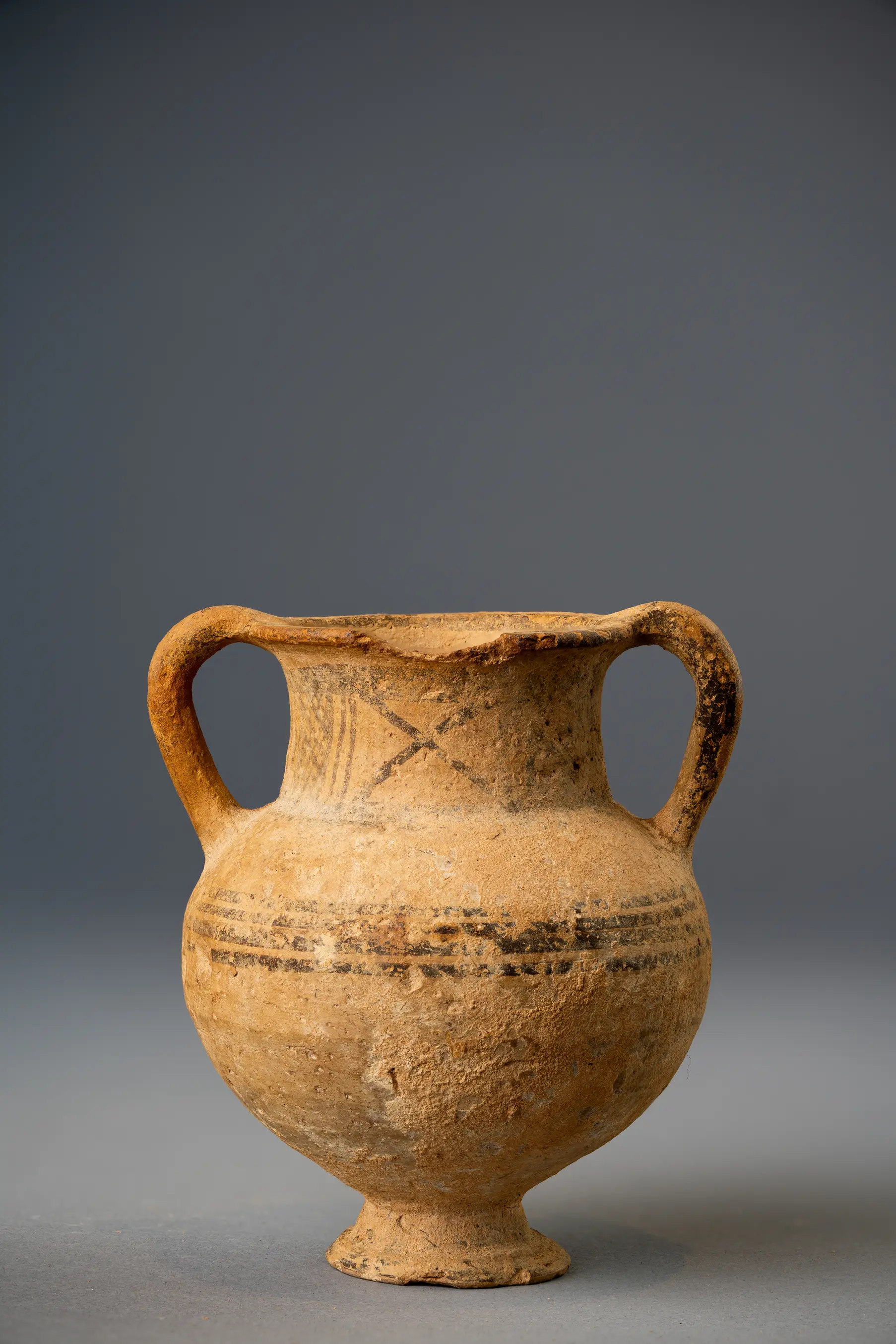
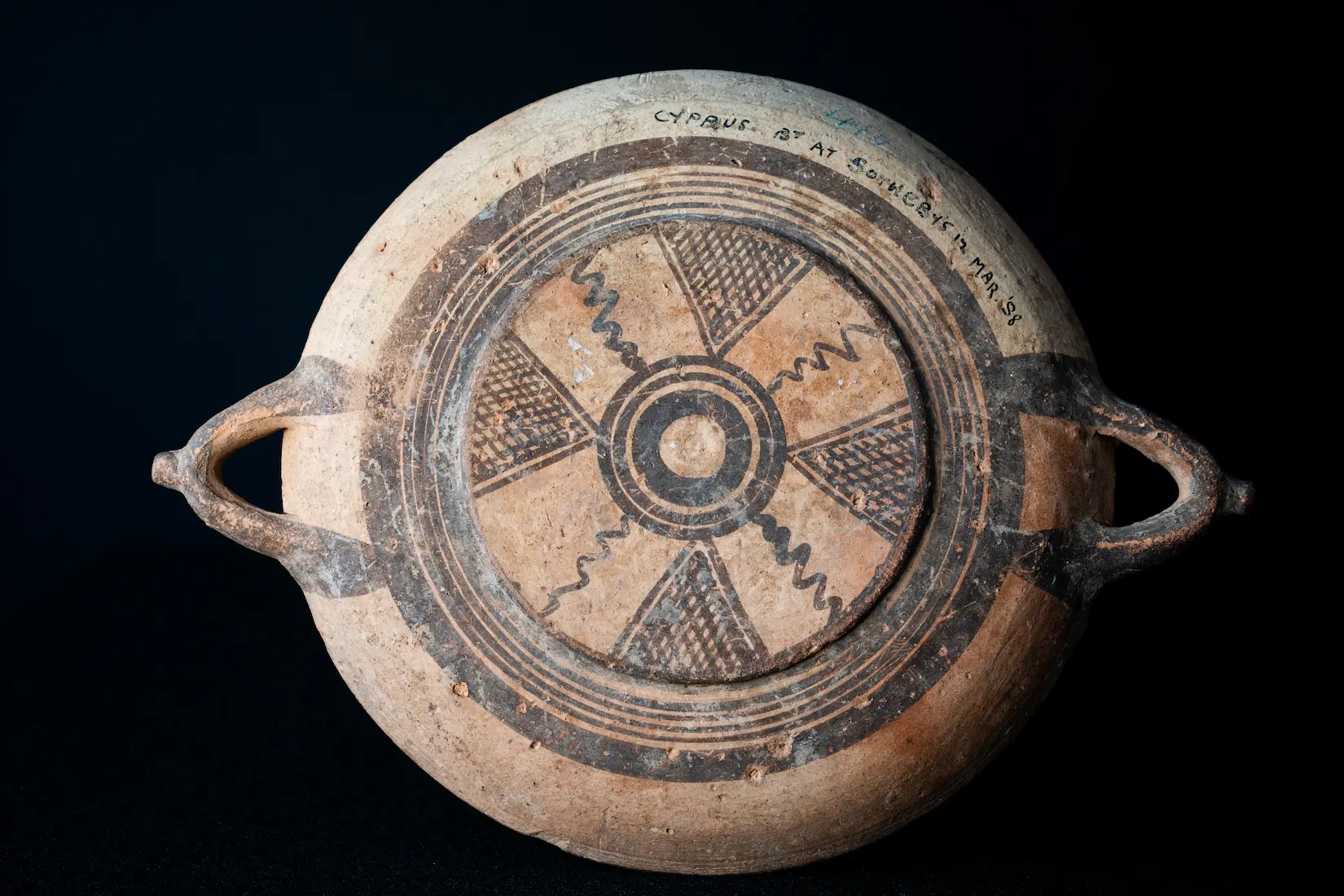
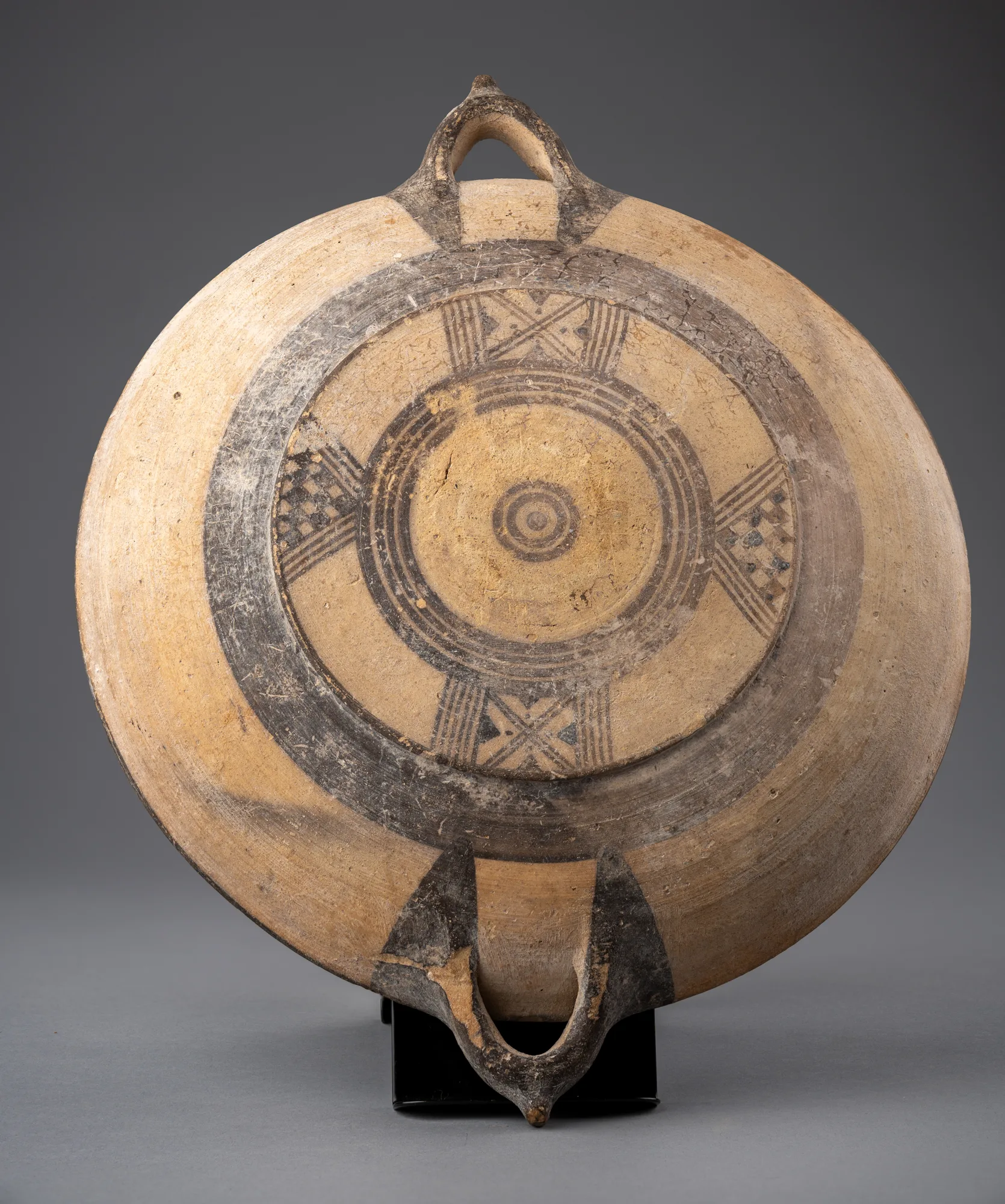
Two shapes show the ware's beginnings. The small footed amphora or amphoriskos descends directly from Proto-White Painted. A White Painted amphoriskos on a conical foot in the Drakopoulos collection, its neck painted with a quick saltire beside a group of strokes, matches a series of twelve from one Cypro-Geometric I tomb at Palaepaphos-Skales [7]. The flat plate, by contrast, is new. Iacovou showed that it does not occur in Proto-White Painted; it is "a shape of local inspiration that appeared first in the White Painted, Bichrome and even Black Slip Painted wares of advanced Cypro-Geometric I groups," and "its circulation is indeed limited to the Cypro-Geometric period" [3, p. 202]. Its main decoration is on the underside: on a large plate with knobbed handles in the Drakopoulos collection, 40 cm across with its handles, four arms of parallel lines cross the base round a small target of circles, while the interior has little more than a painted rim and one band. The placing of the ornament led the excavators of recent tombs at Palaepaphos-Skales to suggest that such plates were displayed when not in use [8], a hypothesis the pottery alone cannot settle.
White Painted II changes little in its repertoire. White Painted III tightens it: its shapes are "markedly restrained and elegant compared with those of Type II," and "the loose and clumsy forms of Type II are no longer found" [1]; the barrel jug becomes more elongated, the funnel mouths of jugs and juglets widen, jug bodies slim, and the pear-shaped jug and the spout-jug with its handle opposite the spout are new [1]. The plates of Type III are very flat. A juglet with a ridge round the neck, Gjerstad noted, was "influenced from the Black-on-Red I (III) ware" [1], the newly arrived red-slipped fabric.
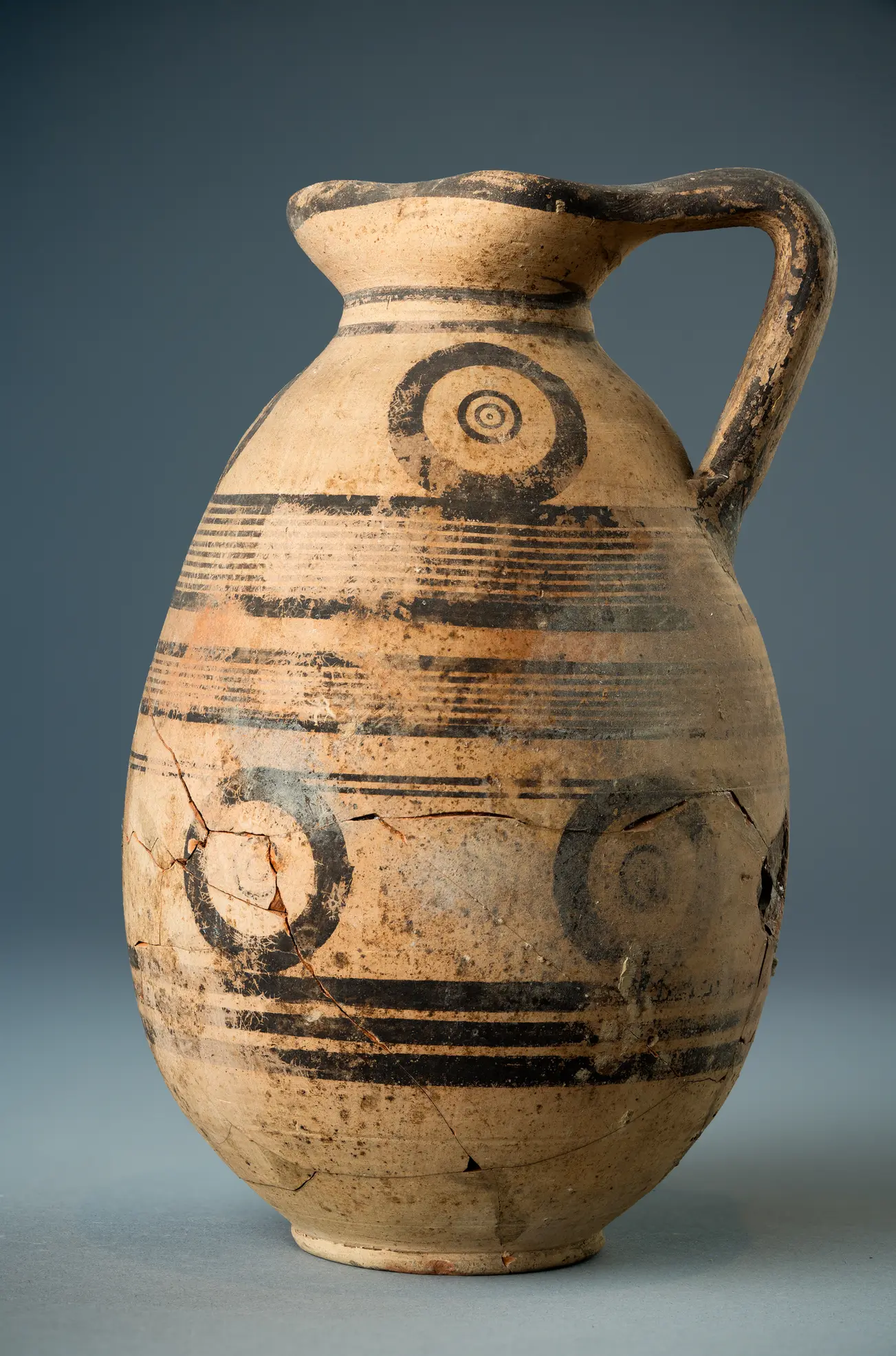
In the Cypro-Archaic the repertoire follows Bichrome. The shapes of White Painted IV are "mainly similar to those of Bichrome IV, but the varieties are much fewer": bowls, goblets, cups, jars, jugs, amphorae, hydriae and bird-shaped vases [1]. The ovoid jug with a pinched mouth and ring base is the standard pourer, the oinochoe of museum labels; the White Painted IV ovoid trefoil jug shown above is one of Gjerstad's Type IV oval jugs. Some shapes are new, such as the pear-shaped juglet with a straight neck, and some imitate metal: a jug on a low foot with a ridged neck "clearly imitates a metal prototype," and a hydria has a human face modelled on its neck [1]. The sack-shaped jug with a pinched rim, low-slung and slack, belongs to White Painted IV and V; a small banded example in the Drakopoulos collection has lost its handle. White Painted V shares the shapes of Bichrome V with a narrower range: the barrel jug takes the bobbin-shaped body of Bichrome V, and the juglets and pinched-rim jugs tend towards a biconical profile [1].
In the Cypro-Classical stages the sharp Type V jugs soften into rounded ones. White Painted VII jugs copy metal vessels, with clay discs at the handle root imitating rivets, angular moulded bases and a ridge at the foot of the neck; there is a new ovoid bottle, and some amphorae copy Athenian shapes [1]. The woman-and-pitcher jug in the British Museum, a White Painted VII jug from Marion with a small modelled woman on its shoulder whose pitcher is the spout, belongs to a type William Childs traces at Marion from the late 6th to the 4th century BCE [9].
Decoration: from rectilinear panels to circle systems
White Painted I ornament is rectilinear and drawn freehand: wavy lines, zigzags, latticed triangles and lozenges, the Maltese cross, set in horizontal zones, in framed panels, or confined to rim, neck and base on an otherwise plain body [1]. A White Painted I amphora given to the British Museum by Thomas Sandwith in 1869, 39.5 cm high, has hatched triangles on the shoulder and big wavy lines round the body. On plates the scheme radiates from the centre of the underside. A plate with latticed triangles and wavy lines in the Drakopoulos collection has four framed, cross-hatched triangles meeting at a ring of circles, the scheme of a White Painted I plate 34.5 cm across from Lapithos Tomb 408, described as having "four lattice triangles meeting in a circle on base" [10]. Gjerstad thought White Painted II a falling-off: "the fresh ornamental spirit and rhythmic sense of White Painted I has disappeared" [1].
White Painted III changes the vocabulary. Gjerstad lists the new elements: "concentric circles; fringed concentric circles; concentric, pendent arcs; vertical row of chevrons; the tree-ornament; the 'eye'-ornament," with winged and chequered lozenges, leaf-rosettes and the first lotus flowers [1]. The swastika, already known, "is now common" [1]. The concentric circles were drawn mechanically, with a multiple brush on a pivot [11], and in Type III they are "never connected" [1]. Dense, linked circle systems therefore point to Type III at the earliest. On the later Type III plates the central ornament grows heavier; a White Painted plate with a sawtooth star in the Drakopoulos collection rings its central circles with outward-pointing solid triangles.
Small jugs show the other side of the change. White Painted III introduced what Gjerstad called the free-field style, "a decorated variety of the plain-bodied style of White Painted I and II: on the free surface of the vase a single ornament is applied," above all on jugs with a pinched rim [1]. He also notes the eye-ornament at the rim [1]. Three Drakopoulos jugs carry the formula in its simplest form. A trefoil jug with painted eyes and swastikas scatters a handful of swastikas over a bare shoulder; a jug with painted eyes, a chevron arrow and a swastika and a juglet with a dotted arrow use the motif that Georgiadou and Maria Dikomitou-Eliadou describe as "a vertical chain of chevrons forming an arrow motif" [12, p. 344].
The Western circle style and the Eastern lotus style
Late in White Painted III, Gjerstad observed, "the uniform decoration hitherto characteristic of the Cypriote Iron Age pottery begins to split up in two different groups; the rectilinear group and the circle group," different in their elements but composed in the same zone, panel and free-field schemes [1]. The two groups are fully developed in Bichrome IV, and Gjerstad gave them a geography. The circle style, which he called the Western style, belongs to the west and north of the island, the country of Marion and Lapithos; the Eastern style, of the east and south, replaced circles with rectilinear panels and with "lotus buds and flowers, rosettes, sacred tree, aquatic birds, quadrupeds, and human figures" [1].
White Painted sits mostly on one side of that line. "Mainly the circle group is represented in White Painted IV," Gjerstad wrote, "the reason of this is that the bichrome treatment is more common in the rectilinear group than in the circle group" [1]. His description of the Western style fits the Drakopoulos jug at the head of this entry closely: "the outer line of the concentric circles is sometimes thicker than the others, and the circles are often connected in vertical or horizontal rows" [1]. On that jug a single circle with a heavy black outer ring sits on the shoulder and a horizontal row of them runs round a lower frieze. A White Painted juglet with funnel mouth and side circles reduces the scheme to one large circle system on the side, centred near the handle in the manner of the barrel jug.
The division was never absolute. Andres Reyes confirmed it in broad terms but recorded circle-style pottery as far east as Aradippou [13], and the British Museum's White Painted V oinochoe from Amathus, on the south coast, has large vertical circles crossed at the shoulder by a horizontal band, with eyes on the mouth and arrowheads below it (site record). The lotus style, meanwhile, is overwhelmingly Bichrome. Georgiadou and Dikomitou-Eliadou, working on about 1,100 vessels from Salamis and its hinterland, argue that the pictorial style "was conceived and developed in the workshops of Salamis and prevailed in the eastern part of the island during the CA period," with Amathus the only other centre where a pictorial style developed [12, pp. 337, 341]. The lotus friezes of the great eastern amphorae belong to that Bichrome tradition.
Regional workshops and export
Gjerstad's system treats Cyprus as a single site [4, p. 225]. Georgiadou's study of the Cypro-Geometric pottery has since identified separate productions at Paphos, Kourion, Amathus, Kition, Lapithos, Salamis and Kythrea, each with its preferred wares, shapes and motifs [2, p. 4]. The workshops of Salamis preferred the Bichrome technique from the start of the Iron Age, and their painters used red more freely than anyone else, to outline designs as well as to fill them [12, p. 338]. A White Painted stage reached at one centre need not have been reached at another in the same decade, and a pot without a findspot can rarely be given to a workshop.
White Painted also travelled. Hélène Sader, surveying Phoenician sites, notes that the oldest Cypriot pottery found there is wheel-made White Painted I of c. 1050 to 850 BCE, and that White Painted I, III and IV and Bichrome I, III and IV are attested mainly at Sarepta, Tyre and Khaldeh; in Iron Age I most Cypriot pottery in the region comes from Dor and Tyre [14]. The traffic ran both ways: Iacovou traces the Bichrome technique itself to the imported Phoenician neck-ridged jug and its local imitations [3, p. 202], and the barrel jug began as a Levantine import before Cypriot potters gave it a horizontal body with a knob at each end [2, p. 5]. Its later history is told in early Iron Age trade networks.
White Painted, Bichrome and the free-field style
Bichrome I needed only one line in Gjerstad's typology: "wheel-made; clay and slip are the same as those of White Painted I; the ornaments are painted in black and supplementary red colour" [1]. Iacovou, following Vassos Karageorghis, describes the Iron Age rule: the red is "secondary to the black with which it is not meant to overlap," used "sparingly to fill solid areas which have been carefully delineated and often outlined in black" [3, p. 202]. White Painted and Bichrome are therefore one fabric with two palettes, made in the same shapes.
Their fortunes diverged. In Cypro-Geometric I and II, White Painted and Bichrome are "the only decorated pottery" on the island [1]. "White Painted is commonest in Cypro-Geometric I, and decreases gradually in number until Cypro-Archaic II B when it reaches a minimum," while Bichrome "is rare in Cypro-Geometric I, but then increases gradually in quantity, so that it becomes more numerous than White Painted in the Cypro-Archaic period" [1]. By Type V, "the vases of Bichrome V are in an overwhelming majority in relation to those of White Painted V," and Gjerstad judged that White Painted V "has a rather poor decoration" beside its two-colour sister [1].
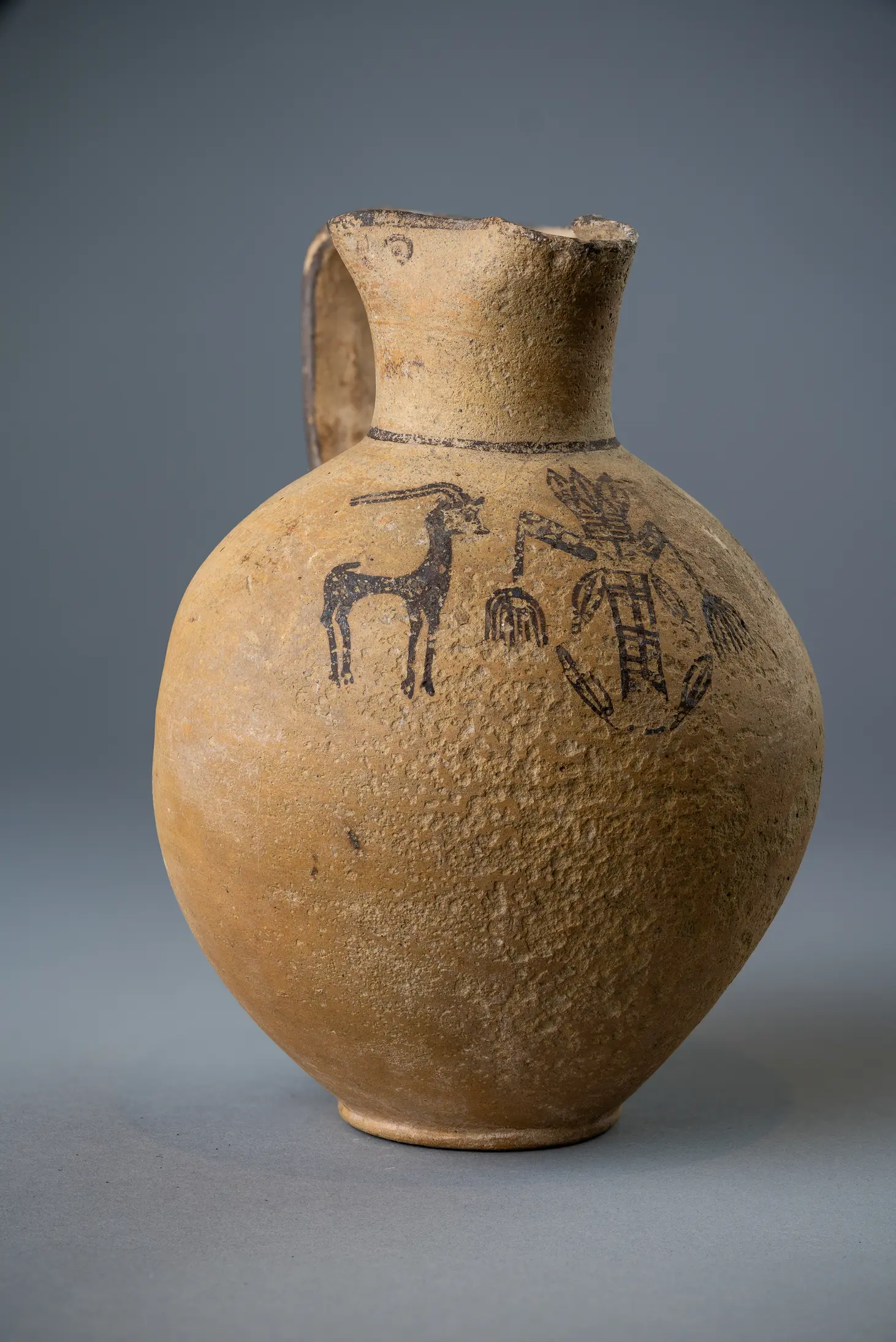
The free-field style shows the relationship plainly. It began in White Painted III as a geometric layout, a single ornament on the bare body of a pinched-mouth jug. By Bichrome IV, Gjerstad wrote, "the free-field style is generally employed on the jugs with pinched mouth, both for geometrical and pictorial designs" [1], and the birds, fish and bulls that made the style famous are mostly Bichrome. White Painted IV free-field jugs are fewer but well attested; the Cesnola collection in New York includes one with a ship and one with a spearman in silhouette [15, nos. 150 and 154]. The White Painted IV trefoil jug with a wild goat in the Drakopoulos collection sets a goat in black silhouette beside a stylised tree on the bare shoulder opposite the handle, with no colour but black. A trefoil jug with painted eyes and dotted crosses shows the geometric version of the same layout in White Painted IV or V: two eyes on the mouth, one neck band and three small signs on the shoulder. The anthropomorphic reading of such jugs is discussed in free-field anthropomorphic forms.
Decline into Plain White
The painted tradition thinned out over two centuries. Gjerstad counted the pottery in the tombs he classified: decorated wares made up 80.6 per cent of all vases in Cypro-Archaic I, 24.2 per cent in the first half of Cypro-Classical I and 9.1 per cent at the end of the period, while Plain White, the undecorated wheel-made ware of the same clay, rose from 43.7 to 73.1 per cent [1, pp. 202–206]. By the end of the Cypro-Classical period Plain White "occupies the same dominating position as was held by White Painted in Cypro-Geometric I" [1]. These are tomb counts, as Gjerstad warned, and plain household pottery always outnumbered painted ware in settlements [1, pp. 202–206]. White Painted itself, after reaching its minimum in Cypro-Archaic II B, held a small and steady share through the Cypro-Classical period, while Bichrome "suddenly falls off to a trifle" [1].
The style changed with the numbers. White Painted VI, Gjerstad wrote, "forms a very poor style. It marks the end of the artistically painted pottery of Cyprus and the beginning of the decadence"; its ornaments are mainly encircling lines and bands, single wavy lines and short strokes, and "the characteristic circle ornaments of the former ware have entirely disappeared," with only the earliest pieces keeping conventional lotus flowers [1]. A White Painted VI oinochoe from Amathus in the British Museum shows the whole programme: bands round neck and belly and a single plant hanging below the neck. White Painted VII adds a panel of crossed lines and, from Athenian red-figure, leaves, palmettes, ivy sprays and vine scrolls [1]. Gjerstad's Types end at VII, and the Hellenistic pottery that followed needed a new system.
How to tell it apart
From handmade White Painted. The Middle Bronze Age ware, classified by Paul Åström, is handmade, often with linear patterns over the whole surface, and it reuses the same numerals about a thousand years earlier. The British Museum has a handmade White Painted IV jug from Klavdia, dated 1850 to 1650 BCE, and a handmade White Painted V amphora from Enkomi, Middle Cypriot III to Late Cypriot I: names identical to Iron Age stages on pots a thousand years older and made by hand. Throwing ridges, a body round in plan and a ring or disc base point to the Iron Age ware; a label that gives a numeral without "wheel-made" or a period should be read with care.
From Proto-White Painted and the Late Bronze Age wheel-made classes. White Painted Wheel-made III and Proto-White Painted are also thrown and pale, but Proto-White Painted paint fires patchy orange to brown, where White Painted I paint is a uniform dull black [3, p. 200]. Plates, barrel jugs and the Cypro-Geometric amphora types are Iron Age markers; kylikes and stirrup jars belong to the Bronze Age side of the line (see the transition from Bronze Age to Iron Age pottery). Old descriptions sometimes call Cypro-Geometric plates "White Slip"; White Slip is a handmade Late Bronze Age ware, and these plates are wheel-made White Painted.
From Bichrome with lost red. This is the hardest case, because the two wares share fabric, shapes and black ornament. Red was the fragile colour: John Myres noted that it "always adhered less strongly than the black to the clay surface" [16, p. 42]. A brownish, purplish or warm patch inside a black-outlined area may be worn red, or it may be burial staining. Raking light and a close look at the areas Bichrome painters normally filled (bands between black lines, the centres of circle systems, outlined solids) usually decide it; where they do not, careful catalogues write "White Painted, possibly Bichrome". Two Drakopoulos pieces carry that caution, the funnel-mouthed juglet, with a warmer tone inside its circle, and the White Painted IV circle jug, with a pinkish tone between some of its lines. The choice does not move the date. White Painted IV and Bichrome IV are both Type IV, and both mean Cypro-Archaic I.
From the stages of White Painted itself. Rectilinear ornament alone fits Types I and II; compass circles, fringed circles and frequent swastikas mean Type III or later; connected circle systems and rows point to Type IV; biconical bodies to Type V; bands and strokes with no circles to Type VI; metal-imitating jugs and Attic plant ornament to Type VII. Each of these is a tendency, and the Ancient Cypriot pottery course works through the method step by step.
Objects on this page
- White Painted Amphoriskos on a Conical FootGeometric I · 1050–850 BC
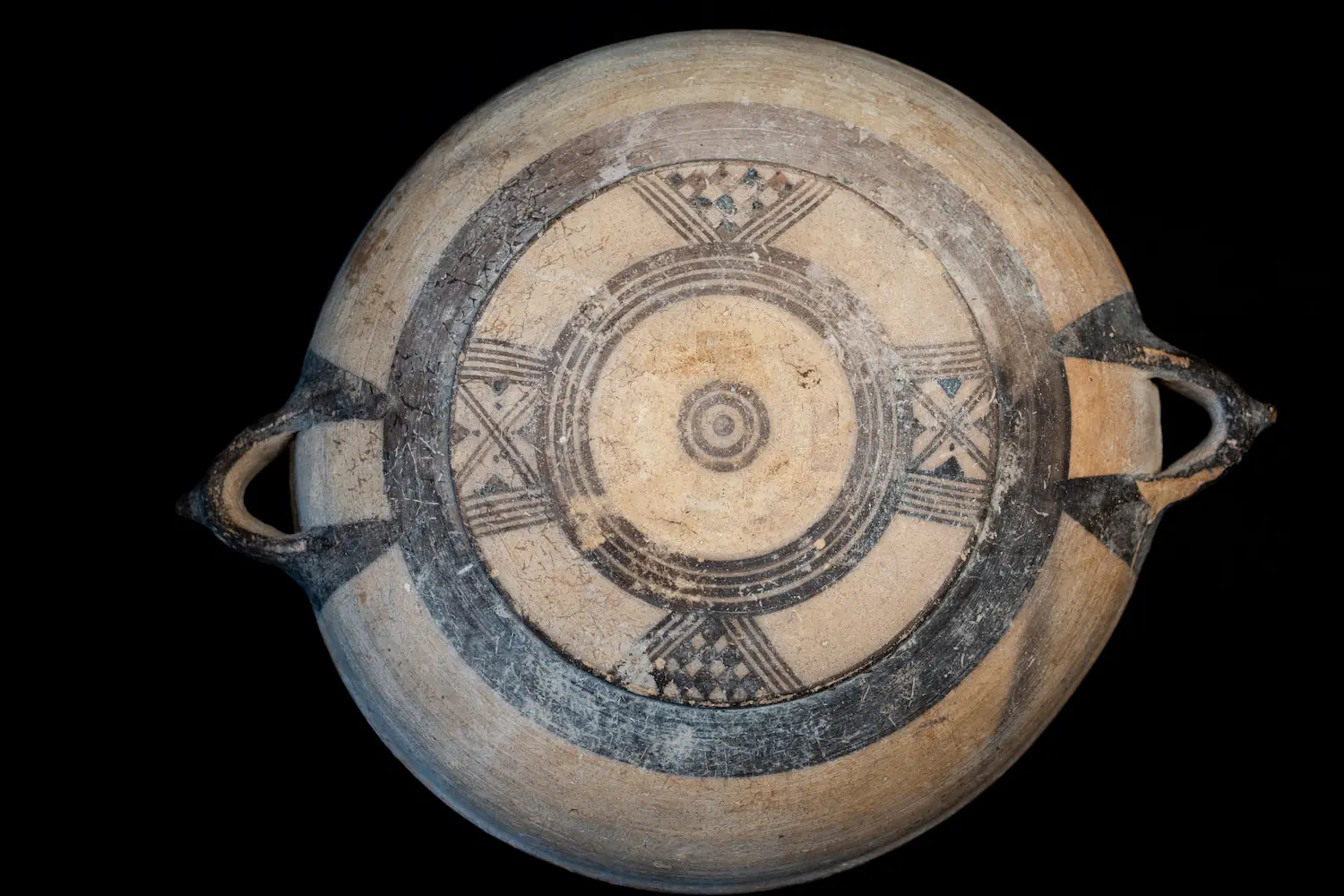 Large White Painted Plate with Knobbed Handles and a Four-Armed Cross on the UndersideGeometric I · 1050–850 BC
- White Painted IV Ovoid Trefoil Jug with Concentric CirclesArchaic I · 750–600 BC
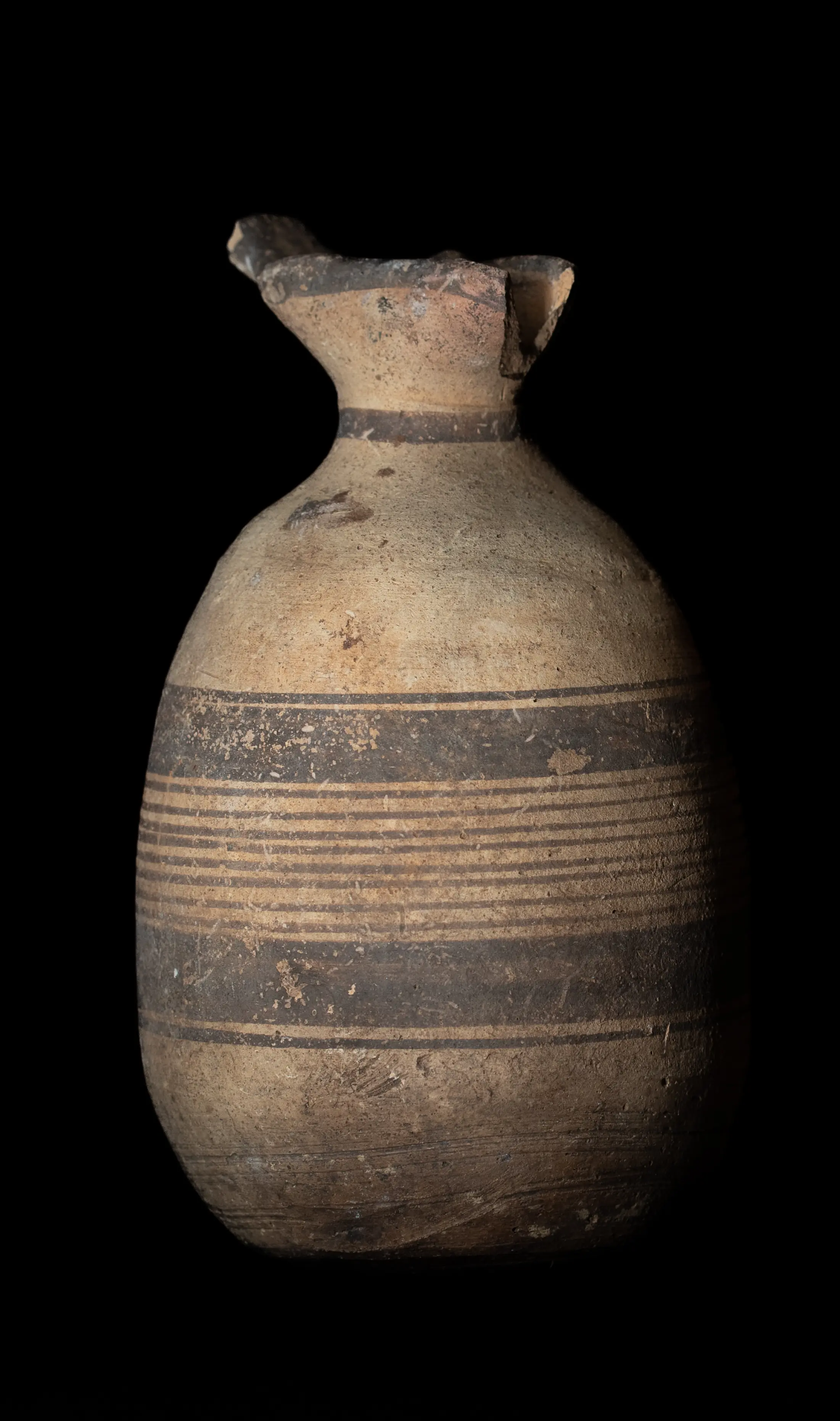 White Painted Sack-Shaped Jug with Banded BodyArchaic · 750–480 BC
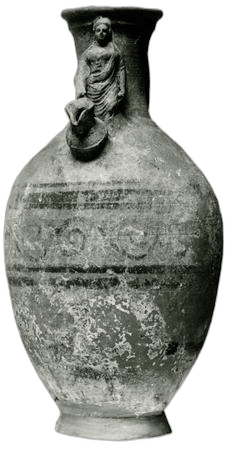 White Painted Woman-and-Pitcher JugClassical · 400–300 BC
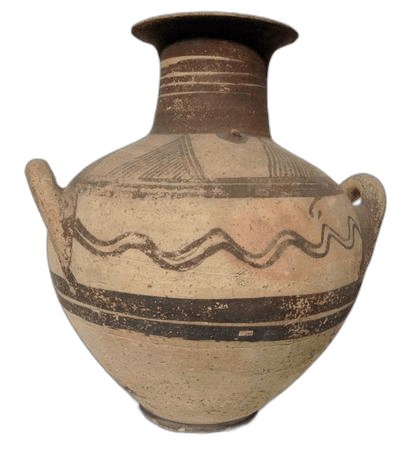 White Painted AmphoraGeometric I · 1050–900 BC
- White Painted Plate with Latticed Triangles and Wavy Lines on the UndersideGeometric I · 1050–850 BC
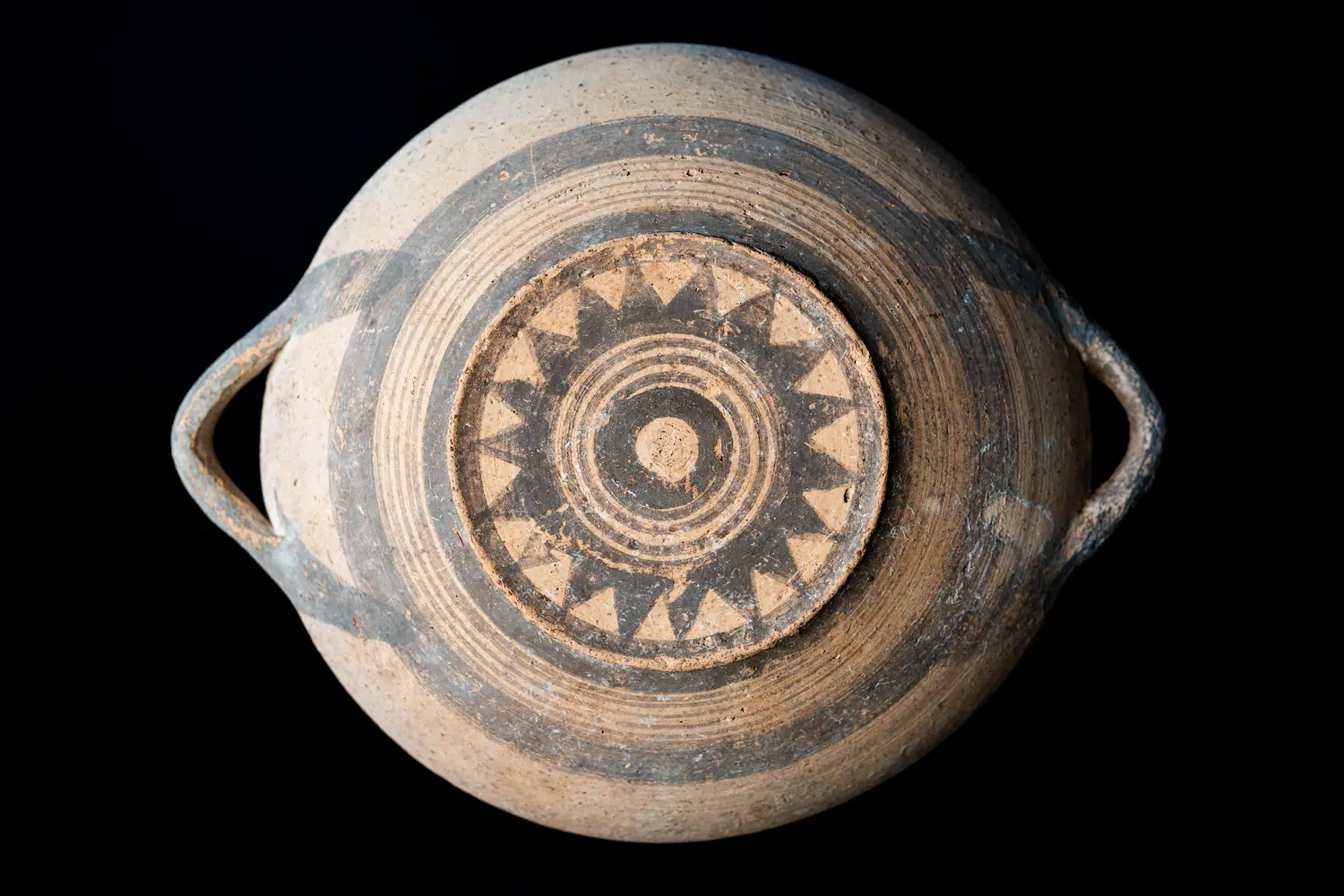 White Painted Plate with a Sawtooth Star on the UndersideGeometric II · 950–750 BC
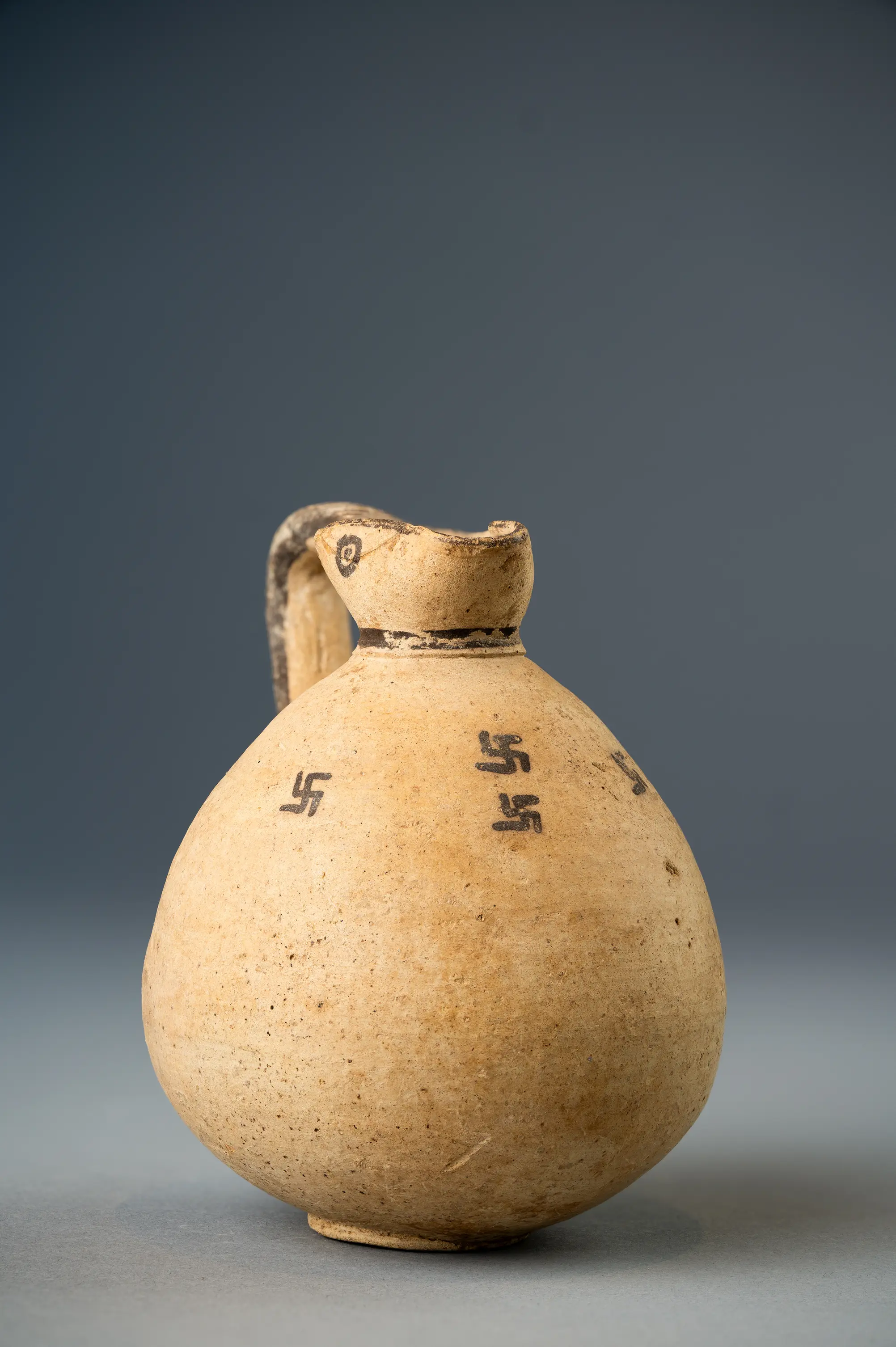 White Painted Trefoil Jug with Painted Eyes and SwastikasGeometric III · 850–600 BC
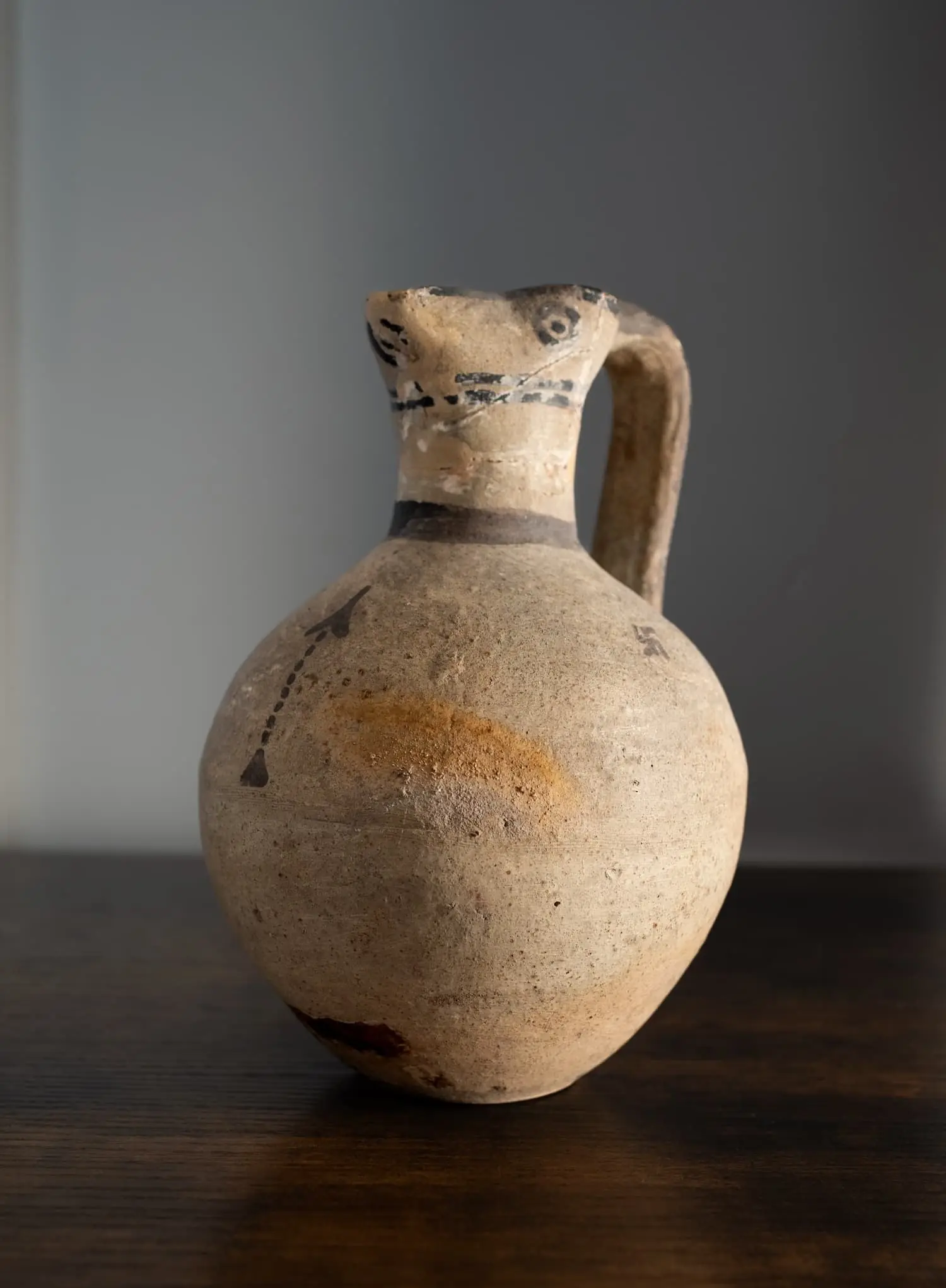 White Painted Jug with Painted Eyes, Chevron Arrow and SwastikaGeometric III · 850–600 BC
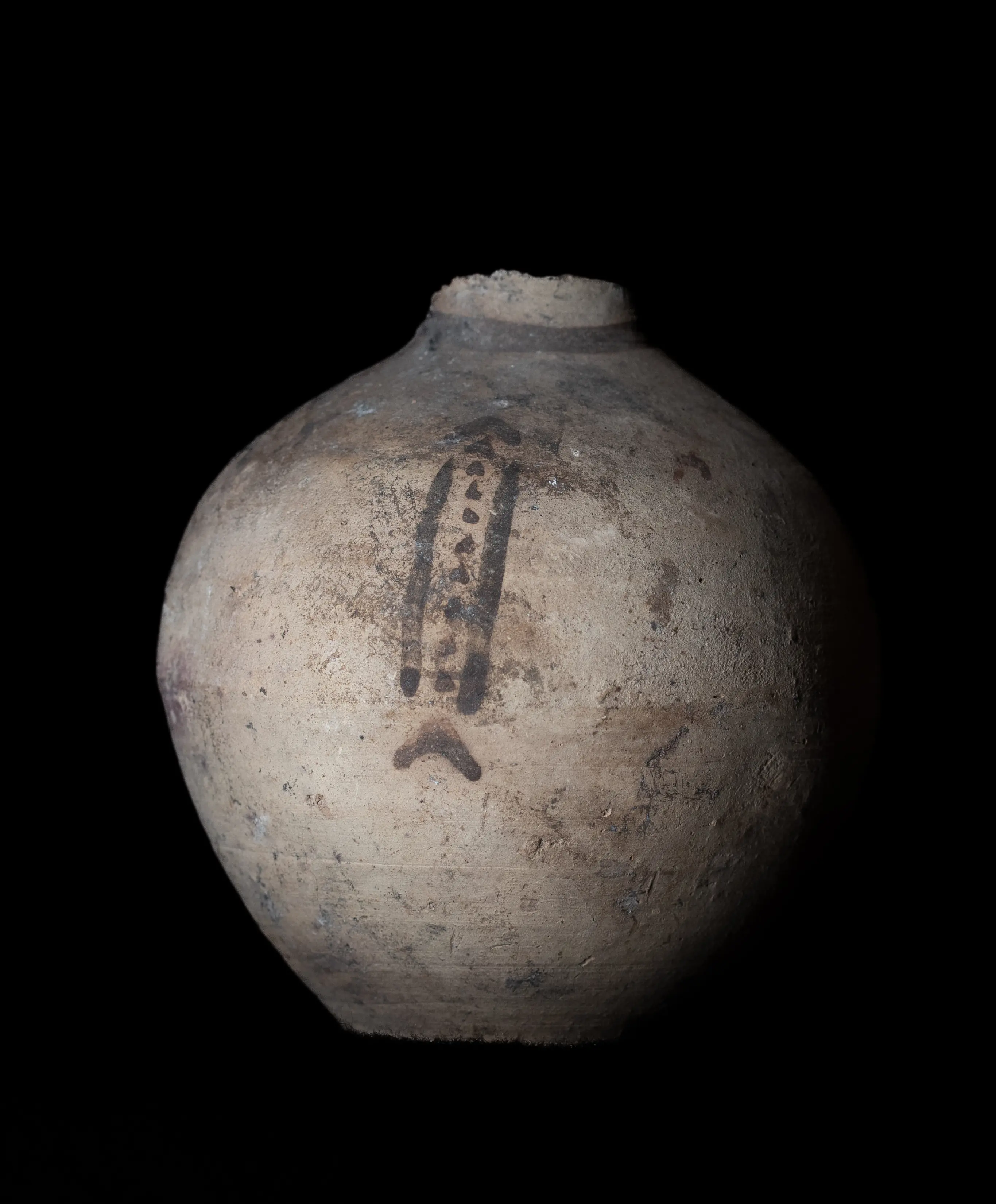 White Painted Juglet with a Dotted ArrowGeometric III · 850–600 BC
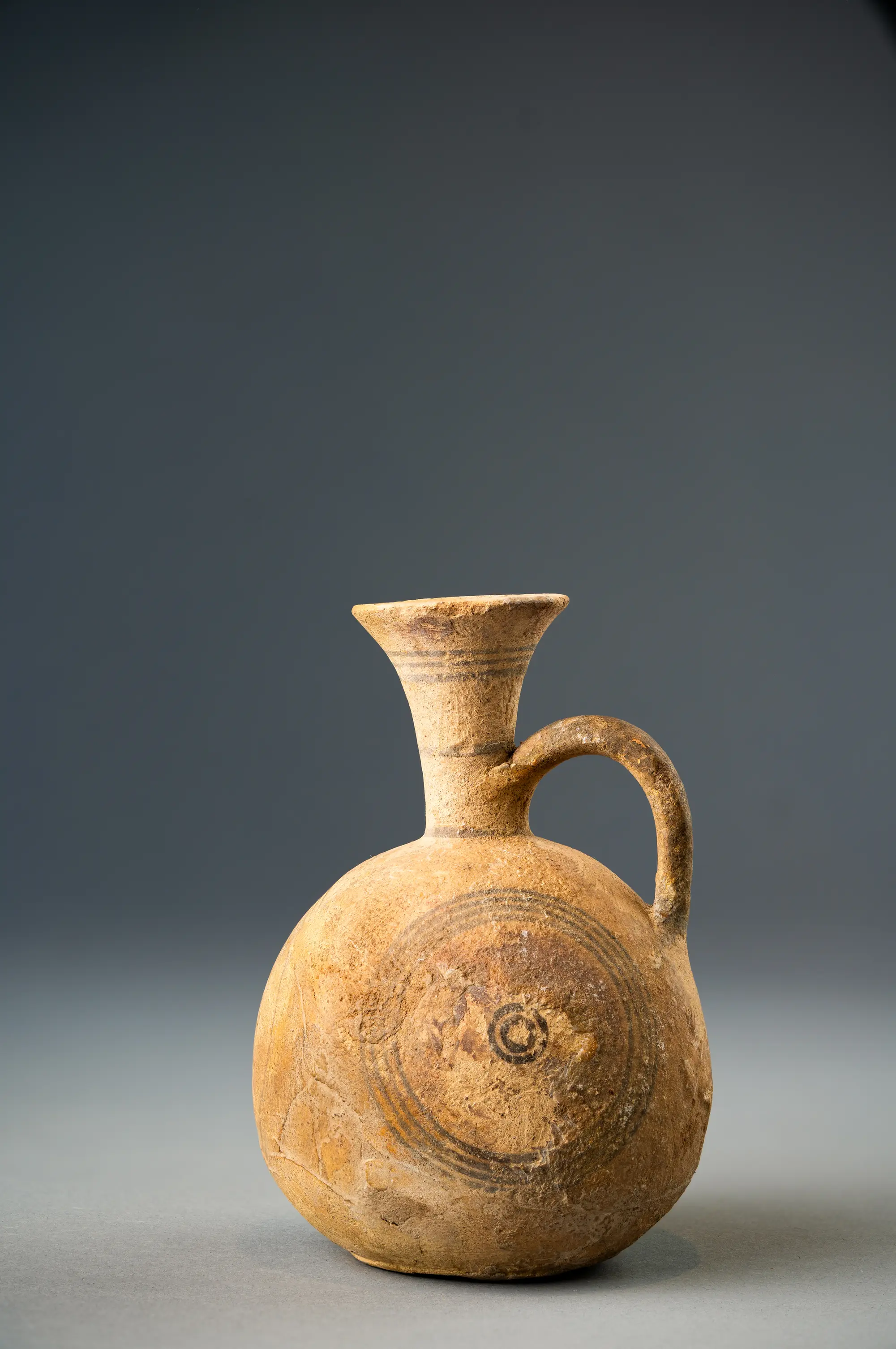 White Painted Juglet with Funnel Mouth and Side CirclesGeometric III · 850–600 BC
and 4 more objects mentioned on this page
References
- 1.Gjerstad, E. (1948). The Swedish Cyprus Expedition, Vol. IV, Part 2: The Cypro-Geometric, Cypro-Archaic and Cypro-Classical Periods. The Swedish Cyprus Expedition.
- 2.Georgiadou, A. (2016). Pottery of Geometric, Archaic and Classical periods in Cyprus. In G. Bourogiannis & C. Panagiotopoulou (Eds.), Kyprios Character: History, Archaeology & Numismatics of Ancient Cyprus. kyprioscharacter.eie.gr
- 3.Iacovou, M. (1991). Proto-White Painted pottery: A classification of the ware. In J. A. Barlow, D. L. Bolger, & B. Kling (Eds.), Cypriot ceramics: Reading the prehistoric record (University Museum Monograph 74, pp. 199–205). The University Museum, University of Pennsylvania.
- 4.Smith, J. S. (2009). Art and society in Cyprus from the Bronze Age into the Iron Age. Cambridge University Press.
- 5.Coldstream, J. N. (1999). On chronology: The CG II mystery and its sequel. In M. Iacovou & D. Michaelides (Eds.), Cyprus: The historicity of the Geometric horizon (pp. 109–118). University of Cyprus.
- 6.Coldstream, J. N. (1968). Greek Geometric pottery. Methuen.
- 7.Karageorghis, V. (1983). Palaepaphos-Skales: An Iron Age cemetery in Cyprus. Universitätsverlag Konstanz.
- 8.Karageorghis, V., & Raptou, E. (2016). Palaepaphos-Skales: Tombs of the Late Cypriote IIIB and Cypro-Geometric periods (excavations of 2008 and 2011). Nicosia.
- 9.Childs, W. A. P. (2012). Marion: A city-kingdom of ancient Cyprus. In W. A. P. Childs, J. S. Smith, & J. M. Padgett (Eds.), City of gold: The archaeology of Polis Chrysochous, Cyprus (pp. 91–107). Princeton University Art Museum.
- 10.Gjerstad, E., Lindros, J., Sjöqvist, E., & Westholm, A. (1934). The Swedish Cyprus Expedition I: Finds and results of the excavations in Cyprus 1927–1931. The Swedish Cyprus Expedition.
- 11.Morris, D. (1985). The art of ancient Cyprus, with a check-list of the author's collection. Phaidon.
- 12.Georgiadou, A., & Dikomitou-Eliadou, M. (2022). The Iron Age pictorial pottery of Salamis within and beyond: An overview of ceramic styles, wares and fabrics. In G. Bourogiannis (Ed.), Beyond Cyprus: Investigating Cypriot connectivity in the Mediterranean from the Late Bronze Age to the end of the Classical period (AURA Supplement 9, pp. 335–348). National and Kapodistrian University of Athens.
- 13.Reyes, A. T. (1994). Archaic Cyprus: A study of the textual and archaeological evidence. Clarendon Press.
- 14.Sader, H. (2019). The history and archaeology of Phoenicia (Archaeology and Biblical Studies 25). SBL Press.
- 15.Karageorghis, V., Mertens, J. R., & Rose, M. E. (2000). Ancient art from Cyprus: The Cesnola Collection in The Metropolitan Museum of Art. The Metropolitan Museum of Art.
- 16.Myres, J. L. (1954). A painted Graeco-Phoenician vase from Ormidhia in Cyprus. American Journal of Archaeology, 58(1), 39–44.