
Contents
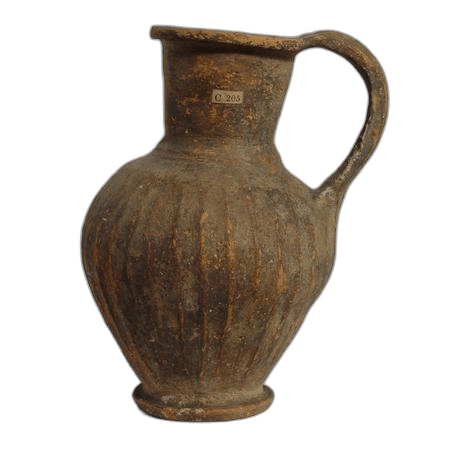
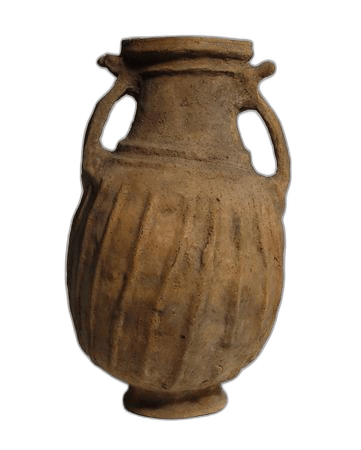
Bucchero is the Late Cypriot ware you recognise by its ribs. The jugs and juglets have bodies covered in close vertical ridges or grooves, set under a thin dark or reddish slip, and the effect copies the fluting of a metal vessel. The fabric is so close to Base Ring II that the two can be hard to tell apart, and some scholars have doubted they should be separated at all. Bucchero was made by hand through most of the Late Bronze Age, turned on the wheel by Late Cypriot IIIA, and travelled in modest numbers to the Levant. The name also clings to two later Iron Age groups, a red-surfaced class and a black-slipped one, which is why the catalogue's Bucchero objects span more than a thousand years.
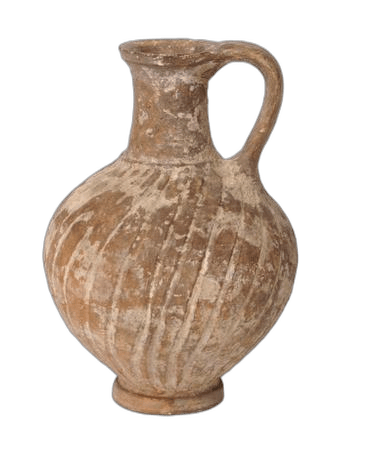
 from Kourion, British Museum 1896,0201.360: handmade, globular body on a splaying ring base, ridge at the neck and vertical relief ribbing down the body under a thin matt brown to black slip.](https://cdn.ancientcyprus.com/britishmuseum/4102-late-cypriot-bucchero-jug.png)
Identification
Michal Artzy, describing the Cypriot imports found in the southern Levant, puts the defining feature plainly: vertical raised ribs or lines on the body, imitating fluting on metal vessels [1]. In Cyprus both jugs and juglets were made in the ware, usually by hand. The jugs that reached the Levant tend to have an exaggerated piriform body, a wide cylindrical neck, an everted rim and a ring base. The fabric fires from brown-black to brown-red and buff, and the core, as in Base Ring II, is usually grey. The surface carries a thin black, brown or reddish slip. Artzy notes that the fabric is so like Base Ring that the two are at times difficult to distinguish, and that Bucchero differs mainly in decoration and vessel size [1].
A well-described example is a jug from Lachish Tomb 1003, now in the Royal Museums of Art and History in Brussels (O 1512). It has a carinated rim, a high handle from rim to shoulder, a short cylindrical neck and a piriform body on a ring base. The clay is red, the surface mottled dark grey, with a very thin, slightly lustrous slip burnished horizontally on the neck and vertically on the body. There are 38 raised ribs, and a horizontal ridge circles the base of the neck [2, cat. 88].
The British Museum's Late Cypriot pieces in the catalogue show the same habits. A small jug from Kourion (pictured) has a ridge at the neck and relief ribbing running from the neck almost to the base, in dark-pink clay under a thin matt brown to black slip (1896,0201.360). An Enkomi jug, 13.8 cm high, has its handle pierced through the body wall and vertical ribbing from mid-shoulder down (1897,0401.908). The ware was not limited to jugs: an Enkomi amphora 21 cm high has a vertically ridged ovoid body, triple-ridged handles with thumb-grips and a matt dark brown self-slip (1897,0401.1326). The ribs themselves change over time: pinched ribs are taken to mark the later style of the ware [3].
In other collections, the Ashmolean holds a small ribbed jug of Late Cypriot II, 14 cm high, purchased in 1959 (AN1959.370). The Penn Museum has a jug labelled "imitation bucchero" from Lapithos Tomb 73A, excavated in 1931–32 (200264).
Bucchero and Base Ring
The closeness to Base Ring runs through the whole literature. In 1960 James Stewart, reviewing the publication of the sanctuary at Myrtou-Pigadhes, reported that Hector Catling had suggested it might be misleading to separate Bucchero from Base Ring at all. Stewart added that a few Base Ring II bowl sherds carry vertical fluted (not ribbed) decoration, and that Bucchero "badly needs restudy, for its first appearance may be dated too early" [4, p. 291].
Paul Åström, whose volumes for the Swedish Cyprus Expedition set the standard classification, kept the two apart but described jugs from Ras Shamra and Minet el-Beida as "the earlier variety of Bucchero Ware of Base-ring II fabric" [5]. The American excavators at Idalion used the same frame: Bucchero Handmade is "related to Base Ring II", and Bucchero Wheelmade is very similar to the handmade ware and also related to Base Ring II [6].
The Brussels catalogue entry repeats the close alliance between the two wares and mentions a further idea: that Bucchero juglets, like the Base Ring juglets often linked with opium, were modelled on poppy capsules [2, cat. 88]. The entry reports this only as a suggestion. The opium question itself belongs to Base Ring ware and to medicine in ancient Cyprus.
Handmade and wheelmade: the dating
The Swedish scheme divides the ware into two: Bucchero Hand-made and Bucchero Wheel-made [5]. The handmade ware is placed in Late Cypriot II, 1425/1415 to 1100/1075 BCE in the Åströms' figures [3]. Its beginning is uncertain. At Myrtou-Pigadhes a very fine Bucchero jug, "akin to the best Base-ring ware", came from a phase that ended about 1400 BCE. Åström commented that this would date it to Late Cypriot IB and IIA1, "but the occurrence of Bucchero Ware as early as this is somewhat doubtful" [5]. Stewart's warning about too early a start points the same way [4, p. 291].
The wheelmade ware is a Late Cypriot III development. In Porphyrios Dikaios's Level IIIA at Enkomi, handmade Bucchero makes up only 1 to 1.2 per cent of the pottery, while "the new ware Bucchero Wheel-made" reaches 3 per cent in Area I and 3.5 per cent in Area III [5]. Ioannis Voskos and Bernard Knapp list Bucchero with Plain White among the wares that "continued to be produced but were now wheelmade" in Late Cypriot IIIA [7, p. 668]. The handmade version did not vanish at once: in Enkomi Level IIIC it still reaches 6.67 per cent in one room [5].
| Stage | Approximate date | What changes |
|---|---|---|
| Possible early pieces (Myrtou-Pigadhes) | Before c. 1400 BCE | Fine Bucchero akin to Base Ring; date doubted by Åström and Stewart |
| Bucchero Hand-made | 1425/1415 to 1100/1075 BCE | Handmade jugs and juglets; pinched ribs in the later style |
| Bucchero Wheel-made | Late Cypriot IIIA onwards | New wheelmade ware beside the handmade one at Enkomi |
| Iron Age namesakes | Cypro-Geometric and later | Wheelmade grooved red and black-slipped vessels called 'Bucchero' |
The British Museum dates its handmade jugs from Enkomi, Kourion and Maroni between the mid-fifteenth and the eleventh centuries BCE, which fits this sequence. For how the Late Cypriot wares shift from hand to wheel together, see the Bronze to Iron Age ceramic transition and Plain White ware.
Find contexts in Cyprus
Bucchero is above all a tomb ware. It occurs at Stephania, Kition, Lapithos-Ayia Anastasia and Kourion-Bamboula, and in large numbers in the tombs of Enkomi [3]. Åström's summaries of Late Cypriot tomb groups show it buried alongside the other wares of its time. In Enkomi Swedish Tomb II, burial group IA (Late Cypriot IIB), a single Bucchero vessel lay with 22 Base Ring II and 11 White Slip II pieces. In Late Cypriot III it often turns up with wheelmade Plain White jugs: the bottom layer of Enkomi French Tomb 6 held four Bucchero and three Plain White Wheel-made II vessels, and Enkomi Swedish Tomb 16 four handmade Bucchero jugs and three Plain White Wheel-made II jugs [5].
Settlement finds are fewer but help with the dating. At Kourion-Bamboula, Bucchero becomes "more frequent than before" at the transition from Late Cypriot IIC to III. At Idalion, periods 2 and 3, the handmade ware makes up 1.4 per cent of the pottery and the wheelmade 1.7 per cent [5]. A Late Cypriot IIC1 house at Hala Sultan Tekke also produced handmade Bucchero [5].
Export to the Levant
Bucchero travelled much less than Base Ring or White Slip. Åström wrote that it was "not common outside Cyprus" and that, as far as was known, it never reached the Aegean. Sherds of a jug from the Cape Gelidonya shipwreck are either Bucchero or Base Ring II [5]. In Syria, an early jug was found in a room of the Niqme-pa palace at Alalakh, Level IV, which Woolley dated 1447 to 1370 BCE, and six jugs come from Ras Shamra and Minet el-Beida at Ugarit. A handmade jug is said to come from Byblos [5].
Further south, Åström lists Hazor, Megiddo, Jerusalem, Tell el-Hesi, Lachish, Tell el-Ajjul and Tell el-Farah [5]. More recent finds include a body sherd from Deir el-Balah, two pieces from Tell Jemmeh, and two ribbed sherds from Tell Keisan with pinched ribs, probably from one jug [3]. In the southern Levant the ware appears in burials with Base Ring II, in Late Bronze IIA contexts that run into early Late Bronze IIB [1]. At Lachish the Bucchero imports date after Base Ring had reached its peak, early in the fourteenth century BCE [2, cat. 88].
The Iron Age "Bucchero" wares
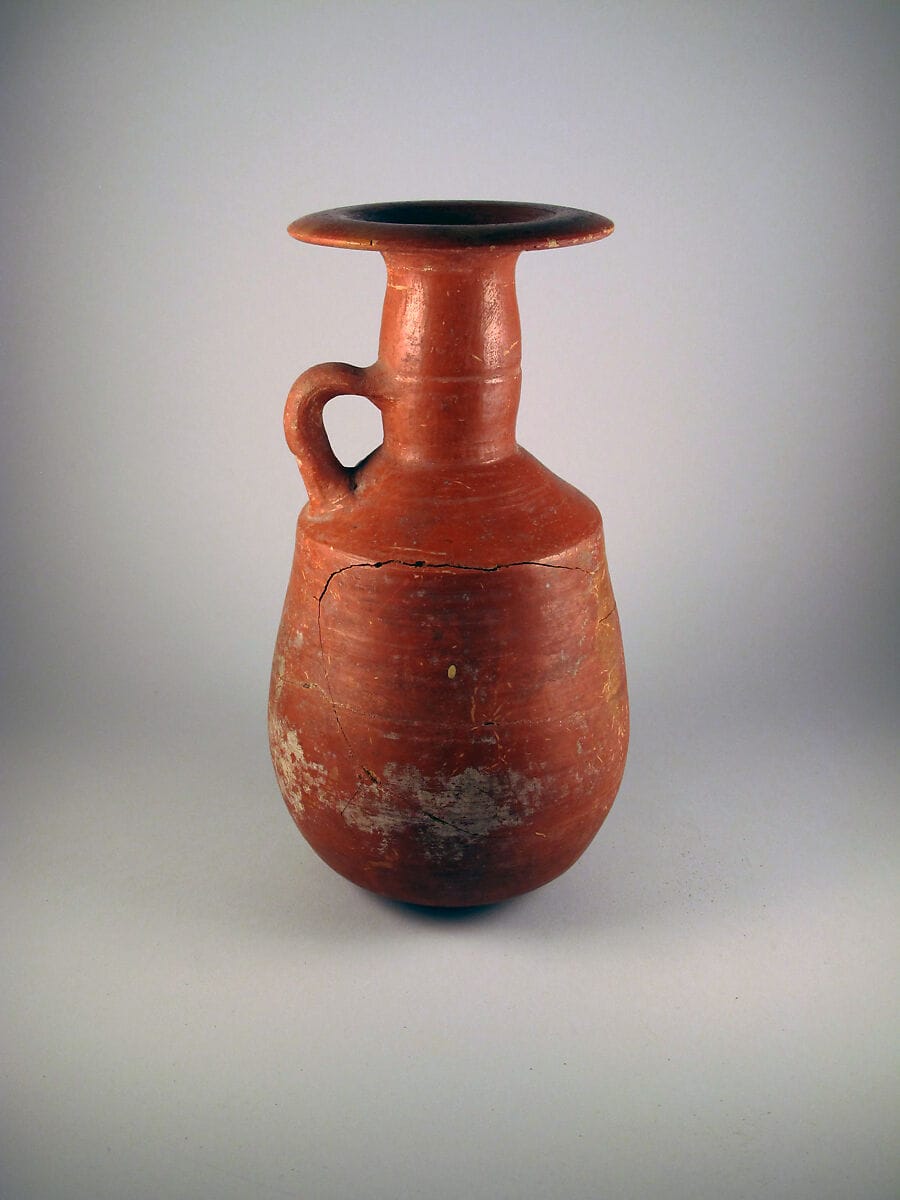
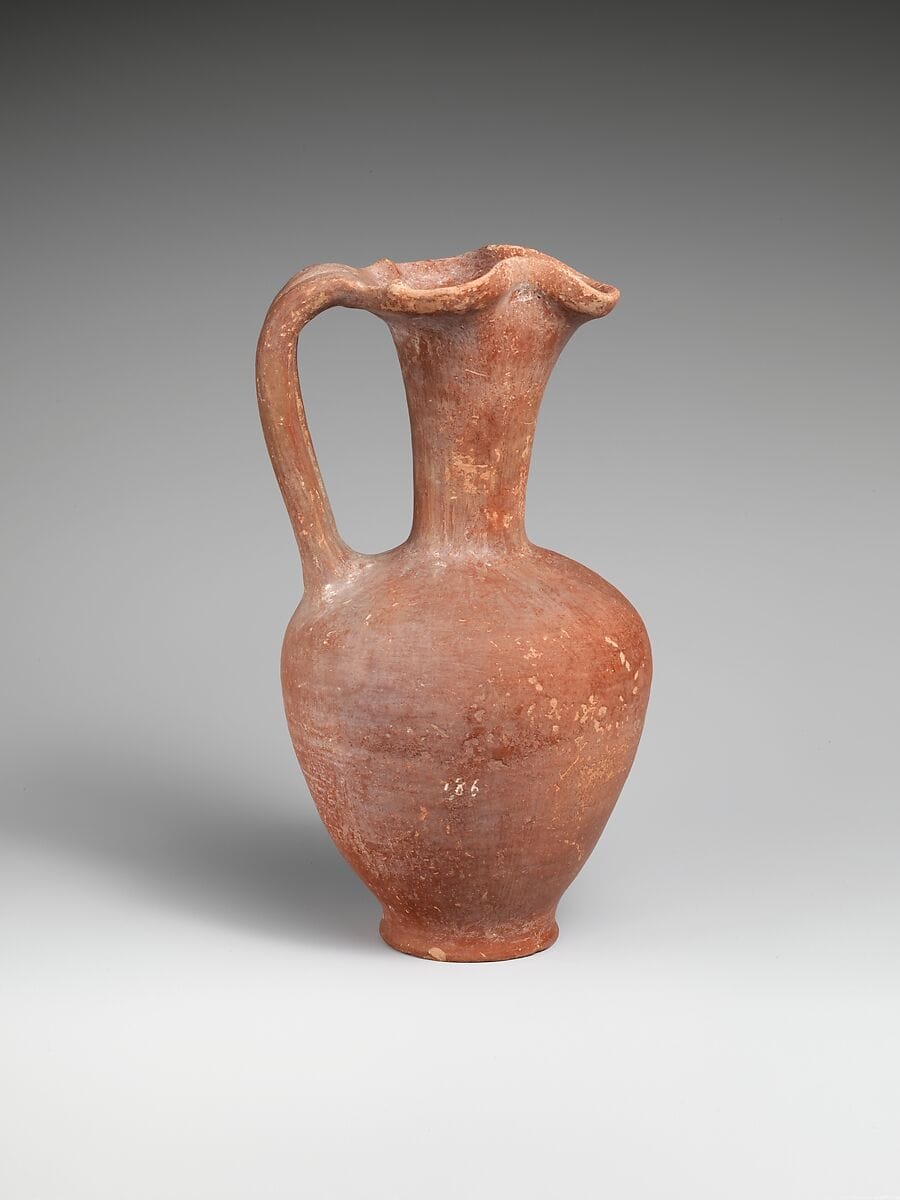
The word did not stop at the end of the Bronze Age. John Myres, cataloguing the Cesnola Collection in 1914, grouped a set of Early Iron Age vessels as "Red Bucchero Wares". Vassos Karageorghis later explained that Myres chose the name because of the vertical grooves on two of the vessels, a shape that resembles the "Black Bucchero", which the Swedish Cyprus Expedition called Black Slip ware [8]. Desmond Morris lists "the ribbed vessels that were originally described as Red Bucchero Ware" among the minor wares of Cyprus [9]. Karageorghis also described the Cypro-Geometric Black Slip or Bucchero ware as a developed version of the ribbed Base Ring ware of later Late Cypriot II and III [10].
, Drakopoulos collection: wheel-made, orange-red surface, close vertical grooves on the lower body. An Iron Age red 'Bucchero' vessel, Cypro-Geometric II to Cypro-Archaic I.](https://cdn.ancientcyprus.com/collections/drakopoulos/late-bronze-age/JAR-BA-003.webp)
The Metropolitan Museum objects in the catalogue under this term all belong to Myres's red group, each described in his handbook as "red bucchero": a jug (74.51.394), an ovoid oinochoe (74.51.642) and a small wide-mouthed amphoriskos with a grooved body (74.51.620). The amphoriskos in the Drakopoulos collection is of the same kind. It is wheel-made, with an orange-red surface and close vertical grooves cut into the lower two-thirds of the body, and is dated Cypro-Geometric II to Cypro-Archaic I. The collection also holds a Black Slip "Bucchero" jug with a fluted body of Cypro-Geometric I to II. For the later setting, see the Cypro-Geometric period.
None of these has anything to do with Etruscan bucchero, the black table ware of central Italy in the seventh to fifth centuries BCE. The two share a name and a dark burnished look. Who first carried the Italian term over to Cypriot pottery is not clear from the literature.
Open questions
Three problems remain. The start date of the ware is weak, resting on a few pieces such as the Myrtou-Pigadhes jug, and both Stewart and Åström doubted it [4, p. 291; 5]. The boundary with Base Ring II is a matter of convention, since the fabric is shared and Catling questioned whether the two should be separated at all [4, p. 291]. The poppy-capsule reading of the juglets is a suggestion without a test behind it [2, cat. 88]. Stewart's call for a restudy of the ware, made in 1960, still describes the state of the question.
In the catalogue
You can see all Bucchero ware in the catalogue. The British Museum's handmade jugs from Enkomi, Maroni (1898,1201.100) and Dhali (1868,0905.41, with oblique fluting) show the Late Cypriot ware. The Metropolitan Museum pieces and the Drakopoulos amphoriskos show the Iron Age red class. Related pages: Base Ring ware, Plain White ware, jugs, amphorae, and the article on pottery production in Bronze Age Cyprus.
Objects on this page
- Late Cypriot Bucchero JugLate Bronze Age III · 1340–1050 BC
 Cypriot Bucchero Handmade JugLate Bronze Age III · 1340–1050 BC
 Cypriot Bucchero AmphoraLate Bronze Age III · 1340–1050 BC
- Two-Handled Amphoriskos with Grooved Bucchero BodyGeometric II · 950–600 BC
 JugArchaic II · 600–480 BC
 OinochoeGeometric III · 799–700 BC
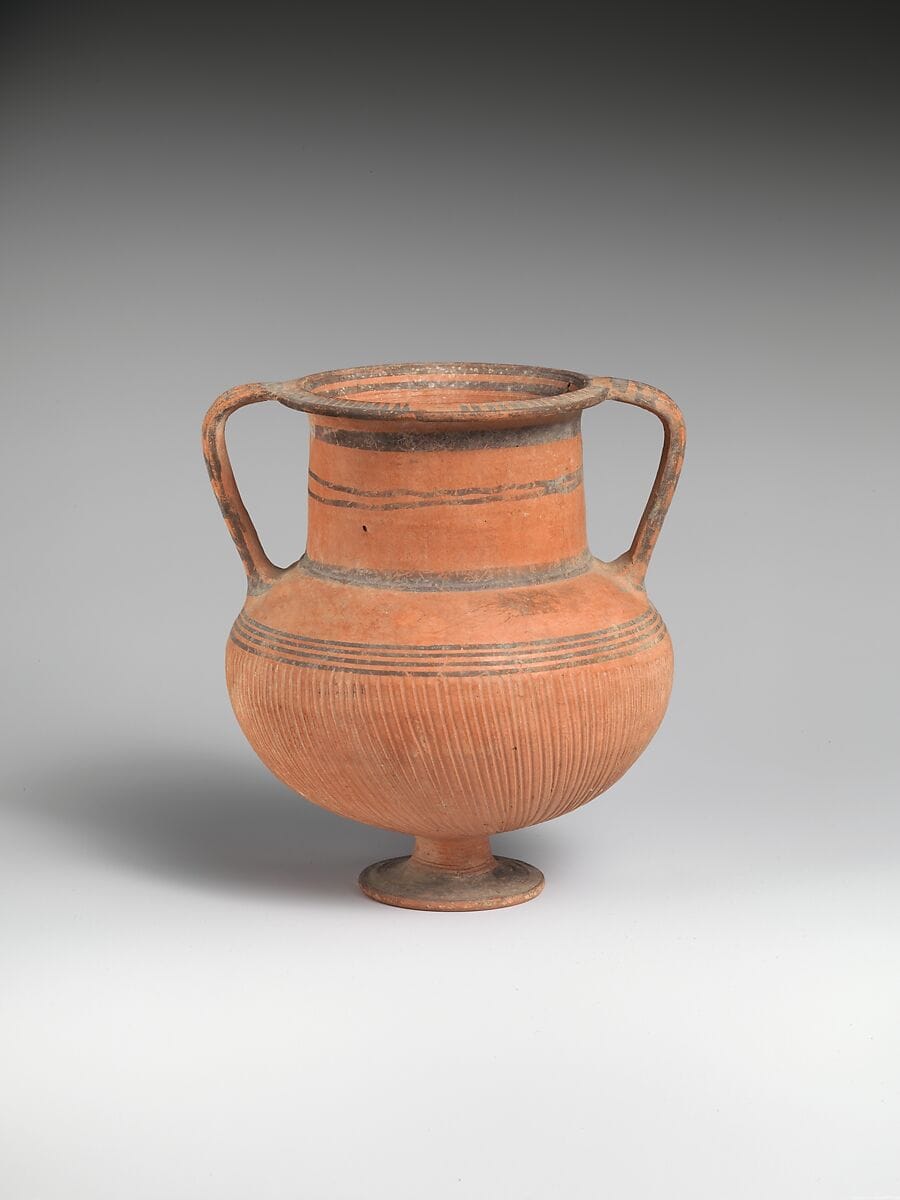 AmphoriskosGeometric III · 850–750 BC
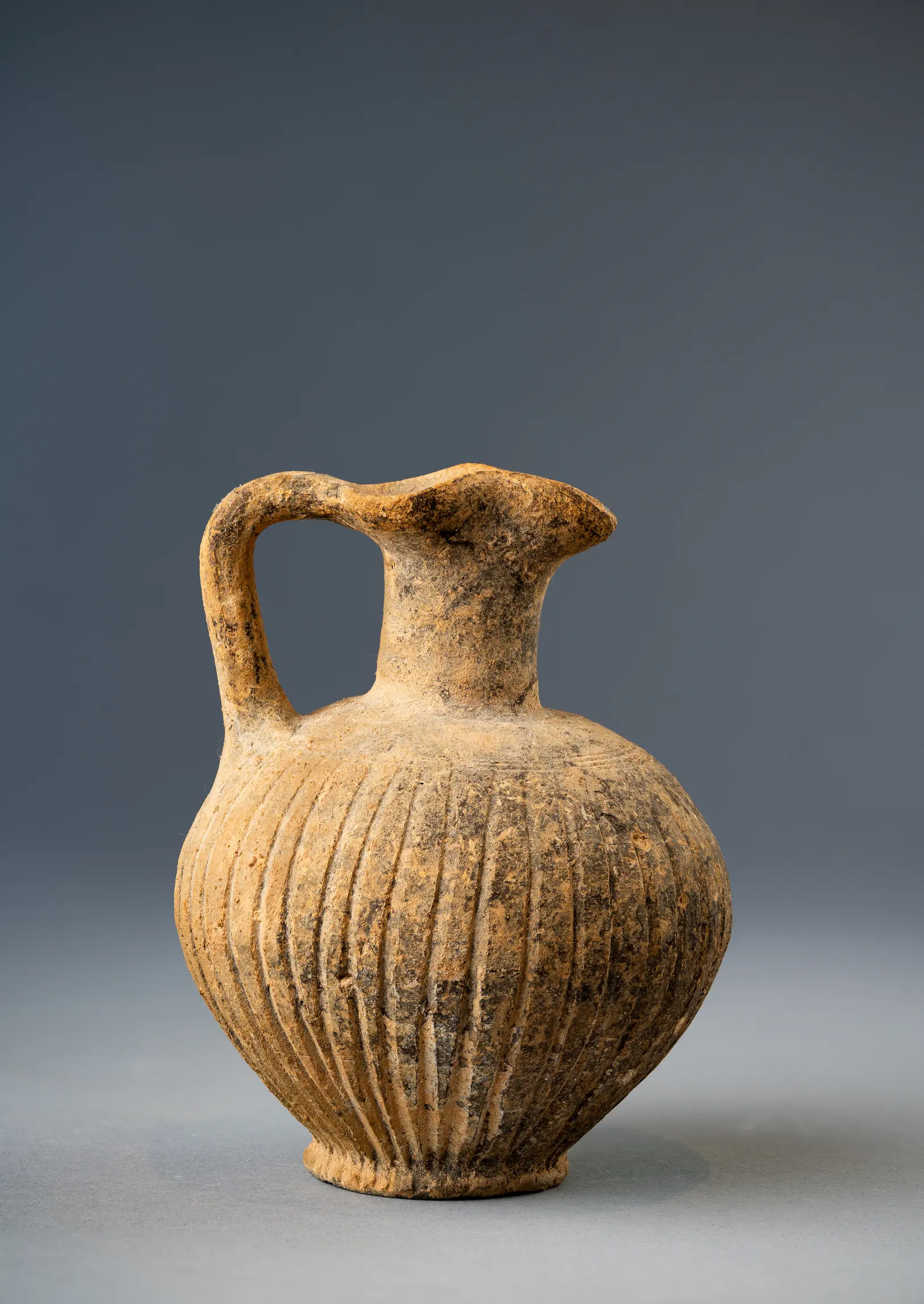 Black Slip Bucchero Jug with Trefoil Mouth and Fluted BodyGeometric I · 1050–850 BC
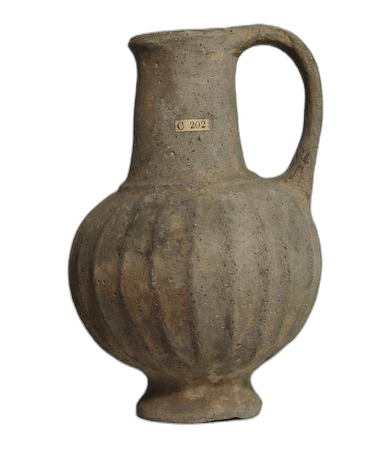 Bucchero Relief JugLate Bronze Age III · 1340–1050 BC
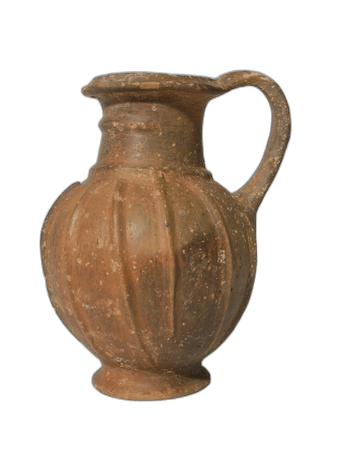 Cypriot Bucchero JugLate Bronze Age II · 1390–1100 BC
 Cypriot Bucchero Fluted JugLate Bronze Age II · 1450–1100 BC
In the catalogue
References
- 1.Artzy, M. (2019). Late Bronze Age I–II Cypriot imports. In S. Gitin (Ed.), The ancient pottery of Israel and its neighbors from the Middle Bronze Age through the Late Bronze Age (Vol. 3, Chapter 4.2). Israel Exploration Society.
- 2.Pilides, D., & Papadimitriou, N. (Eds.). (2012). Ancient Cyprus: Cultures in dialogue. Department of Antiquities, Cyprus.
- 3.Gilboa, A., & Yasur-Landau, A. (Eds.). (2020). Nomads of the Mediterranean: Trade and contact in the Bronze and Iron Ages. Studies in honor of Michal Artzy. Brill. https://doi.org/10.1163/9789004430112
- 4.Stewart, J. R. (1960). [Review of the excavations at Myrtou-Pigadhes]. American Journal of Archaeology, 64(3), 290–292. https://www.jstor.org/stable/502478
- 5.Åström, P., et al. (1972). *The Swedish Cyprus Expedition, Vol. IV, Part 1D: The Late Cypriote Bronze Age. Relative and absolute chronology, foreign relations, historical conclusions*. Swedish Cyprus Expedition.
- 6.Stager, L. E., & Walker, A. M. (Eds.). (1989). American Expedition to Idalion, Cyprus 1973–1980 (Oriental Institute Communications 24). Oriental Institute of the University of Chicago.
- 7.Voskos, I., & Knapp, A. B. (2008). Cyprus at the end of the Late Bronze Age: Crisis and colonization or continuity and hybridization? American Journal of Archaeology, 112(4), 659–684.
- 8.Karageorghis, V., & Karageorghis, J. V. (1956). Some inscribed Iron-Age vases from Cyprus. American Journal of Archaeology, 60(4). https://doi.org/10.2307/500874
- 9.Morris, D. (1985). The art of ancient Cyprus. Phaidon.
- 10.Karageorghis, V. (1982). Cyprus from the Stone Age to the Romans. Thames and Hudson.