
How to Identify Ancient Cypriot Pottery: A Visual Guide
A ware-by-ware key to Cypriot pottery (Red Polished, White Painted, Base Ring, White Slip, Bichrome, Black-on-Red) with dates and safe checks to make at home.

Alexis Drakopoulos
October 3, 2026·Guides · Collecting · Ceramics·21 min read


Share


Alexis Drakopoulos is a Greek Cypriot Machine Learning Engineer working in Financial Crimes. He is passionate about Archeology and making it accessible to everyone. About Me.
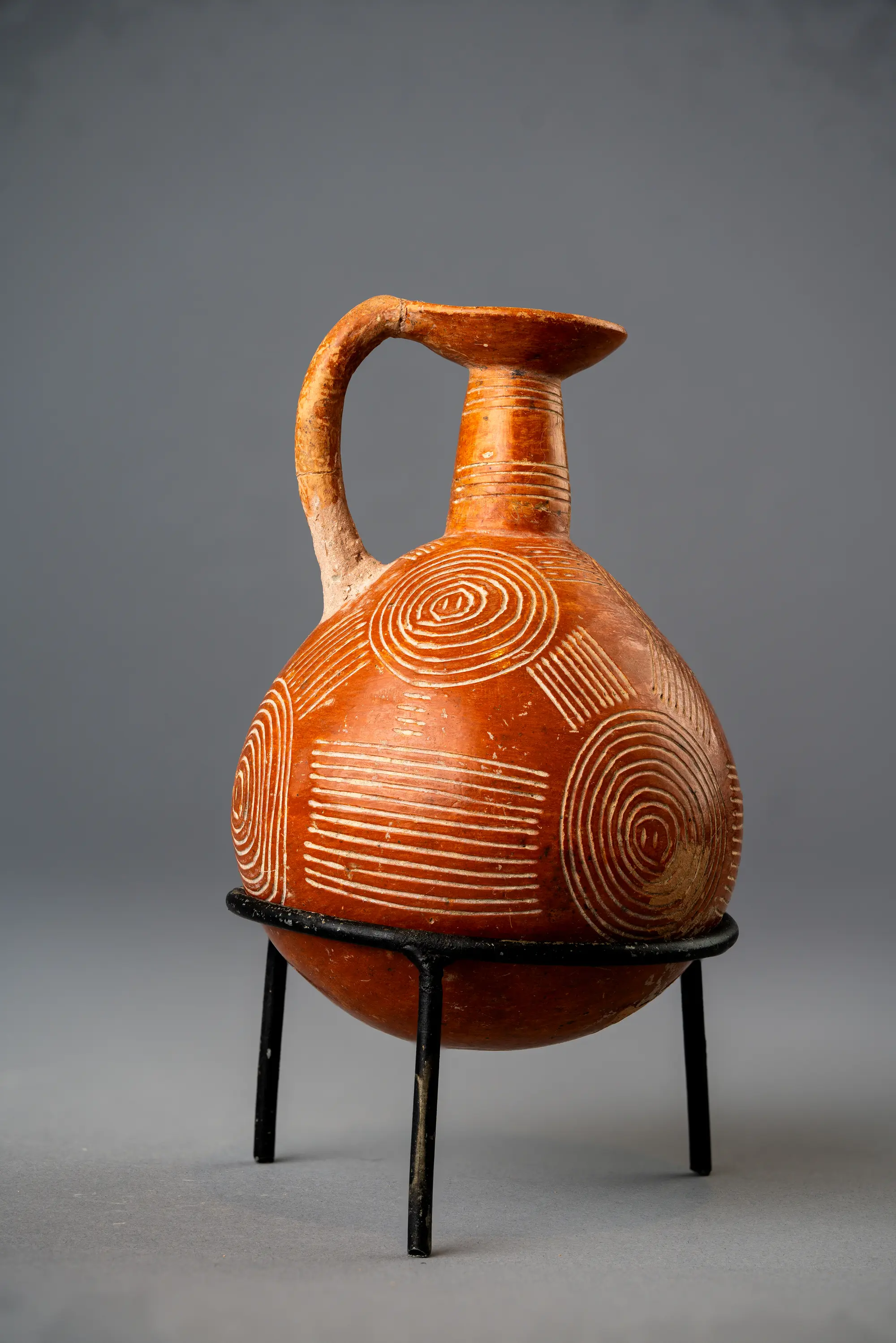
The jug on the stand above has no flat base. Its potter built it by hand around 2000 BC, polished its red slip to a soft shine, cut circles and parallel lines into the surface and filled them with white. Together those details place it in one family of Cypriot pottery, Red Polished, in a few minutes and without any instrument.
Cypriot archaeologists classify pots first by ware: how the surface was finished (polished, slipped, painted or left plain) and whether the pot was built by hand or on the wheel. Nearly every ware name describes the surface; Base Ring, named after the ring foot of its jugs and bowls, is the exception [1]. Answer three questions about your pot (hand or wheel? polished, slipped or painted? which colours?) and you can usually reach the right family, which gives you a date range.
Before you start: is it ancient Cypriot pottery at all?
Three things put a pot outside this guide. A glassy glaze, often green or yellow and sometimes with designs scratched through it, almost always means a much later pot: the glazed sgraffito wares of Cyprus are medieval. Moulded relief under a glossy red coat suggests Roman red-gloss tableware. A crisp stamp on the base, a printed or impressed "replica" mark, or a chalky, plaster-like body points to a modern reproduction of the kind museum shops and handicraft workshops have sold for decades. The guide to Cypriot pottery replicas and fakes covers those, heavy nineteenth-century restoration and what a thermoluminescence test can settle.
One rule for everything that follows: do not clean, scrape, soak or "test" the surface. The slip and the paint are the evidence. A damp cloth can lift the white fill out of incised lines and take faded paint with it; acid and bleach do worse.
Leave paper labels, painted numbers and lead seals on handles exactly where they are. They record where the pot has been, and the guide to export licences, seals and labels explains how to read them.
What can I check at home without harming the pot?
You need daylight, a phone torch and ideally a magnifier. Hold the pot by its body, never by a handle or spout, over a towel.
- Hand or wheel. Shine the torch inside the neck and look at the base. A wheel leaves fine horizontal ridges round the inside, an even wall, a symmetrical profile and a neatly turned ring or disc foot; perfectly concentric painted circles were drawn while the pot turned. A handmade pot shows small irregularities: a neck leaning off vertical, uneven walls, finger marks, a round or pointed base that will not stand, sometimes vertical knife-paring.
- The handle join. On many Bronze Age Cypriot jugs and juglets the potter pushed the end of the handle through a hole in the body wall like a dowel, and the plug can sometimes be seen inside. Nicolle Hirschfeld calls it "the typical Cypriot practice of attaching handles by inserting them through the wall of the vase" [4]. It supports a Cypriot identification; its absence proves nothing.
- The finish. Polished pots have a soft sheen, often with faint streaks from the polishing tool. A thick slip is a separate coat of fine clay; where it is chipped, a differently coloured body shows. Matt paint has no gloss.
- Colours and technique. Note the colour of the ground and of every paint, and whether the decoration is painted, incised and filled with white, or applied in relief. The table below runs on these combinations.
- Sound. Late Bronze Age Base Ring is thin and very hard, between 5 and 7 on the Mohs scale, and excavators have long cited its "metallic chink" when tapped [6]. Vaughan, who studied the fabric, notes that any thin, hard ware gives the same sound [6], so a gentle fingernail tap is a hint only.
- The base. Round, pointed and simple flat bases are typical of handmade Early and Middle Bronze Age pots. Iron Age wheelmade jugs and bowls usually stand on a ring, a disc or a low conical foot.
One fact keeps the hand-or-wheel test honest. The potter's wheel reached Cyprus around 1650 BC, yet Base Ring and White Slip, the island's great Late Bronze Age export wares, were handmade for as long as they were made, until about 1200 BC, and handmade and wheel-shaped versions of the same plain jugs were made side by side for some four centuries [5]. Handmade therefore does not mean "before 1650 BC". Almost everything wheelmade, though, is Late Bronze Age or later, and almost all Iron Age fine pottery, from about 1050 BC, is wheelmade.
Which Cypriot ware is my pot? A quick key
Start with the first column, then match the surface. The dates follow the site's types of ware pages; older books give slightly different figures.
| Built | Surface and decoration | Typical shapes | Ware | Date |
|---|---|---|---|---|
| Hand | Polished red to red-brown, often black at the top or mottled; incised lines filled with white, or applied relief | Round-based jugs, bowls, bottles, tulip bowls | Red Polished | c. 2300 to 1650 BC |
| Hand | Even, glossy red with no incision; flat base | Jugs with tall cut-away spouts, flasks | Red Polished Philia | c. 2450 to 2250 BC |
| Hand | Polished black all over, incised and white-filled | Small juglets, bowls | Black Polished | c. 2100 to 1850 BC |
| Hand | Matt brown or black paint in lattices and hatched bands on a pale buff ground | Juglets with beaked cut-away necks, small amphorae | White Painted (Bronze Age) | c. 2000 to 1650 BC |
| Hand | Thin, hard, dark brown to black; raised relief lines, or white-painted lines | Bilbil juglets, jugs, carinated bowls | Base Ring I and II | c. 1600 to 1200 BC |
| Hand | Thick creamy-white slip over a dark body, painted in brown or black | Hemispherical bowls with a wishbone handle | White Slip I and II | c. 1650 to 1200 BC |
| Hand | Undecorated dark or reddish slip, knife-pared | Wishbone-handled bowls, pinched-lip jugs | Monochrome | c. 1650 to 1340 BC |
| Hand or wheel | Pale cream, buff or pink, unpainted | Jugs, kraters, bowls | Plain White | c. 1700 to 310 BC (several series) |
| Wheel | Red and black paint on the upper body, light ground | Tankards, kraters | Bichrome Wheelmade | c. 1600 to 1450 BC |
| Wheel | Matt black paint on a buff or cream ground; bands and concentric circles | Trefoil jugs, amphorae, barrel jugs, plates | White Painted (Iron Age) | c. 1050 to 310 BC |
| Wheel | Black and red paint on a buff or cream ground | Trefoil jugs, amphorae, barrel jugs | Bichrome (Iron Age) | c. 1050 to 310 BC |
| Wheel | Burnished red slip with fine black bands and small circles | Small juglets, bowls | Black-on-Red | c. 950 to 600 BC, later in smaller numbers |
| Wheel | Red slip with black and white paint | Jugs, amphorae, juglets | Bichrome Red | c. 750 to 310 BC |
| Wheel | Lustrous red slip, unpainted | Carinated bowls, jugs | Red Slip (Iron Age) | from c. 850 BC |
The wares an owner is most likely to have are White Painted, Red Polished, Base Ring and Bichrome; White Slip bowls and Black-on-Red juglets turn up regularly too. Within a ware, the finer dating comes from shape and motif, and is specialist work; the site's course on Cypriot pottery goes through it ware by ware.
Why does the label say "White Painted IV"? Two traps in the names
The first trap is that the same names were reused for unrelated wares in the Bronze Age and the Iron Age. White Painted, Bichrome, Black Slip, Plain White and Red Slip each exist twice, once as handmade Bronze Age pottery and again, centuries later, as wheelmade Iron Age pottery [2]. An old label that says only "White Painted" tells you little until you know whether the pot was made by hand (Middle Bronze Age) or on the wheel (Iron Age).
The second is that the Roman numerals are not a clean clock. In the Bronze Age they mix date, style and region. Robert Merrillees pointed out that the long-lived Red Polished bowl with knob lugs, which runs from Early Cypriot II to Middle Cypriot III, was filed as Red Polished II, "when technically the majority belong to Red Polished III and some are Red Polished IV" [1]. He called the ware names themselves "titles of academic convenience" [1]. In the Iron Age the numbers are tidier, because Einar Gjerstad tied them to periods: White Painted and Bichrome I to III are Cypro-Geometric, IV and V Cypro-Archaic, VI and VII Cypro-Classical [3]. Later wares carry the period number in brackets, so Black-on-Red II (IV) means the second stage of Black-on-Red, made in period IV (Cypro-Archaic I). Read a numeral on an old label as one cataloguer's opinion.
Is it Red Polished?
Red Polished is the handmade pottery of the Early Bronze Age, made from about 2300 BC into the Middle Bronze Age until about 1650 BC, and one of the commonest Cypriot wares on the market. Look for a red to red-brown slip polished to a sheen. Because it was fired at low temperatures in open fires, the colour wanders: many pots are black-topped (mouth and upper body black, lower body red, from firing or cooling mouth-down in ash), and others are mottled red, brown and black.
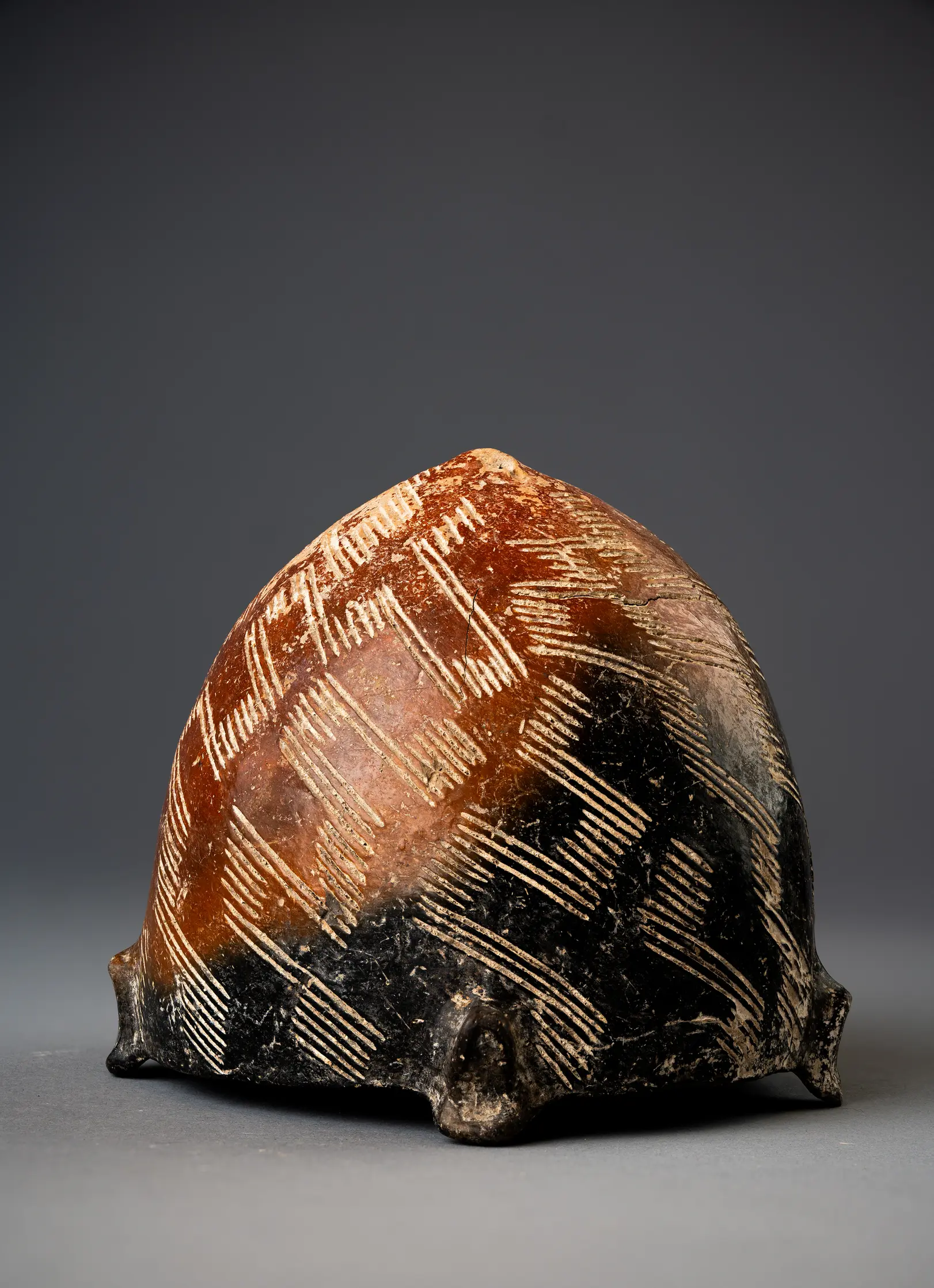
Decoration is absent, incised (zigzags, hatched bands, lattices, concentric circles, the cuts filled with white), or applied in relief as snakes, ridges and knobs. Shapes include hemispherical bowls with lugs, jugs with cut-away or beaked spouts, bottles, askoi, multi-necked vessels and the tulip bowl, whose pointed base cannot stand and which seems to have been made for the grave. The tulip bowl shown here has both the black top and white-filled hatching. Most pieces are 10 to 30 cm tall, though double-necked jugs from the north coast exceed half a metre.
Region shows. North-coast pots from Bellapais-Vounous and Lapithos are finely incised and elaborate. In the south, at sites such as Sotira and Psematismenos, the pots are harder, mottled and plain: none of the 624 Red Polished Mottled vessels published from Psematismenos carries incision [8].
Common confusions. Iron Age Red Slip, or Black-on-Red that has lost its paint, can look similar, but those are wheelmade, thin and regular, with ring bases and trefoil mouths. Modern village red ware and souvenir copies are the other risk. The Red Polished page has more shapes and examples.
Red Polished Philia
The earliest Red Polished, of the Philia phase (about 2450 to 2250 BC), looks different: an even, high-lustre red over a pale body, mostly undecorated, with separately made flat bases, rod handles, tall cut-away spouts and novel shapes such as round-based flasks and handled jars [7]. It is rarely offered under that name. See Red Polished Philia.
Black Polished
Black Polished, made from late in the Early Bronze Age to about 1850 BC, is Red Polished fired black all over in a smoky, oxygen-poor atmosphere: small juglets and bowls, incised with white-filled patterns [9], and uncommon. Before calling a pot Black Polished, turn it over: a black-topped Red Polished pot is red underneath.
Is it Middle Bronze Age White Painted?
Handmade White Painted belongs to the Middle Bronze Age, about 2000 to 1650 BC. The surface is pale buff, cream or light orange, and the paint is matt brown or black (sometimes orange-red), laid in linear patterns that often cover most of the pot: lattices, hatched triangles, wavy lines and close networks of crossing lines. Paul Åström sorted these into named styles such as Pendent Line and Cross Line [10]. Typical shapes are juglets (8 to 15 cm) and jugs (up to about 30 cm) with a beaked, cut-away neck and a round base, small amphorae, and bowls with rising handles.
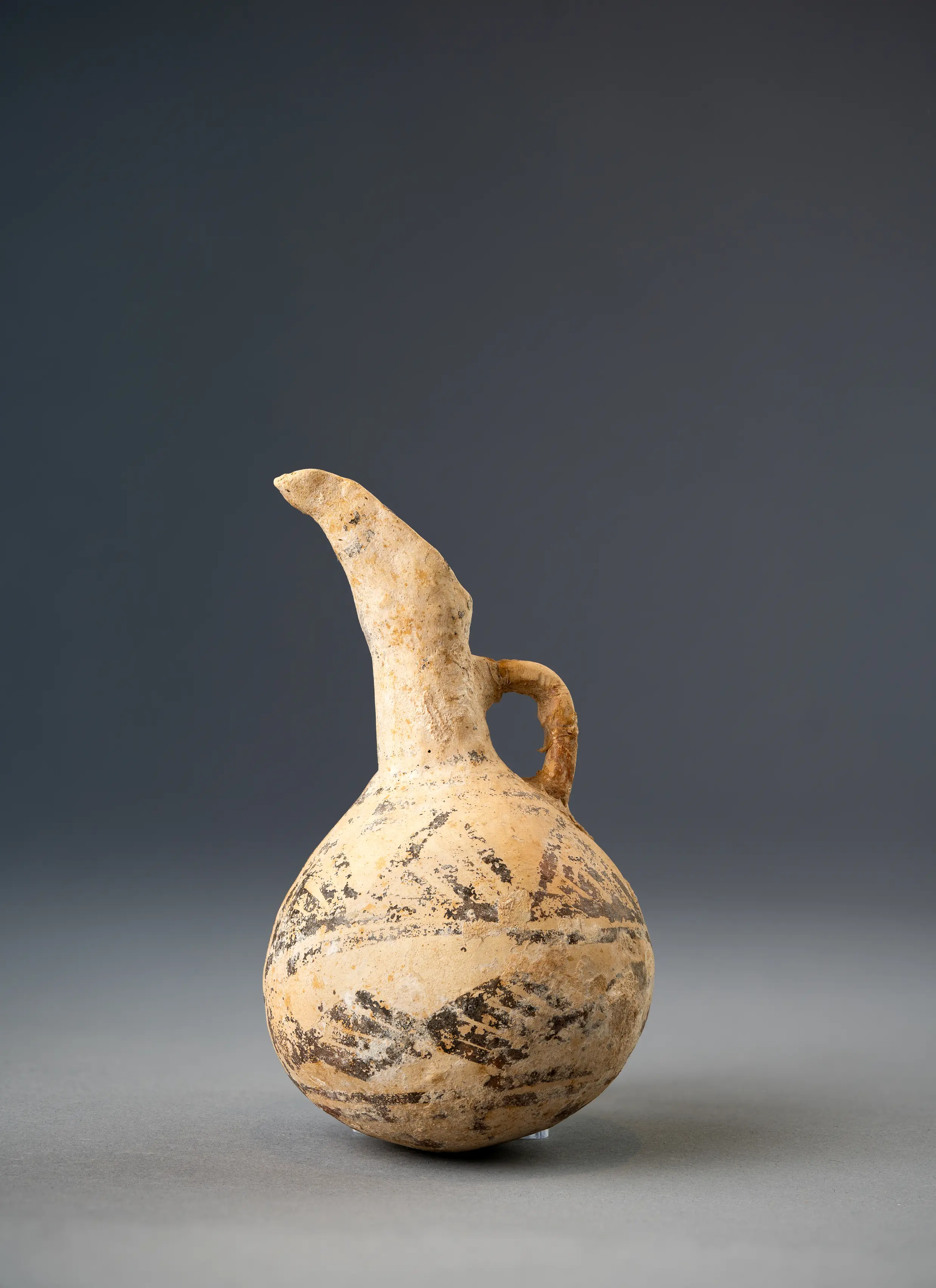
It is very common on the market, though in its own day it was a minority fine ware; small juglets of it travelled to Egypt and the Levant, where they now help date that period.
Common confusions. Iron Age White Painted is wheelmade, with concentric circles, trefoil mouths and ring bases (see below). White Slip has a thick, enamel-like coat over a dark body. Chalcolithic Red-on-White is far older and rarely seen outside museums. A White Painted pot whose paint has worn away can pass for Plain White [11]. More on the White Painted page and its lattice motifs.
Black Slip and Red Slip (Bronze Age)
These handmade Middle Bronze Age wares carry a dark slip over light buff clay. At Kalopsidha Åström described Black Slip as hard buff clay with a matt black slip "toning to red", incised with parallel lines, zigzags, networks and chevrons, mostly on juglets [12]. The colour runs from red to black depending on the firing. Black Slip is duller than Red Polished, and thicker and softer than Base Ring, the Late Bronze Age ware it is thought to anticipate [9]. Both are uncommon under these names; the Plain White page has a section on them.
Is it Base Ring?
Base Ring is the dark, thin-walled, handmade ware of the Late Bronze Age, about 1600 to 1200 BC, named for the ring foot on most of its jugs and bowls [1]. The fabric is fine and hard, the walls a few millimetres thick, the surface dark brown, black or grey. Base Ring I tends to have a lustrous slip with raised relief lines, spirals and snake-like ribs. Base Ring II is duller, with groups of thin white-painted lines and lattices on the matt dark surface. The two overlap heavily in time [6]. Some Base Ring was fired red rather than dark, so colour alone does not exclude it.
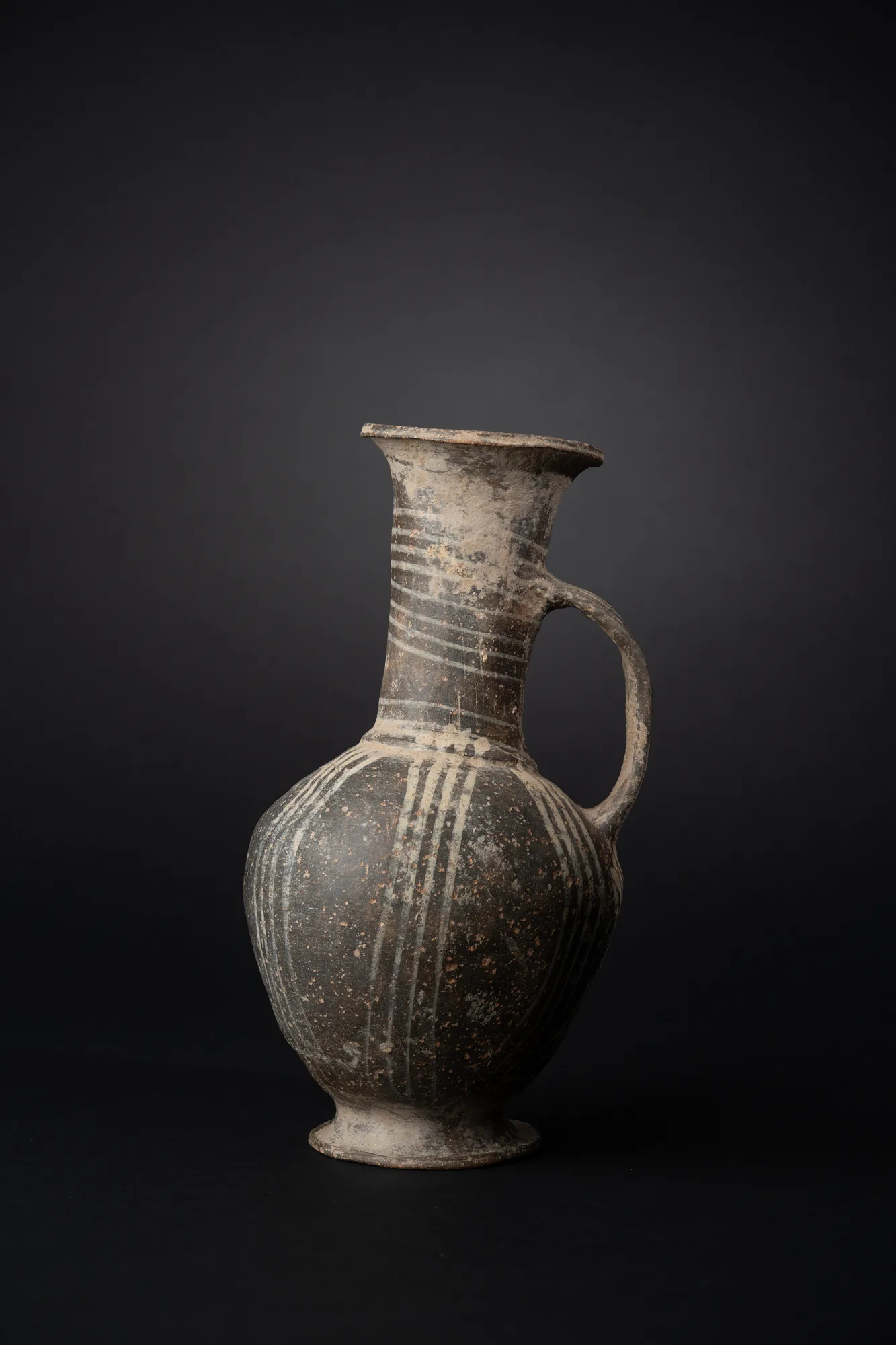
The best-known shape is the bilbil, a small juglet with a globular body and a tall narrow neck, often compared to an upturned poppy head (whether it carried opium is unresolved). There are also jugs up to 50 cm tall, carinated bowls with wishbone handles, bull-shaped vessels and female figurines. The Base Ring II jug shown here has white lines crossing into a lattice on a matt dark body, which sits slightly off vertical, a sign of hand building. Bilbils and Base Ring II jugs and bowls are common in collections.
Common confusions. Monochrome is thicker, undecorated and visibly knife-pared. Middle Bronze Age Black Slip is softer and thicker. Iron Age Black Slip jugs are wheelmade and usually have trefoil mouths. See Base Ring, Base Ring bulls and Astarte figures.
Is it a White Slip "milk bowl"?
White Slip is handmade Late Bronze Age pottery with a thick, smooth, creamy-white slip covering a dark, gritty, iron-rich body. Where the slip is chipped the dark body shows, which settles most doubts. Uneven firing often leaves the slip cream at the rim and greyish-blue towards the base. The paint is dark brown, black or red-brown.
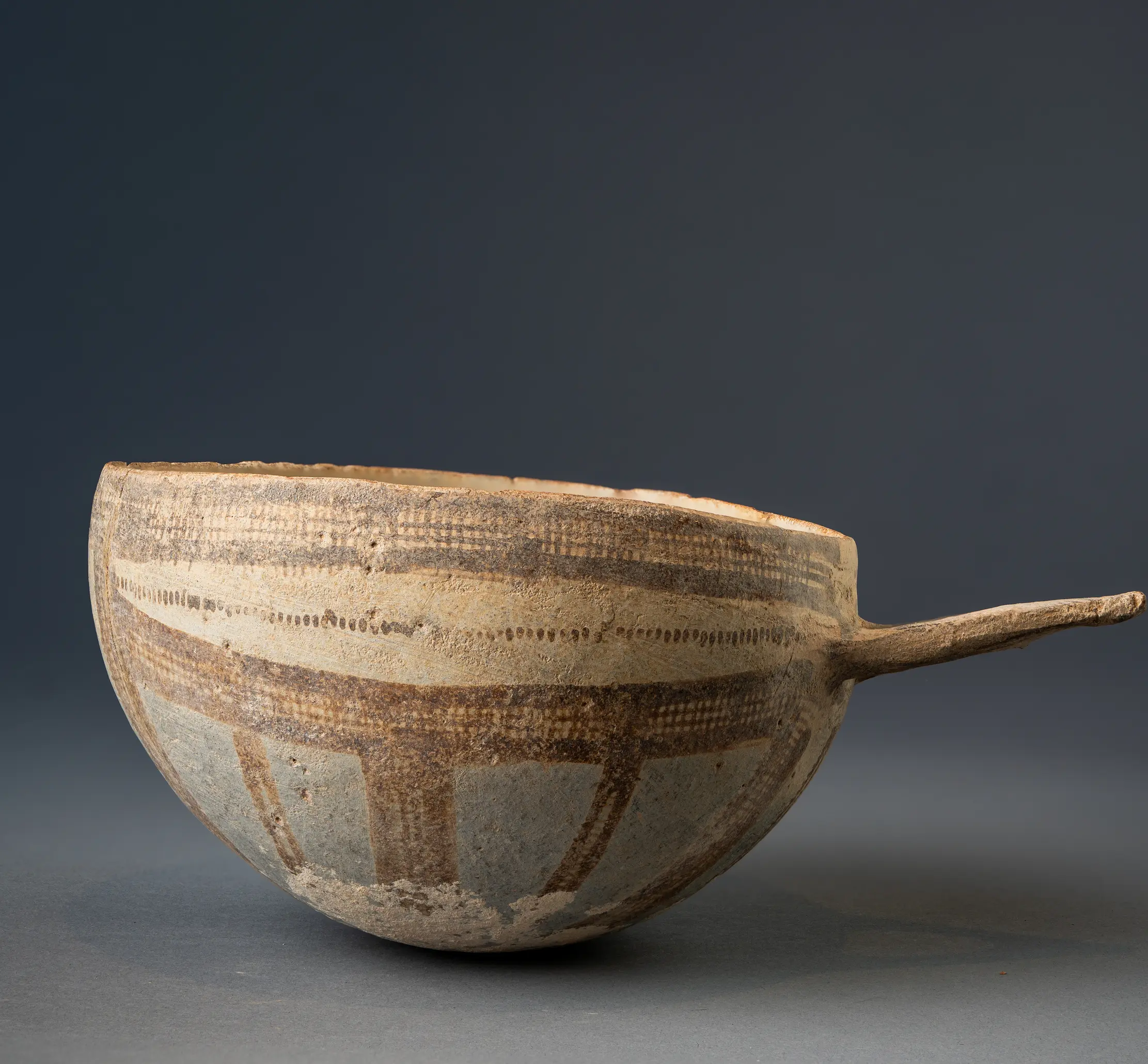
Most surviving White Slip is one shape: the hemispherical bowl with a wishbone handle rising from below the rim, about 17 to 21 cm across and 10 cm high, long nicknamed the "milk bowl". White Slip I (about 1575 to 1475 BC) is painted in fine, careful red-brown to black lines, wavy lines and dot-bordered lattices. White Slip II (about 1475 BC to the early twelfth century BC) is heavier and standardised, dominated by the ladder pattern (a band with cross strokes) hanging from the rim, with lattice bands and rows of dots, as on the bowl shown here. Jugs and kraters exist but are rarer.
White Slip bowls are fairly common, and many have been broken and restored. A pot with a pale ground and paint but a light-coloured body and Middle Bronze Age shape is more likely White Painted. The White Slip page and the article on how White Slip was made go further.
What about plain and wheelmade Late Bronze Age pots?
Monochrome (about 1650 to 1340 BC) is handmade and undecorated. Erik Sjöqvist described its clay as "buff or reddish in colour, sometimes brick-red and in a few cases pink or grey"; the main shapes are a carinated bowl with a wishbone handle and a jug with a pinched lip, and the surface often shows vertical paring with a knife [13]. Russell, who classified the plain wares from Kalavasos-Ayios Dhimitrios, admits that "there are more distinct wares than there are terms" [13]. It is rarely offered under its own name.
Plain White, handmade from the Middle Bronze Age and wheelmade from the Late, has no paint and little or no polish. Lindy Crewe stresses that "the surface of Plain White is not necessarily white": it can be cream, pink or buff, with or without a pale slip [5]. Typical shapes are trefoil and round-mouthed jugs, kraters, bowls and juglets; over-fired pieces turn greenish. Gjerstad's Iron Age Plain White is a separate series, and by the fourth century BC most pots placed in Cypriot tombs were plain [3]. Without a findspot, Plain White is hard to date.
Bichrome Wheelmade (about 1600 to 1450 BC) was the first Cypriot fine ware made on the wheel: a light, smoothed surface with red and black paint on the upper part of tankards, kraters and jugs, in metopes, cross-hatching and checkerboards, sometimes with birds, bulls or fish. It is rare in private hands; see Bichrome.
Is it Iron Age White Painted or Bichrome?
These are the wheelmade painted wares of the Cypro-Geometric, Cypro-Archaic and Cypro-Classical periods, about 1050 to 310 BC, and together they are the commonest group of Cypriot pottery on the market. The clay is buff, cream or greenish under a slip of the same colour. White Painted carries dull, matt black or dark brown paint only. Bichrome adds red: in Gjerstad's words, "the ornaments are painted in black and supplementary red colour" [3].
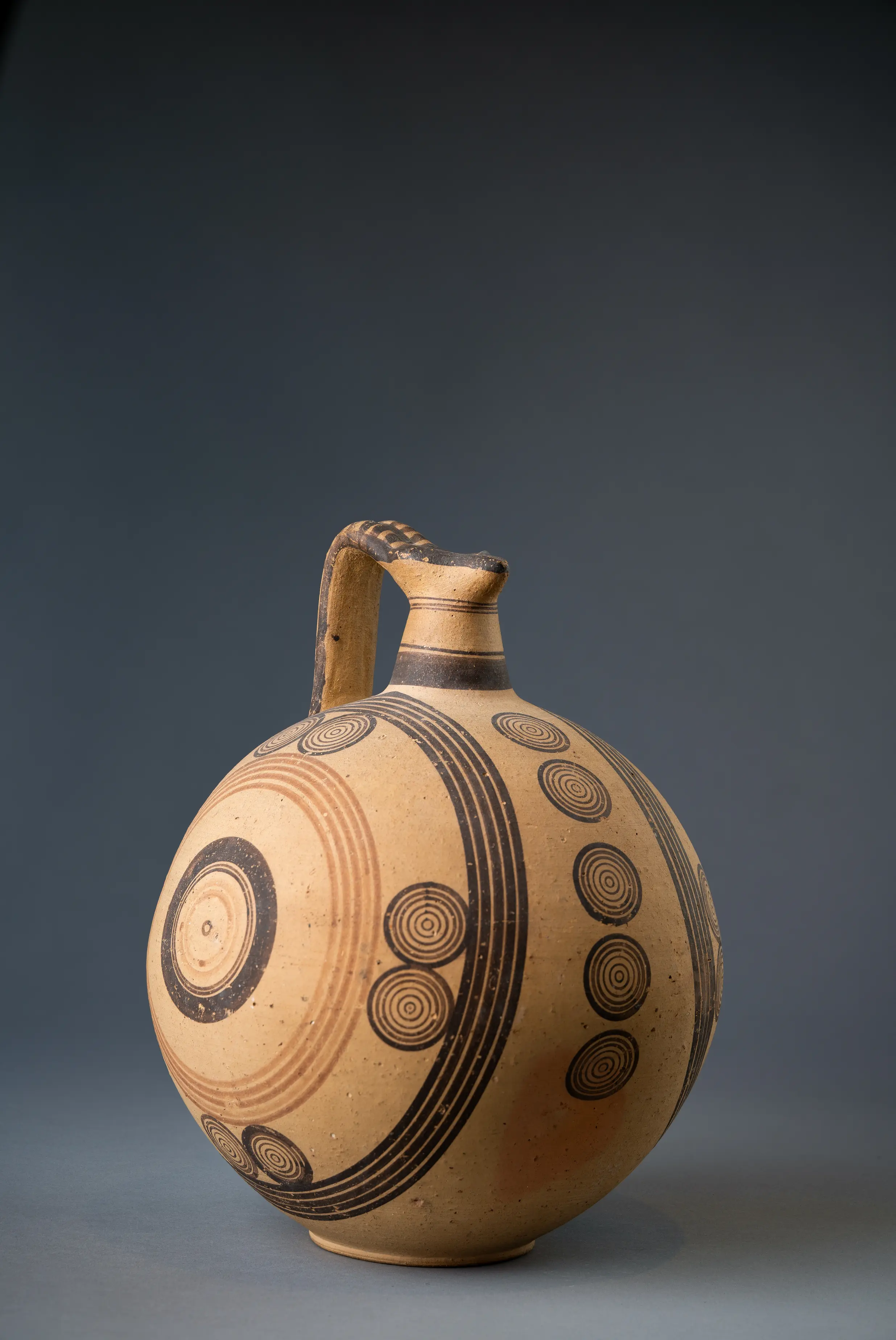
Look for bands and concentric circles, drawn with a multiple brush or compass while the pot turned, which is why they nest so neatly. Circle systems are often set in rows across the body, a style Gjerstad called "a veritable circle dance on the pots" [3]; the 31 cm Bichrome IV trefoil jug shown here carries vertical circle systems in red and black. Eastern workshops favoured lotus flowers. Some Archaic jugs carry a single bird or motif on a bare body, the free-field style; these are the exception in their own period and are rare and costly today. In the Classical period decoration thins to a few encircling lines.
Shapes include trefoil (pinched-mouth) jugs, barrel jugs lying on their side, amphorae up to 80 cm tall, bowls, juglets and, in the Cypro-Geometric period, plates decorated mainly on the underside.
Common confusions:
- Bronze Age White Painted is handmade, with beaked cut-away necks and round bases.
- White Painted against Bichrome: red paint fades and flakes, so a pot that looks White Painted may once have been Bichrome. Careful catalogues sometimes say "Bichrome IV or White Painted IV".
- Mycenaean and Aegean-style pots, which reached Cyprus in the Late Bronze Age, have a lustrous, semi-glossy paint on very fine pale clay and Aegean shapes such as stirrup jars; Cypriot Iron Age paint is matt. See Mycenaean imports and local imitations.
- Proto-White Painted, of the eleventh century BC, has uneven orange-brown paint, where White Painted I has a uniform dull black [15]. See Proto-White Painted.
Is it Black-on-Red?
Black-on-Red is a thin-walled, wheelmade Iron Age ware with a red or orange slip burnished to a lustre and painted in matt black, made in quantity from the late tenth century BC to about the end of the seventh, with later stages into the Classical period [14]. Decoration is thin bands and small, neat concentric circles on the shoulder; the black "sometimes fades to purple or brown". Nicola Schreiber, who wrote the standard study, says the ware "is, in fact, easily recognisable on examination and has seldom been mistaken for another ware" [14].
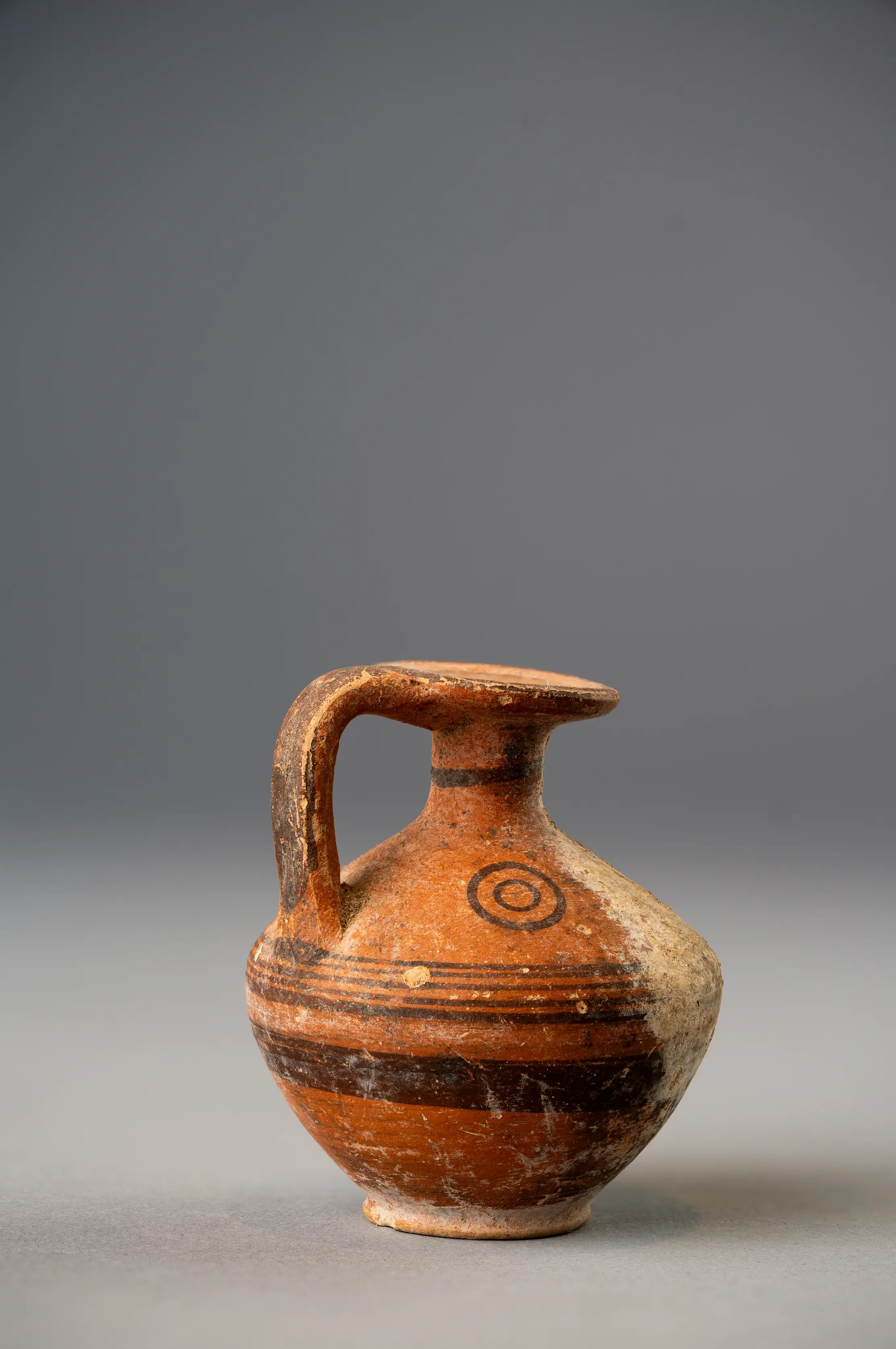
Above all it is a ware of small juglets, mostly 6 to 13 cm tall, with a ridge on the neck where the handle joins, a flaring lip or disc mouth and a flat or disc base [14]; there are also bowls and plates. The squat juglet shown here, with one double-ringed circle on its shoulder, is typical. Juglets are among the most frequently offered small Cypriot pots.
Old labels often call it "Cypro-Phoenician", from an older belief that the ware was Phoenician; the origins of Black-on-Red explains why it is now treated as Cypriot. See also Black-on-Red.
Bichrome Red, Red Slip and Black Slip (Iron Age)
Bichrome Red has the same red slip, painted "with black and supplementary white paint; occasionally red colour is used instead of white" [3]. The white is the diagnostic and also the most fragile part, so a pot that now looks Black-on-Red may once have been Bichrome Red. Common shapes are jugs, amphorae and juglets, including figure-jugs with a small woman holding a jug on the shoulder. See Bichrome Red.
Iron Age Red Slip is the same red-slipped ware without paint, most often carinated bowls and jugs. Red-slipped pottery was also made across the Levant, so a plain red bowl is hard to place without a findspot. Iron Age Black Slip, common in the Cypro-Geometric period [3], includes jugs with vertical grooves or ribs copying metal, sometimes called "Bucchero", a word borrowed from Etruscan pottery with no connection to it.
What else might be in a Cypriot collection?
A few rarer classes turn up often enough to name:
- Combed ware and Red-on-White, Neolithic and Chalcolithic, rare outside museums.
- Drab Polished, a duller brownish-grey polished ware of western Cyprus.
- Red Lustrous Wheelmade, very hard and glossy red, mostly spindle bottles; whether it was made in Cyprus is still argued.
- White Shaved juglets, Late Bronze Age dippers shaved vertically with a knife to a point.
- White Painted Wheelmade III, the painted ware of the end of the Bronze Age (see the Bronze to Iron Age transition).
- Attic black-gloss, fine glossy black cups and bowls imported from Athens in the Classical period.
- Hellenistic unguentaria, spindle-shaped unslipped bottles of the late fourth to second centuries BC.
Is it a figurine rather than a pot?
Cypriot clay figures share the wares of the pots. Plank figures are flat, rectangular human figures of incised Red Polished from the Early and Middle Bronze Age; they are among the most faked Cypriot objects, so read the replicas guide before trusting one. Hollow Red Polished animal vessels are pots. Late Bronze Age Base Ring figures, nude females with bird-like or human faces, are flat, dark and incised, and the same ware was used for hollow bull-shaped vessels.
Iron Age snowman figurines, mostly 8 to 20 cm tall, have a columnar body flaring to a flat base, a pinched beak-like face and pellet eyes, often with a pale slip and red or black paint. Many have hollow bodies thrown on the wheel with hand-made heads and arms; others are solid or have moulded faces [16]. In photographs they can resemble Base Ring bird-faced figures, which are flat slabs of dark fabric. Horse-and-rider figurines belong to the same Iron Age tradition, and later mould-made heads are covered in how Cypriot figurines are classified.
When can't I tell, and what photos help?
Some pots cannot be identified by eye. A red-slipped juglet under a crust of lime could belong to several wares, and only a conservator's cleaning might show which; worn paint, as the sections above show, can move a pot from one ware to another. If your pot falls into one of these gaps, send us photos and we will tell you what we can see.
The pictures that help most are:
- The whole pot from the front, back and both sides, against a plain background, with a ruler.
- The base, straight on.
- The inside of the neck or mouth, lit with a torch.
- A close-up of the surface in low, raking light, which shows polish, incision and brush marks.
- Any chip or break that shows the body under the slip.
- Every label, number, seal and paper, front and back.
Once you know the ware, the next questions are usually what it is worth and how it left Cyprus: see what a Cypriot antiquity is worth and brought home from Cyprus.
References
- 1.Merrillees, R. S. (1991). The principles of Cypriot Bronze Age pottery classification. In J. A. Barlow, D. L. Bolger & B. Kling (Eds.), Cypriot Ceramics: Reading the Prehistoric Record (University Museum Monograph 74, pp. 237-240). University of Pennsylvania Museum.
- 2.Stager, L. E., & Saltz, D. L. (1974). The Swedish Cyprus Expedition, 1927-1931. In L. E. Stager, A. Walker & G. E. Wright (Eds.), American Expedition to Idalion, Cyprus: First Preliminary Report, Seasons of 1971 and 1972 (pp. xxix-xxx). American Schools of Oriental Research.
- 3.Gjerstad, E. (1948). The Swedish Cyprus Expedition, Vol. IV, Part 2: The Cypro-Geometric, Cypro-Archaic and Cypro-Classical Periods. Swedish Cyprus Expedition.
- 4.Hirschfeld, N. (2011). The Cypriot ceramic cargo of the Uluburun shipwreck. In W. Gauss, M. Lindblom, R. A. K. Smith & J. C. Wright (Eds.), Our Cups Are Full: Pottery and Society in the Aegean Bronze Age (pp. 115-120). Archaeopress.
- 5.Crewe, L. (2015). Plain wares and urban identities in Late Bronze Age Cyprus. In C. Glatz (Ed.), Plain Pottery Traditions of the Eastern Mediterranean and Near East (UCL Institute of Archaeology Publications 67). Left Coast Press.
- 6.Vaughan, S. J. (1991). Material and technical characterization of Base Ring ware: A new fabric typology. In J. A. Barlow, D. L. Bolger & B. Kling (Eds.), Cypriot Ceramics: Reading the Prehistoric Record (University Museum Monograph 74, pp. 119-130). University of Pennsylvania Museum.
- 7.Webb, J. M., & Frankel, D. (1999). Characterizing the Philia facies: Material culture, chronology, and the origin of the Bronze Age in Cyprus. American Journal of Archaeology, 103(1), 3-43.
- 8.Webb, J. M., & Frankel, D. (2013). Cultural regionalism and divergent social trajectories in Early Bronze Age Cyprus. American Journal of Archaeology, 117(1), 59-81.
- 9.Karageorghis, V., with Mertens, J. R., & Rose, M. E. (2000). Ancient Art from Cyprus: The Cesnola Collection in the Metropolitan Museum of Art. The Metropolitan Museum of Art.
- 10.Åström, P. (1972). The Swedish Cyprus Expedition, Vol. IV, Part 1B: The Middle Cypriote Bronze Age. Swedish Cyprus Expedition.
- 11.Crewe, L. (2009). Regionalism and the first appearance of Plain White Handmade ware in the Middle Cypriot Bronze Age. In I. Hein (Ed.), The Formation of Cyprus in the 2nd Millennium B.C. (Contributions to the Chronology of the Eastern Mediterranean 20). Austrian Academy of Sciences Press.
- 12.Åström, P. (1966). Excavations at Kalopsidha and Ayios Iakovos in Cyprus (Studies in Mediterranean Archaeology 2). Lund.
- 13.Russell, P. J. (1991). Handmade burnished wares of the Late Bronze Age: Toward a clearer classification system. In J. A. Barlow, D. L. Bolger & B. Kling (Eds.), Cypriot Ceramics: Reading the Prehistoric Record (University Museum Monograph 74). University of Pennsylvania Museum.
- 14.Schreiber, N. (2003). The Cypro-Phoenician Pottery of the Iron Age (Culture and History of the Ancient Near East 13). Brill.
- 15.Iacovou, M. (1991). Proto-White Painted pottery: A classification of the ware. In J. A. Barlow, D. L. Bolger & B. Kling (Eds.), Cypriot Ceramics: Reading the Prehistoric Record (University Museum Monograph 74, pp. 199-205). University of Pennsylvania Museum.
- 16.Young, J. H., & Young, S. H. (1955). Terracotta Figurines from Kourion in Cyprus. The University Museum, University of Pennsylvania.