
Contents
A krater is a large open vessel with a wide mouth, used for mixing and serving drink. In Cyprus the shape belongs above all to the Late Bronze Age, when painted Mycenaean kraters were shipped to the island in numbers that "almost rival" those found in mainland Greece, and when Cypriot potters began to make their own [1]. Most of the Mycenaean examples on the island come from tombs, and their painted horses and chariots made them one of the best-known imports of the period. After a gap at the end of the Bronze Age the shape returned in the Cypro-Geometric period, and Greek kraters of the Classical and Hellenistic periods reached the island later still. You can see all kraters in the catalogue.
Shape and terms
In the Late Bronze Age Aegean, kraters were "some of the largest fine-ware vessels in the ceramic repertoire", about 35 to 50 cm high with some larger, and the broad shoulder and upper body gave painters a wide field for pictures [1]. The form seems to have Minoan antecedents [1]. Specialists classify Mycenaean kraters by Arne Furumark's shape numbers (FS), published in 1941 and refined by Penelope Mountjoy in 1986 and 1999. Laerke Recht and Christine Morris sort the kraters that carry chariot scenes into three families [1]:
| Family | Furumark shapes | Form | Handles | Date (Aegean phases) |
|---|---|---|---|---|
| Stemmed (open) krater | FS 7–9 | Broad opening, no neck, stemmed base | Vertical strap handles | LH IIIA2 early |
| Amphoroid krater | FS 53–55 | Neck much narrower than the body; tall | Vertical strap handles, rim to upper shoulder | LH IIIA2–IIIB |
| Ring-based (loop-handled) krater | FS 281–284 | Broad opening, no neck, ring base | Horizontal loop handles | LH IIIB–IIIC |
Cypriot terms map onto these families only in part. The amphoroid krater keeps its name. The ring-based form is the one that Cypriot catalogues call a bell krater: a British Museum example from Klavdia is described as a "bell krater of Furumark type FS 281, with ring base and round loop handles" (British Museum 1899,1229.129; catalogue record). "Chariot krater" is a description of decoration, not a shape: it means any krater painted with a horse-drawn chariot, and the amphoroid krater carries the motif far more often than the others [1]. The column krater belongs to a different world, the Greek painted pottery of the first millennium BCE (see below).
Amphoroid kraters
The amphoroid krater has a narrow neck set on a broad body, which "restricts access to the interior and creates a taller, more imposing vessel"; the neck grows taller over the life of the form, and two vertical strap handles run from rim to upper shoulder [1]. It is "by far the most commonly used shape for chariot scenes", and it dates to LH IIIA2–IIIB [1], roughly the fourteenth and thirteenth centuries BCE. See all amphoroid kraters in the catalogue.
The Mycenaean examples found in Cyprus were imports. Recht and Morris catalogue 381 chariot kraters, more than doubling Joost Crouwel's 1981 count, and conclude from ceramic and chemical analysis that all of those found so far were made in Greece, most likely in the Argolid, where the potters' quarter at Berbati has a concentration of chariot krater fragments unmatched elsewhere in Greece [1]. The earliest chariot kraters of all, dated LH IIIA2 early, were found outside Greece: 22 in Cyprus and two in the Levant. Recht and Morris read this as production for directional export from the start [1]. In Cyprus they cluster at Enkomi and, to a lesser degree, Maroni and Hala Sultan Tekke, and they are "conspicuously few or even completely absent" at Kition and Alassa [1].
Cypriot potters had their own amphoroid kraters. Bernard Knapp notes that kraters of this type are known on the island by the sixteenth and fifteenth centuries BCE (Late Cypriot I–II), in White Painted Wheelmade I–II and Proto-White Wheelmade I, and that the form had Levantine forerunners in the Middle Bronze Age [2, p. 37]. His example is a pictorial amphoroid krater from Room 58 of Temple 5 at Kition, dated to Late Cypriot IIIA in the twelfth century, with a butterfly ornament and a vertical row of fish from Levantine painting and a bird and fish of Aegean type. "Despite this array of influences, the end product seems purely Cypriot" [2, p. 37].
Plain examples were made too. The Ashmolean Museum has a plain white amphoroid krater, 19.1 cm high with a rim 22.3 cm across, from tomb 4 at Larnaka-Laxia tou Riou, excavated by John Myres in 1894 and allocated to Oxford by the Cyprus Exploration Fund (Ashmolean AN1896-1908.C.77). Maria Iacovou traces the amphoroid krater past the end of the Bronze Age: pictorial examples continue in Cyprus to Late Cypriot IIIA, and in Late Cypriot IIIB the shape is rare, never pictorial, and made in Proto-White Painted and plain ware [3]. Its second life in the Iron Age is described below.
Bell kraters
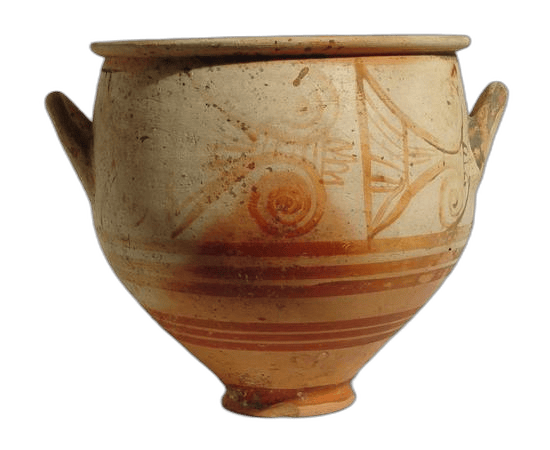
The bell krater is the ring-based krater with a broad mouth, no neck and two horizontal loop handles. In the Aegean the ring-based krater is an LH IIIB2–IIIC shape and became the dominant krater at Mycenae and Tiryns, but it was rarely exported: none has yet been identified in the Levant, and only six chariot-decorated examples have been found in Cyprus [1]. See all bell kraters in the catalogue.
The Cypriot bell krater grew out of these imports. Knapp calls it "an Aegean shape that had been integrated into the Cypriot pottery-making tradition before the end of 13th century BCE", made in the Rude or Pastoral Style [2, p. 37]. Recht and Morris also note that White Painted Wheelmade potters made "a shape similar to the ring-based krater" with elaborate pictorial scenes, but did not take over the horse and chariot [1]. The names of the style, and the debate over whether these kraters are poor copies or a local school, are set out under Mycenaean imports and local imitations and White Painted Wheelmade ware.
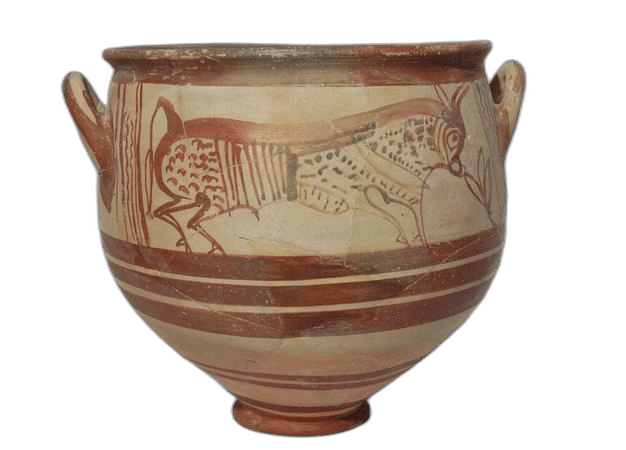
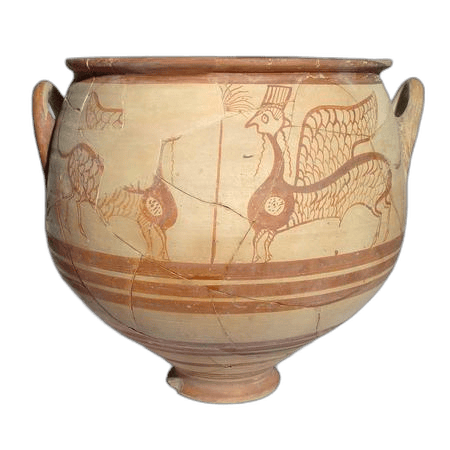
The British Museum's Enkomi bell kraters, from the Turner Bequest excavations of the 1890s, show the range. One (1897,0401.931; catalogue record), 26.5 cm high, has two long-necked birds with a mound between them on one side and three volute plants on the other. The largest (1897,0401.1260; catalogue record, shown at the head of this entry) stands 41 cm high and pairs a spotted bull with two sphinxes flanking a tree. A third (1897,0401.933; catalogue record) has a bull with lattice on its neck on one face and a spotted goat by a tree on the other. The Klavdia krater cited above has a bull sniffing leaves. Two rim and body sherds in the Hunterian Museum, Glasgow, are catalogued as Rude Style bell krater fragments (GLAHM D.1981.3 and D.1981.4).
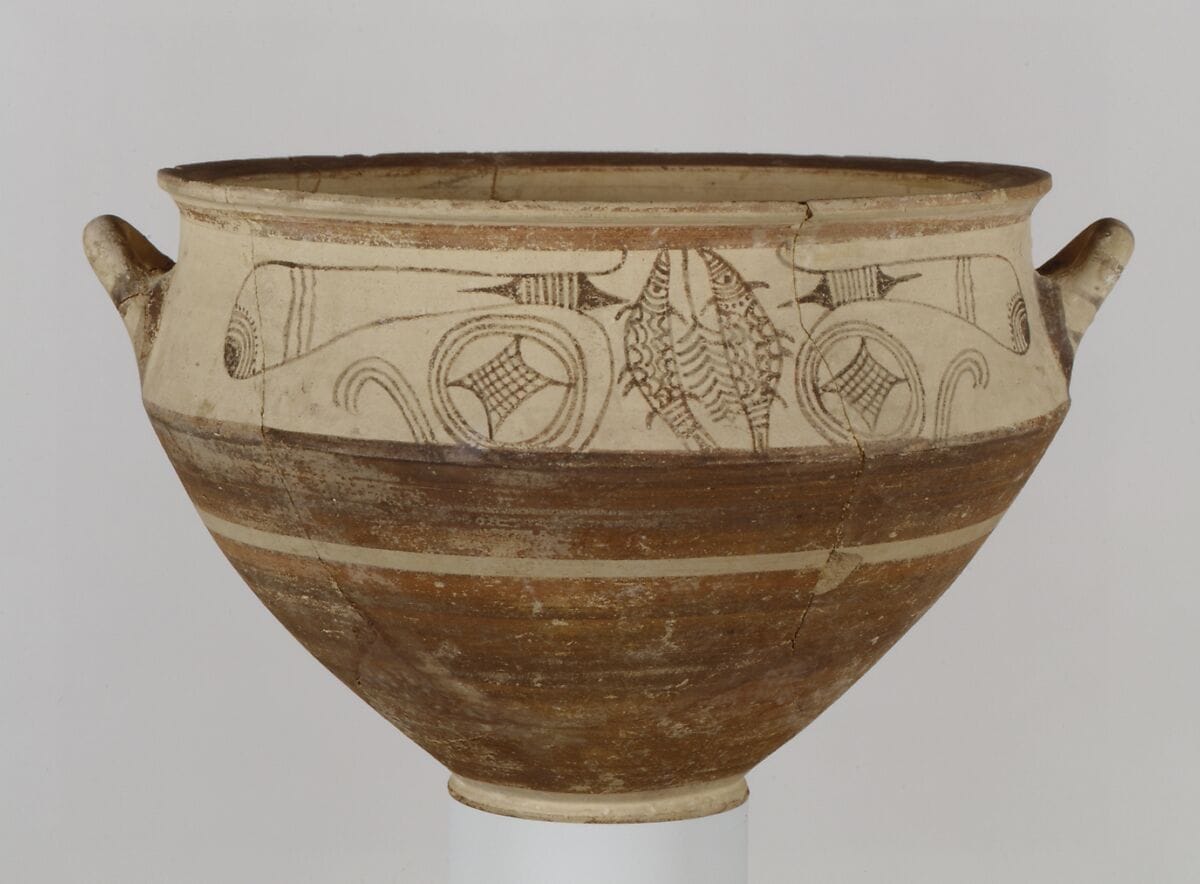
The shape lasted into the twelfth and eleventh centuries. Porphyrios Dikaios found numerous LH IIIC:1b bell kraters and fragments in the destruction of Level IIIB at Enkomi, painted with birds and fish drawn from Aegean, Levantine and Cypriot traditions [2, p. 37]. The Metropolitan Museum's terracotta krater said to be from Idalion (74.51.429), 21.5 cm high and 30.7 cm across, belongs to this phase: the Met describes its shape and decoration as derived from Aegean models of Mycenaean IIIC:1b and dates it to Late Cypriot III.
Column kraters
The column krater is a Greek shape of the first millennium BCE, best known from Attic painted pottery of the fifth century BCE, and it has no Late Bronze Age Cypriot ancestor. The catalogue has no column kraters yet. In Cyprus the form is attested late: John Lund's survey of pottery in Hellenistic and Roman Cyprus lists a column krater class among the table wares of the period, with examples from Panagia Emathousa-Aradippou and the Hill of Agios Georgios in Nicosia, the one complete example about 24.7 cm high, alongside a lidded bell krater about 27.5 cm high [4]. These later bell kraters are Greek vessels of the Hellenistic period and should not be confused with the Late Bronze Age bell kraters above.
The Iron Age return
Iacovou states plainly that "kraters are not a LC IIIB shape; they become obsolete by the end of LC IIIA" [3]. She notes exceptions: a large pictorial Proto-White Painted krater from the Sanctuary of the Ingot God at Enkomi, and a smaller krater with wavy lines from Alaas [3]. The Bronze to Iron Age transition entry sets this out with the other shapes that faded at the time.
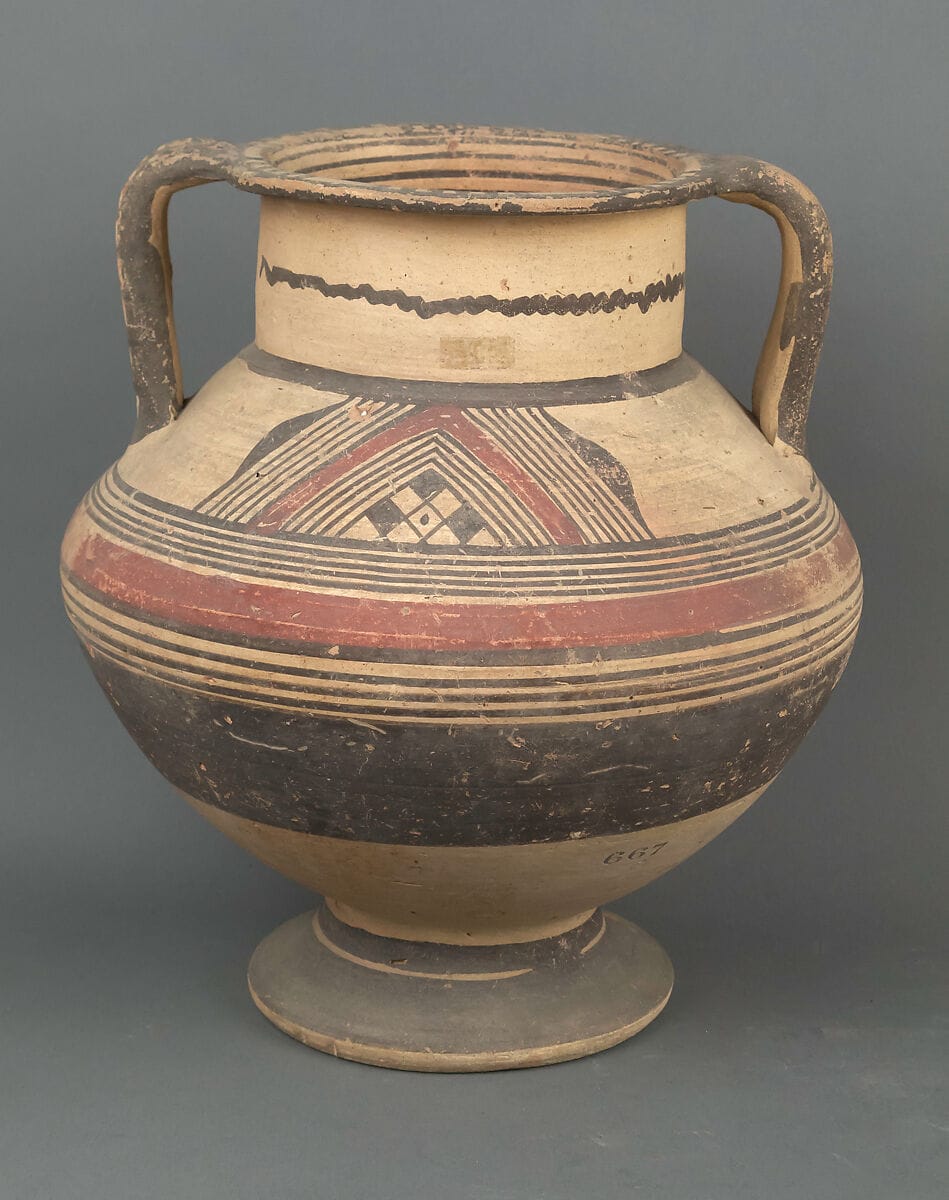
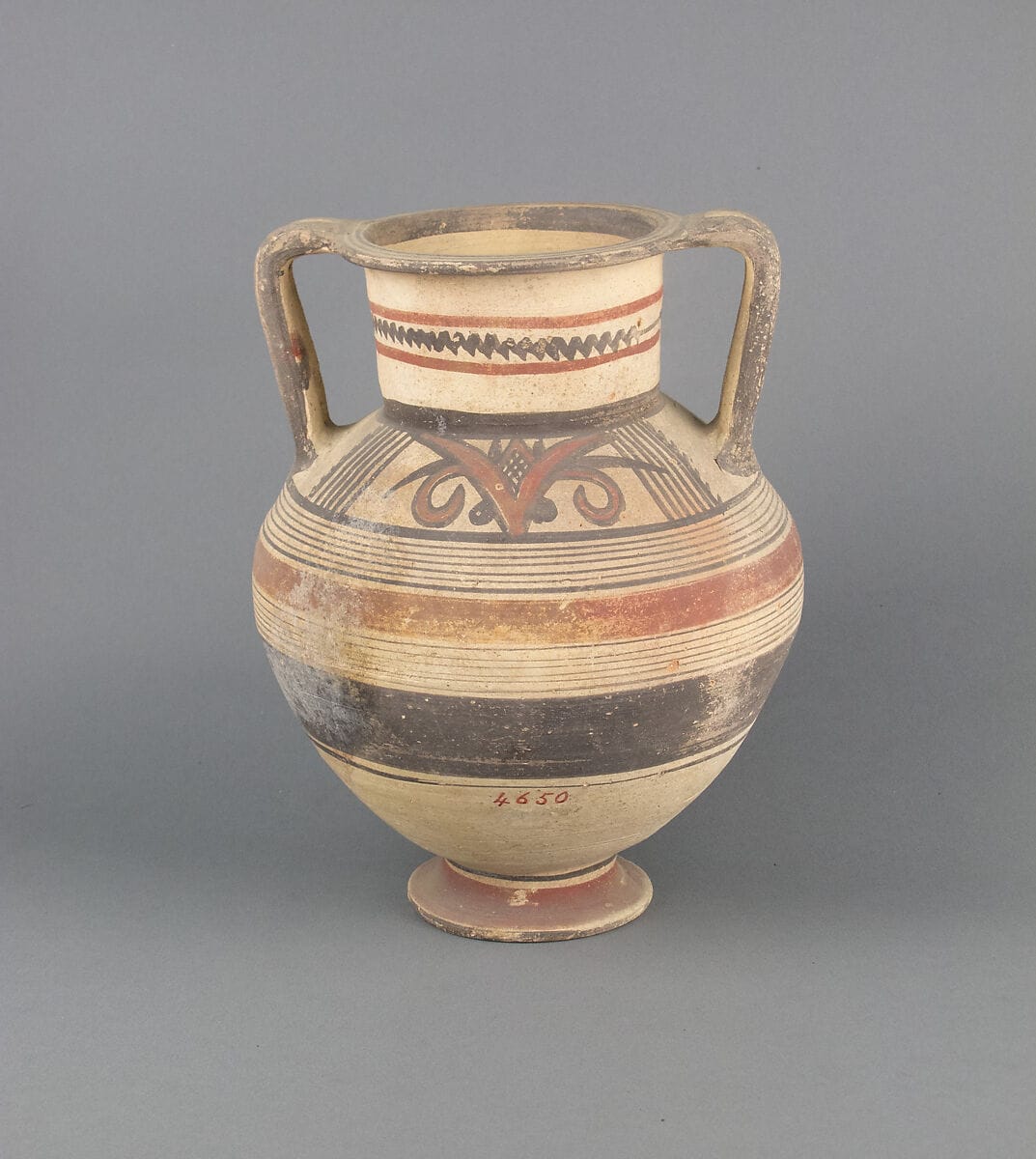
The gap did not last. In early Cypro-Geometric I amphoroid kraters are as rare as in Late Cypriot IIIB, but in late Cypro-Geometric I they increase in White Painted and Bichrome, and "the shape begins to have a second floruit as a pictorial vase" [3]. The picture has moved: "the pictorial scene is on the neck, not on the shoulder" [3]. For the amphorae that share this neck-and-handle arrangement, see Amphora.
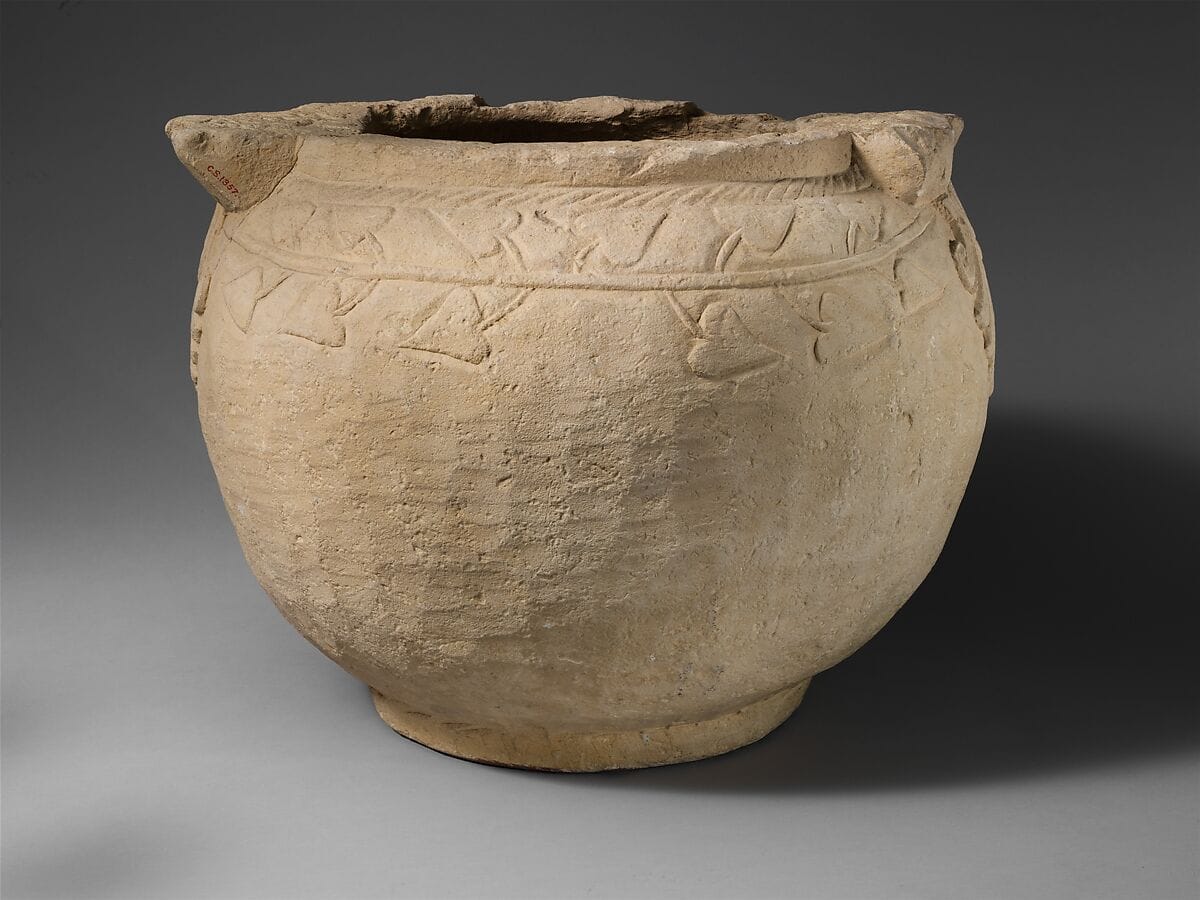
The Metropolitan Museum's Cesnola collection holds a run of Iron Age kraters without recorded findspots. A krater with bands, wavy lines, chequered triangles and lotus (21.9 cm) and a two-handled krater of angular form with three birds separated by trees on each side (22.6 cm) are catalogued as Cypro-Archaic I, and a grooved krater with a miniature bowl on one handle as Cypro-Geometric I. The shape also passed into stone. A Hellenistic limestone votive krater from the sanctuary at Golgoi, recorded as "found at entrance of Temple", is 43.8 cm high and 58.4 cm across and weighs 68 kg; the Met suggests that such large stone vases stood near the temple as votives or served in the cult.
Kraters in tombs
The contexts of the Mycenaean kraters split sharply between Greece and Cyprus. In the Aegean most krater fragments come from settlements or workshop dumps, and only ten from tombs; in Cyprus "this scenario is reversed", and most come from burials [1]. Recht and Morris think the share from tombs should be higher still, since many museum kraters without a recorded findspot are complete: 13 of the 40 without exact provenance are complete or nearly so [1].
Use-wear shows that the vessels served the living before they went into the ground, so the older view that they were made "particularly for tombs" does not hold [1]. Recht and Morris connect them to the feasting and drinking sets that Louise Steel has shown were a distinctive part of Cypriot funerary practice: the amphoroid krater "was well placed to function as a centrepiece for such ceremonial consumption of liquids" [1]. The processional chariot scenes could show an entourage on its way to the tomb, but "there is nothing specific in the imagery to either prove or disprove this notion" [1]. They likewise find little support in the krater paintings for a military reading of the chariot, and see the scenes as display of status shared across the eastern Mediterranean [1]. A few scenes look mythological, such as the so-called "Zeus krater", read as a chariot before Zeus holding scales [1].
Two older debates run through the literature. The first concerns where the pictorial kraters were made. In 1914 John Myres described the pictorial material as "a local Cypriote school", part of a long tradition that linked these vases to Mycenaean settlers on the island; laboratory analysis has since placed their production in Greece [1]. The second concerns the end of the Bronze Age, when Knapp reads the mixed Aegean, Levantine and Cypriot motifs on kraters such as the Kition piece as local hybrid products rather than evidence of colonists, arguing that twelfth- and eleventh-century Cypriot material culture reflects "an amalgamation of Cypriot, Aegean and Levantine materialities" [2, p. 32]. The Mycenaeans entry gives the wider picture.
Kraters in the catalogue
The catalogue's krater page gathers the island's examples, most of them from the Cesnola collection at the Metropolitan Museum and the British Museum's Enkomi excavations. No krater is yet in the Drakopoulos collection. For the wares in which kraters were made, see White Painted Wheelmade, Plain White, Proto-White Painted and Bichrome; for the open shapes kraters sat beside on the table, see Bowls and Jugs.
Objects on this page
 Furumark Bell KraterLate Bronze Age II · 1275–1200 BC
).webp) Plain white amphoroid kraterLate Bronze Age II · 1550–1200 BC
Plain white amphoroid kraterLate Bronze Age II · 1550–1200 BC- Pastoral Style Bell KraterLate Bronze Age II · 1250–1200 BC
 Pastoral Style Bell KraterLate Bronze Age II · 1250–1200 BC
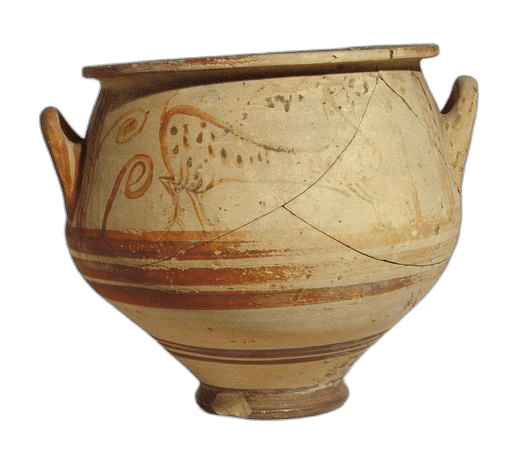 White Painted Bell KraterLate Bronze Age II · 1250–1200 BC
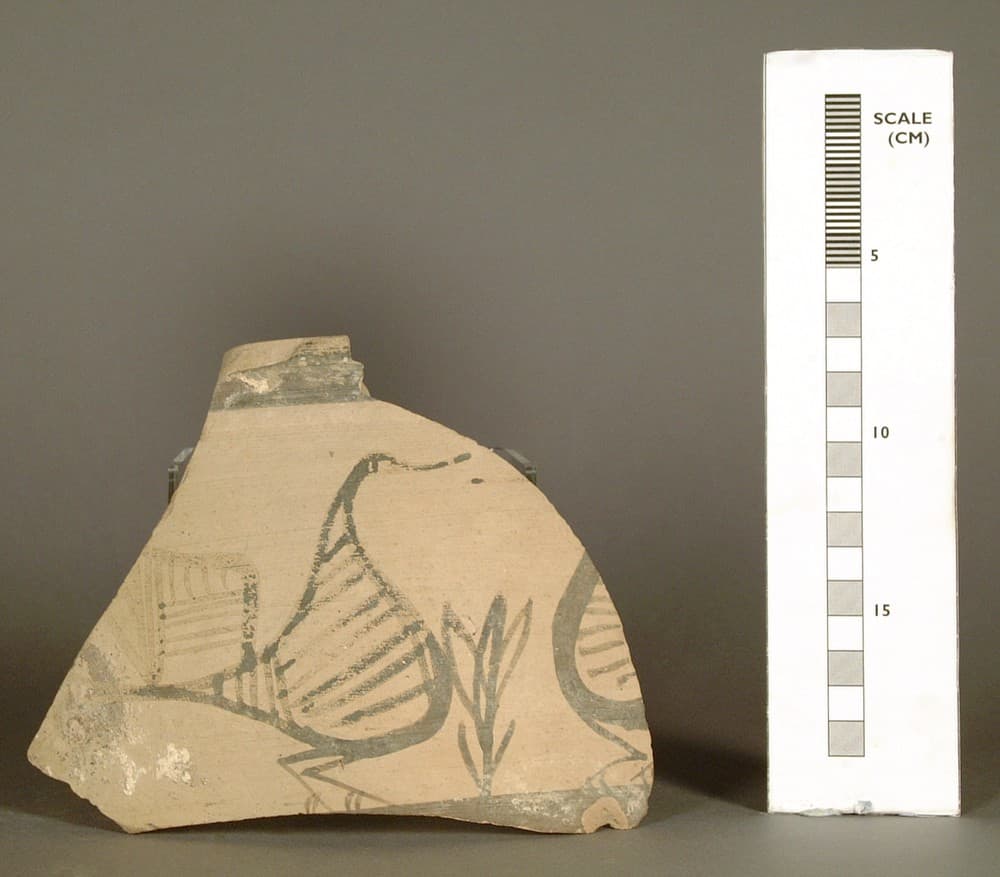 bell kraterLate Bronze Age II · 1400–1200 BC
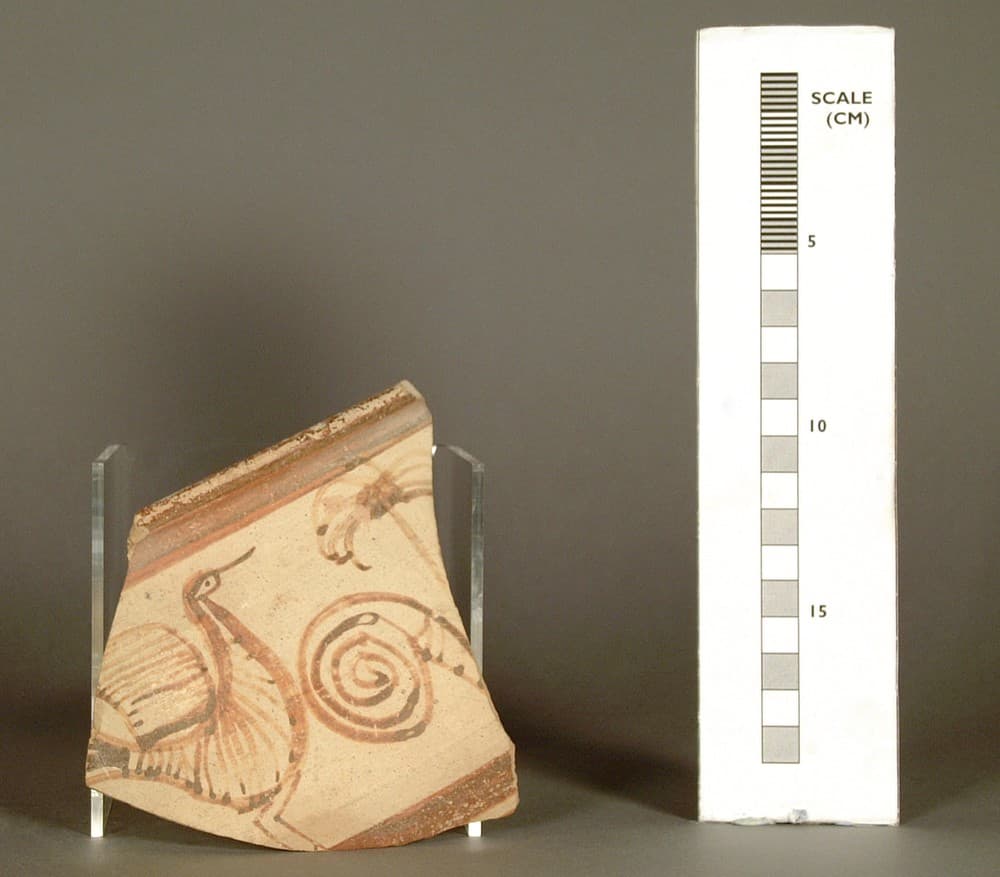 bell kraterLate Bronze Age II · 1400–1200 BC
- Terracotta kraterLate Bronze Age III · 1150–1100 BC
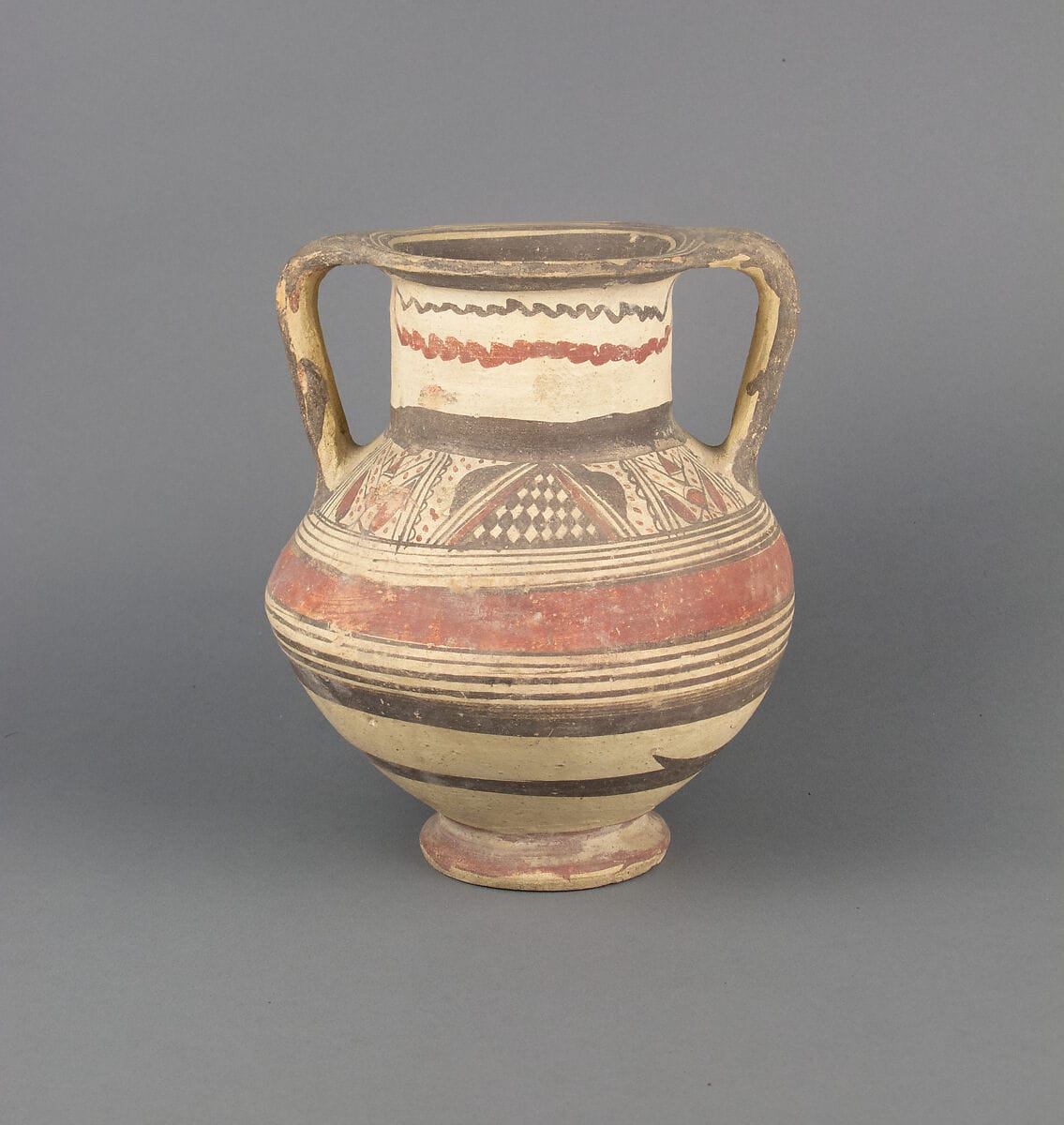 KraterArchaic I · 750–600 BC
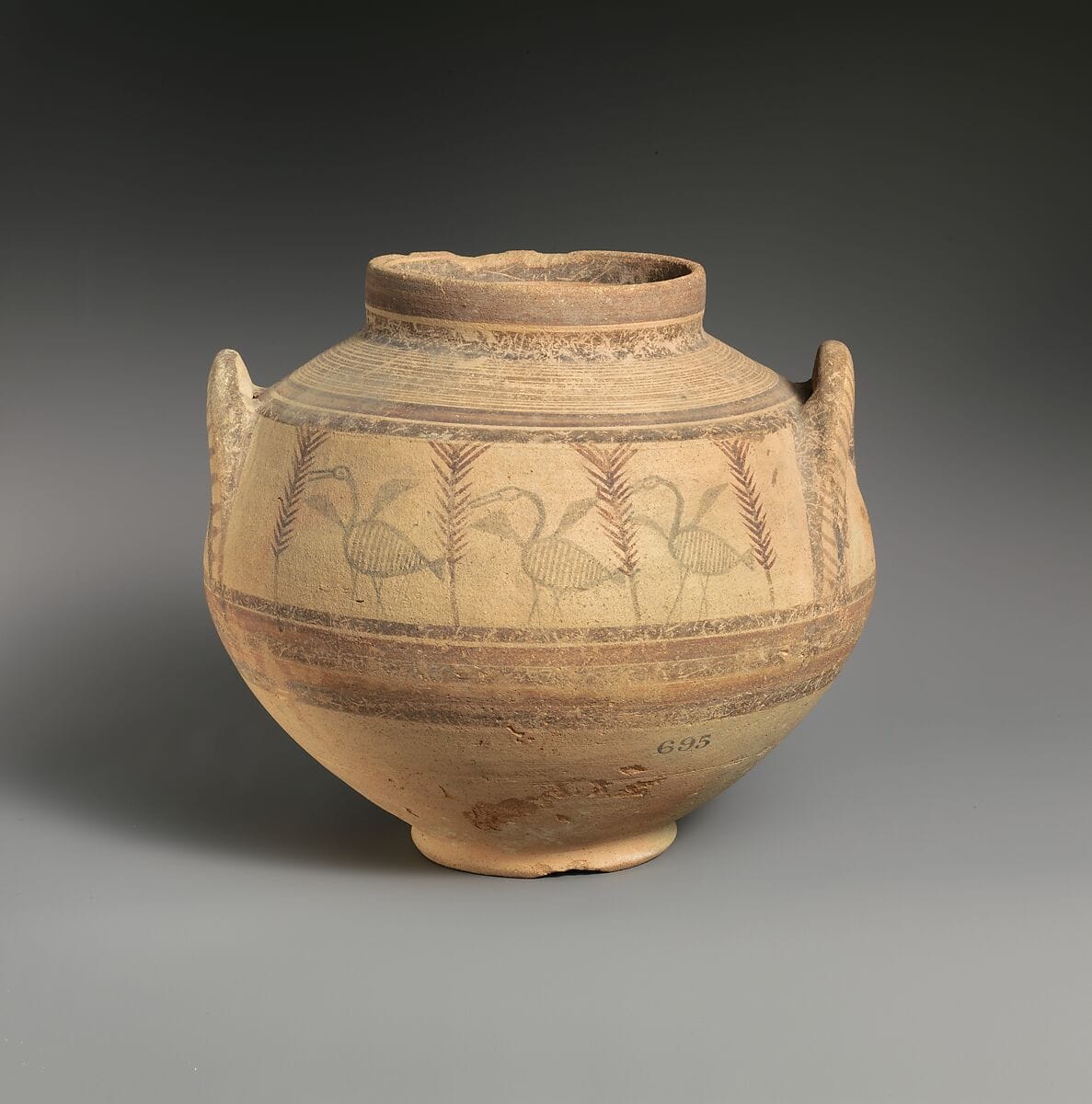 KraterArchaic I · 750–600 BC
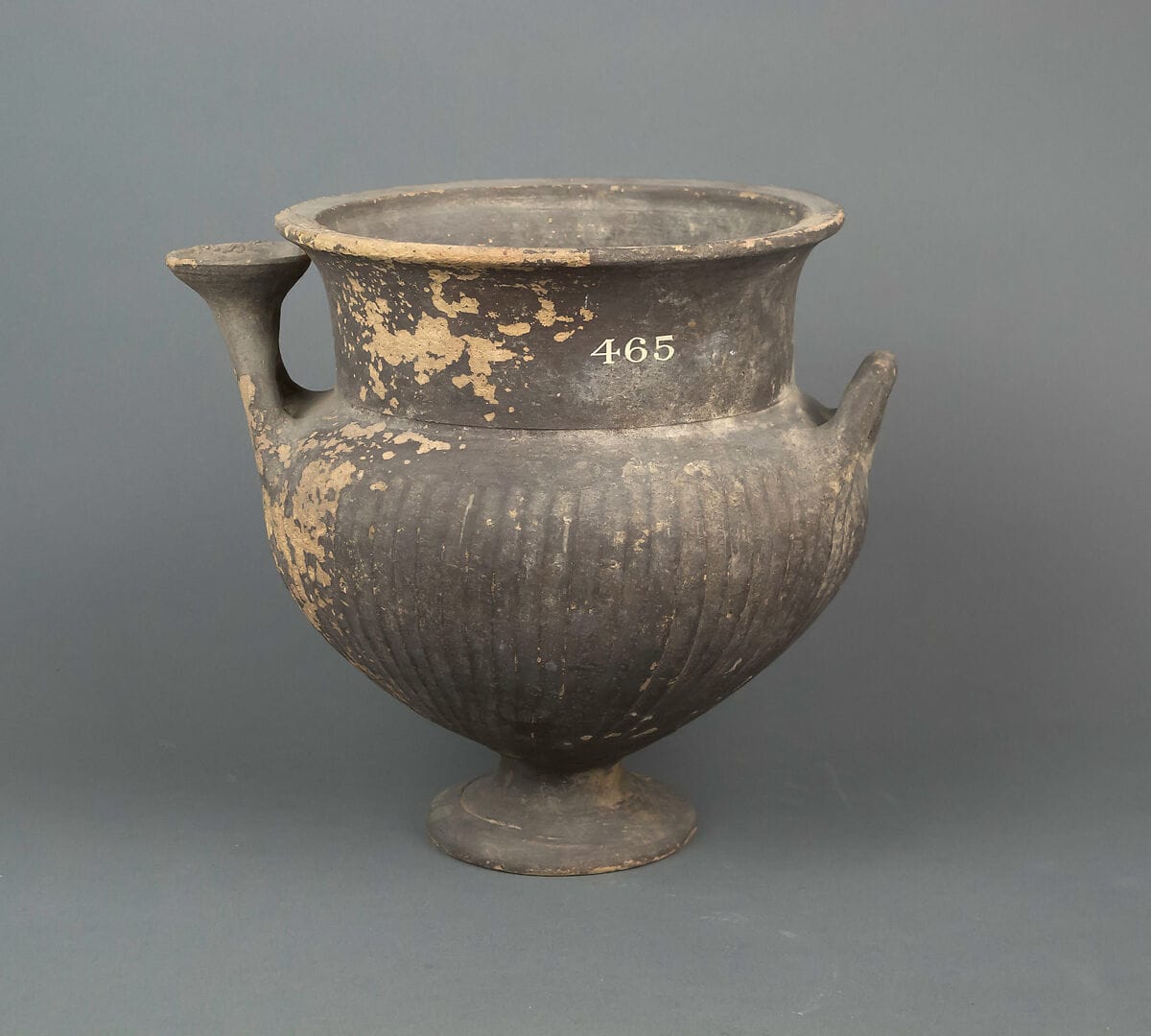 KraterGeometric I · 1050–950 BC
In the catalogue
References
- 1.Recht, L., & Morris, C. E. (2021). Chariot kraters and horse-human relations in Late Bronze Age Greece and Cyprus. Annual of the British School at Athens, 116, 95–132. https://doi.org/10.1017/S0068245421000022
- 2.Knapp, A. B. (2012). Matter of fact: Transcultural contacts in the Late Bronze Age eastern Mediterranean. In J. Maran & P. W. Stockhammer (Eds.), Materiality and social practice: Transformative capacities of intercultural encounters (pp. 32–50). Oxbow Books.
- 3.Iacovou, M. (1991). Proto-White Painted pottery: A classification of the fabric. In J. A. Barlow, D. L. Bolger, & B. Kling (Eds.), Cypriot ceramics: Reading the prehistoric record (University Museum Monograph 74). The University Museum, University of Pennsylvania.
- 4.Lund, J. (2015). A study of the circulation of ceramics in Cyprus from the 3rd century BC to the 3rd century AD (Gösta Enbom Monographs 5). Aarhus University Press.