
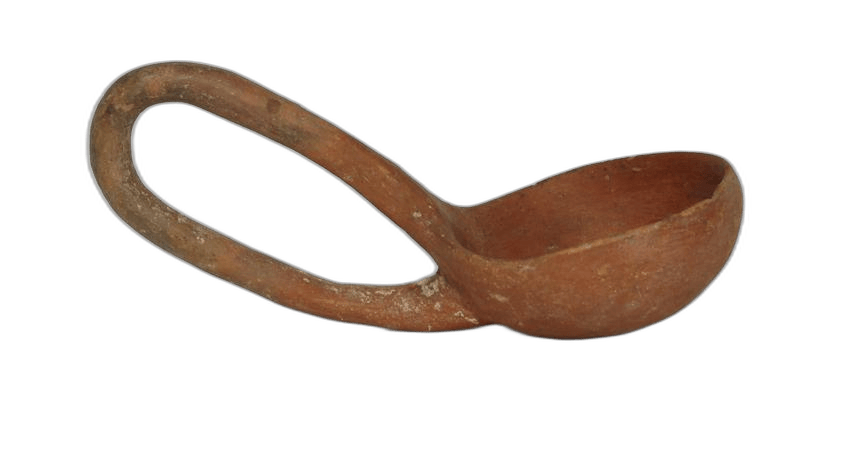
A dipper is a small vessel with one handle set high above its body, made to be lowered into a larger container and lifted out full. On this site it is one of the nine basic shapes, and the bucket gathers everything the museums variously call dipper, ladle, dipper cup, dipper bowl, kyathos, spoon and scoop, in clay, stone and bronze. The class is small but long-lived. It begins with the heavy Red Polished dippers of the Early Bronze Age, runs through the fine high-handled cups of the Middle Bronze Age and the Plain White dipper cups of the early Iron Age drinking set, and ends with bronze ladles in Archaic and Classical tombs. It also includes, by name only, the Late Bronze Age "dipper juglet," a closed export container that shares nothing with the open dipper except a Levantine label. Desmond Morris, who gave the class its most useful definition, chose "dipper" over the older "ladle" for a practical reason: two of the vessels in his own collection "are too big to be thought of as simple ladles" [1, p. 75].
Definition and the site's scheme
Morris's structural definition is the one the site follows. Dippers are "squat vessels with tall handles," a Bronze Age speciality occurring in Red Polished and White Painted ware, with the single handle attached either vertically or horizontally, and it "appears to have been used to facilitate dipping down into a liquid held in a larger vessel, or possibly into some sort of food solid such as seed or grain stored in a large jar" [1, p. 75]. He concedes that "some examples may be no more than small cups with abnormally exaggerated handles," but keeps them together "on structural grounds" [1, p. 75]. That is exactly the logic of the nine-shape scheme: a dipper is recognised by the proportion of handle to body, not by ware, period or presumed use.
The excavation typologies scatter the same objects. James Stewart's Corpus gives the tripod dipper its own class, Type VIII E, among the tripod vessels [2, p. 323], and files the open dippers as bowl types: the British Museum's Red Polished III dipper from the Cesnola-era acquisitions (1884,1210.95), a shallow round-based body with slightly flaring sides and "a single long vertical loop handle extending from lower body to rim," 11.3 cm high, is catalogued as Stewart Type XXII B /artifact/3505-red-polished-dipper. At the settlement of Alambra the excavators used the compound "dipper-amphorae" for medium-sized two-handled vessels of Red Polished A, which shows how blurred the edges of the class become once the handle is doubled [4]. The Iron Age typology of Palaepaphos-Skales lists the dipper as type XIII (xii) among the open shapes [8, p. 46].
Early and Middle Bronze Age: Red Polished dippers
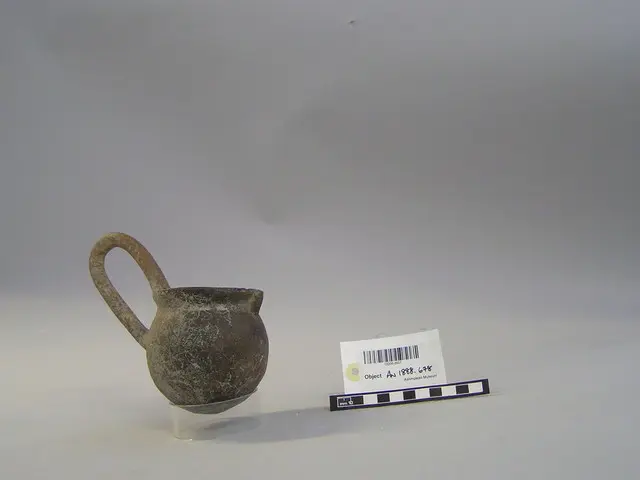
Two sizes of Red Polished dipper exist and they probably did different jobs. The large form is heavy-walled, with a cutaway spout and a tall, strong vertical handle: Morris illustrates an incised example 38.5 cm high (DM-IRP-72) and a mottled one of 25 cm with a single lug at the neck-base opposite the handle (DM-MRP-25) [1, p. 75]. These are jug-sized vessels whose handle rises well above the rim, and the cutaway spout borrowed from the contemporary jug makes them pourers as well as scoops. The Ashmolean's Red Polished III high-handled spouted dipper (AN1888.678), 15 cm high and 8.5 cm across, is a mid-sized version of the same idea, and the museum's Red Polished IV "dipper bowls" (AN1896-1908.C.20, AN1947.132) and Red Polished dippers of Middle Cypriot II to III date (AN1953.1088, 6.8 cm high; AN1965.730) show the small end of the range. The Larnaca District Museum displays a case of Red Polished dippers of both sizes.
The small form is what the settlement excavators call a bowl-ladle. At Marki-Alonia these are "hemispherical in shape, fine-walled and furnished with a high vertical handle," and they are rare: Andrew Sneddon recorded a single possible fragment in the cemetery material and notes that they are "similarly rare in the settlement assemblage," to the point that his one cemetery example was classified as a ladle "solely on the basis of the smallness of its dimensions" [3]. The rarity matters. If dippers were the standard implement for serving from the large round-bottomed jars that Louise Steel describes as set into hollows in Bronze Age floors [5], one would expect them everywhere; their scarcity suggests that most serving was done by tipping a jug or plunging an ordinary hand-held bowl, and that the purpose-made dipper was a specialised or occasional tool.
The tripod dipper, Stewart's Type VIII E, adds three short feet to a small deep body with one or two handles, one set higher than the other. Stewart grouped it with the tripod cooking pots, and the Middle Cypriot examples in the Liverpool and Phylaktou collections are catalogued under the same type [2, p. 323]. A vessel with feet is not lowered into anything; the type shows how "dipper" in the older literature drifted toward meaning any small handled cup, which is the ambiguity Morris tried to close.
Late Bronze Age: the dipper juglet and the stone ladle
The most widely distributed Cypriot object with "dipper" in its name is not a dipper at all. The White Shaved juglet of the Late Cypriot period is a closed, spindle-shaped container with a pointed base and a single handle, its surface pared with a knife, and it is called a dipper juglet because its shape "was certainly derived from the Middle and Late Bronze Age dipper-juglet tradition of Palestine," where such juglets were used to draw oil or wine from larger jars [6, p. 56]. Barry Gittlen showed that the Cypriot version was made by Cypriot methods, that the elongated form makes up 97 per cent of the White Shaved pottery found in Palestine and 94 per cent of that found on Cyprus, that three times as many have been found in Palestine as on the island, and that the Cypriot distribution is confined to the neighbourhood of Enkomi, the likely place of manufacture; his conclusion is that they "were manufactured specifically to meet the demands of the existing Palestinian market" [6, pp. 55–56]. A representative example is the White Shaved juglet from Lachish Tomb 1003 in Brussels (O 1514), 16.2 cm high, with trefoil mouth, raised handle and the diagnostic vertical trimming marks; the catalogue calls the class "imitations of Palestinian dipper juglets, most probably used as commodity containers" [7, cat. 87]. On this site these juglets are sorted under jug and discussed with the other small export containers under bottle; they are mentioned here so that the name does not mislead.
True ladles of the Late Bronze Age are more often stone or metal than clay. The Cesnola collection includes an alabaster spoon or ladle of Late Cypriot III date (Met 74.51.5119), and the deep hemispherical Plain White ladle in the British Museum (1982,0729.301), 17.5 cm high, with a thick vertical handle "swelling at the top into a suspension loop," belongs to the plain utilitarian wares that continue across the Bronze to Iron Age transition.
Early Iron Age: the dipper in the drinking set
The clearest functional context for any Cypriot dipper comes from the tombs of Palaepaphos-Skales. In the 1983 publication Vassos Karageorghis observed that the Plain White I dipper (type XIII (xii)) "is of a common shape and always occurs in Plain White I ware with drinking-sets of both the LC IIIB and CG I periods" [8, p. 46]. The 2008 and 2011 tombs confirmed the pattern: a Plain White I dipper with a shallow convex-sided bowl, flattened base and a raised horizontal loop handle at the rim, 15.5 cm in total height with a bowl only 8.7 cm across, was found among the White Painted I cups and bowls of a Cypro-Geometric chamber [9, Tomb 199, no. 42]. A vessel whose handle nearly doubles its height and whose bowl holds a single serving is a dipper in the strict sense, and its constant companions, the cups with double-curving sides and the trefoil jugs, tell us what it dipped into: the wine or other drink of a funerary meal. The Ashmolean's White Painted dipper cups (AN1885.530, AN1888.1255, AN1953.842) are the painted equivalents in the same period, and the British Museum's White Painted kyathos bowl uses the Greek name for the same thing.
Morris thought the shape did "not appear to survive into the Iron Age" [1, p. 75]. That is true of the heavy Red Polished dipper; it is not true of the class, which persists in Plain White and White Painted through the Cypro-Geometric period and then passes to metal. The British Museum's bronze dipper with a bird-head handle and the Cesnola collection's terracotta ladle-saucers of Late Classical date (Met 74.51.1988) mark the later end. By then the ladle was part of the wine service alongside the bronze strainer and the bowl, the set that the Skales excavators describe in Cypro-Geometric I and Cypro-Archaic warrior tombs [9, Tomb 199]; the strainers are treated under strainer.
Function: the limits of the evidence
The functional case for the dipper rests on shape and association, not on residues or wear. No published study reports contents, sooting or use-wear on a Cypriot dipper. The evidence is therefore: a handle that rises far above a small body, which makes sense only for lifting; a cutaway spout on the large Bronze Age form, which makes sense only for pouring; rarity in settlements, which argues against daily use; and repeated association with cups and jugs in tombs, which argues for the serving of drink at funerary meals. Morris's alternative, that some were scoops for grain or seed from storage jars, is not excluded by anything, and the large heavy-walled form would suit dry goods better than the fine Plain White cup would. The stone and metal ladles of the Late Bronze Age and Iron Age presumably served liquids, since a stone scoop for grain would be an odd extravagance.
Named examples
| Vessel | Ware and date | Collection and number | Size |
|---|---|---|---|
| Heavy-walled dipper with cutaway spout | Incised Red Polished, Early Cypriot | Desmond Morris collection DM-IRP-72 | H 38.5 cm |
| High-handled spouted dipper | Red Polished III | Ashmolean Museum AN1888.678 | H 15 cm, D 8.5 cm |
| Dipper, Stewart Type XXII B | Red Polished III | British Museum 1884,1210.95 | H 11.3 cm |
| Dipper | Red Polished, Middle Cypriot II–III | Ashmolean Museum AN1953.1088 | H 6.8 cm |
| Dipper bowl | Red Polished IV, Middle Cypriot I–II | Ashmolean Museum AN1896-1908.C.20 | |
| White Shaved 'dipper juglet', Lachish Tomb 1003 | White Shaved, Late Cypriot II | Royal Museums of Art and History, Brussels, O 1514 | H 16.2 cm |
| Alabaster spoon or ladle | Late Cypriot III | Metropolitan Museum of Art 74.51.5119 | |
| Ladle with suspension loop | Plain White, handmade | British Museum 1982,0729.301 | H 17.5 cm |
| Dipper with raised loop handle, Skales Tomb 199 no. 42 | Plain White I, Cypro-Geometric I | Kouklia, Palaepaphos excavations | H 15.5 cm, bowl D 8.7 cm |
| Terracotta ladle-saucer | Late Classical | Metropolitan Museum of Art 74.51.1988 |
Summary
The Cypriot dipper is defined by a handle out of proportion to its body, and that definition holds from the Early Bronze Age to the Classical period across clay, stone and bronze. The Red Polished dippers come in a heavy spouted size and a fine cup size, both uncommon in settlements; the Plain White dipper of the eleventh to ninth centuries is a fixed member of the funerary drinking set at Palaepaphos; and the metal ladle takes over in the Archaic tombs. The White Shaved "dipper juglet" is a Levantine name for a Cypriot export container and belongs with the jugs. What every dipper was lowered into is inferred rather than known, and the drink of the Cypro-Geometric tomb is the one context in which the inference is strong.
References
- 1.Morris, D. (1985). The Art of Ancient Cyprus, with a Check-list of the Author's Collection. Oxford: Phaidon.
- 2.Stewart, J. R. (1962). The Early Cypriote Bronze Age. In P. Dikaios & J. R. Stewart, The Swedish Cyprus Expedition, Vol. IV, Part 1A (pp. 205–401). Lund: The Swedish Cyprus Expedition.
- 3.Sneddon, A. C. (2002). The Cemeteries at Marki: Using a Looted Landscape to Investigate Prehistoric Bronze Age Cyprus (BAR International Series 1028). Oxford: Archaeopress.
- 4.Coleman, J. E., Barlow, J. A., Mogelonsky, M. K., & Schaar, K. W. (1996). Alambra: A Middle Bronze Age Settlement in Cyprus (Studies in Mediterranean Archaeology 118). Jonsered: Paul Åströms Förlag.
- 5.Steel, L. (2016). Kitchenalia in Bronze Age Cyprus. Gastronomica: The Journal of Critical Food Studies, 16(3), 79–90.
- 6.Gittlen, B. M. (1981). The cultural and chronological implications of the Cypro-Palestinian trade during the Late Bronze Age. Bulletin of the American Schools of Oriental Research, 241, 49–59.
- 7.Pilides, D., & Papadimitriou, N. (Eds.). (2012). Ancient Cyprus: Cultures in Dialogue (exhibition catalogue). Nicosia: Department of Antiquities, Cyprus.
- 8.Karageorghis, V. (1983). Palaepaphos-Skales: An Iron Age Cemetery in Cyprus (Ausgrabungen in Alt-Paphos auf Cypern 3). Konstanz: Universitätsverlag.
- 9.Karageorghis, V., & Raptou, E. (2016). Palaepaphos-Skales: Tombs of the Late Cypriote IIIB and Cypro-Geometric Periods (Excavations of 2008 and 2011). Nicosia: The Cyprus Institute.