
Contents
Red Lustrous Wheelmade ware (RLWm) is the finest-bodied pottery of the Late Bronze Age eastern Mediterranean: a hard, compact red clay, thrown on the wheel and burnished to a deep shine, made into a small set of distinctive shapes. Spindle bottles, lentoid or "pilgrim" flasks and long arm-shaped vessels turn up in Cypriot tombs, in Egypt and Nubia, along the Levantine coast and deep in Hittite Anatolia [1; 2, p. 105]. Most of what it held was probably a liquid, and for a century scholars have argued over where it was made. The ware sits alongside Base Ring and White Slip in Late Cypriot assemblages but, unlike them, it was thrown on the wheel. You can see all Red Lustrous Wheelmade ware in the catalogue.
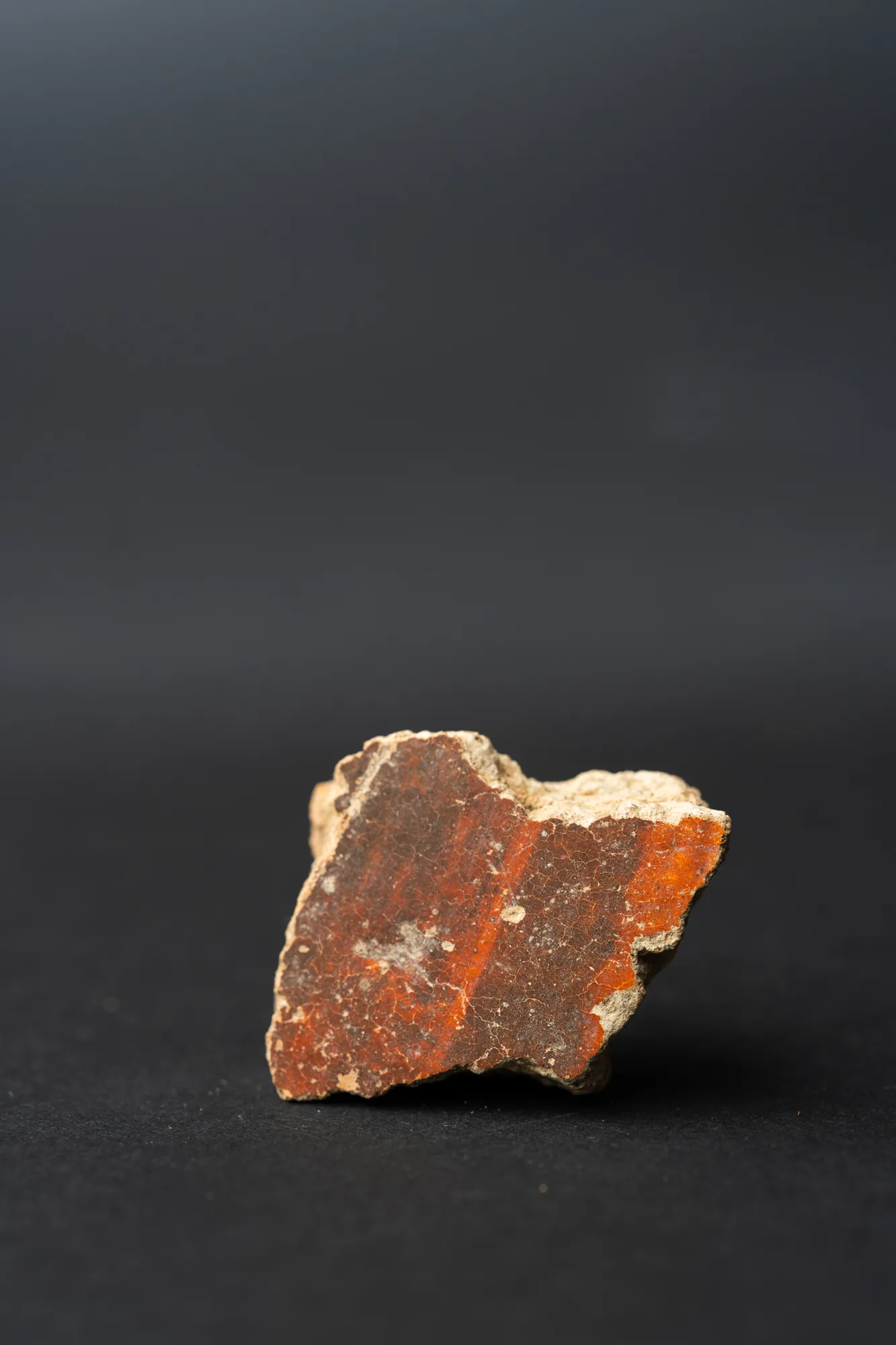
The name "Red Lustrous" is used for three unrelated things in Cypriot archaeology, so a warning first. It names a handmade red burnished pottery of the Late Neolithic Sotira culture (the Drakopoulos collection's Red Lustrous body sherd with fire-mottled slip belongs to that much earlier tradition, more than two thousand years before RLWm); it names the Late Bronze Age wheelmade ware described here; and it names an Iron Age ware of Einar Gjerstad's Cypro-Classical system, covered under Iron Age lustrous wares below.
Fabric and finish
Knappett, Kilikoglou, Steele and Stern define the ware by its surface: "the exterior surface of this ware, especially on closed vessels, is red and highly lustrous. This effect is created by careful burnishing (often in long vertical strokes) and subsequent firing in an oxidising atmosphere of pots whose fabric is red, often with a salmon-pink tinge. The paste is extremely fine and compact, with few if any inclusions or voids" [1]. That the pots are wheelmade matters, they add, because the other major Cypriot wares of the period, Base Ring and White Slip, are handmade [1].
Louise Steel describes the same "characteristic reddish-orange, very finely grained, non-porous and homogenous fabric", fired in oxidising conditions and occasionally grey at the core where it was not fired through, with a red slip that is usually highly burnished and only rarely scratch-burnished [3]. Firing temperatures reached about 900 to 1000°C [3]. Michal Artzy, writing for the Levantine finds, notes that the vessels are usually reddish throughout, "a sign of a well-controlled kiln", self-slipped in the colour of the clay and burnished when leather-hard; the burnished slip sometimes flakes away [4]. The clay is so well levigated that petrography struggles to place it [4], a problem that runs through the whole provenance debate. For firing in general see pottery kilns and firing.
Shapes
The repertoire is small. The typical shapes are "the spindle bottle, the lentoid or 'pilgrim' flask and the arm-shaped vessel or 'libation arm'" [1]. The spindle bottle is the commonest; Eriksson's 1993 monograph divides it into five types by the ratio of height to diameter and by the form of the foot [1]. Artzy describes it as an elongated cylindrical body tapering to a short ring base, with a pronounced shoulder, a high narrow neck, an overhanging everted ring-like rim, and a handle from just below the rim to the shoulder [4]. Steel adds kraters, jugs and bowls to the list, and flasks with fenestrated bases [3]. For the shapes across wares, see bottles and flasks.
| Shape | Key features | Catalogue example |
|---|---|---|
| Spindle bottle | Tall tapering body, ring base, narrow neck, everted ring rim; five types (Eriksson) | Ashmolean AN1886.18, 35.6 cm |
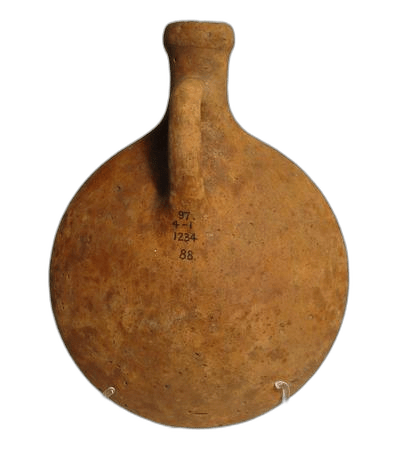
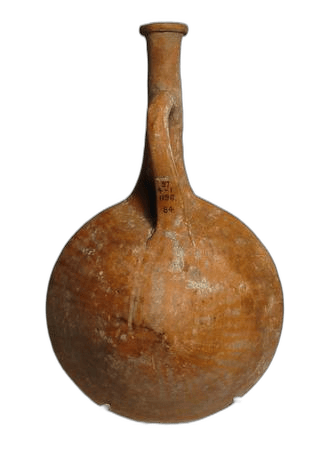
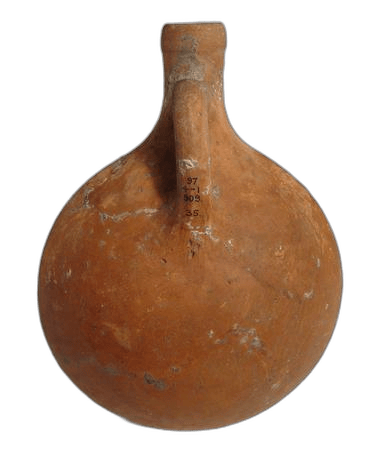
| Lentoid (pilgrim) flask | Flattened, often asymmetrical body; long neck; handle neck to shoulder | British Museum 1897,0401.1234 (Enkomi) |
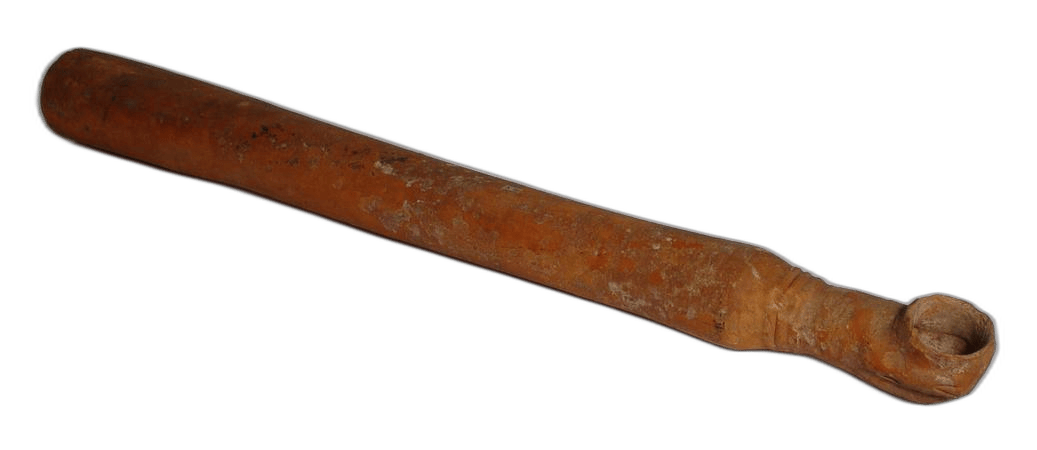
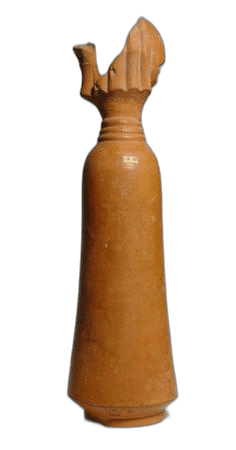
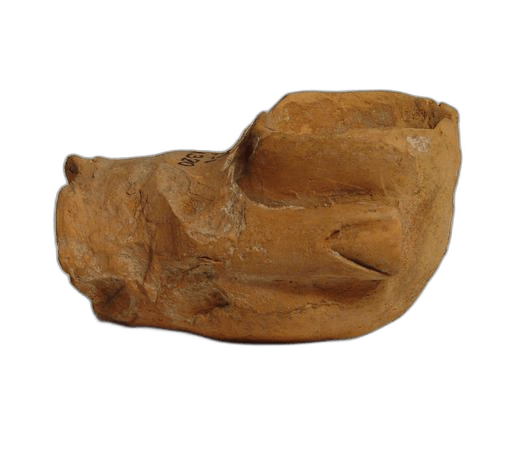
| Arm-shaped vessel | Long tube ending in a modelled hand holding a cup; 29 to 85 cm | British Museum 1897,0401.1108 (Enkomi) |
| Kraters, jugs, bowls | Rarer open and pouring shapes | None in the catalogue |
.](https://cdn.ancientcyprus.com/britishmuseum/3966-red-lustrous-pilgrim-flask.png)
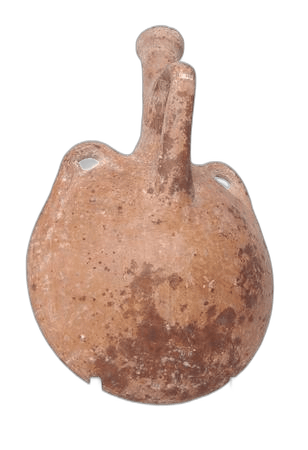
The British Museum's Enkomi flasks show the type well. A lentoid flask, 19 cm long, has a collar rim, a handle from mid-neck to shoulder and an asymmetrical body, one face rounded and the other convex, with rough multi-directional burnishing to a low lustre. A pilgrim flask from Klavdia, 26.5 cm high, carries incised Cypro-Minoan characters on its handle. A third, bought from Cesnola, has two loop handles at the neck as well as the vertical one.
The arm-shaped vessel is the oddest shape in Late Bronze Age pottery. Steel describes a tubular body with a narrow opening, a "wrist" marked by three moulded ridges, and a small hemispherical cup held in a modelled right hand complete with fingernails; examples run from 29 to 85 cm long [3]. Against Eriksson, who thought them wheelmade, Steel argues that the bodies were built from coils, and she notes that the tube makes no attempt to imitate an actual arm [3]. The British Museum's 61.7 cm arm vessel from Enkomi has a cross incised on its base before firing; a much shorter example, 28.7 cm, keeps a pre-firing potmark, the three ridges at the wrist and vertical burnishing on the body, and a detached hand holding a cup, 7.7 cm long, is all that survives of a third. A further arm from Maroni, British Museum 1898,1201.122, is 64.5 cm long.
Date and distribution
Knappett and colleagues place the start of the ware "some time during the 16th century BC", with production continuing "through until the early 12th century BC" [1]. Eriksson pins its first appearance in Cyprus to the end of Late Cypriot IA, "at least fifty years or so after the introduction of the potter's wheel in Cyprus" [2, p. 105]. Steel follows it on the island from LC IA to LC IIC, the fifteenth to thirteenth centuries, with survivals into LC IIIA at Hala Sultan Tekke, Enkomi and Myrtou-Pigadhes [3]. Museum records usually give the broader LC II bracket of 1450 to 1200 BC.
In Cyprus the ware is found almost everywhere except the far southwest, with major concentrations at Kazaphani in the north (LC I to II), Enkomi (LC I to III) and Hala Sultan Tekke (LC II) [2, p. 105]. Abroad it went down the Nile into Nubia, widely through Palestine, to sites in Lebanon and Syria, to Cilicia and the Anatolian plateau, and to a few Mediterranean islands [2, p. 105]. Steel reads this as a ware that linked two exchange systems: the maritime network of the Levant, Cyprus, Egypt and the Aegean, and the overland routes of Cilicia and north-central Anatolia [3]. In Egypt and Syria-Palestine it is commonest earlier in the Late Bronze Age; in Anatolia Eriksson placed it in the fourteenth and thirteenth centuries, but Dirk Mielke and Ekin Kozal have argued that the earliest Anatolian finds are at least as early as the Cypriot ones [3]. In the southern Levant Artzy lists spindle bottles, thicker bottles, jug-shaped vessels and a few pilgrim flasks; an arm-shaped vessel has been found only at Tell Abu Hawam [4]. See also Ugarit and the Levant and the Hittite Empire.
Find contexts in Cyprus
The richest Cypriot evidence comes from Kalavasos-Ayios Dhimitrios, where 579 sherds of the ware were recovered, all from spindle bottles, lentoid flasks and arm-shaped vessels and all connected directly or indirectly with burials [1]. Tomb 11, sealed and unlooted, held three young women, three infants and a child, with at least 17 or 18 spindle bottles and five lentoid flasks alongside gold, silver, ivory and glass; it dates to LC IIA:2 [1]. Tomb 13 had six lentoid flasks and a spindle bottle among 90 pots, and Tomb 14 four spindle bottles, two lentoid flasks and three arm-shaped vessels [1]. Alison South linked the high proportion of the ware in Tomb 11 to the young women buried there [1].
The largest group of arm-shaped vessels from the island comes from a so-called sanctuary at Ayios Iakovos-Dhima, north of Enkomi, of LC IIA date: six arms lay beside a bathtub sunk into a plaster floor, and a spindle bottle lay in the tub [3]. Single arms are known from Episkopi-Bamboula, a tomb at Kourion, a tomb at Ayia Paraskevi, Maroni Tomb 7 and several Enkomi tombs, and at Arediou-Vouppes, an inland farming settlement, fragments of the ware were found near a tomb and a sunken room [3]. For everyday settings see Late Bronze Age village life. The Medelhavsmuseet spindle bottle, 28.5 cm high, was found on the chamber floor of Enkomi Tomb 13 by the Swedish Cyprus Expedition in 1930, and the Ashmolean spindle bottle AN1886.18, 35.6 cm high, was bought in 1886.
Contents and use
Closed shapes dominate, and Knappett and colleagues took this to mean the pots travelled for what they held: "one valuable liquid commodity, a perfumed oil perhaps" [1]. Earlier attempts to identify the contents, including Paul Åström's study of a spindle bottle in 1969, produced inconclusive results ranging from honey and oil to bitumen and resin [1]. Their own gas chromatography of absorbed residues, mostly on sherds from Boğazköy, found beeswax or beeswax with fat or oil, consistent with a waterproofing treatment; the contents did "not co-vary with either the fabric or the form", and local coarse pots showed the same signature [1]. Perfumed oil therefore remains a hypothesis. Vassos Karageorghis, cataloguing the spindle bottles and arms of the Cesnola Collection, wrote that the bottles "may have contained perfumed oils" and that the arms were "possibly used as incense burners in religious rituals" [6, p. 60].
Steel's study of the arms takes a different line. Arms are found in large numbers at Boğazköy and other central Anatolian sites but are extremely rare elsewhere outside Cyprus (Alalakh, Ugarit, Tell Abu Hawam, Memphis), and she concludes that the arm was "not a vessel intended for distribution in the normal Cypro-Levantine exchange networks but instead made specifically for the Hittite market" [3]. In Anatolian scholarship it is known as the "libation arm".
Where was it made?
No workshop has been found, and "nowhere is it very obviously a local product" [1]. Opinion has moved several times [1; 3]:
| Proposed source | Main proponents | Basis |
|---|---|---|
| North Syria | Gjerstad 1926; Sjöqvist 1940; Merrillees 1963 | Burnishing and the spindle bottle seen as foreign to Cypriot tradition |
| Cyprus | Åström 1972; Eriksson 1991 and 1993 | Quantity, range of shapes, long life on the island, Cypro-Minoan-like potmarks |
| Anatolia or Cilicia | Courtois 1978 and 1979 | Distribution in southern and central Anatolia |
| Cyprus (north coast, then southwest) | Knappett et al. 2005; Grave et al. 2014 | Chemical and petrographic analysis; match with Mamonia clays |
| Rough Cilicia | Kozal 2015; Kibaroglu et al. 2019 and 2025 | Petrography, elemental and isotope analysis of Anatolian finds |
Eriksson's case for Cyprus rested on four points: the island has the greatest quantities, the fullest range of shapes, the longest chronological span and potmarks resembling Cypro-Minoan signs [1]. "This very fine class of pottery can claim Cyprus as its homeland," she wrote [2, p. 105]. Knappett and colleagues judged each point inconclusive, the Cypro-Minoan link "far from conclusive" [1], although they too settled on a Cypriot source. Steel reports Grave and colleagues' 2014 neutron activation match with the bentonitic clays of the Mamonia Complex in southwest Cyprus, and a study by Bouthillier and colleagues showing a single geochemical signature, which implies one production region [3]. Her own summary is that "while several studies have identified Cyprus as the source of RLW, the exact location still remains unresolved" [3].
Artzy, in 2019, still called Cyprus "presently considered the most likely" source, but noted that the large numbers found at Boğazköy-Hattusa and in the Göksu valley weaken the argument from quantity, that the ware was apparently also made at other centres, and that local imitations were produced on the Lebanese-Syrian coast [4]. The most recent analytical work, by Kibaroglu, Kozal and colleagues, states that RLWm production has been "linked to Rough Cilicia (Southern Anatolia)" [5]. The question is open. The impressed marks on some bases may be Cypro-Minoan signs [4], but other scholars attribute them to different Late Bronze Age marking systems [3]; on the script itself see writing and literacy.
Black Lustrous Wheelmade ware
Black Lustrous Wheelmade ware (BLWM) is the dark counterpart of RLWm and is much shorter-lived. It "first appeared at the beginning of the Late Bronze Age", has a grey-blackish fabric and a black burnished, lustrous surface, and was limited to Late Bronze Age I, whereas RLWm lasted some three hundred years through LB I and II [5]. The shapes are mostly juglets, with some bowls and jugs. It occurs in Cyprus, the Levant, Egypt and Plain Cilicia (Kinet Höyük and Sirkeli Höyük), always in small numbers per site, and not at all in Rough Cilicia or central Anatolia [5]. Artzy lists it among the main Cypriot imports to the southern Levant in LB I [4].
Its Cypriot origin is less disputed. A 2025 study of 45 BLWM samples from Alalakh, Enkomi, Ashkelon and Aniba in Nubia, compared with 22 clay samples from northern Cyprus, identified several clay sources in northern and northeastern Cyprus, and concluded that BLWM and RLWm "represent distinct manufacturing traditions" [5]. The resemblance of name and finish is therefore no guide to a shared workshop. A rarer White Lustrous Wheelmade ware, known from a few spindle bottles in the southern Levant, completes the family [4]. You can see Black Lustrous Wheelmade ware in the catalogue.
Iron Age lustrous wares
Gjerstad's typology of Iron Age pottery in the Swedish Cyprus Expedition reports reuses the names for two unrelated Cypro-Classical wares [7]. Black Lustrous I (VI) belongs to Cypro-Classical I, about 480 to 400 BC: "wheel-made; brown clay, hard and well baked; slightly lustrous, thin slip", made into bowls with a base-ring and drooping rim and into sack-shaped juglets [7]. Red Lustrous I (VII) belongs to Cypro-Classical II, about 400 to 310 BC: "wheel-made; light buff, well silted clay, covered by a fine wash; thick, lustrous, brown or reddish-brown slip, which easily crumbles", with a single type, a spindle-shaped jug with a flat base, narrow neck and swollen rim [7]. In Gjerstad's scheme the Roman numerals mark the stage, VI for Cypro-Classical I and VII for Cypro-Classical II.
The Iron Age spindle-shaped jug echoes the Late Bronze Age spindle bottle in outline, but some eight centuries separate them and the fabrics differ completely. There is no connection between the two Red Lustrous wares beyond the name. For the Cypro-Classical pottery around them see the Iron Age White Painted and Black-on-Red entries. The catalogue keeps them apart: Red Lustrous ware (Iron Age) and Black Lustrous ware (Iron Age).
Further reading
The standard monograph is Eriksson's Red Lustrous Wheel-made Ware (SIMA 103, 1993). The 2007 conference volume edited by Irmgard Hein, The Lustrous Wares of Late Bronze Age Cyprus and the Eastern Mediterranean, gathers papers on both lustrous wares by Artzy, Åström, Eriksson, Knappett and Kilikoglou, Kozal, Mielke, and South and Steel. For the other fine wares of the period see Base Ring, White Slip, Plain White and White Painted Wheelmade, and the imported Mycenaean pottery found with it in the same tombs. The British Museum holds the largest group of the ware on this site, most of it from the Turner Bequest excavations at Enkomi. For telling the wares apart in the hand, see how to identify ancient Cypriot pottery.
Objects on this page
 Red Lustrous Ware Body Sherd with Fire-Mottled SlipNeolithic · 4500–3900 BC
- Red Lustrous Pilgrim FlaskLate Bronze Age II · 1450–1200 BC
 Red Lustrous Lentoid FlaskLate Bronze Age II · 1450–1200 BC
 Red Lustrous Pilgrim FlaskLate Bronze Age II · 1600–1100 BC
 Red Lustrous Arm VesselLate Bronze Age II · 1450–1200 BC
 Red Lustrous Arm-shaped VesselLate Bronze Age II · 1450–1200 BC
 Red Lustrous Hand CupLate Bronze Age II · 1450–1200 BC
In the catalogue
References
- 1.Knappett, C., Kilikoglou, V., Steele, V., & Stern, B. (2005). The circulation and consumption of Red Lustrous Wheelmade ware: Petrographic, chemical and residue analysis. Anatolian Studies, 55, 25–59. https://doi.org/10.1017/S0066154600000648
- 2.Eriksson, K. (1991). Chapter 10. In J. A. Barlow, D. L. Bolger, & B. Kling (Eds.), Cypriot ceramics: Reading the prehistoric record. The University Museum, University of Pennsylvania.
- 3.Steel, L. (2018). Another look at Red Lustrous arm-vessels. In L. Crewe, L. Hulin, & J. Webb (Eds.), Structures of inequality: Studies in honour of Alison K. South (SIMA Pocketbook 187, pp. 197–210).
- 4.Artzy, M. (2019). Late Bronze Age I–II Cypriot imports. In S. Gitin (Ed.), The ancient pottery of Israel and its neighbors from the Middle Bronze Age through the Late Bronze Age (Vol. 3, pp. 339–380). Israel Exploration Society.
- 5.Kibaroglu, Kozal, Crewe, Martin, Hein, Monien, & Bergoffen (2025). A comparative archaeometric study of Late Bronze Age Black Lustrous and Red Lustrous Wheel-made wares from the Eastern Mediterranean.
- 6.Karageorghis, V. (2000). Ancient art from Cyprus: The Cesnola Collection in the Metropolitan Museum of Art. The Metropolitan Museum of Art.
- 7.Gjerstad, E. (1948). The Swedish Cyprus Expedition, Vol. IV, Part 2: The Cypro-Geometric, Cypro-Archaic and Cypro-Classical periods. The Swedish Cyprus Expedition.