
Paul Åström: The Man Who Printed Cypriot Archaeology
Paul Åström dug a Late Bronze Age harbour town for thirty years and never wrote its final report. His largest mark on Cypriot archaeology was made in print rather than in the ground: a pottery typology that dated half the eastern Mediterranean, and a press that published almost everyone who came after him.
Alexis Drakopoulos
March 15, 2026·Archeology · History · Research·9 min read


Share


Alexis Drakopoulos is a Greek Cypriot Machine Learning Engineer working in Financial Crimes. He is passionate about Archeology and making it accessible to everyone. About Me.
In 1955 Paul Åström, a doctoral student from Lund, travelled to a fifty-two-room mock-baronial mansion in the bush outside Bathurst, New South Wales, to learn how to date a pot. The house was called Mount Pleasant. It belonged to James Stewart, the Australian authority on Early Cypriot pottery, and it came with sheep, assorted poultry, and numerous cats [1]. Robert Merrillees, a Sydney undergraduate who would write to Åström for the next half-century, was also there, and found the whole arrangement entirely natural [1].
What Åström took from that house he spent fifty years turning into an instrument. By the time he died in 2008 the small field he had entered was a global one, and a large share of what it had published carried his imprint, often literally. His name is on a pottery typology, on an excavation that ran for three decades, and on the spine of several hundred books he did not write. He is the rare archaeologist whose largest contribution was made in print.
How Cypriot pottery became a clock for the Bronze Age
When Åström started, Cypriot archaeology was small enough to list by name. There were, he recalled near the end of his life, "very few Cypriot archaeologists: Dikaios, Stewart, Karageorghis, Catling and a few others" [4]. The thing that grew the field was, in part, the thing he had gone to Australia to study.
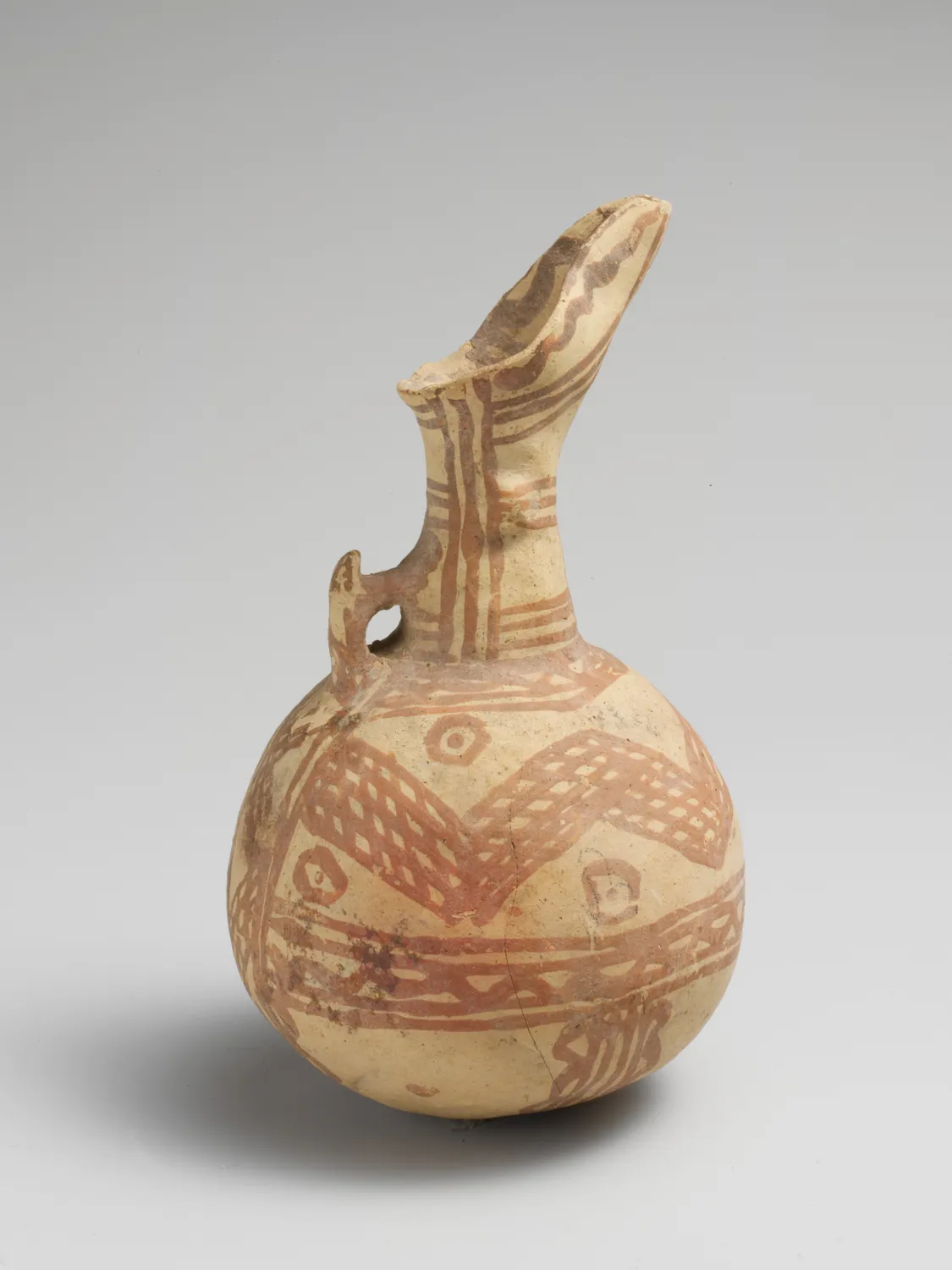
His Lund dissertation, The Middle Cypriote Bronze Age, defended in 1958 and printed the year before, was a synthesis of the whole period built on the close reading of pots [5]. The point of it reached well past Cyprus. Cypriot pottery had been carried all over the eastern Mediterranean in antiquity, so it turns up in datable Egyptian, Levantine, and Aegean deposits; fix the order of the Cypriot wares securely, and you can date the foreign contexts they sit in, and the foreign objects beside them. A sequence of jugs and bowls became a chronological tool for half a sea. The book went back to press some twenty years after it first appeared, which for a pottery synthesis is a long life [2].
Behind the work stood Einar Gjerstad, the leader of the original Swedish Cyprus Expedition of 1927–1931 and the teacher Åström named as his own. In 1972 Åström closed the circle: he wrote the Late Bronze Age volumes that completed the Expedition's vast publication, the architecture and pottery in one part, the chronology and foreign relations in another [6]. He had finished the old expedition. Then he started one of his own.
The harbour town he never finished
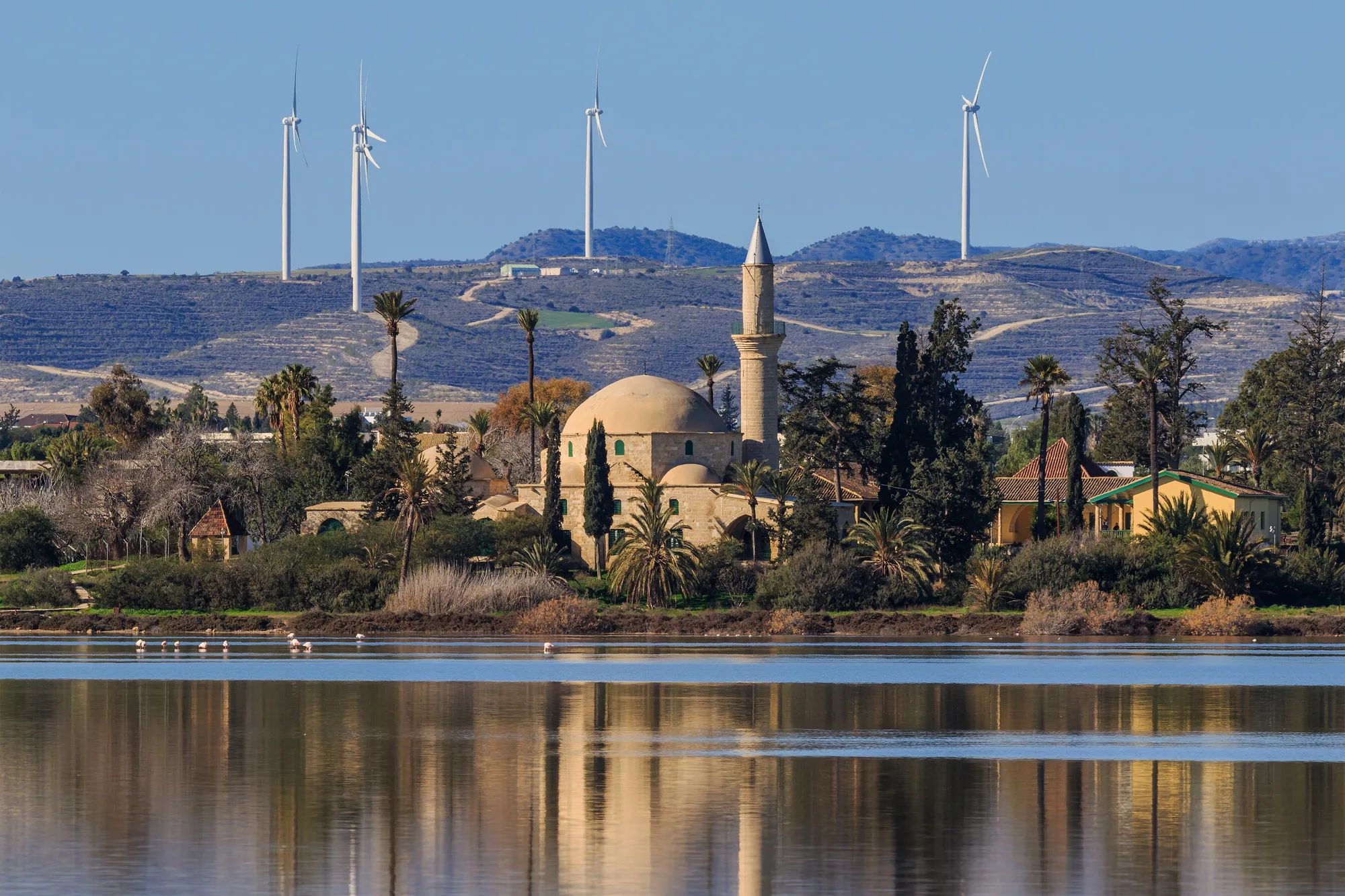
Hala Sultan Tekke sits in a field by the Larnaca Salt Lake, beside the Muslim shrine that gives it its name. Åström ran a topographic survey and three trial trenches there in 1971, and after a proton-magnetometer survey the following year began the excavation that would occupy him, on and off, for more than thirty years [8]. Choosing where to dig by what a magnetometer reported under the soil was an early use of geophysical prospecting on the island.
What came up was one of the principal Late Bronze Age harbour towns of the south coast, founded around 1600 BC and flourishing until just before 1200, with a main street four to five metres wide, courtyard houses, and two well-cut bathrooms walled in ashlar [9]. The bronze tools the diggers recovered were the gear of a working coast: a pruning hook, a trident, a shepherd's crook, a charcoal shovel [9]. There was copper slag and a mould for casting arrowheads, gold and silver in the making, lead net-weights and fish bones, and carved offcuts of elephant tusk.
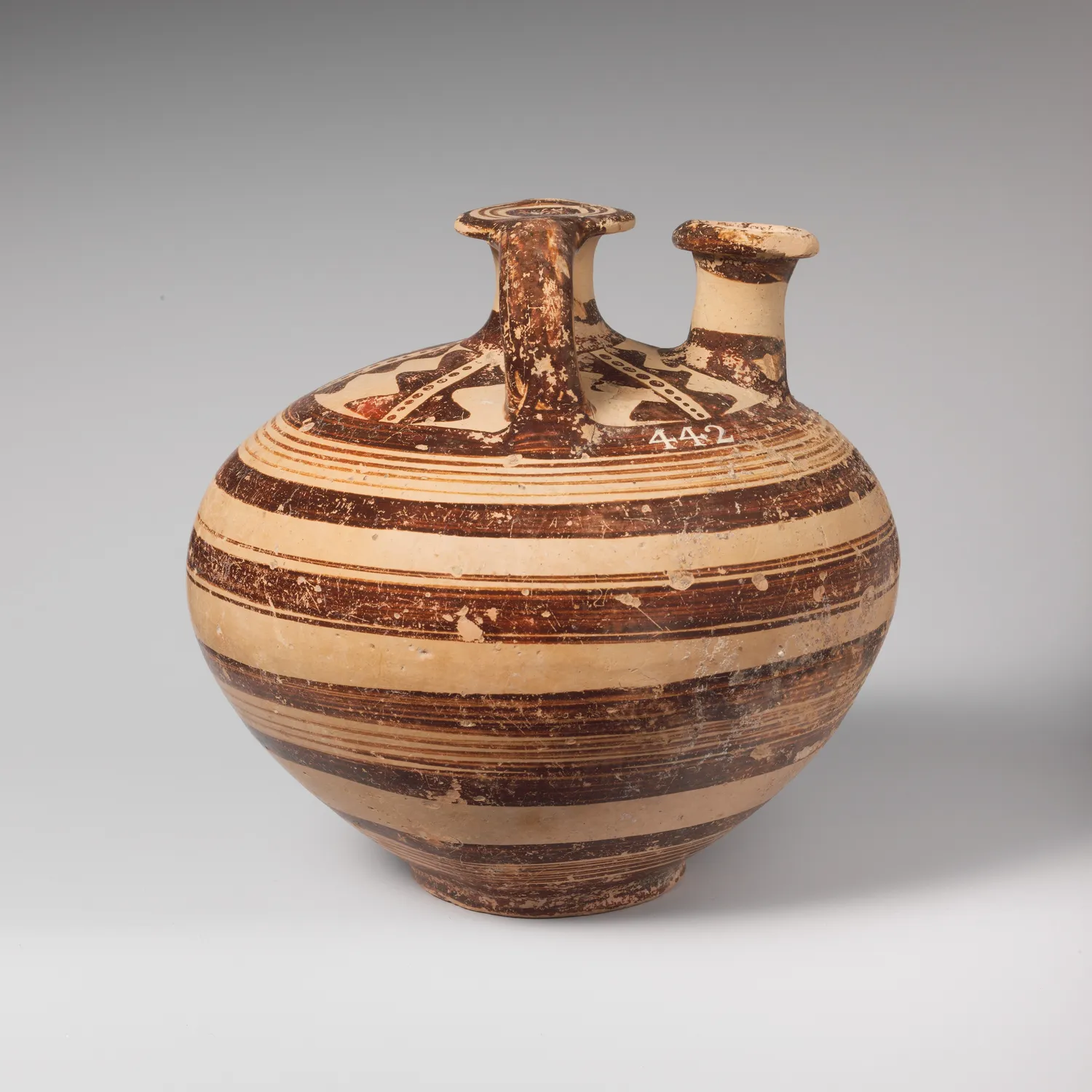
The imports placed the town in a network that ran the length of the sea. Mycenaean and Minoan vases from Greece and Crete, grey Minyan ware from Asia Minor, the largest concentration of Canaanite transport jars known from Cyprus, and a silver bowl carrying a West Semitic inscription in cuneiform [9]. The Egyptian connection was the most particular. Wine jars and the cartouches of three pharaohs, Horemheb, Seti I, and Ramesses II, turned up in the deposits, and among the food remains were the bones of Nile perch, a fish of the Egyptian river [9]. The perch bones have been read against the Tale of Wenamun, the Egyptian account of an envoy sent up the Levantine coast who is kept supplied with baskets of fish from home while he waits at Byblos.
The interdisciplinary instinct that ran the dig was old in him. At Kalopsidha in 1959 he had already pulled in eight specialists to report on plant remains, residues, bone, charcoal, pollen, molluscs, stone, and fingerprints [4]. Hala Sultan Tekke was that method at full scale, sustained across a war: the 1974 invasion interrupted the work, and the project resumed afterward in the south. Twelve fascicles came out between 1976 and 2007 [8]. The book that never came out was the synthesis, the volume that would have said what the whole town meant. He died before he wrote it [1]. The excavation itself outlived him; his Gothenburg successors took it up as a new Swedish Cyprus Expedition that still digs the site today, the same lineage running back to Gjerstad.
The red books
Åström's largest single gift to Cypriot archaeology was a publishing house.
He founded Paul Åströms Förlag in Sweden, and in 1962 brought out the first volume of its flagship series, Studies in Mediterranean Archaeology. The hardback "red SIMA" books became, in one young scholar's phrase, "the nec plus ultra of archaeological publications" [3]. Around them he built an ecosystem: a softcover pocket-book series for shorter or unfinished work, a series for archaeology and natural science, translations of the classical authors, a journal of prehistoric religion. As editor of SIMA he saw 135 monographs into print; the pocket-book series ran to 175 volumes [2]. A great deal of what the field knows about Cyprus, the Aegean, and the Levant in the later twentieth century passed through that one Swedish imprint.
The defining feature was access. Åström "offered many young scholars the opportunity to publish their master's and/or PhD work" [3], and took in research in progress, dossiers, and recent discoveries, "giving everyone, without prejudice or sectarianism, the chance to publish their contribution quickly" [1]. Annie Caubet, who knew the press well, named the cost of that policy plainly: "Some no doubt reproached him for the uneven quality of the contents, the lack of synthetic reflection in some of these volumes" [1]. Her verdict was that the speed and the openness were worth the unevenness, and that is the honest measure of the thing. A low door lets in work that a higher one would have kept out, in both directions.
The generosity was personal as well as editorial. When Melbourne's National Gallery of Victoria backed out of publishing its antiquities catalogues, Åström printed the Cypriot one through SIMA anyway, without subsidy [1]. He also wrote the field's reference works about itself. His Who's Who in Cypriote Archaeology of 1971 counted roughly six hundred people then dealing with the subject in some way [7], a number that would have astonished the Lund student who, sixteen years earlier, could have named the entire profession over dinner. Cyprus made him a Grand Commander of its Order of Merit in 2005 [2]; the Institut de France elected him a foreign correspondent in 1998, one of only two specialists in Cypriot prehistory it has ever admitted, the other being Vassos Karageorghis [1].
Every archaeologist is a detective
His own phrase was "every archaeologist is actually a detective" [3], and he meant it literally enough to recruit two Swedish police officers, Sven Eriksson and Karl-Erik Sjöquist, to help him study the finger- and palm-prints potters had left in wet clay. The work produced a small shelf of titles, from Fingerprints and Archaeology in 1980 to Knossos: Keepers and Kneaders in 1991, and an honorary place in Stockholm's Ancient Fingerprint Society. He wrote on Greek dress, on whether a pot retains the sound of the wheel that turned it, and, well outside archaeology, on Rainer Maria Rilke and the Swedish poet Gunnar Ekelöf [3]. Manfred Bietak's tally of the output came to 687 publications [2].
The serious centre of that range was dating. Åström convened the colloquium that opened the modern argument over Bronze Age absolute chronology, "High, Middle or Low?", at Gothenburg in 1987, and a second meeting in Austria three years later [2]. Those gatherings seeded the large Austrian research programme on eastern-Mediterranean synchronisation that ran into the next century. He was, by then, the field's working methodologist of time, the man who organised the question of how old everything actually was.
Anyone who attended a congress on Cypriot archaeology in those decades knew him by sight. Caubet's portrait is of the indefatigable Åström at every meeting, lugging crates of his latest books to give away and collecting promises of future ones from everyone he met [1]. Karin Nys remembered Liège in 1993, the distinguished researchers in a knot, ignoring the few students standing timidly in a corner, "except for Paul Åström," who detached himself from the famous names, came over, and later told them: "Students who attend a full congress are very welcome at my excavation!" [3]. The open door of the press was the open door of the man. The friendship that had begun at Mount Pleasant ran without a break until the end; it was Merrillees who wrote one of his obituaries [1].
He was to give the closing lecture at the Cypriot proceedings in Brussels in October 2008 when he fell suddenly ill. On 3 October he dictated to his wife Elisabeth the text he wanted read in his place, "Cypriot Archaeology: A Prospering Story," and died the next day [4]. The talk surveyed a field now practised, he wrote, all over the world "from Australia to America" [4], the same Australia where, fifty-three years before, he had gone to a house full of cats to learn how to date a pot.
It closes on the rule he had kept for fifty years: documentation first, interpretation afterwards [4]. He had kept the first half almost to a fault. The harbour town at Hala Sultan Tekke had been surveyed, trenched, sieved, and published across twelve fascicles. The interpretation, the one book that would have told us what all of it meant, was the part he did not live to write [1].
References
- 1.Robert S. Merrillees and Annie Caubet, “In memoriam Paul Åström (1929–2008),” Cahiers du Centre d'Études Chypriotes 38 (2008), 9–12.
- 2.Manfred Bietak, obituary of Paul Åström, Ägypten und Levante / Egypt and the Levant XIX (2009), 16–18.
- 3.Karin Nys, “Paul Åström, the Mentor of Several Generations,” in POCA 2008 (Brussels: Cypriot material-culture proceedings), 15–20.
- 4.Paul Åström, “Cypriot Archaeology: A Prospering Story” (text dictated 3 October 2008), in POCA 2008 (Brussels), 22–23.
- 5.Paul Åström, The Middle Cypriote Bronze Age (Lund, 1957; doctoral defence 1958).
- 6.The Swedish Cyprus Expedition, vol. IV part 1C (P. Åström, with M. R. Popham) and part 1D (Lena Åström; P. Åström with V. E. G. Kenna and M. R. Popham) (Lund, 1972).
- 7.Paul Åström, Who's Who in Cypriote Archaeology: Biographical and Bibliographical Notes, Studies in Mediterranean Archaeology 23 (Göteborg, 1971).
- 8.Paul Åström et al., Hala Sultan Tekke 1–12, Studies in Mediterranean Archaeology 45:1–12 (Göteborg and Sävedalen, 1976–2007).
- 9.Paul Åström, “Hala Sultan Tekke,” in The Oxford Encyclopedia of Archaeology in the Near East, ed. Eric M. Meyers, vol. 2 (New York and Oxford, 1997), 462–463.