
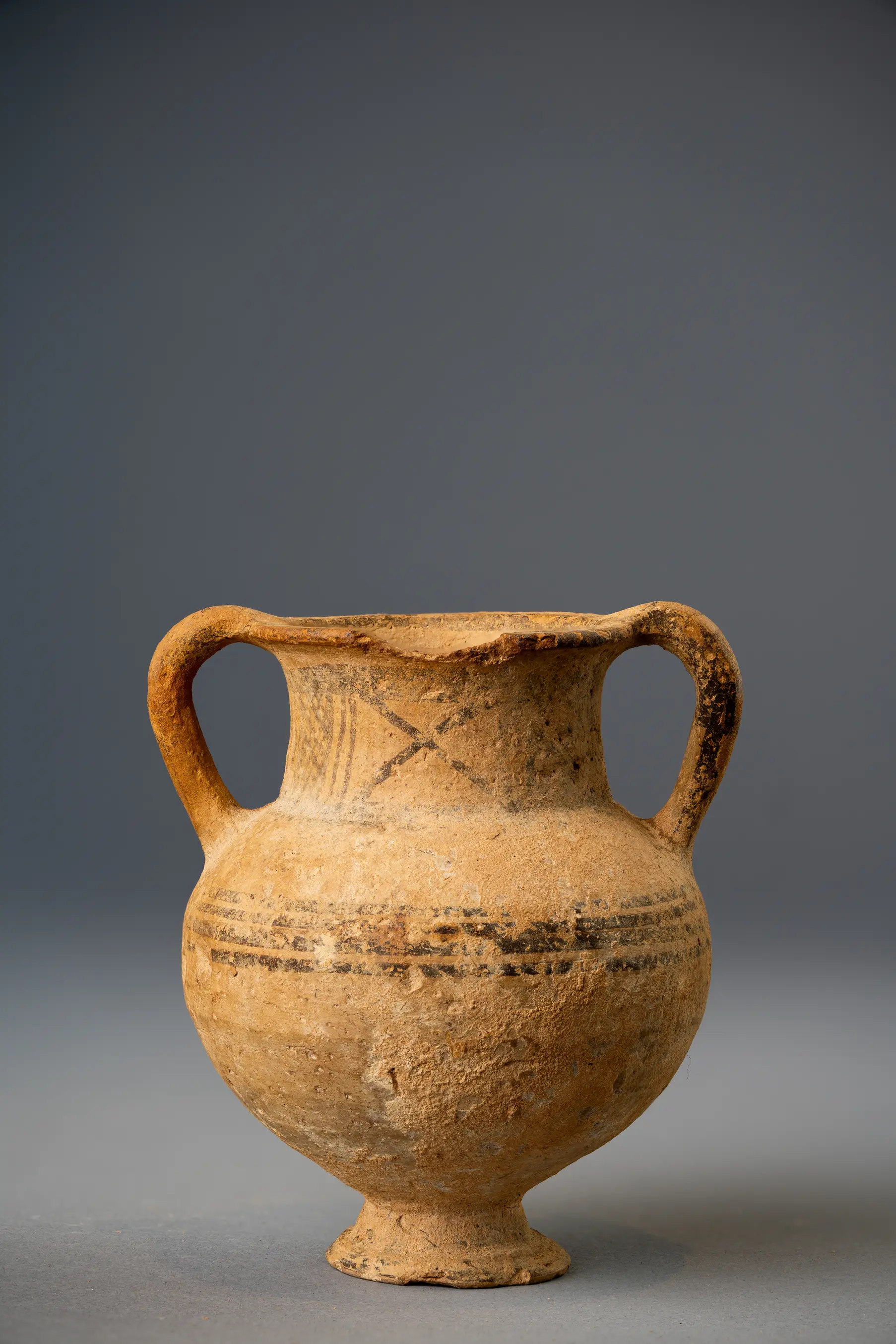
Proto-White Painted (PWP) ware is the painted pottery of Late Cypriot IIIB, the last phase of the Cypriot Bronze Age by the conventional reckoning, roughly 1125 or 1100 to 1050 BCE. It is wheelmade, pale-bodied and decorated in a dark matt paint, and it carries a repertoire of shapes derived largely from the Mycenaean IIIC tradition. Maria Iacovou, whose 1988 monograph and 1991 classification define the ware as it is now used, calls it "the last of the Late Bronze Age painted Cypriot wares, which was produced on the island as late as the inception of the White Painted pottery of the Cypro-Geometric I period" [1, p. 199]. The name was coined by Einar Gjerstad in 1944 in the same exchange of papers in which Arne Furumark named the preceding Decorated Late Cypriot III, and it was chosen to say something: this is the ancestor of the White Painted wares of the Iron Age [2; 3]. Everything about PWP is therefore transitional. It closes the century-long Cypriot production of Aegean-style pottery, and it opens the Cypro-Geometric sequence, so that to classify it is to decide where the Bronze Age ends.
Names and definition
The ware was recognised long before it was named. Max Ohnefalsch-Richter found it in a tomb at Lapithos in 1893 and called the vases "late Mykenaean"; John Myres isolated six examples from Kouklia Tombs 6 and 12 in 1899 and called them "Native Imitations" of the Mycenaean fabric, an indigenous ware closely tied in shape to late Mycenaean pottery [1, p. 199]. In 1910 Myres set the Bronze-to-Iron transition at about 1050 BCE, a date that "remains a conventional but unshakable absolute date for the end of the Cypriot Bronze Age" [1, p. 199]. H. B. Walters and the young Gjerstad called the material "Cypriote Submycenaean"; Erik Sjöqvist dispersed it into his "late Levanto-Helladic class"; Furumark restored its individuality in 1941 but called it "decorated early Cypro-Geometric pottery" [1, p. 199]. In 1944 Furumark and Gjerstad agreed to divide Late Cypriot III into two phases, an early LC IIIA marked by Decorated Late Cypriote III and a late LC IIIB marked by the ware Gjerstad called Proto-White Painted [2, p. 75; 3, p. 232]. Angeliki Pieridou's 1973 corpus, still the standard plate volume, used the Greek term "Protogeometric" as a translation of Proto-White Painted, a usage other scholars declined to adopt because it invites confusion with the later and unrelated Greek Protogeometric style [4; 5, p. 71].
Fabric does not define the ware. To the eye the clay is "greenish" or "brownish", "certainly not different from the clay of the White Painted ware of the Cypriot Iron Age", sometimes well sifted but more often carrying small red, black or lime-white inclusions; the surface is not slipped but bears "a distinct coating made of diluted clay" that provides a light matt ground for dark decoration [1, p. 200]. What defines PWP is the behaviour of its paint. An originally matt black, washy pigment fired, unevenly on any one vase, "into shades from light orange to brown", whereas the White Painted I of Cypro-Geometric I "has a uniform dull, matte black washy decoration" [1, p. 200]. Pieridou had already used this criterion in 1965 to pick PWP survivals out of an early Cypro-Geometric tomb: the vases "are identified by the distinct matt orange or orange-brown colour of their painted decoration" [1, p. 200]. Marguerite Yon suggested, and Iacovou came to accept without reservation after studying the mixed settlement deposit from the Asproyi bothros at Palaepaphos, that the effect was deliberate: potters "tried, rather unsuccessfully, to achieve the fine, orange, light-color effect of local Mycenaean IIIC pottery" [1, p. 200]. The effort was short-lived; by late PWP groups such as Xerolimni Tomb 9 the paint is already the uniform black of White Painted I.
Antecedents: Mycenaean IIIC:1b and White Painted Wheelmade III
PWP emerges from the locally made, Aegean-style pottery that Cyprus had produced since the late thirteenth century. That pottery has carried more names than any other Cypriot class. Barbara Kling, whose 1989 monograph remains the standard study, lists the labels applied to what is essentially one body of "wheelmade, decorated in a dark matt paint on a light-colored surface" pottery of LC IIC to IIIA: matte-painted Levanto-Helladic, Rude or Pastoral Style, Late Mycenaean IIIB, Mycenaean IIIC:1b, Submycenaean, Decorated Late Cypriot III [7]. The names were not innocent. "Mycenaean IIIC:1b", lifted from Furumark's Aegean divisions and adopted wholesale by Dikaios for the post-destruction levels at Enkomi, encoded the theory that an Aegean population had arrived around 1200 BCE and replaced the local culture; once assigned, the classifications "then served to confirm" the historical interpretation that had produced them [7, p. 206]. Kling therefore adopted Paul Åström's neutral term White Painted Wheelmade III, which "spans the LC IIC and IIIA periods and includes all the matte-painted, wheelmade pottery in use in Cyprus at this time" [7, p. 207]. The repertoire is a tableware one, dominated by the deep bowl or skyphos and the bell krater, decorated in the spiral-and-panel grammar of LH IIIC, and it appears in small quantities already in LC IIC before increasing sharply across the end of the thirteenth century [6].
Two results settle its origin. Neutron activation analysis by Hans Mommsen and Penelope Mountjoy has identified the chemical profiles of eight production centres on the island, among them Paphos, Kourion, Alassa, Hala Sultan Tekke, Kition, Enkomi and Sinda, so that the Aegean-style pottery of Cyprus is a Cypriot industry, not an import [9]. And macroscopic study of the vessels shows rilling and compression ridges that denote true wheel-throwing, a change in the potter's motor habits from the wheel-fashioning of earlier Plain White, though larger jugs and amphorae still show coil seams [10]. Susan Sherratt read the whole phenomenon as import substitution: Cypriot coastal workshops filling, with cheap wheelmade copies, the gap left when the Mycenaean palaces stopped exporting fine ware [8]. Iacovou's summary of what PWP then did to this material is the key sentence of the ware's definition: "The polymorphy of the painted pottery of LC IIIA that tortures us in search of a common term is put to rest once Proto-White Painted appears. Its appearance marks the coming together of all the earlier painted wares of LC IIIA" [1, p. 204].
One antecedent must be excluded. Furumark in 1965 picked out the wavy-line skyphoi and cups of Enkomi Level III as "early Proto-White Painted". Iacovou, following Dikaios, rejects this: those vessels are local Mycenaean IIIC, their profiles differ from true PWP counterparts, PWP deep bowls "rarely carry wavy line decoration", and Enkomi Level III "represents a single cultural phase which is LC IIIA and no part of the level should be assigned to LC IIIB" [1, p. 203]. Kling holds the two broadly contemporary at Enkomi; the disagreement bears on the stratigraphy of one site rather than on the ware's definition [6, pp. 173–174].
The repertoire of shapes
For dating a deposit, the presence or absence of particular shapes is "a vital criterion for differentiating LC IIIA, LC IIIB, and Cypro-Geometric I" [1, p. 200]. Sherratt characterises PWP as "the highest quality of Aegean-style pottery manufacture with the largest repertory of shapes of Aegean origin that are standardised and mass-produced" [8, p. 193]. The belly-handled amphora is the trademark: "totally absent in LC IIIA", it originates in the Mycenaean IIIC repertoire, "appeared first in Proto-White Painted and became the trademark of LC IIIB deposits", and continues in the White Painted and Bichrome of CG I [1, p. 200]. The amphoriskos, in collared-neck, wide-necked and miniature belly-handled forms, has its floruit in LC IIIB. The kylix and the stirrup jar are Mycenaean shapes that die out: the large stirrup jar becomes obsolete early in LC IIIB, and only rare relics of the kylix and small stirrup jar occur in transitional CG I tombs, though six PWP kylikes came from a small LC IIIB tomb at Kition and fragments of four stirrup jars from the LC IIIB stratum of Lapithos Tomb 503A [1, pp. 200–202]. Kraters are essentially not an LC IIIB shape; the amphoroid krater becomes rare and, in this phase, never pictorial. The flat plate does not exist in PWP at all; it is "a shape of local inspiration" that first appears in advanced CG I groups [1, p. 202]. Zoomorphic askoi and bird vases are plentiful, more so than in the Aegean, and Valerie Cook has used this and the profiles of the bottles and naiskoi to argue that the Levantine and Anatolian strand in the amalgam is stronger than Iacovou's Aegean-derivative framing allows [5, pp. 90–95]. The kalathos, a deep flaring footed bowl, and the cylindrical-bodied "bottle" with carinated shoulder complete the closed and open sets, with jugs and trefoil-mouthed oenochoai carrying bands and latticed triangles on the shoulder [4; 11].
| Shape | LC IIIA (Myc IIIC / WPWm III) | LC IIIB (Proto-White Painted) | CG I (White Painted I) |
|---|---|---|---|
| Belly-handled amphora | Absent | Trademark shape | Frequent, in WP I and Bichrome I |
| Amphoriskos | One probable Rhodian import (Sinda) | Floruit | Common, gone by end of CG I |
| Kylix | Common | Distinct PWP type | Rare relics only |
| Stirrup jar | Present | Large type obsolete early; small survives | Rare relics only |
| Deep bowl (skyphos) | Dominant, often wavy line | Banded, rarely wavy line | Footed deep bowl continues |
| Krater / amphoroid krater | Common, pictorial | Rare, never pictorial | Revives late in CG I, scene on neck |
| Plate | Absent | Absent | New, local inspiration |
| Bird askos, zoomorphic vase | Rare | Plentiful | Continues |
Decoration is the geometric vocabulary of the latest Mycenaean IIIC naturalised on Cyprus: the wavy line, zones of oblique strokes, plain, framed and latticed triangles, net-rhomboids, semicircles and panels, with a restricted pictorial set of palm tree, birds, goat, dog and human figure catalogued by Pieridou [4; 5, p. 97]. The compass-drawn concentric circle that later becomes the emblem of Cypro-Geometric pottery is not yet a feature; Gjerstad's typology introduces it only with White Painted III [16].
Proto-Bichrome and the pictorial silhouette
PWP is "as a rule, a monochrome ware", and Iacovou warns against reading the orange-to-brown variation of the paint as a second colour [1, p. 202]. A genuine purple-red second pigment does occur, rarely, in a technique quite unlike the later Bichrome: black and purple "interchange symmetrically, or are combined in the drawing of every motif; it certainly looks as if the same brush was dipped into both pigments", and it falls on Aegean shapes (stirrup jars, pyxides, kalathoi, kylikes, belly-handled amphorae) or on forms affiliated with the Philistine repertoire such as bird askoi and ring vases [1, pp. 202–203]. The Swedish Cyprus Expedition and Karageorghis call this variant Proto-Bichrome. Iacovou rejects the term on principle: PWP anticipates White Painted, but bichrome PWP does not anticipate Cypro-Geometric Bichrome, in which red is a secondary fill carefully outlined in black and never overlapping it; Pieridou had said in 1966 that the LC IIIB bichrome "is wholly unconnected with the Bichrome style of Iron Age pottery" [1, pp. 202–203]. She derives the Iron Age technique instead from the imported Phoenician globular neck-ridged jug, a shape absent from PWP deposits. Distribution is telling: no bichrome vase occurs in the Sanctuary of the Ingot God at Enkomi, in Idalion-Ayios Georghios Tomb 2 or in Kaloriziki Tomb 40, whereas nearly half the vases from Alaas and a good number from Palaepaphos are bichrome, so the technique belonged to workshops at the two ends of the island [1, p. 203; 11, p. 47].
The pictorial content of PWP is small and, for Iacovou, decisive. Her 1988 monograph catalogued the eleventh-century figurative vases: the bird-hunter krater from Enkomi, the fishing scene, the Palaepaphos kalathos with lyre-player, birds and long-horned goat, and the centaurs from the Ingot God sanctuary [13]. The entire figurative corpus for LC IIIB and CG I together numbers fewer than fifty vessels, executed in silhouette and "captivated between abstract panels", and from early CG I the human image all but disappears [14, pp. 196–202]. Her point is chronological. Cyprus produced this pottery "at a time when the Aegean world had already sunk into the 'picture-less' Submycenaean period"; the Aegean-style painted pottery of Cyprus "reached its finest quality production not in the late 13th or in the 12th but in the 11th century" [14, p. 3]. PWP is thus "the last triumphant act of the East Mediterranean Aegeanising horizon", and Cyprus ran à contretemps, out of step, with the Aegean clock [14, p. 5].
Chronology
The conventional bracket for PWP is LC IIIB, about 1125 or 1100 to 1050 BCE, and within it Iacovou distinguishes Early, Mature and Late stages [13]. Both ends are conventions. The lower, 1050, descends from Myres through Gjerstad, who fixed it partly by the appearance of White Painted I at Megiddo stratum VIA [16, p. 427; 5, p. 73]. The upper is the more disputed. Furumark placed the appearance of PWP around 1150, a date Dikaios accepted in 1965 [5, p. 69]. Jack Benson, publishing the Bamboula settlement at Kourion, argued that the LC IIIB phase "must be a short one, say fifty years", bringing the end of LC IIIA to about 1100 [15, p. 35]. Iacovou lowers the inception on Aegean grounds: the basic PWP repertoire is "to a great extent a derivative of Mycenaean IIIC Middle and consequently a contemporary of Mycenaean IIIC Late", so the Middle phase of Mycenaean IIIC is a terminus after which PWP began [1, p. 204]. Cyprus "did not reach the Submycenaean stage stylistically or chronologically": around the middle of the eleventh century, when Submycenaean superseded Mycenaean IIIC Late in the Aegean, LC IIIB ended and PWP gave way to White Painted I [1, p. 204].
None of this rests on radiocarbon; the dates are cross-dated through pottery to Aegean and Levantine sequences that are themselves anchored to Egypt. Karageorghis and Raptou, publishing the newest Skales tombs, stress how fragile the framework remains for the whole span from about 1100 to 850 BCE and call for better-stratified settlements before the typology can be firmly dated [17, pp. 62–63]. A related argument concerns where the Bronze Age should end. Iacovou holds that "the material culture differentiates between LC IIIB and LC IIIA far better than between LC IIIB and the succeeding CG I", so that LC IIIB is "the initial phase of the Cypriote Iron Age, the preamble to CG I", and 1050 "artificially divides the 11th century in two equal halves" [14, p. 191]. Louise Steel agrees that "the major discontinuity in the archaeological record is at the LC IIIA/IIIB interface" [18, p. 246]. On this reading, and it is now the majority one, the PWP phase belongs culturally to the Iron Age, and the island had no Dark Age; the argument is developed in Maria Iacovou's work on the eleventh century.
Find contexts
The appearance of PWP coincides with "a most significant shift of settlement and cemetery sites that defines the transition from LC IIIA to LC IIIB" [1, p. 203]. The ware is absent from the settlements destroyed or abandoned in LC IIIA, among them Pyla-Kokkinokremos, Maa-Palaeokastro, Episkopi-Bamboula, Sinda and Hala Sultan Tekke, and it is not found in tombs constructed before LC IIIB. Its major deposits are single-use tomb groups in a new tomb type, the chamber with a long dromos, at the sites of the later city-kingdoms: Lapithos, Salamis, Kaloriziki and Kourion, Idalion, Kition and Palaepaphos [1, p. 203; 11, pp. 25–26].
Kourion-Kaloriziki gives the classic groups. Tombs 25 and 26, dug by John Daniel in 1937 and republished by Benson, were treated by Sjöqvist, Furumark and Gjerstad as safe CG IA tombs with PWP survivals, and Tomb 40, published by George McFadden in 1954 with its bronze urn and sceptre, is the securely LC IIIB group without any bichrome vase [12; 1, pp. 199–203]. Alaas, near Gastria in the south Karpas, is the type-cemetery: six small chamber tombs, five intact, of the first half of the eleventh century, published by Karageorghis in 1975 under a title that introduced the word "Protogeometric" to Cypriot archaeology [11]. At Palaepaphos-Skales, the great Iron Age cemetery excavated by Karageorghis in 1979 and again in 2008 and 2011, only three tombs in the whole Palaepaphos region fall wholly within LC IIIB (Xylinos Tombs 9 and 186, Skales Tomb 192); they contain few, single-burial offerings "of imaginative shapes and not repetitive", occasionally an imported Levantine flask, and gold jewellery, and their vases so closely recall Alaas that the excavators infer "a kind of koene style throughout Cyprus" in the early eleventh century [17, p. 60]. At Palaepaphos-Kaminia the last impoverished pit burials before abandonment contained a single PWP stirrup jar or juglet, while LC IIIB burials moved to new grounds at Xerolimni and Lakkos tou Skarnou [1, p. 203]. Lapithos Tomb 503A preserves a stratified LC IIIB deposit under a CG I reuse, and Tomb 502 a CG IA deposit in which thirteen of sixty-nine vases are PWP or transitional [19]. Enkomi's Sanctuary of the Ingot God outlived the city, whose inhabitants moved to Salamis and founded a new sanctuary there, and its floors hold the short early phase of PWP [1, p. 203]. Kition is the one excavated settlement not abandoned in LC IIIA, and there PWP begins in Area II after the destruction of Floor III [1, p. 203].
From Proto-White Painted to White Painted I
The transition to the Cypro-Geometric is, in Iacovou's words, "indistinct and uneventful" [14, p. 191]. Gjerstad's Type I of the Swedish Cyprus Expedition, which defines CG I, describes White Painted I as wheelmade, of buff or brown clay "well silted, with a buff or somewhat greenish slip, smooth and not infrequently polished", decorated in black or brown matt paint with "purely geometrical" elements arranged in zone, panel and plain-bodied styles [16]. Gjerstad also noted that White Painted and Plain White "continue the Proto-White-Painted and Plain White wares of Late Cypriote III" in an unbroken typological line [16, p. 181]. Anna Georgiadou's study of Lapithos Tomb 502 confirms the continuity at the level of individual vases: footed deep bowls, cups, kalathoi, belly-handled amphorae, amphoriskoi, side-spouted jugs, flasks and bottles pass from PWP into WP I with only incremental changes of profile, and several vessels can be reassigned to PWP on shape and fabric alone; the PWP paint "changes after the firing to orange or light brown tones" and flakes, while WP I paint lies thin and stable [19]. What changes is the disciplining of ornament into a tighter geometric grammar, the loss of the human figure, and the consolidation of wheel-throwing, standardisation and mass production that PWP had begun [19; 10]. The White Painted I to III wares that follow are treated in the White Painted entry; a small CG jar in the Drakopoulos collection (Small White Painted Jar) and a White Painted juglet show the pale ground and matt black bands that the PWP potters were reaching towards.
Pots and people
The ware sits at the centre of the oldest argument in Cypriot archaeology. The colonisation model, argued for decades by Vassos Karageorghis, treats the Aegean-style pottery of LC IIIA and its PWP successor as the material trace of Achaean settlers who arrived around 1200 BCE and again a generation later; in the most recent statement of the position, the Aegean influence on Cypriot pottery of the twelfth and eleventh centuries "is due to the presence of people, among them no doubt potters, who continued their ceramic production in Cyprus" [17, p. 60]. The continuity model severs pots from peoples. Sherratt reads the wheelmade Aegean-style industry as an economic phenomenon driven by import substitution and the collapse of Levantine markets for handmade Cypriot wares, one in which "it was the pottery that moved, not the people" [8]. Kling found that the eclectic, multi-source stylistic parallels "do not support interpretations that view this pottery as evidence for the arrival of a massive influx of new settlers from one Aegean source at one time" [6, p. 175]. Voskos and Knapp add the quantitative point that imported Mycenaean ware is under 1 per cent of the assemblage where it can be counted, and the methodological one that neither technology nor style can be equated with ethnicity [20]. For PWP specifically Iacovou is categorical: the ware "could not have been suddenly imported to Cyprus by newcomers; it was the result of a local amalgamation" of Aegean, Cypriot and even Philistine traditions [1, p. 204]. Cook, weighing the Syro-Anatolian profiles of several shapes, agrees that it is a hybrid but disputes which strand dominates [5, pp. 90–95].
What none of the pottery arguments can settle is the language question. The Greek dialect of Iron Age Cyprus, Arcado-Cypriot, written in a syllabary adapted from the Bronze Age script, is the one piece of evidence that requires Greek speakers to have settled on the island, and Iacovou's migration is argued from language, not from pots [20; 14]. The Opheltas obelos from Skales Tomb 49, inscribed with a Greek name in the Cypriot syllabary and buried in a tomb of Cypriot type, is the emblem of the compromise: a Greek speaker buried as a Cypriot [20]. The Cypro-Geometric cemeteries are "quite uniform in type and in their mortuary equipment", and no ethnic boundary can be drawn through them [20]. PWP, on this view, registers a transformation and an amalgamation; it does not register a conquest.
Conclusion
Proto-White Painted ware is a short-lived, island-wide, wheel-thrown painted ware that consolidated the diverse Aegean-style production of the twelfth century into a single standardised repertoire and handed it, almost unchanged in shape, to the White Painted I of the Cypro-Geometric period. Its diagnostics are narrow and practical: an orange-to-brown firing of the dark paint, the belly-handled amphora and amphoriskos, the absence of the plate and of pictorial kraters. Its contexts are the new long-dromos tombs of the eleventh-century foundations that became the Iron Age kingdoms. Its date, about 1125 to 1050 BCE, is a convention cross-dated through Aegean and Levantine pottery and still without radiocarbon support. And its interpretation remains the point at which the migrationist and continuity readings of the end of the Cypriot Bronze Age meet, with the balance of current opinion holding that the pots were made by Cypriots, whoever those Cypriots had by then become.
References
- 1.Iacovou, M. (1991). Proto-White Painted pottery: A classification of the ware. In J. A. Barlow, D. L. Bolger, & B. Kling (Eds.), *Cypriot ceramics: Reading the prehistoric record* (University Museum Monograph 74, pp. 199–205). University Museum, University of Pennsylvania.
- 2.Gjerstad, E. (1944). The initial date of the Cypriote Iron Age. *Opuscula Archaeologica*, *3*, 73–106.
- 3.Furumark, A. (1944). The Mycenaean IIIC pottery and its relation to Cypriote fabrics. *Opuscula Archaeologica*, *3*, 194–265.
- 4.Pieridou, A. (1973). *Ο Πρωτογεωμετρικός Ρυθμός εν Κύπρω* [The Protogeometric style in Cyprus]. Archaeological Society at Athens.
- 5.Cook, V. (2010). *Cyprus during the transition from the Bronze to the Iron Age: The evidence of foreign contacts in Proto White Painted–White Painted I pottery contexts*. Valerie Cook.
- 6.Kling, B. (1989). *Mycenaean IIIC:1b and related pottery in Cyprus* (Studies in Mediterranean Archaeology 87). Paul Åströms Förlag.
- 7.Kling, B. (1991). A terminology for the matte-painted, wheelmade pottery of Late Cypriot IIC–IIIA. In J. A. Barlow, D. L. Bolger, & B. Kling (Eds.), *Cypriot ceramics: Reading the prehistoric record* (University Museum Monograph 74). University Museum, University of Pennsylvania.
- 8.Sherratt, E. S. (1991). Cypriot pottery of Aegean type in LC II–III: Problems of classification, chronology and interpretation. In J. A. Barlow, D. L. Bolger, & B. Kling (Eds.), *Cypriot ceramics: Reading the prehistoric record* (University Museum Monograph 74). University Museum, University of Pennsylvania.
- 9.Mountjoy, P. A., & Mommsen, H. (2015). Neutron activation analysis of Aegean-style IIIC pottery from 11 Cypriot and various Near Eastern sites. *Ägypten und Levante*, *25*, 421–508.
- 10.Georgiou, A. (2018). From the hand to the wheel: Revisiting the transformations of the Late Cypriot ceramic industry of finewares during the 13th-to-12th century BC transition. In I. Caloi & C. Langohr (Eds.), *Technology in crisis*. Presses universitaires de Louvain.
- 11.Karageorghis, V. (1975). *Alaas: A Protogeometric necropolis in Cyprus*. Department of Antiquities, Cyprus.
- 12.Benson, J. L. (1973). *The necropolis of Kaloriziki* (Studies in Mediterranean Archaeology 36). Paul Åströms Förlag.
- 13.Iacovou, M. (1988). *The pictorial pottery of eleventh century B.C. Cyprus* (Studies in Mediterranean Archaeology 79). Paul Åströms Förlag.
- 14.Iacovou, M. (2006). À contretemps: The Late Helladic IIIC syntax and context of Early Iron Age pictorial pottery in Cyprus. In E. Rystedt & B. Wells (Eds.), *Pictorial pursuits: Figurative painting on Mycenaean and Geometric pottery* (pp. 191–203). Swedish Institute at Athens.
- 15.Benson, J. L. (1972). *Bamboula at Kourion: The necropolis and the finds*. University of Pennsylvania Press.
- 16.Gjerstad, E. (1948). *The Cypro-Geometric, Cypro-Archaic and Cypro-Classical periods* (The Swedish Cyprus Expedition, Vol. IV, Part 2). The Swedish Cyprus Expedition.
- 17.Karageorghis, V., & Raptou, E. (2016). *Palaepaphos-Skales: Tombs of the Late Cypriote IIIB and Cypro-Geometric periods (excavations of 2008 and 2011)*. The Cyprus Institute.
- 18.Steel, L. (2004). *Cyprus before history: From the earliest settlers to the end of the Bronze Age*. Duckworth.
- 19.Georgiadou, A. (2012). The early Cypro-Geometric I pottery: Examining the evidence from Lapithos Tomb 502. In A. Georgiou (Ed.), *Cyprus: An island culture. Society and social relations from the Bronze Age to the Venetian period*. Oxbow Books.
- 20.Voskos, I., & Knapp, A. B. (2008). Cyprus at the end of the Late Bronze Age: Crisis and colonization or continuity and hybridization? *American Journal of Archaeology*, *112*(4), 659–684.