
Contents
Most of the pottery made in ancient Cyprus was never painted, never polished to a shine and never meant for a tomb display. It was the heavy, gritty pottery of the storeroom and the hearth: trays for processing food, cooking pots set straight into the fire, and storage jars (pithoi) that could stand taller than the people who filled them. Archaeologists group this material as "coarse ware", a term that describes a fabric and a function rather than a single ware with one history. Because it is plain and abundant, it has been studied far less than the painted classes. Paul Åström's volume of the Swedish Cyprus Expedition (1972) gave Late Bronze Age cooking pots no typology of their own and placed their fabrics under "coarse ware", and Porphyrios Dikaios left out the chapter on plain wares from his final Enkomi report "in view of the enormous quantity of material" [1, p. 175]. This page covers three families that the catalogue distinguishes: the coarse fabric of the Chalcolithic, the pithos and cooking wares of the Late Bronze Age, and the coarse and plain wares of the Iron Age.
The numbers show why the class matters. On the coastal survey at Pyla-Koutsopetria, 90 percent of the 408 Iron Age sherds that could be assigned to a ware were coarse ware, medium-coarse ware or amphora fragments, and the survey team found that "surface treatments and fabric played a more important role in identification than shape" [2, p. 231]. Coarse pottery is the bulk of what lies in Cypriot fields, and most of it is recognised by touch and by the look of a fresh break.
| Family | Date | Typical forms | Key evidence |
|---|---|---|---|
| Chalcolithic coarse ware | c. 3900–2500 BCE | Trays with U-shaped openings, hole-mouth trays, early storage jars | Kissonerga-Mylouthkia, Kalavasos-Ayious, Erimi |
| Late Bronze Age coarse and pithos wares | c. 1650–1050 BCE | Pithoi, round-based cooking pots, Coarse Monochrome; flat-based wheelmade cooking jugs from the 12th century | Kalavasos-Ayios Dhimitrios, Alassa, Maroni, Toumba tou Skourou |
| Iron Age coarse and plain wares | c. 1050–310 BCE | Cooking pots, jugs, flasks, pithoi | Amathus, Kourion, Marion, Kouklia |
Chalcolithic coarse ware
In the Chalcolithic (c. 3900–2500 BCE; the end date varies between schemes), coarse ware is defined by its fabric. The Lemba Archaeological Project, directed by Edgar Peltenburg, abbreviates it CW and restricts the term to "Fabric E without paint". When the same coarse fabric carries a painted or slipped surface, the surface class is named first and the fabric second, so "RM-e" means Red Monochrome treatment on coarse fabric E [3, p. 174]. The definition matters because it separates two things that older classifications mixed: what a pot was made of, and how its surface was finished.
The characteristic coarse form is the tray. The excavated catalogue from Kissonerga-Mylouthkia, on the west coast near Kissonerga, includes a Coarse Ware tray (KMyl 436, Type 4) found in hearth 152.183: thin-walled, with a flanged base and a U-shaped opening, and with no slip or paint. A second tray has a plain "pinched" rim and a surface that is "hand-smoothed but irregular and lumpy" [3, p. 178]. A particular coarse flanged base, Type C, was "found invariably in association with coarse ware and other Fabric E trays" [3, p. 173].
These trays continue a Late Neolithic tradition. At Kalavasos-Ayious, Douglas Baird divided the coarse pottery into Types A, B and C, separated from the fine wares by the quantity and size of their inclusions, by limited finishing and decoration, and by firing that left surfaces poorly oxidised or deliberately reduced. The result was a friable product. Type A vessels were trays with concave walls and U-shaped openings, their bases built on a mat or on chopped straw; Types B and C were hole-mouth trays, often with upturned lugs [4]. Baird traced the same pattern at Ayios Epiktitos-Vrysi, Dhali-Agridhi, Philia-Drakos A and Early Chalcolithic Kissonerga-Mylouthkia, where friable coarse trays have drainage holes. He also argued that classifications led by decoration had obscured these fabric groups [4].
The Ashmolean Museum holds coarse ware sherds from both main Chalcolithic regions: a coarse ware potsherd from Kissonerga-Mylouthkia (AN1978.34), presented by Peltenburg in 1978, and a coarse ware sherd from Erimi (AN1935.714.c), presented by the Cyprus Museum in 1935. No complete Chalcolithic coarse vessel is in our catalogue yet; the catalogue term page will list them as they are added. For the wider setting see the Chalcolithic period, Lemba-Lakkous and Erimi, and for the painted wares that sit beside these trays, Red-on-White Ware.
Late Bronze Age coarse and pithos wares
Pithoi. Large storage jars entered the Cypriot repertoire in the third millennium BCE, and in the Late Cypriot period they became part of the island's political economy [5, p. 109]. Priscilla Keswani describes their uses as household storage of food and liquids, official and elite storage in very large jars "up to two meters in height", mainly in Late Cypriot II–III, and shipment overseas with cargoes of copper. A transformation of the Middle Cypriot pithos wares was already under way in Late Cypriot I [5, p. 109]. From the Late Cypriot IIC pithoi of Kalavasos-Ayios Dhimitrios she defined three groups (I–III); Group I comprises wide-mouthed, short-necked jars used for short-term storage that was opened often [5, p. 109].
The survey team of the Troodos Archaeological and Environmental Survey Project, following Despina Pilides, defines a pithos as a "very large storage jar with ovoid or high-shouldered body, vertical neck, usually a flaring rim, flat base and plain surface", made from clays that fire tan to cream with some gritty temper. Late Cypriot I pithoi are clumsier handmade shapes in a wider range of fabrics, with applied bands, relief rope decoration and fingertip "pie-crust" impressions. Plain body sherds of Late Bronze Age and Iron Age pithoi can be hard to tell apart [6, p. 79].
The scale of storage is best known from Kalavasos-Ayios Dhimitrios, excavated by Alison South. An estimated 45 pithoi stood in the North Pithos Magazine and some 50 in the Pithos Hall of Building X, which has been identified as an administrative centre and storage hall. Residue analyses suggest that most held olive oil, pressed in a high-capacity olive press immediately west of the building [7]. Jennifer Webb and David Frankel set this beside other sites: at Toumba tou Skourou several thousand pithos sherds, clay balls, unfired pots and special earths identify a pithos workshop supplying western Cyprus, and at Analiondas-Palioklichia, a 13th-century BCE storage and production centre, well over a thousand pithos fragments lay on the surface [7]. Pithoi also stood in the storerooms of Alassa and Maroni, two of the sites Keswani compares [5].
Cooking pots. Late Cypriot cooking pots are "as a rule handmade, with flaring rims, short concave necks, globular bodies and characteristically rounded bases", with hard-fired fabrics and smoothed, self-slipped surfaces. The repertoire is small: a one-handled jug with a wide mouth, a larger two-handled version, and a narrow-necked jug. Pots of Coarse Monochrome ware, handmade with burnished surfaces, were also used to prepare food [8]. A petrographic study of cooking pots from Kalavasos-Ayios Dhimitrios, Pyla-Kokkinokremos and Maa-Palaeokastro, mostly of Late Cypriot IIC and IIIA date (the 13th and 12th centuries BCE), found that these coarse fabrics could be highly specialised products, and it notes that cooking pots had long been overlooked "because of their coarse, undecorated appearance" [8].
At the transition from Late Cypriot IIC to IIIA, around the start of the 12th century BCE, wheelmade cooking pots became more common: small and medium one-handled cooking jugs and two-handled cooking amphorae with flat bases, modelled on Aegean prototypes [8]. Reinhard Jung describes this as Mycenaean-type cooking pots replacing the traditional Cypriot vessels at many sites, with regional differences [1, pp. 175–176]. The new pots did not simply sweep the old ones away: flat-based wheelmade jugs and round-based handmade pots are found in the same contexts [8]. Whether the change marks newcomers from the Aegean, a new way of cooking adopted by islanders, or both is part of the wider debate over the end of the Bronze Age (see Mycenaean imports and local imitations and the Late Bronze Age).
Two classification problems remain open. One is the status of Coarse Monochrome, a burnished handmade ware that in sherd form resembles plain utility and cooking pottery [6, p. 79]. The other is Åström's choice to count cooking-pot fabrics as coarse ware, which left the cooking pot without its own typology for decades [1, p. 175]. The survey team also notes that the cooking ware of this period, sack-shaped handmade pots in a heavily tempered ferrous fabric that continue the Early and Middle Bronze Age tradition without its Red Polished slip, is "not well studied" [6, p. 79].
The catalogue has two examples, both small. A plain coarse ware bowl from Denia-Kafkalla, 9 cm high and presented to the Ashmolean by Hector Catling in 1953 (museum record), is dated c. 1850–1650 BCE and shows the Middle Cypriot coarse tradition from which the Late Cypriot wares grew. A wheelmade jug or beaker in Liverpool, from the St Andrews University and Liverpool Museums expedition at Kouklia (Palaepaphos), is a round-based, wide-mouthed, one-handled pot in undecorated red clay, catalogued as possible kitchen ware of c. 1200–1050 BCE. See all Late Bronze Age coarse and pithos ware in the catalogue.
Iron Age coarse and plain wares
From the Middle to Late Cypriot transition onward, a pale "white ware" tradition gradually became the basis for all Cypriot Iron Age ceramics, edging out the handmade, slipped wares [6, p. 79]. Its painted products are the White Painted and Bichrome wares; its unpainted fine products are Plain White. Iron Age coarse wares sit at the heavy end of the same tradition. They are poorly published as a class, and much of the evidence comes from survey. At Pyla-Koutsopetria, Cypro-Geometric coarse ware appeared in two survey units, and the undifferentiated Iron Age material was overwhelmingly coarse, with pithos sherds among it [2, pp. 224, 231–232].
The museum pieces in the catalogue show the range of forms better than the published typologies do:
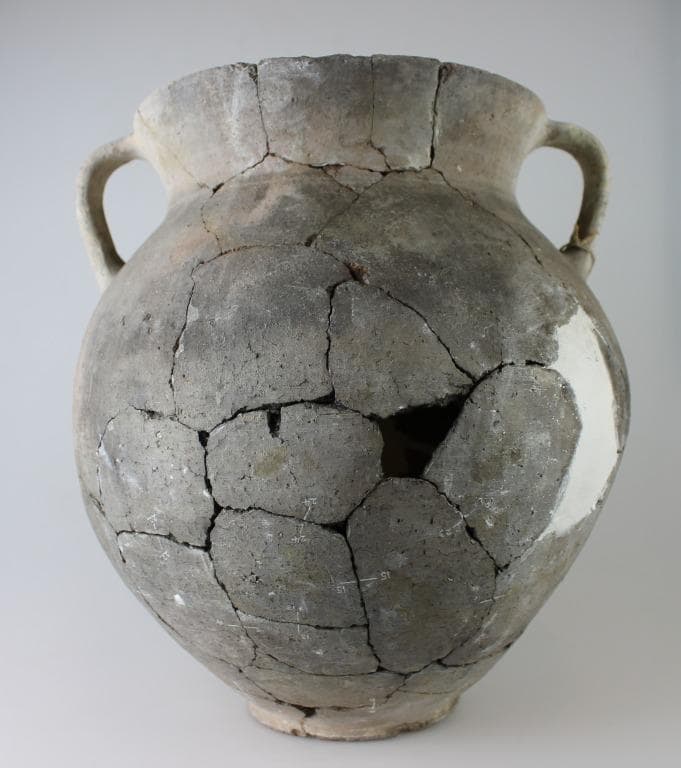
- A cooking pot of Cypro-Geometric I date (c. 1050–950 BCE) from the Kouklia expedition, now in Liverpool: a large coarse jar 335 mm high with two small vertical handles from shoulder to rim and a slightly conical neck. The clay is dark and the surface burnished black, a finish that recalls the burnished Coarse Monochrome of the Late Bronze Age. It has been rebuilt from many sherds.
- A miniature coarseware cooking pot from Amathus (British Museum 1894,1101.549), excavated with the Turner Bequest: wheelmade, 6.3 cm high, with a hemispherical lower body on a round base, a concave upper body and a single strap handle, in coarse buff-orange clay with many inclusions, fired black through much of the fabric. Its date is given broadly as c. 1050–475 BCE.
- A coarse ware jug from Kourion (British Museum 1982,0729.360): wheelmade, 13.5 cm high, with a depressed globular body, a wide concave neck and a single handle, in coarse red clay.
- A coarse white jug from Marion (British Museum 1887,0801.51), c. 475–300 BCE: 11 cm high, its shape close to Plain White VI–VII but made of coarser buff clay. The museum's record leaves its classification between Plain White and Coarse Ware, which shows how the two blur.
- A coarse ware flask from Naukratis in Egypt (British Museum 1888,0601.729), c. 630–550 BCE, in grey-brown clay with traces of red paint, and a pair of coarse red body sherds of Cypro-Classical II date from Kouklia, from a large amphora, pithos or kitchen vessel.
Museum collections favour small, complete pots. The settlement pottery of the Iron Age kingdoms (cooking pots, kitchen jars and the pithoi of houses and palaces) is known mainly from sherds and is still largely unpublished as a typology. For the period background see Cypro-Geometric and Cypro-Archaic, and for the transition that created the Iron Age fabrics, Proto-White Painted Ware. See all Iron Age coarse and plain wares in the catalogue.
Identification and firing
Coarse wares are identified by fabric first. A fresh break shows the size and density of the inclusions; the surface shows whether the pot was smoothed, self-slipped or burnished; and the colour of the core shows how it was fired. Chalcolithic trays are friable and often reduced, with oxidised bases where they stood on a mat during firing [4]. Late Bronze Age cooking pots are hard-fired [8], and pithos clays fire tan to cream with gritty temper [6, p. 79]. Shape helps only once a rim, handle or base survives, which is why survey teams lean on fabric [2, p. 231]. For how these pots were fired see Pottery Kilns and Firing, and for practical advice on recognising Cypriot wares, How to identify ancient Cypriot pottery and The making of ancient Cypriot pottery.
Why coarse wares matter
Coarse pottery records what the painted wares leave out: how food was stored, processed and cooked, and how much of it there was. The 95 or so pithoi at Kalavasos-Ayios Dhimitrios measure the oil reserves of a Late Cypriot centre [7]; the switch to flat-based wheelmade cooking jugs in the 12th century BCE is one of the clearest changes in daily practice at the end of the Bronze Age [1, pp. 175–176; 8]; and the Late Neolithic and Chalcolithic trays, some found in hearths, record food processing at a household scale [3, p. 178; 4]. Because the class is defined by fabric and function, each period's coarse ware needs its own description, and the categories in the catalogue follow that division.
Objects on this page
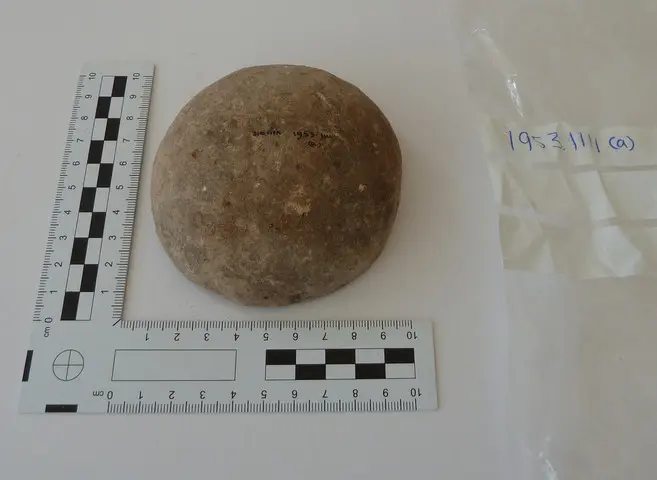 Plain coarse ware bowlMiddle Bronze Age II · 1850–1650 BC
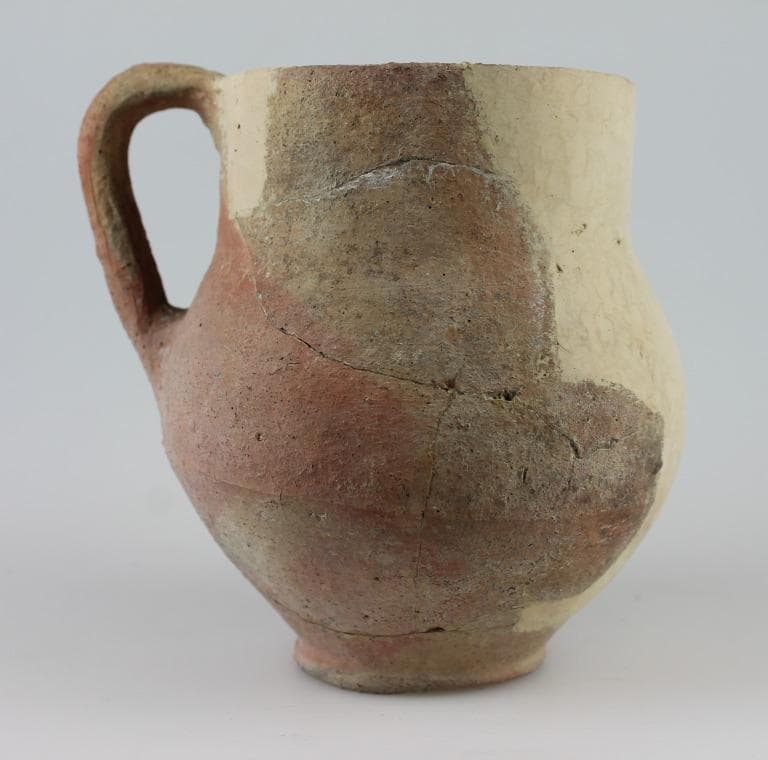 Jug or beakerLate Bronze Age III · 1200–1050 BC
- Cooking Pot?Geometric I · 1050–950 BC
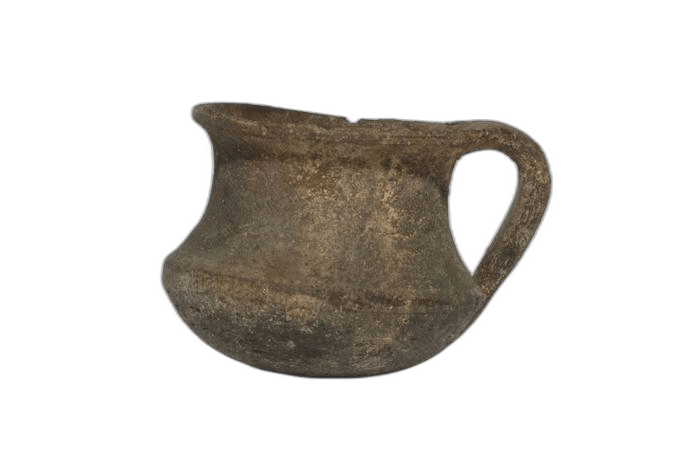 Coarseware Cooking PotGeometric · 1050–475 BC
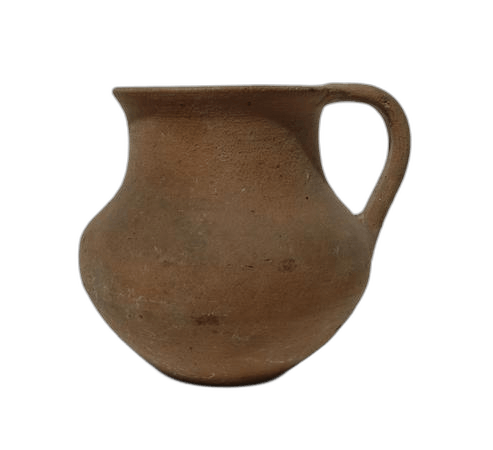 Coarse Ware JugClassical · 500–50 BC
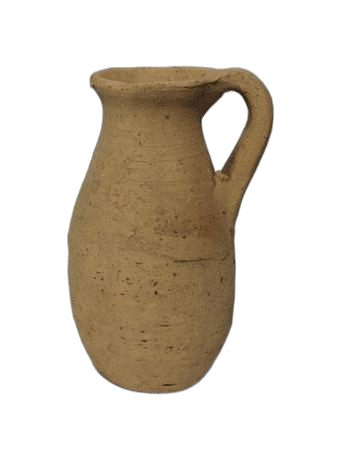 Coarse White JugClassical · 475–300 BC
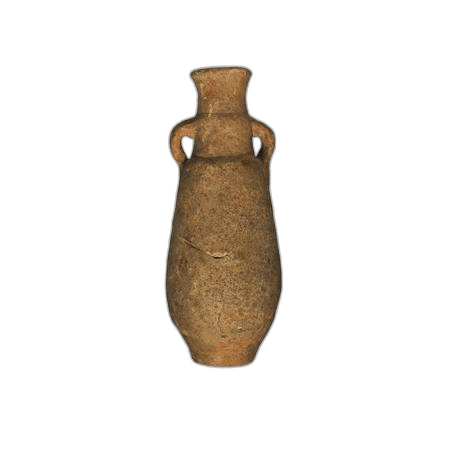 Coarse Ware FlaskArchaic II · 630–550 BC
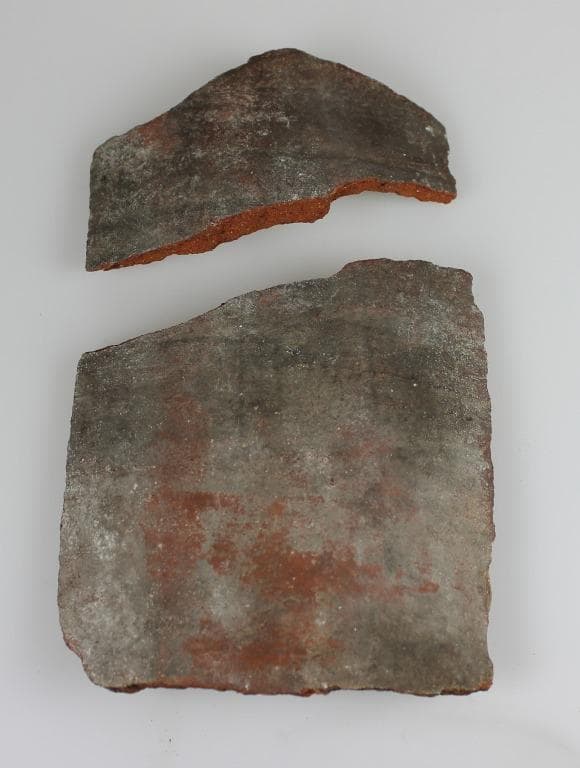 Vessel FragmentsClassical · 400–325 BC
In the catalogue
References
- 1.Jung, R. (2017). Cooking vessels from Late Bronze Age Cyprus: Local traditions, western and eastern innovations. In J. Hruby & D. Trusty (Eds.), From cooking vessels to cultural practices in the Late Bronze Age Aegean. Oxbow Books.
- 2.Caraher, W. R., Moore, R. S., & Pettegrew, D. K. (2014). Pyla-Koutsopetria I: Archaeological survey of an ancient coastal town (ASOR Archaeological Reports 21). American Schools of Oriental Research.
- 3.Peltenburg, E., et al. (2003). The colonisation and settlement of Cyprus: Investigations at Kissonerga-Mylouthkia, 1976–1996 (Lemba Archaeological Project III.1; Studies in Mediterranean Archaeology 70:4). Paul Åströms Förlag.
- 4.Baird, D. (1991). A flexible classification of Late Neolithic and Chalcolithic pottery. In J. A. Barlow, D. L. Bolger & B. Kling (Eds.), Cypriot ceramics: Reading the prehistoric record (University Museum Monograph 74, pp. 21–28). University of Pennsylvania Museum.
- 5.Keswani, P. S. (2009). Exploring regional variation in Late Cypriot II–III pithoi: Perspectives from Alassa and Kalavasos. In I. Hein (Ed.), The formation of Cyprus in the 2nd millennium B.C.: Studies in regionalism during the Middle and Late Bronze Ages (Contributions to the Chronology of the Eastern Mediterranean 20). Austrian Academy of Sciences.
- 6.Given, M., Knapp, A. B., et al. (2013). Landscape and interaction: The Troodos Archaeological and Environmental Survey Project, Cyprus. Volume 1: Methodology, analysis and interpretation (Levant Supplementary Series 14). Oxbow Books / Council for British Research in the Levant.
- 7.Webb, J. M., & Frankel, D. (1994). Making an impression: Storage and surplus finance in Late Bronze Age Cyprus. Journal of Mediterranean Archaeology, 7(1). https://doi.org/10.1558/jmea.v7i1.5
- 8.Dikomitou-Eliadou, M., Georgiou, A., & Vionis, A. K. (2016). Cooking fabric recipes: An interdisciplinary study of Cypriot cooking pots of the Late Bronze Age. Journal of Archaeological Science: Reports. https://doi.org/10.1016/j.jasrep.2015.12.016