
Fieldwork·In brief
Late Bronze Age tower found on the city wall of Palaepaphos, near Aphrodite's sanctuary
A University of Athens team traced a bastion that was enlarged into a tower of about 7.4 by 7.3 metres on the wall at Marcello, Kouklia, in August and September 2026.



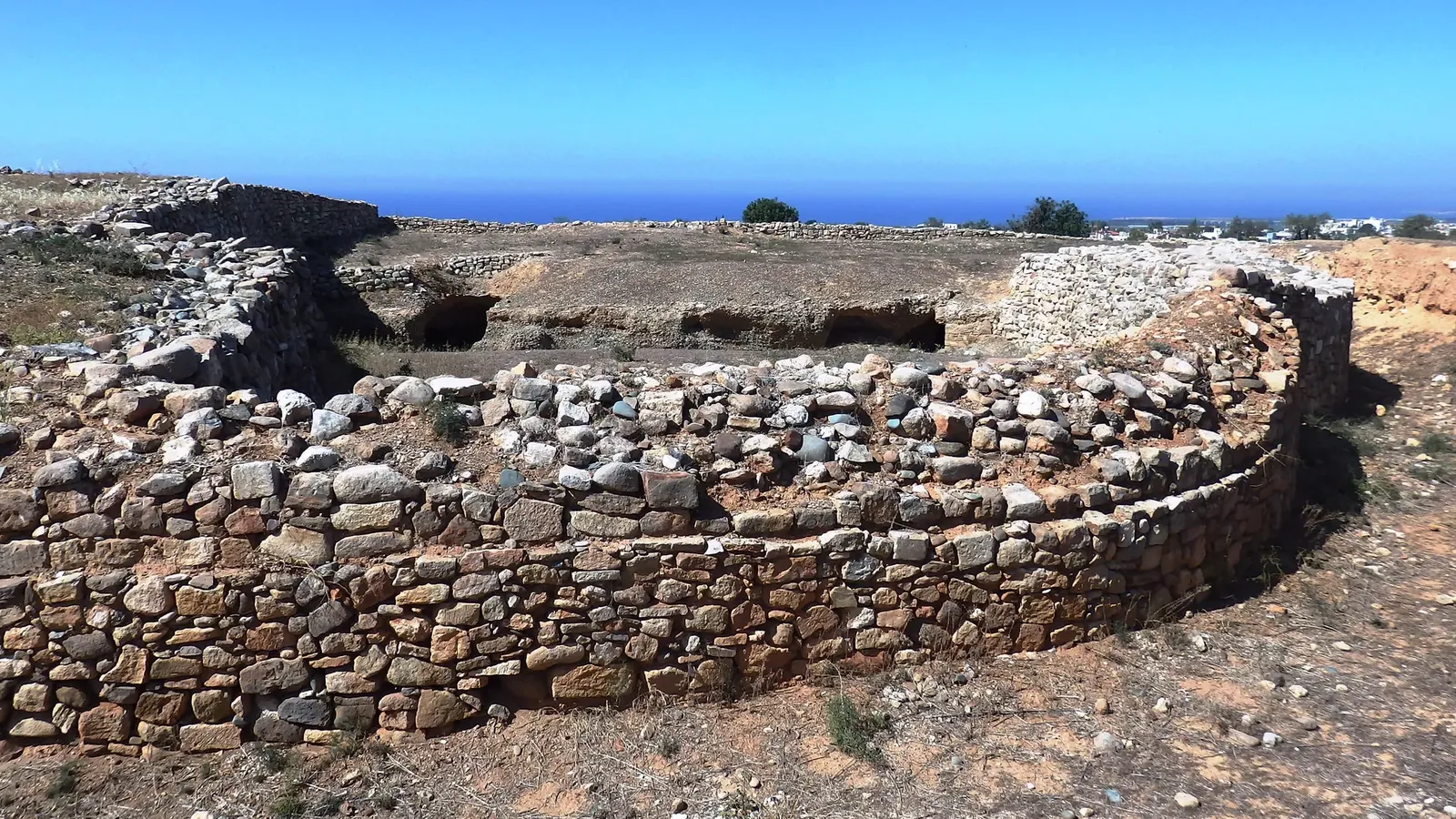
The foundations of a near-square tower built onto the Late Bronze Age city wall have been excavated at Marcello (Marchello) in Kouklia, the Department of Antiquities announced on 21 October 2026. A National and Kapodistrian University of Athens team under Professor Konstantinos Kopanias dug in August and September.
The Department says the results document, for the first time, a monumental fortified enclosure at Palaepaphos in the Late Bronze Age. An undisturbed deposit against the wall, with pottery of the same age, supports a Late Cypriot IIC–IIIA date for its first phase, at the end of the period; marl spread over its stone footing probably levelled it for a mudbrick superstructure.
The tower started as a rectangular bastion of Late Cypriot IIIA projecting from the wall. A Π-shaped addition made it a block of about 7.4 by 7.3 metres around a central room of some 9 square metres. Within Late Cypriot IIIA a wall about 2.7 metres thick went onto its north-west side.
In the 4th century BCE (late Cypro-Classical) a further wall strengthened its north-east and south-east faces, and the city wall was probably widened. The Athens team has so far found no Cypro-Geometric or Cypro-Archaic building phase in its area.
Marcello lies just under a kilometre north-east of the sanctuary of Aphrodite. British, Swiss-German and University of Cyprus teams exposed a long wall and a monumental gate there before the Athens excavations began in 2021.
On ancientcyprus.com
- Sites
- Palaepaphos
- People
- Konstantinos Kopanias
- Periods
- Late Bronze Age, Cypro-Classical
More in Fieldwork
- Idalion excavators fixed points by RTK, 3D-scanned a statue fragment and logged finds in OCHRE
- Rescue dig in the Nile Delta finds a 1.6-metre head of Ramesses II
- Ochre working, a hearth and a second round building found at Chalcolithic Erimi-Pamboula
- Swedish team reaches Hala Sultan Tekke's earliest town levels, of the 17th–15th centuries BCE
- Jars off Turkey's Kekova may come from the oldest known shipwreck, up to 4,700 years old