
Research·Brief
Strabo's Arsinoe near Palaepaphos probably never existed, argues study of a Ptolemaic queen's cult
Giorgos Papantoniou argues that the cult of Arsinoe II tied Cypriot towns and sanctuaries to Ptolemaic rule, down to a tithe-collector's pots at the Kafizin grotto.



Of the three Cypriot towns that scholars have said were named after the Ptolemaic queen Arsinoe II, the one Strabo placed near Palaepaphos probably never existed, Giorgos Papantoniou argues. His article, published online in The Annual of the British School at Athens on 16 October 2026, reads the queen's cult as a means of tying local communities to the Hellenistic administration of the Ptolemies, in public sanctuaries and probably in private houses too.
Three towns called Arsinoe
Arsinoe II, sister and wife of Ptolemy II, was deified around 270 BCE, and her cult was linked to Aphrodite. Papantoniou ties the name to Ptolemaic sea power: at least 16 Ptolemaic settlements around the Mediterranean bore it, many beside promontories with anchorages.
The surest Cypriot case is Marion. Diodorus records that Ptolemy I destroyed it in 312 BCE and moved its people to Nea Paphos; it was later restored, probably by Ptolemy II, under the queen's name. At Polis Chrysochous, where William A. P. Childs led Princeton's excavations from 1983 to 2007, the remains point to a thriving Hellenistic town.
A second Arsinoe, with a harbour, is placed by Strabo between Salamis and Leukolla, probably where Famagusta now stands. Medieval Famagusta covers the site, and it lies in the area occupied by Turkey since the 1974 invasion, where no lawful excavation can take place.
Strabo's third Arsinoe, with an anchorage, a shrine and a sacred grove, lay between Palaepaphos and Hierokepis (Geroskipou), but has never been located. In 1999 Bekker-Nielsen suggested that Strabo's entry duplicates Marion-Arsinoe. Papantoniou follows him and proposes dropping the town altogether: the harbour of Nea Paphos, facing Alexandria, met the fleet's needs.
Map of Cyprus
Arsinoe in Cyprus
- Towns named Arsinoe
- Evidence for the cult discussed in the paper
- Ground above 200, 500, 1,000 m
Sites on this map
- 1Marion
- 2Famagusta (probable Arsinoe) (approx.)
- 3Kafizin (approx.)
- 4Chytroi
- 5Idalion
- 6Soli-Cholades (approx.)
- 7Palaepaphos (Kouklia)
Pots for a nymph and a queen
The fullest evidence comes from the Nymph's grotto on Kafizin hill, which Porphyrios Dikaios and T. B. Mitford excavated in 1949. Pots dedicated there in the last quarter of the 3rd century BCE (Mitford's date, which Papantoniou keeps) carry inscriptions in the Greek alphabet and the Cypriot syllabary. The title Adelphe, sister, appears almost only on the decorated wares, and inscription no. 300 names Philadelphus.
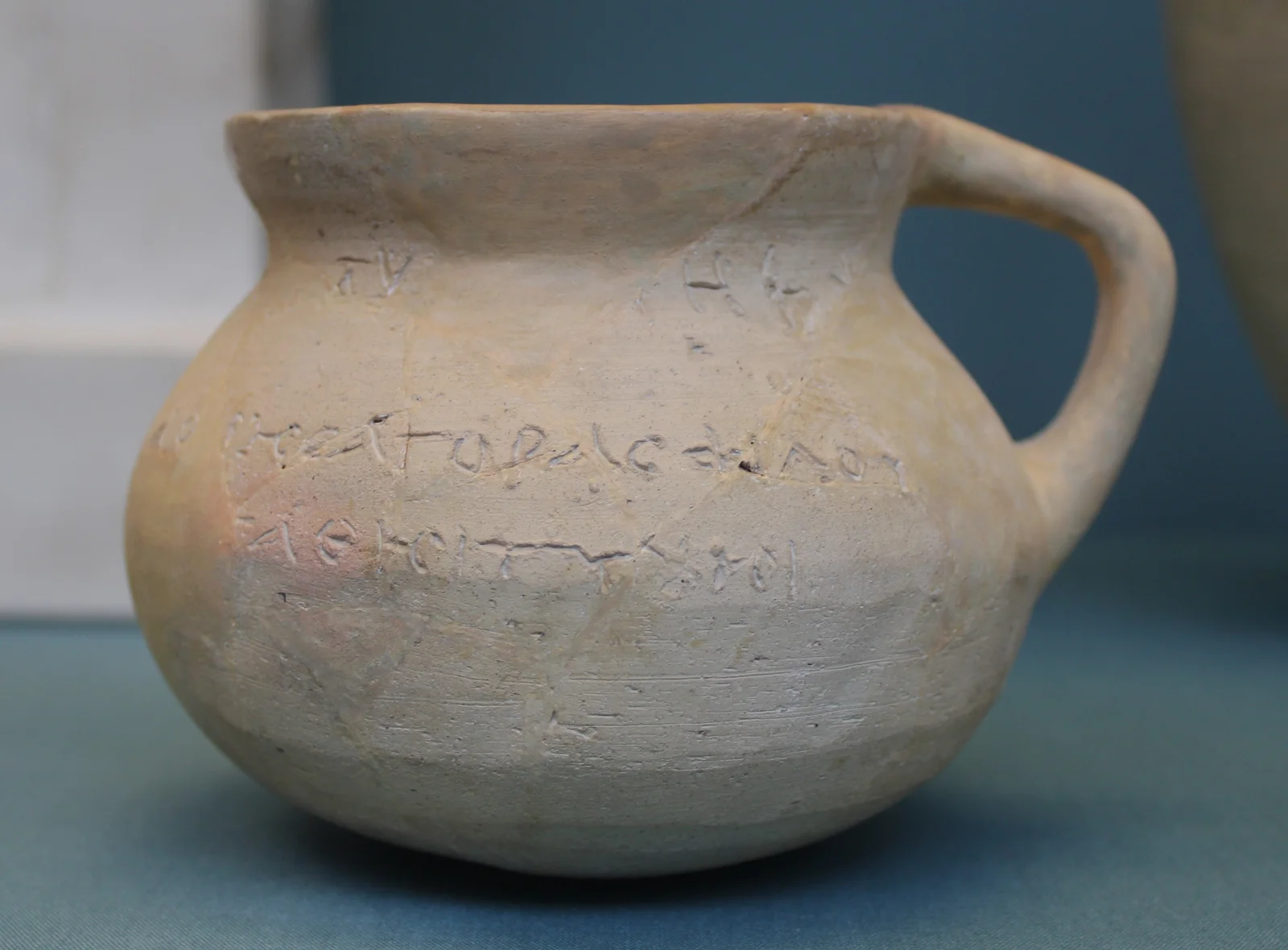
Many are signed by Onesagoras, a barber who served as mantiarchos, overseer of divination, and often calls himself dekatephoros. Papantoniou reads him as a collector of tithes from tenants of an estate, the Androklou oikos, for a company that farmed flax and linseed. On that reading, local elites and local scripts were drawn into Ptolemaic tax collection in the 3rd century BCE. He calls the idea preliminary and speculative, and records the alternative view that the tithes were religious dedications.
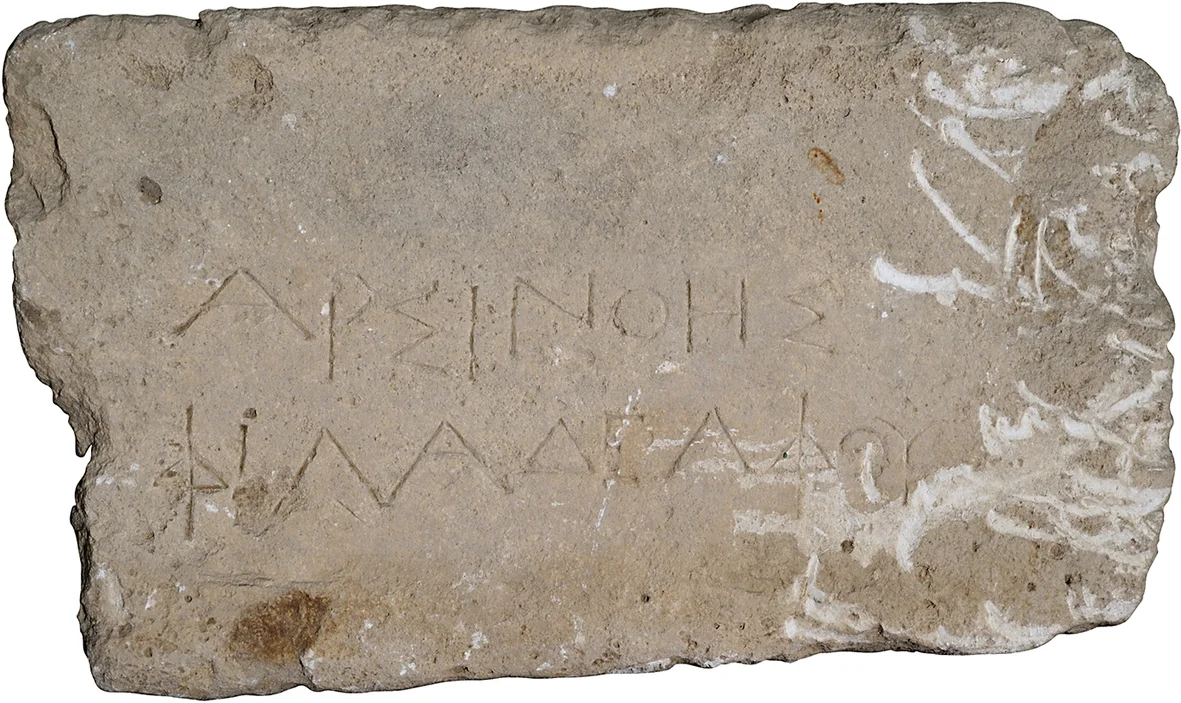
A marble statue base from Chytroi (Kythrea), in the occupied north, dedicated by Aristokles son of Aristokles of Alexandria, is the only Cypriot text that links her to a deity, the Nymph Naias. An inscription of 254 BCE from Idalion names a kanephoros, a basket-bearer, and an Arsinoeion, a temple of the queen inside the old sanctuary. Altars, plaques and jugs bearing her name come from eleven places, from Paphos and Kourion to Ledra and, in the occupied north, Karpasia.
How long it lasted
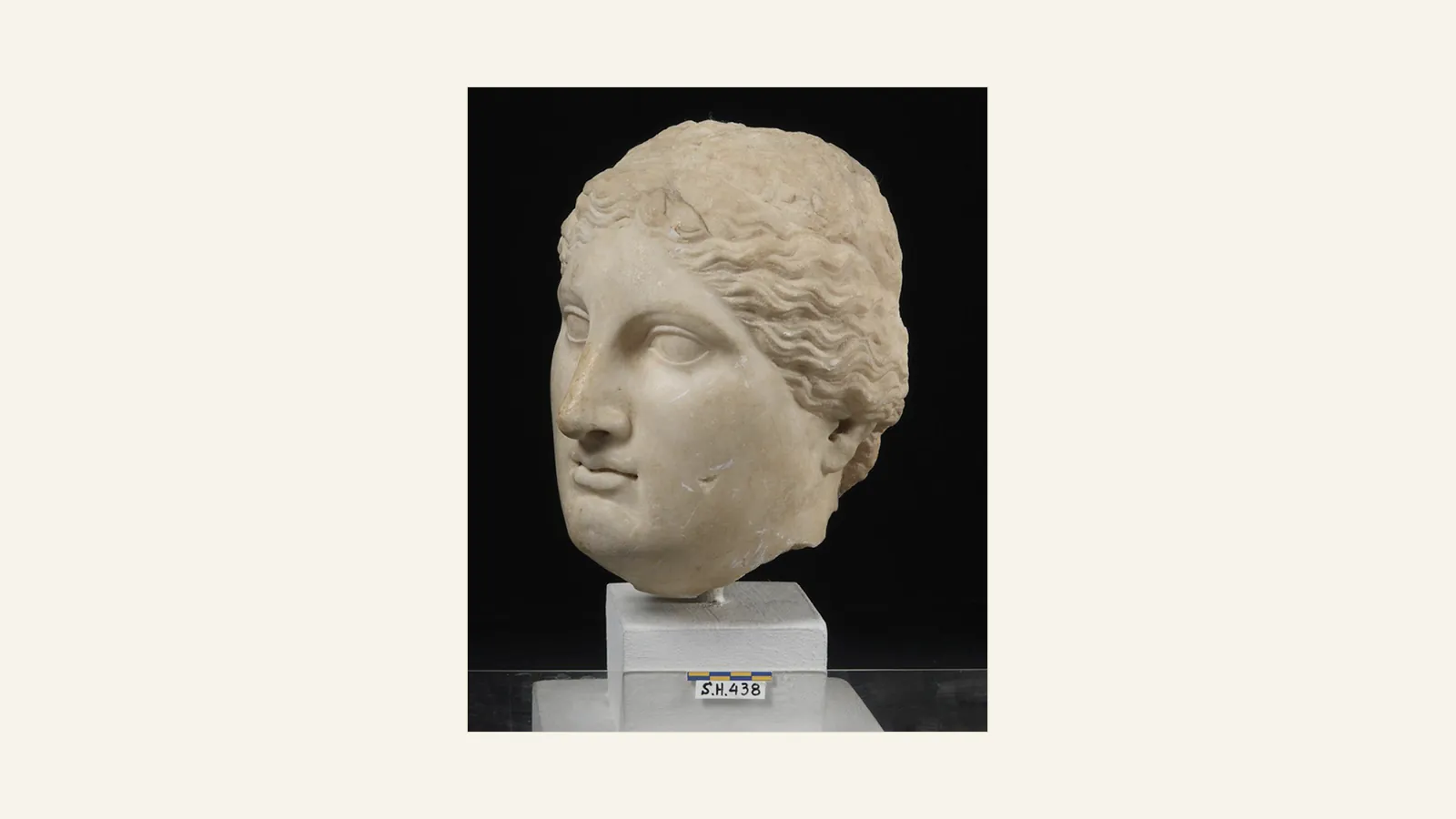
The marble head above, from the sanctuary of Aphrodite at Soloi-Cholades, also in the occupied north, has been identified both as the goddess and as the queen. In Papantoniou's account the cult served the Ptolemies until about the middle of the 2nd century BCE, when the dynasty turned to internal and dynastic matters, which may explain why the Arsinoe towns later prospered less. At Soloi-Cholades, founded in the early Hellenistic period, the cult of Isis entered the temple towards the end of the period.
Original source
On ancientcyprus.com
More in Research
- Wheat traces at Chlorakas-Palloures question the view that cereals were minor in Chalcolithic Cyprus
- Charred barley and chaff in a Pyla shaft point to stored animal fodder around 1200 BCE
- Late Bronze Age hoard of at least 111 bronzes at Galinoporni was packed in cloth, cord and grass
- Bronze Age tombs at Hala Sultan Tekke held what may be burnt bouquets of grain and wild flowers
- 48 carved stones near Kourion may come from an unknown Roman temple, study argues