
Contents
"Style" means three different things in the study of Cypriot Iron Age vase painting, and most confusion about the subject comes from mixing them. The first is a way of laying out the picture on the pot: in metopes, in zones, or alone on the bare body, which is the free-field style. The second is a repertoire: the figured, or pictorial, decoration of birds, bulls, sphinxes and people, as opposed to the circles and lines of the geometric tradition. The third is a regional manner, a way of painting tied to one kingdom's workshops. Two of these are recognised for the Cypro-Archaic period, at Salamis and at Amathus. This page sets out the figured repertoire and the two regional styles, and how the labels came to be used. You can see all Iron Age painting styles in the catalogue.
Layout, repertoire and region
Einar Gjerstad, publishing the Swedish Cyprus Expedition's Iron Age pottery in 1948, split the decoration of Bichrome IV into two regional systems. "The circle style can be localized to the western and northern parts of Cyprus, and the rectilinear style to the eastern and southern parts of the island," he wrote, and he called them the Western and the Eastern style [1]. The Eastern style admitted "lotus buds and flowers, rosettes, sacred tree, aquatic birds, quadrupeds, and human figures" [1]. He was explicit that his styles were defined by their elements and not by their layout: "the difference between the styles is a difference between the decorative elements, and does not refer to their composition." Both zone, panel and free-field arrangements occur in each, and the free field "is generally employed on the jugs with pinched mouth, both for geometrical and pictorial designs" [1]. A western jug with a vertical row of concentric circles on its plain body is free-field without being pictorial.
That distinction still holds. Karageorghis, in the Metropolitan Museum's Cesnola catalogue, describes the free field as "a special pictorial style" that developed "in the eastern part of the island" during Cypro-Archaic I-II, made in either White Painted or Bichrome, with "linear and geometric decorations" absent [2, introduction to cat. 149-161]. Anna Georgiadou and Maria Dikomitou-Eliadou call free field, panelled and floral "conventional terms" for "the mode of arrangement of a pictorial scene" [3, p. 342]. The regional labels, Salamis and Amathus, sit on top: each kingdom's painters used more than one layout.
The groupings are modern and art-historical. Most were built from museum vases without findspots, many of them from the Cesnola collection and the nineteenth-century trade, and only a small number have been tested by clay analysis (see below).
Figured scenes
The figured repertoire is older than either regional style. A kalathos of the eleventh century BCE in the Cyprus Museum, 15 cm high and 27 cm across, already carries panels with human figures, animals and birds among geometric motifs, in a pictorial manner rooted in Mycenaean IIIC painting with Levantine influence [4, p. 68]. Maria Iacovou published the eleventh-century pictorial pottery as a corpus in 1988 (Studies in Mediterranean Archaeology 79). In early Cypro-Geometric White Painted the figures stay bound by symmetry: a White Painted I kylix from Lapithos Ayia Anastasia Tomb 2 carries birds arranged as mirror images [4, p. 68]. Karageorghis puts the start of the Iron Age pictorial style in the Cypro-Geometric period, "sporadically until the Cypro-Geometric III period, when it became a major part of the repertoire" [2, introduction to cat. 149-161].
Two amphorae anchor the Cypro-Geometric sequence. The Kaloriziki amphora, a Bichrome vessel from the Kaloriziki cemetery at Kourion, has panels on the neck showing a figure pouring a libation from a small jug over a large amphora and a long-haired figure in a hatched chiton holding a lyre. Porphyrios Dikaios dated it "roughly to the second part of the tenth century B.C." and saw it as a stage "between the Mycenaean times and the period of the Hubbard amphora" [5]. The Hubbard amphora itself, in the Cyprus Museum, has an enthroned woman drinking through a tube from a jar while an attendant pours, with a sphinx smelling a flower; Dikaios read the scene as a funerary rite in honour of the seated woman [5]. Karageorghis's museum guide describes its drawing as "as free as the painting of a small child" [4, p. 77].
Gjerstad used these two pots to define two groups within Bichrome III. In the first, "the figures of birds, quadrupeds, men, etc. are still geometrical or geometricising" and serve as ornaments of metopes; in the second, "magnificently represented by the so-called Hubbard amphora," the figures are "more freely drawn, with the body usually designed in contour-lines," and run as a continuous frieze. He judged that the second group began later than the first [1]. The first group includes a jar with a tripartite temple flanked by trees and birds [1]. In Bichrome IV, of Cypro-Archaic I, "the touch of the brush is much surer, and the body has overcome the geometrical abstractness and obtained volumen"; the birds "may be interpreted as soul-birds," and the subjects include "cult representations, but also pure genre" [1].
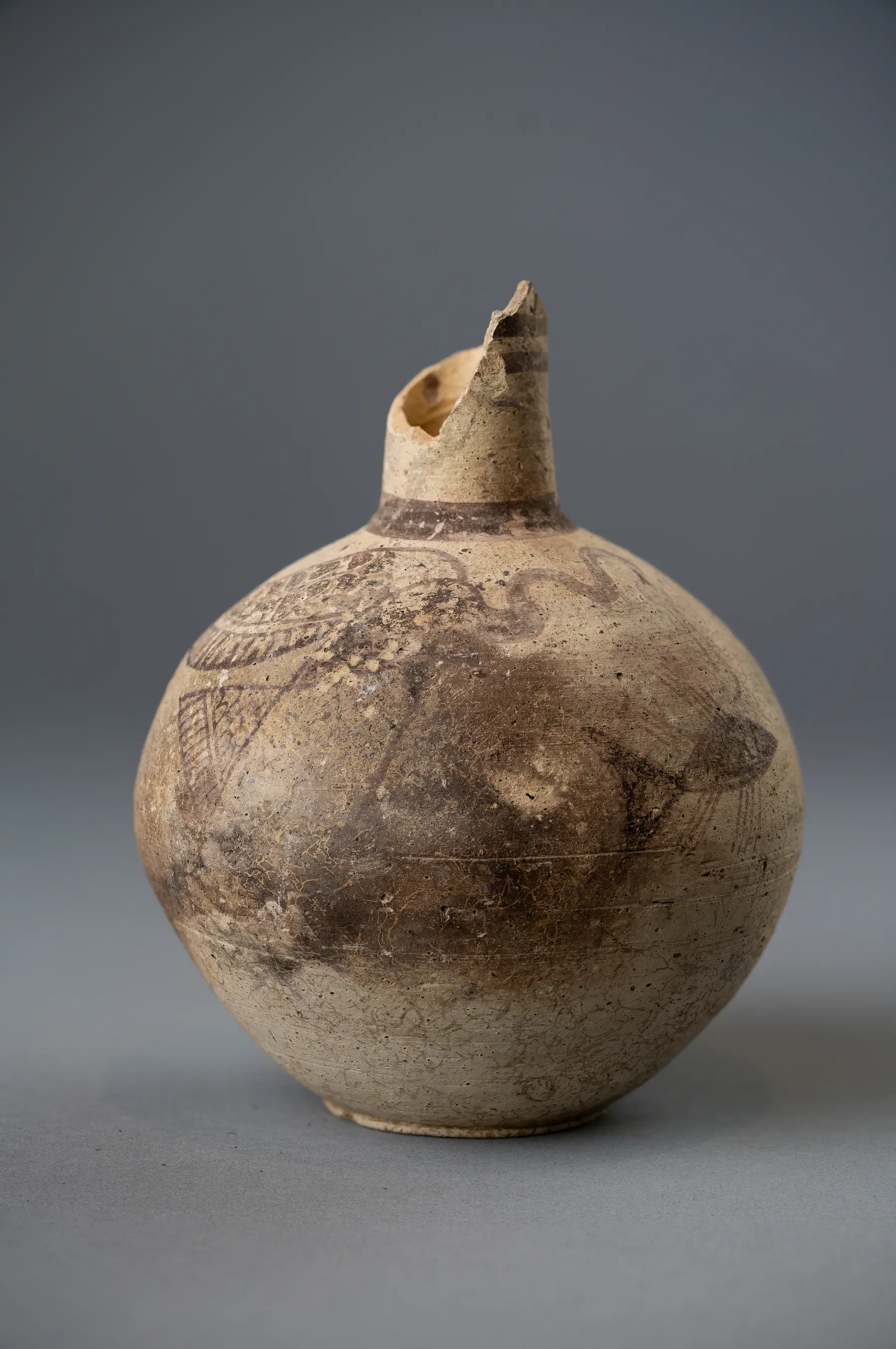
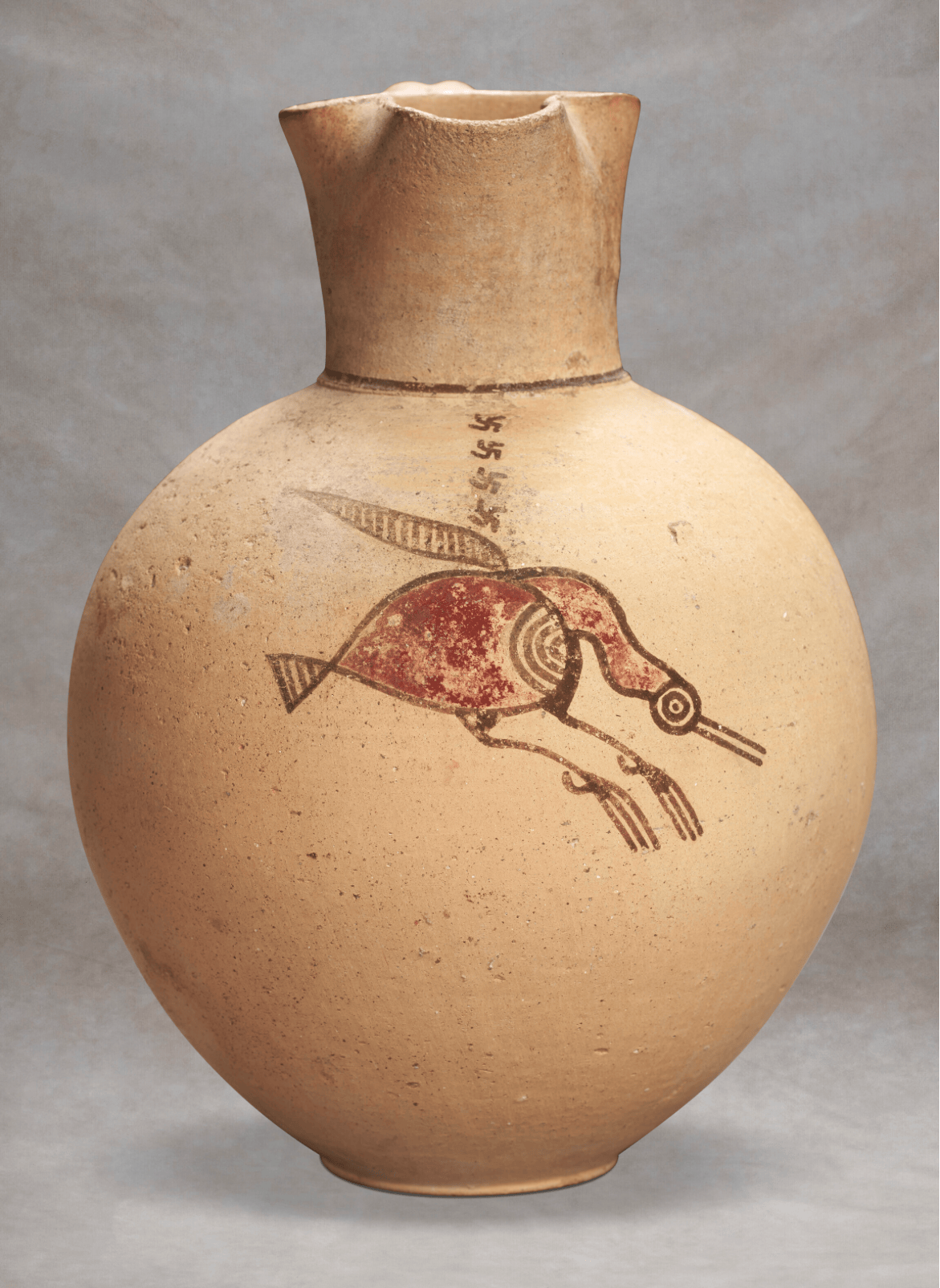
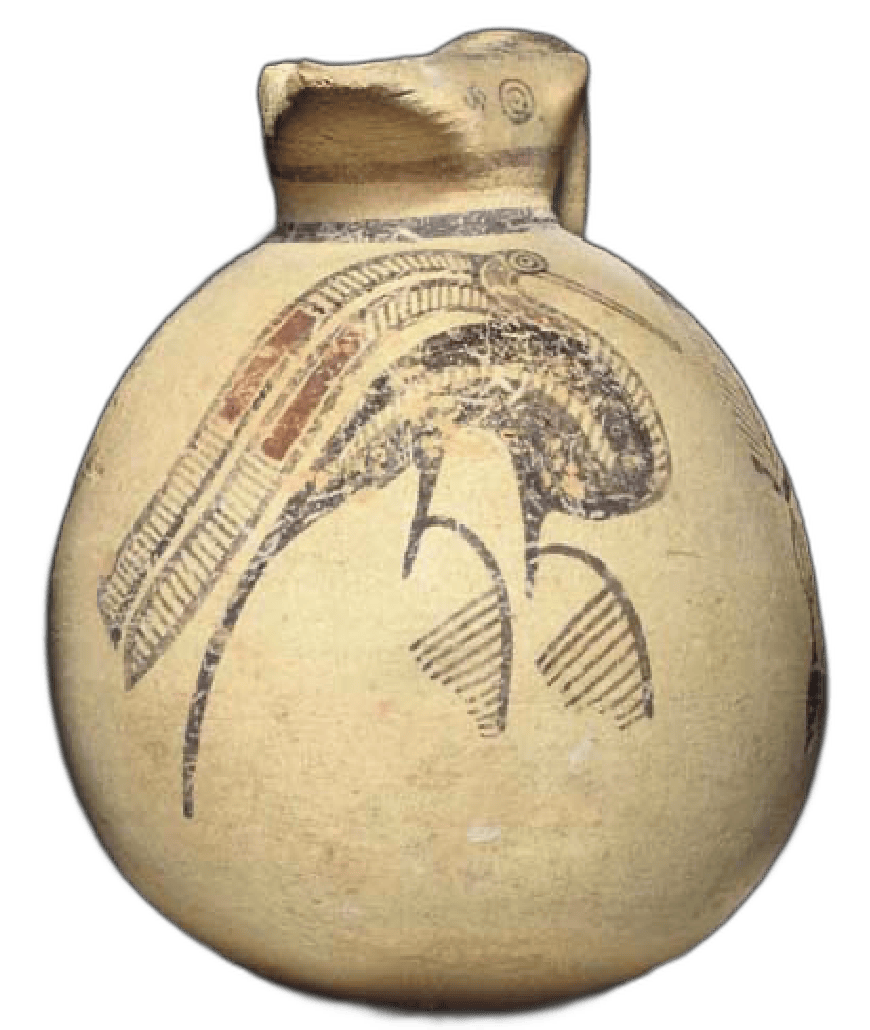
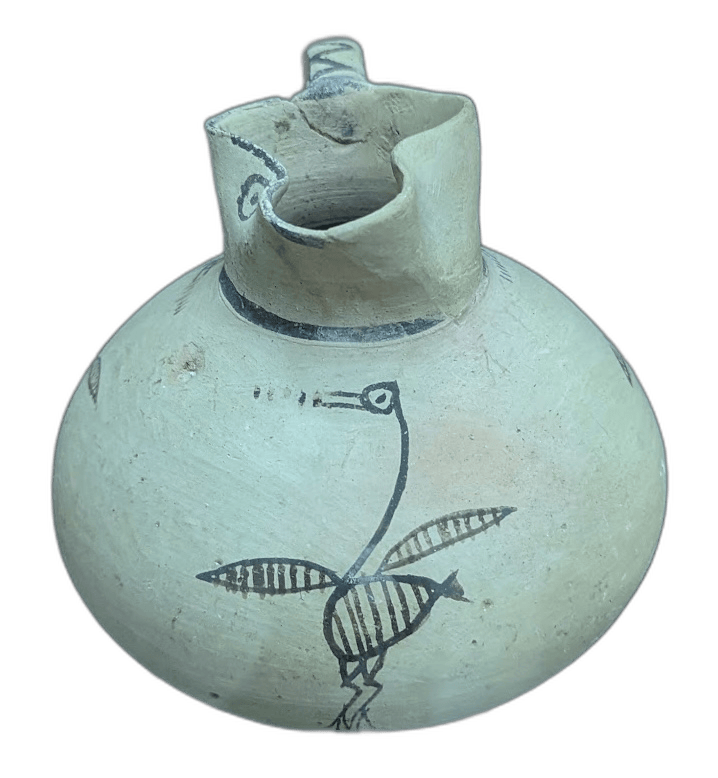
The subjects of the mature figured style are set out by Karageorghis: "human figures, quadrupeds, birds, often paired with fish, and combinations of motifs in ambitious compositions," with stylised flowers as favoured ornament [2, introduction to cat. 149-161]. The small Drakopoulos Bichrome IV jug with a waterfowl catching a fish, 15 cm high, shows that pairing: a hatched waterbird stretches its neck in S-bends across the shoulder towards a dark-bodied fish with a forked tail. The trefoil jug with a striding bird in the same collection shows the usual carrier, a pinched-mouth jug with the picture opposite the handle. In the 7th century, according to the same guide, the pictorial style "came to dominate vase painting, especially in eastern Cyprus," and the bull sniffing a lotus, a subject current "since the Mycenaean era," was one of its favourites [4, p. 78].
Human scenes are the rarer part of the repertoire, and they carry the debates. The Pierides catalogue publishes a jug with the Phoenician god Reshef and another with a seated human shown frontally, and points to "Cypro-Phoenician metal bowls" as a source for the painters [6, p. 21]. Georgiadou and Dikomitou-Eliadou describe the sphinxes, lions and winged creatures of the Salaminian floral style as "indisputably of Near Eastern origin" [3, p. 341]. The Cyprus Museum guide traces the figured tradition back to Mycenaean IIIC pictorial painting [4, p. 68]. The two views address different stages and need not exclude each other. The question of meaning is open too: Dikaios read the Hubbard amphora as a funerary rite, and Gjerstad allowed both cult and genre on Bichrome IV [1, 5]. Figured painting is overwhelmingly on Bichrome and White Painted; on Black-on-Red, whose dishes "normally feature concentric bands," a pictorial exterior is an exception [2, cat. 149].
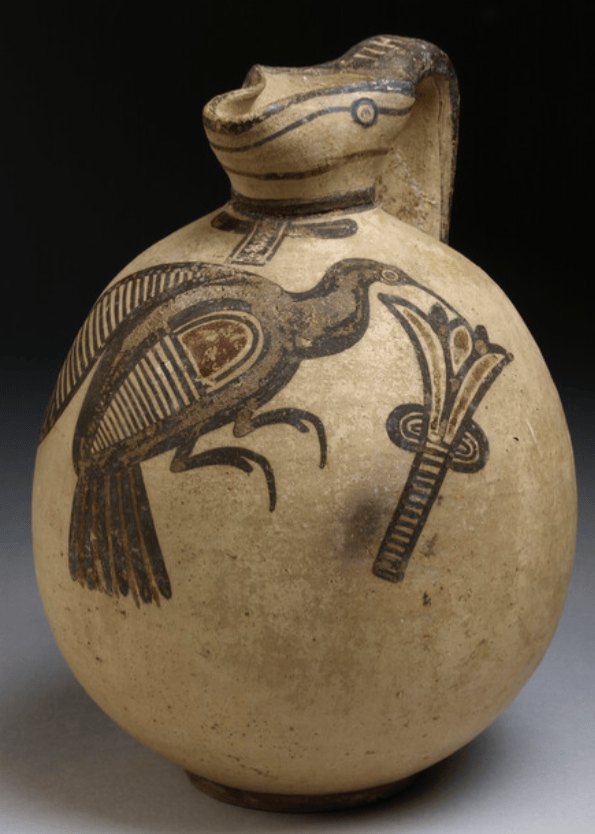
The catalogue's examples of this group are dominated by single birds on jugs: the Ashmolean's free-field jug with an ibis and reeds, a Bichrome kylix with a bird, the Met's Cesnola jug 74.51.527 and others. None of the examples listed here shows a human or narrative scene.
Salamis style
No scholar has defined a "Salamis style" under that exact name as a type. The label is shorthand for what Georgiadou and Dikomitou-Eliadou call the pictorial pottery of Salamis, produced "by the polity of Salamis during the late CG and CA" and decorated in "the so-called 'floral style,' the 'free field' and the 'panelled' style," all "exclusively produced in Bichrome Ware" [3, p. 335]. Their study rests on about 1,100 vessels from tombs at Salamis, around Famagusta bay, in the Mesaoria and the Karpas, excavated by the Department of Antiquities before 1974 and now in the Cyprus Museum [3, p. 337]. Karageorghis and Jean des Gagniers had earlier assembled the Iron Age figured vases as a corpus, La céramique chypriote de style figuré (1974, supplement 1979), and Karageorghis's Cesnola catalogue speaks of "one or two workshops in the eastern part of the island" for the bird-and-fish jugs [2, cat. 161]. The Salaminian attribution makes that east more precise.
Bichrome is the core of the style. Salaminian workshops made it from the eleventh century BCE, with a first peak in Cypro-Geometric III and a second in the seventh and sixth centuries with the floral style [3, p. 338]. Elsewhere red is a supplementary colour; at Salamis it fills and outlines ornaments and figures [3, p. 338]. Paphos, by contrast, made little Bichrome and preferred Black-on-Red [3, p. 338]. The authors date the three modes as overlapping: panelled from Cypro-Geometric III (the ninth century), free field from the beginning of Cypro-Archaic (the eighth century), and floral in the seventh and sixth [3, p. 342].
The floral style is the part of the Salaminian output not covered on the free-field page. It packs lotus flowers of varying size and form, rosettes and guilloche into dense recurring zones, often with humans, animals or mythical creatures [3, pp. 341-342]. The same decoration appears on the corselets of medium and large terracotta statues from Salamis, perhaps imitating textiles; only at Salamis is one pictorial style shared by vases and statues, which the authors take as evidence that potters, painters and coroplasts worked in the same workshops [3, p. 341]. A Bichrome IV belly-handled amphora from Peristerona in the Famagusta district, 90 cm high, carries its decoration on neck and shoulder [3, p. 342]. Other shapes are trefoil-mouthed jugs, barrel jugs, jars and footed deep bowls [3, pp. 342-343].
The subjects range over birds, bulls, goats and fish; sphinxes, lions and centaurs; warriors, horsemen, hunts, and women dancing or holding and smelling a lotus [3, pp. 342-343]. Waterbirds are "particularly popular," alone, in pairs, with a lotus or branch, or catching a fish, drawn in a mix of silhouette and outline with black and red fillings [3, p. 343]. The pictorial vessels were made "primarily for local consumption within the polity of Salamis," unlike Salaminian geometric pottery, which travelled widely [3, p. 335].
The attribution is still mainly stylistic. Of 170 samples taken for analysis only five were pictorial [3, p. 339], and most known pictorial vessels come from private and museum collections without context [3, p. 335]. Gjerstad's free field, zone and panel were modes shared by east and west; Georgiadou and Dikomitou-Eliadou treat floral, free field and panelled as three modes of one Salaminian style. Both positions describe the same pots from different angles.
Amathus Style
The Amathus Style (also called the Amathus Group) is the painted manner of the kingdom of Amathus on the south coast, best known on small Bichrome amphorisks of Cypro-Archaic II (c. 600-480 BCE). Georgiadou and Dikomitou-Eliadou call Amathus "the only other contemporary production centre where a pictorial style developed," one that "followed specific rules, regarding pottery wares, shapes, figurative motifs and imagery" [3, p. 341].
The fullest account is Sabine Fourrier's study of the Amathusian vases in the Louvre. She identifies three Amathusian series across the Archaic period: pinched-mouth jugs with free-field decoration (Bichrome IV, typical of Cypro-Archaic I), spouted jugs, and the amphorisks and jugs "du style d'Amathonte" (class V, typical of Cypro-Archaic II) [7, p. 56]. Amphorisks with horizontal handles and a cylindrical or flared neck are among the characteristic Amathusian forms of Cypro-Archaic II. The plainest have bands and cross-hatching between the handles; late in the period they appear in Bichrome Red, with white crosses on a red ground, "a sure marker" of late Archaic contexts at Amathus [7, p. 62]. The rarer amphorisks with plant or figured decoration are the ones to which the term "style d'Amathonte" has most often been reserved [7, p. 62, n. 27].
On these the decoration sits in metopes, usually three. The central metope shows the goddess, as a Hathor mask or a stele with a Hathor capital, or a plant substitute such as a tree or stylised lotus flowers, flanked by chequerboard panels [7, pp. 63-64]. The finest pieces add a lotus frieze on the lower body, with incised details in imitation of Greek black-figure [7, p. 64]. Fourrier reads the Hathor image as the goddess who gives life and protects royal power; most finds come from the necropoleis and the palace dumps, few from the sanctuary of Aphrodite [7, p. 63]. Known findspots are almost all at Amathus, with two from tombs at Limassol, one from Kalavasos and one perhaps from Idalion [7, p. 63]. In the same phase Amathusian pinched-mouth jugs with concentric circles replace their subsidiary geometric motifs with a Hathor mask, a bird, or a profile figure smelling a flower, as on a jug from Amathus Tomb 411 in the Limassol Museum [7, p. 65].
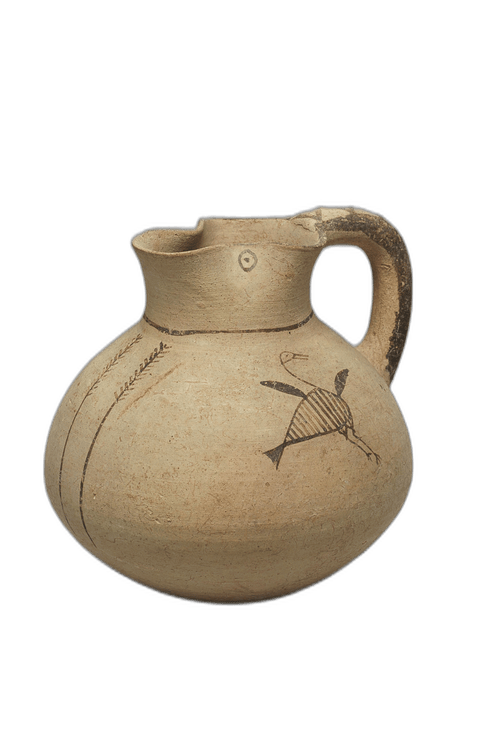
Fourrier's summary treats the style as a whole workshop habit [7, pp. 68-69]. Shapes are squat, with short necks and globular or biconical bodies. The repertoire takes from the geometric west and the floral and figured east; waterbirds and plants are drawn "in a dry, graphic form, line prevailing over volume," often wedged between geometric motifs, while circle-decorated pots admit a tree, bird or Hathor mask. The bird is the favourite subject from the free-field jugs to the amphorisks. A local "Bichrome amathousien," two pigments fired to a near-matching mauve-grey, appears in Cypro-Archaic I and is frequent on Amathus Style amphorisks [7, pp. 68-69]. Gjerstad's east and west do not fit Amathus: its painters used both. A related hybrid output, horizontal-handled amphorae and dinoi on pale ground and on red slip, hardly left the kingdom either [9].
Comparanda include the Ashmolean's Bichrome V belly amphora AN1896-1908.C.239, 19.5 cm high, from Myres's 1894 excavations at Amathus and catalogued as Amathus Style, Cypro-Archaic II. Karageorghis and des Gagniers used "Amathus Style" as a heading in their corpus, for Bichrome V amphorae from Amathus in the Cyprus Museum with birds or a lotus in rectangular panels (cited in [8, p. 329]). The one catalogue example on this site is a small jug in Vienna, 12 cm high, which the museum describes as belonging "to the well-known group of pottery in Amathus style," with stylised birds and trees. Two further papers define the style, by Karageorghis (1989) and by Antoine Hermary (1997), with Fourrier's 2008 publication of the North Rampart deposit at Amathus. Georgiadou and Dikomitou-Eliadou note that "only a handful" of Amathus Style vessels have been found outside the city-kingdom [3, p. 346]. Fourrier calls the series "une production originale et cohérente" [7, p. 69].
Salamis and Amathus compared
| Salamis | Amathus | |
|---|---|---|
| Date | Cypro-Geometric III to Cypro-Archaic | Cypro-Archaic I-II, style proper in CA II |
| Ware | Bichrome only, red used for fill and outline | Bichrome, local mauve-grey Bichrome, Bichrome Red |
| Layouts | Panelled, free field, floral | Free field on CA I jugs; metopes on CA II amphorisks |
| Shapes | Belly-handled amphorae, trefoil jugs, barrel jugs, footed bowls | Amphorisks, squat jugs, spouted jugs |
| Subjects | Waterbirds, bulls, sphinxes, lions, warriors, hunts, women with lotus | Birds, Hathor mask or stele, lotus, trees |
| Circulation | Mainly local; geometric wares exported | Mainly local; a handful outside the kingdom |
The table draws on Georgiadou and Dikomitou-Eliadou for Salamis [3, pp. 335-343] and on Fourrier for Amathus [7, pp. 56-69]. A later offshoot, the Marion Bird Style of Cypro-Classical II jugs with a modelled woman holding a jug, has been linked to Amathusian workshops [8, p. 116].
Further reading on this site
For the layout most of these pots share, see Free-field style; for the wares, Bichrome, Iron Age White Painted and Black-on-Red; for the period frame, Cypro-Geometric and Cypro-Archaic. The articles The Journey of a Free-Field Bird and Cypriot Free-Field Art follow single pots, and The Ancient City of Amathus describes the kingdom. Objects of both groups are in the Drakopoulos, Metropolitan Museum and Ashmolean collections.
Objects on this page
- Bichrome IV Jug with a Waterfowl Catching a FishArchaic I · 750–600 BC
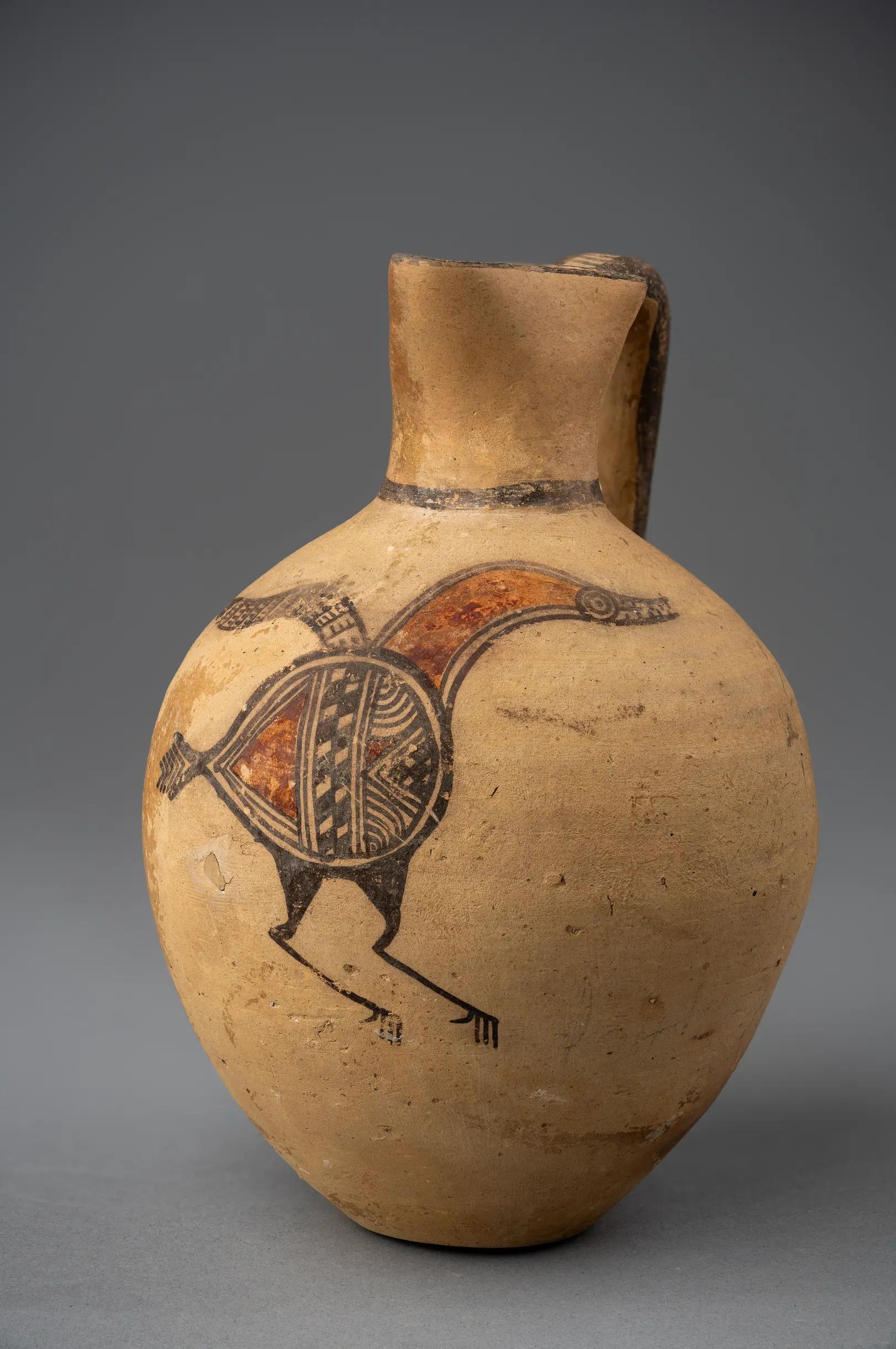 Bichrome IV Trefoil Jug with a Striding BirdArchaic I · 750–600 BC
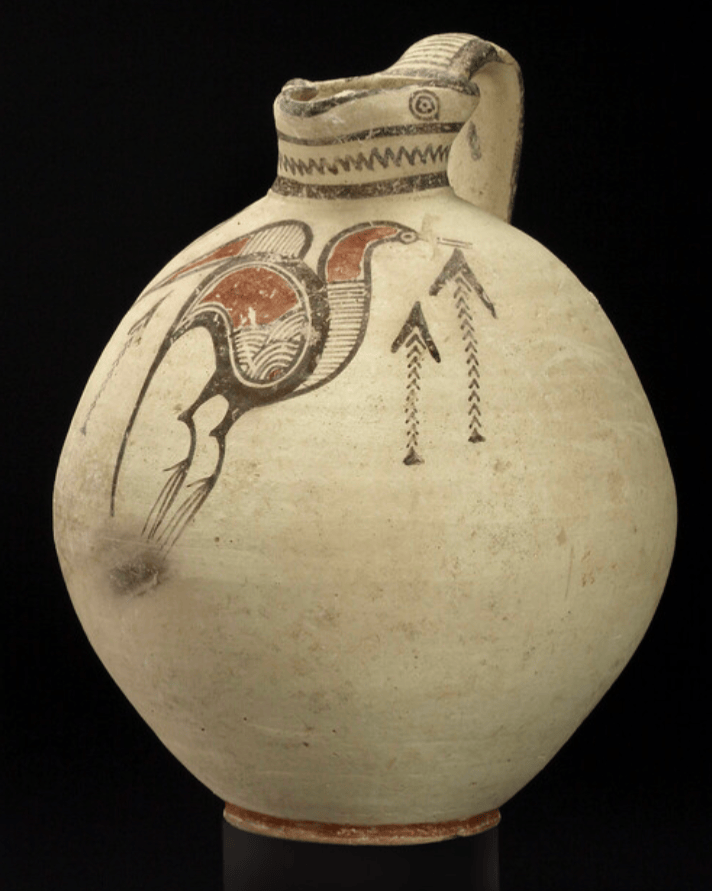 Free-field bichrome jug with image of an Ibis bird and reedsArchaic · 750–475 BC
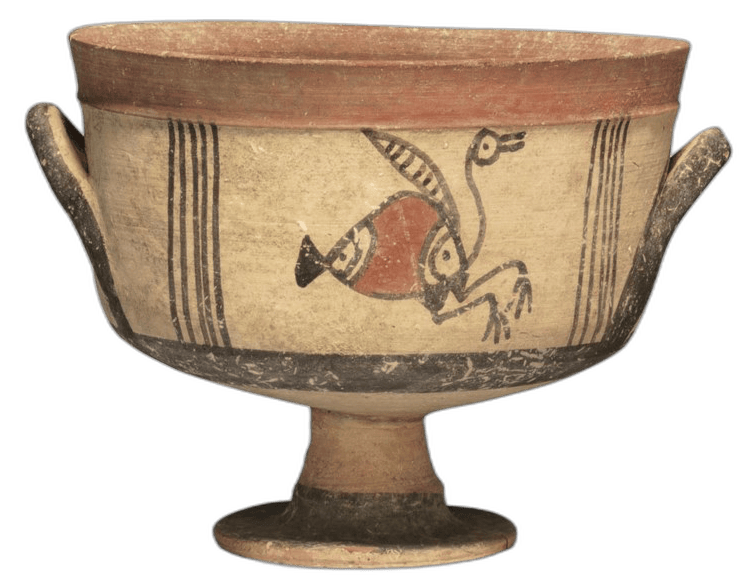 Bichrome Kylix with Bird Free Field ArtGeometric III · 850–750 BC
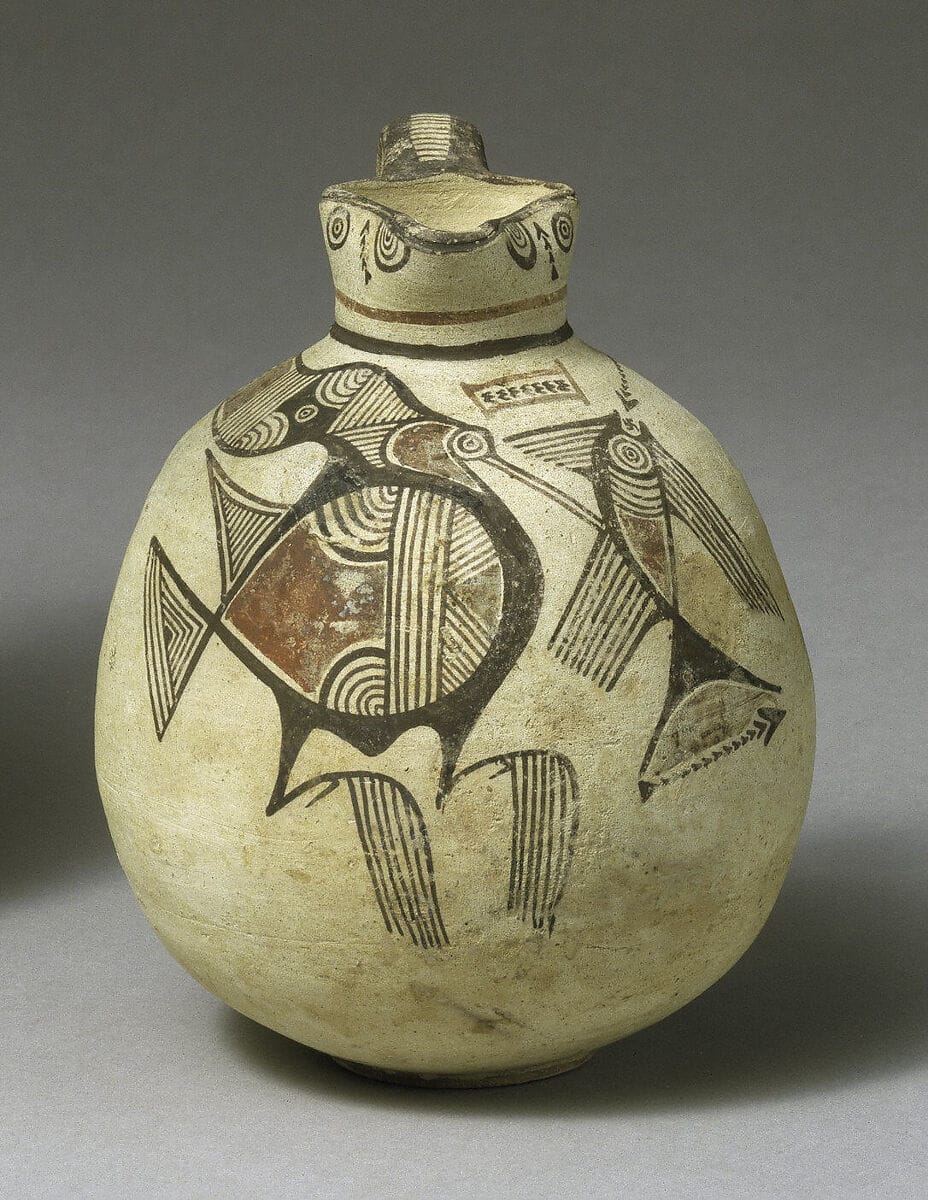 Terracotta jugArchaic I · 750–600 BC
- Känchen der White Painted IV WareArchaic I · 760–600 BC
In the catalogue
References
- 1.Gjerstad, E. (1948). The Swedish Cyprus Expedition, Vol. IV, Part 2: The Cypro-Geometric, Cypro-Archaic and Cypro-Classical Periods. Stockholm: The Swedish Cyprus Expedition.
- 2.Karageorghis, V., Mertens, J. R., & Rose, M. E. (2000). Ancient Art from Cyprus: The Cesnola Collection in The Metropolitan Museum of Art. New York: The Metropolitan Museum of Art. (Cited by catalogue number.)
- 3.Georgiadou, A., & Dikomitou-Eliadou, M. (2022). The Iron Age pictorial pottery of Salamis within and beyond: An overview of ceramic styles, wares and fabrics. In G. Bourogiannis (Ed.), Beyond Cyprus: Investigating Cypriot connectivity in the Mediterranean from the Late Bronze Age to the end of the Classical Period (AURA Supplement 9, pp. 335-348). Athens: National and Kapodistrian University of Athens.
- 4.Karageorghis, V. (1989). *The Cyprus Museum*. Nicosia: C. Epiphaniou Publications.
- 5.Dikaios, P. (1937). An Iron Age painted amphora in the Cyprus Museum. The Annual of the British School at Athens, 37, 56-72. https://doi.org/10.1017/S0068245400017974
- 6.Cypriote Antiquities in the Pierides Collection, Larnaca (collection catalogue). Larnaca.
- 7.Fourrier, S. (2005). Vases archaïques d'Amathonte au musée du Louvre. Cahiers du Centre d'Études Chypriotes, 35, 55-76. https://www.persee.fr/doc/cchyp_0761-8271_2005_num_35_1_1475
- 8.Dissinger, A. M. (2017). Cypro-Archaic bird iconography: Types, uses, and meanings [Doctoral dissertation, University of Virginia].
- 9.Alpe, L., & Fourrier, S. (2003). Une production originale d'Amathonte : les amphores à anses horizontales et les dinoi de style hybride. Cahiers du Centre d'Études Chypriotes, 33.