
Contents
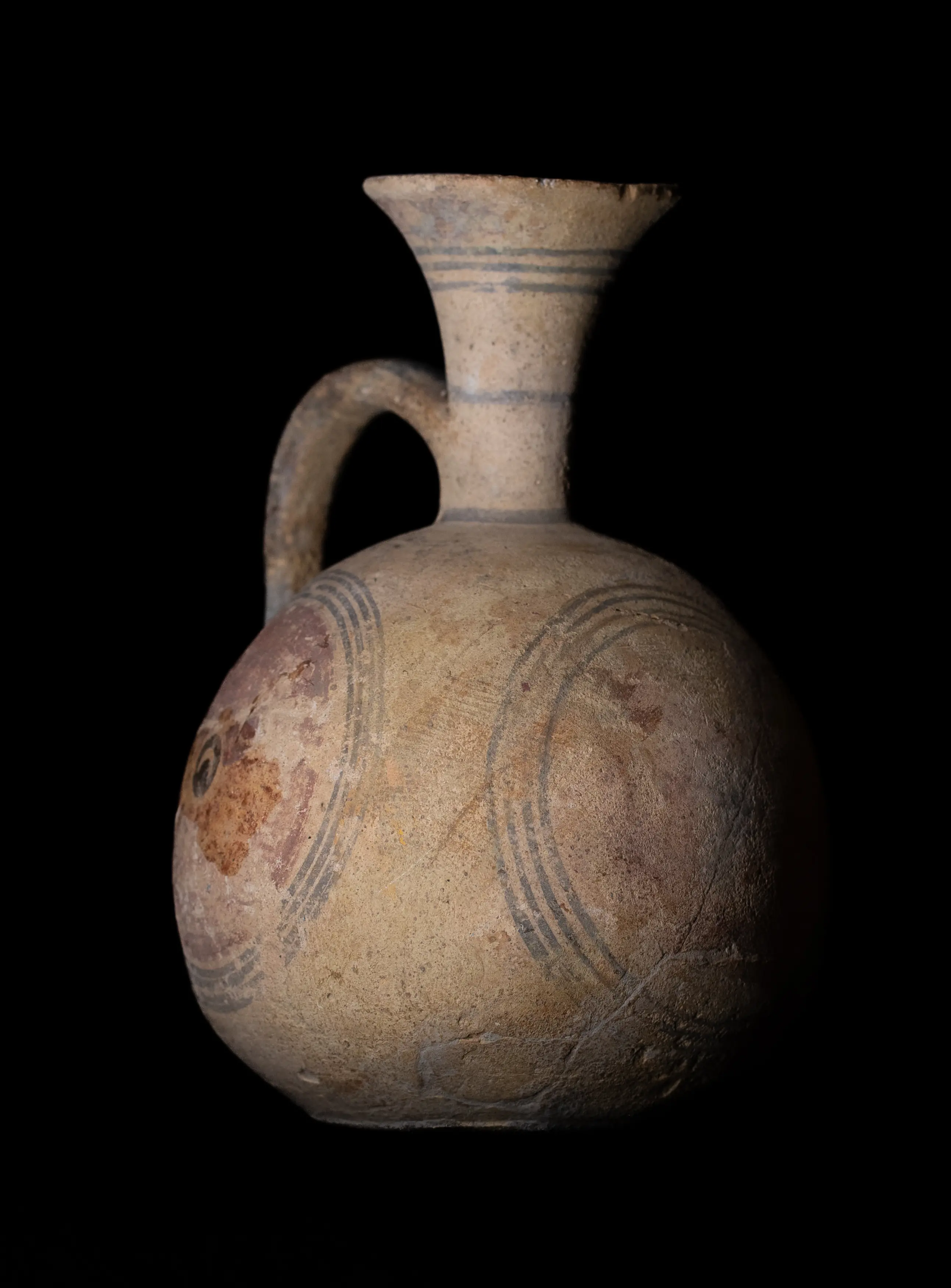
A juglet is a small jug: a closed vessel with one handle and a narrow neck that restricts the flow of what it holds. Lesley Bushnell defines the term in use as covering "a range of small closed ceramic forms such as small jugs, flasks and bottles that have narrow necks to restrict the flow of liquids," whose contents were meant "to be dispensed in small, controllable quantities" [1, p. 196]. There is no agreed height at which a jug becomes a juglet. The structural rules that govern all Cypriot jugs, the base and spout that date them, are set out on the jugs page; this page deals with the small members of the family, the wares they were made in, what they held and where they went. The header image shows the Drakopoulos Bichrome IV handle-ridge juglet of Cypro-Archaic I, whose handle springs from a moulded ridge midway up the neck. See all juglets in the catalogue.
How juglets are classified
Juglets are sorted by ware first and shape second. For the Bronze Age the standard scheme is the one published by the Swedish Cyprus Expedition, in which Paul Åström divided each ware into numbered classes; Bushnell's typological guide to Bronze Age juglets follows it, grouping all the juglets of one ware together [2, p. 153]. For the Iron Age the frame is Einar Gjerstad's sequence of Types I to VII for each ware, which Nicolle Schreiber and Joanna Smith use and argue over [8, p. 48; 9, p. 222]. The same small vessel can therefore appear in a museum catalogue as "juglet," "small jug," "perfume flask," "lekythos" or "aryballos." The ware name and the class number tell more than the shape word.
Size varies widely. The Ashmolean holds White Painted juglets of Middle Cypriot date about 16 cm high, while the Black-on-Red miniature juglets of the Iron Age are 5 to 6 cm [9, p. 222]. What unites them is the narrow neck, the single handle and, in most cases, a context in a tomb.
| Ware | Date | Typical juglet | Classification |
|---|---|---|---|
| Red Polished (Philia and Early Cypriot) | Philia facies to Middle Cypriot I | Beak-spouted or cut-away juglet, round base | By ware and shape |
| Black Slip II and III | Middle Cypriot I/II to III | Globular, short neck, incised | Åström |
| Black Lustrous Wheel-made | Late Cypriot IA to IB | Very long neck, flat base | Åström |
| Base Ring I | Late Cypriot IA:2 to IIA:2 | Relief decoration, ridge on neck; class VID | Åström |
| Base Ring II | Late Cypriot IB:2 to IIC | White-painted bands; class IXB | Åström |
| Black-on-Red and Bichrome | Cypro-Geometric III to Cypro-Archaic | Neck-ridge juglet; small aryballos | Gjerstad Types I to V |
Early Bronze Age juglets
The juglet arrives with the jug. Jennifer Webb and David Frankel list "narrow-necked beak-spouted jugs and juglets" among the novelties of the Philia facies [3, p. 39]. At Sotira-Kaminoudhia the excavators single out "the oddly truncated juglets" among the Philia-phase types, and treat the more developed shape of their Juglet D as a mark of a late stage of the phase [4].
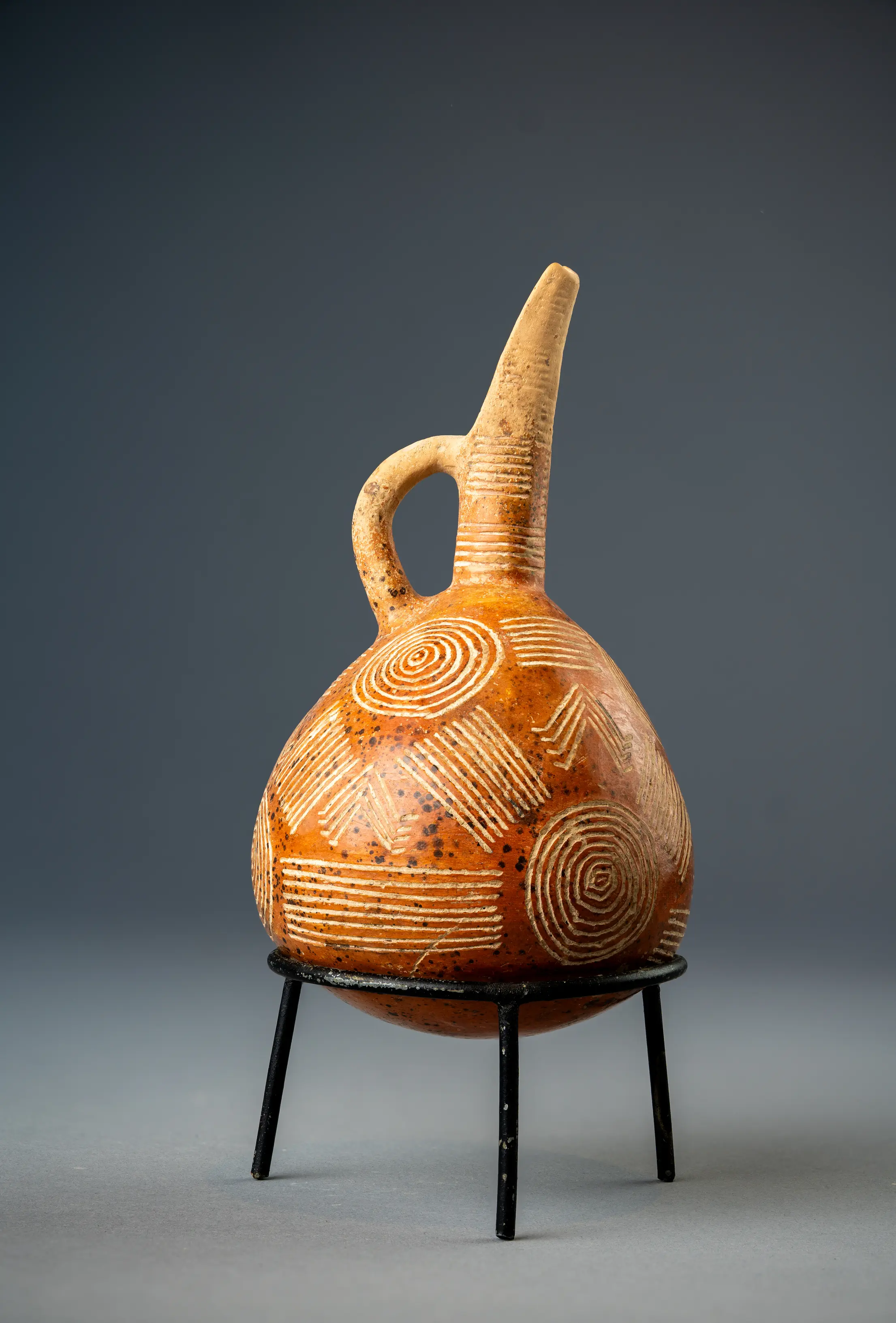
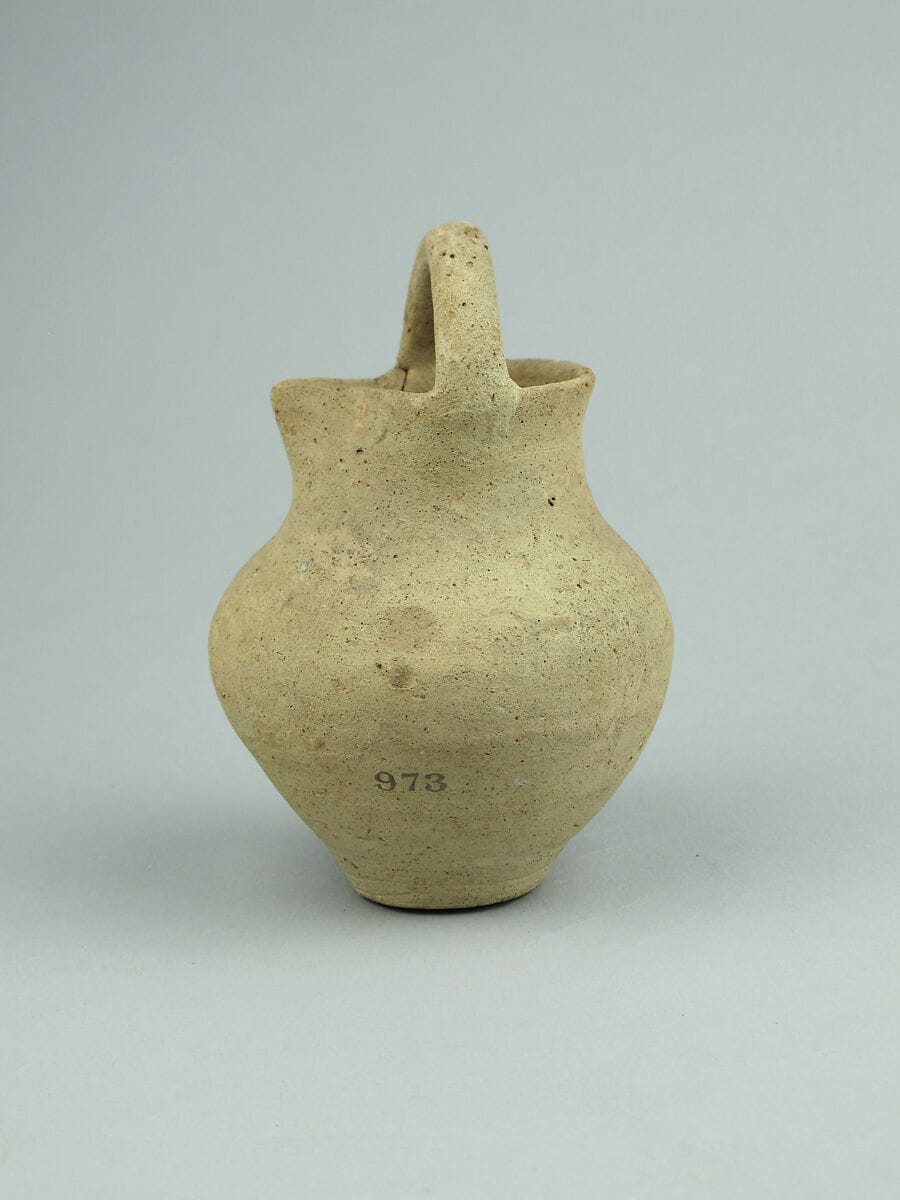
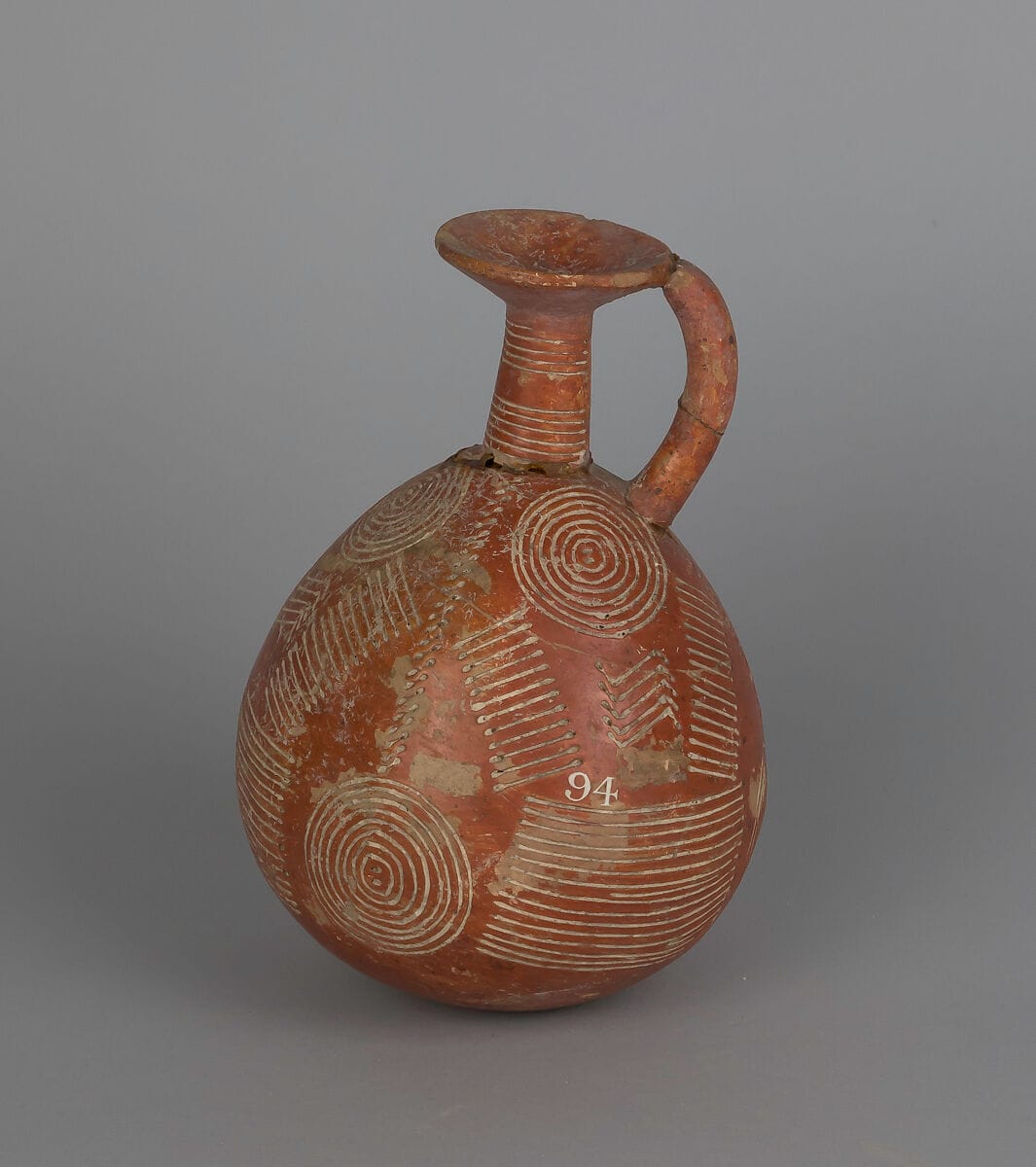
Through the Early Bronze Age the small jug was made in Red Polished and its related dark-surfaced wares, by hand, on a round base. The Drakopoulos collection has a run of them. The Red Polished beak-spouted juglet with incised circles, of Early Cypriot III to Middle Cypriot I, has a pear-shaped body on a heavy rounded base and a narrow neck that rises into a long beak cut away obliquely at the tip; the Black Polished juglet with incised decoration and circled bosses of the same date has a burnished grey-black surface with white-filled incision. The Red Polished juglet with hatched triangles and the plain handmade juglet with a pinched spout show the same basic form without the long beak.
Middle Bronze Age juglets
In the Middle Bronze Age the juglet was made in White Painted and in the Black Slip wares. The Drakopoulos White Painted III to IV juglet with cut-away neck, of about 1850 to 1650 BCE, keeps the Early Bronze Age beak spout on a near-spherical body painted in matt dark paint.
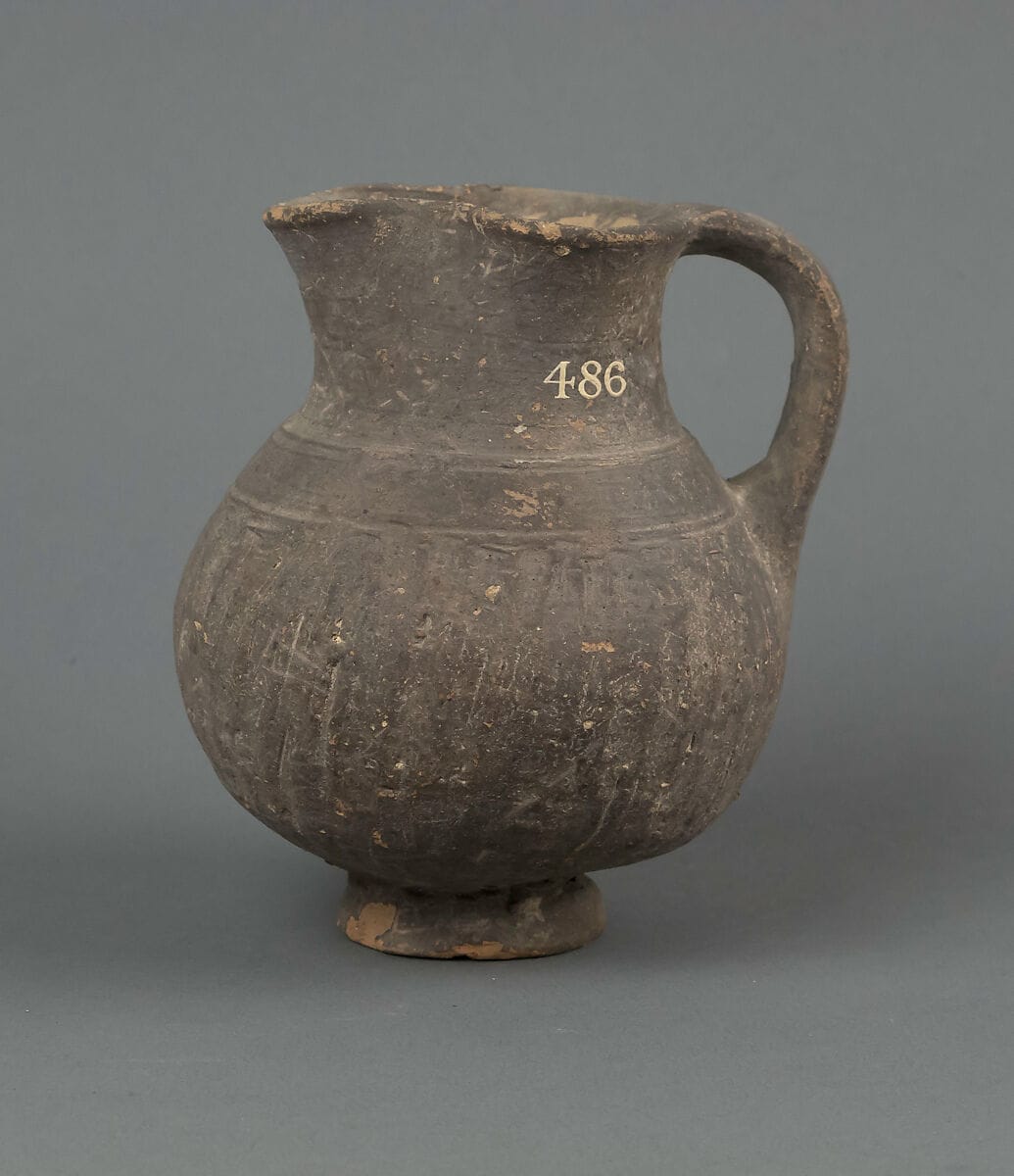
Black Slip II juglets originated in the north-west of the island, around Lapithos and Stephania, and run from Middle Cypriot I/II into Middle Cypriot III. They are globular or depressed globular, with a round base, a narrow and often short neck and a round or beaked mouth, decorated with incised straight, wavy or zigzag lines and punctate dots [2, p. 156]. The British Museum's Black Slip II juglet, 7.5 cm high, has a swollen piriform body with incised circles on the shoulder and zigzags on the body. Black Slip III, mainly of Middle Cypriot III, has a funnel or pinched mouth and handles or string-holes from mid-neck to shoulder, and imitates Tell el-Yahudiyeh juglets [2, p. 156].
The Ashmolean's Black Slip II or III juglet from Kalopsida Tomb 11, 11.9 cm high and dated Middle Cypriot III, about 1725 to 1650 BCE, has a globular body on a flattened base, a tall concave neck and a strap handle from mid-neck to shoulder; its incision was made with a three-toothed tool introduced in late Middle Cypriot II or early Middle Cypriot III [5, cat. 14]. The Metropolitan Museum has a composite Black Slip III juglet of unusual shape, 9.5 cm high, from the Cesnola collection (74.51.1249) [6, p. 50, cat. 44].
Late Bronze Age juglets
At the start of the Late Bronze Age Cypriot potters produced a series of new juglet types. Bushnell calls the process "productive consumption": producers responding to the demand of consumers, which she suggests lies behind the many new juglet types of early Late Cypriot, with some regional competition in designing them [1, p. 198].
Base Ring juglets are the best known. Proto Base Ring juglets of Late Cypriot IA:1 to IB have globular to piriform bodies, funnel necks, strap handles and flat bases, in fabrics derived from the Black Slip tradition [2, p. 153]. Base Ring I juglets, from Late Cypriot IA:2 to IIA:2, carry relief decoration on the body and often a ridge or double ridge midway along the neck. Åström's class VID divides them into juglets with a circular mouth (VID1, with globular, depressed or carinated bodies) and juglets with a pinched mouth (VID2) [2, p. 153]. Base Ring II juglets, class IXB, overlap with Base Ring I from Late Cypriot IB:2 and last until Late Cypriot IIC; they are coarser, with a thin slip and white-painted decoration [2, p. 153]. Bushnell warns that the numerals imply a chronology that the evidence does not support everywhere, since the changes happened at different times in different regions; Vaughan's reclassification by fabric has not been generally adopted [2, p. 153].
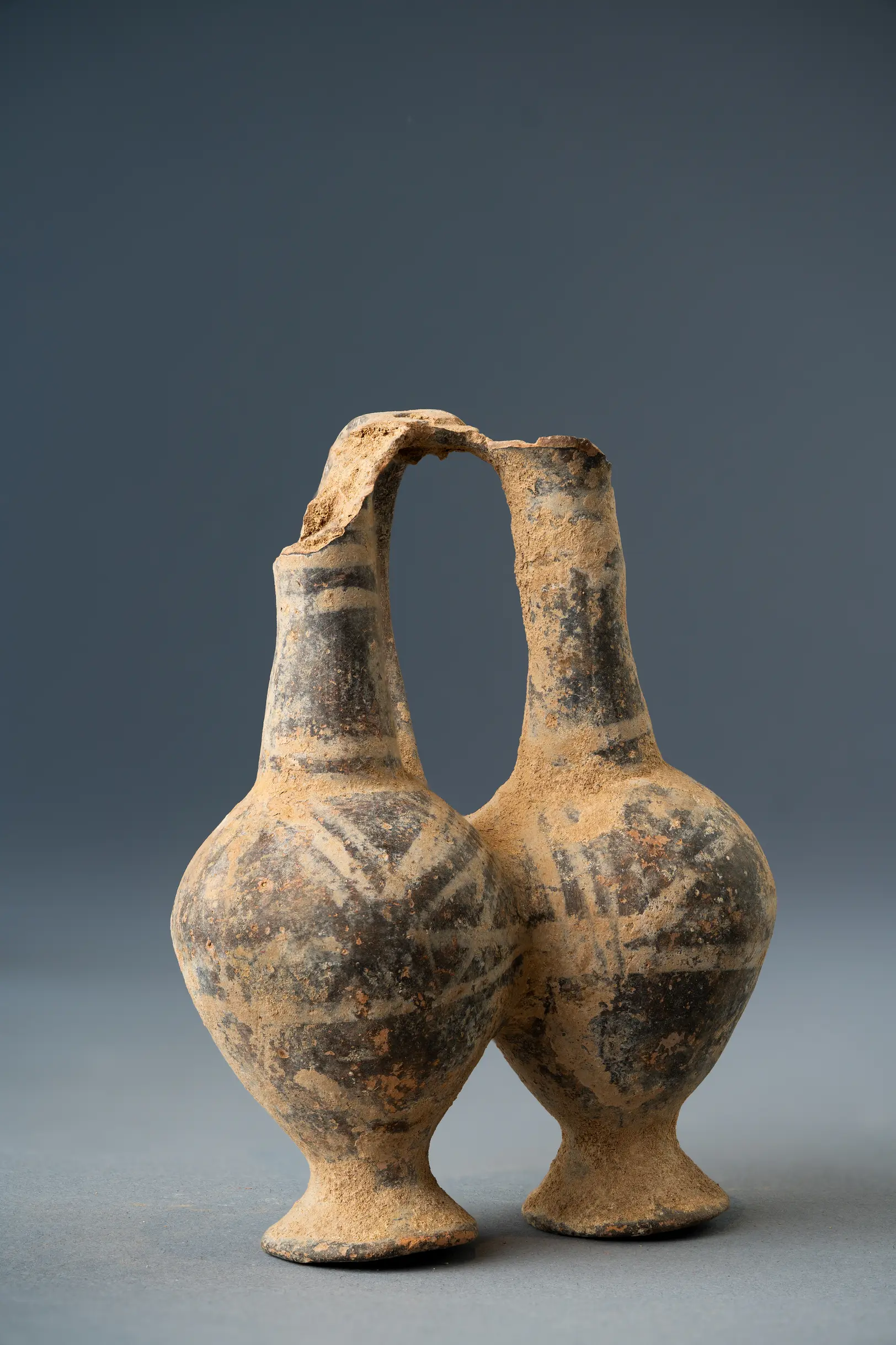
The British Museum's Base Ring I juglet from Enkomi has a long tapering neck with a trumpet mouth, a relief ridge where the handle meets the neck and three relief ridges down the body. The double juglet, Åström's class XIIA, is two piriform juglets joined, with a single flat handle forked at both ends [2, p. 153]: the Museum's Base Ring I double juglet from Enkomi has a joint handle rising above the rims and splitting into a Y on the two shoulders. The Drakopoulos Base Ring II double juglet is the later version, two globular bodies on their own ring feet, with long necks joined at the top by an arching bridge. The Brooklyn Museum's Base Ring juglet, 14.6 cm high and dated about 1550 to 1400 BCE, is of the bilbil shape discussed under bottles.
Base Ring juglets were made in Cyprus and sold in the Levant and Egypt [1, p. 198]. Other juglets of the period travelled further. Black Lustrous Wheel-made juglets, with very long necks, flared rolled tops and flat bases, were made in Cyprus from Late Cypriot IA:1 to IB [2, p. 156] and were popular in Palestine, in the Memphis-Faiyum region of Egypt and as far south as Nubia [1, p. 198]. White Shaved juglets copied the southern Levantine dipper juglet and seem to have been made for Palestinian buyers (see dipper) [1, p. 198]. Black Slip V, the Late Cypriot successor of Black Slip III, has an ovoid to biconical body, a long narrow neck and a funnel mouth, with incised zigzags or hatching [2, p. 156].
What juglets held
The narrow neck points to a liquid used in small amounts, and the usual reading is perfumed oil [1, p. 196]. For Base Ring juglets one alternative has had a long life. In 1962 Robert Merrillees proposed that they carried opium, since the juglet turned upside down resembles a poppy head, and he repeated the case in 1968 and 1974 [7]. Earlier claims of opium residues from Egypt and from Tell el-Ajjul proved inconclusive, and one positive analysis concerned a single unprovenanced vessel [7]. Shlomo Bunimovitz and Zvi Lederman then had residues analysed from three Base Ring I juglets from Tel Beth-Shemesh, of the fourteenth century BCE, and from fourteen Base Ring I and II jugs and juglets from Cyprus: none contained opium, and the residues were of aromatic plant oils [7]. Merrillees himself had by then called the opium link a "factoid" [7]. The question is not closed for every juglet, but for Base Ring the evidence now favours oil.
Iron Age juglets
In the Iron Age the juglet was wheel-made, and the commonest form was the juglet with a ridge on the neck from which the handle springs. Gjerstad derived the ridge from the collar-rim of White Painted I and noted the Black-on-Red neck-ridge juglet as a non-Cypriot form; it is "possibly the most common BoR form to be found in early Iron II levels in Palestine" [8, p. 48]. Its date is argued. Schreiber's Phase 1 of Black-on-Red, about 950 to 890/880 BCE, has been questioned; Smith reviews the Levantine evidence, notes that ridge-necked globular juglets occur in Stratum IIa at Horbat Rosh Zayit (about 920 to 880 BCE), and places the workshop probably in western Cyprus near Palaepaphos-Skales, while allowing that the ridge-neck juglet may be among the earliest Black-on-Red products of Kition [9, pp. 222–223]. The origins of Black-on-Red ware are discussed in a separate article.
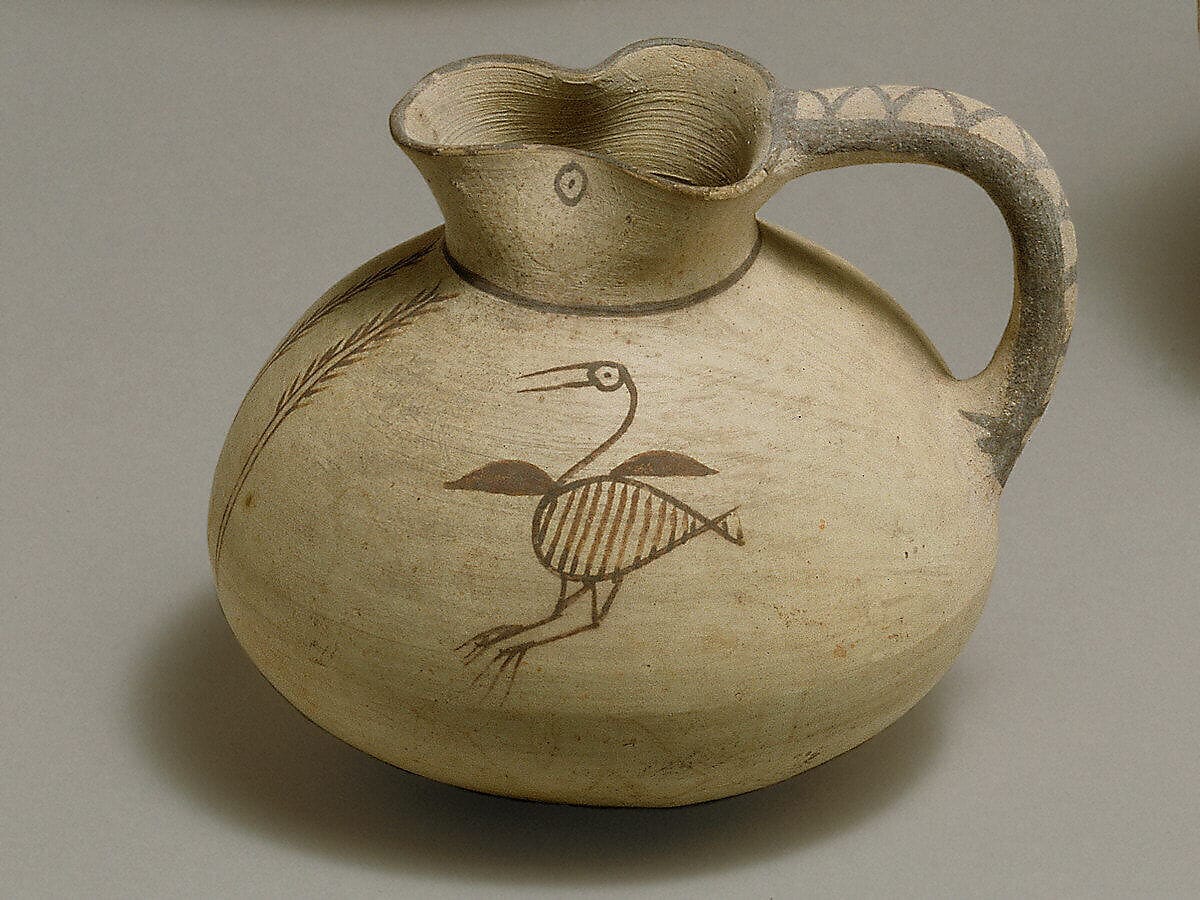
Juglets of the same period were made in White Painted and Bichrome. The Drakopoulos White Painted juglet with funnel mouth and side circles, of about 850 to 600 BCE, has an almost spherical body, a tall narrow neck with a wide funnel mouth, and a handle from mid-neck to shoulder; the Bichrome IV handle-ridge juglet in the header has a broad flat disc rim painted solid red. The British Museum has a Black-on-Red I juglet with a neck-ridge found in Egypt, decorated with a swastika, and a juglet from Naukratis that may be a local imitation of Black-on-Red.
Schreiber connects the Black-on-Red juglets with the trade in perfumed oil and compares them with the later Corinthian aryballoi, filled at Corinth and exported widely [8, p. 103]. The export of Iron Age juglets to the Levant, Crete and the Aegean is described under jugs.
Aryballoi
An aryballos is a small globular oil flask with a narrow neck, a disc mouth and usually a single handle. The word is Greek, the name of a Greek perfume-flask shape, and in Cypriot catalogues it is applied to small Cypriot juglets of the Iron Age that look like one. The British Museum describes the same pieces as "aryballos or perfume flask" or "aryballos or juglet," and some are catalogued as lekythoi. On this site all of them are filed as juglets, and the label is a museum convention. See all aryballoi in the catalogue.
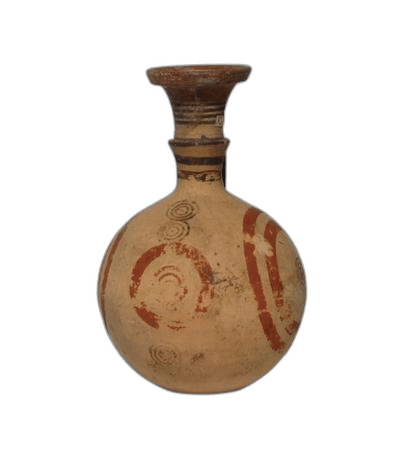
The examples are Black-on-Red and Bichrome, of the Cypro-Geometric III and Cypro-Archaic periods. The British Museum's Black-on-Red aryballos, 8 cm high and dated about 900 to 600 BCE, has a globular body on a flat base, a narrow neck with a ridge flaring to an everted rim, a handle from shoulder to neck-ridge, and pairs of concentric circles on the shoulder. Its Bichrome IV aryballos from Amathus, 10 cm high and of about 750 to 600 BCE, has the same ridged neck under a mushroom-shaped lip and vertical concentric circles painted in black, purple and red. Both are neck-ridge juglets in everything but name.
The Cypriot shape had a Greek afterlife. The Spaghetti Ware of Rhodes, a class of small ridge-necked juglets and squat globular aryballoi made from the end of the eighth century BCE, takes both its shapes and its decoration of encircling lines, concentric circles and wavy lines ending in hooked spirals from Cypriot White Painted IV of Cypro-Archaic I, which included "ridge-necked juglets, small aryballoi and also other shapes such as oinochoai" [10]. On Rhodes the shape evolved from the globular ridge-necked juglet towards "a proper aryballos with eliminated ridge," and the two types are found together in a single infant burial at Exochi [10]. In Cyprus, then, the aryballos is the neck-ridge juglet; in the Aegean the ridge was dropped and the Greek aryballos took over, until Protocorinthian aryballoi replaced the Rhodian ones in the third quarter of the seventh century BCE [10].
Summary
The juglet is the Cypriot jug made small for a costly liquid. It appears with the beak-spouted Red Polished juglets of the Philia facies, is made in Black Slip and White Painted through the Middle Bronze Age, multiplies into new export types at the start of the Late Bronze Age, above all Base Ring, and returns in the Iron Age as the wheel-made neck-ridge juglet of Black-on-Red and Bichrome, which museums also call aryballos or lekythos. Residue analysis of Base Ring juglets points to aromatic oils, and the distribution of the Iron Age juglets across the Levant and the Aegean follows the same trade. Related shapes are treated under jugs, bottles, flasks and complex vessels.
Objects on this page
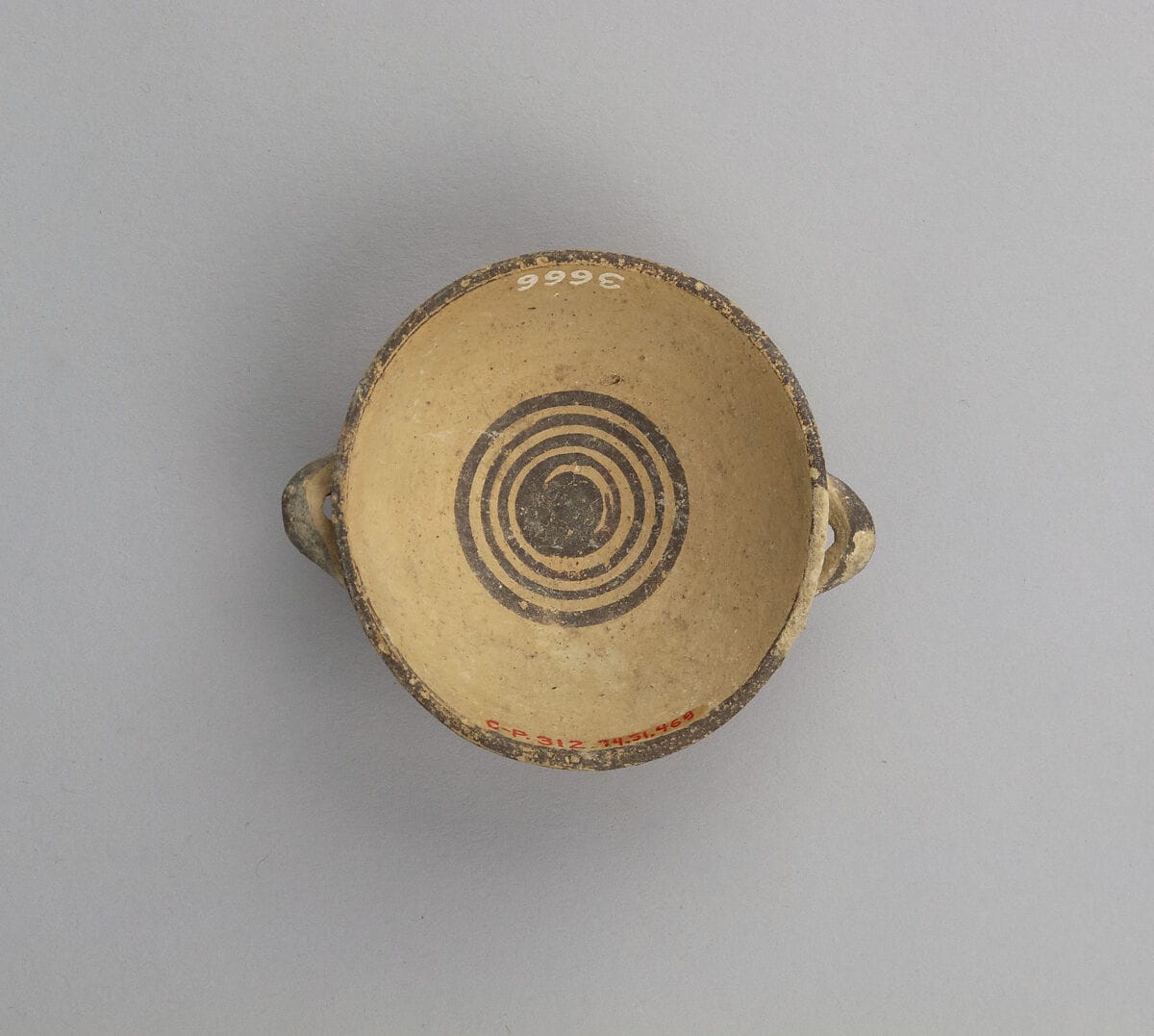
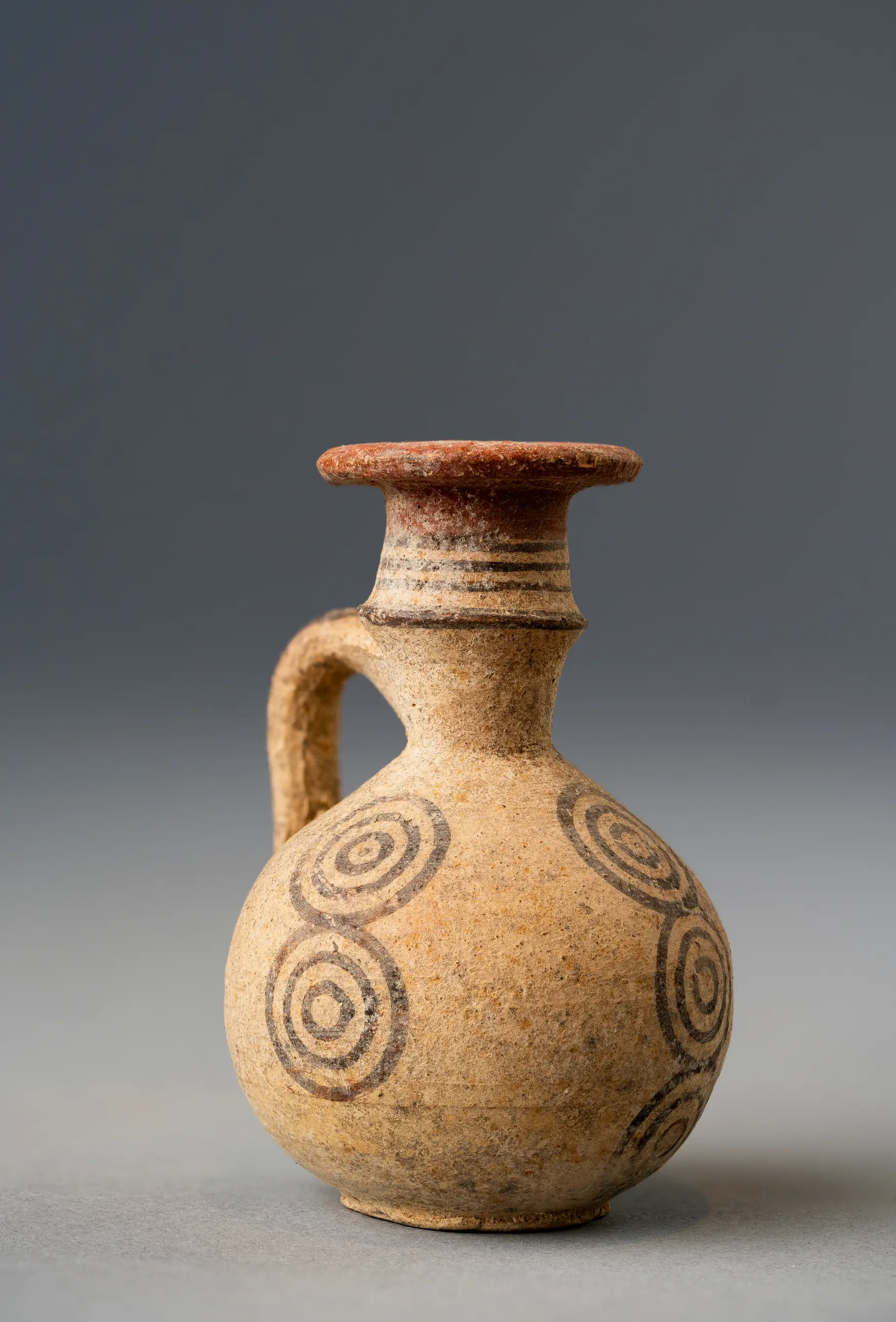 Bichrome IV Handle-Ridge Juglet with Rows of Concentric CirclesArchaic I · 750–600 BC
- Red Polished Beak-Spouted Juglet with Incised CirclesEarly Bronze Age III · 2100–1850 BC
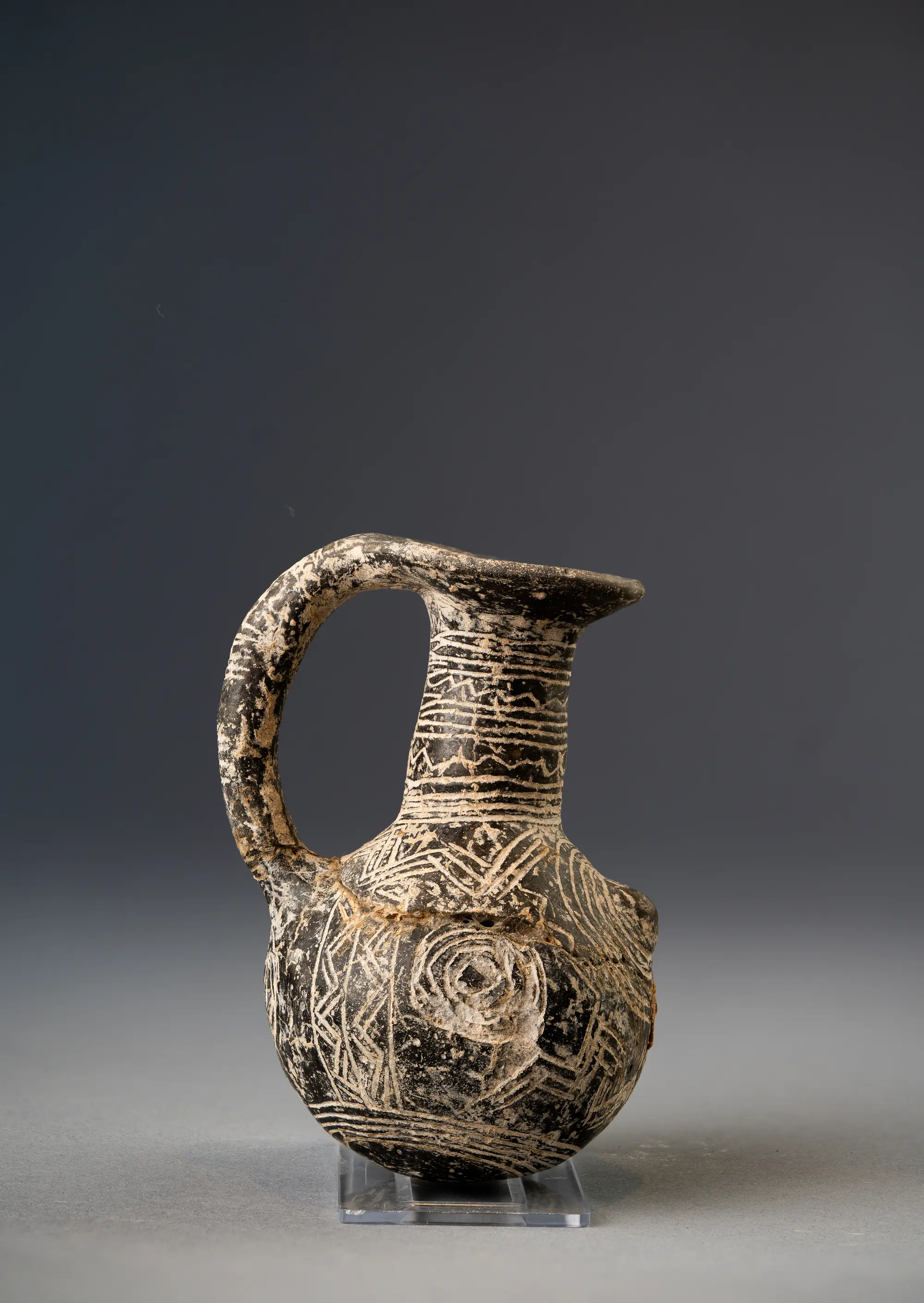 Black Polished Juglet with Incised Decoration and Circled BossesEarly Bronze Age III · 2100–1850 BC
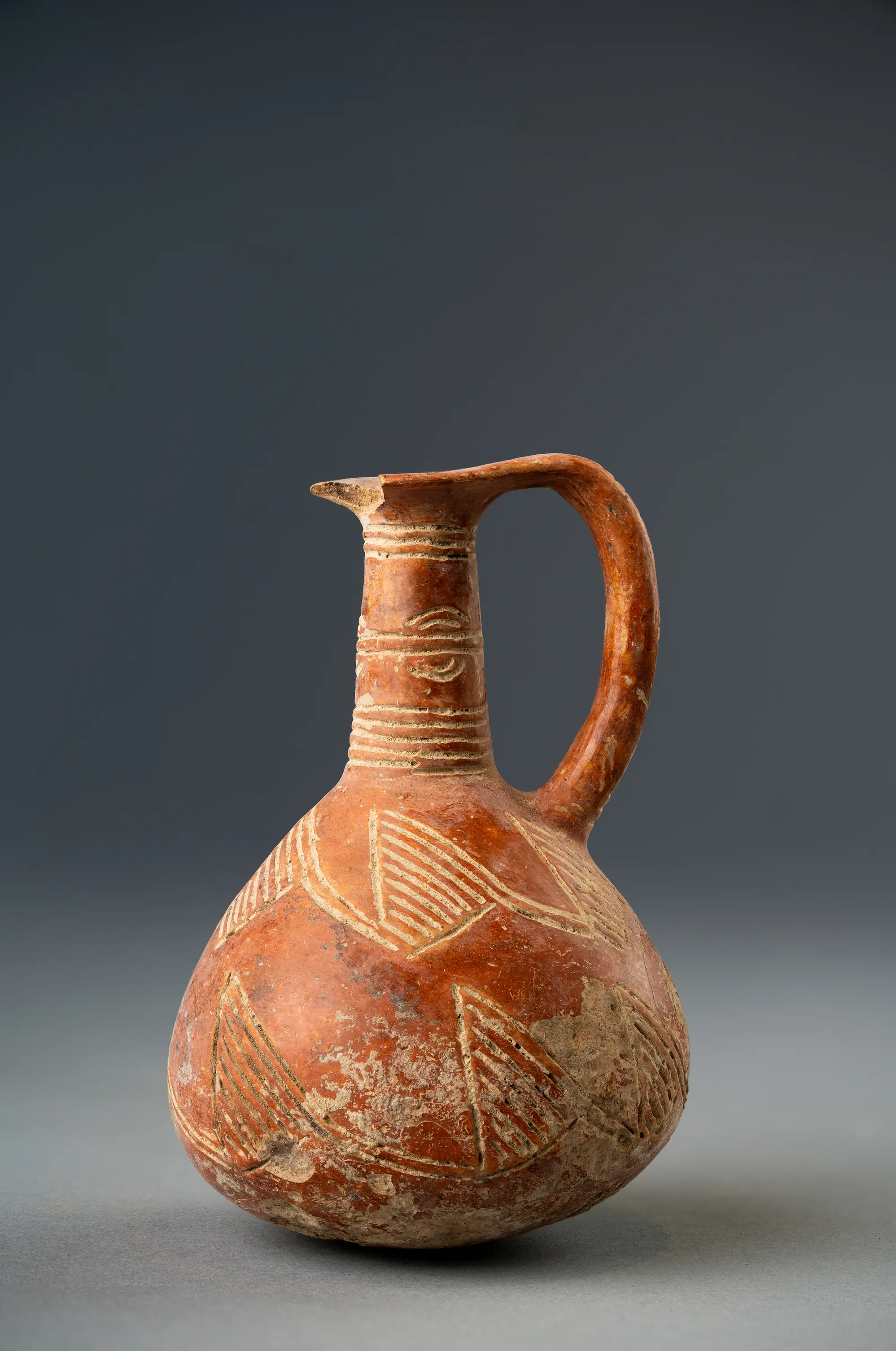 Red Polished Juglet with Hatched TrianglesEarly Bronze Age III · 2100–1800 BC
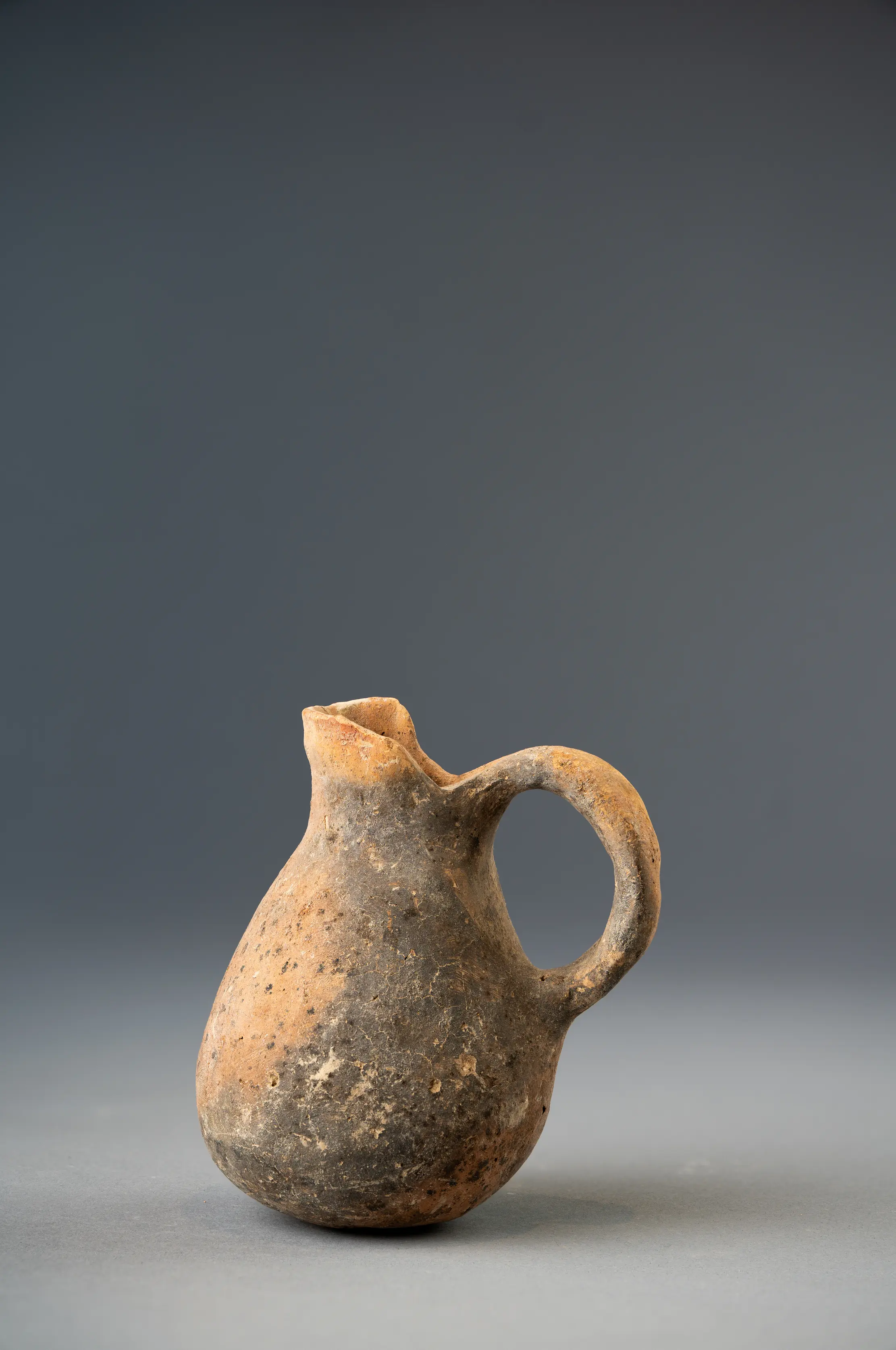 Plain Handmade Bronze Age JugletEarly Bronze Age III · 2100–1650 BC
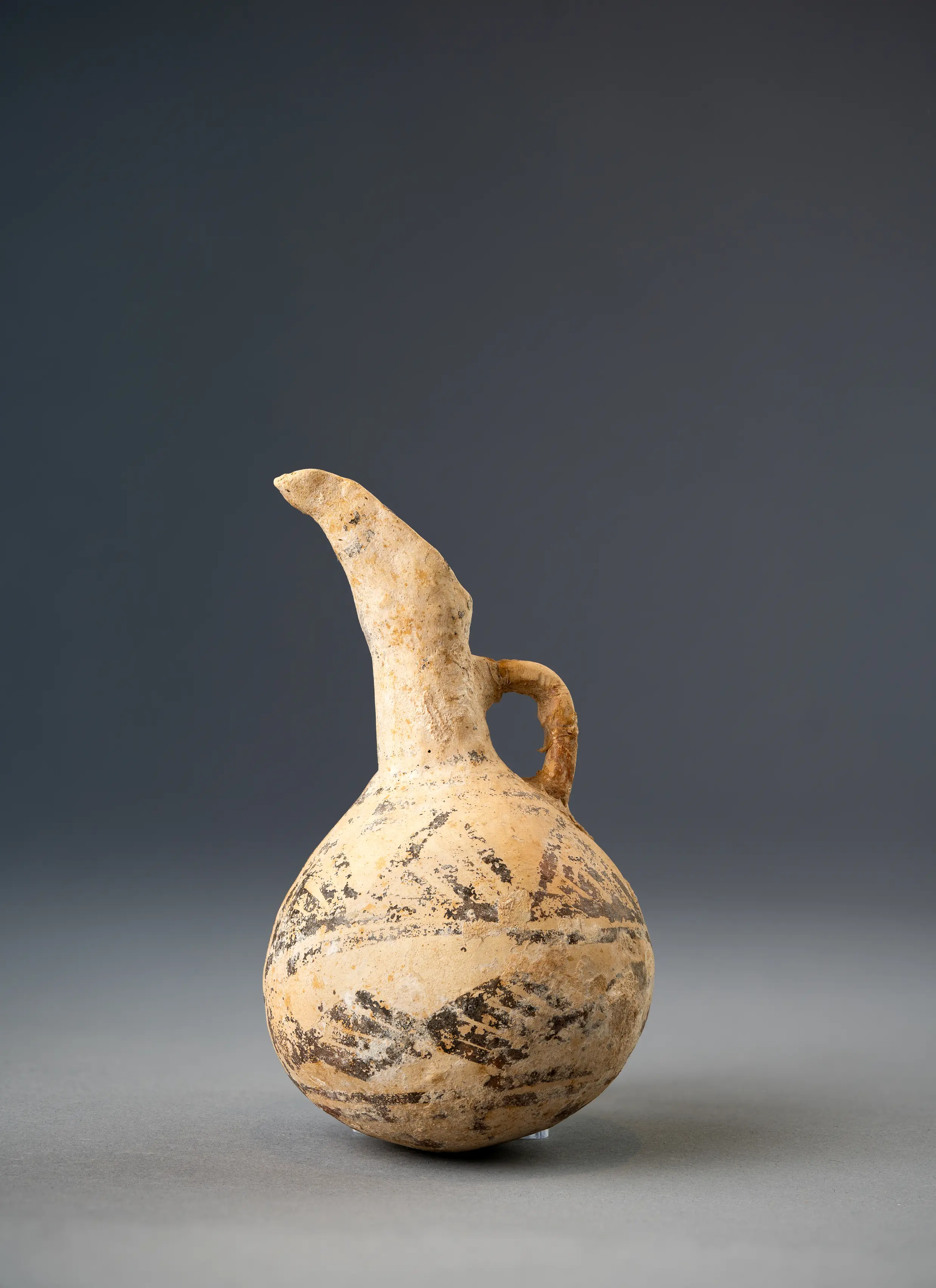 White Painted III-IV Juglet with Cut-away NeckMiddle Bronze Age II · 1850–1650 BC
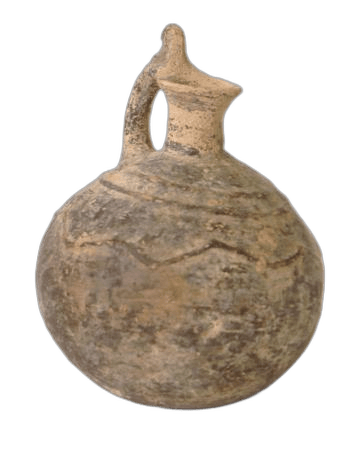 Black Slip Juglet.Middle Bronze Age I · 1950–1750 BC
).webp) Black Slip II or III jugletMiddle Bronze Age III · 1750–1650 BC
Black Slip II or III jugletMiddle Bronze Age III · 1750–1650 BC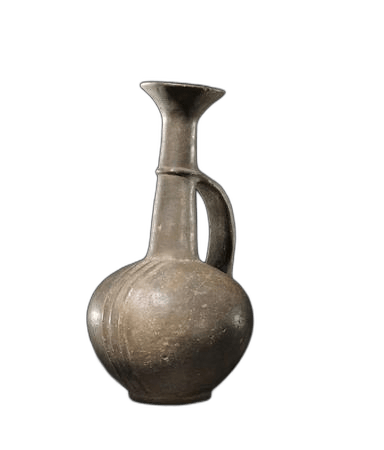 Base Ring Ware JugletLate Bronze Age I · 1600–1340 BC
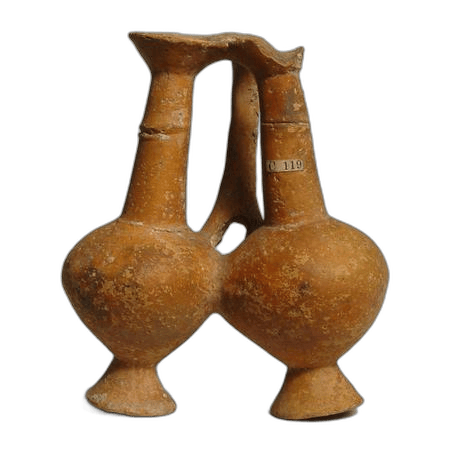 Base Ring Double JugletLate Bronze Age I · 1600–1340 BC
- Base Ring II Double Juglet with White-Painted DecorationLate Bronze Age II · 1450–1200 BC
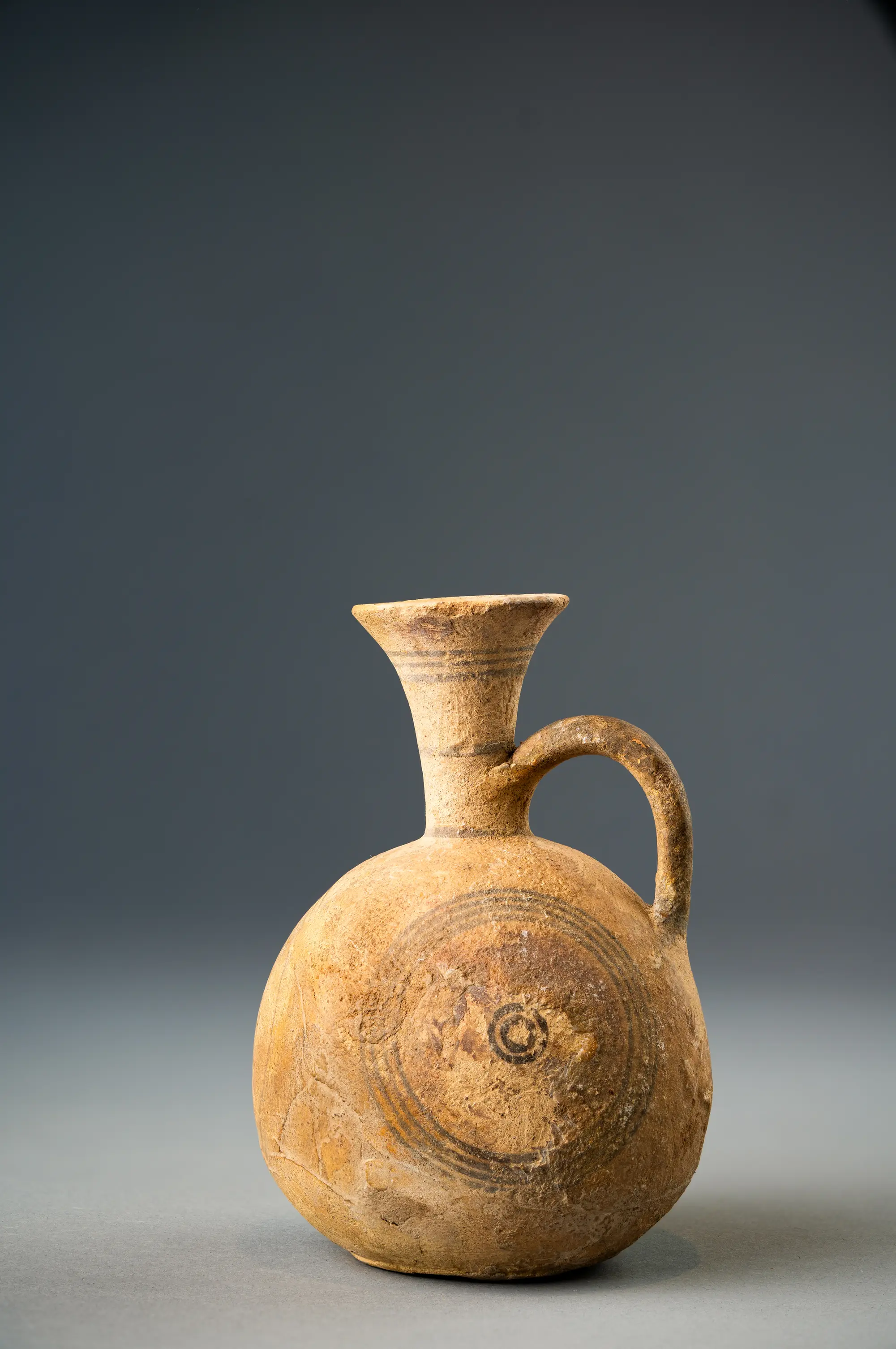 White Painted Juglet with Funnel Mouth and Side CirclesGeometric III · 850–600 BC
and 2 more objects mentioned on this page
In the catalogue
References
- 1.Bushnell, L. (2012). Mycenaean perfumed oil and the role of Cyprus. In A. Georgiou (Ed.), Cyprus, an island culture: Society and social relations from the Bronze Age to the Venetian period (pp. 196–209). Oxbow Books.
- 2.Bushnell, L. (2016). Precious commodities: The socio-economic implications of the distribution of juglets in the eastern Mediterranean during the Middle and Late Bronze Age (BAR International Series 2826). BAR Publishing. https://doi.org/10.30861/9781407315652
- 3.Webb, J. M., & Frankel, D. (1999). Characterizing the Philia facies: Material culture, chronology, and the origin of the Bronze Age in Cyprus. American Journal of Archaeology, 103(1), 3–43.
- 4.Swiny, S., Rapp, G., & Herscher, E. (Eds.). (2003). Sotira Kaminoudhia: An Early Bronze Age site in Cyprus (CAARI Monograph Series, Vol. 4). American Schools of Oriental Research.
- 5.Pilides, D., & Papadimitriou, N. (Eds.). (2012). Ancient Cyprus: Cultures in dialogue. Department of Antiquities, Cyprus.
- 6.Karageorghis, V., Mertens, J. R., & Rose, M. E. (2000). Ancient art from Cyprus: The Cesnola collection in The Metropolitan Museum of Art. The Metropolitan Museum of Art.
- 7.Bunimovitz, S., & Lederman, Z. (2016). Opium or oil? Late Bronze Age Cypriot Base Ring juglets and international trade revisited. Antiquity, 90. https://doi.org/10.15184/aqy.2016.177
- 8.Schreiber, N. (2003). The Cypro-Phoenician pottery of the Iron Age (Culture and History of the Ancient Near East, Vol. 13). Brill.
- 9.Smith, J. S. (2009). Art and society in Cyprus from the Bronze Age into the Iron Age. Cambridge University Press.
- 10.Late Geometric, Subgeometric and Archaic pottery. In S. Schierup (Ed.), Documenting ancient Rhodes: Archaeological expeditions and Rhodian antiquities.