
Contents
Greek pottery in Cyprus means the painted and black-gloss vessels made in the Aegean and carried to the island between the late tenth century BCE and the end of the Cypriot city-kingdoms around 300 BCE. It begins as a trickle of Euboean and Attic drinking cups in a handful of tombs at Amathus and Salamis, widens in the seventh and sixth centuries with Corinthian perfume flasks and East Greek tablewares, and ends as a flood of Attic black-figure, red-figure and plain black-gloss pottery that reached almost every part of the island. Einar Gjerstad, writing in 1948, compared the scale of the Classical Attic import to that of Mycenaean pottery in the Late Bronze Age [1, p. 197].
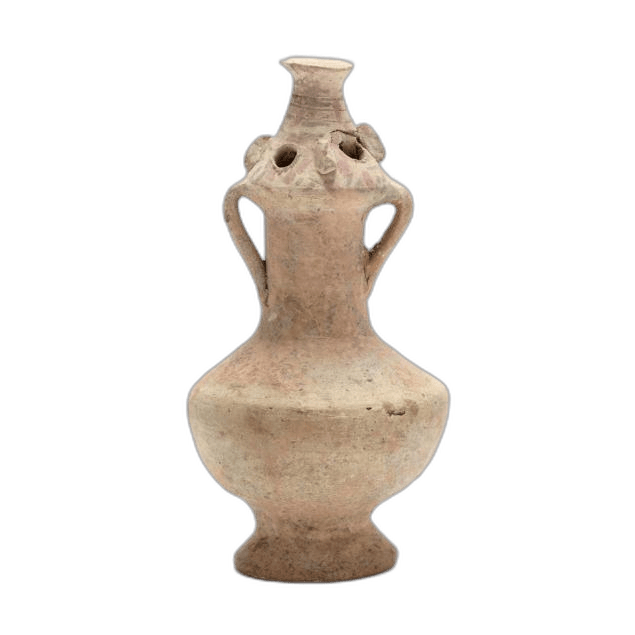
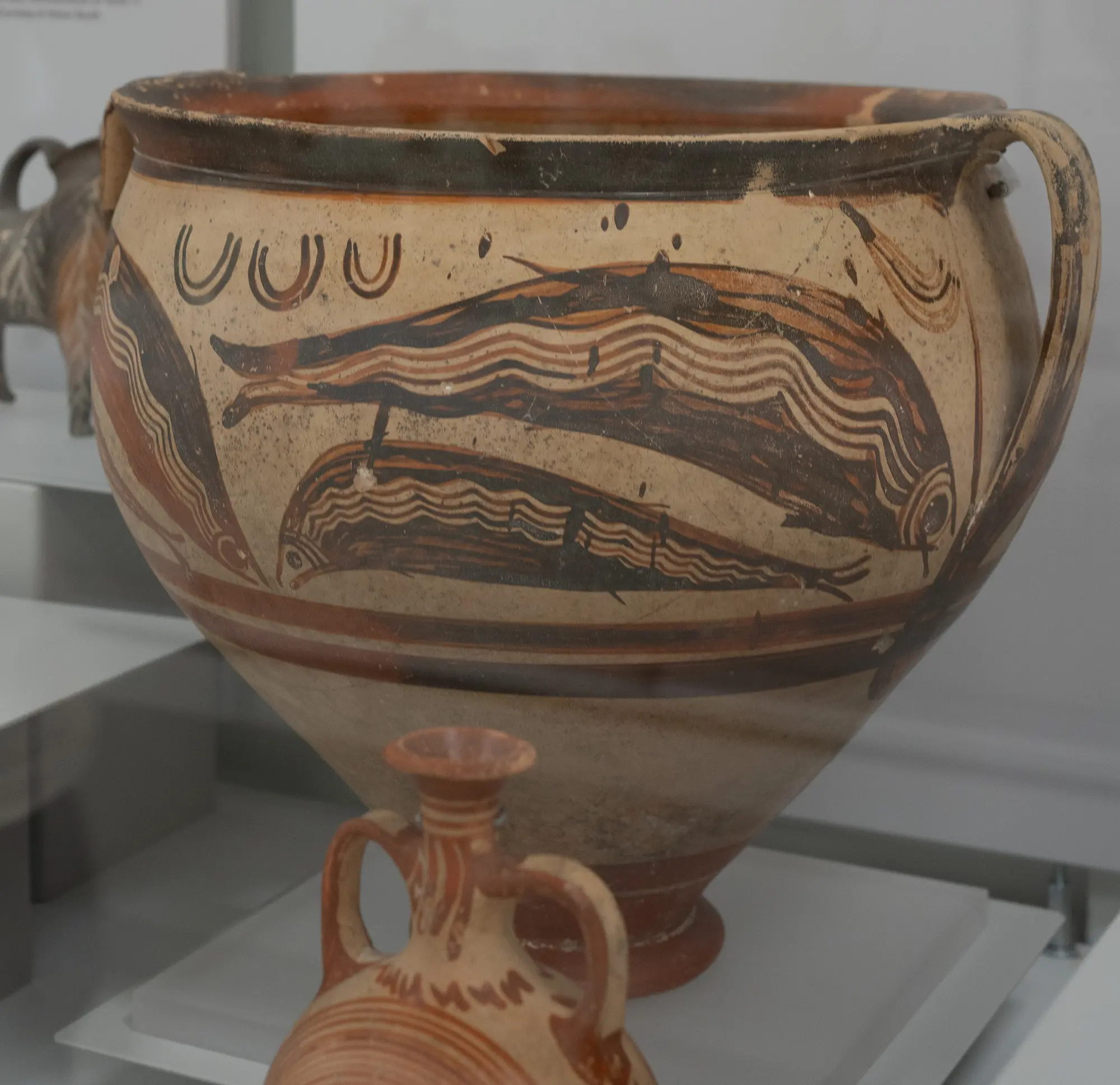
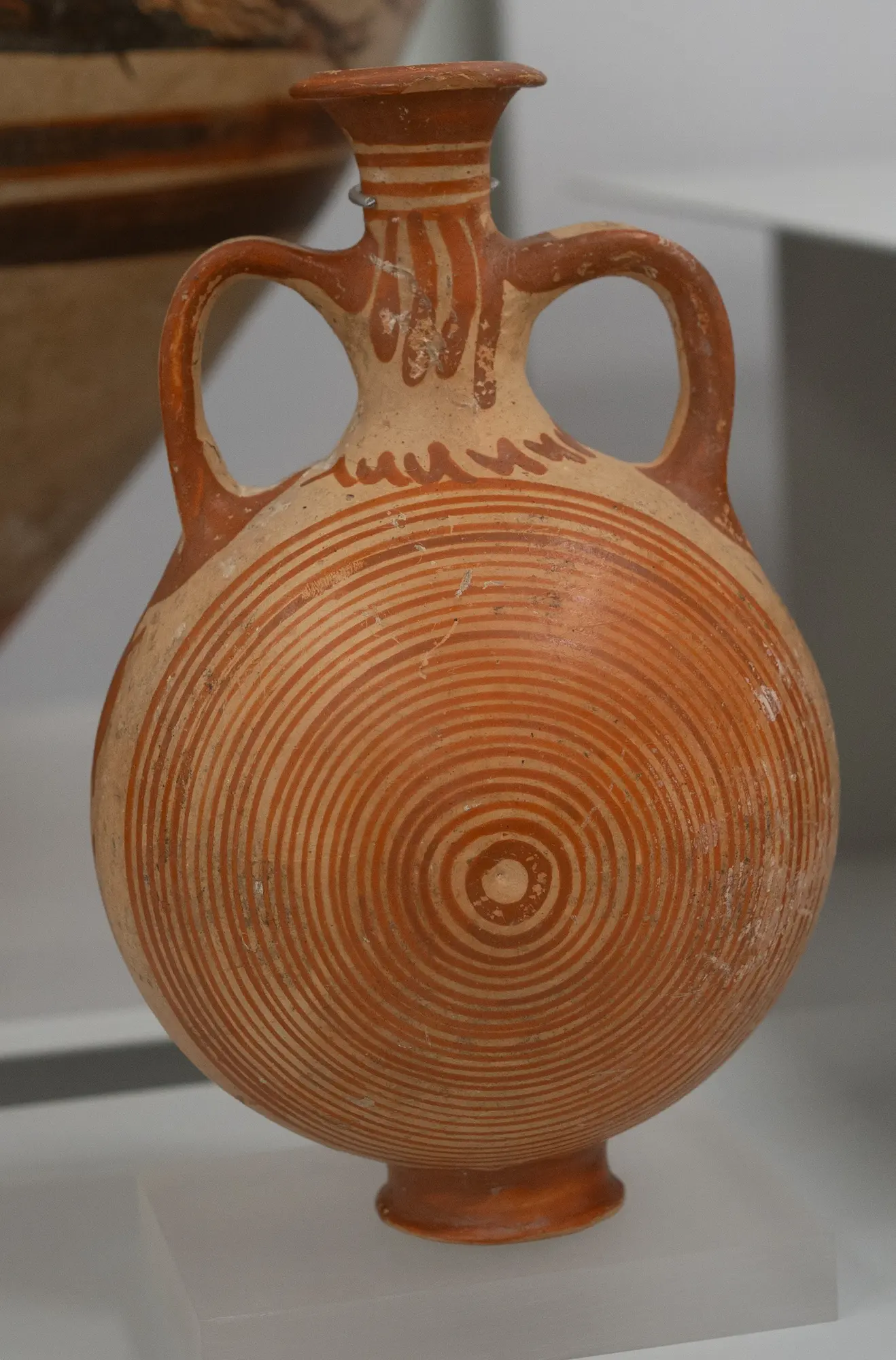
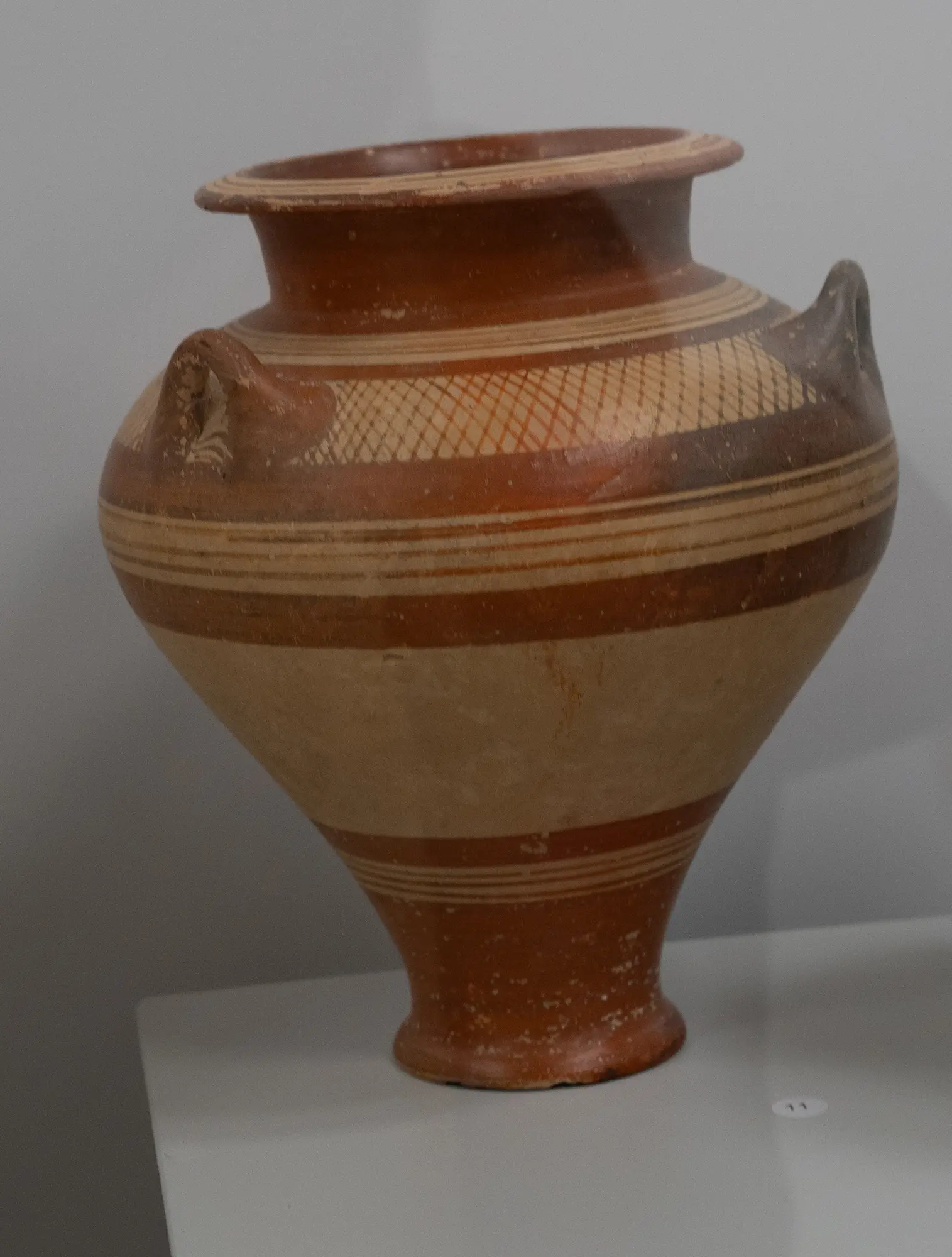
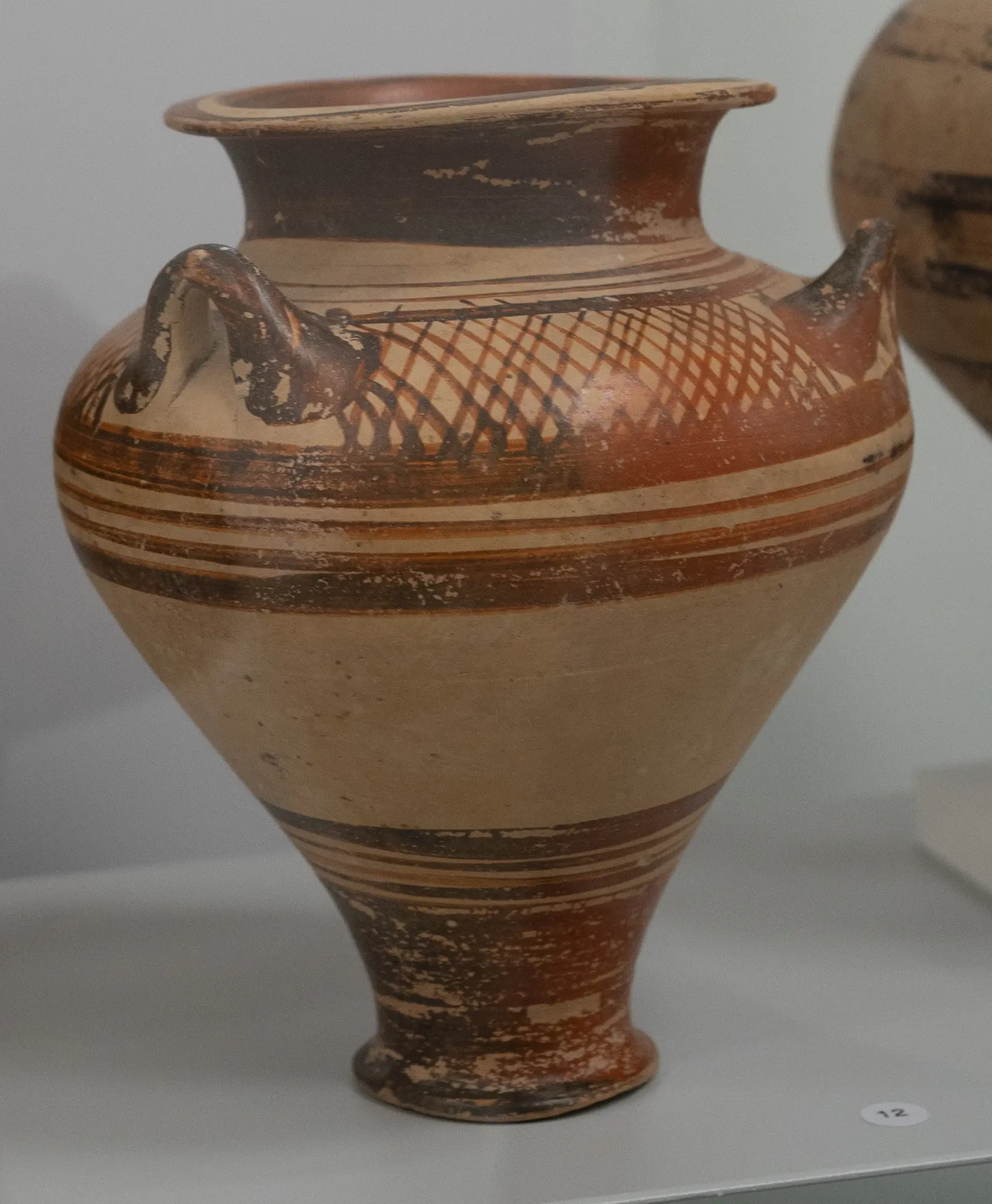
This page covers the Iron Age and Classical imports only. The earlier Aegean pottery of the Late Bronze Age has its own entry, and several of the "Aegean" jars and kylikes in the catalogue, such as the Aegean Kylix in the Larnaca Museum, belong to that earlier story rather than this one. You can see all objects from the Aegean and Greece in the catalogue.
How the picture was built
Gjerstad's chapter on Greek pottery in the fourth volume of the Swedish Cyprus Expedition (1948) set out the first overall sequence, but it carried no illustrations, and the older holdings of the Cyprus Museum had never been published with pictures either; J. D. Beazley had published only a few Attic vases from the museum [5, p. 7]. In 1977 Gjerstad edited a corpus, Greek Geometric and Archaic Pottery Found in Cyprus, that brought together his own catalogue of finds from across the island with contributions by Yves Calvet and Marguerite Yon on the Salamis city excavations, Vassos Karageorghis on Kition and Jean-Paul Thalmann on Amathus [5, p. 5].
Gjerstad's scheme ran in three stages [1, p. 197]:
| Stage | What Gjerstad saw | Later revision |
|---|---|---|
| Cypro-Geometric | Few Greek imports, mostly East Greek and reaching Cyprus via Rhodes; Cypriot exports to Greece more important than imports | Euboean and Attic cups are now seen as the earliest and most numerous Geometric imports |
| Cypro-Archaic I–II | Steadily increasing East Greek imports; Attic black-figure begins in Cypro-Archaic II B | First Attic decorated vases dated c. 580 BCE at Salamis |
| Cypro-Classical | Masses of Greek pottery, almost entirely Attic red-figure, white-ground and black-glazed, landed at a few ports, Marion chief among them | Figures from Marion inflated by nineteenth-century collecting |
Gjerstad also observed that no Cypro-Classical pottery had been found imported in Greece, so by the fifth century the traffic in fine pottery ran one way [1, p. 197].
Greek Geometric imports
The first Greek vessels to reach Iron Age Cyprus were drinking cups and mixing bowls of the Protogeometric and Geometric styles, made chiefly in Euboea and Attica. Anthony Snodgrass noted a Cyprus-Greece connection in pottery and early ironwork around 1050 BCE, then no precisely dated evidence of contact (Crete perhaps excepted) until a stage contemporary with the end of Attic Protogeometric, when the Greek mainland "resumes the exchange of actual imports with Cyprus" [4, p. 294].
Irene Lemos and Helen Hatcher tested sixteen vases from Amathus tombs, published by J. N. Coldstream, by chemical analysis. Their results matched Coldstream's attributions: twelve Euboean, three Attic, and one Cypriot Bichrome IV imitation of a Euboean Late Geometric skyphos. The Euboean group runs from Late Protogeometric circle-skyphoi through Sub-Protogeometric III pendent-semicircle skyphoi to Late Geometric kraters and bird-skyphoi. They concluded that communication between the Aegean and Cyprus revived from the end of the tenth century and that Euboean vases were both the earliest imports and the most numerous [2]. That reverses Gjerstad's view of an East Greek lead in this phase.
Nota Kourou places most of the Greek imports in Cypro-Geometric III, which she aligns with Greek Early and Middle Geometric, about 900 to 750 BCE (Gjerstad's absolute dates for Cypro-Geometric III were lower). In this stage the Euboean pendent-semicircle skyphos turns up widely in Cyprus and the eastern Mediterranean, and Attic pottery appears in Cyprus and the Near East for the first time [3, p. 81]. Attic Middle Geometric vases are rare in Cypriot tombs and usually come singly, often beside Euboean skyphoi: a krater alone in Amathus tomb 13, a single Attic skyphos in tomb 240. Kourou reads the krater-and-skyphos pair as the idea of an Attic dinner set; in Amathus tomb 321 a Euboean Atticising krater, a Euboean skyphos and an Attic skyphos make a "Euboean make-over" of it. The largest group comes from Salamis Royal Tomb 1: an Attic Middle Geometric krater, 21 Attic skyphoi and ten pendent-semicircle skyphoi and plates of Euboean or Cycladic make. Across Cypro-Geometric III contexts she counts 32 Attic Middle Geometric vases and four Late Geometric I [3].
Gjerstad judged Greek influence on Cypriot potters in this period to be slight: outward-pointing handle ends on bowls, chevron groups, and a Black-on-Red bowl copying Late Geometric pictorial scenes [1, p. 197]. Calvet and Yon found Cypriot copies of Greek Geometric skyphoi in White Painted and Bichrome IV–V very common at Salamis [6, p. 13]. No Geometric Greek sherd came from the Salamis city excavations themselves; everything Greek there is Archaic [6, p. 9].
The catalogue has no securely identified Geometric import yet. See Greek Protogeometric and Geometric pottery in the catalogue. For the Cypriot side of these exchanges, see Cypro-Geometric and the bronze-to-iron transition in pottery.
Corinthian pottery
Protocorinthian and Corinthian pottery, made at Corinth from the late eighth to the mid-sixth century BCE, is scarce in Cyprus. Gjerstad listed it with Attic Geometric among the "comparatively few specimens of West-Greek provenance" before Attic black-figure arrived [1, p. 197].
The best-published group is from the Archaic sanctuary excavated in the city of Salamis. Calvet and Yon list a late Protocorinthian kotyle with running dogs, which they would not date earlier than about 625 BCE in this context; an Early Corinthian skyphos rim of about 625 BCE; round "football" aryballoi and an alabastron of 620 to 590 BCE; and a Middle Corinthian aryballos with padded dancers of about 600 to 570 BCE, a piece earlier placed in Late Corinthian [6, p. 12]. Most are small perfume containers. The Cyprus Museum holds two Early Corinthian alabastra acquired in 1935, C 795 with cocks and C 796 with two bulls sharing one head [5, p. 39].
There is no Corinthian vase in the catalogue at present. The one object tagged Corinthian is a Roman mould-made lamp with a bust of Athena wearing a Corinthian helmet, where the word describes the helmet. See Corinthian pottery in the catalogue and objects made at Corinth.
East Greek pottery
East Greek pottery came from the Greek cities and islands of the Anatolian coast, Rhodes, Chios and their neighbours. Gjerstad thought it the majority of Greek imports in the Geometric and Archaic periods, with Rhodes acting as a clearing centre for the trade, and he described a steadily rising East Greek import through Cypro-Archaic I and II, about 750 to 480 BCE [1, p. 197]. By the Classical period it had shrunk to a small share beside Attic ware.
At Salamis, pottery from the Greek cities of Asia Minor is the largest body of Greek material from before 480 BCE in the city excavations, and all of it is Archaic [6, pp. 9–10]. Calvet and Yon sort it by type, since workshops can rarely be fixed: "Rhodian" bird bowls, rosette bowls and red-line bowls of the late seventh and early sixth centuries; "Rhodian" plates of the first half of the sixth; Wild Goat Style vessels, probably mostly from Rhodian workshops; East Greek black-figure; and large series of Ionian cups and Ionian amphorae [6, pp. 10, 13–14]. One Wild Goat oinochoe fragment with lotus flowers and grazing deer, of the late seventh century and probably Rhodian, was found at Salamis in 1890 and is in the British Museum [6, p. 14].
The Wild Goat Style is easiest to grasp from complete vessels such as a Royal Ontario Museum oinochoe with a frieze of geese, dated about 620 to 590 BCE and probably from Miletos (ROM 920.69.4), though its findspot is unknown and it is not a Cypriot find. See East Greek pottery in the catalogue and objects made in East Greece.
Attic Black-Figure
Attic black-figure reached Cyprus in the early sixth century BCE. At Salamis the earliest Attic material is a set of SOS transport amphorae of the late seventh or early sixth century, then a black-figure amphora fragment with the forepart of a horse dated no later than 580 BCE, and lekanis fragments by the Polos Painter [6, p. 10]. Nina Eriksson, who gathered 895 Attic black-figure and red-figure vases and fragments from Cyprus, dates the first imports to about 580/575 BCE [7]. The oldest decorated Attic vase on the island, of about 580 BCE, is from Salamis; Marion has pieces of the same date, and Kition takes Attic pottery only after the last quarter of the sixth century [8, p. 505].
Gjerstad placed the beginning of the black-figure import in Cypro-Archaic II B and saw the Attic trade "begin to conquer the Cypriote market" at the close of the Archaic period, with goods landed at the ports of the south and west coasts [1, p. 197].
Eriksson found Attic figured pottery in tombs, in sanctuaries and in the palaces of Amathus and Vouni. Drinking vessels, lekythoi and askoi were the most popular shapes. Kraters, nearly all from sanctuaries, were the commonest votive type, which she links to banqueting and to rites such as the theoxenia and the marzeah [7]. She argues that the distribution, which parallels that in the wider eastern Mediterranean, points to Phoenician traders, alongside direct contact with Athens and private travellers; the vases arrived at the main harbours and were redistributed inland [7]. See also the Phoenicians.
At Marion, black-figure and red-figure cups were scratched with their owners' names in the Cypriot syllabary, and these graffiti appear only on imported Attic cups placed in graves [8, p. 504]. There is no black-figure vase in the catalogue yet: see Attic black-figure in the catalogue and objects made in Athens and Attica.
Attic Red-Figure
In Classical Cyprus, Gjerstad found the Greek imports to be almost entirely Attic red-figure, white-ground and black-glazed, spread "to almost every place in Cyprus", with Marion the principal port until the end of the fifth century [1, p. 197]. Eriksson places the last Attic figured imports around 325/300 BCE and ties the end of the trade to the end of the city-kingdoms [7]. At Salamis, by contrast, the city excavations produced a single red-figure fragment in the Severe style [6, p. 10].
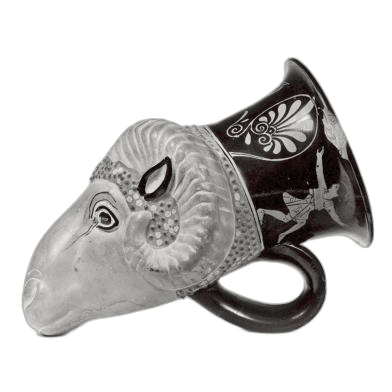
The catalogue's red-figure example is an Attic rhyton shaped as a ram's head in the Royal Ontario Museum (ROM 919.5.6). It is part wheel-thrown, part mould-made, about 430 BCE and 21.3 cm high. Its neck shows a dancing girl and a draped man playing the double aulos, and Beazley attributed it to the Marlay Painter. The museum records it as found at Arsinoe in Cyprus in 1886, probably in a tomb: that is, at Polis, on the site of ancient Marion.
Marion is also where the numbers need most care. Attic pottery makes up 78.8 percent of the Cypro-Classical Marion assemblage collected by Max Ohnefalsch-Richter in the nineteenth century, against 38.2 percent in the Swedish Cyprus Expedition's later excavation at the same site [8, p. 505]. The early excavators favoured collecting Attic vases over local ones, so the percentages are distorted to an unknown degree, and Marion's reputation as a particularly Hellenised city rests partly on that selection. See Attic red-figure in the catalogue.
Attic Black-Gloss
Plain Attic cups and bowls coated all over in black gloss, without figured decoration, came to Cyprus "in droves" in the fifth and fourth centuries BCE and have been studied far less than the figured wares [8, p. 505]. At Marion they are mostly one- or two-handled cups from rock-cut tombs. Some are pristine and come in pairs with similar inscriptions; others are worn, so they had been used in life before burial, and inscribed Attic pots from settlements confirm non-funerary use [8, p. 505]. See Cypro-Classical for the political setting.
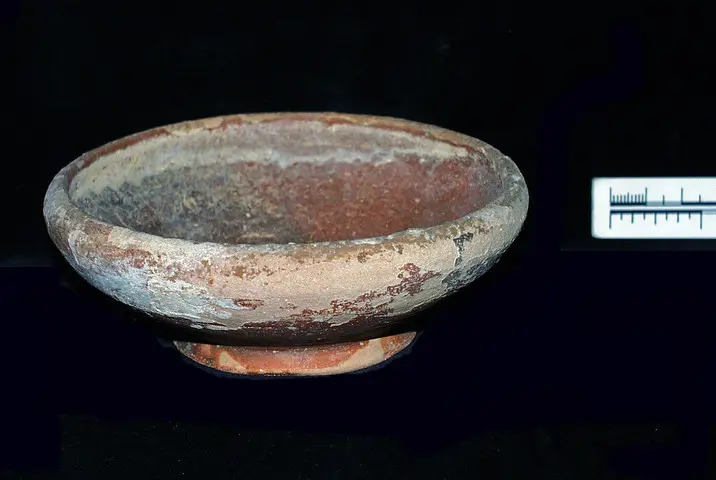
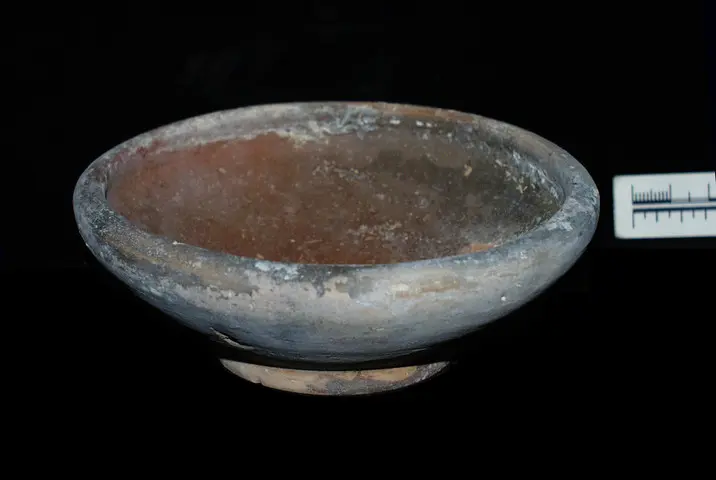
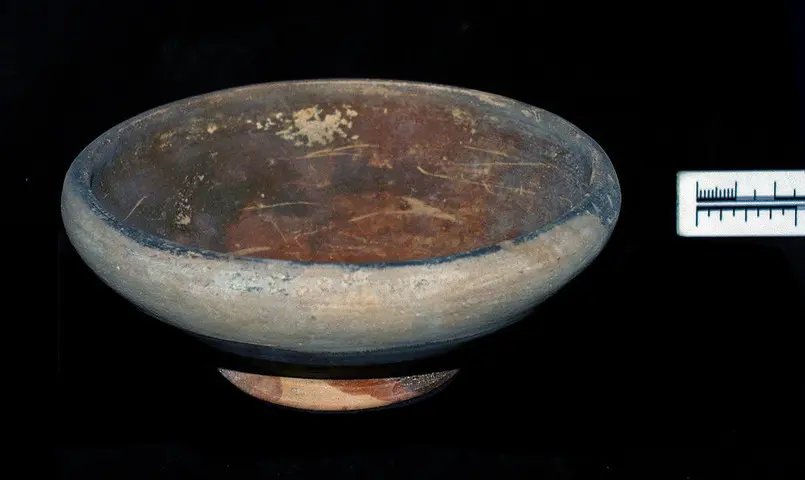
Cypriot potters copied the shapes. Three small bowls in the Ashmolean Museum (AN1938.1404, AN1938.1408 and AN1938.1409; Ashmolean record) are local black-washed imitations of the Attic salt-cellar, with an inverted rim, 4.4 cm high and 11.7 cm across. They come from tomb 10 at Tsambres near Rizokarpaso, excavated by J. du Plat Taylor and allocated to Oxford in 1938, and are dated to the Hellenistic period, after the Attic imports had stopped. An imported Attic salt-cellar of about 375 to 350 BCE, found at Naukratis in Egypt, shows the model (British Museum 1910,0222.161).
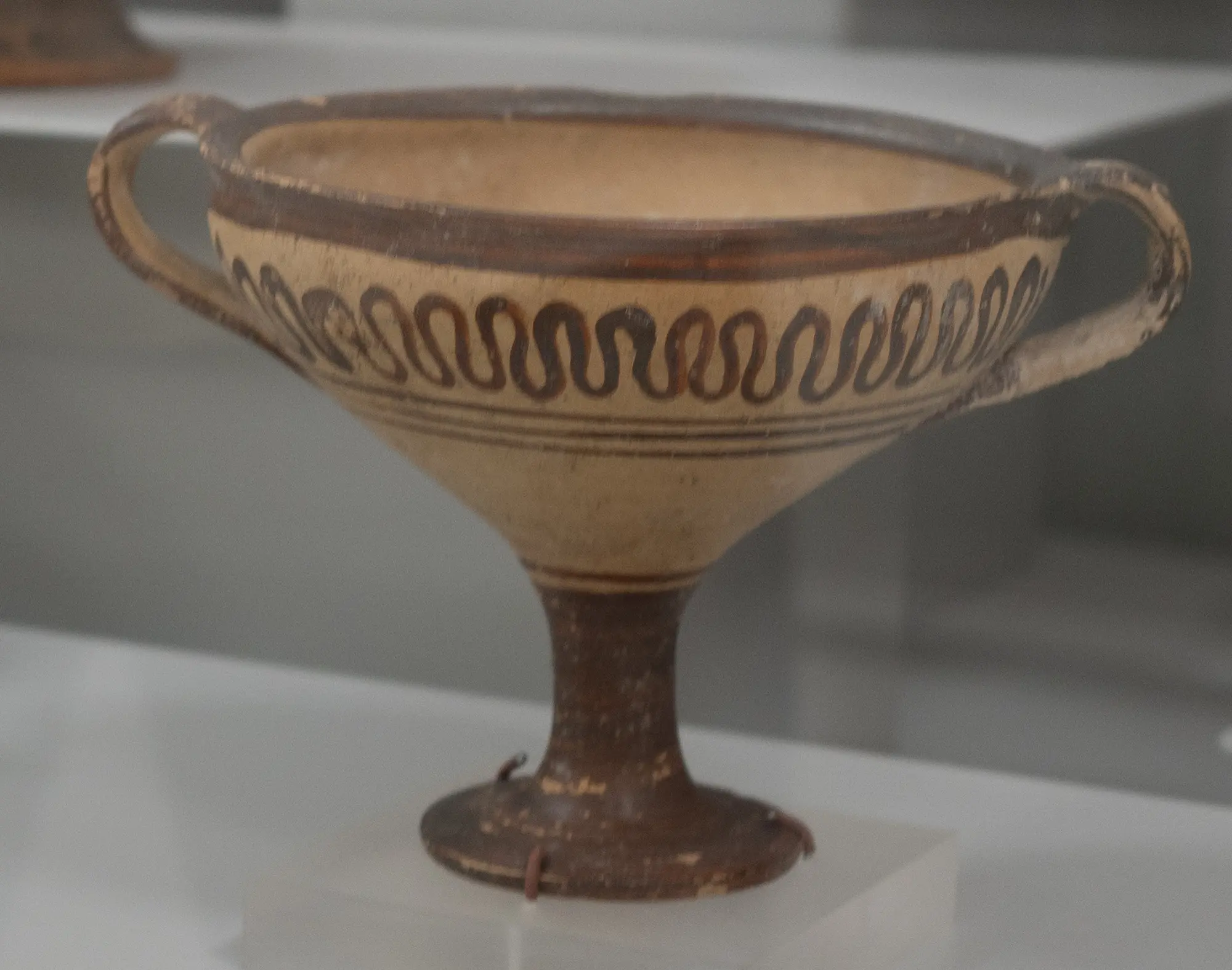
The catalogue also has a low two-handled black-gloss kylix on a pedestal foot in the Cyprus Museum, Jacksonville, described as possibly Attic and dated between the sixth and fourth centuries BCE. See Attic black-gloss in the catalogue.
Imports and their Cypriot users
Across six centuries the Greek pottery in Cyprus is mostly tableware for drinking and mixing wine, with small perfume flasks in the Archaic period. It went into tombs and sanctuaries, and later into houses and palaces. Cypriot buyers chose particular shapes, marked cups with their own names in their own script, and had local potters copy Greek forms in White Painted, Bichrome and black-washed fabrics. The questions still open are who carried the pottery (Euboeans, Phoenicians or Cypriots themselves), how far the old Marion collections skew the Classical figures, and how large the plain black-gloss import really was. For the Cypriot wares that sat beside these imports, see Black-on-Red, Bichrome Red and the shapes of Cypriot jugs.
Objects on this page
 Aegean KylixLate Bronze Age II · 1600–1050 BC
- Attic red-figure rhyton shaped as a ram's head430 BC
- Black wash covered small bowl with inverted rim, Cypriot imitation of an Attic black-gloss salt-cellarHellenistic · 312–58 BC
 Black wash covered small bowl with inverted rim, Cypriot imitation of an Attic black-gloss salt-cellarHellenistic · 312–58 BC
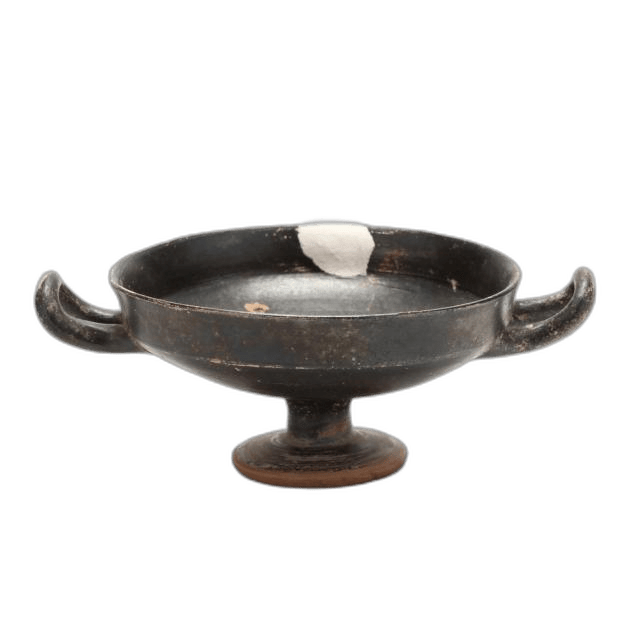 Classical Greek Blackware Terracotta KylixArchaic II · 600–301 BC
In the catalogue
References
- 1.Gjerstad, E. (1948). The Cypro-Geometric, Cypro-Archaic and Cypro-Classical Periods (The Swedish Cyprus Expedition, Vol. IV, Part 2). The Swedish Cyprus Expedition.
- 2.Lemos, I. S., & Hatcher, H. (1991). Early Greek vases in Cyprus: Euboean and Attic. Oxford Journal of Archaeology, 10, 197–208. https://doi.org/10.1111/j.1468-0092.1991.tb00013.x
- 3.Kourou, N. (2019). Cyprus and the Aegean in the Geometric period: The case of Salamis. In S. Rogge, C. Ioannou, & T. Mavrojannis (Eds.), Salamis of Cyprus: History and archaeology from the earliest times to Late Antiquity (Schriften des Instituts für Interdisziplinäre Zypern-Studien 13). Waxmann.
- 4.Snodgrass, A. M. (1971). The Dark Age of Greece: An archaeological survey of the eleventh to the eighth centuries BC. Edinburgh University Press.
- 5.Gjerstad, E. (Ed.). (1977). Greek Geometric and Archaic pottery found in Cyprus (Skrifter utgivna av Svenska institutet i Athen, 4°, 26). Svenska institutet i Athen.
- 6.Calvet, Y., & Yon, M. (1977). Céramique trouvée à Salamine (fouilles de la ville). In E. Gjerstad (Ed.), Greek Geometric and Archaic pottery found in Cyprus (pp. 9–21). Svenska institutet i Athen.
- 7.Eriksson, N. (2011). Athenian pottery and Cypriote preferences: An investigation of the Attic black figure and red figure pottery found in Cyprus (GOTARC Series B, No. 57) [Doctoral dissertation, University of Gothenburg].
- 8.Bourogiannis, G. (Ed.). (2022). Beyond Cyprus: Investigating Cypriot connectivity in the Mediterranean from the Late Bronze Age to the end of the Classical Period (AURA Supplement 9). Faculty of History and Archaeology, National and Kapodistrian University of Athens. https://doi.org/10.26247/aurasup.9