
Contents
On a Drakopoulos Bichrome skyphos, probably of Cypro-Archaic I, a stag stands in each panel of the handle zone: a small red-filled lozenge for a body, a long stalk of a neck, stick legs and branching antlers drawn like a sprig of twigs. The cup was once described as carrying goats. The antlers settle it, and the confusion is typical of the subject. Goats and deer are the wild animals Cypriot potters drew and modelled most often, from the Red Polished jugs of the Early Bronze Age to the free-field jugs of the seventh century BC, and the two are not always easy to tell apart.
This entry covers wild goats (including the long-horned animals usually called ibex) and deer, chiefly stags. For the vessels on which they appear see Free-Field Art and the ware pages; for the trees and lotus flowers they so often stand beside see Plants and Lotus Flowers. You can see all goat, deer and ibex objects in the catalogue.
Telling goat from stag
Lone Wriedt Sørensen, writing on painted Iron Age pottery, agrees with Vassos Karageorghis that "the goat is a popular motif, but so is the stag, and sometimes it is actually difficult to tell them apart" [1]. A working rule follows from the drawings themselves. Antlers, branched or tined, mean a deer. Long horns curving back over the spine, with no branching, mean a goat. Where the head is reduced to a blob or the horns to a single stroke, the honest label is "goat or stag", and catalogue records sometimes call the same animal either.
Specialists on the Near Eastern versions of the motif use the zoological names Capra ibex or Capra aegagrus for the wild goats [4]. For Cyprus the deer at least were real local animals. Pavlos Flourentzos identifies the Bronze Age deer as Persian fallow deer (Dama mesopotamica), present on the island since the Aceramic Neolithic, around 9000 BC, after the first settlers brought them from the Levant [2]. Which wild goat, if any, the Iron Age painters had in mind is not something the drawings can tell us.
Pose is described with three heraldic terms that Lesley Bushnell applies to the goats: rampant (rearing on the hind legs), statant (standing on all four) and couchant (lying down). "Quite often," she adds, "they appeared to be eating the leaves of the tree" [4].
| Period | Main form | Typical examples |
|---|---|---|
| Early and Middle Cypriot | Modelled in relief or in the round on Red Polished and Drab Polished | Vounous jugs and stemmed bowls; Kotchati jug; deer-shaped askoi |
| Late Cypriot | Rare on pottery; goat-and-tree icon on seals, gold, faience; deer on bronze and ivory | Enkomi gold ring; Myrtou-Pigadhes bronze ring; Maa-Palaeokastro pithos fragment |
| Proto-White Painted and Cypro-Geometric | Painted in silhouette; friezes and panels | Goats feeding on a palm (Palaepaphos-Xylinos); White Painted II flask with deer |
| Cypro-Archaic I and II | Free-field jugs; panels; hunt and offering scenes | Bichrome IV goat-and-lotus jug; archer-and-stag jug; Bichrome Red jug in London |
Bronze Age: modelled stags and goats
The first Cypriot goats and deer are modelled in clay, not painted. At Bellapais-Vounous a large Red Polished stemmed bowl from Tomb 160A (no. 17, now in the Cyprus Museum, 52.9 cm high) carries three small conical bowls and three quadrupeds set alternately round its rim, which Karageorghis identifies as "one stag and two oxen(?)" [3]. Flourentzos lists further Vounous pieces: a jug with a male deer on neck and shoulder from Tomb 11, a jug with two male deer in relief on the shoulder from Tomb 32A, a relief of a male deer standing over a female or young, and a White Painted I spouted bowl from Tomb 2 with a pair of deer, from the last phase of the Early Bronze Age [2]. He also excavated, in 1986, a fragmentary Red Polished jug with a fallow deer at Nicosia-Agia Paraskevi, and notes two late Early Bronze Age Drab Polished jugs with deer scenes [2].
Goats appear beside them. A large Red Polished jug from Kotchati in the Pierides collection (55 cm high) has on each side of the lower neck "a goat in relief with a slender body, long vertical neck, long curved horns", with oxen on the shoulder [3]. On some pieces the identification stays open: a Drab Polished jug carries a "quadruped (ox or goat?)" on its shoulder [3]. These modelled animals belong with the wider class of Red Polished zoomorphic vessels and the funerary assemblages discussed under Vounous and Early Bronze Age burial.
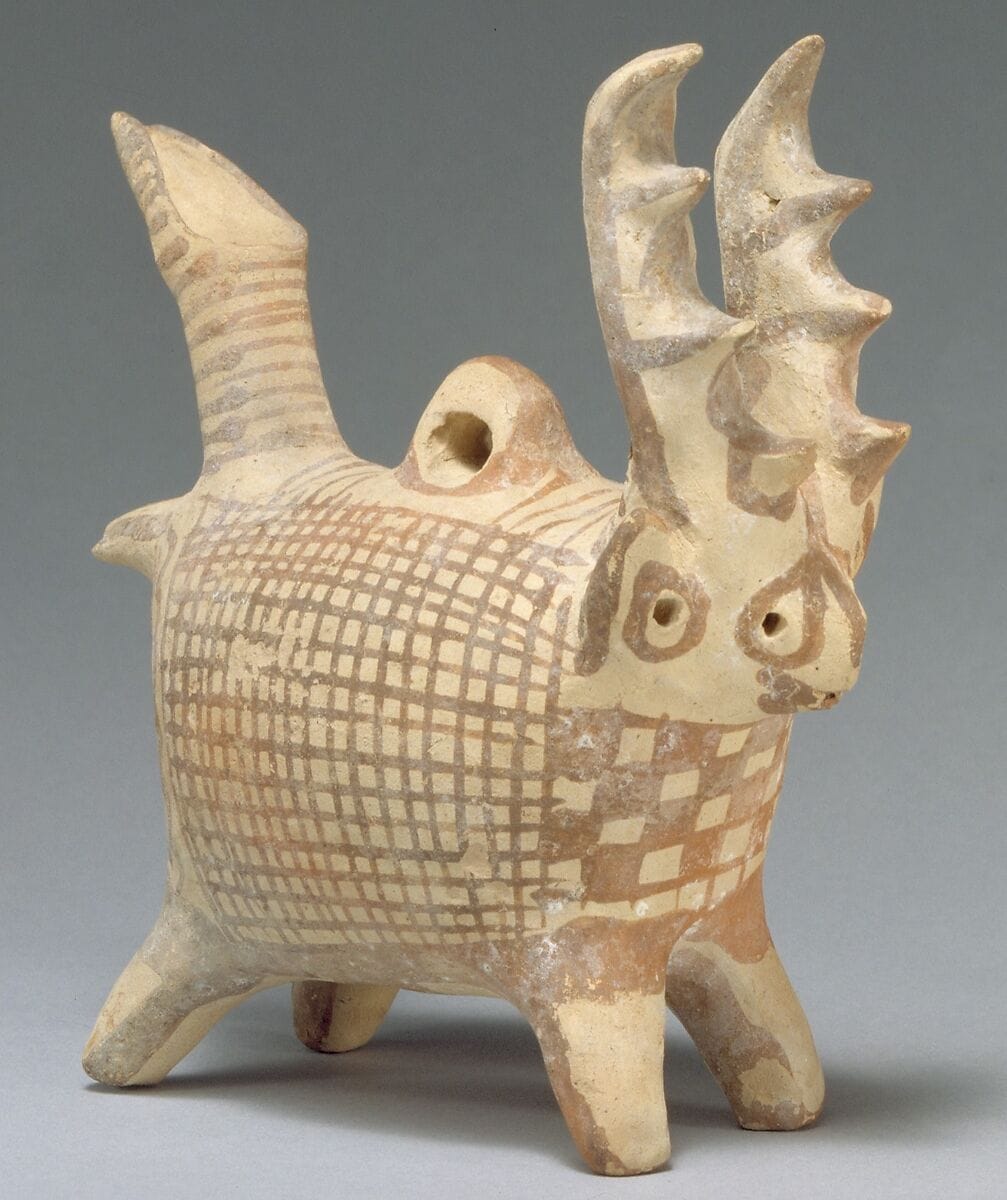
In the Middle Bronze Age the deer becomes a whole vessel. Flourentzos points to two deer-shaped animal vases from Cesnola's excavations in the Metropolitan Museum [2]. One is the Met's terracotta zoomorphic askos 74.51.798, 14.1 cm long, dated 1900–1600 BC; the site's catalogue includes the related askos with antlers, catalogued as Middle Cypriot III, and a further zoomorphic askos of the same period.
The Late Bronze Age, by Flourentzos's account, is "rather poor" in deer on vases. The animal moves to other materials: a galloping deer on a bronze ring from Myrtou-Pigadhes, a seated female deer on an ivory lid from Enkomi, and on a pithos fragment from Maa-Palaeokastro a male deer run down by a chariot and hunter [2].
The goat-and-tree icon
The Late Bronze Age did bring one goat motif in quantity: two wild goats set antithetically about a tree, the "palm-and-ibex" or "sacred tree" composition. Bushnell, who calls it an icon, traces it to the mid-fourth millennium BC and argues that it "almost certainly originated in Iran, in the Susiana plain", against those who place its origin in Mesopotamia [4]. About 65% of the examples she counted are on seals, sealings and signet rings, and 19% on vases [4].
In Cyprus the icon "had no history". It was first imported in the late Middle Cypriot period and by the Late Bronze Age had become more popular than in Iran itself; Bushnell calls the island "the highest consumer of this icon" [4]. It appears chiefly on luxury goods from rich tombs: a gold signet ring from Enkomi British Tomb 93, cylinder seals of the Elaborate Style, faience vases from Kition imported from Egypt, and the Klavdhia diadem, where a lotus replaces the tree. On one Cypriot version copper ingots stand in for the goats [4]. She explains its popularity through the decentralised trade of the coastal centres (Enkomi, Maroni-Vournes, Kalavasos-Ayios Dhimitrios) and elites using exotic imagery as a mark of standing, and disagrees with Lubsen-Admiral and Steel that the motif reached Cyprus from Palestine [4]. She is also careful to say that the meanings are "extremely difficult to interpret" and changed with each culture that took the image up [4].
On Mycenaean pottery found in Cyprus, such as a krater from a Maroni tomb and an Early Pastoral Style krater from Kazaphani, the icon "was not a common motif" [4]. After 1200 BC Cyprus was, in Bushnell's account, the only place it survived, on bronze tripods; she believes it also lived on in the silhouette style of eleventh-century pictorial pottery, where wild goats, trees and stylised hills appear [4]. That last point is her own argument.
Iron Age: friezes, panels and the free field
On painted pottery the goat is traced back to Proto-White Painted and continues into Cypro-Archaic II; the stag appears from Cypro-Geometric I, "sometimes staged together with the goat" [1]. Bushnell cites a White Painted footed bowl from Palaepaphos-Xylinos with silhouetted goats, horns exaggerated, feeding on a palm, and a Bichrome I lentoid flask with running goats and birds [4]. Flourentzos adds a Cypro-Geometric I bowl with a male fallow deer among geometric motifs and an ibex or mouflon nearby, and a White Painted II lentoid flask in the Hadjiprodromou collection with a frieze of five male deer and one female in a circle [2].
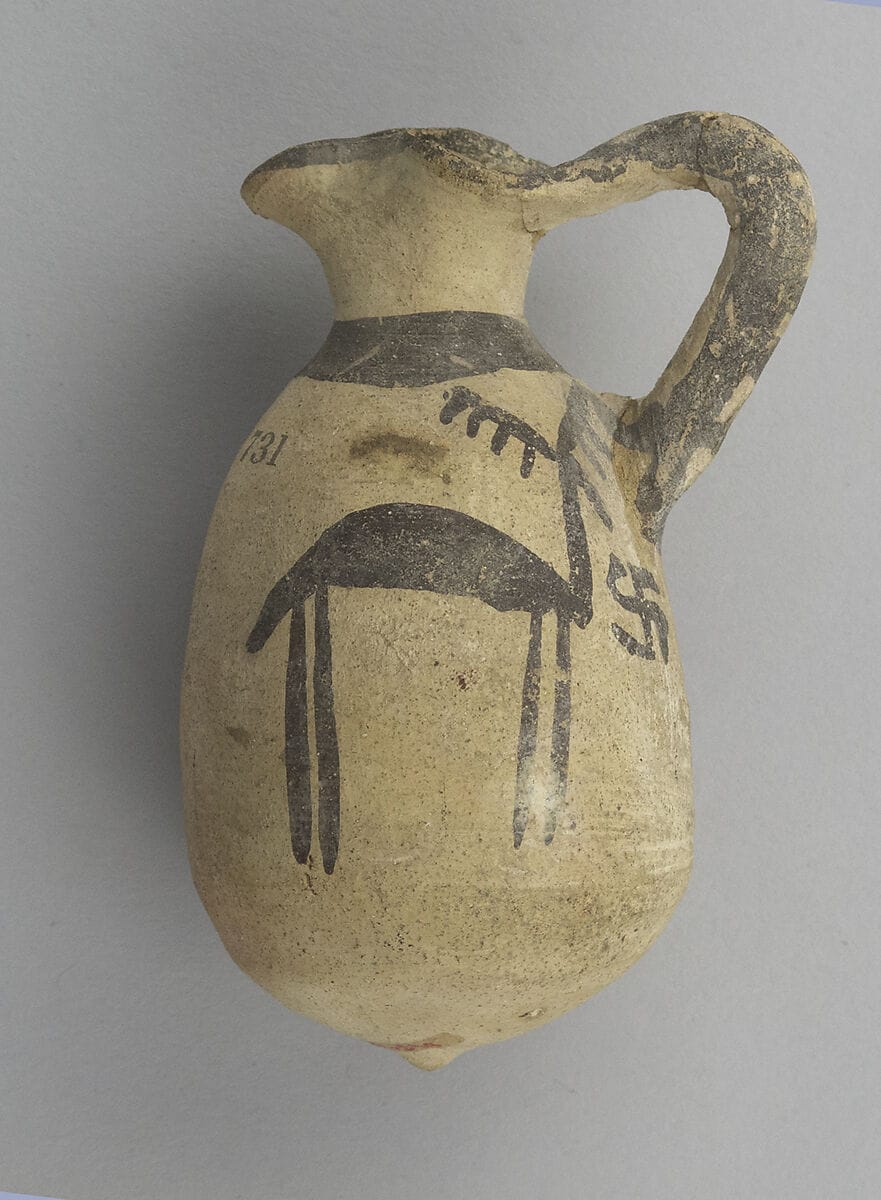
The site's catalogue has several Cypro-Geometric pieces in the Metropolitan Museum: a trick vase and a vase on a high foot with two goats' heads in relief, both catalogued as Cypro-Geometric I, and a small "bird-jug" type jug with a stag and swastikas, 10.3 cm high, catalogued as Cypro-Geometric III. Its pairing of stag and swastika recurs later on a Bichrome kylix in the Cyprus Museum (1971/X-19/2) with a standing male deer between two swastikas [2].
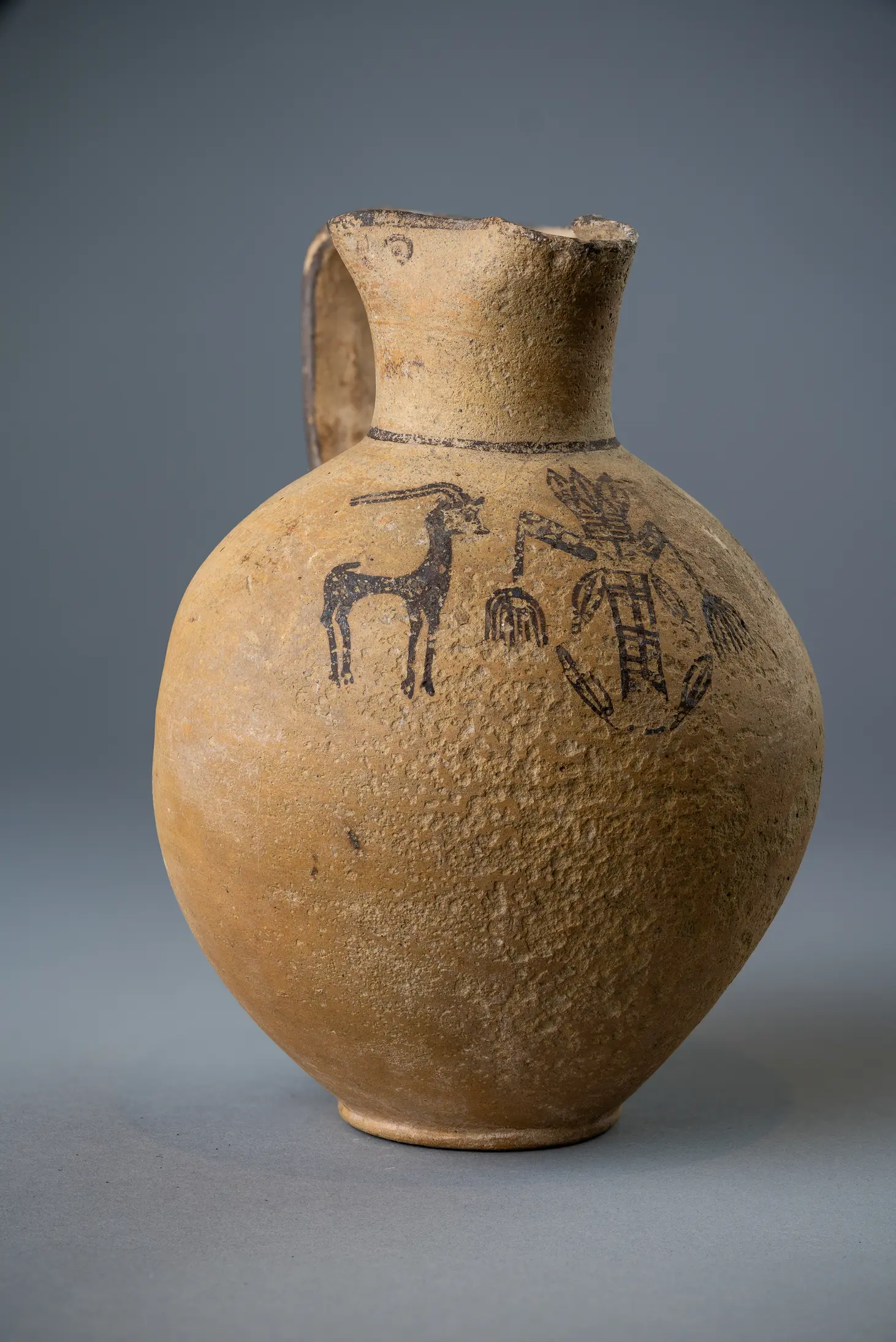
The Drakopoulos skyphos at the head of this page keeps the panel layout: ladders of small squares divide the handle zone into metopes, each holding one stag, with a chequerboard beside the handle. It shows the older syntax still in use alongside the free field.
In Cypro-Archaic I, Flourentzos notes "an increasing number of representations of deer and especially deer hunting, mainly on vases of the so called Free-Field style" [2]. His list includes a Black-on-Red oenochoe in the British Museum with a male deer on the shoulder beside concentric circles, an Ashmolean jug with pairs of male deer and birds flanked by trees, and a Cyprus Museum jug (B.777) with a deer feeding from a lotus between a bird and a wild goat [2]. A Bichrome jug in the Cyprus Museum, dated 750–650 BC and 28 cm high, shows an archer moving right and shooting at a stag that stands before a plant, with a bull before a flower behind him [5, no. 300].
The best-known goat is on a Bichrome IV jug in the Cyprus Museum, 26 cm high, said to come from a tomb between Vatyli and Sinda and attributed to the workshops of Salamis. The goat rears on its hind legs before a large lotus with red leaves, its silhouette body marked with red "wheel" motifs. The catalogue notes that the goat, "an iconographical theme of Near Eastern inspiration", is "already attested in the pottery of the Late Bronze Age and becomes a privileged figural representation in Cypro-Geometric and Cypro-Archaic pottery" [6]. Bushnell reads the stout, rosette-patterned goats nibbling at an elaborate lotus on Bichrome IV as the icon in its most stylised Cypriot form [4].
The Drakopoulos White Painted IV trefoil jug belongs to this group. A single wild goat in black silhouette, long horns swept back over the spine and the eye left in reserve, faces a larger composite figure with a feathery crown and a ladder-like stem. Read as a tree, it gives one goat where the icon has two; the site's article on free-field anthropomorphic forms discusses the other readings. Goats continue into Cypro-Archaic II: the British Museum's Bichrome Red jug 1909,0619.3, 27.94 cm high and dated around 500 BC, is painted in black and added white with concentric circles and a goat (see Bichrome Red).
Hunt, offering and hybrids
Several Iron Age scenes put the goat or stag in a human story. Sørensen notes that goats and stags "seem to play a role as an animal of prey" [1]. One amphora neck shows two men carrying a goat slung from a pole, which "may illustrate either the successful outcome of a hunt or the animal being carried off to sacrifice, or both" [1]. A frieze of women, one leading "a goat or a stag by the horns", suggests an offering procession [1].
Goats also keep stranger company. A White Painted III jug shows a human-headed creature, "probably a goat", and a small stag jumping up against a tree [1]. Goats appear with sphinxes, with frontal heads, and on sixth-century amphorae made at Amathus, where a goat is led towards a Hathor stele [1]. Sørensen compares rampant ibexes flanking a tree on North Syrian ivories and goats flanking a tree on a silver bowl from Amathus, and suggests that animals touching or smelling the tree may reflect an animistic way of thinking [1]. That reading is hers; no ancient text explains the motif.
Beyond pottery
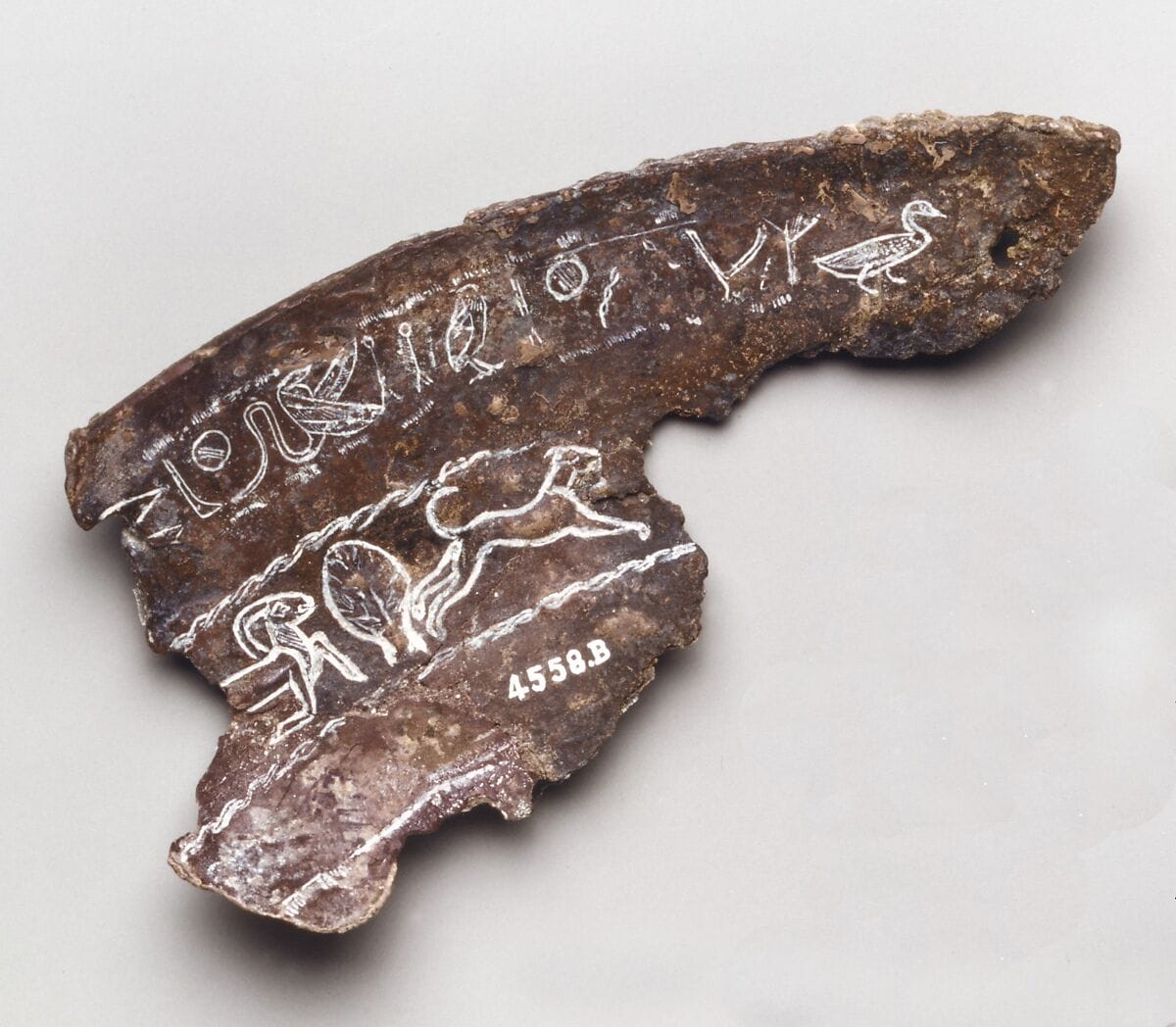
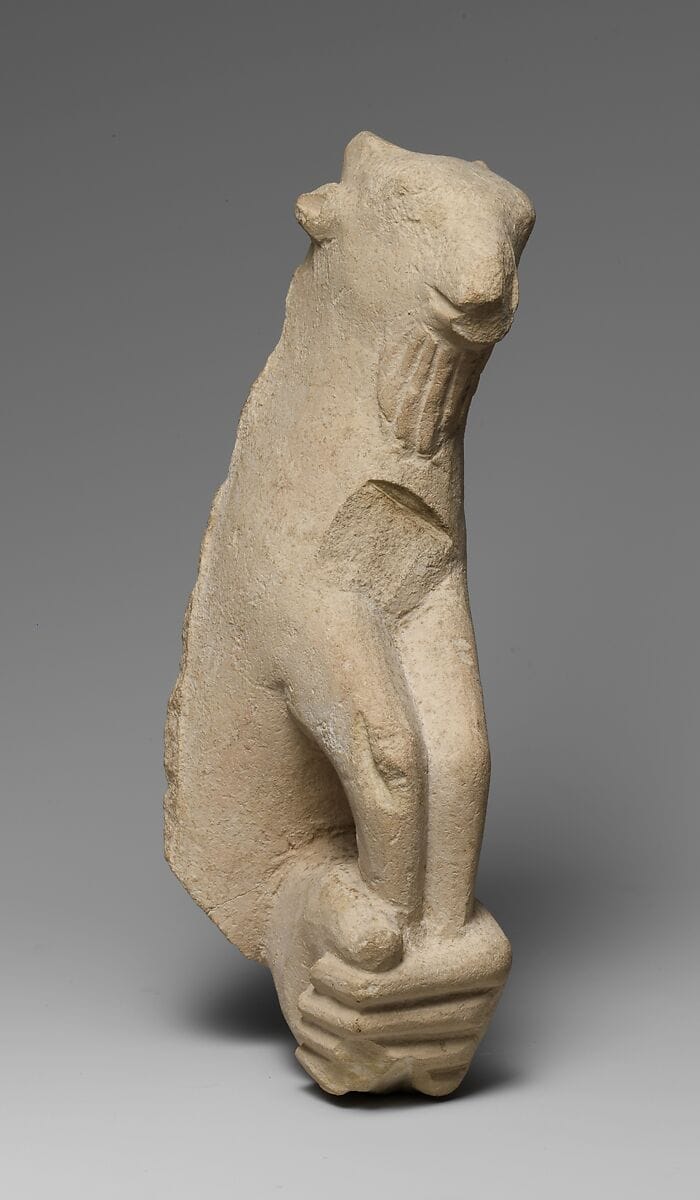
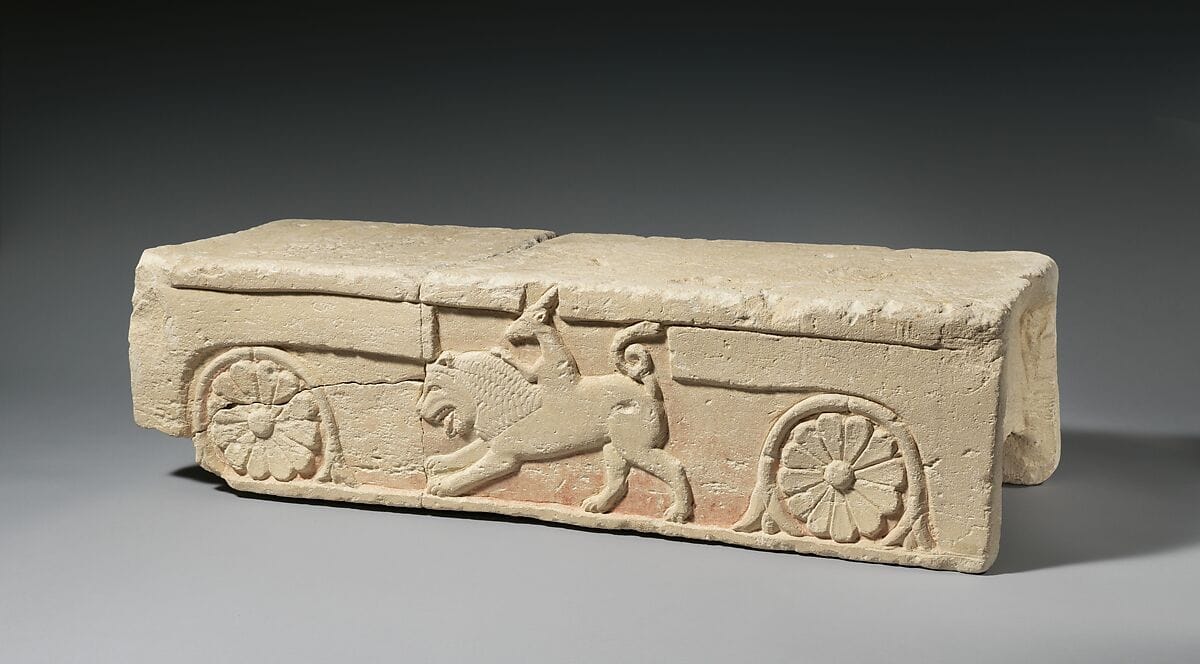
The same animals turn up in other materials, often in the Cesnola collection at the Metropolitan Museum. The Met's bronze statuette of a stag 74.51.5589, 12.9 cm high, is dated to the ninth or eighth century BC. Its fragmentary silver bowl 74.51.4557, of about 710–675 BC, includes deer among banqueters and women, and the site catalogue has two further silver bowl fragments from the same collection. In stone the goat appears as an offering: a limestone hand holding a kid, from a votary statue of the kind discussed under temple boys, and animals on a limestone footstool.
What the motif tells us
Across some two thousand years the goat and the stag change medium and meaning. In the Early Bronze Age they are modelled animals among oxen on funerary vessels. In the Late Bronze Age the goat arrives a second time as a borrowed Near Eastern icon on luxury goods. In the Iron Age both are painted, first in friezes and panels and then alone on the shoulder of a free-field jug, sometimes hunted, sometimes led to an altar. The Dynamic Island catalogue sets the Cypriot goat jugs beside the East Greek "Wild Goat" style as "different regional expressions of the Orientalizing cultural phenomenon" [6]. For the wider grammar of these jugs see the article on Cypriot free-field art; for the catalogue's own objects, see all goat, deer and ibex objects in the catalogue.
Objects on this page
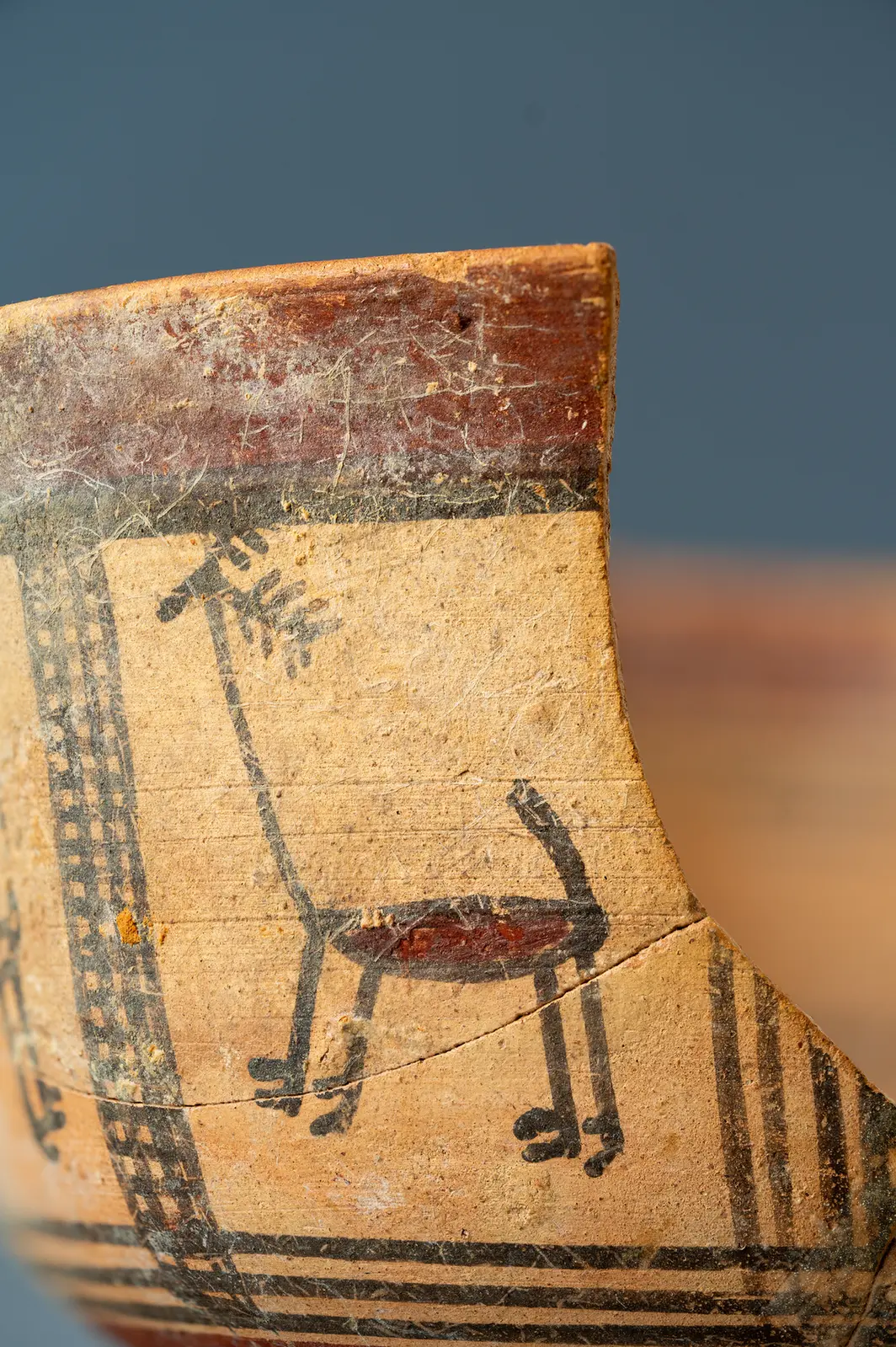 Bichrome Skyphos with Stags in MetopesArchaic I · 750–600 BC
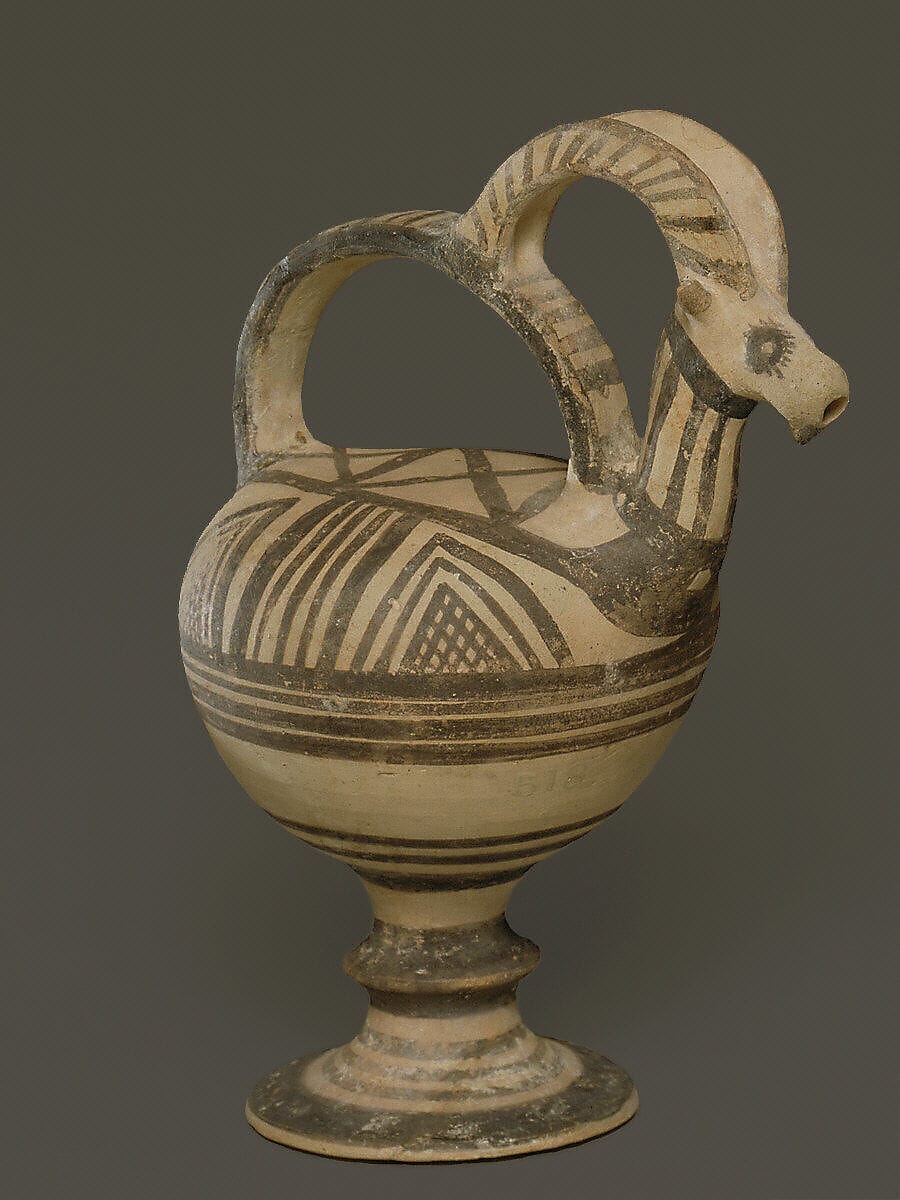 Terracotta trick vaseGeometric I · 1050–950 BC
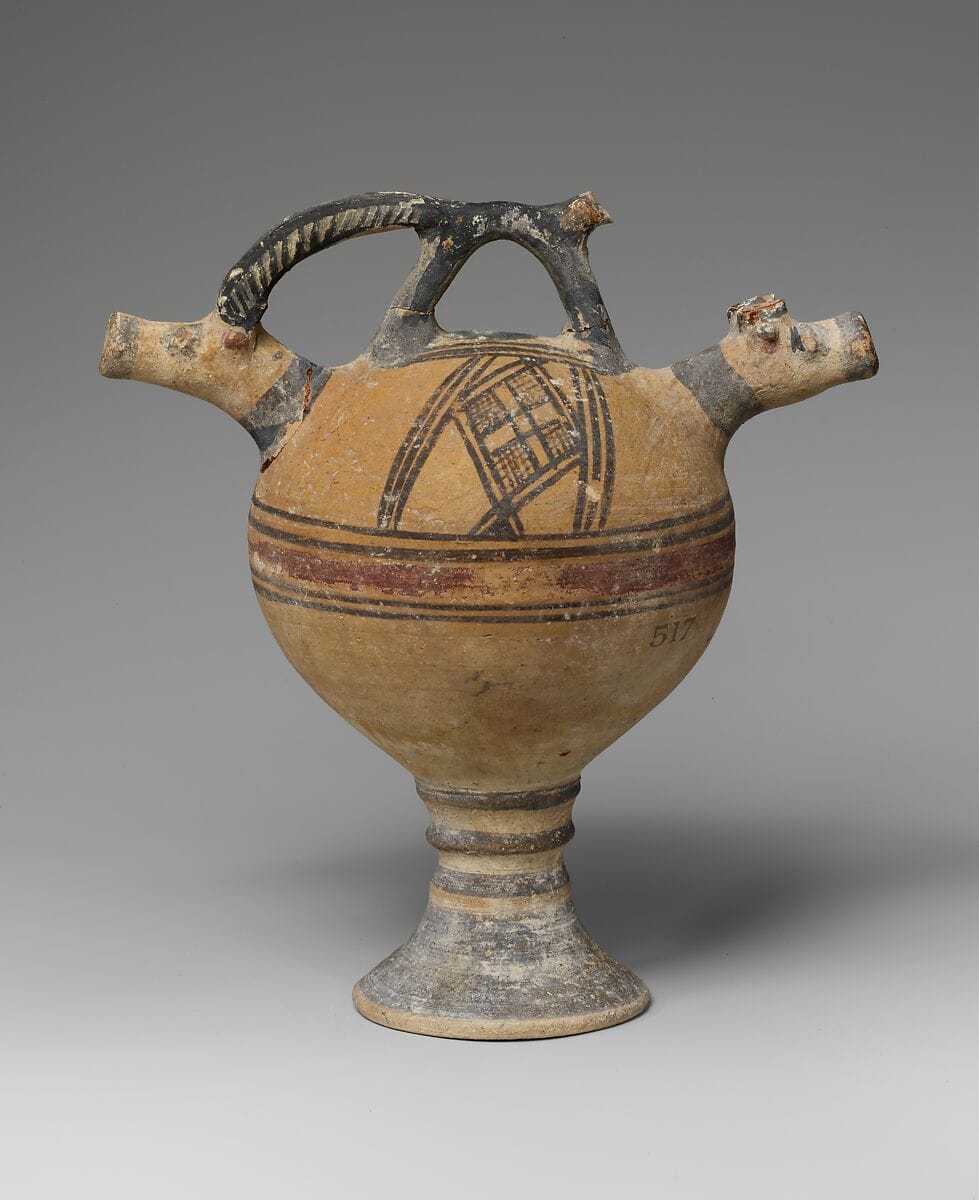 Terracotta vase on a high foot with two goats' heads in reliefGeometric I · 1050–900 BC
 JugGeometric III · 850–750 BC
- White Painted IV Trefoil Jug with a Wild Goat and a Composite Plant-like FigureArchaic I · 750–600 BC
 Two fragments of a silver bowlArchaic I · 699–600 BC
 Limestone statue fragment of a left hand holding a kidArchaic II · 500–450 BC
 Limestone footstoolArchaic II · 500–450 BC
In the catalogue
References
- 1.Sørensen, L. W. (2015). Here there be monsters: Hybrids painted on Cypriot Iron Age pottery. In J. Fejfer, M. Moltesen, & A. Rathje (Eds.), Tradition: Transmission of Culture in the Ancient World (Acta Hyperborea 14, pp. 427 ff.). Copenhagen.
- 2.Flourentzos, P. (2002). The iconography of deer in Cyprus through the ages. Zeitschrift für Jagdwissenschaft, 48 (Supplement 1), 180–193. https://doi.org/10.1007/BF02192407
- 3.Karageorghis, V. (1991). *The Coroplastic Art of Ancient Cyprus, I: Chalcolithic to Late Cypriote I*. Nicosia: A. G. Leventis Foundation.
- 4.Bushnell, L. (2008). The wild goat-and-tree icon and its special significance for ancient Cyprus. In G. Papantoniou et al. (Eds.), POCA 2005: Postgraduate Cypriot Archaeology (BAR International Series 1803, pp. 65 ff.). Oxford: Archaeopress.
- 5.Tatton-Brown, V. (Ed.). (1979). Cyprus BC: 7000 Years of History. London: British Museum Publications. (Cited by catalogue number.)
- 6.Halbertsma, R. B., & Pilides, D. (Eds.). (2019). Cyprus: A Dynamic Island. Leiden: Sidestone Press / Rijksmuseum van Oudheden.