
Contents
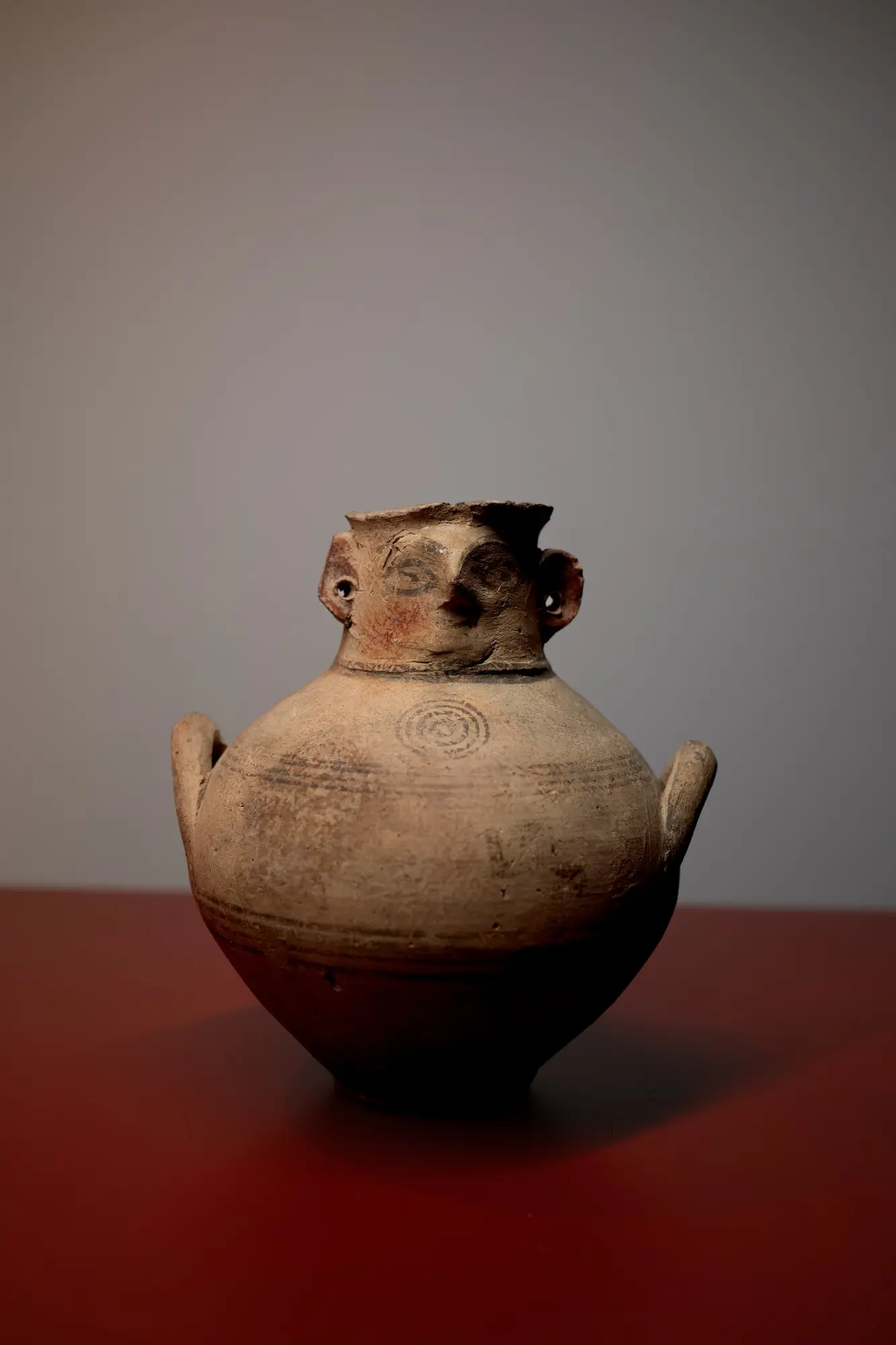
A small Bichrome IV jar in the Drakopoulos collection has a neck that is also a head. The nose is pinched out of the clay, the eyes are painted as concentric rings under arched brows, a single stroke makes the mouth, and two round ears are applied at the sides, pierced and painted red (Bichrome IV Face-Neck Jar of the Kourion Type). It is one of the quieter ways a Cypriot potter put a person on a pot. The others range from crowded clay tableaux of the Early Bronze Age to painted warriors, archers and dancers on Iron Age jugs and amphorae.
This entry covers human figures painted, modelled or applied in relief on Cypriot pottery, from the Red Polished scenes of Bellapais-Vounous to the Cypro-Archaic free-field jugs. Free-standing terracottas made beside the pots, such as horse-and-rider figurines and ring-dance groups, have their own pages and are only touched on here. See all human figures in the catalogue, or browse the wider group of figural motifs.
What counts as a human figure on a pot
Cypriot potters used four techniques, and they belong to different periods. In the Early Bronze Age figures were modelled in the round and set on or inside a vessel, or shaped in low relief on its wall. In the Iron Age they were painted, usually in silhouette or outline, as part of a pictorial scene. Between these lie hybrids: a vessel neck modelled as a face, or a protome on a jug shoulder with painted features.
The ware matters less than the technique. Human figures turn up in Red Polished, Proto-White Painted, White Painted and Bichrome, and the catalogue records the motif across all of them. A good rule for identification is to ask whether the figure is part of the pot's structure (a neck, a handle, a figure standing on a rim) or drawn on its surface. The first is a Bronze Age habit that returns in the Cypro-Archaic face-neck jars; the second is the Iron Age norm.
| Period | Technique | Typical examples |
|---|---|---|
| Early Bronze Age III (Red Polished) | Modelled in the round, relief | Vounous bowl, Kotchati model, ploughing model, figures on jug necks and pyxides |
| Late Bronze Age | Very rare on Cypriot pottery | Pictorial vases are emblematic, without narrative scenes |
| Cypro-Geometric I (11th to 10th c. BCE) | Painted, a handful of vases | Proto-White Painted kalathos and pyxis; White Painted I dish from Skales |
| Cypro-Geometric III | Painted, panelled scenes | Hubbard amphora |
| Cypro-Archaic I and II | Painted free-field and panelled scenes; modelled faces | Spearman, archer and lotus jugs; masked protomes; Kourion face-neck jars |
Early Bronze Age: scenes in clay
The densest group of human figures on Cypriot pottery comes from the end of the Early Bronze Age, in Red Polished ware, with Bellapais-Vounous as the type-site (see Early Bronze Age and Red Polished). The best known piece is the Vounous bowl from Tomb 22, now in the Cyprus Museum. Vassos Karageorghis described it as a clay model of an open-air enclosure containing human and animal figures in the round: opposite the gate, against the wall, three figures in relief hold snakes and wear bull-masks, groups of people stand and sit inside, one kneels before the relief figures, and oxen stand on either side of the gate [1, p. 52]. Stephanie Budin counts five standing figures, two or three with phallic bulges and the rest without sexual characteristics, four people seated on a bench, two of them clearly male, the largest male on an outsized chair, a figure looking over the wall who does not seem to be allowed in, and a woman holding an infant in front of one of the pens [3, pp. 266-267]. Many figures in these compositions are gender-neutral [3, p. 266].
Louise Steel notes that Tomb 22 was an ordinary looted chamber tomb with standard Red Polished pottery, three Black Polished vessels, two bronze knives, a scraper, a whetstone, a composite vase and a ring vase. Only one other scene modelled inside a bowl is known, found in 2011 in a looted tomb at Nicosia-Ayia Paraskevi [2]. Because the figures stand taller than the bowl's sides, she reads it as an object made to be looked at, a fixed tableau rather than a set of moveable pieces [2].
Other models extend the repertoire. A Red Polished model from a tomb at Kotchati (Cyprus Museum 1970/V-28/1, height 19 cm) has a panel with three poles in relief topped by bull-heads, and a female figure standing on the floor about to pour libations into a jar; Karageorghis thought it an abbreviated version of the Vounous sanctuary [1, p. 53]. From Vounous also comes a ploughing scene: a table on five legs carrying two pairs of oxen drawing ploughs, with four human figures, two behind the ploughs and two holding what may be a trough of grain (height 19 cm, length 41 cm) [1, p. 50].
Figures were also attached to ordinary shapes. Desmond Morris lists small plank figures applied to Red Polished gourd-shaped jugs opposite the handle, figures reduced to a face in relief on jugs, bowls and jars, figures on egg-shaped pyxides, and figures on the multiple-bowl vessels from Vounous [4, p. 152]. These belong with the tulip bowls and cult vessels and with the free-standing plank figures. For the burial context, see Vounous and Early Bronze Age burial and the article Vounous: a Bronze Age society known only from its dead.
Late Bronze Age to early Cypro-Geometric: an absence and its exceptions
After the Early Bronze Age the human figure almost leaves Cypriot pottery. Maria Iacovou characterises Late Cypriot pictorial painting as decorative and emblematic, without a coherent narrative style, and asks where the human figures are in twelfth-century Cyprus at a time when the Aegean shows an outburst of them [5]. She counts only four Proto-White Painted vases with human figures, all of the 11th century BCE (Late Cypriot IIIB). Among them are a pyxis with an archaising Mycenaean hero carrying a tower shield and a kalathos from Palaepaphos with a lyre-player in a short tunic and plumed helmet, beside a long-horned quadruped and its keeper. Iacovou argues that this imagery came from the Aegean Late Helladic IIIC tradition rather than from contemporary Cyprus [5]. See Proto-White Painted ware and Late Bronze Age.
From early Cypro-Geometric I the human image all but disappears again: White Painted I and Bichrome I use only animals. It returns in the 10th-century phase of Cypro-Geometric I, mostly on Cypriot shapes such as the flat dish, the tripod and the box [5]. A White Painted I dish from Palaepaphos-Skales shows the kind of scene involved: a two-headed, fish-tailed snake monster attacked by two bearded men, one with two daggers attached to his arms, the other drawing a bow, with arrows already lodged in the monster, a bull and two dogs [6, p. 103].
Cypro-Geometric III: the Hubbard amphora
The amphora named after its former owner, Hubbard, now in the Cyprus Museum, was found by illicit diggers in the east of the island. Porphyrios Dikaios, who published it in 1937, dated it to the beginning of the ninth century BCE and classed it between Einar Gjerstad's types II and III, noting that the eastern style favoured non-geometric ornaments, even human figures [7]. One side shows a ring dance of four women in skirts, their breasts marked, with a male lyre-player; they hold branches between them. The faces are grotesque, with noses like birds' beaks [7]. The amphora also shows drinking through a siphon, a rite Dikaios took as evidence of relations between Cyprus and Syria [7].
A later Cyprus Museum guide dates the amphora lower, to the end of the Geometric period at the beginning of the eighth century. It describes the obverse as a woman on a throne sipping through a straw from a jug, a winged sphinx sniffing a flower and a second woman pouring, with a bull protome on the wall, and the reverse as a dancing woman and a male lyre-player. It calls the obverse "undoubtedly Oriental" and the reverse based on Greek prototypes [8, p. 77, no. 73]. The two dates differ by roughly a century; both fall within the Cypro-Geometric period. John Myres had called the painting "styleless", and Dikaios quotes his view that the scenes were experiments, "aspirations after a free style" [7].
The ring dance on the amphora has a three-dimensional counterpart in terracotta groups of figures dancing round a tree, made later in the Cypro-Archaic period. Two veiled dancers from such a group are in the Drakopoulos collection.
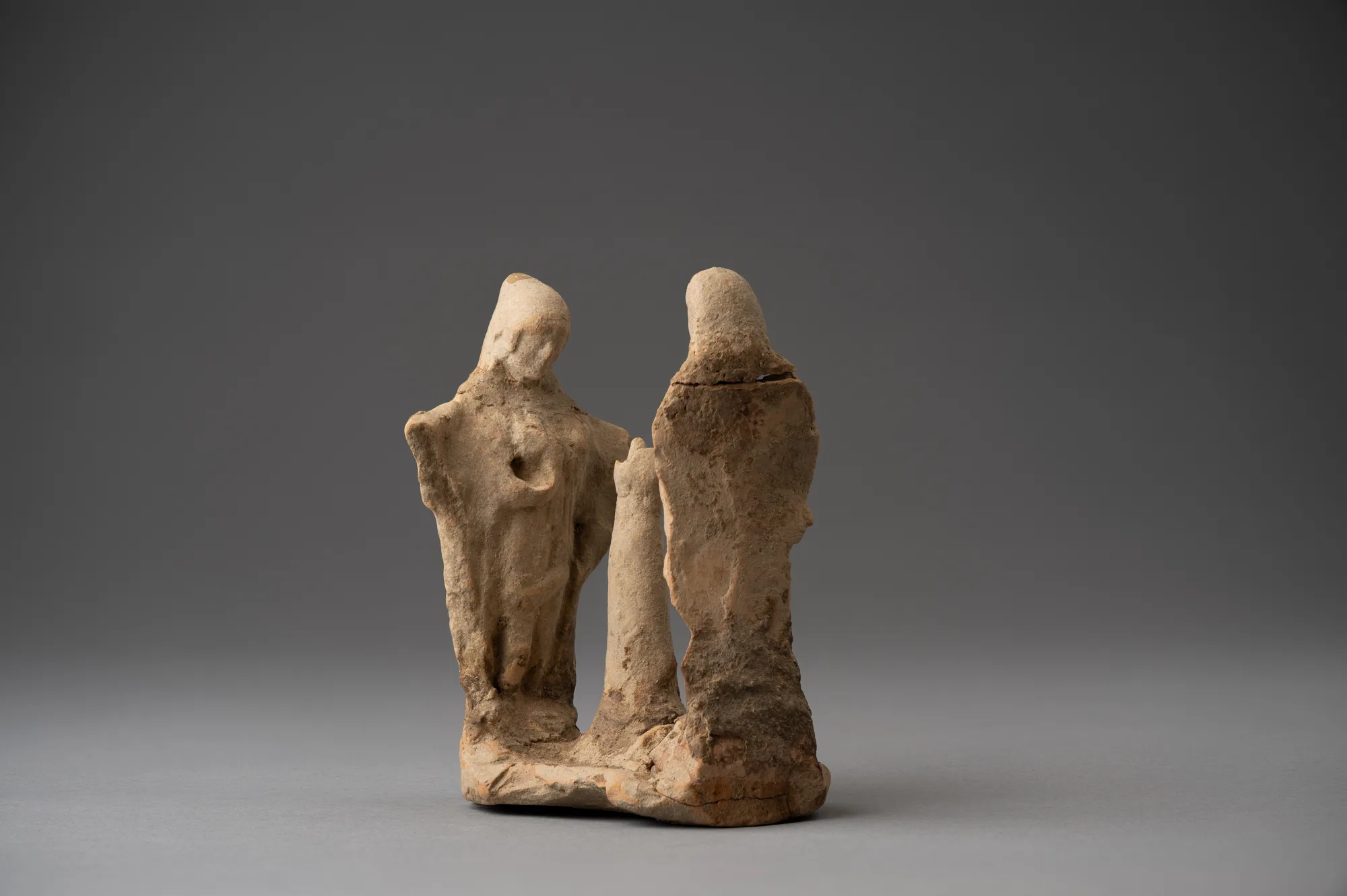
The two veiled figures are discussed in Ring-dance groups and the article Two figures and a tree for that piece.
Cypro-Archaic: warriors, archers, lotus-smellers and masks
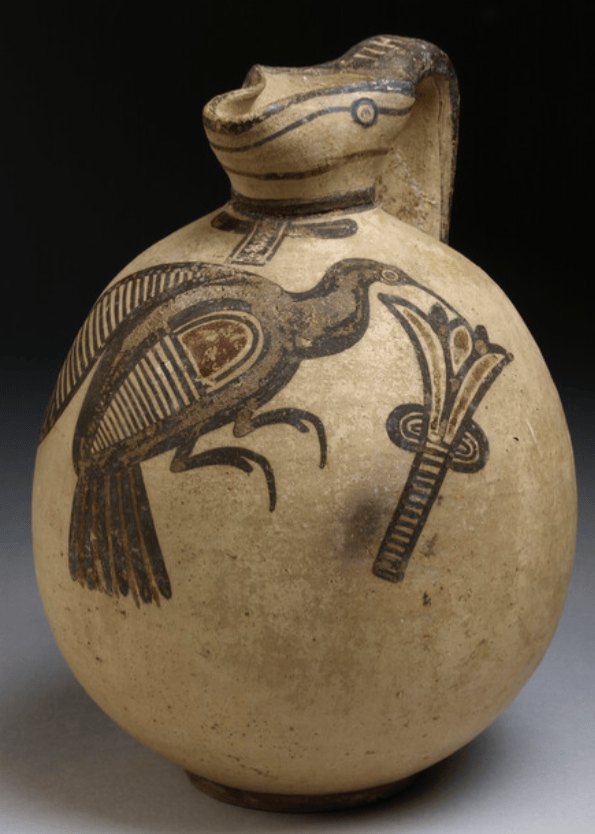
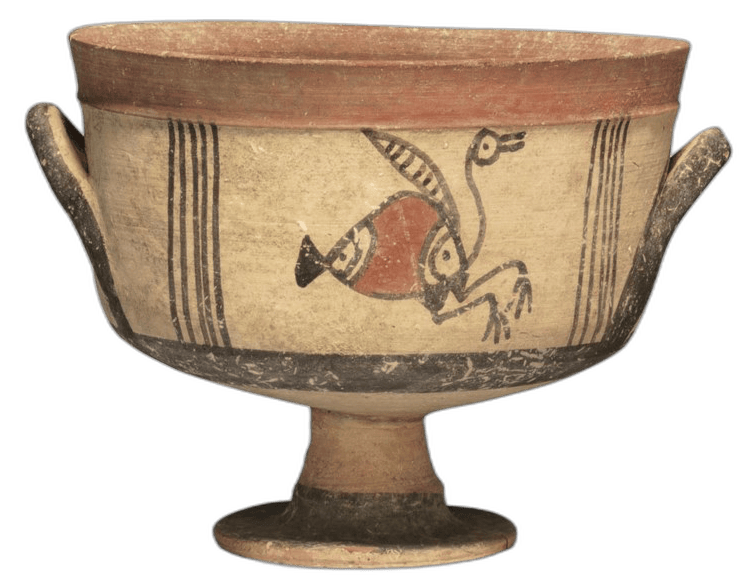
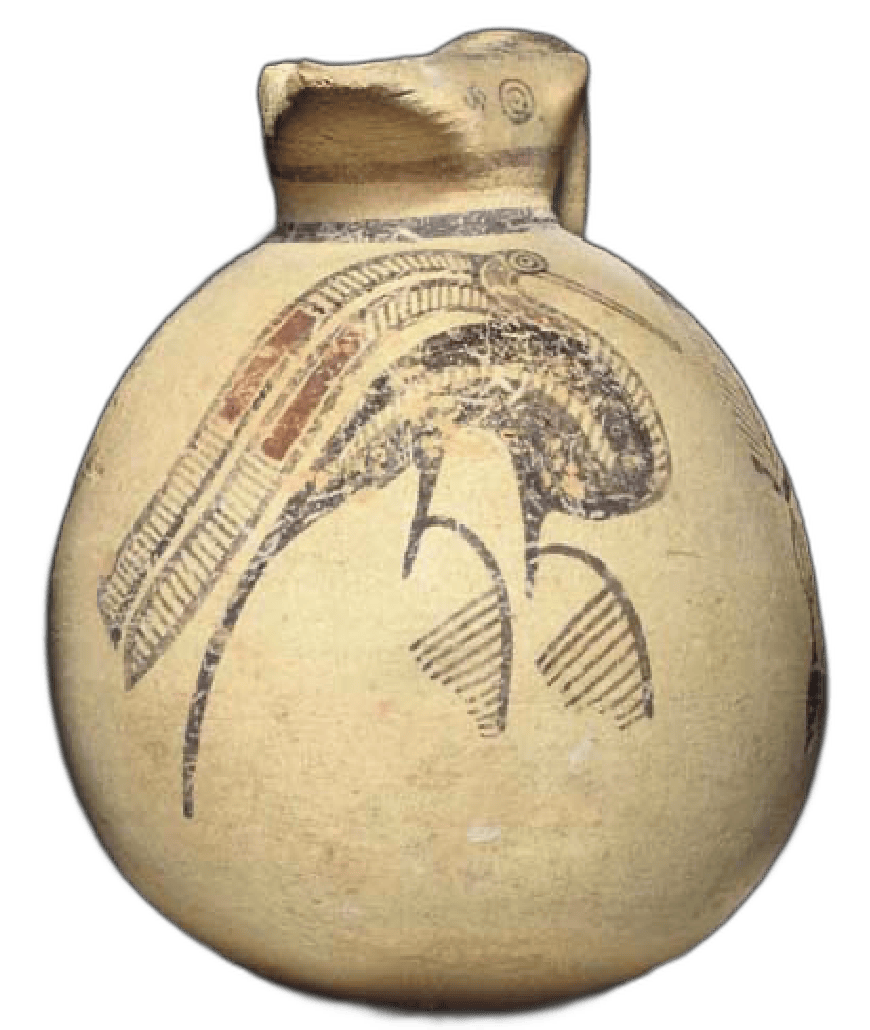
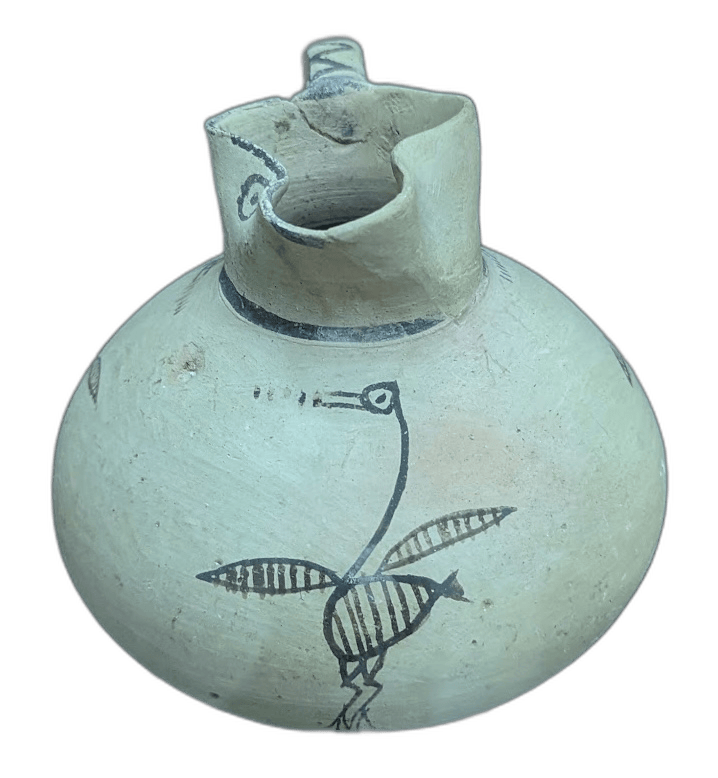
In Cypro-Archaic I and II the human figure became a regular subject of Bichrome and White Painted vase-painting. Anna Georgiadou and Maria Dikomitou-Eliadou note that the same themes, human figures and animals among them, appear in both the free-field style, where a single scene occupies the whole surface, and the panelled style, where it is set in zones or panels [9, pp. 342-343]. Karageorghis lists human figures first among the subjects favoured in the free-field style, in which linear and geometric decoration is absent [10, p. 108, intro. to cat. 149].
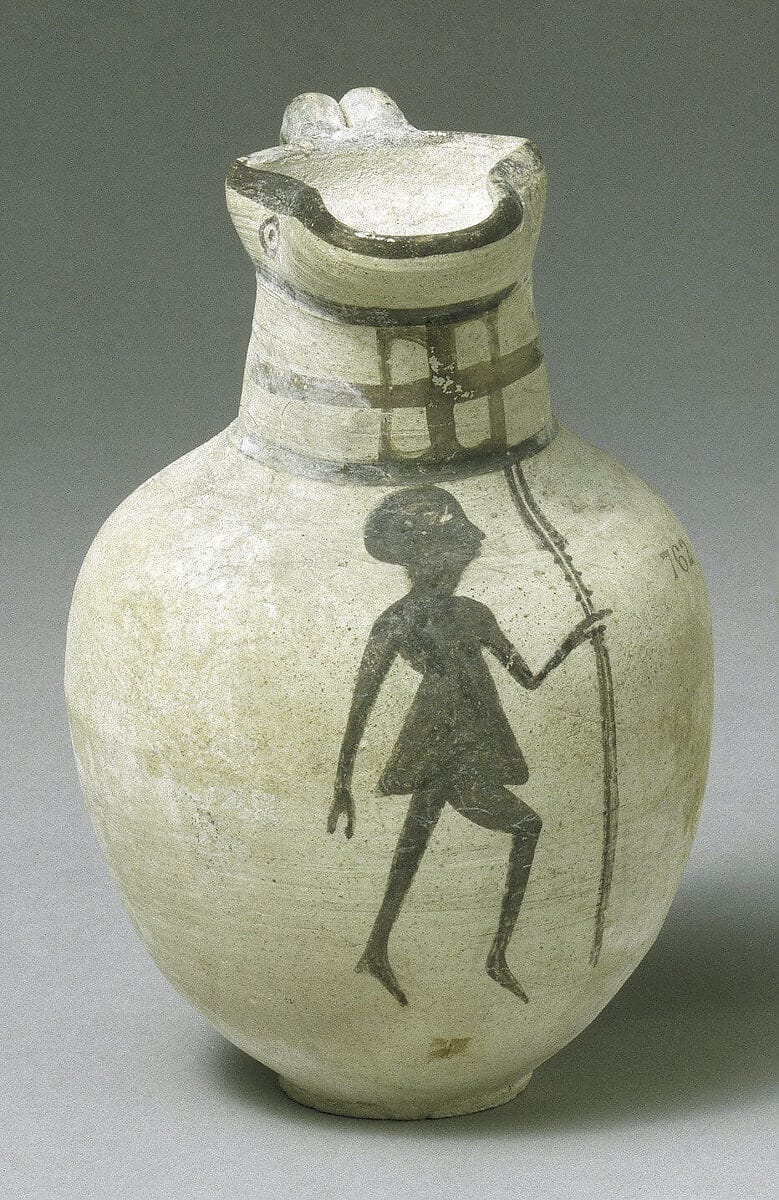
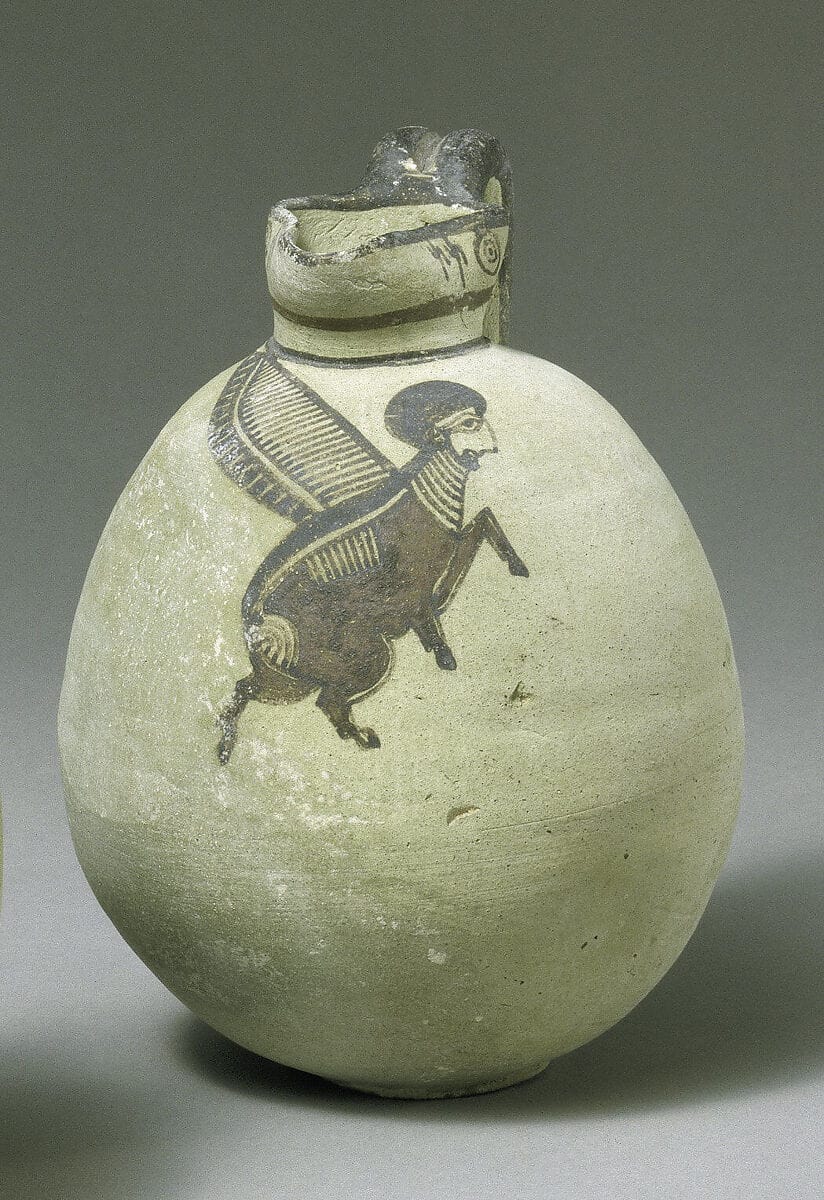
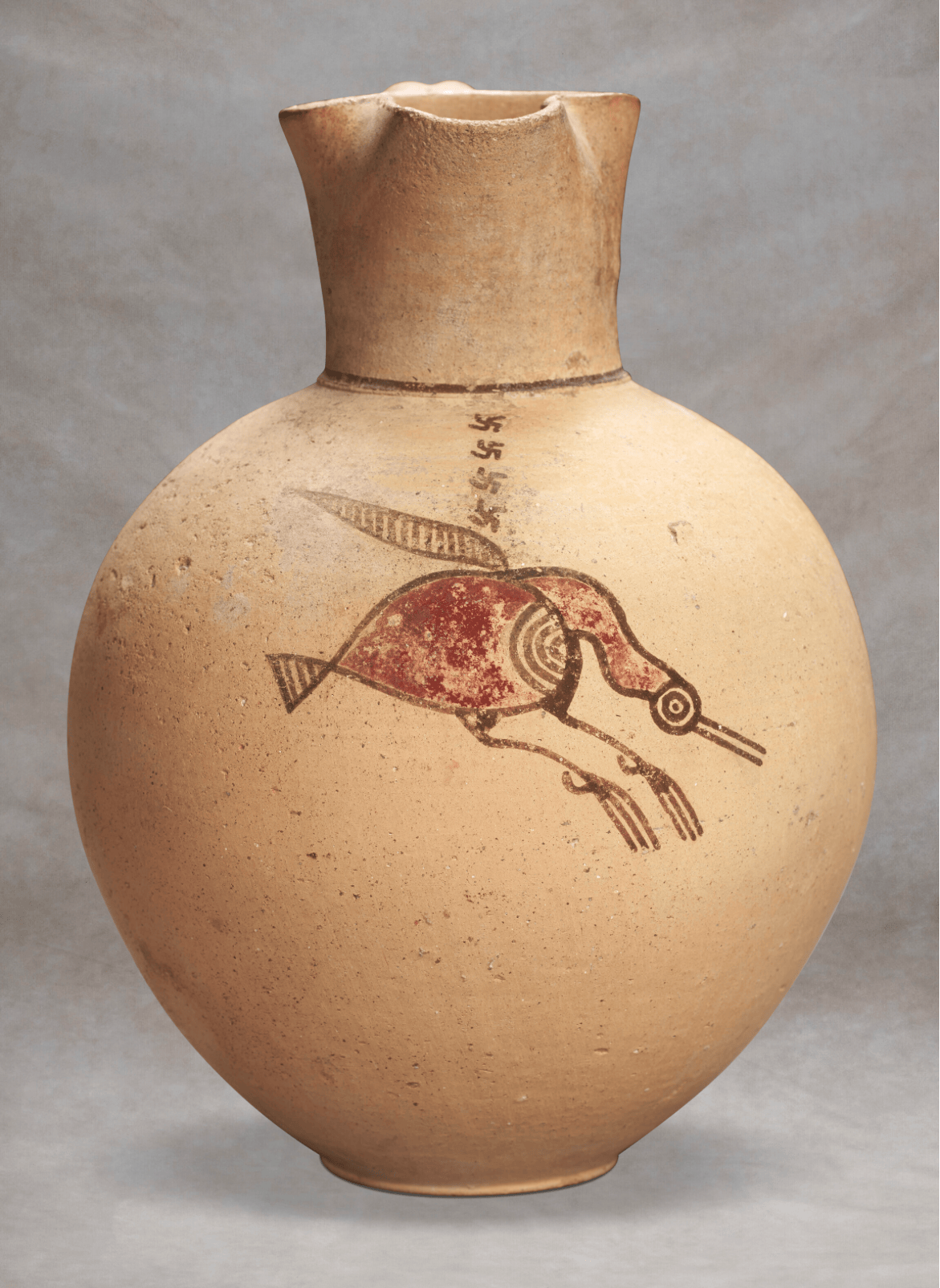
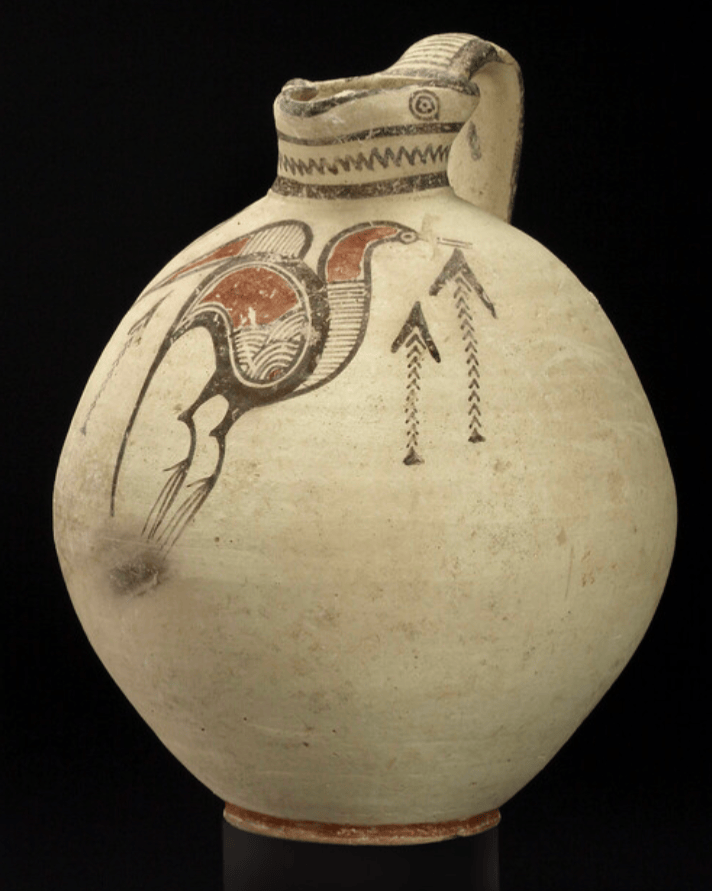
The Metropolitan Museum holds two examples worth comparing. A small White Painted IV jug (74.51.532), said to be from Ormidhia, shows a human figure in silhouette marching right with spears; Karageorghis notes that the face appears to be that of a black African (Terracotta jug; [10, p. 109, cat. 150]). A Bichrome IV jug (74.51.508), said to be from Kourion, carries a protome with a red-painted face and a horned helmet which, Karageorghis suggests, may represent a man wearing a mask (Terracotta jug; [10, cat. 152]). He compares masks on other jugs and in coroplastic art, such as the Met's terracotta female protome-mask 74.51.1473. Not every figure resolves into a person: a Bichrome IV jug in the same collection (74.51.512) shows a winged quadruped with human features that he could not identify [10, cat. 151].
The Ashmolean Museum has a sack-shaped Bichrome jug with a free-field image of a bearded man, Cypro-Archaic, 18 cm high (AN1974.436).
The older Cyprus Museum guide groups several more subjects. A jug with a painted human figure has a head recalling the Egyptianizing limestone sculpture of the early sixth century; another shows an archer drawing his bow at a stag with a dog behind, a hunting scene renewed by eastern influence; a sixth-century deep bowl combines sphinxes and human figures holding lotus flowers; and a jug bought in 1941 shows two figures, "perhaps a god and goddess", smelling lotus flowers [11, p. 77]. The sacred tree flanked by two birds or two human figures was a favourite design, and the guide attributes the incised detail on some of these vases to Greek Ionian black-figure influence [11, p. 77]. For the plant side of these scenes, see Lotus flowers and Plants.
Faces on necks: the Kourion face-neck jars
The modelled human face came back to pottery in Cypro-Archaic jars and hydriae whose necks are shaped as heads. A Bichrome hydria from the Kourion region in the Cyprus Museum (1975/IX-29/3, height 17 cm), dated 750-650 BCE, has a neck in the form of a human face with features painted or in relief [12, p. 111, no. 307]. The Drakopoulos jar shown at the head of this page belongs to the same small group: a squat Bichrome IV jar with two loop handles, whose short neck carries a pinched nose, painted ring eyes and pierced, red-painted ears (Bichrome IV Face-Neck Jar of the Kourion Type). The same catalogue also records a hanging lamp with a warrior holding an axe and a bull's head at the top (1977/VIII-23/14), another sign that potters in this period readily turned vessels into figures [12, p. 111, no. 309].
Figures beside the pots
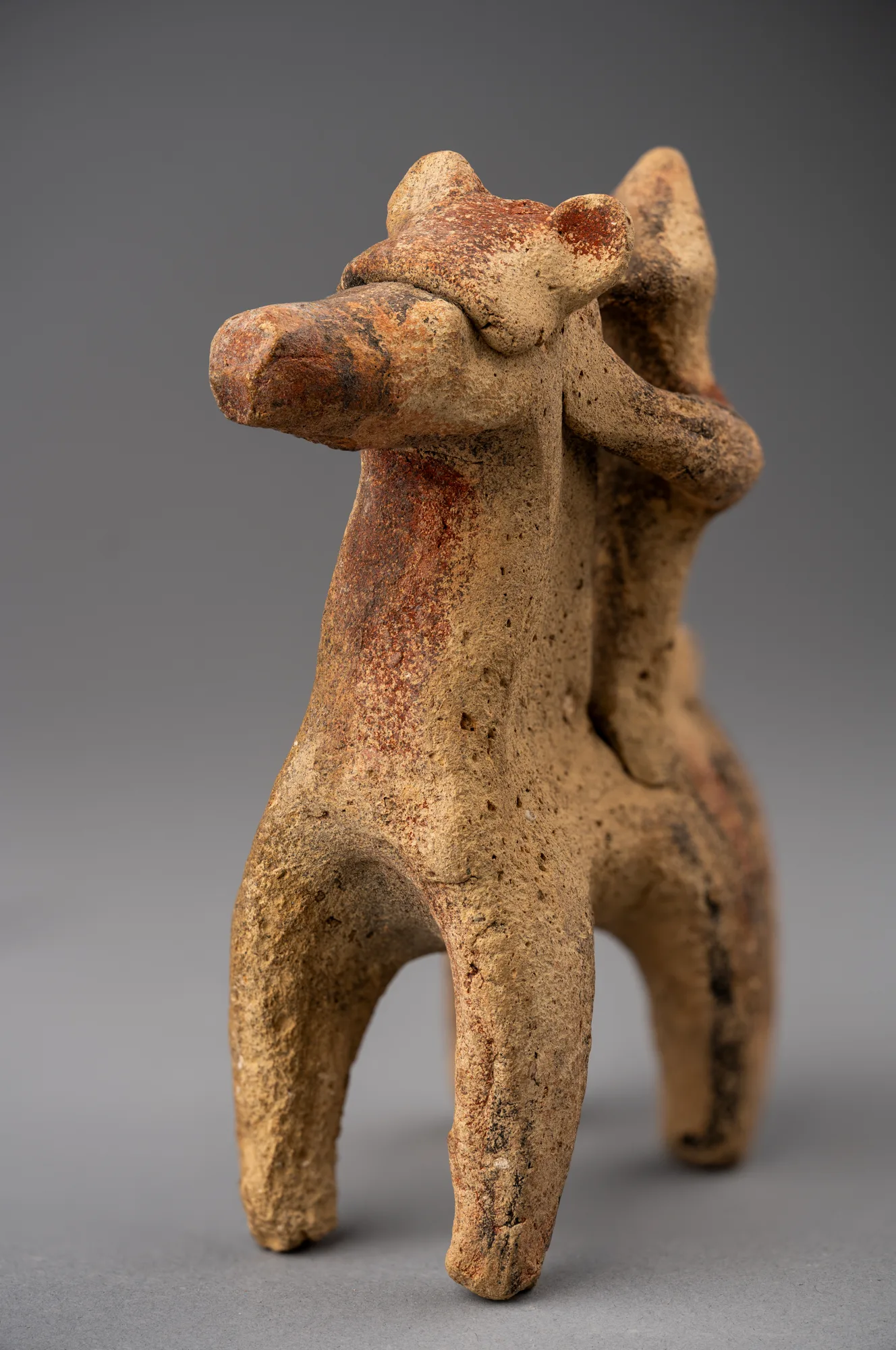
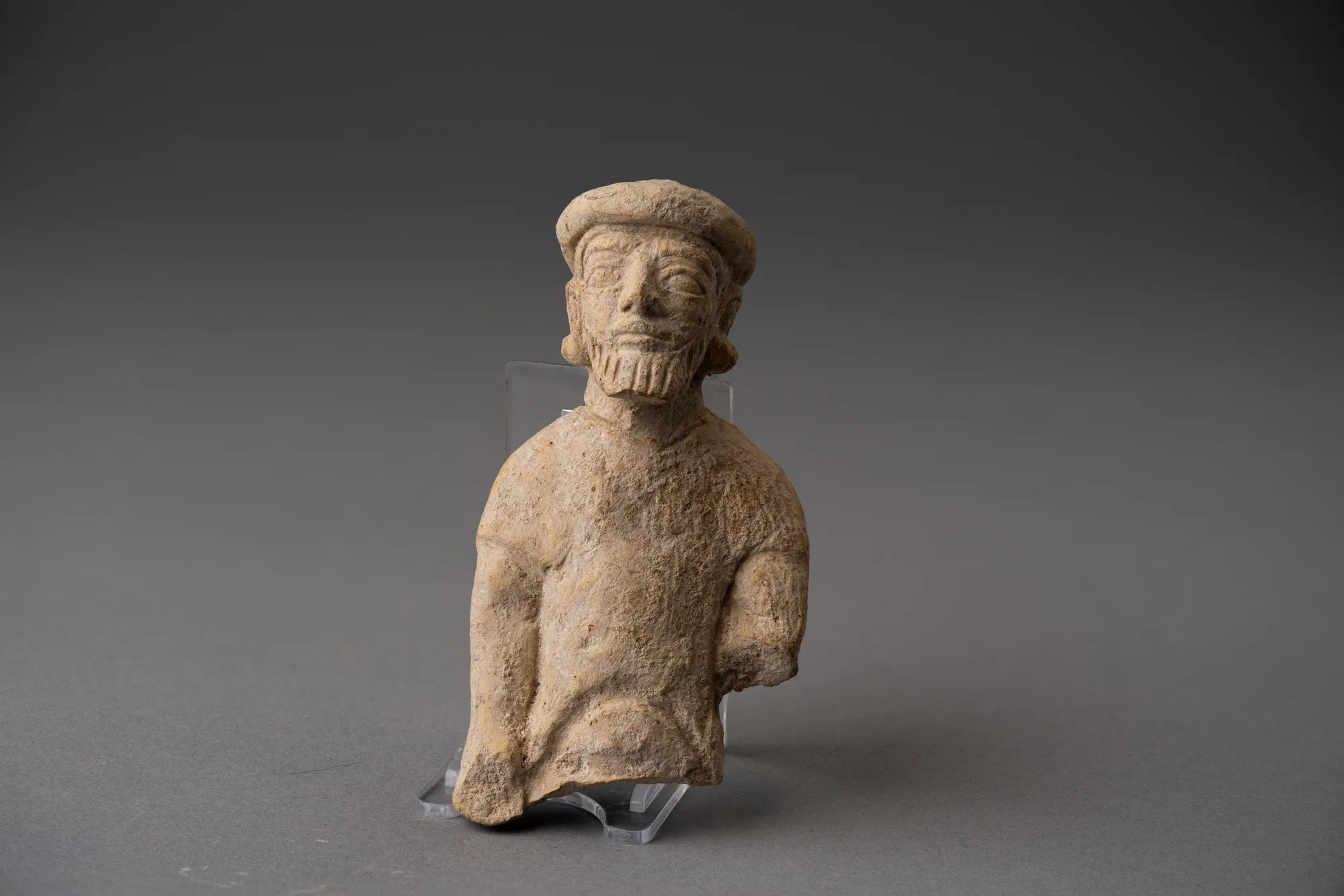
The painted figures of the Cypro-Archaic period share their subjects with the handmade terracottas of the same centuries: riders, dancers and votaries. The Drakopoulos horse and rider with a painted star on the neck is a Cypro-Archaic example, and the upper body of a bearded horseman with a mould-made face shows the later Kourion type. These are treated in Horse-and-rider figurines, Snowman figurines and How Cypriot figurines are classified.
Reading the figures: the debates
The Vounous bowl has carried most of the interpretation. Dikaios read it as a sanctuary with a high priest and a Mother Goddess; Budin finds the identification of the small woman with the infant as a Mother Goddess tenuous, and notes Mogelonsky's argument, from Classical and ethnographic parallels, that the scene is funerary [3, p. 267]. As Steel summarises, Edgar Peltenburg (1994) read it as a symbol of a new hierarchical order in three units: the domestic and pastoral, a male secular hierarchy, and a symbolic spiritual world. Steel considers this over-formalised and prefers a display tableau of daily and ritual life [2].
For the Iron Age the main question is whether Cypriot painters told stories. Iacovou's answer for the Late Bronze Age and earliest Iron Age is that they mostly did not: the island's pictorial pottery was emblematic, and the few narrative human scenes of the 11th century look back to Aegean models [5]. The Hubbard amphora's dates (ninth century for Dikaios, early eighth for the museum guide) and its mixed Oriental and Greek elements show how much rests on a few pieces [7] [8, p. 77]. The masked protomes raise a separate problem: Karageorghis's suggestion that they show people wearing masks links the vases to the terracotta masks of the sanctuaries, but it remains a suggestion [10, cat. 152].
Related pages
For the wider painted repertoire, see Free-field art, the article The journey of a free-field bird and the Cypro-Archaic period. For the Early Bronze Age modelled figures, the Vounous double-necked bird jug and Red Polished zoomorphic vessels show the animal side of the same tradition. Collection holdings can be browsed in the Drakopoulos collection, the Metropolitan Museum and the Ashmolean Museum.
Objects on this page
 Bichrome IV Face-Neck Jar of the Kourion TypeArchaic I · 750–600 BC
- Two Veiled Figures from a Terracotta Ring-Dance Group, with the Stump of the Central TreeArchaic · 750–480 BC
 Terracotta jugArchaic I · 750–600 BC
 Terracotta jugArchaic I · 750–600 BC
 Horse and Rider Figurine with a Painted Star on the NeckArchaic II · 600–480 BC
 Upper Body of a Bearded Horseman with a Mould-Made Face, Kourion TypeHellenistic · 400–200 BC
In the catalogue
References
- 1.Karageorghis, V. (1982). Cyprus: From the Stone Age to the Romans. London: Thames and Hudson.
- 2.Steel, L. (2013). The social world of Early-Middle Bronze Age Cyprus: Rethinking the Vounous bowl. Journal of Mediterranean Archaeology, 26(1), 51-73. https://doi.org/10.1558/jmea.v26i1.51
- 3.Budin, S. L. (2011). Images of Woman and Child from the Bronze Age: Reconsidering Fertility, Maternity, and Gender in the Ancient World. Cambridge: Cambridge University Press.
- 4.Morris, D. (1985). The Art of Ancient Cyprus. Oxford: Phaidon.
- 5.Iacovou, M. (2006). À contretemps: Late Helladic IIIC syntax and context of Early Iron Age pictorial pottery in Cyprus. In E. Rystedt & B. Wells (Eds.), Pictorial pursuits: Figurative painting on Mycenaean and Geometric pottery (pp. 191-203). Swedish Institute at Athens.
- 6.Karageorghis, V. (1983). Palaepaphos-Skales: An Iron Age Cemetery in Cyprus.
- 7.Dikaios, P. (1937). An Iron Age painted amphora in the Cyprus Museum. Annual of the British School at Athens, 37, 56-72. https://doi.org/10.1017/S0068245400017974
- 8.The Cyprus Museum, Nicosia (museum guide).
- 9.Georgiadou, A., & Dikomitou-Eliadou, M. (2022). The Iron Age pictorial pottery of Salamis within and beyond: An overview of ceramic styles, wares and fabrics. In G. Bourogiannis (Ed.), Beyond Cyprus: Investigating Cypriot connectivity in the Mediterranean from the Late Bronze Age to the end of the Classical Period (AURA Supplement 9, pp. 335-348). Athens: National and Kapodistrian University of Athens.
- 10.Karageorghis, V., Mertens, J. R., & Rose, M. E. (2000). Ancient Art from Cyprus: The Cesnola Collection in The Metropolitan Museum of Art. New York: The Metropolitan Museum of Art. (Cited by page and catalogue number.)
- 11.A Guide to the Cyprus Museum (museum guide).
- 12.Cyprus BC: 7000 Years of History (exhibition catalogue).