
Contents
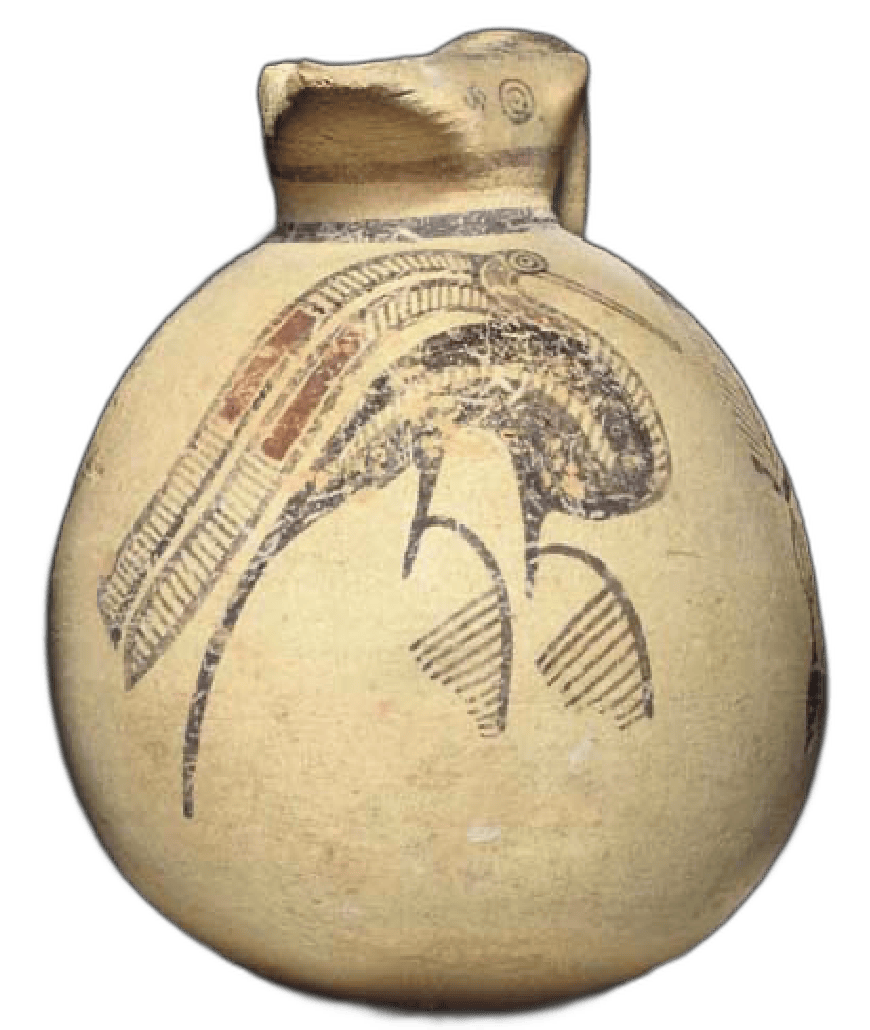
A Bichrome IV jug in the Drakopoulos collection, 15 cm high, carries a single scene on its shoulder: a waterfowl with a hatched body stretches its neck in tight S-bends towards a fish (see the jug). It is a small and ordinary example of the commonest picture on Cypriot Iron Age pottery. Desmond Morris, who collected and wrote about Cypriot art, put it simply: "Birds were popular with Cypriot artists in all epochs" [1]. What changed over three thousand years was how the bird got onto the pot. In the Bronze Age potters modelled it in clay and stuck it on; in the Iron Age they painted it.
This entry treats the bird as a subject across the whole sequence. The layout in which the Iron Age birds were painted has its own entry, Free-field art, and the Vounous figural jugs are covered in Red Polished zoomorphic vessels. You can see all birds in the catalogue, where the motif is recorded on more than two hundred objects.
Identifying a bird on a Cypriot pot
A bird appears on Cypriot pottery in three ways. It can be modelled in the round and attached to a vessel, perched on a rim, a shoulder or between two necks. The whole vessel can be shaped as a bird, as with the bird-shaped jugs and askoi. Or it can be painted on the surface, which is the Iron Age habit.
The early modelled birds are heavily stylised. Morris advised identifying them by beak, tail and wings rather than by legs, because bird-shaped juglets may have "three or even four short, stumpy legs," added as stands for the pot rather than as anatomy [1]. One of his own Red Polished gourd jugs has a bird on a pierced lug that looks four-legged for the same reason [1].
Species are rarely certain. Alicia Dissinger, in the fullest study of Cypro-Archaic bird images (2017), weighed size and shape, colour, behaviour and habitat as criteria. Behaviour and habitat cannot be read from a vase painting and colour is unreliable, so the silhouette is the only usable guide. Because "most of the depictions, regardless of medium, are highly stylized," she sorted the images into three broad groups instead of species: birds of prey, songbirds and waterfowl [4, p. 24].
Bronze Age: the modelled bird
On Red Polished pottery of the Early and Middle Bronze Age, birds are sculpted. Vassos Karageorghis, in his corpus of Cypriot coroplastic art, noted birds perched on bowl rims facing inwards, outwards or sideways, "almost always in association with miniature bowls," and called them "a successful adaptation of the bird motif in coroplastic art." On other jugs a single bird stands on the shoulder in front of a small bowl [2, p. 171]. Morris illustrated two Mottled Red Polished bird-jugs, 11.6 and 14.5 cm high, with relief and incised decoration [1].
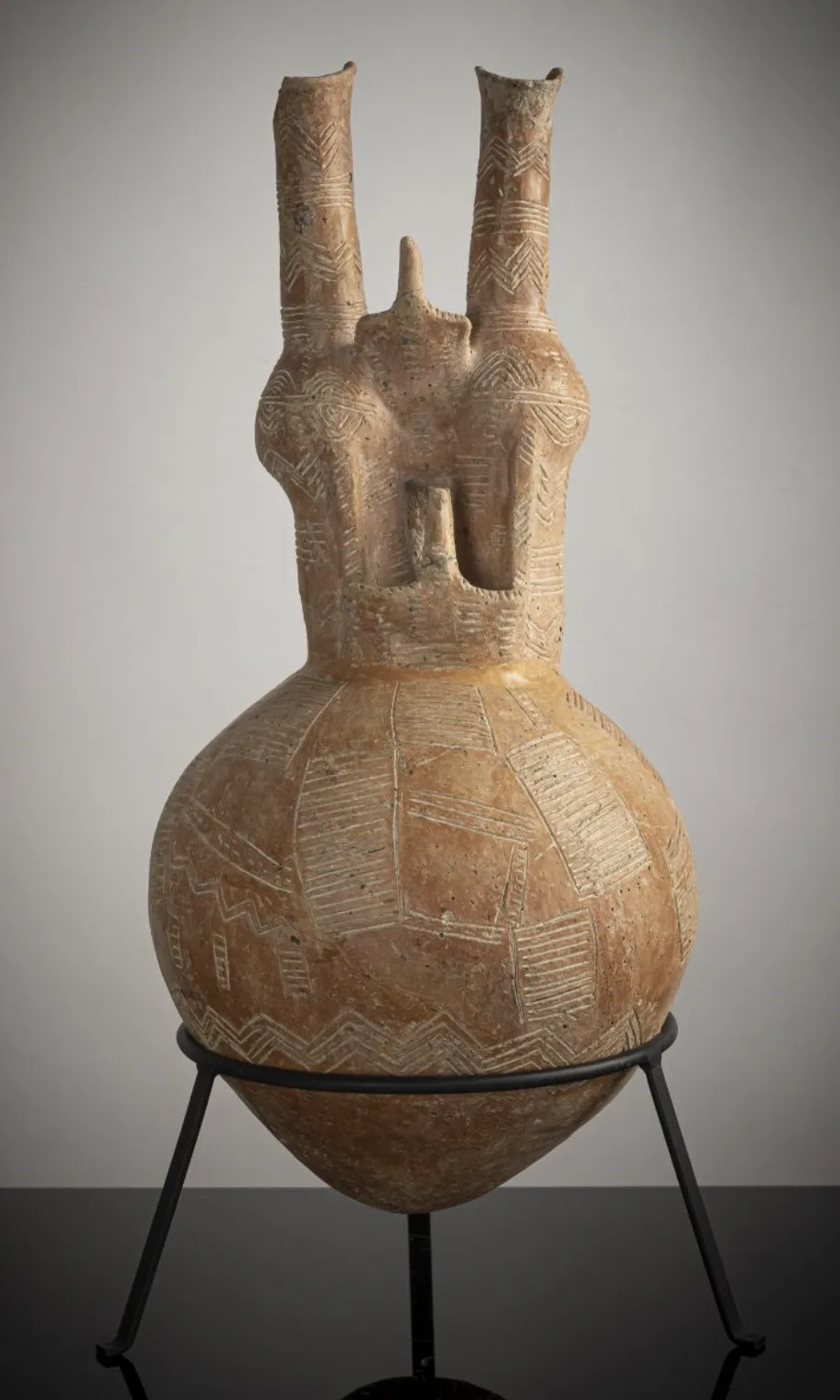
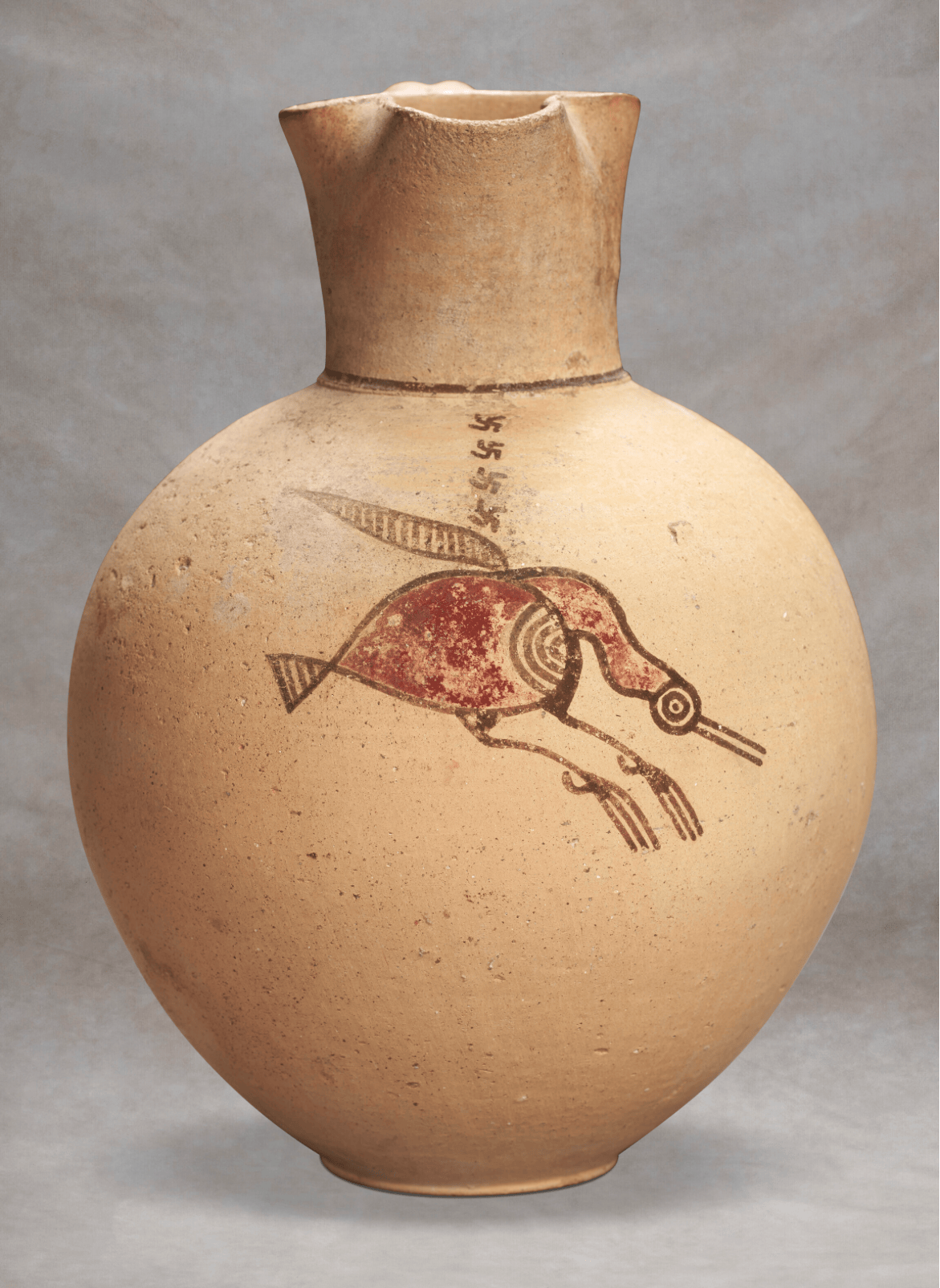
The grandest examples are the big double-necked jugs with a bird between the necks. Karageorghis recorded a Red Polished jug from Lapithos Tomb 802A, 68 cm high, with a flat human figurine on the handle, a bird in the round between the necks and a bull on the shoulder [2, p. 145]. The Drakopoulos double-necked jug, about 57 cm high and dated Early Cypriot II to III, has two flat, plank-like birds stacked one above the other between its necks, where the published parallels carry one (see the jug). Its story and its Vounous parallels are told in the article on the Vounous double-necked bird jug, and the cemetery itself under Bellapais-Vounous. Many of these pieces were made for the tomb, and the tulip bowls and cult vessels entry covers the wider class.
Painted birds are almost absent from the Bronze Age. Jack Benson, surveying the material in 1975, found that bird decoration "was rarely if ever reflected in any truly Cypriote Bronze Age fabric, not even Late Cypriote III Decorated ware," and concluded that "there was little or no interest in the depiction of birds on the part of native Bronze Age potters." He added the proper caution that "it is never safe ... to draw categorical conclusions from the absence of something" [3, p. 130].
Late Bronze Age to Cypro-Geometric: the bird returns
The Late Bronze Age kept the three-dimensional bird alive in small numbers. Morris's sequence runs from White Shaved "owls" to Proto-White Painted bird-jugs; his own collection included a White Shaved owl-shaped rattle 9.8 cm high and a Proto-White Painted bird-jug 17.3 cm high [1]. He also noted that the terracotta bird figurine remained a rarity [1].
Benson tied the painted bird to the arrival of foreign models at the end of the Bronze Age. Only with Proto-White Painted ware do "bird vases ... enjoy a certain currency in tomb groups, corresponding in their general format to Greek prototypes." Pictorial motifs are rare in both Late Cypriot III and Proto-White Painted wares, with "perhaps only three instances, all with birds," the most elaborate a kalathos from Kouklia where birds sit beside a "union jack" pattern that he read as showing Mycenaean and Syro-Palestinian influence. Gem-cutters of the same period, following Edith Porada, adapted their birds from Egyptian sources [3, p. 130]. The bronze-to-iron transition entry sets out the ceramic background.
In the Cypro-Geometric period birds were "not particularly numerous" at first. One substantial workshop marks the later part of the period, and the motif then runs on into the Cypro-Archaic "in a much broader stream" [3, p. 129]. Morris summed up the result as "a great explosion of bird paintings in the Iron Age," on Bichrome and White Painted jugs and bird-juglets [1].
Cypro-Archaic: the painted bird
In the Cypro-Archaic period the bird became the leading subject of Bichrome IV free-field painting, usually on jugs. Karageorghis, describing a free-field jug in the Cyprus Museum, wrote that "the most popular motif of the pictorial style of seventh century vase painting is unquestionably the bird," because its body and wings "suit the decorative requirements of the style," and noted how well the bird and a curved tree matched the rounded shape of the jug [5, p. 81].
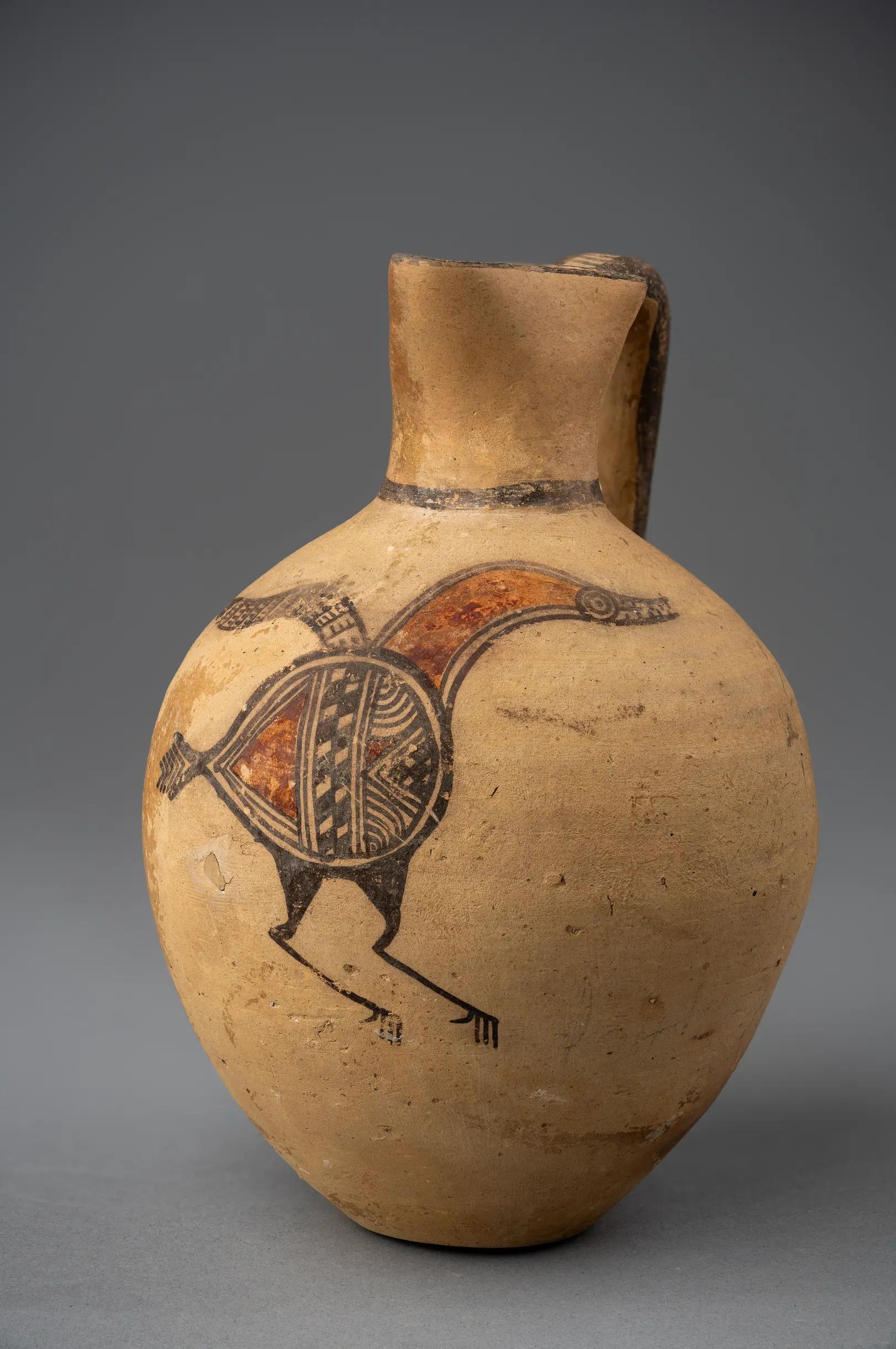
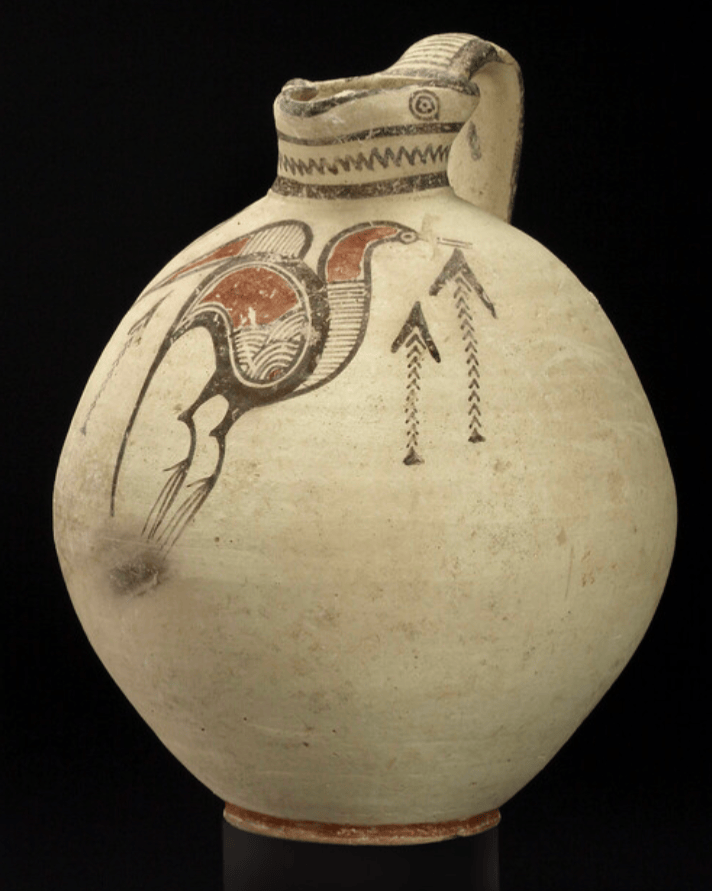
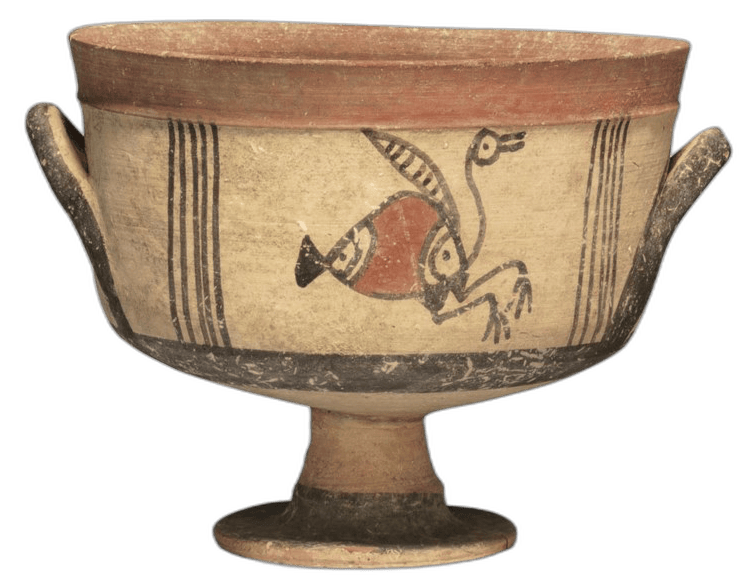
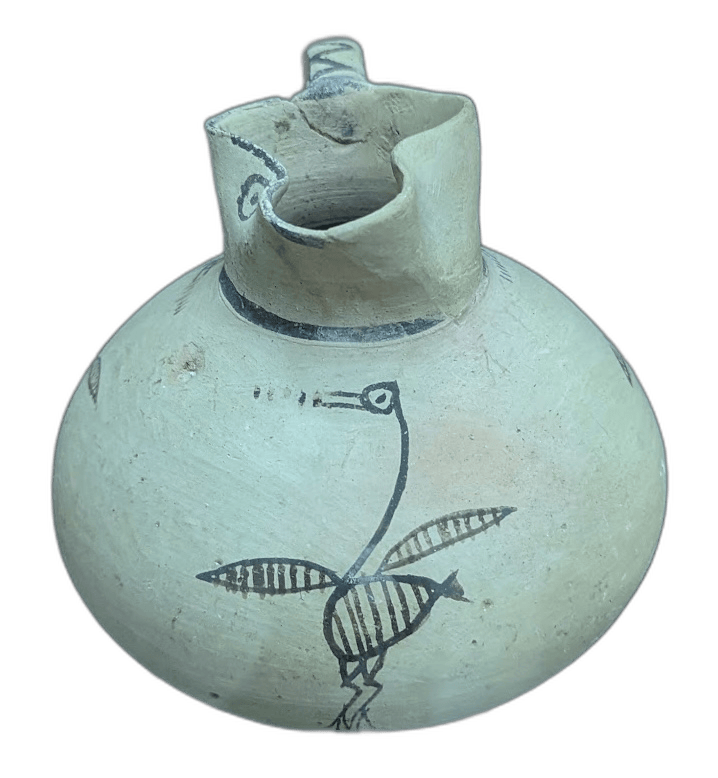
Most of these birds are waterfowl, with long necks and heavy bodies. Dissinger recognised ducks and geese, swans and wading birds, and identified the Great Crested Grebe by its two head tufts on two Bichrome IV jugs, a barrel jug in Edinburgh and a jug in the Cyprus Museum [4, p. 267]. The bird is usually alone, as on the Drakopoulos trefoil jug with a striding bird, whose round body is divided into chequer, hatched and red segments. Two compositions recur with a second element. In the first the bird pecks at a lotus flower: the Ashmolean has a Bichrome IV jug 22 cm high with a bird pecking a lotus blossom (AN1966.235) and a squat jug 19.5 cm high with a bird picking a lotus (AN1967.1088; catalogue page). In the second the bird seizes a fish, as on the Drakopoulos jug above. A related series of small squat jugs, associated with Amathus, is always decorated with birds; the Met's Cesnola juglet 74.51.537, 11.8 cm high, is one.
Dissinger counted the motifs that accompany birds on the vessels she catalogued. They are mostly stock fillers:
| Motif beside the bird | Vessels |
|---|---|
| Lotus | 89 |
| Swastika | 79 |
| Chevron arrow | 57 |
| Plant | 51 |
| Circle | 25 |
| Dotted X | 22 |
| W | 17 |
| Staff | 13 |
| Chevron | 13 |
| Rosette | 12 |
| Tree | 10 |
| Pomegranate | 7 |
| Palm tree | 6 |
| M | 3 |
The figures come from her Table 10; her text gives 84 for the lotus [4, p. 144]. Chevron arrows sit "below the beak or behind the bird, but always point upward," and swastikas sit by the head or above the back [4, p. 144]. See the entries on lotus flowers, swastikas, arrows, plants and circles. Her catalogue includes a bird jug from Salamis Tomb 46 [4, p. 345].
What the birds meant
The interpretation of Cypriot birds has a long and uneven history.
For the Bronze Age, Karageorghis warned against reading the modelled birds as symbols. "It is tempting to attribute a symbolic meaning to birds, as in their association with fertility (e.g. in later times when doves were associated with the cult of Aphrodite ...), but there is no justification for such a concept during the prehistoric period" [2, p. 171]. The dove of Aphrodite belongs to a much later world, and projecting it back onto Red Polished jugs is the error he had in mind.
For the Iron Age, Einar Gjerstad, publishing the Swedish Cyprus Expedition material, inclined to call the heavy-bodied Bichrome IV birds "soul birds." Sylvia Benton questioned this in 1961: "What does the author mean by the term 'soul birds' ... May we not think of these birds as just Bustards?" She pointed to two Oxford jugs and read the birds as possibly Great Bustards, though she admitted the subject was "too large a field to be discussed here" [6]. Her bustard reading has not been widely followed, and Dissinger's identifications favour waterfowl.
Dissinger's study, the most systematic so far, ties each bird type to a kind of find-place. In the Cypro-Archaic, she argues, the three types "were deposited and used in particular ways," so that each "was perceived to have its own cultural connotation": birds of prey in private cultic settings, songbirds with ritual equipment in sanctuaries, and waterfowl "most commonly discovered in mortuary assemblages, insinuating a relationship between the bird and conceptions of death" [4, p. 4]. She suggests that the migrating waterbird stood for the soul's passage, or was seen as a creature to protect or accompany the dead [4, p. 267]. The songbird belongs to a different setting: "75% of the figures portrayed with songbirds are female," and she cites Nancy Serwint linking doves with Aphrodite and a female fertility goddess, while noting male figures with songbirds too [4, p. 264].
Two limits apply. Her reading covers the Cypro-Archaic only, and it rests on the pieces with a known context; many painted bird jugs, including famous ones, have none. The distinction itself is useful. The goddess's dove is a songbird of the sanctuaries, and the waterfowl of the free-field jugs is a bird of the tombs; the two should not be merged.
Further reading on this site
The style in which most Iron Age birds were painted is covered in Free-field art, with the longer essay Cypriot Free Field Art and the biography of one Cesnola bird jug, A Bird in the Hand. Related wares are Bichrome Red and Iron Age White Painted. See also the people pages for Porphyrios Dikaios, excavator of Vounous, and Vassos Karageorghis. The Drakopoulos bird jugs are listed with the rest of the collection.
Objects on this page
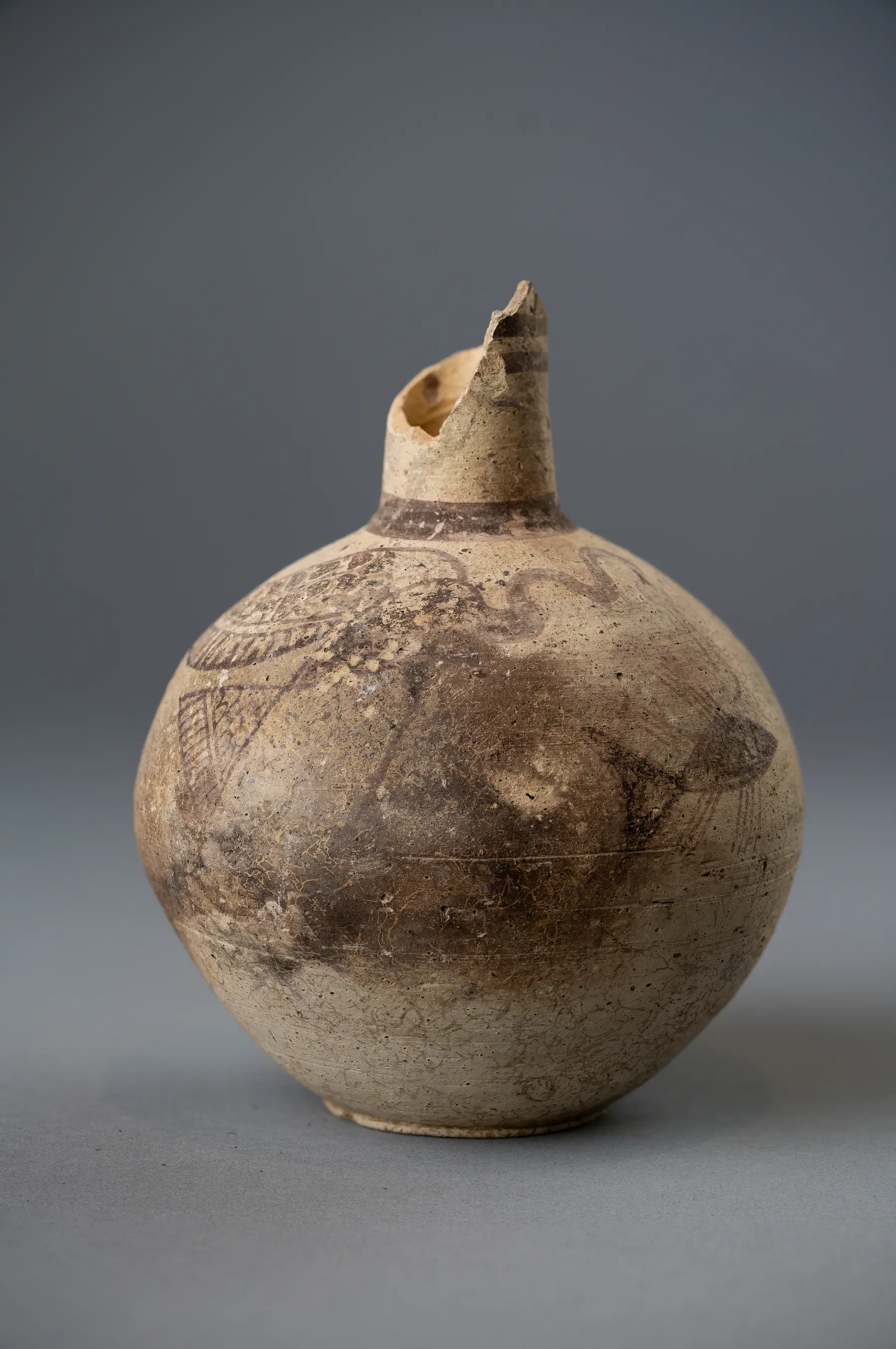 Bichrome IV Jug with a Waterfowl Catching a FishArchaic I · 750–600 BC
- Red Polished Double-Necked Jug with Two Modelled BirdsEarly Bronze Age II · 2300–2000 BC
- Bichrome IV Trefoil Jug with a Striding BirdArchaic I · 750–600 BC
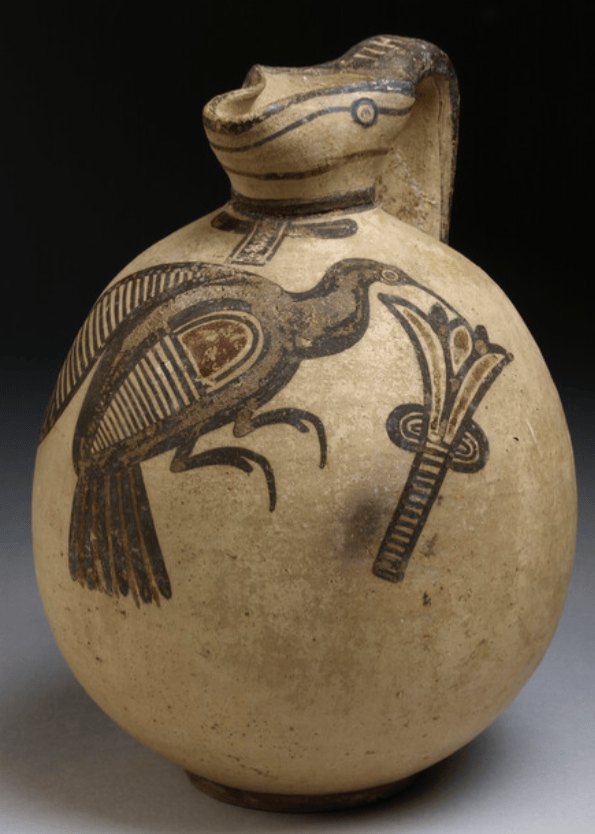 Squat bichrome jug in free-field style with image of bird picking a lotus flowerArchaic · 750–475 BC
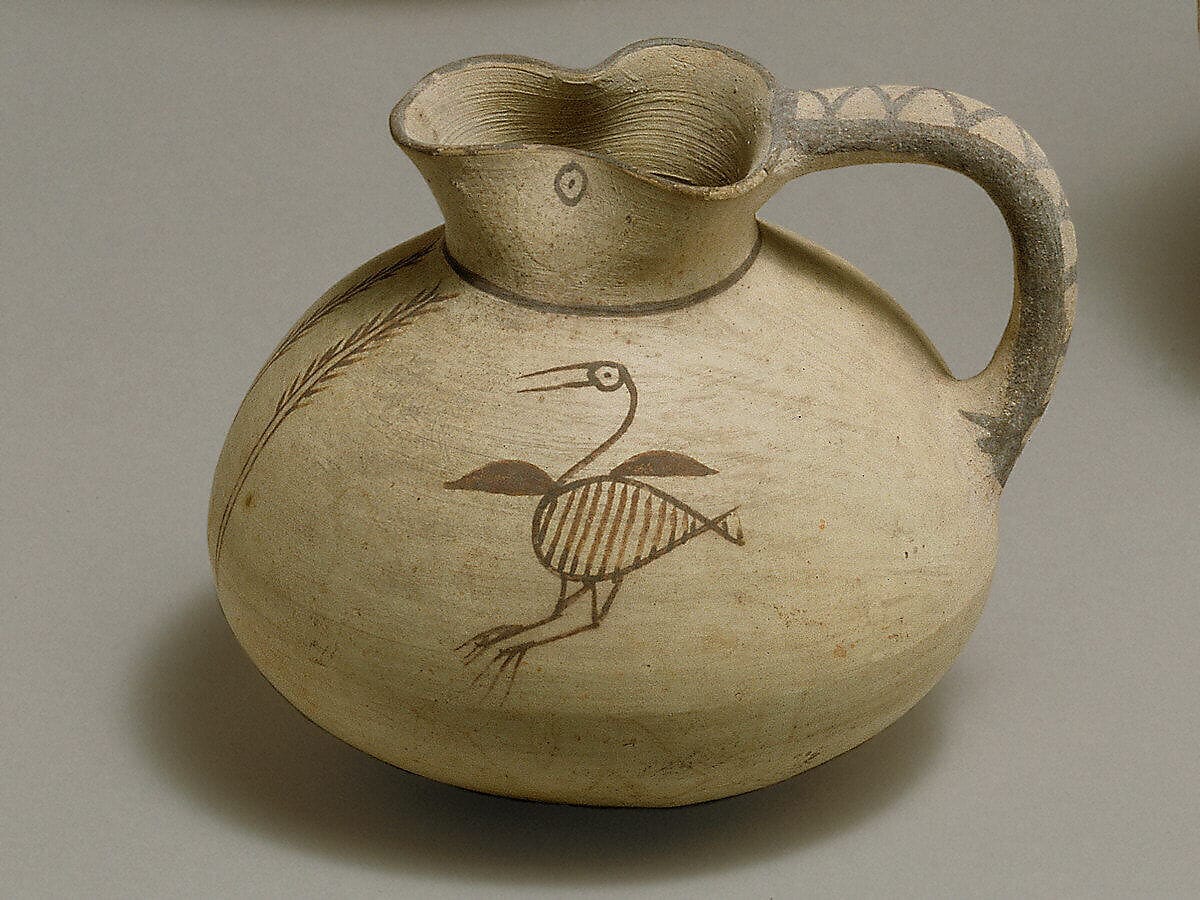 JugletArchaic I · 750–600 BC
In the catalogue
References
- 1.Morris, D. (1985). The Art of Ancient Cyprus, with a Check-list of the Author's Collection. Oxford: Phaidon. (Chapter 9, "Birds".)
- 2.Karageorghis, V. (1991). *The Coroplastic Art of Ancient Cyprus I: Chalcolithic to Late Cypriote I*. Nicosia: A. G. Leventis Foundation.
- 3.Benson, J. L. (1975). Birds on Cypro-Geometric pottery. In N. Robertson (Ed.), The Archaeology of Cyprus: Recent Developments (pp. 129-150). Park Ridge, NJ: Noyes Press.
- 4.Dissinger, A. M. (2017). Cypro-Archaic bird iconography: Types, uses, and meanings [Doctoral dissertation, University of Virginia].
- 5.Karageorghis, V. (1989). *The Cyprus Museum*. Nicosia: C. Epiphaniou Publications.
- 6.Benton, S. (1961). Cattle egrets and bustards in Greek art. Journal of Hellenic Studies, 81, 44-55.