
Contents
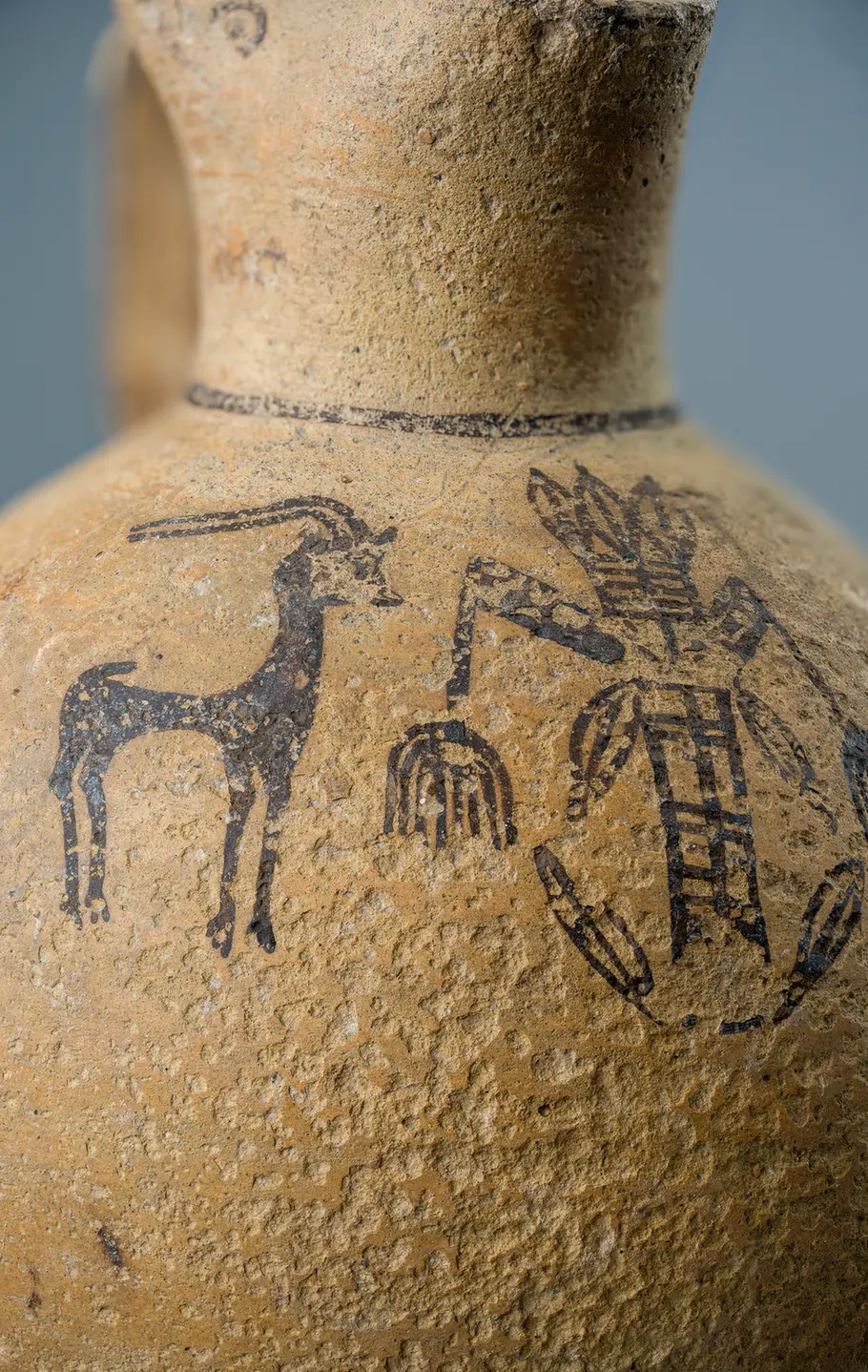
A small Cypro-Archaic jug in the Drakopoulos collection shows a horned goat in black silhouette facing a tall stylised tree. The tree has a ladder-hatched trunk and a fan of drooping fronds, and the collection catalogue reads it as a date palm. A goat beside a tree is an old composition in the art of the Near East, first seen in the mid-fourth millennium BC, and in the Late Bronze Age Cyprus used it more than any other region [1, pp. 66, 70]. This entry covers trees, date palms, branches and the goat-and-tree or "sacred tree" composition on Cypriot pottery and related media. The lotus flower and the lotus-and-bud frieze have their own entry under lotus flowers, and the layout in which most Cypro-Archaic trees appear is covered under free-field art.
What counts as a plant motif
Three kinds of vegetation turn up on Cypriot vases. The first is a tree: a vertical trunk with a crown of branches or leaves, sometimes reduced to a stick with a few strokes. The second is the palm, recognisable by a fan of fronds at the top of a bare, often hatched, trunk. The third is loose vegetation: branches, sprays and small plants used as fillers between animals. Rosettes and lotus flowers sit at the edge of the category, and at times a lotus stands in the place a tree would normally occupy.
Most Cypriot trees belong to one composition. Lesley Bushnell defines the "wild goat-and-tree icon" as two wild goats placed antithetically about a stylised tree, a scheme also published as the "sacred tree", the "palm-and-ibex motif" and "Animals at the Tree of Life" [1, p. 65]. The trees she collected represent deciduous trees, palms or conifers; the goats can be rampant, standing or couchant, and are often eating the leaves [1, p. 65]. The central plant could change with the region: in New Kingdom Egypt a lotus replaced the tree, and in Late Bronze Age Palestine a palm [1, p. 65]. Pottery was a minority medium for the icon. About 65% of the examples Bushnell gathered are on glyptic (seals) and 19% on vases [1, p. 66].
Bronze Age: an imported icon
The icon had no history in Cyprus before it was imported at the end of the Middle Bronze Age [1, p. 66]. In the Late Bronze Age it became more popular in Cyprus than in Iran, the other region with a strong attachment to it; Bushnell's table gives Cyprus 40 Late Bronze Age examples, 18% of her total and the highest share of any region [1, pp. 66, 70]. Most are on cylinder seals (61%), including seals in the Cypriot Elaborate Style, and the rest are on luxury goods: a gold ring from British Tomb 93 at Enkomi with couchant goats, birds and a palm, a gold mouthpiece, a diadem from Klavdhia-Tremithos in which a lotus takes the place of the tree, faience vases from Kition and an ivory gaming box from Enkomi [1, p. 70]. On one Cypriot seal, copper ingots replace the goats on either side of the tree [1, p. 72].
Two Late Cypriot seals in the British Museum show the range. A haematite cylinder (1900,0521.3) is engraved with a sacred tree between two confronted lions, two leaping goats, a winged ox-headed figure and a draped woman. A cruder sandstone cylinder from Hala Sultan Tekke (1898,1201.199) carries a stylised sacred tree and other figures; it is catalogued on this site as the stylised tree cylinder seal.
On pottery the Late Bronze Age tree appears mainly on imported or Aegean-style kraters. Bushnell cites a Mycenaean krater from a tomb at Maroni painted with goats and tree, and a Pastoral Style krater from Kazaphani [1, p. 72]. The route by which the icon reached the island is disputed. Lubsen-Admiral (1998) and Steel (1997) argued for a transfer from Palestine to Cyprus; Bushnell disagrees, and holds that Cyprus kept "elemental variations" of the icon alive at the end of the Late Bronze Age and probably reintroduced it in the Early Iron Age [1, pp. 66, 72].
Eleventh century: palms at Palaepaphos
The clearest early palm on a Cypriot vase is on a kalathos from Tomb 9 at Palaepaphos-Xerolimni, a Proto-Bichrome vessel of 1100-1050 BC in the Cyprus Museum. Its panels hold "a lyre player, figures with raised arms, a goat, birds and a palm tree" [2, no. 139]. Maier and Karageorghis list "tree motifs" among its images, date it to the first half of the eleventh century and see both Aegean and Near Eastern inspiration in it [3].
Where this silhouette pictorial style came from is argued. Bushnell notes the goat-and-tree on eleventh-century pictorial pottery in silhouette, following Maria Iacovou (1988), and reports that Marguerite Yon (1970) and Iacovou (1997) both treat the silhouette style of Proto-White Painted as a Cypriot innovation, independent of Mycenaean pictorial painting; Iacovou calls a Cretan origin "utterly unfounded" [1, pp. 73-74]. Bushnell goes further and suggests that Cyprus may have carried the icon, in its bird-and-tree form, back to the Aegean [1, p. 74].
A second source of palms came from the Levantine coast. Among the eastern imports in the Palaepaphos-Skales cemetery, Patricia Bikai singled out the Palm Tree Jar from Tomb 49 (no. 80) as "by far the most interesting piece" [4, p. 396]. On mainland jars of this class the decoration moves over time "from a recognizable tree combined with the wavy line to the simple three or four stroke tree." The Skales jar sits between: its palm has four strokes but it keeps the panel division with a wavy line, and Bikai placed it towards the end of the eleventh century BC [4, p. 398]. She observed that the palm motif, concentric circles and the strainer spout are shared by Phoenician and Philistine pottery, and left open the question "who was influencing whom?" She also counted the Palm Tree Jar among the mainland forms that influenced the Cypriot repertoire [4].
Cypro-Geometric: Phoenician palm jugs and goats at a palm
In Cypro-Geometric II palms appear on imported Phoenician jugs. A Phoenician Bichrome jug in the National Archaeological Museum of Athens (inv. 11571, H 30.5 cm) has a latticed lozenge on each side of its strainer spout and a "palm tree" motif above it. Karageorghis notes that such jugs occur in Cyprus in Cypro-Geometric II at Palaepaphos and Amathus, and that they were imported from Phoenicia before Phoenicians settled on the island [5, no. 121].
Local potters used the whole composition. Bushnell cites a White Painted footed bowl from Palaepaphos-Xylinos with goats feeding on a palm tree, and lists among the Iron Age revivals a Bichrome I lentoid flask with running goats and birds from the Cesnola collection in the Metropolitan Museum [1, p. 73].
Cypro-Archaic: sacred trees, sphinxes and single goats
By Cypro-Archaic I the lotus often takes the tree's place. A Bichrome IV amphora in the Cyprus Museum (1935/B 2009, H 47.5 cm) shows two opposed sphinxes flanking "a schematically rendered lotus flower". Pilides and Papadimitriou read the sphinxes as guardians of the sacred tree of life and the scheme as "inspired by Levantine prototypes", while the meander on the same vase comes from Greek Geometric [6, cat. 231]. Bushnell likewise lists Bichrome IV vases on which stylised goats nibble an elaborate lotus [1, p. 73]. A companion amphora of about 600 BC from eastern Cyprus carries a frieze of lotus flowers and buds with reserved rosettes [6, cat. 230]; the lotus flowers entry follows that line of development.
Trees also appear on free-field jugs. A Bichrome jug of 750-650 BC in the Cyprus Museum shows a "bird to the right before a stylised tree" [2, no. 301]. The Drakopoulos free-field jug with a goat and a date palm (right; 22 cm, c. 700-600 BC by the catalogue) is the same kind of composition: one animal, one tree, and a smaller flowering plant on a stalk between them. It departs from Bushnell's icon in having a single goat instead of an antithetic pair, and the tree is drawn with a pair of arm-like strokes that led the cataloguer to call it anthropomorphic. Whether the painter intended a palm, a generic tree or a figure is not settled by any published parallel; the site's article on the anthropomorphic free-field jug discusses the reading. Lotus and bird combinations of the same period, such as the Ashmolean's squat Bichrome jug with a bird picking a lotus flower, are covered in the sibling entries.
Other vegetal ornament of the period is abstract. The Drakopoulos large Archaic plate, partly restored, carries bands of reserved rosettes, the same device as on the eastern amphora above.
Greek imports brought the tree back in Aegean dress. The Euboean Late Geometric krater by the Cesnola Painter, from the Cesnola collection, has as its themes "the Oriental Tree of Life flanked by animals" and grazing horses [7, pp. 30-32]. The Metropolitan Museum dates it c. 750-740 BC and gives a height of 130.8 cm with its lid (Met 74.51.965); like most Cesnola pieces its reported findspot, Kourion, rests on Cesnola's word. Tomb 11 at Kition produced an Attic Late Geometric Ia kantharos, 24 cm high, with a Tree of Life on each side, flanked on one by birds and pendent double axes and on the other by rampant goats. Coldstream explains the choice of subject by noting that "the Tree of Life, heraldically flanked by animals or birds, was well established in the figured repertoire of the Levant well back in the Late Bronze Age" [7, pp. 30-32]. On his reading, Cypriot buyers picked out Greek pots that showed a subject they already knew.
Reading the tree
The labels in use, "sacred tree" and "Tree of Life", are modern and assume a religious meaning that no inscription on these vases confirms. Bushnell's argument rests on frequency and medium: the icon was concentrated in Cyprus in the Late Bronze Age, on seals and gold, and it was revived there in the Iron Age, which she takes as a sign of special significance for the island [1, pp. 66, 70, 73]. The seal with ingots in place of goats suggests that the scheme could be adapted to local concerns [1, p. 72]. Pilides and Papadimitriou point to Levantine models for the Archaic sphinx-and-lotus version [6, cat. 231], and the Phoenician palm jugs and jars at Skales show one channel by which palms reached Cypriot tombs [4] [5, no. 121].
Identification is the practical problem. A four-stroke palm on a Levantine jar, a lotus between sphinxes and a hatched trunk with fronds on a free-field jug all occupy the same position in the same scheme, and the painters did not label their plants. This entry sorts them by the crown: a fan of long fronds for a palm, spreading branches or leaves for a tree, a cup with petals for a lotus.
In short
Trees and palms on Cypriot pottery belong mostly to the goat-and-tree composition, which reached the island late in the Middle Bronze Age and was used most on Late Bronze Age seals and luxury goods. It reappeared on eleventh-century pictorial vases at Palaepaphos, on imported Phoenician palm-tree jars and jugs, on White Painted and Bichrome vessels of the Cypro-Geometric period, and on Cypro-Archaic Bichrome, where the lotus often replaced the tree. For the lotus see lotus flowers; for the layout of the Archaic jugs see free-field art; for the jug shape see jugs.
Objects on this page
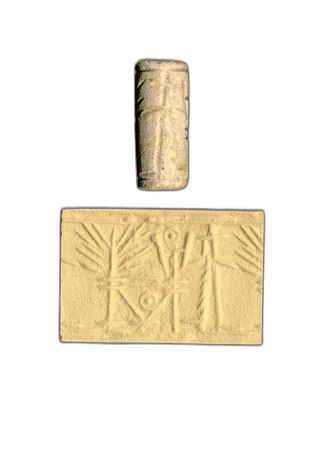 Stylised Tree Cylinder SealLate Bronze Age I · 1650–1050 BC
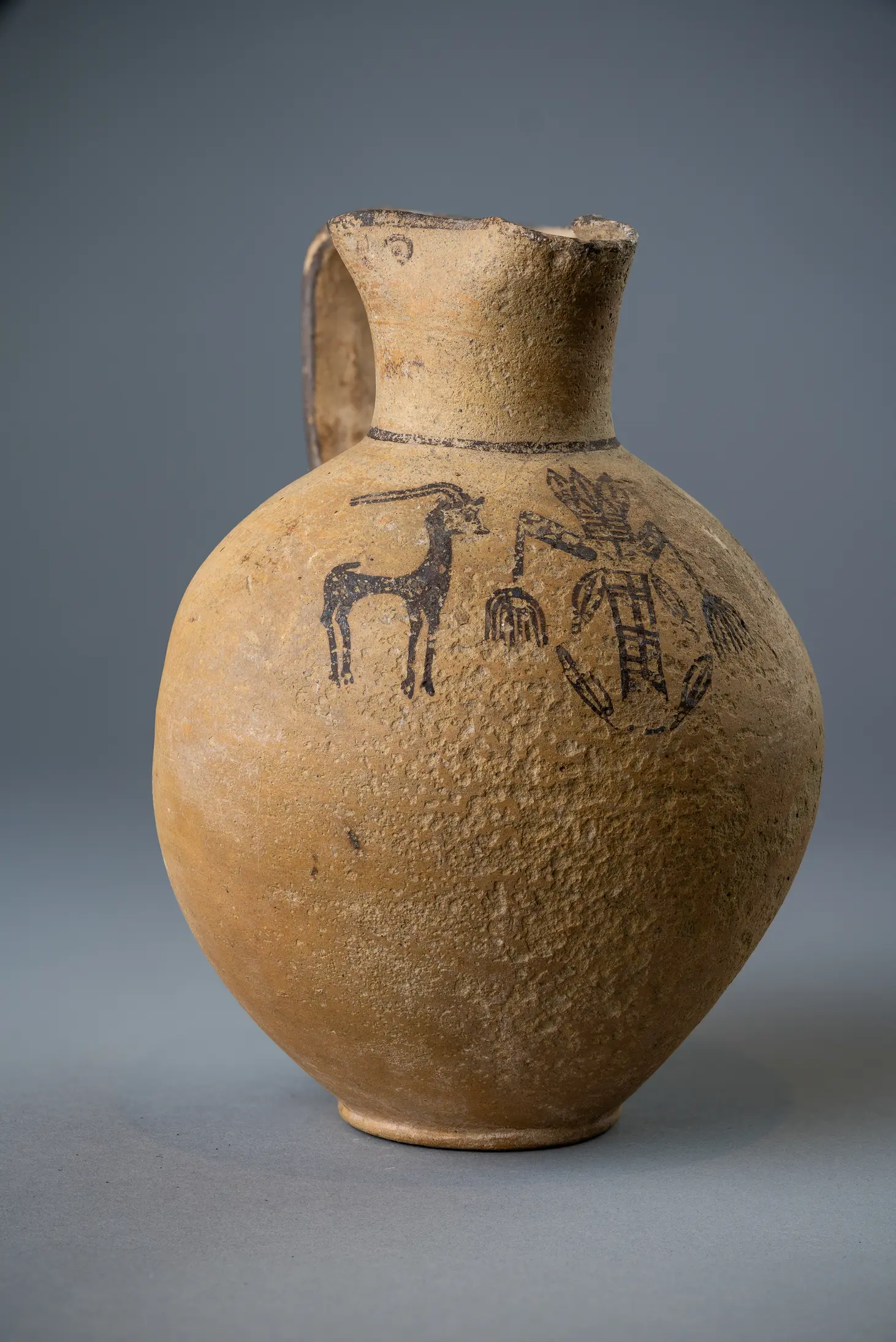 White Painted IV Trefoil Jug with a Wild Goat and a Composite Plant-like FigureArchaic I · 750–600 BC
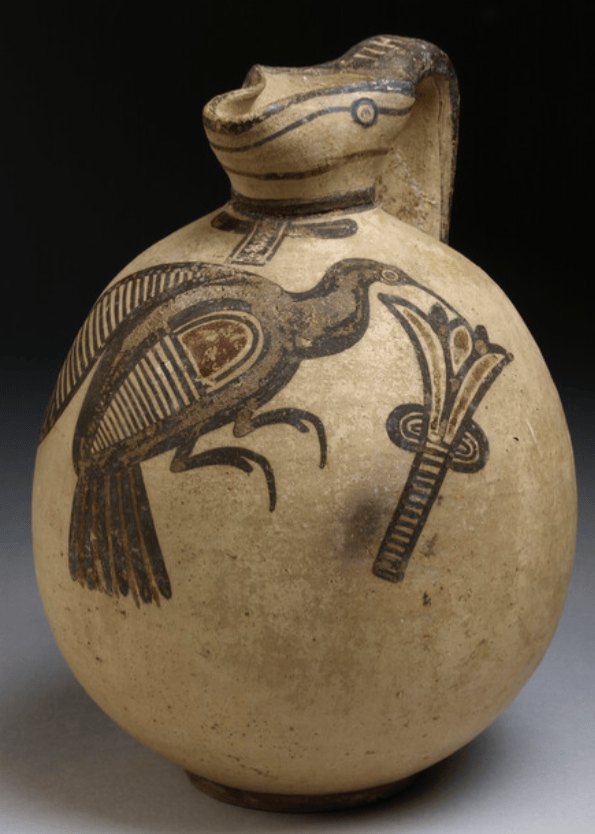 Squat bichrome jug in free-field style with image of bird picking a lotus flowerArchaic · 750–475 BC
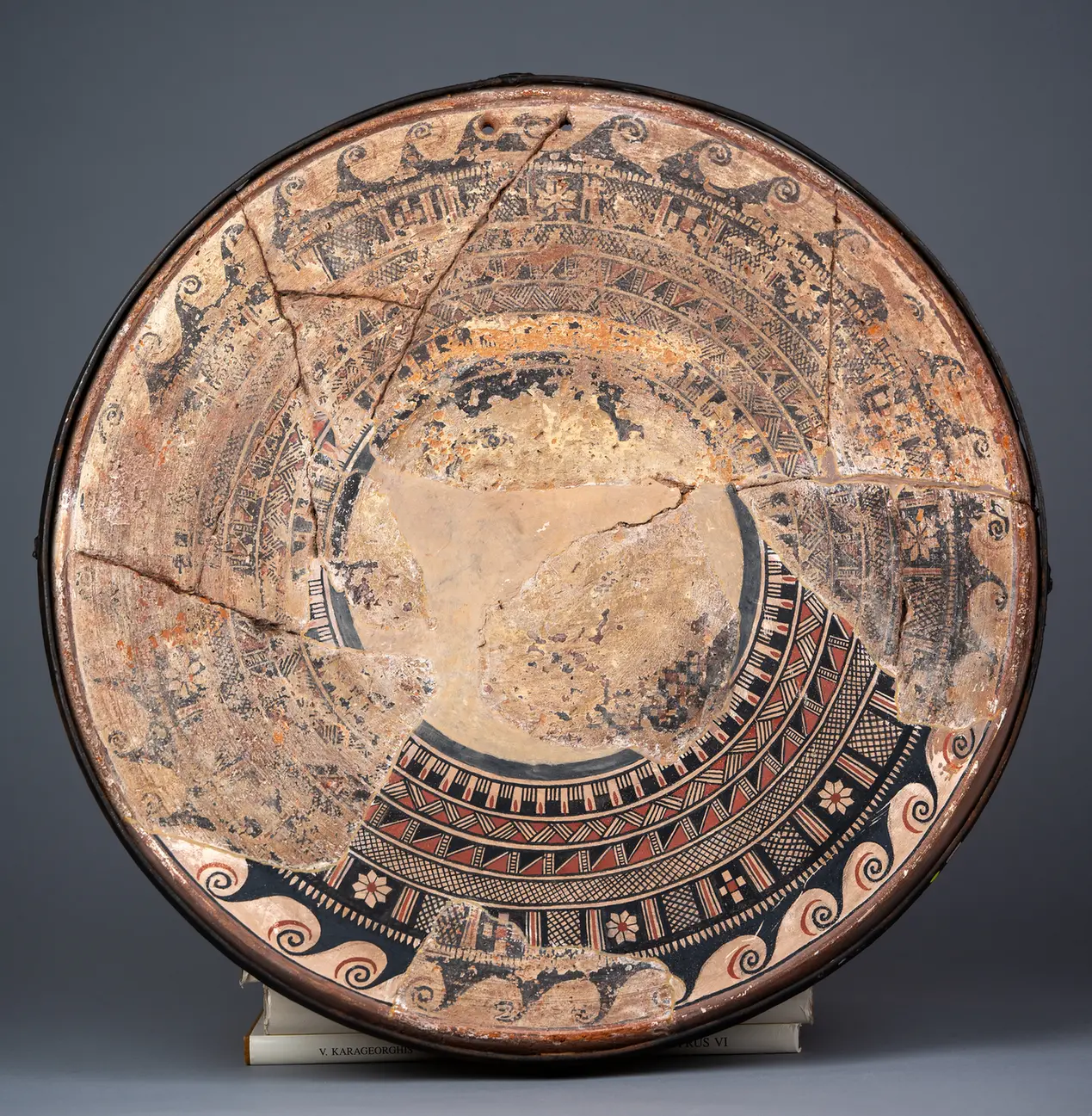 Large Bichrome Plate from Salamis with a Wave Band and Rosette MetopesArchaic I · 700–550 BC
References
- 1.Bushnell, L. (2008). The wild goat-and-tree icon and its special significance for ancient Cyprus. In G. Papantoniou (Ed.), with A. Fitzgerald & S. Hargis, POCA 2005: Postgraduate Cypriot Archaeology (BAR International Series 1803, pp. 65-76). Archaeopress.
- 2.Tatton-Brown, V. (Ed.). (1979). Cyprus BC: 7000 years of history. British Museum.
- 3.Maier, F. G., & Karageorghis, V. (1984). Paphos: History and archaeology. A. G. Leventis Foundation.
- 4.Bikai, P. M. (1983). The imports from the East. In V. Karageorghis, Palaepaphos-Skales: An Iron Age cemetery in Cyprus (Ausgrabungen in Alt-Paphos auf Cypern 3). Konstanz.
- 5.Karageorghis, V. (2003). Ancient Cypriote art in the National Archaeological Museum of Athens. A. G. Leventis Foundation.
- 6.Pilides, D., & Papadimitriou, N. (Eds.). (2012). Ancient Cyprus: Cultures in dialogue. Department of Antiquities, Cyprus.
- 7.Coldstream, J. N. (2009). Cypriot taste in early Greek ceramic imports. Ancient West & East, 8, 21-36.