
Contents
When Einar Gjerstad listed the decoration of Cypro-Geometric White Painted I pottery in 1948, he called it "purely geometrical" and named, among encircling lines, zigzags, arc ornaments and the Maltese cross, "hatched and latticed triangles and lozenges; dotted lozenges" and "groups and bands of filled triangles" [1]. By then the triangle had been on Cypriot pots for more than two thousand years. It was painted on Chalcolithic bowls, incised on Early Bronze Age Red Polished ware, painted in rows on Middle Cypriot White Painted bowls and jugs, chained into lozenges on Late Cypriot White Slip, and used to frame panels on Iron Age amphorae. This entry follows the triangle and the lozenge (a triangle doubled base to base, also called a diamond) through those settings, with a section on herringbone, the incised feather pattern that travels with them on Early Bronze Age pottery. Latticed triangles and lozenges as a fill are treated more fully under lattice and checkerboards, and diamond chains drawn as paired zigzags under zigzags. The site's catalogue lists the objects carrying the motif: see all triangles and lozenges in the catalogue, or the wider group of geometric motifs in the catalogue.
Hatched, latticed and interlocking
Most of the vocabulary describes how the triangle is filled. A hatched triangle is filled with parallel strokes running one way; a cross-hatched or latticed triangle has two sets of strokes crossing to make a net. A solid triangle is filled in completely, and an outlined one is left blank inside. Pendent triangles hang point down from a band; triangles set point to base in two alternating rows are called interlocking. A lozenge (or diamond) may be hatched, cross-hatched, dotted or solid, and lozenges set point to point make a chain, running horizontally round a pot or vertically down it.
L. A. C. Gagné's 2012 study of Middle Cypriot White Painted ware uses exactly these terms to sort the pottery of Lapithos, Dhenia and Alambra into workshop groups: framed hatched triangles, interlocking hatched triangles, cross-hatched triangles, hatched diamonds, cross-hatched diamonds and flasks decorated with vertical diamond chains each define a group [2]. Gjerstad's descriptions of Iron Age pottery add the "dotted lozenge" and the triangle filled with a "diaper pattern" [1].
Chalcolithic painted triangles
The earliest Cypriot triangles are painted. Paige Bockman's 2015 study of Chalcolithic painted motifs defines the triangle motif as a "triangle shaped motif found either solid or outlined; often found hanging pendant from horizontal" bands, and records it "solid, blank, and filled with decoration, alone and as part of larger motifs, sometimes pendant from rim bands" [3]. Its use varied sharply from site to site. Triangles were "used fairly often at both Souskiou-Vathyrkakas and Kissonerga-Mylouthkia, only once at Kissonerga-Mosphilia, and not at all at Erimi-Pamboula or Lemba-Lakkous" [3]. At Souskiou they appear on bowls and on figurines and figurative vessels, and at Kissonerga-Mylouthkia on figurines [3]. The pottery is the Red-on-White of the Chalcolithic; see Kissonerga and Erimi.
Porphyrios Dikaios, publishing his Vounous excavations in 1940, compared the incised triangles of Early Bronze Age Red Polished ware with painted Chalcolithic pottery from Erimi: "The triangles placed apex to apex ... may be compared with Erimi pl. xx, 35, 36," and triangles "placed one next to the other with a narrow plain band between" seemed to him to represent "a similar painted pattern" [4]. That was his argument for a link between the painted and the incised traditions. Bockman's count of no triangles at all at Erimi-Pamboula [3] is a reason not to treat the Erimi comparison as a proof of continuity.
Early Bronze Age: incised triangles and lozenges
On Red Polished pottery the motif was cut into the leather-hard surface before firing. Jennifer Webb and David Frankel describe Philia Red Polished decoration as incision, pattern burnishing or differential firing, with incised motifs that are "relatively simple, restricted in number, and often limited to specific parts of the vessel" [5]. The decorated vessels were mostly amphoras, cutaway-mouthed jugs, small jars and flasks. What happened next differed by region. Assemblages from Early Cypriot I and II tombs "across the south/central region are almost entirely undecorated," while on the north coast incised decoration on Red Polished I and II "is relatively common" [5]. See Jennifer Webb, David Frankel and the Early Bronze Age.
The north-coast cemetery of Vounous gives the fullest range. Dikaios described two clay models of ox horns from Tomb 36 decorated with "bands of zigzags, groups of chevrons, lozenges, and hatched triangles" [4]. A large composite vase (his no. 67, pl. XXXII c), 0.83 m high, has bands of parallel lines alternating with zigzags on the necks, and on the bodies a "row of hatched triangles pendent from horizontal bands, base up" [4]. Lozenges and triangles also run in chains: a White Painted bowl from Vounous (no. 117, pl. LV, 12) has a "chain of hatched lozenges and triangles round the body" and a cross on the base [4]. Webb and Frankel list the motifs on the Vounous ritual vessels as rayed circles, reversed swastikas, crosses, concentric rectangles, scrolls "and zigzag, chevron, herringbone, dotted, and other motifs" [5]. The Vounous burial customs entry describes the tombs in which these pots were placed.
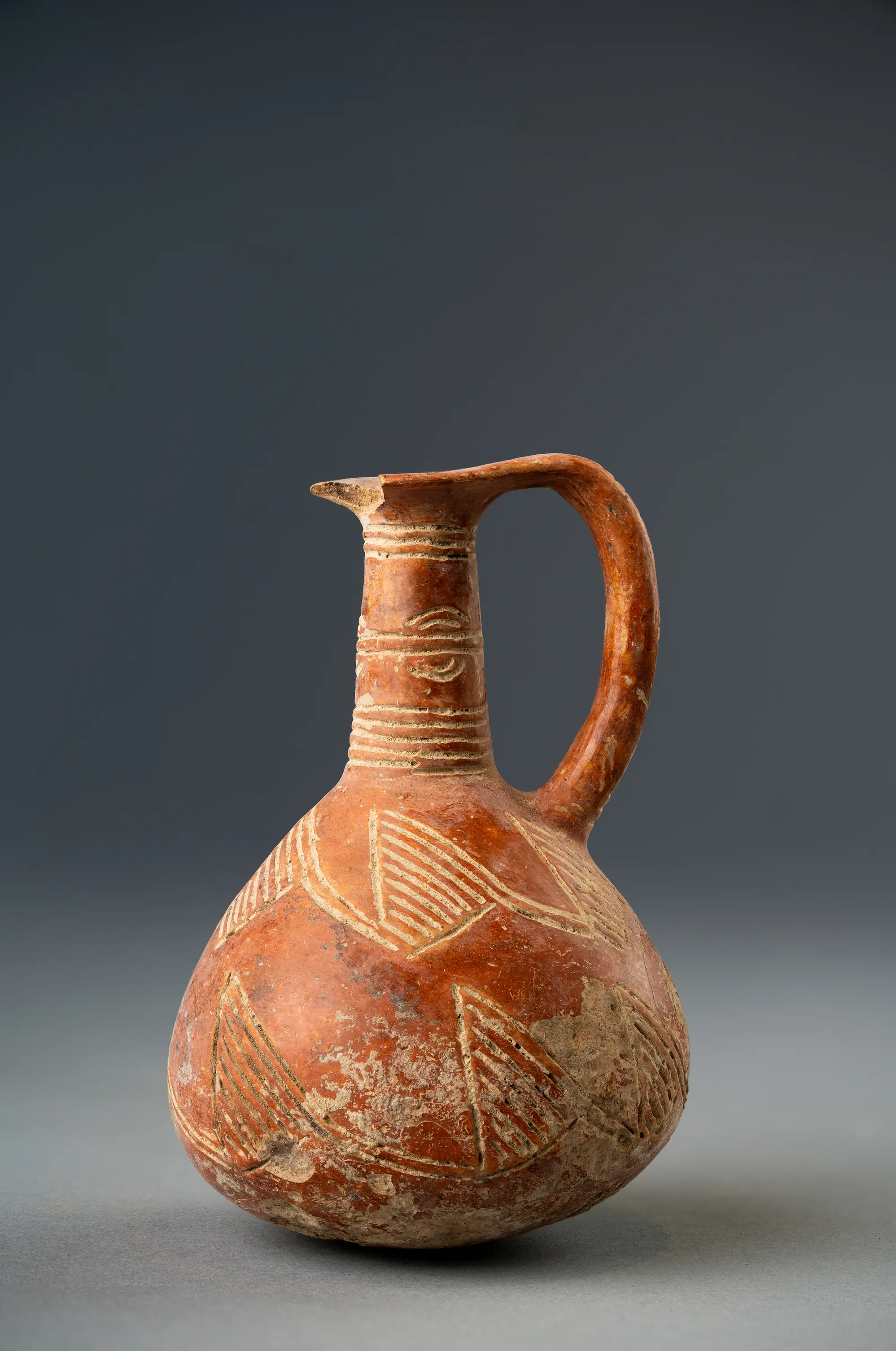
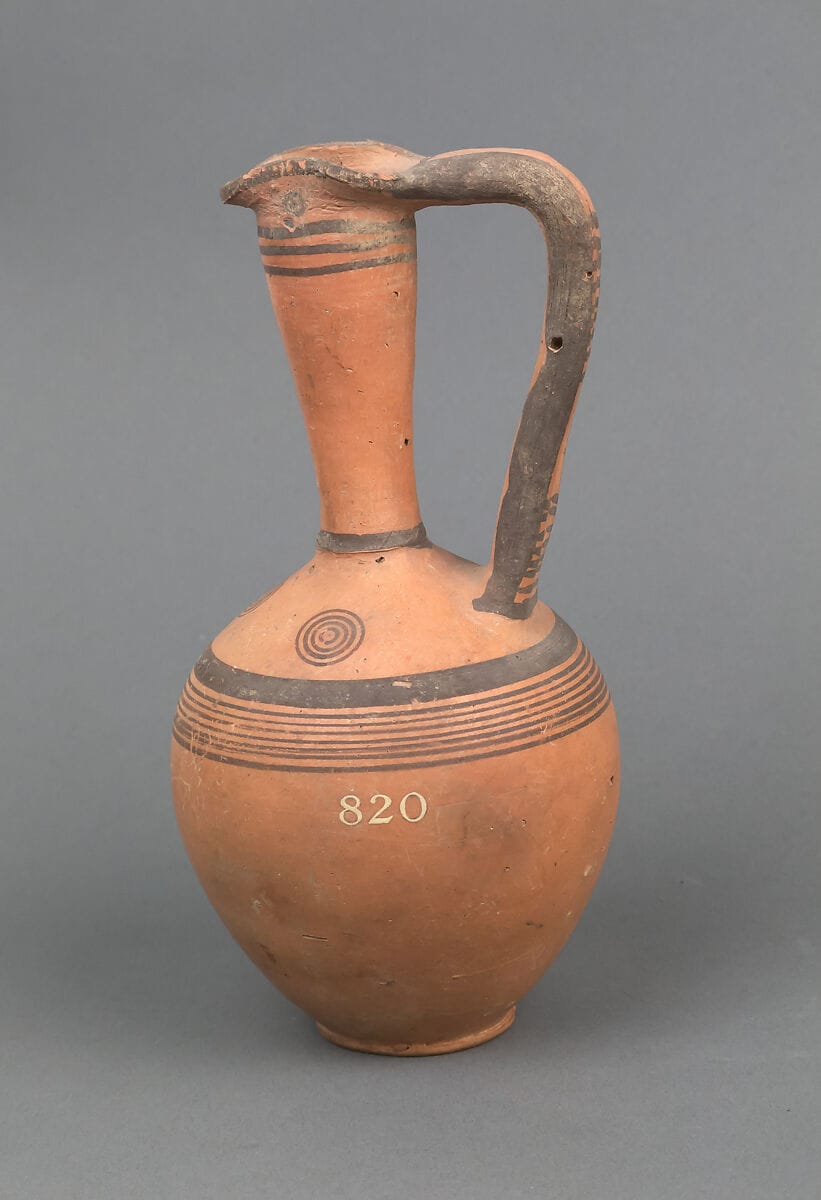
The Drakopoulos collection has a small example: a handmade Red Polished juglet with a gourd-shaped body and a pinched beak mouth, incised with two registers of hatched triangles and dated c. 2100 to 1800 BCE. The same incised language appears off the vessels. The collection's three-necked plank figure carries incised lozenge and zigzag bands on its body; see plank figures and Red Polished.
Herringbone
Herringbone is a band of short oblique strokes set in two rows that meet along a central line, like the bones of a fish or the grains on an ear of wheat. It is also called herring-bone or the feather pattern. On Cypriot pottery it belongs above all to the incised Red Polished tradition of the third millennium BCE.
It was part of the Philia style from the start. Ellen Herscher, publishing the pottery from the Early Bronze Age settlement of Sotira-Kaminoudhia excavated by Stuart Swiny, found incised decoration uncommon there, "with the notable exceptions of Red Polished South Coast ware, which continues the parallel lines and herringbone motifs of the Philia style" [6]. She suggested these decorated pieces were made "for special purposes, and may possibly be imports from other southern sites" [6]. At Kissonerga in the west, Edgar Peltenburg reported from Period 5 of Kissonerga-Mosphilia "part of a small jar [with] an incised herringbone design on its shoulder," matched in shape and decoration by jars from Philia tombs in central Cyprus, and used it to argue that Philia traits reached the west [7]. Peltenburg's dating of the Philia phase depends on which of two models is adopted; on one, Philia would begin before 2400/2300 BC [7]. On the north coast herringbone is among the motifs of the Vounous ritual vessels [5].
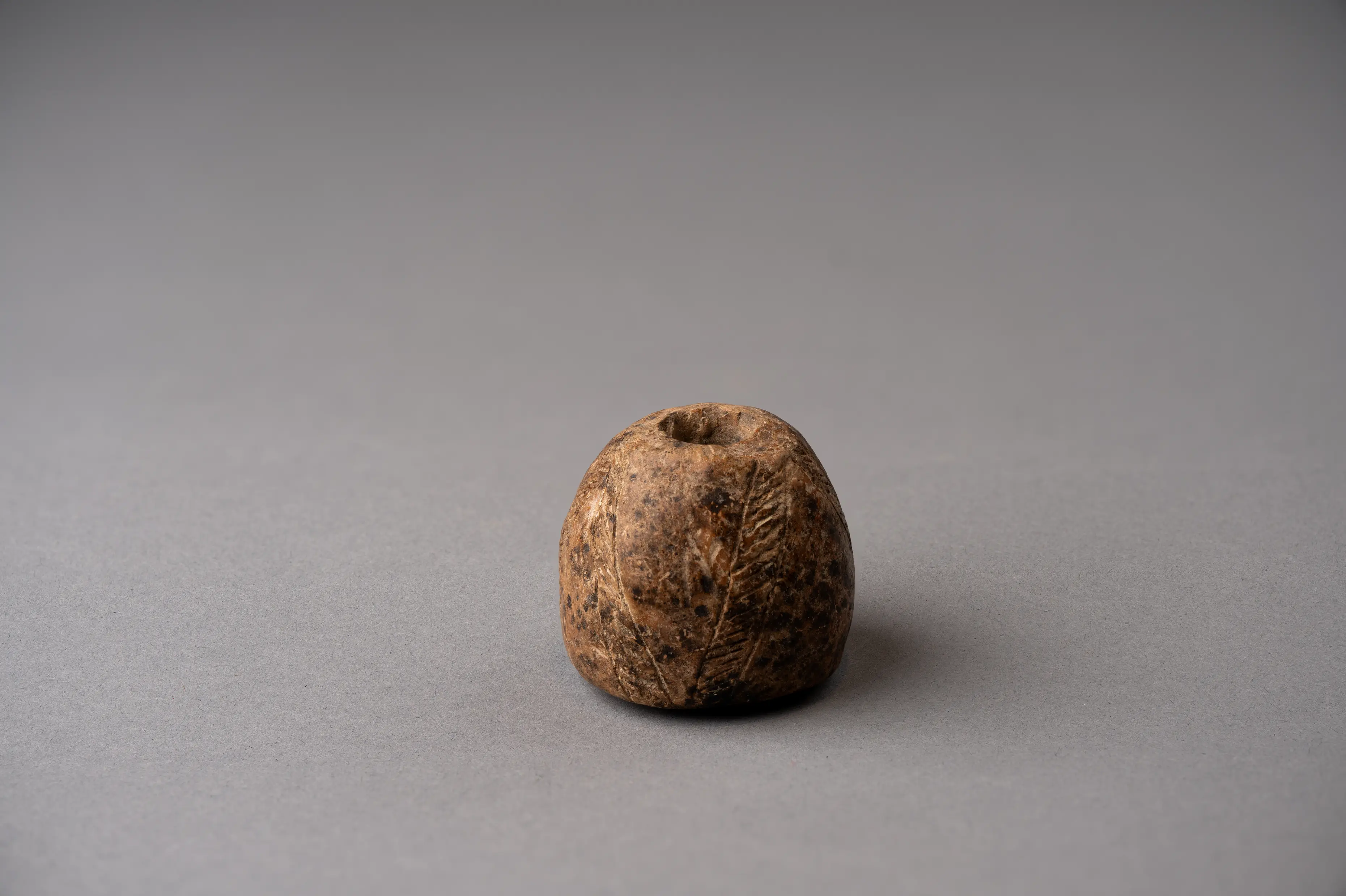
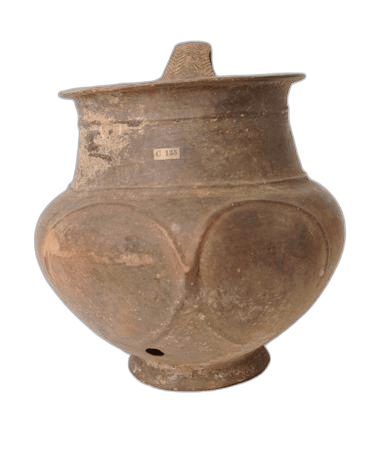
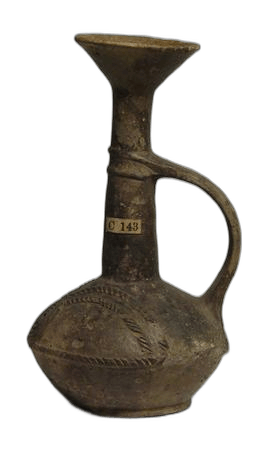
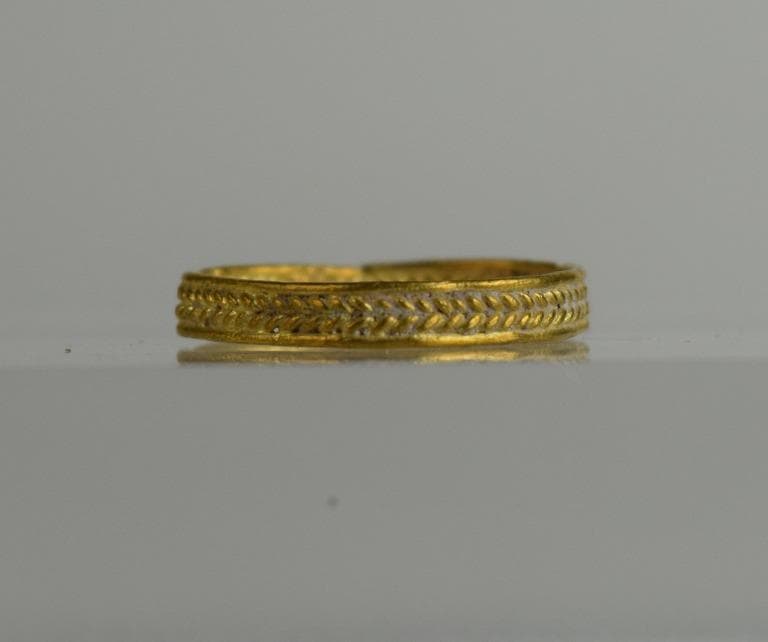
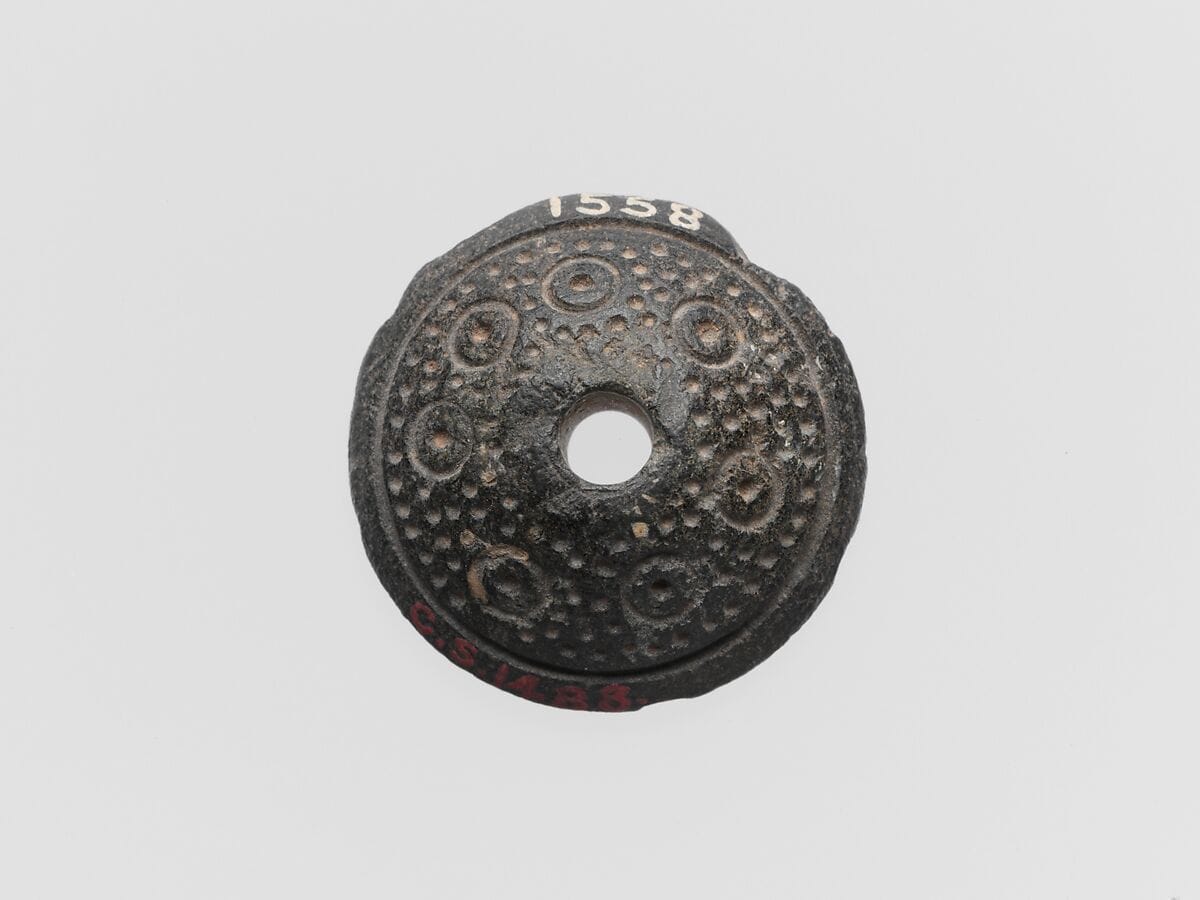
Herringbone also turns up on small clay objects. A bell-shaped spindle whorl in the Drakopoulos collection, dated c. 2000 to 1725 BCE, has incised herringbone or feather bands on its faceted sides; the spindle whorls and textile tools entry describes the class. The site's catalogue also tags a few Late Bronze Age Base Ring pieces in the British Museum, such as a tankard and a juglet, and a metal finger ring in Liverpool, with herringbone, but on present evidence it is in the incised Red Polished of the Philia and Early Cypriot phases that the pattern is at home. See all herringbone in the catalogue.
Middle Bronze Age: White Painted triangle friezes
In the Middle Bronze Age the triangle becomes a painted motif on White Painted ware, and Gagné's study shows how closely it can track individual workshops. At Lapithos, Group 9 bowls have "a single row of hatched triangles framed by a double stroke on the left side," and their bases carry a crossed-line motif with circles in the spaces; "the limited number of motifs used to decorate these bowls points to some standardization between shapes and decorative motifs at Lapithos" [2, p. 123]. Lapithos Group 11, the interlocking hatched triangles, contains a jug, a deep bowl, two hemispherical bowls and a donkey askos; the two bowls are so alike that "the painter, and possibly the potter, of one bowl must have been aware of the work of the maker of the other" [2, p. 124].
Gagné suggests where the interlocking design came from. A deep bowl from Tomb 48 at Dhenia has hatched triangles with multiple framing lines on the left, "almost a hybrid of the hatched triangles and alternating oblique lines, which may have been the inspiration for the interlocking hatched triangles" [2, p. 156]. Dhenia also has cross-hatched triangles on the shoulders of deep bowls and jugs, sometimes in several rows [2, p. 156]. At Alambra a bowl has "cross-hatched triangles, with an alternating zigzag pattern that makes a diamond chain just under the triangle frieze," closest to a deep bowl from Lapithos; interlocking hatched triangles survive there "only as sherds" and are "far outnumbered by vessels with cross-hatching" [2, p. 178]. A tankard from Laxia tou Riou carries hatched diamonds on the neck and interlocking hatched triangles on the lower body, which Gagné reads as imitation of Lapithos styles, noting that "hatched diamond chains and interlocking hatched triangles also occur at Vounous and Dhenia" [2, p. 203]. At Enkomi a jug and sherds with hatched triangles resemble pots from Lapithos Tomb 804 so closely that she raises the possibility of a single painter [2, p. 193]. These attributions are hers and rest on the drawing; her fabric analysis matched only some of the sherds to Lapithos.
The scheme is also found away from the north coast. A British Museum White Painted jug from Klavdia, hand-made with a globular body and cut-away spout, is dated by the museum to Middle Cypriot III (1750 to 1650 BC) and painted with "an alternating pattern of hatched triangles and dotted circles on body."
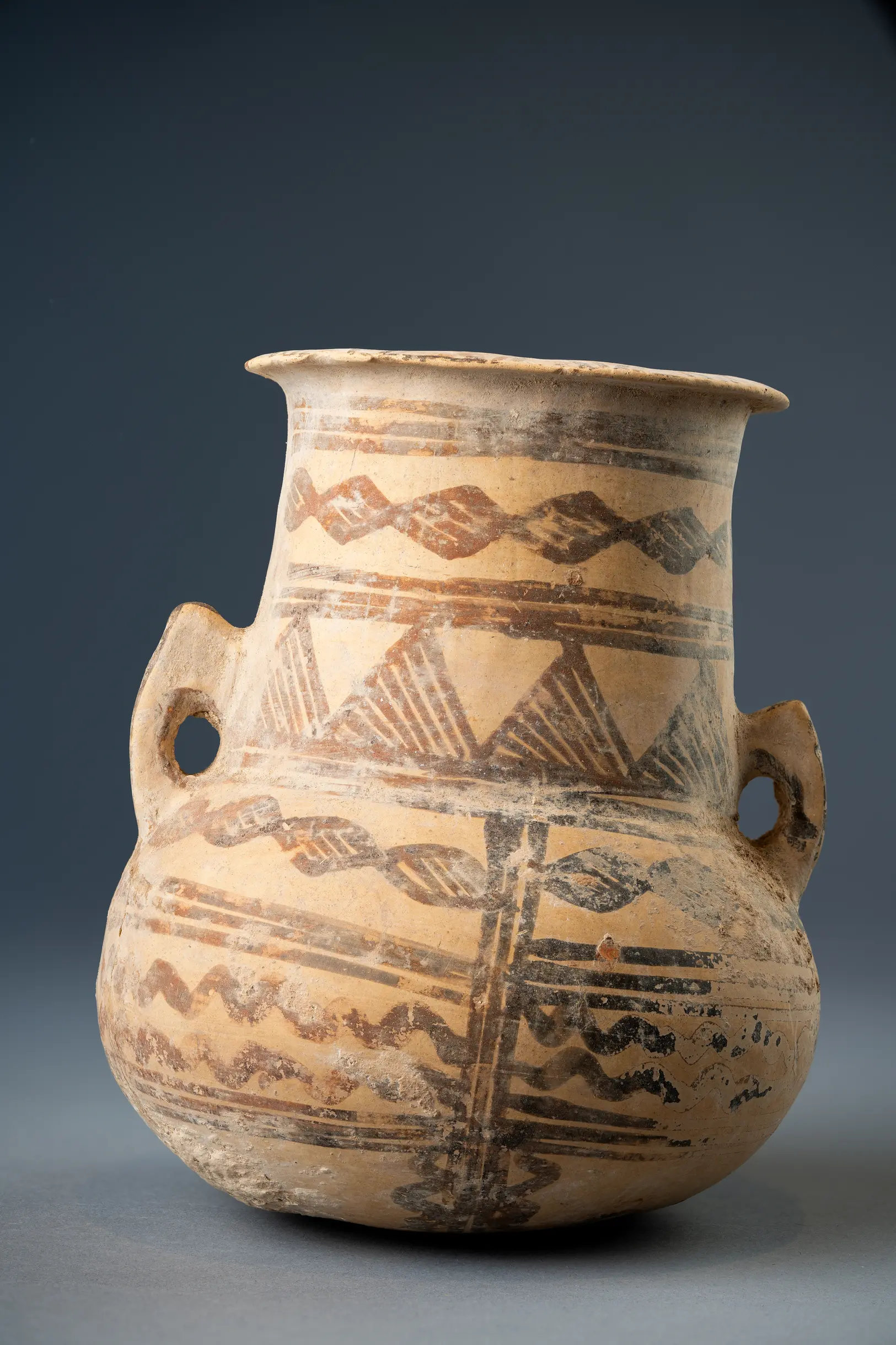
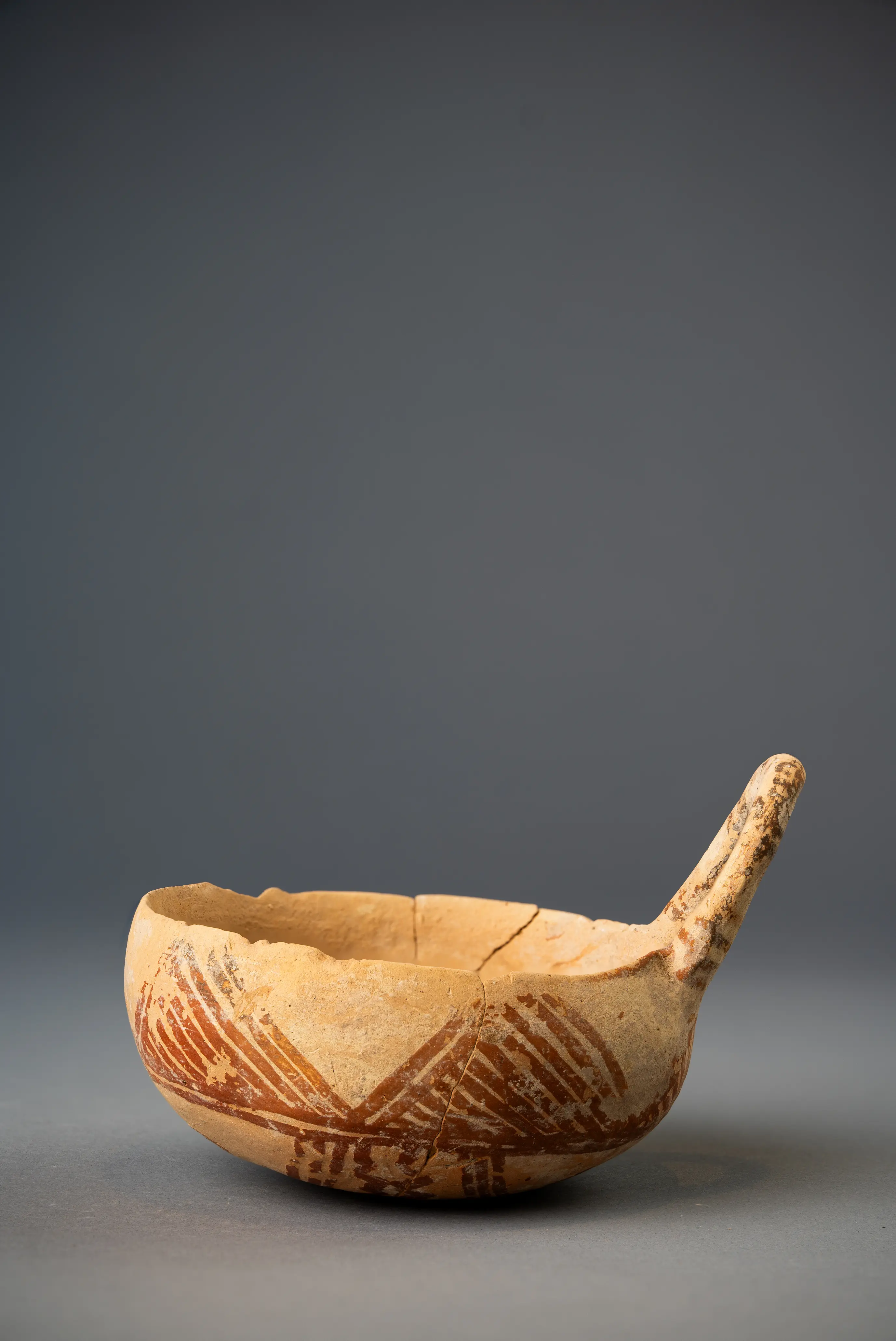
Three pieces in the Drakopoulos collection show the Middle Cypriot range. A small White Painted amphora with pierced lug handles combines hatched lozenge chains, hatched triangles, wavy lines and a vertical ladder, the kind of chain of lozenges and triangles Dikaios recorded at Vounous [4]. A hemispherical bowl with a rising rod handle has a hatched-triangle frieze and a quartered base with wavy lines and rings, close in scheme to the Lapithos bowls with a single triangle row and a decorated base. A small juglet with a beaked cut-away spout keeps worn zones of hatched triangles in dark matt paint on a pale buff body. All three are dated Middle Cypriot II to III. A Cesnola askos in the Metropolitan Museum, a small "fantastic vase with ring-handle, spout, and lattice triangles," is catalogued as Middle Cypriot.
Late Bronze Age: the lozenge chain
In the Late Bronze Age the cross-hatched lozenge chain appears on White Slip II, and from there it passed to some Mycenaean-style pottery. It is the common feature by which P. A. Mountjoy grouped a group of Mycenaean IIIC stirrup jars found in Turkey, Israel and Cyprus (at Tarsus, Bethshan, Tell Keisan, Kouklia and Hala Sultan Tekke). She pointed out that "the lozenge chain derives from the earlier White Slip II Ware," with good parallels on early LH IIIC vases from Kition, and proposed a Cypriot origin for the group, while noting that its main diagnostic feature was the banding of the body [8]. The direction of borrowing is a hypothesis, supported by style and by some neutron activation analysis that could not pin the jars to a particular Cypriot site [8].
Hatched triangles show a similar Cypriot preference. Kathleen Birney observed that on mainland Mycenaean pottery hatched triangles "appear most often on closed forms, typically in rows on the shoulder zones of stirrup jars and jugs," whereas on Cyprus they are "a common decoration on Myc IIIC:1b open forms, particularly skyphoi FS 284 and kraters," so that "the Cypriot versions thus appear to reflect Near Eastern compositional preferences, rather than those of mainland Greece" [9]. She also notes that on small sherds hatched triangles are hard to tell from the diaper net [9]. See Late Bronze Age.
Iron Age: bands, panels and frames
On Iron Age White Painted and Bichrome pottery, triangles and lozenges become the building blocks of zones and panels. Gjerstad describes White Painted I bowls with "series of latticed triangles, single triangles with diaper pattern," dish bases with "rows of latticed lozenges, latticed triangles meeting in the centre," pinched-mouth jugs with "isolated, latticed triangles" on the shoulder, and belly-handled amphorae with "zones of latticed triangles, lozenges, wavy lines," or panels separated by "bands of latticed lozenges" [1]. A clay model of a tripod stand from Palaepaphos-Skales (see Paphos), in White Painted I style, has "chequers of latticed lozenges," triglyphs "filled with hatched tangent triangles flanking a vertical chain of small reserved lozenges," and "a vertical row of hatched tangent triangles" [10]. The Drakopoulos plate with latticed triangles and wavy lines on its underside belongs to this family and is discussed on the lattice page.
Two British Museum amphorae show the motif on a larger scale. A White Painted amphora from Kourion, 42.3 cm high and dated Cypro-Geometric (1050 to 900 BC), has "hatched lozenges and triangles on the shoulder." A much larger amphora from Aradhippou, 76 cm high and dated 800 to 600 BC, sets "lozenges, hatched and latticed triangles" in shoulder panels with stylised floral motifs, swastikas and a quadruped beside a tree. In the Cypro-Archaic period the triangle frames and fills. A Bichrome IV amphora in the Swedish Cyprus Expedition's publication has "framed lattice-triangles on shoulder, and a panel-pattern of vertical, framed bands of lattice-lozenges, flanking a winged square of five lattice-lozenges between the handles" [11]. Two Cesnola pieces in the Metropolitan Museum catalogued as Cypro-Archaic I, a krater with "chequered triangles" and lotus and an amphora with "triangle ornament and swastikas," show the triangle set among the other motifs of the period; see Maltese cross, swastikas and lotus flowers.
Meaning and classification
| Period | Ware | Typical form of the motif |
|---|---|---|
| Chalcolithic | Red-on-White | Painted solid, blank or filled triangles, often pendent from rim bands |
| Early Bronze Age (Philia, Early Cypriot) | Red Polished | Incised hatched triangles, lozenges, herringbone |
| Middle Bronze Age | White Painted | Framed hatched, cross-hatched and interlocking triangles; diamond chains |
| Late Bronze Age | White Slip II, Mycenaean IIIC | Cross-hatched lozenge chain; hatched triangles on open forms |
| Cypro-Geometric and Cypro-Archaic | White Painted, Bichrome | Latticed triangles and lozenges in zones, panels and frames |
The studies that work most closely with triangles and lozenges treat them as ornament and as evidence for who made a pot. Gagné's Middle Cypriot workshop groups [2], Mountjoy's Cypriot stirrup jars [8] and Birney's open forms [9] all use the way a triangle is filled, framed and placed to group vessels by maker or region. None of them offers a reading of what a triangle meant to a Cypriot potter, and the site does not offer one either. Some of the finer distinctions are also unstable on the ground: a hatched triangle with several framing lines shades into alternating oblique lines [2, p. 156], a lozenge chain can be drawn as two crossing zigzags, and a hatched triangle on a small sherd can be part of a diaper net [9]. For the neighbouring motifs, see lattice and checkerboards, zigzags, wavy lines and arrows, and the Drakopoulos collection for the pieces illustrated here.
Objects on this page
- Red Polished Juglet with Hatched TrianglesEarly Bronze Age III · 2100–1800 BC
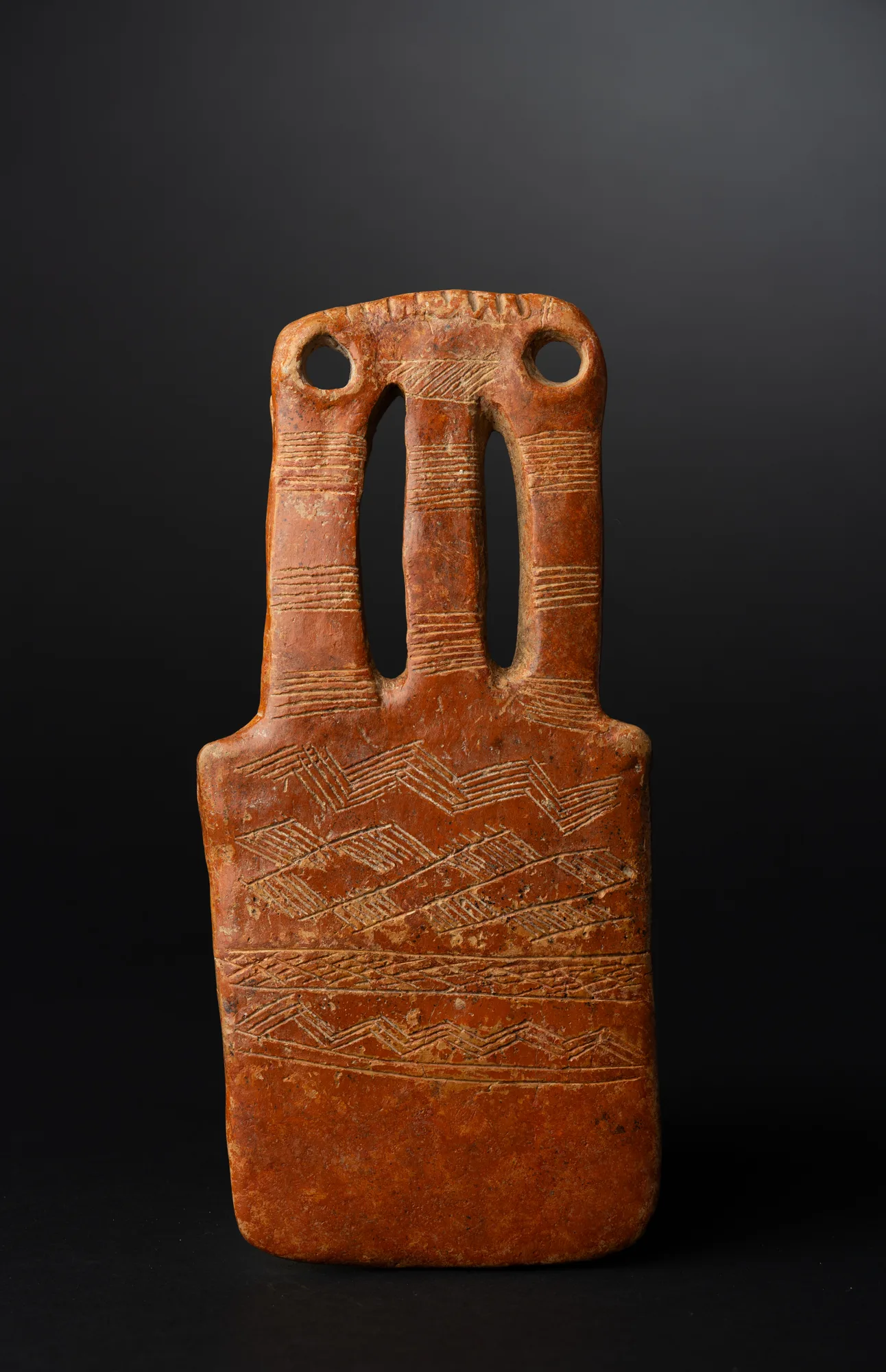 Red Polished Three-Necked Plank FigureMiddle Bronze Age I · 2000–1800 BC
- Spindle Whorl with Incised Herringbone BandsMiddle Bronze Age I · 2000–1725 BC
 Base Ring TankardLate Bronze Age I · 1600–1340 BC
 Base Ring Ware JugletLate Bronze Age I · 1550–1450 BC
 Finger RingLate Bronze Age II · 1350–1250 BC
- White Painted III-IV Amphora with Lozenge Chains and Hatched TrianglesMiddle Bronze Age II · 1850–1650 BC
 White Painted III-IV Bowl with Rising Handle and Hatched TrianglesMiddle Bronze Age II · 1850–1650 BC
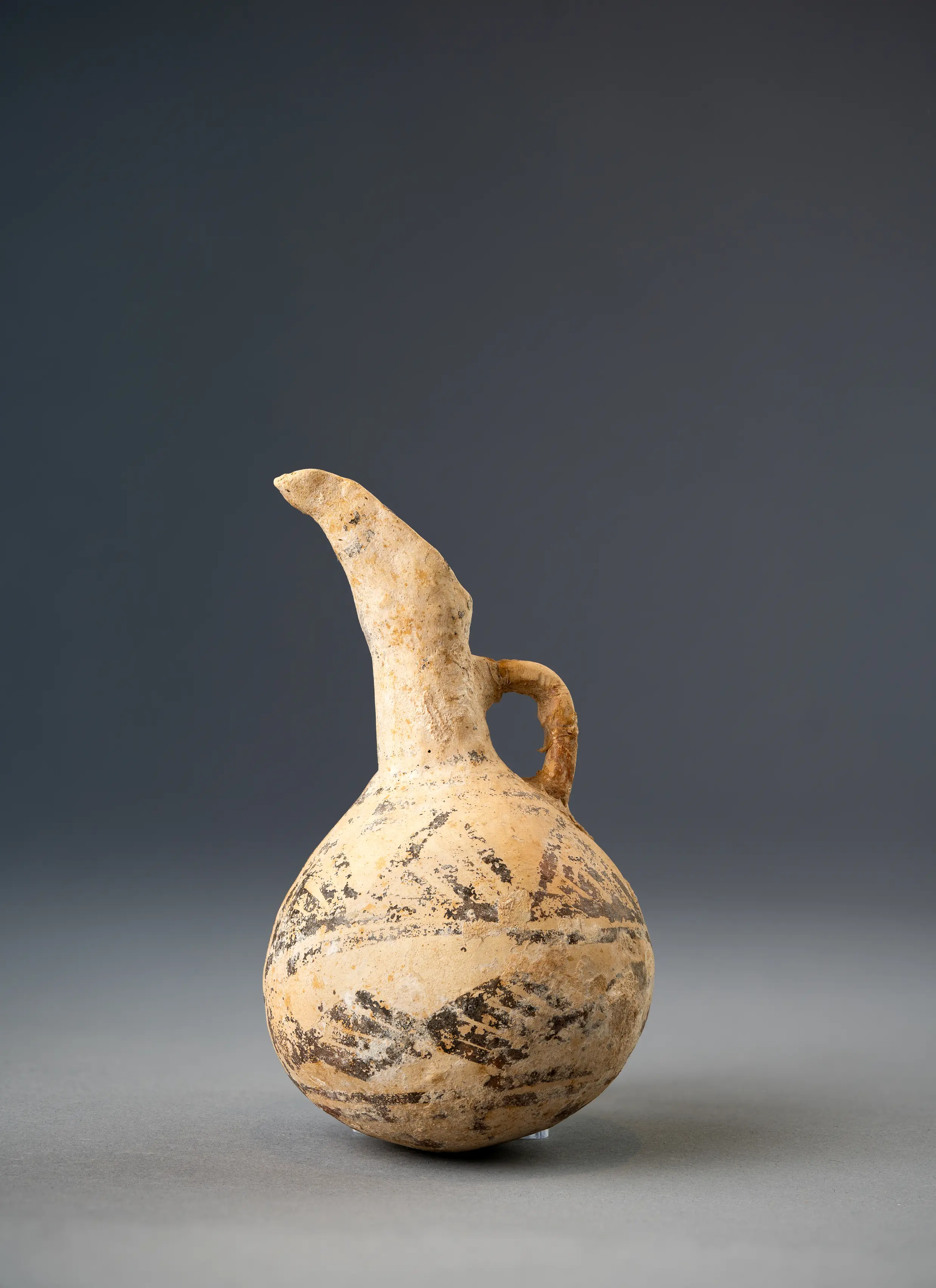 White Painted III-IV Juglet with Cut-away NeckMiddle Bronze Age II · 1850–1650 BC
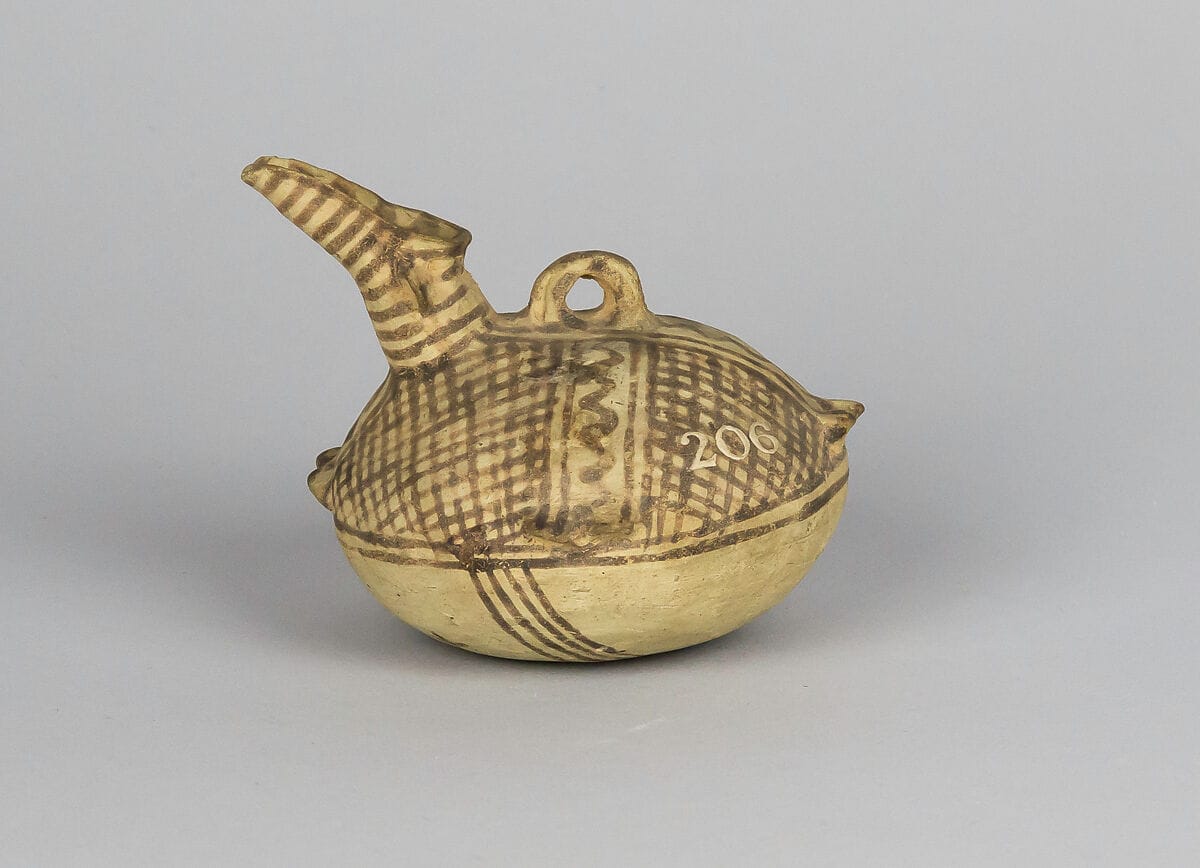 AskosMiddle Bronze Age II · 1900–1600 BC
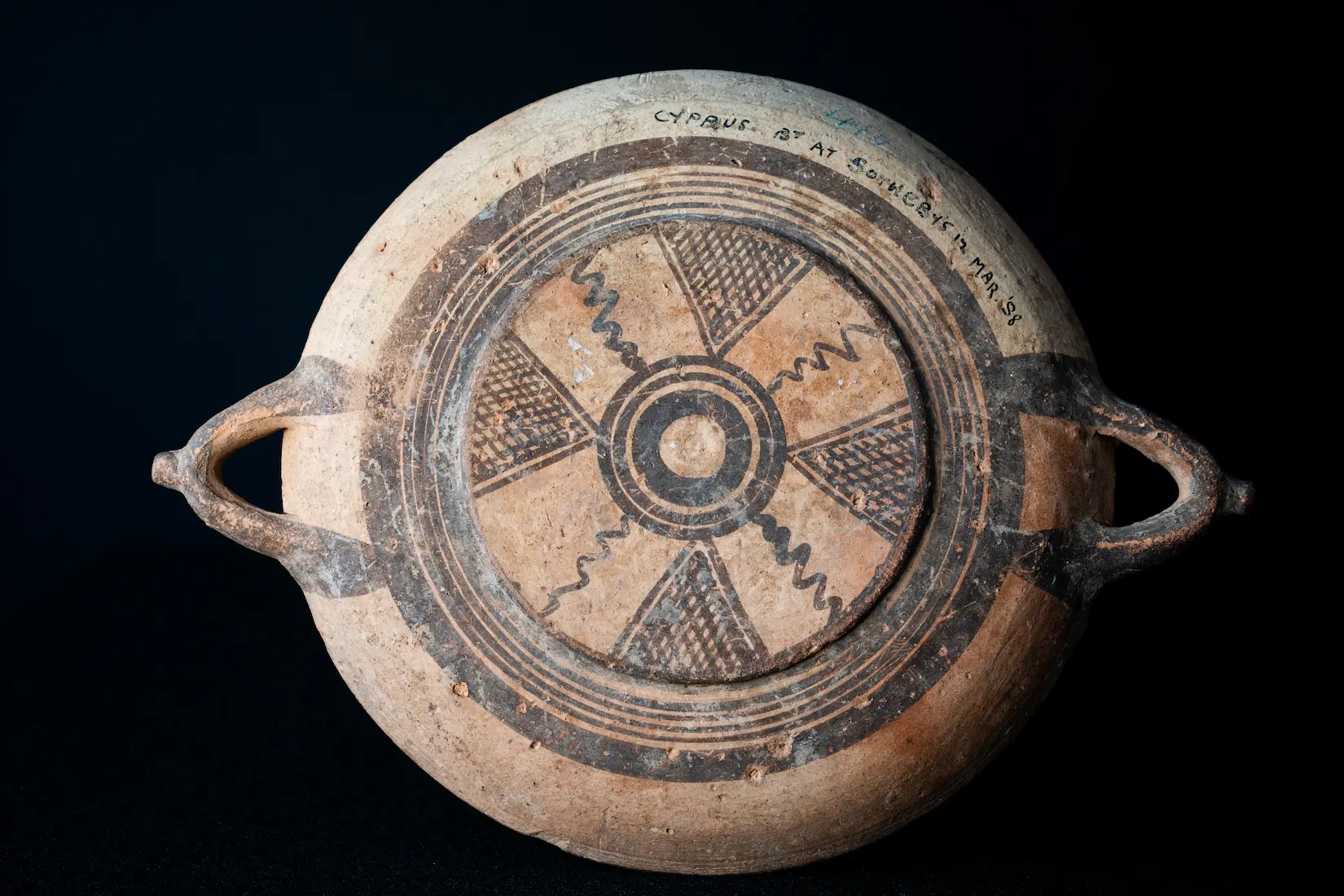 White Painted Plate with Latticed Triangles and Wavy Lines on the UndersideGeometric I · 1050–850 BC
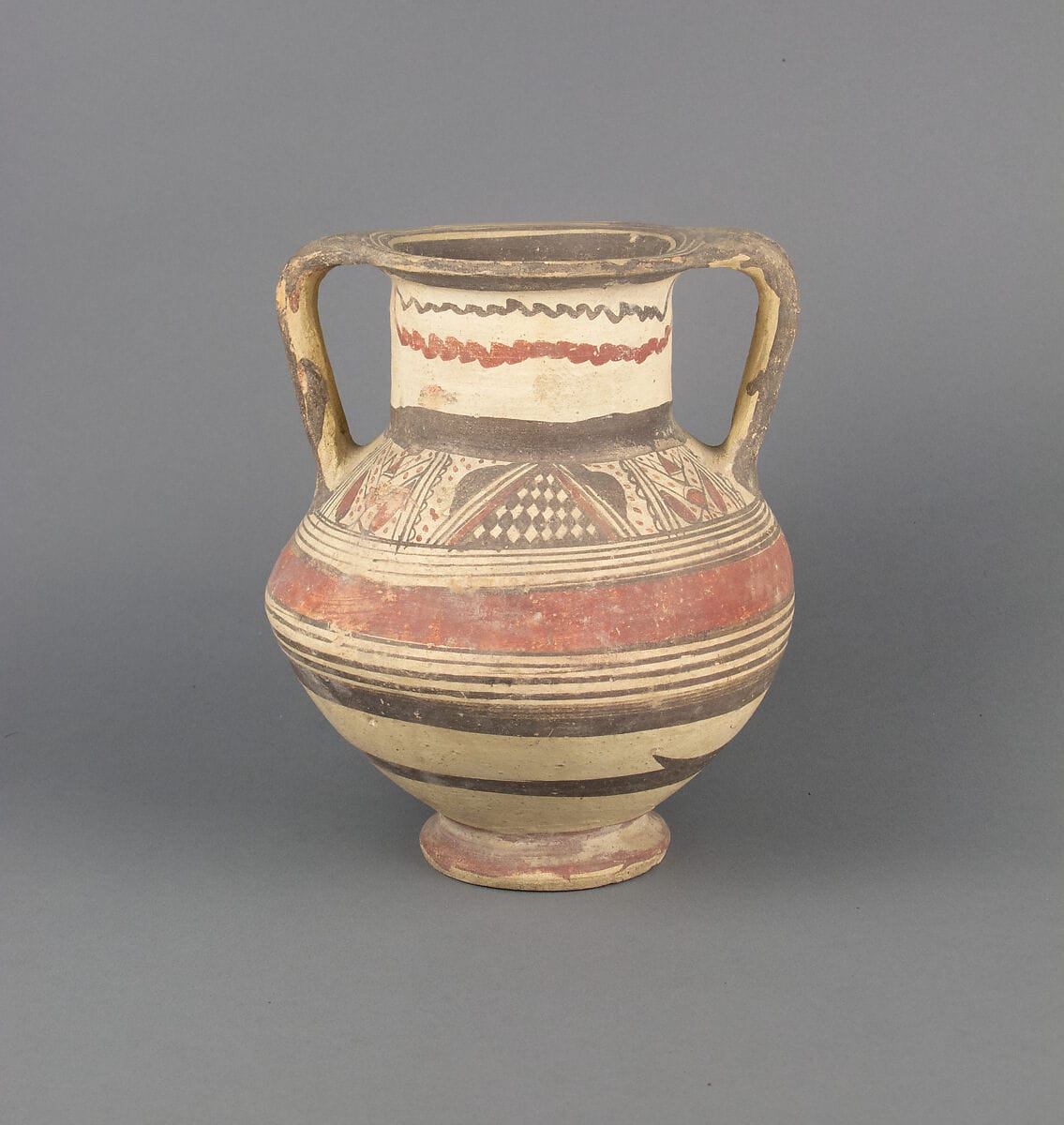 KraterArchaic I · 750–600 BC
and 1 more object mentioned on this page
In the catalogue
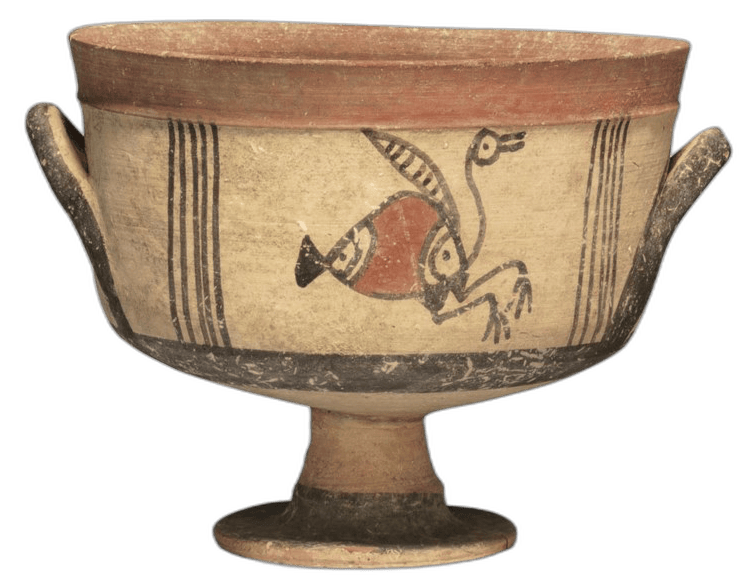
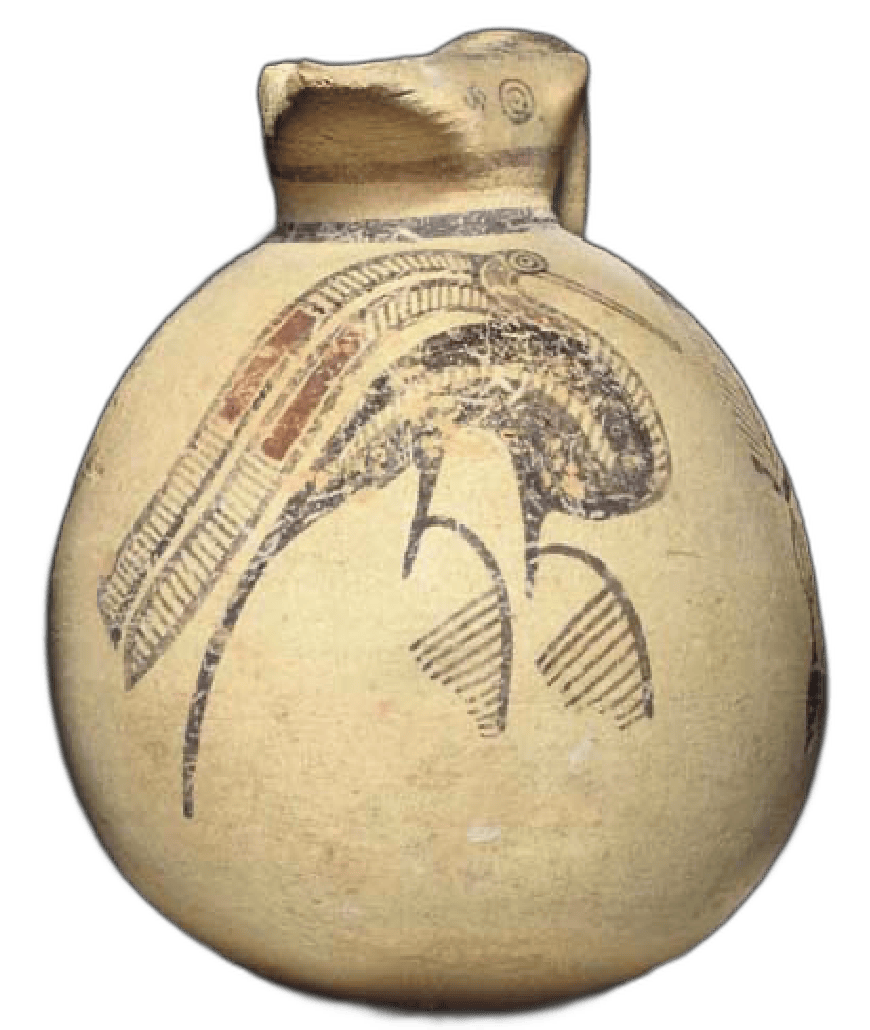
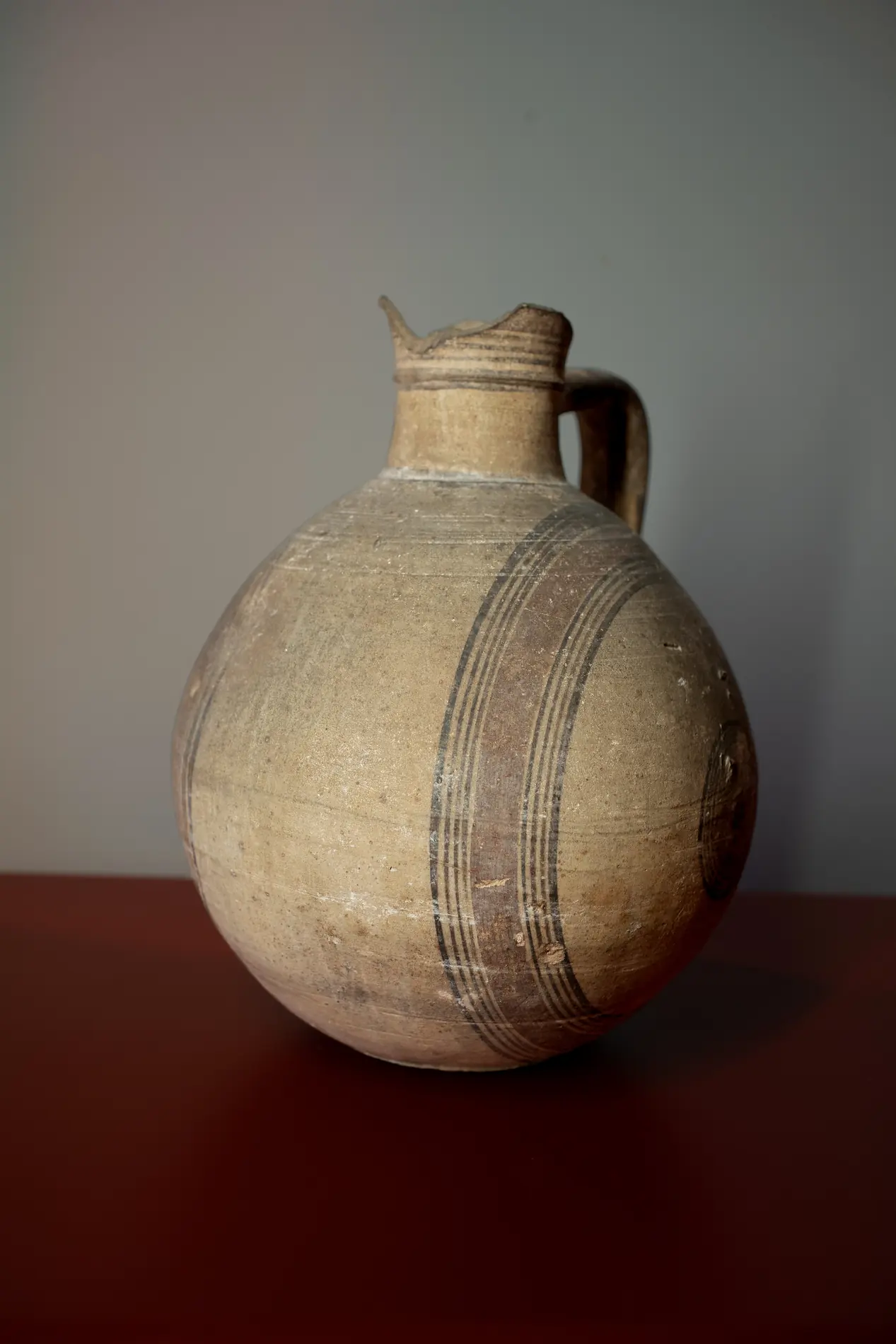
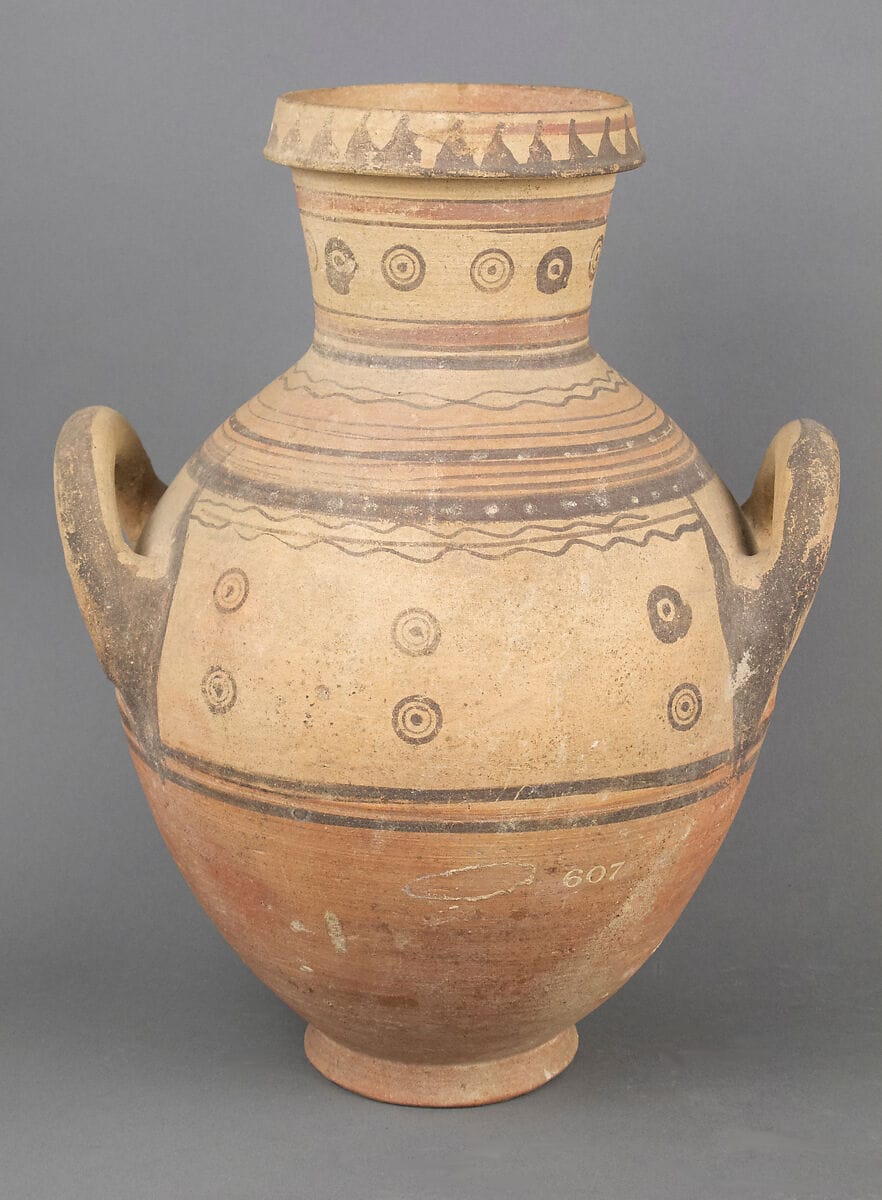
References
- 1.Gjerstad, E. (1948). The Swedish Cyprus Expedition, Vol. IV, Part 2: The Cypro-Geometric, Cypro-Archaic and Cypro-Classical periods. The Swedish Cyprus Expedition.
- 2.Gagné, L. A. C. (2012). Middle Cypriot White Painted ware: A study of pottery production and distribution in Middle Bronze Age Cyprus [Doctoral dissertation, University of Toronto].
- 3.Bockman, P. (2015). The painted motifs of Cypriot ceramic art: A study of iconography and identity [Master's thesis, University of Nevada, Las Vegas]. http://dx.doi.org/10.34917/8220087
- 4.Dikaios, P. (1940). The excavations at Vounous-Bellapais in Cyprus, 1931-2. Archaeologia, 88, 1-174.
- 5.Webb, J. M., & Frankel, D. (2013). Cultural regionalism and divergent social trajectories in Early Bronze Age Cyprus. American Journal of Archaeology, 117(1), 59-81.
- 6.Herscher, E. (2003). The ceramics. In S. Swiny, G. Rapp, & E. Herscher (Eds.), Sotira Kaminoudhia: An Early Bronze Age site in Cyprus (CAARI Monograph Series 4). American Schools of Oriental Research.
- 7.Peltenburg, E. (1991). Kissonerga-Mosphilia: A major Chalcolithic site in Cyprus. Bulletin of the American Schools of Oriental Research, 282/283.
- 8.Mountjoy, P. A. (n.d.). A Near Eastern group of Mycenaean IIIC pottery. In Autochthon: Papers presented to O. T. P. K. Dickinson on the occasion of his retirement.
- 9.Birney, K. J. (2007). Sea Peoples or Syrian peddlers? The Late Bronze-Iron I Aegean presence in Syria and Cilicia [Doctoral dissertation, Harvard University].
- 10.Karageorghis, V., & Raptou, E. (n.d.). Palaepaphos-Skales: Tombs of the Late Cypriote IIIB and Cypro-Geometric periods (Excavations of 2008 and 2011).
- 11.Gjerstad, E., et al. (1935). The Swedish Cyprus Expedition, Vol. II: Finds and results of the excavations in Cyprus 1927-1931 (Text). The Swedish Cyprus Expedition. https://archive.org/details/in.ernet.dli.2015.106120