
Geometric III
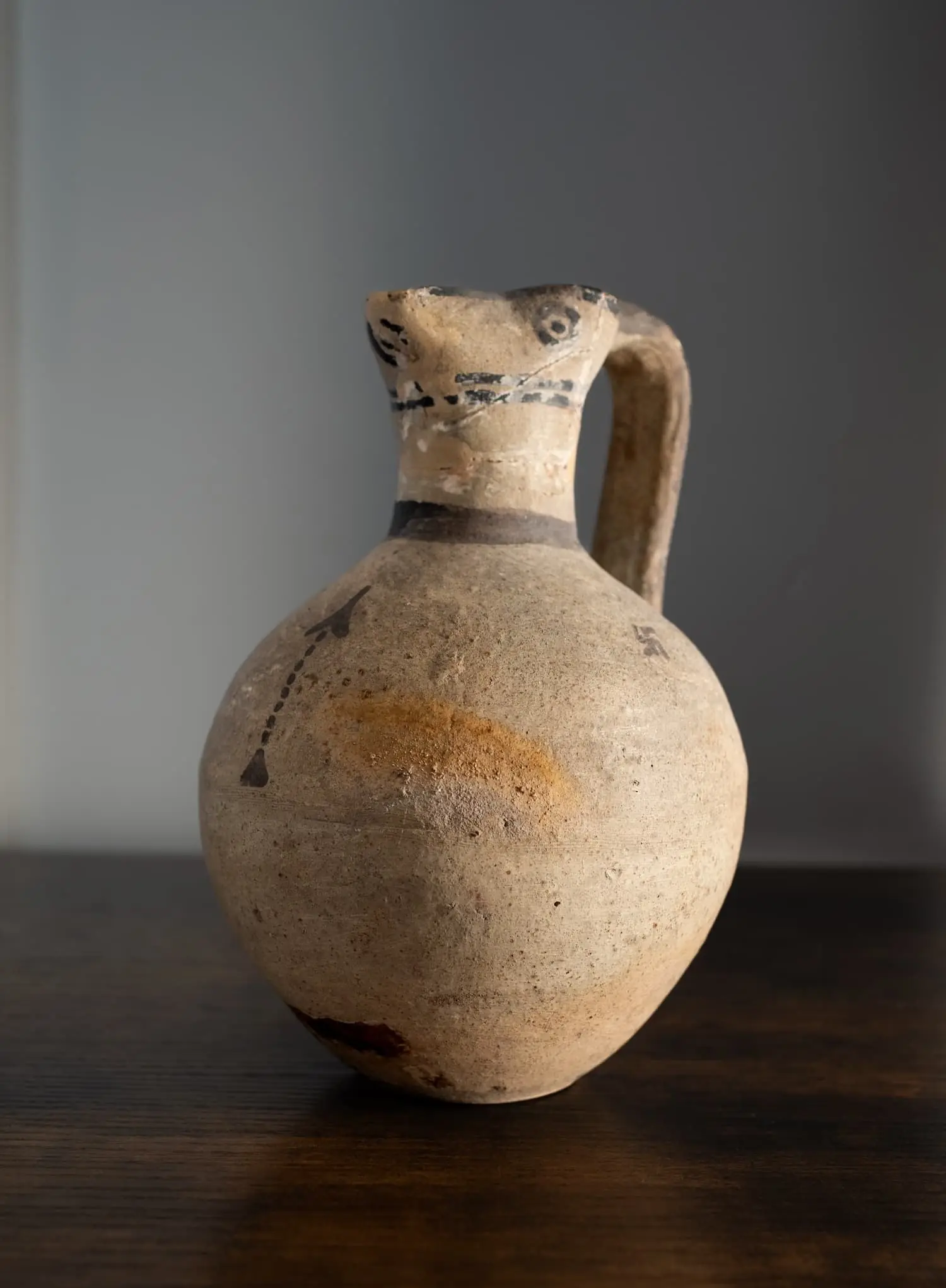
White Painted Jug with Painted Eyes, Chevron Arrow and Swastika
Small White Painted trefoil jug with eyes painted on the mouth, a dotted chevron arrow on the body and a swastika by the handle, c. 850–600 BCE.
Date
850 - 600 BC
Accession No.
JUG-GE-019
Collection
Alexis Drakopoulos
3D Model
Provenance
- Late 20th century, European art market
- Until 2024, private collection, Cambridge, UK
- 2024–present, Alexis Drakopoulos, London
Cypro-Geometric III to Cypro-Archaic I, c. 850–600 BCE · White Painted ware · Wheel-made
A small globular jug on a narrow flat base, with a tall cylindrical neck, a pinched trefoil mouth and a strap handle from rim to shoulder. The clay is pale buff, the paint a dense matt black.
An eye is painted on each side of the mouth, a dot inside a ring, with short strokes around it, so that the pinched spout becomes a face. Below the mouth run two black bands and a thick band marks the base of the neck. On the body the painter placed only two small signs: at the front a vertical chain of dots capped by an arrowhead and closed at the foot by a solid triangle, and beside it a small swastika. Fine cracks with pale filling cross the neck, a patch of orange-brown staining lies on the shoulder, and there is a patch of surface loss near the base.
Commentary
The jug is White Painted ware: black matt paint on a light ground, with no red. Its decoration is the geometric free field that Gjerstad describes for White Painted III, in which a single ornament is set on the bare body of a pinched-mouth jug; among his examples are "rows of chevrons, sometimes combined with a single ornament as filling ornaments" [1, p. 47], and on plates of the same ware "the fringed concentric circles, the swastika, and the row of chevrons" [1, p. 48]. The motif on this jug is what the literature calls a chevron arrow, "a vertical chain of chevrons forming an arrow motif" [2, p. 344], here reduced to a column of dots with a point at the top.
The closest parallel is the Metropolitan Museum's pinched-mouth jug 74.51.447 from the Cesnola collection, dated by the museum to Cypro-Geometric III (c. 850–750 BCE). It has an eye on the rim, bands on the neck and, on the body, a vertical chevron arrow with a swastika on either side. The Pitt Rivers Museum's White Painted trefoil jug 1884.38.57, with an eye on the mouth and dotted chevron arrows on the body, is also dated to Cypro-Geometric III. A White Painted V oinochoe from Amathus in the British Museum, 1894,1101.286, shows that eyes on the mouth and arrowhead motifs continued into Cypro-Archaic II. On balance a date from the later ninth to the seventh century BCE fits this piece best, and White Painted III or early IV is the likeliest type.
The small ornaments on the body link the jug to a repertoire that Georgiadou and Dikomitou-Eliadou identify at Salamis, where the dotted cross, swastikas and the chevron arrow appear "individually in panels or as supplementary ornaments" [2, p. 344]. On later Bichrome IV bird jugs the chevron arrow becomes one of the bird's regular companions, third in frequency after the lotus and the swastika [3, p. 144]. Here it stands alone, at the earlier stage. The eyes on the mouth are a widespread Iron Age convention; a Bichrome IV jug in the Cyprus Museum has "an 'eyelet' ... painted on either side of the spout" [4, p. 288]. Whether the eyes carried a protective meaning is unknown.
Jugs of this kind were small table pourers, and complete examples usually come from tombs. We know of no record of this jug's findspot, and the Salamis parallels concern the motif only.
The pale lines across the neck appear to be old breaks, rejoined and filled. They interrupt the neck bands and the eye on that side, and some paint along them may be restored.
References
- 1.Gjerstad, E. (1948) The Swedish Cyprus Expedition, Vol. IV, Part 2: The Cypro-Geometric, Cypro-Archaic and Cypro-Classical Periods. Stockholm: The Swedish Cyprus Expedition, pp. 47–48. (Page numbers follow the digitised text, which is not paginated like the printed volume.)
- 2.Georgiadou, A. and Dikomitou-Eliadou, M. (2022) The Iron Age pictorial pottery of Salamis within and beyond: an overview of ceramic styles, wares and fabrics. In G. Bourogiannis (ed.), Beyond Cyprus: Investigating Cypriot Connectivity in the Mediterranean from the Late Bronze Age to the End of the Classical Period (AURA Supplement 9). Athens: National and Kapodistrian University of Athens, pp. 335–348, p. 344.
- 3.Dissinger, A. M. (2017) Cypro-Archaic Bird Iconography: Types, Uses, and Meanings. PhD dissertation, University of Virginia, pp. 143–144.
- 4.Bombardieri, L. and Panero, E. (eds) (2021) Cyprus. Crossroads of Civilizations. Exhibition catalogue, Musei Reali, Turin, cat. 094, p. 288.
More from the Catalogue
Browse related objects
Bichrome Oinochoe
Archaic I
Free-field bichrome jug with image of an Ibis bird and reeds
Archaic
Squat bichrome jug in free-field style with image of bird picking a lotus flower
Archaic
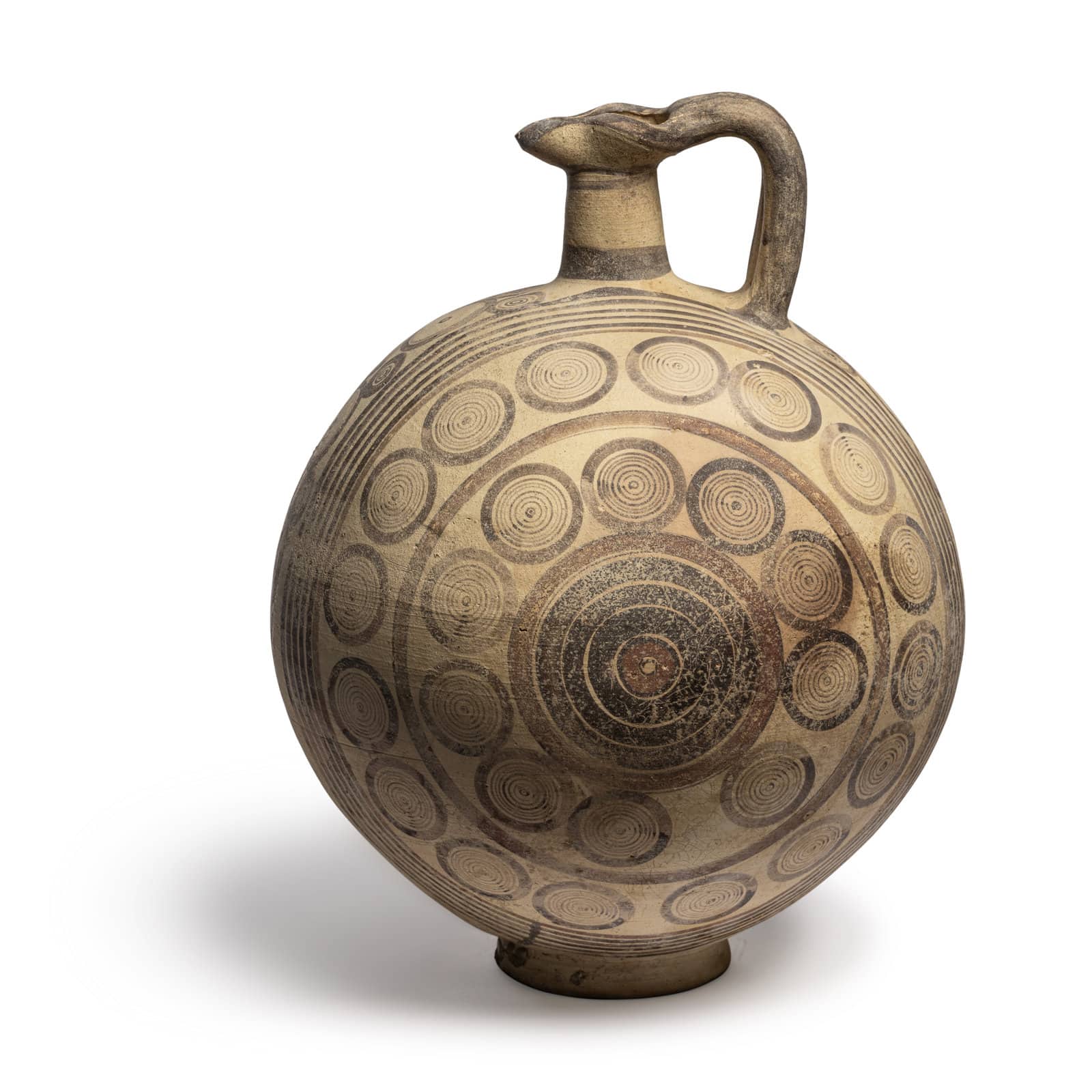
A Cypriot Bichrome-Ware Oinochoe Jug
Archaic I
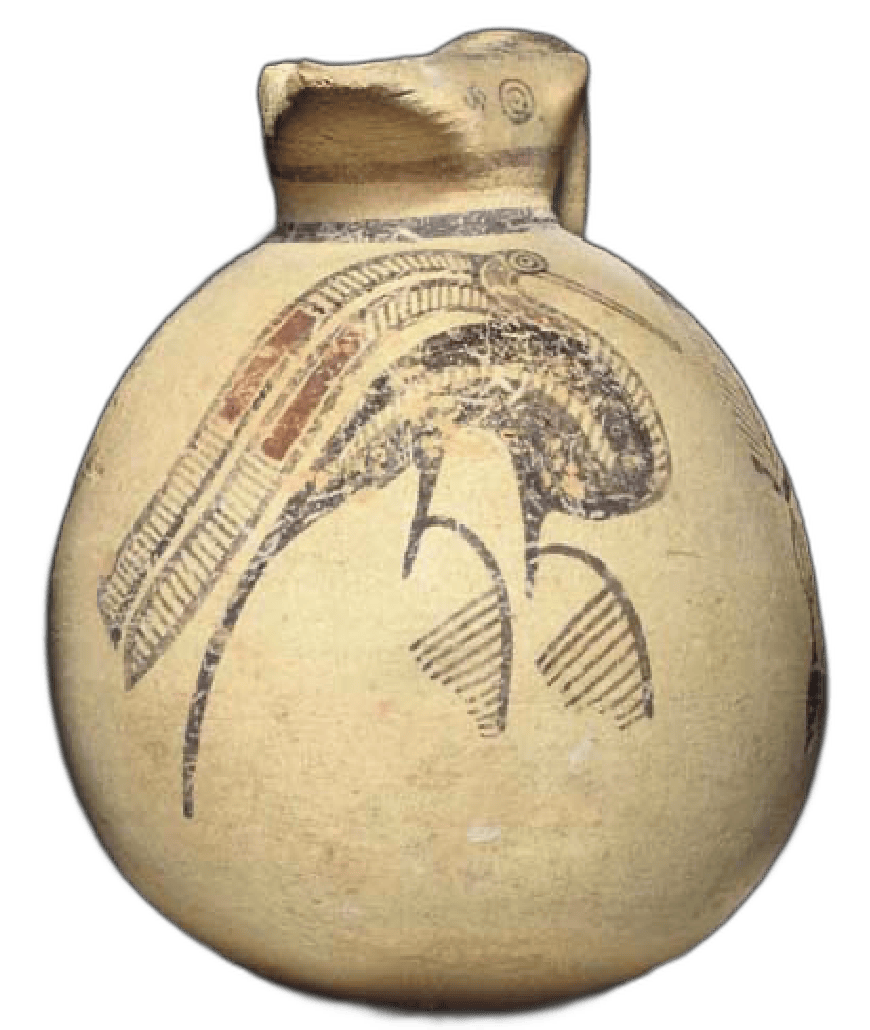
Oinochoe with Free Field Bird
Archaic I
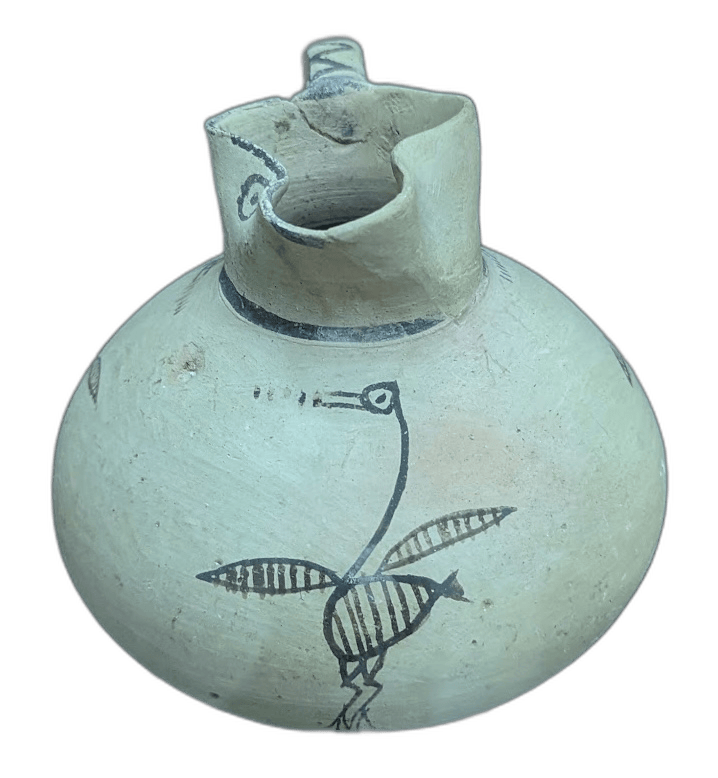
Small Oinochoe with Free Field Bird
Archaic I
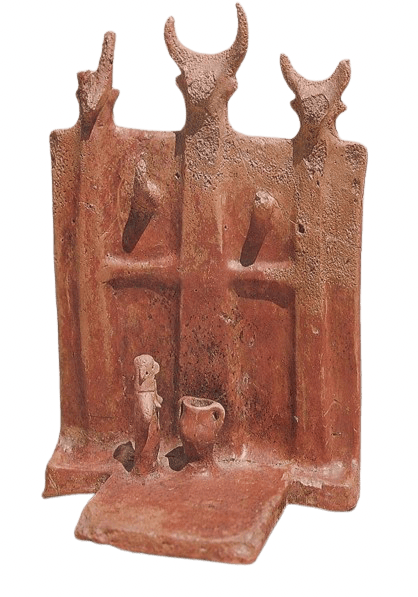
Red Polished Shrine
Middle Bronze Age I
Black-On-Red Geometric Jug Sherd
Geometric II
Bichrome Jug
Geometric
Bichrome Juglet
Geometric
Bichrome Oinochoe
Geometric
Juglet
Archaic II
Oinochoe
Geometric III
Jug
Archaic I
Juglet
Archaic I
Jug
Geometric I
Terracotta jug
Early Bronze Age I
Juglet
Geometric I