
Contents
Bronze figurines are the smallest and rarest branch of Cypriot figure-making. Where terracotta figurines survive in the tens of thousands and limestone statues fill museum galleries, cast bronze figures number in the dozens for any one period: a few gods and goddesses of the 12th century BCE, a series of small Archaic votaries, a scatter of animals, and one life-size Classical head. Bronze could be melted down and recast, and much of what once stood in Cypriot sanctuaries has not survived. What remains is closely tied to the island's copper: several of the earliest figures stand on miniature copper ingots, and two of the best known come from a town where copper was worked a few metres from the shrines. This page covers figures cast in the round in bronze; for the clay and stone traditions they sat beside, see how Cypriot figurines are classified and Archaic limestone sculpture. You can see all metal figurines in the catalogue.
Definition and technique
A bronze figurine here means a small human or animal figure cast in copper alloy, normally solid, from a few centimetres to about a hand's height. The larger Late Bronze Age cult statues and the hollow-cast Classical head from Tamassos are included because they belong to the same metalworking story, even though they are statues rather than figurines.
Metal figures in the round begin in Cyprus in early Late Cypriot II, and lost-wax casting is in use by Late Cypriot III, though the exact moment of its introduction is unknown [1]. A. T. Reyes, writing on the Archaic statuettes, notes that all of them were made by lost-wax casting, "in general use in Cyprus from at least the thirteenth century BC" [2, p. 245]. In this method the figure is modelled in wax, coated in clay, and the wax melted out and replaced by molten metal. Details such as hair, belts and kilt borders were then incised with a metal graver, and tenons under the feet fixed the figure to a base [2, p. 245]. The Archaic figures have never been chemically analysed [2, p. 245], so their exact alloys are unknown.
A thesis on the Enkomi Ingot God by B. J. Sabatini argues that its ingot base and lower legs were cast on to the figure in a single further pour [3]. That reading rests on published photographs rather than examination of the object, and is best treated as a working hypothesis.
Chronology at a glance
| Phase | Date | What survives | Key sites |
|---|---|---|---|
| Late Cypriot II–III | c. 13th–11th c. BCE | Cult statues of gods, small nude goddesses on ingots, 'Oriental-style' statuettes, animals, a ritual wagon | Enkomi, Pyla, Nicosia, Paphos-Teratsoudhia |
| Cypro-Geometric | c. 1050–750 BCE | No human figures known; some animals | Uncertain (Cesnola purchases) |
| Cypro-Archaic | c. 7th–6th c. BCE | Male votaries in Egyptian-style kilts and helmets; animals | Idalion, Ayia Irini, Kition, Tamassos, Kourion |
| Late Archaic to Classical | late 6th–5th c. BCE | Greek-style youths; the Tamassos bronze statue | Idalion, Tamassos |
The gods of Enkomi (Late Cypriot III)
The two largest Late Bronze Age bronzes both come from Enkomi, on the east coast, and both are now in the Cyprus Museum.
The Horned God was found in one of two inner cult rooms of a sanctuary built of ashlar blocks [5]. At just over 54 cm it is the largest bronze statue known from this period [4, p. 202; 5]. Sources round its height differently, between 54 cm and 55 cm [4, p. 202; 6, p. 47]. It is a youthful male figure wearing a horned cap, modelled "in a much more naturalistic way" than the Ingot God [6, p. 47]. It lay in a pit by the east wall of Room 10, with its head and horns standing 5 cm above Floor I, and a miniature bronze sickle had been placed in front of its outstretched right hand [7, p. 77].
The Ingot God came to light on 4 October 1963, in the sixteenth season of the French mission, in a building now called the Sanctuary of the Ingot God in Quarter 5E [3]. It stood upright in a pit in a small inner room of a hall measuring 16.4 by 9.6 m [3]. The figure is 31 cm tall (about 35 cm with its tenon), weighs 2,108 g, and stands on an ingot-shaped base 9.5 by 6.4 cm [3]. It wears a horned conical helmet and a long skirt, has a light beard and bare feet, and holds a spear in its right hand and a round shield in its left [3]. Budin gives its height as 34.5 cm [4, p. 202].
The Swedish Cyprus Expedition's summary of the bronzes called the Ingot God "more primitive" than the Horned God, with a face close to those of Cypriot terracottas, and read it as a warrior god whose ingot base marks the importance of copper as "the source of wealth and weapons for the Cypriotes" [1]. Sabatini sees it as a version of the Near Eastern smiting god, shown standing rather than striding [3]; the smiting pose is discussed further under Melqart. Budin stresses that the iconography, technique and find contexts of both figures mark them as cult statues in places of fairly public worship [4, p. 202].
The link with metalworking is physical as well as symbolic. Workshops lay about 10 m north-west of the Ingot God sanctuary, metalworking in the neighbouring quarters peaked at the end of the 13th and in the 12th centuries, and the sanctuaries held miniature oxhide ingots and caches of miniature bronze weapons and tools [6, p. 47]. For the wider industry see copper metallurgy, metals beyond copper and the article Metal in Ancient Cyprus.
Goddesses on ingots and other small Late Bronze Age bronzes
Beside the two gods stands a group of much smaller nude female figures. Budin counts six: one from Bairaktar in Nicosia (10.5 cm), one from Pyla (10.3 cm, from a founder's hoard), the unprovenanced Bomford figurine (10 cm), one from Paphos-Teratsoudhia (9.5 cm), a two-faced "Double Goddess" from Enkomi (5.5 cm) and a similar double figure of 3.5 cm [4, p. 202]. The Enkomi double figure came from Room 11 of the Horned God building and wears its hair in tresses like the Bomford figure [6, p. 47]. Budin draws the contrast plainly: "The gods of Enkomi are cult statues; the goddesses are statuettes, bordering on figurines" [4, p. 202].
The Bomford figurine, now in the Ashmolean Museum (1971.888), stands on an oxhide ingot, as the Ingot God does, and Bernard Knapp dates it probably to the 13th century BCE (his ProBA 2) [8]. The Cyprus Museum guide notes the Ashmolean's acquisition of a nude figure "almost identical" to one in Nicosia, with a base in the form of a copper ingot [9, no. 59]. The shared base has led scholars such as Hector Catling and Jennifer Webb to read these women as a goddess connected with copper and its sources. Their wider setting is covered under Astarte figures.
The Cyprus Museum also holds a set of bronze statuettes that its guide calls "purely Oriental" in style, from Khoulou (12 cm), Enkomi (12.2 cm and 7.5 cm) and Nicosia (10.5 cm), presented "as cult offerings in the shrines of the large towns such as Enkomi" [9, no. 59]. From a well at Enkomi came a small bronze wagon, 9.5 cm high, carrying a man leading a bull on a rope, with a calf and a dog, which the guide reads as a cart transporting a sacrificial bull [9, no. 60]. The Swedish summary judged the Late Bronze Age statuettes a mixture of Near Eastern imports and local figures with Aegean features, and the animal figures probably Cypriot made [1].
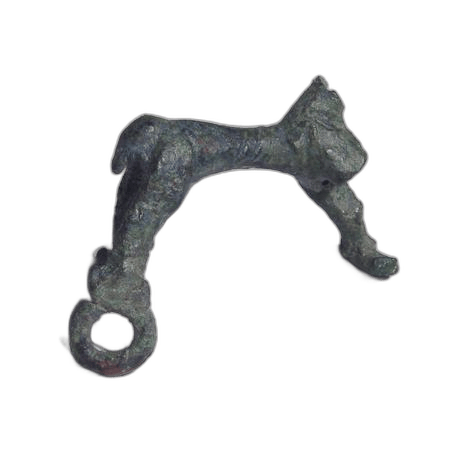
A modest example of the animal series is the bronze quadruped from Enkomi in the British Museum. It comes from a foundry hoard, dates c. 1200–1050 BCE, and is 4.1 cm high and 5.9 cm long; the museum describes it as possibly a deer or goat, with its front legs on a bar and its hind legs on an open ring, and suggests it may have belonged to a bronze stand or harness. Its find context, a hoard of metal gathered for recasting, shows how easily such pieces could disappear into the crucible.
The Cypro-Geometric gap and the animals
After the 11th century the human figures stop. Reyes states that "no anthropomorphic bronze figurines are known from Cyprus in the CG period" and that no continuity can be traced between the Late Bronze Age Egyptianizing figures and the Archaic series [2, p. 255]. He reads the later revival as "a true shift in local votive practice", while warning that knowledge of the Cypro-Geometric period comes mostly from tombs [2, p. 255].
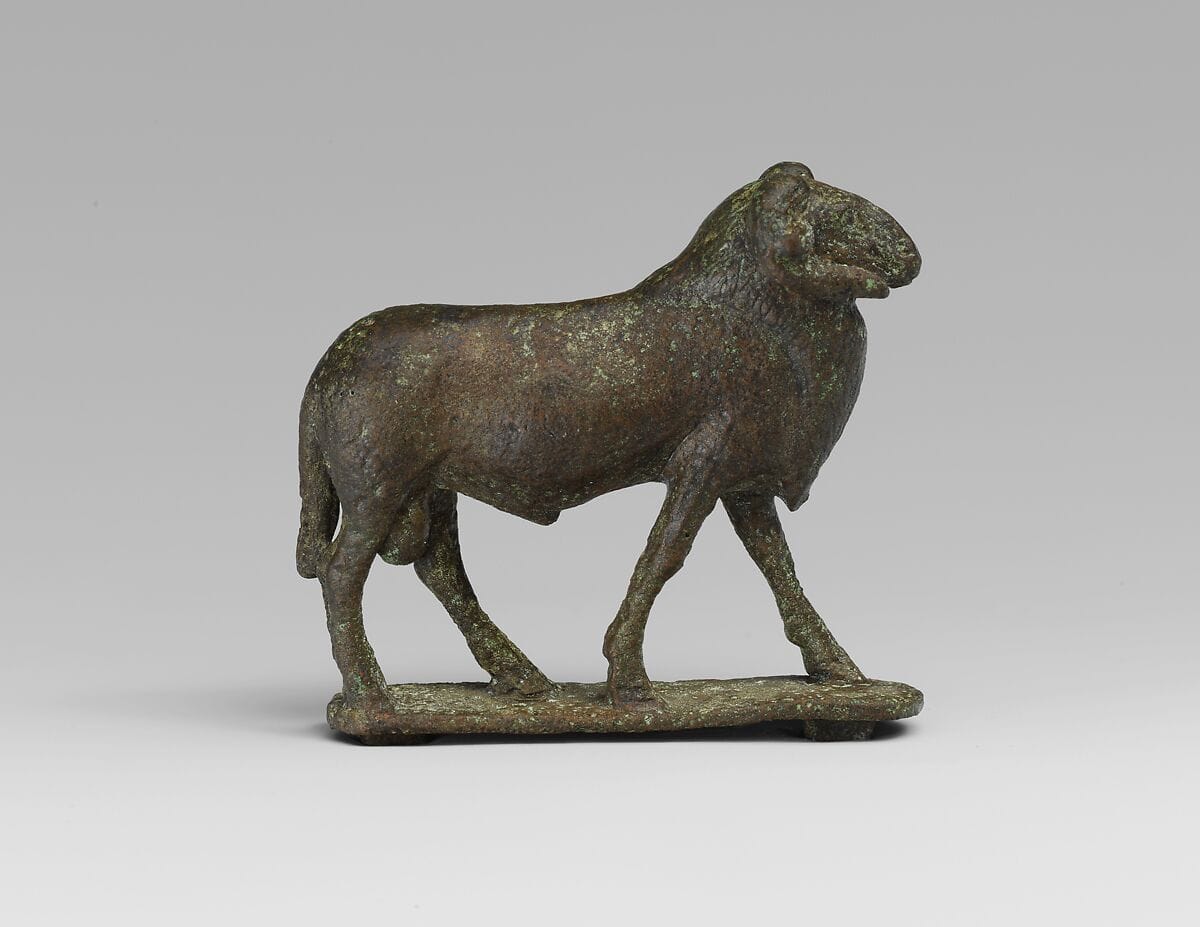
Animals are less clear. The Metropolitan Museum dates several bronze animals from the Cesnola collection to the Geometric period, 9th to 8th century BCE: a stag 12.9 cm high, cast solid and heavily corroded, said to be from Kourion (Met 74.51.5589), and a goat 10.8 cm high in a similar rough style (Met 74.51.5591). A bird of prey with glass paste, dated 8th to 7th century, may once have decorated a tripod or vase handle (Met 74.51.5571). These were bought in Cyprus by Cesnola without recorded contexts, and the dates are the museum's stylistic judgements.
Cypro-Archaic votive statuettes
The Archaic bronze statuettes remain "less well known than the contemporary limestone and terracotta sculptures" [2, p. 243]. Reyes catalogued 45, of which the largest group from one site is thirteen found in 1868 by Robert Hamilton Lang, British consul, at the temple of Apollo at Idalion, now in the British Museum [2, pp. 243, 256]. Lang described about a thousand sculptures there and "tiny feet in bronze, still adhering to some of the marble slabs" [2, p. 244]. Other findspots include Ayia Irini (three), Kition (two) and Tamassos (three), with seventeen of unknown origin [2, p. 256]. Two from Ayia Irini are dated by their contexts: one of 9.5 cm from the first half of the 7th century, in Stockholm, and one of 9.2 cm from c. 650–600 BCE, in the Cyprus Museum [2].
Unless otherwise stated, the figures are men in Egyptian-style kilts and conical helmets, some imitating the Egyptian white crown [2, p. 244]. Reyes sorted them by stance: Group A stands with arms at the sides and left leg forward, a pose he reads as a mortal worshipper or attendant; Group B holds one fist to the chest; other groups are seated or miscellaneous [2]. The Egyptianizing headdress, jewellery and clothing match 7th and 6th century Cypriot sculpture and a cultural background shared with the Phoenician coast, and the series had begun by the start of the 6th century [2, p. 254]. Seated bronzes from Enkomi had earlier been identified as the god El, but Reyes notes that a seated pose need not mean a god, and long robes may mark priests [2, p. 252].
Where were they made? Separating Cypriot from imported Levantine figures is "hazardous at best" [2, p. 255]. At Idalion, eight of the thirteen share incised detail and round scowling faces, and three may come from one workshop; Reyes suggests production at Idalion, near the copper sources of the Troodos foothills, while admitting this is an assumption [2, pp. 255–256]. Almost all come from sanctuaries as dedications, one comes from a tomb at Larnaca-Ayios Georghios, and rings on the backs of two suggest they hung as pendants [2, p. 256]. All the Archaic human bronzes are male except one doubtful female figure in the Pierides Museum, so a female bronze votive is "not as yet unequivocally attested" [2, pp. 253, 255]. For the wider cultural setting see Phoenicians and Egypt.
Small animal bronzes continued alongside them. The Met's rooster, 4.1 cm high on a small rectangular plate with incised details, is dated to the 6th century BCE (Met 74.51.5535), and the British Museum's schematic bull from Kourion, 3.3 cm high and weighing about 50 g, to 600–500 BCE. The catalogue also files a bronze Hathor sistrum from the sanctuary of Aphrodite at Palaepaphos (Kouklia) under this heading; it is in fact a fragment of a ritual rattle with a Hathor head and cobras, a cast object rather than a figurine.
Late Archaic and Classical: Greek-style bronzes
From the last quarter of the 6th century East Greek influence brings softer, smiling faces, and by the late Archaic and Classical periods the statuettes are "for the most part, purely Hellenized", like two kouros-like youths of the late 6th or early 5th century [2, p. 254]. A Louvre charioteer of 13.4 cm, with lines inlaid in silver wire, was dated by André Parrot to the 5th or 4th century with Achaemenid influence; Reyes thought it possibly earlier [2, p. 253].
The British Museum's bronze youth from Idalion, 11.5 cm high and dated c. 440–420 BCE, is a naked young man that the museum describes as of the Doryphoros type (BM 1872,0816.88).
The only large bronze to survive from Classical Cyprus is the Severe Style head from Tamassos in the British Museum. Peasants digging for water in a dry riverbed near Tamassos in 1836 found a complete life-size bronze statue of a youth, which fell apart; the head passed through the Chatsworth collection to the museum [10]. It is about 31.5 cm high and dated c. 460–450 BCE, with curls cast separately and attached at ear level and eyes once inlaid with coloured glass or stone; the right eye still has its metal casing cut as lashes [10]. A leg in the Louvre may come from the same statue, and the figure may represent Apollo [10]. The period setting is under Cypro-Classical.
Debates and open questions
The dating of the Enkomi sanctuaries is disputed. Porphyrios Dikaios placed the later levels in Late Cypriot IIIB, Maria Iacovou assigned all of Level III to Late Cypriot IIIA, and Kling divided it between the two [7, p. 77]. Dikaios read the burial of the Horned God and the caching of the Ingot God as hasty concealment; Webb argues instead that both were deliberate, ritual depositions made when the cult places were closed, and that the Ingot God sanctuary served two deities [7, p. 77]. On Dikaios's chronology, final abandonment falls around 1075 BCE, in Late Cypriot IIIB [6, p. 47].
Other questions remain open: whether the small figures show gods or worshippers, which pieces were made in Cyprus and which imported, and why human figures vanish between the 11th and 7th centuries. Each new statuette from a dated context helps; the Late Bronze Age and Cypro-Archaic period pages give the background, and the British Museum and Metropolitan Museum collection pages list further examples.
Objects on this page
- Bronze Quadruped FigureLate Bronze Age III · 1200–1050 BC
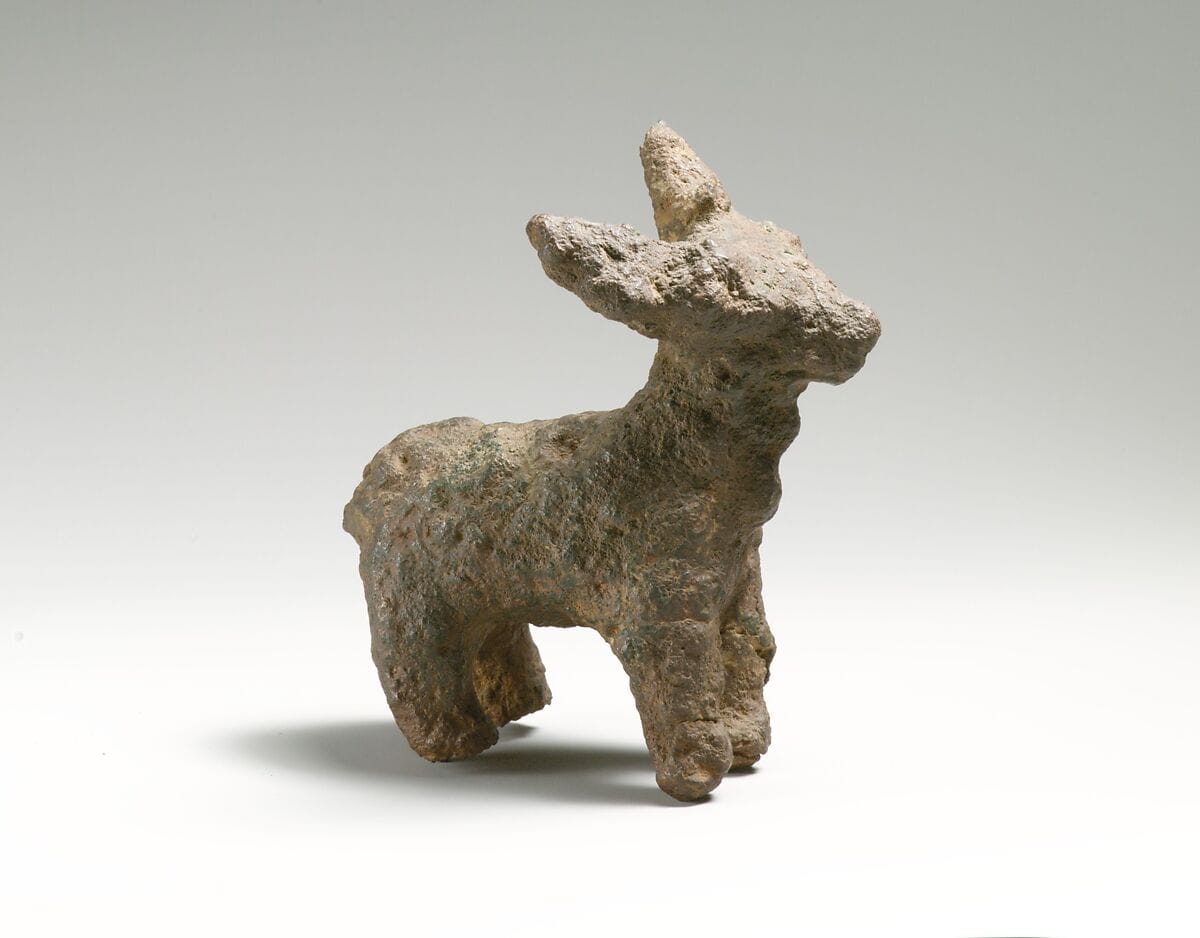 Bronze statuette of a stagGeometric III · 899–700 BC
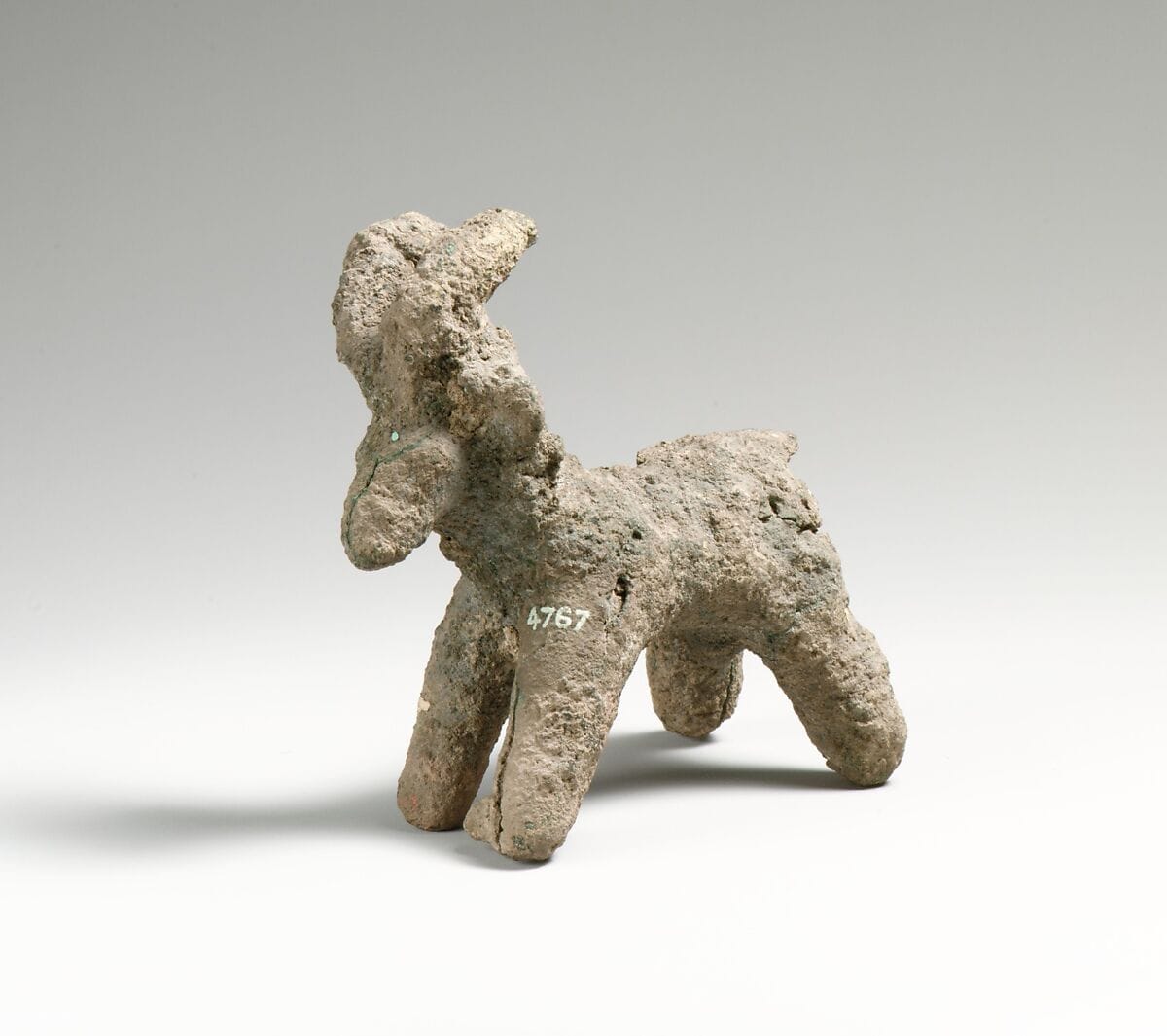 Bronze statuette of a goatGeometric III · 899–700 BC
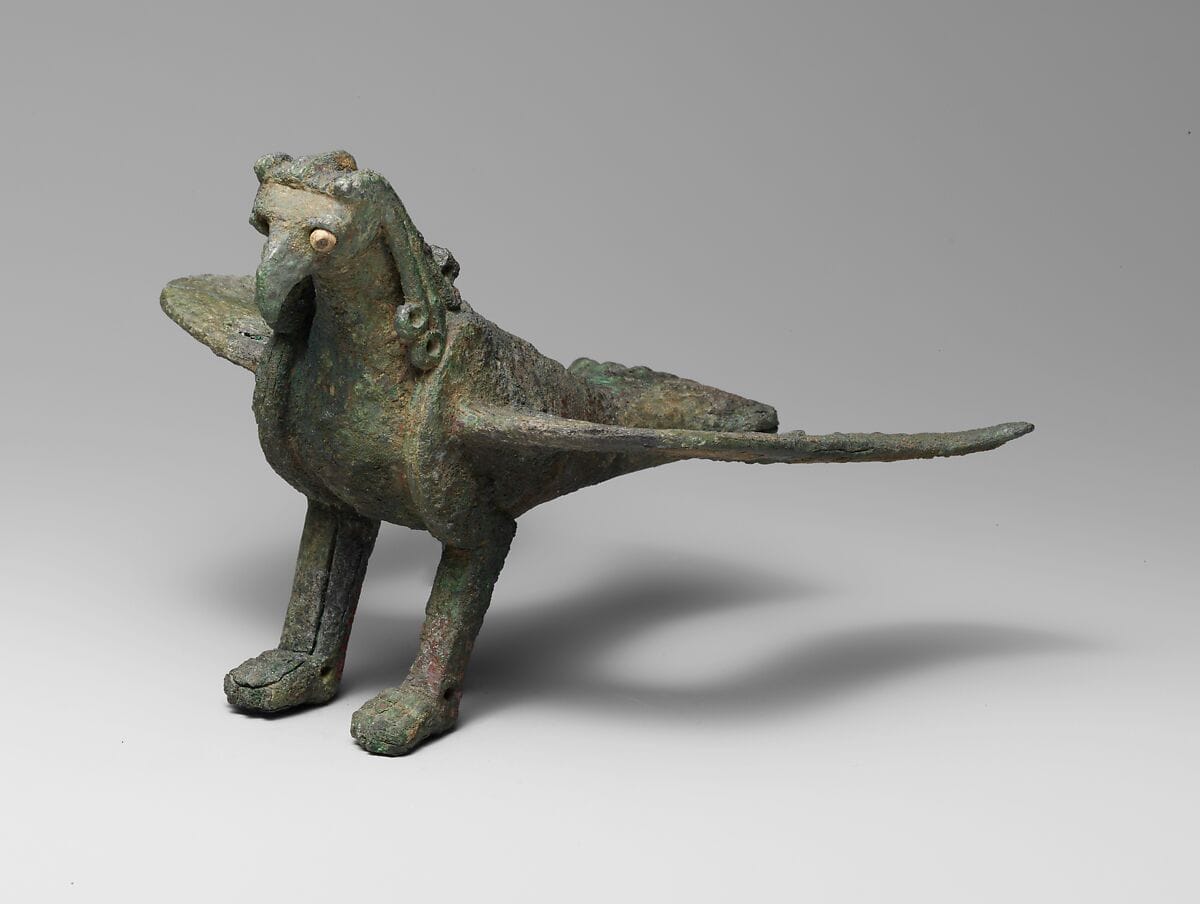 Bronze statuette of a bird of preyArchaic I · 799–600 BC
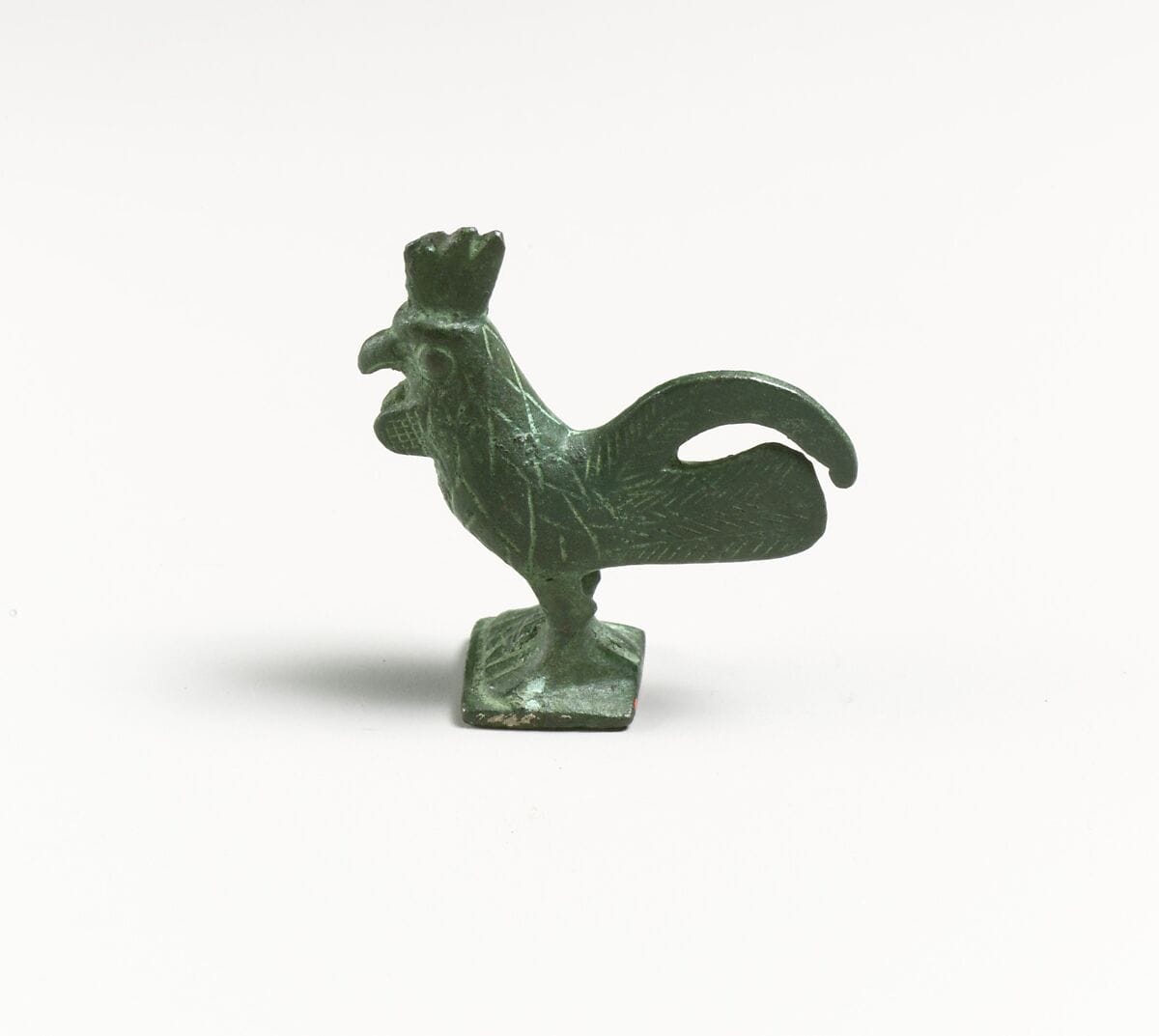 Bronze statuette of a roosterArchaic II · 599–500 BC
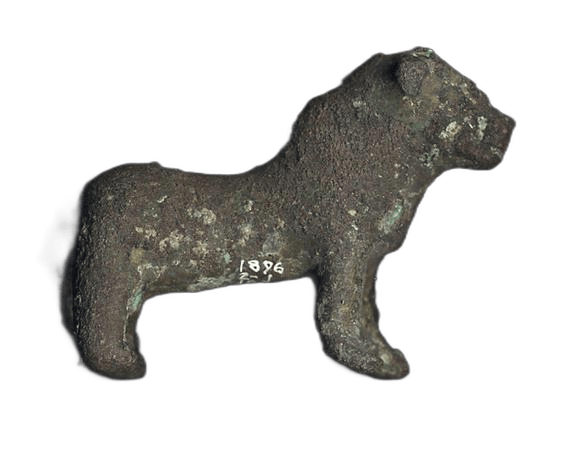 Bronze Bull FigureArchaic II · 600–500 BC
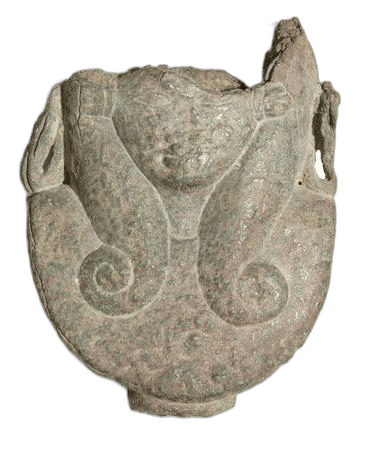 Bronze Hathor SistrumArchaic I · 750–500 BC
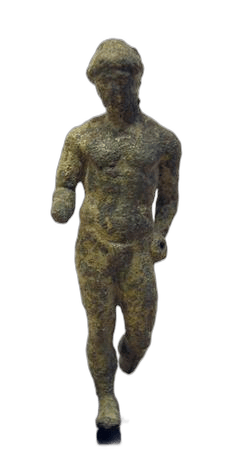 Bronze Doryphoros FigurineClassical · 440–420 BC
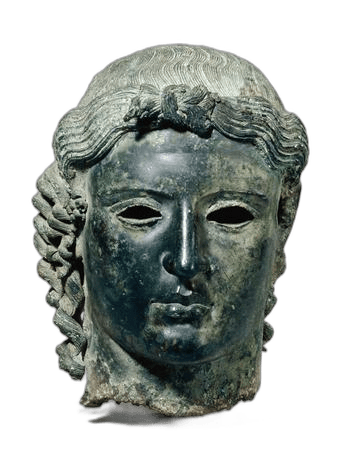 Severe Style Bronze HeadClassical · 470–460 BC
In the catalogue
References
- 1.Swedish Cyprus Expedition. (n.d.). Bronze. In The Swedish Cyprus Expedition (part 3, a summary after H. W. Catling, Cypriot bronzework in the Mycenaean world, 1964). Swedish Cyprus Expedition.
- 2.Reyes, A. T. (1992). The anthropomorphic bronze statuettes of Archaic Idalion, Cyprus. Annual of the British School at Athens, 87, 243–257. https://doi.org/10.1017/S0068245400015161
- 3.Sabatini, B. J. (2007). The Ingot God: The technological advancement and implementation of metallurgic ability on Late Bronze Age Cyprus [Master's thesis, Tufts University].
- 4.Budin, S. L. (2014). Before Kypris was Aphrodite. In D. T. Sugimoto (Ed.), Transformation of a goddess: Ishtar, Astarte, Aphrodite (Orbis Biblicus et Orientalis 263, pp. 195–215). Academic Press Fribourg; Vandenhoeck & Ruprecht.
- 5.Ancient Cyprus: 7000 years of art and archaeology. (n.d.). Louisiana State University Press.
- 6.Lupack, S. M. (2008). The role of the religious sector in the economy of Late Bronze Age Mycenaean Greece (BAR International Series 1858). Archaeopress.
- 7.Webb, J. M. (2001). The sanctuary of the Ingot God at Enkomi: A new reading of its construction, use and abandonment. In P. M. Fischer (Ed.), Contributions to the archaeology and history of the Bronze and Iron Ages in the Eastern Mediterranean: Studies in honour of Paul Åström (Sonderschriften 39, pp. 69–82). Österreichisches Archäologisches Institut.
- 8.Knapp, A. B. (2008). Prehistoric and protohistoric Cyprus: Identity, insularity, and connectivity. Oxford University Press.
- 9.The Cyprus Museum, Nicosia [Museum guide]. (n.d.). Epiphaniou Publications.
- 10.The Greek miracle: Classical sculpture from the dawn of democracy, the fifth century B.C. (n.d.) [Exhibition catalogue]. National Gallery of Art, Washington.