
Contents
Very few musical instruments survive from ancient Cyprus. What does survive is a large body of images of people making music, and most of those images are small clay figures. Katerina Kolotourou puts it plainly: "Images of musicians are a favourite subject in Cypriote iconography of the Iron Age", and although music appears on "a handful of vases, seal stones and bronze bowls", "the vast number of representations of musicians is to be found in the coroplastic art of the Cypro-Geometric and the Cypro-Archaic periods" [1, p. 183]. These terracottas were made to be offered in sanctuaries or placed in graves, and besides "the customary lyres and auloi" they show a marked liking for frame drums and cymbals [1, p. 183]. John Franklin notes that the corpus has never been fully assembled, because hundreds of first-millennium votive musicians are scattered through collections around the world [2]. This entry covers the physical instruments that do survive, the Late Bronze Age background, the lyres, pipes, drums and cymbals of the Cypro-Geometric, Cypro-Archaic and Cypro-Classical periods, the myth of Kinyras, and the points on which specialists disagree. It belongs with the daily life hub and its companion entries on food and diet and clothing and dress.
What survives: rattles, cymbals and scapulae
Clay rattles are "the earliest instruments to be found on the island" [1, p. 186]. More than fifty awl-shaped terracotta rattles are known from Enkomi, Hala Sultan Tekke, Idalion and other sites, mainly from Middle and Late Cypriot graves. Kolotourou, drawing on Buchholz's 1990 study, reports that none has been found in a child burial, which makes it "unlikely that they were used as toys" [1, p. 186]. A unique rattle in the form of a horse comes from a Late Cypriot II–III tomb at Kazakhani [1, pp. 186–187]. A second Bronze Age class is catalogued by Vassos Karageorghis among the Cypriot holdings of the National Archaeological Museum in Athens: three Late Cypriot I White Painted VI rattles (inv. 11956–11958), 8.9 to 14.2 cm high, each with an ovoid body and two holes for eyes. "A fairly large number of such objects are known, mostly from Cyprus, but also from the Levant"; they come from tombs, "but many of the known examples have no provenance" [3, cat. 82–84].
From the Cypro-Geometric period into Roman times the rattle takes new shapes: pomegranates, small bottles (phormiskoi) and pigs, again mostly from graves. Here the toy question reopens. Pig rattles were found in two child burials, at Salamis and at Trikomo, which, Kolotourou notes following Buchholz (1966), "may suggest that these rattles were also used as toys" [1, p. 187]. She keeps both readings in play: even in a child's grave it is "unlikely ... that the instrument would be devoid of its cultic significance" [1, p. 187]. The Bronze Age awl rattles and the later pig rattles therefore point in different directions, and the evidence does not yet settle whether any Cypriot rattle was made for play.
Kolotourou lists two excavated finds of cymbals. The earlier is a bronze pair from Pyla-Kokkinokremos, buried with a bronzesmith's hoard in the courtyard of a fortified building (Room 22, Complex B) before the site was abandoned at the end of Late Cypriot IIC. The later is a single bronze cymbal from Palaepaphos-Skales Tomb 64, a Cypro-Geometric II grave used for one burial and furnished with an iron sword and knife, which suggests a man [1, p. 195]. Both are plate cymbals about 10 cm across, the same type as Late Bronze Age cymbals from Hazor, Megiddo, Ugarit and the Uluburun wreck. Kolotourou is careful about their use: "The find contexts of the two Cypriote cymbals do not provide clear evidence with regard to the cultic use" [1, p. 195].
The third candidate is a class of incised cattle shoulder blades (scapulae), mostly Late Cypriot with some Cypro-Archaic and Cypro-Classical examples, from Kition, Enkomi, Myrtou-Pigadhes, Limassol-Komissariato and Palaepaphos. All come from temples or sanctuaries except one from a Palaepaphos tomb. Some scholars read them as scrapers (rasps); the polished surfaces and wear running at right angles to the incisions on examples from Ugarit and Kition support this. Others point out that no plectra have been found and prefer temple account-keeping or divination with shoulder blades (scapulomancy); the positions go back to Taylor (1957), Webb (1977) and Braun (2002) [1, pp. 187–188]. The question is open.
Rattles and scrapers never entered the image repertoire. Frame drums are depicted from Late Cypriot III, and cymbals appear in clay figures from the Cypro-Geometric period, becoming more frequent in the Cypro-Archaic [1, p. 188].
Late Bronze Age antecedents
The earliest Cypriot image of a stringed instrument may be on a Late Cypriot II faience bowl of the fourteenth or thirteenth century BCE in the Cyprus Museum, which has no recorded find-spot. Porphyrios Dikaios, in his 1961 guide, described "two human figures, one dancing and, to their left, Bes". Franklin reconstructs the left-hand figure as a woman "wielding a lyre of Levantine type", with a bird-head finial on the crossbar and hanging tassels, held horizontally "as usual in Canaanite and New Kingdom representations" [2]. Related faience dishes show women playing lutes: one said to come from near Idalion, one in Leiden (a lute-girl with a Bes tattoo) and one from a tomb at Maroni. More than 130 faience vessels and fragments are known from Late Bronze Age Cyprus, and whether they are Egyptian imports, the products of a Canaanite workshop or local imitations is debated [2].
The thirteenth-century bronze stands from Kourion add harps, several of them of Mesopotamian type [2]. From the Ingot God sanctuary at Enkomi come about a hundred broken terracotta figures that "clearly predict the IA votive dance-groups", though they are "too fragmentary for specific instruments to be identified" [2].
The first drummer is disputed. Averett points to a Late Cypriot II "bird-faced" Base Ring female figure of 1400–1230 BCE in the Louvre (AM 1), who holds a disk over her left breast that is "most likely a hand drum" [4, p. 15]. Kolotourou states that the frame drum "is first encountered in the Late Cypriote III period" [1, p. 188]. The name Kinyras, formed from the word for lyre, is already attested twice as a personal name at Mycenaean Pylos [2].
Lyres: shapes and the "ethnic" debate
Franklin distinguishes two lyre forms in Iron Age Cyprus. The first is a round-based, symmetrical lyre, "first attested in an eleventh-century vase painting" and then found regularly on vases and votive figures. The second is a flat-based, often asymmetrical lyre, shown on the engraved metal bowls of the ninth to sixth centuries; it is a Syro-Levantine type going back to the third millennium and "convincingly correlated with the word knr" [2].
The key early images are painted pots. An eleventh-century kalathos from Kouklia (Old Paphos) shows a warrior with a sword holding a round-based lyre, "parading or dancing"; the other panel probably shows a goat or ram sacrificed at an altar beside a tree. Coldstream compared the lyre-player to "Kinyras himself"; Sherratt replied that if so, it is "a quite different Kinyras ... the more recognisably Greek version" [2]. A late tenth-century vase from Kaloriziki near Kourion has lyre arms drawn as zigzags beside a libation scene [2]. The Hubbard amphora from the Famagusta district, of about 800 BCE and a "longtime centerpiece of the Cyprus Museum", shows what Markoe read as a funeral: "a lyric choral ritual honors the deceased who sits enthroned", a scene Franklin sets beside the Rāpi'u text from Ugarit [2]. The amphora is also a standard example of free-field painting.
How to read the two lyre types is the main typological argument. Lawergren (1998) held that "Cyprus had both Eastern and Western lyres": round-based lyres "flourished ca. 1100-800 B.C.E. ... in the wake of Aegean influences", thin lyres arrived from about 850 BCE through Phoenician influence, and "a very large number of round-based lyres" appear again in the fifth century. Deger-Jalkotzy went further, calling the lyres, "previously unknown", "an ethnic marker of Aegean influx" [2]. Franklin (2016) accepts that Lawergren's distinction "remains broadly valid" but finds that "it is not clear just where the line should be drawn". Equating western with Aegean and eastern with Phoenician, he argues, turns Cyprus into "a passive matrix for the implantation of foreign lyric identities", an idea "not only politically objectionable, but inherently implausible". He notes zigzag arms and round bases on two early second-millennium seals from southern Anatolia, and proposes that the Iron Age round-based lyres are "Cypro-Aegean hybrids". The lyres held by votive figures are "distinctly round", and this was "by far the dominant Cypriot form prior to the Phoenician influx" [2].
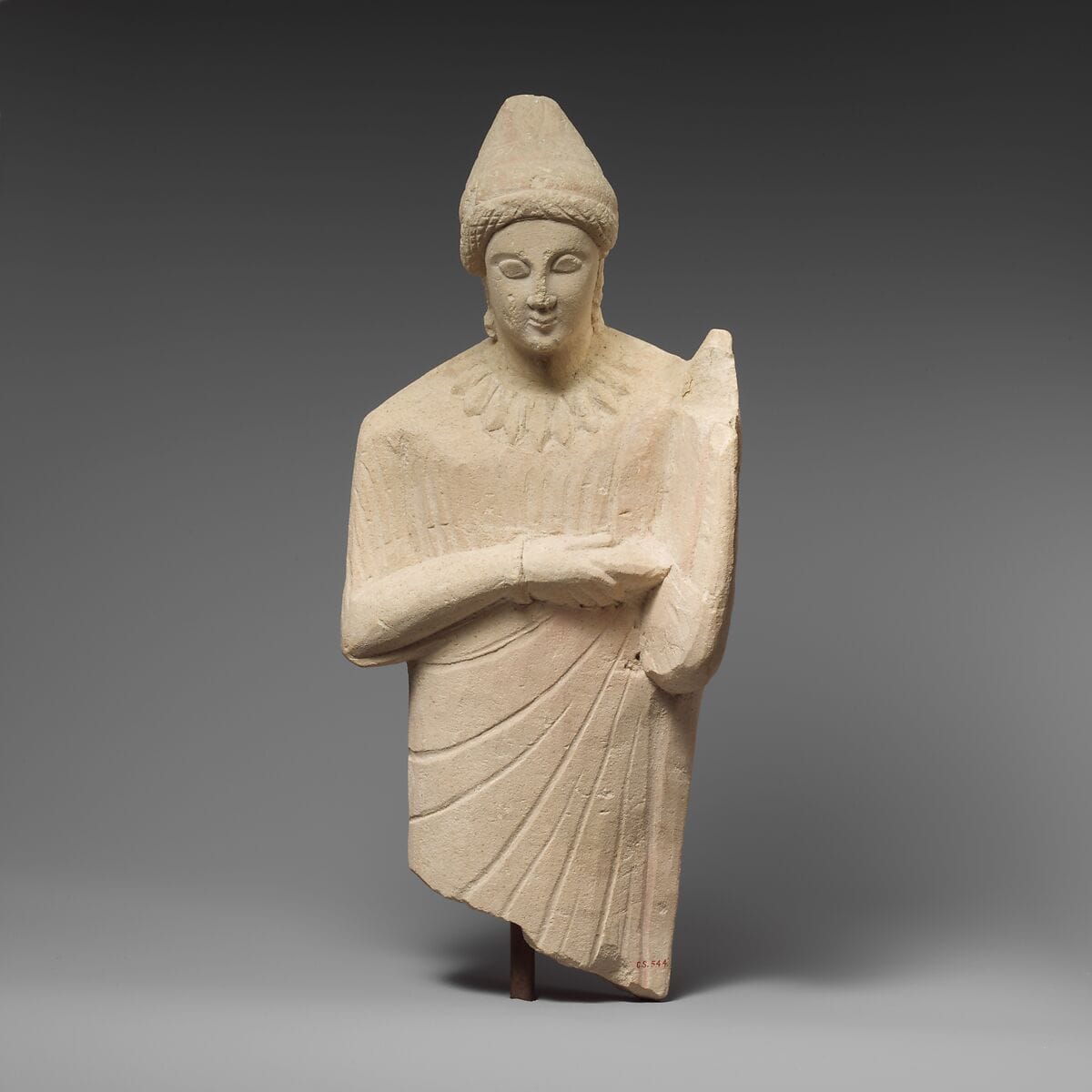
The figures themselves are numerous. Leriou, using the catalogue of Cypriot coroplastic art by Karageorghis and Karageorghis, counts 89 lyre players against 23 flute players, "found primarily in sanctuaries, with a mere handful associated with burial contexts" [5, p. 530]. A Cypro-Archaic terracotta lyre player from Kition, excavated by Myres in 1894 for the Cyprus Exploration Fund, is in the Ashmolean (AN1896-1908.C.320). In limestone the best-known example is the late fifth- or early fourth-century BCE statuette of a female lyre player, 35.6 cm high, in the Metropolitan Museum (74.51.2641), shown at the head of this page.
Double pipes, ring dances and the sanctuary
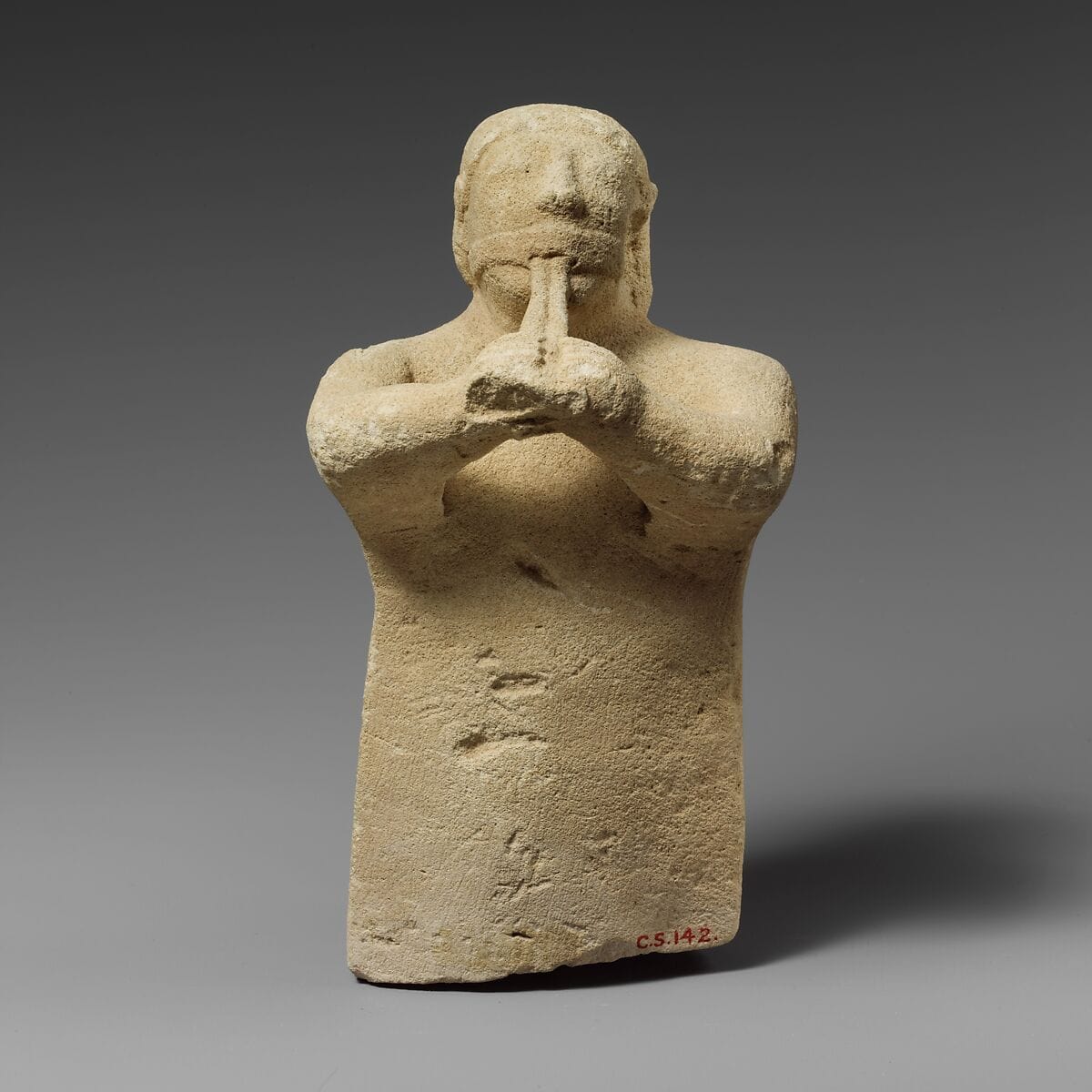
Leriou divides the Cypro-Archaic terracotta musicians into "flute-, lyre- (or harp) and tambourine- (or tympanon) players", and notes that the flute and lyre themes are attested "from as early as the end of the Late Cypriot period" [5, p. 529]. The "flute" of these figures is the aulos, the double pipe that Averett calls the "double flute" [4, p. 15].
The pipes are most at home in the ring dance. Clay models show groups of "usually three to six" figures, holding hands or resting their hands on each other's shoulders, "dancing around a flute player or a tree" on a round clay base. The earliest ring-dance models are Cypro-Geometric I. Leriou counts only about twenty in all, none from a burial, and "all seven examples of ring-dance models with secure provenance originate from open-air sanctuaries": Ayia Irini, Arsos-Pervolia, Chytroi-Katsourkas, Katydata-Linou, Idalion and Yeroskipou-Monagri, three of them linked to cult places of Aphrodite [5, pp. 528–529]. The central flute player is "usually male". A model in the Louvre, "allegedly from Idalion", has four dancers and a lyre player around a perforated column topped by three birds, which has been read as a dovecote. At the end of the Cypro-Classical period limestone ring dances from Achna (five) and Pyla-Stavros (two) have clearly female dancers [5, pp. 528–529]. Averett summarises the type as "circular compositions of female dancers holding hands and surrounding a central male musician", who plays "the double flute or lyre"; one Cypro-Archaic I group of about 700 BCE has a woman drummer at the centre instead [4, p. 15]. The site's article on two figures and a tree looks at one of these tree-centred groups.
At the sanctuary of Apollo Hylates at Kourion more than ten complete ring-dance terracottas were found, but here the dancers "move in single file", a scheme with no parallel elsewhere on the island that may reflect a local rite [5, p. 529].
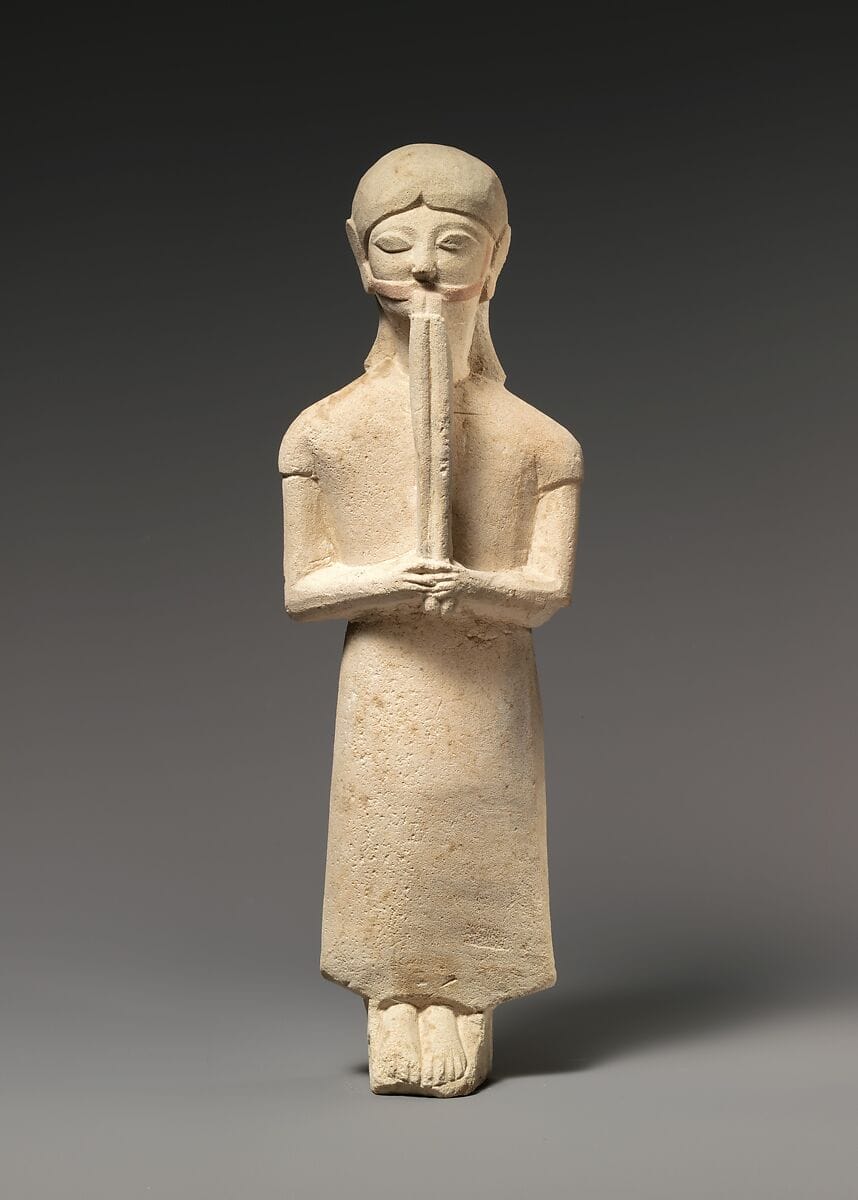
The setting explains why so many musicians survive. At Ayia Irini "more than two thousand terracotta statues and figurines" were found in place, standing in a semicircle around a stone altar, and most Cypro-Archaic ritual took place in open courtyards [5, p. 528]. Figures of musicians may have been dedicated "to provide eternal pleasure through music to the gods" [5, p. 529]. In stone, the Met holds an Archaic limestone flute-player of the first half of the sixth century BCE, 26.7 cm high (74.51.2508), shown here, and a smaller limestone aulos player of the same date. For the stone sculptures in general see Archaic limestone sculpture.
Frame drums and cymbals: percussion and gender
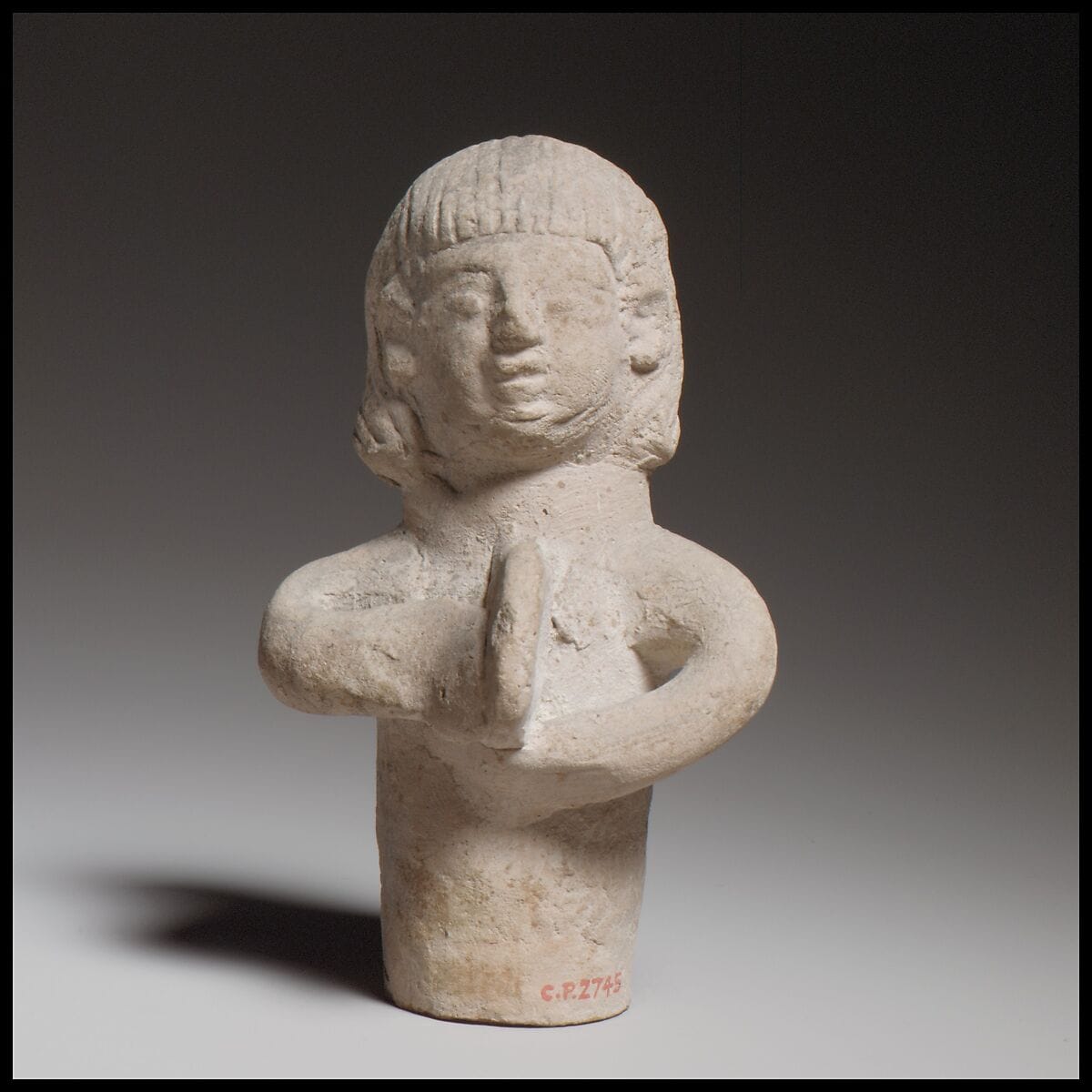
The frame drum, the "tambourine" or tympanon of the literature, had a wooden or metal frame with a membrane "nailed, glued or laced", and in Cyprus it was struck with the bare hands [1, p. 188]. In clay it is rendered as "a clay disc, flat and large enough to cover the upper body" [1, pp. 189–190]. Kolotourou distinguishes three ways of holding it: perpendicular to the body and played, the most common (for example in the Lapithos workshop); parallel to the upper body and played; and held flat against the front of the body without being played, on mould-made plaques, especially from Arsos but also from Lapithos, Idalion, Achna and Amathus [1, p. 190]. The Arsos-style plaques, some up to 35 cm high, travelled: at least eight reached the Heraion on Samos in strata of 730 to 700 BCE, thirty were published from Lindos, and others come from Kameiros [1, p. 194]. Averett puts the arrival of the tympanon in the Aegean at the end of the eighth century [4, p. 20].
The drummer is "one of the most prolific" figure types of the Archaic period, and its disk has been read as a tambourine, a rattle, a platter, a loaf of bread, a sun-disk or a moon [4, p. 15]. Averett attributes the standardisation of the type in the Cypro-Archaic period "probably" to Phoenician influence, and assigns the drummer in the Missouri museum to the kingdom of Salamis, "most likely at the Achna sanctuary or perhaps at nearby Arsos" [4, pp. 14, 16]. An enthroned woman holding a disk, late Cypro-Archaic II and "reputedly from Idalion", may be a goddess; Kolotourou finds a link with Aphrodite or Astarte "plausible" [1, pp. 189–190] (see Astarte figures). Leriou counts no fewer than 115 tambourine players, "the largest group of terracotta musicians" [5, p. 530]. A Kamelarga-style standing female tambourine player in the Met is a typical Cypro-Archaic II example.
Two disagreements run through this material. The first is gender. Leriou states that "all terracotta figurines of tambourine-players are female", that they come from sanctuaries of the Cypriot goddess (Achna, Larnaca-Kamelarga, Kouklia, Yeroskipou-Monagri, Pyrga, Idalion, Arsos, Chytroi-Skali and Lapithos), that they "do not appear in burial contexts", and that they may represent "priestesses, specialised attendants, or even members of a ceremonial band" [5, p. 530]. Kolotourou points to three male mould-made figures in the Louvre, two of them from Cyprus and of the Arsos workshop, which hold the disk in the same way and "may reflect the practice of the tambourine being played not only by females but also by males" [1, pp. 194–195]. Leriou herself sets aside 29 figures from Amathus tombs that Karageorghis classed as tambourine players: they are of both sexes and hold a different object, read by others as "a cake, a pomegranate or even a baetyl" [5, p. 530].
The second is whether some "tambourine players" are cymbal players. Meerschaert (1991) held that cymbals are not depicted in Cyprus. Kolotourou argues that "more than a dozen male terracotta figurines dated between the 8th and 6th centuries BC", with the hands placed "antithetically on each side of a disc" and usually called drummers, are in fact playing cymbals; the type began at Amathus and was exported to Idalion [1, pp. 197–198]. The large Cypro-Archaic II output of Lapithos is the test case. Karageorghis catalogued 34 figures and knew of at least 130 more in collections; most hold their disks "in the manner of cymbals". Yon and Caubet (1988) read them as cymbal players, while Karageorghis (1998) read them as holding a tambourine "simply held rather than played" [1, p. 198]. The British Museum catalogues a 15 cm Lapithos figure of this workshop as a woman playing a cymbal (1900,0903.9).
| Instrument | Earliest Cypriot evidence | Kind of evidence | Sources |
|---|---|---|---|
| Clay rattle | Middle and Late Cypriot graves; LC I White Painted VI type | Surviving objects | [1]; [3] |
| Scraper (incised scapula)? | Late Cypriot sanctuaries | Surviving objects; identification disputed | [1] |
| Lyre | LC II faience bowl (reconstructed); 11th-century Kouklia kalathos | Images and figurines | [2] |
| Lute | Late Cypriot faience dishes | Images | [2] |
| Harp | 13th-century Kourion bronze stands | Images | [2] |
| Double pipe | End of the Late Cypriot period; CG I onward in ring dances | Figurines | [5] |
| Frame drum | LC II Base Ring figure (Averett) or LC III (Kolotourou) | Figurines and plaques | [1]; [4] |
| Cymbals | Pyla-Kokkinokremos pair, end of LC IIC; Skales T. 64, CG II | Surviving objects; figurines disputed | [1] |
Music on bowls and in funerary scenes
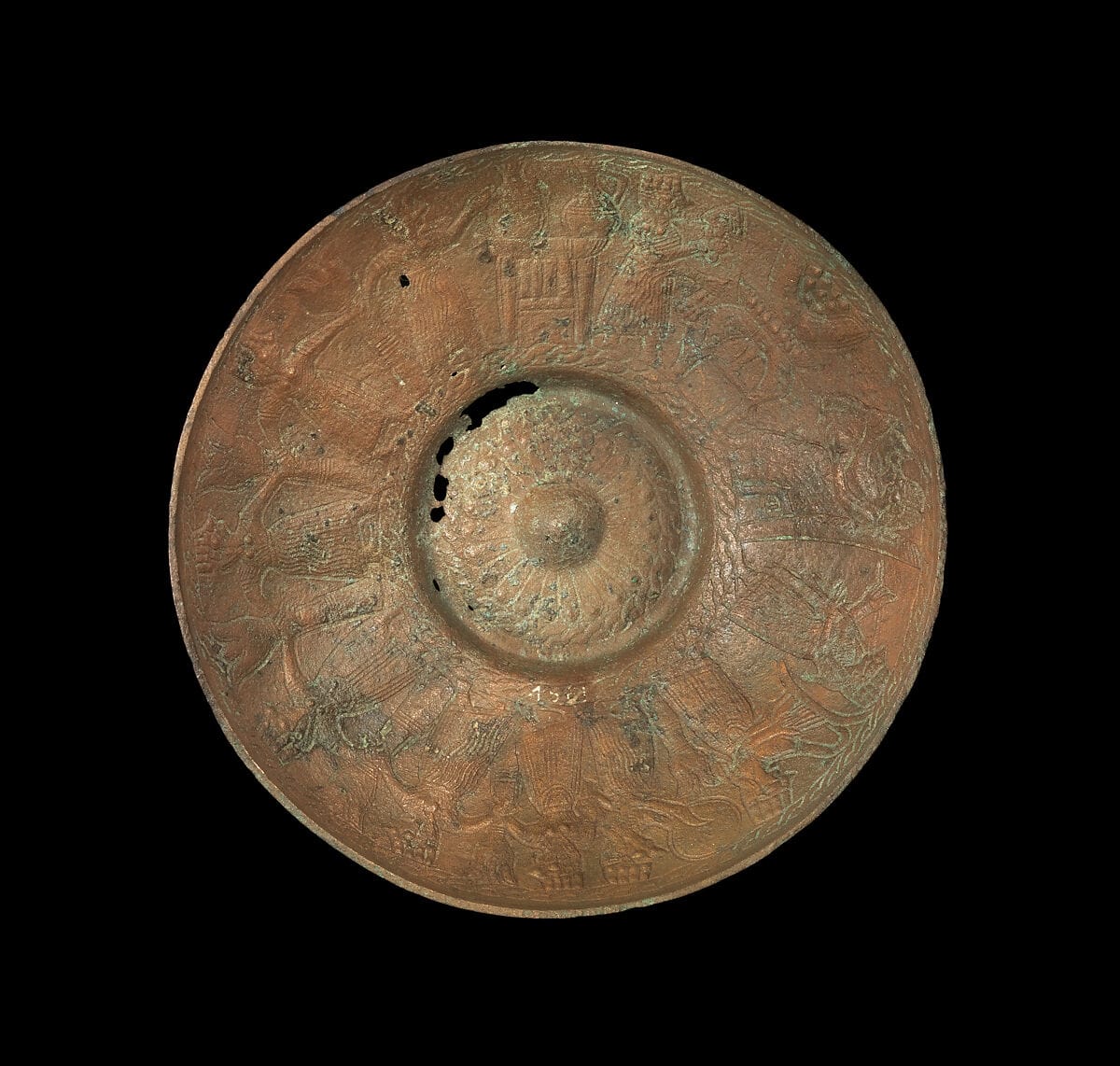
The engraved metal bowls of about 900 to 600 BCE, often called Cypro-Phoenician, have been found in Cyprus, Crete, Nimrud, Etruria, Iran and Israel. Some were probably made on the island: they depict Cypriot pots and vehicles, some carry Cypro-syllabic inscriptions, and on one from Kourion (Markoe's Cy11) the owner's name was engraved when the bowl was made. Cyprus is "the only area which has produced finds, in both votive and funerary contexts, throughout the life-cycle of the bowls" [2]. Their musical scenes are generally "a celebration of Astarte/'Aphrodite'", with processions "of normally female musicians", dancers and offering-bearers; where the goddess scene merges with a banquet, on Cy5 and Cy6, "a hierogamic reading seems plausible" [2]. Kolotourou lists Cy3, Cy5, Cy6, Cy7 and Cy13 as the bowls with music [1, p. 183]. Cy6 shows an ensemble with a Phoenician-type lyre and bears two Cypro-syllabic inscriptions, one read as "king" and the other perhaps as Κυπρομέδουσα, "Ruling over Cyprus" [6, p. 410 n. 62]; the script is treated in writing and literacy. A small eighth-century bronze bowl in the Met, 13.3 cm across, is catalogued with the subjects goddess, dancers and musicians (74.51.5700). For the vessel form in general see the site's article on Cypriot bowls.
Whether music belonged to funerals is argued from two different bodies of evidence. The painted scenes of the early Iron Age, the Hubbard amphora above all, have been read as funerary rites with lyre and chorus [2]. The Cypro-Archaic figurines point the other way: their distribution leads Leriou to conclude that "music did not hold a central role in CA funerary rites" [5, p. 530]. The two positions concern different periods and different media, and both may hold.
Kinyras and the divine lyre
Kinyras, the legendary king of Cyprus from whom the kings of Paphos claimed descent, bears a name that ties Cypriot music to the Levant. At Late Bronze Age Ugarit an Akkadian list of gods (RS 1.017 and RS 20.024) ends with "Divine Censer", "Divine Lyre (kinnāru)" and "Divine Kings"; the double sign for "god" and "wood" before the lyre's name marks "a physical Lyre that was somehow regarded as Divine". The word kinnāru is "cognate with both Heb. kinnōr and 'Gk.' kinyra" [6, p. 5]. Albright wrote that the derivation of Kinyras from kinýra "may now be regarded as certain", and pointed out that Ugarit can be seen "on a clear day" from Salamis and the Karpas. Baurain, by contrast, judged the positing of a real god Kinnaru "fort excessif" [6, pp. 5–6]. Franklin (2016) considers Kinyras' "kinship to the Divine Kinnāru-lyre of Ugarit ... now beyond doubt, although the circumstances of his arrival in Cyprus ... await full explication" [2].
The Greek sources remember him in several roles. Pindar makes Kinyras "priest of Aphrodite" and "beloved of Apollo", and treats Cypriot songs in his praise as a living custom; Homer has him, as a great king, send a friendship gift to Agamemnon; and Apollo bore the epithet Kenyristḗs [6, pp. 226, 409–410]. The last of the Kinyrad kings of Paphos, Nikokles II (died about 306 BCE), styled himself "Priest of the Queen" and refounded Nea Paphos, and Mlynarczyk has suggested that Apollo was made Kinyras' father at that time [6, pp. 409–410]. A seventh-century limestone head from Palaepaphos (KA 730) is published as a "Kinyrad king" [6, p. 408].
What can and cannot be said
The Cypriot evidence for music is abundant in one sense and thin in another. There are hundreds of musician figures, a few engraved bowls and painted vases, a scatter of rattles, two finds of cymbals and a disputed group of incised shoulder blades; the evidence for lyres, lutes, harps and pipes discussed here consists of images. Leriou adds a caution that applies to the whole field: "almost half" of the figurine evidence is "of unknown provenance and accompanied by no contextual information" [5, p. 530]. Her counts of 89 lyre players, 23 flute players and at least 115 tambourine players therefore describe what museums hold as much as what sanctuaries received. Within those limits the pattern is consistent. Music in Iron Age Cyprus is shown above all in sanctuaries, often of the goddess later called Aphrodite; the drum is the characteristic instrument of the figurines and is usually, though perhaps not always, held by women; and the lyre carries a history, through Kinyras and the kinnāru of Ugarit, that links the island to the Levant as much as to the Aegean. The terracottas themselves are covered in the statues hub, and the wider religious setting in the entries on the Cypro-Archaic period and the Phoenicians.
Objects on this page
References
- 1.Kolotourou, K. (2005). Music and cult: The significance of percussion and the Cypriote connection. In V. Karageorghis, H. Matthäus, & S. Rogge (Eds.), Cyprus: Religion and society from the Late Bronze Age to the end of the Archaic period (pp. 183–204). Bibliothek am Guthof.
- 2.Franklin, J. C. (2016). Ethnicity and musical identity in the lyric landscape of early Cyprus. Greek and Roman Musical Studies, 4. https://doi.org/10.1163/22129758-12341256
- 3.Karageorghis, V. (2003). Ancient Cypriote art in the National Archaeological Museum of Athens. A. G. Leventis Foundation.
- 4.Averett, E. W. (2002–2004). Drumming for the divine: A female tympanon player from Cyprus. Muse (Museum of Art and Archaeology, University of Missouri), 36–38.
- 5.Leriou, A. (2017). The musician, the dancer and the priest: Readdressing Cypro-Archaic ritual. In V. Vlachou & A. Gadolou (Eds.), Terpsis: Studies in Mediterranean archaeology in honour of Nota Kourou (Études d'archéologie 10). CReA-Patrimoine.
- 6.Franklin, J. C. (2015). Kinyras: The divine lyre (Hellenic Studies 70). Center for Hellenic Studies.