
Contents
A relief is a carving that stays attached to its background: the figures project from a flat slab instead of standing free. In Cyprus almost every surviving relief is cut in the island's soft local limestone, and many still carry traces of the red paint that once coloured their grounds and details. The class covers three kinds of object. Votive reliefs were set up in sanctuaries as gifts to a god. Funerary stelae (Greek stelai, the plural used by Antoine Hermary) were upright slabs or pillars that marked or decorated a tomb. Small relief plaques, often showing a single body part, were dedicated in sanctuaries alongside statues. The best-known group, and the one most of our own catalogue examples come from, is the Cesnola Collection in the Metropolitan Museum of Art, excavated or bought by Luigi Palma di Cesnola in the 1870s and dominated by finds from Golgoi. See all reliefs in the catalogue.
What counts as a Cypriot relief
The common denominator is technique and stone. Cypriot sculptors worked the same soft limestone for reliefs that they used for Archaic limestone statues, and they painted it: red grounds, red fillets and red details on cushions and garments survive on many pieces (see limestone polychromy) [1, pp. 336, 344]. Hellenistic grave reliefs were cut from the soft white to yellow-white limestone of the Mesaoria, reached a maximum height of about 1.85 m, and carried their figures in high relief [3].
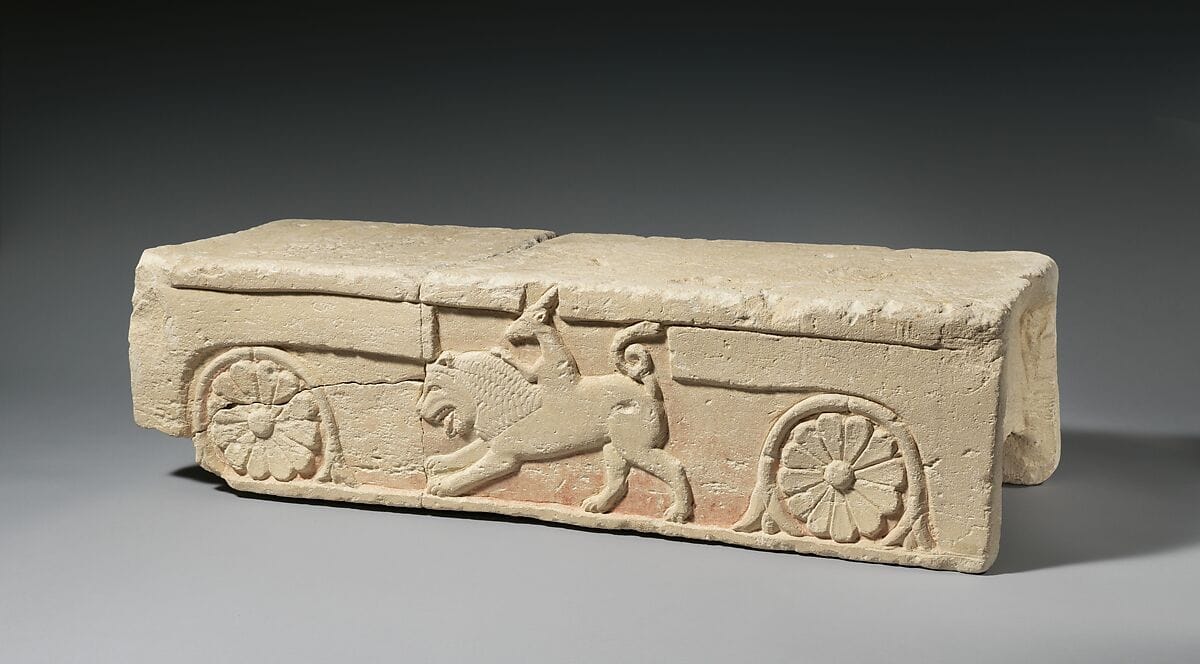
Function divides the class more sharply than style. A funerary stele belongs to a tomb and to a named or implied dead person; a votive relief belongs to a sanctuary and a god. The small plaques with ears, eyes or breasts sit on the boundary between relief sculpture and the anatomical votives dedicated at healing and fertility cults, and some catalogue entries for furniture, such as a limestone footstool decorated with a chimaera between rosettes on a red ground, are reliefs only in the sense of their ornament [1, p. 317].
| Group | Date | Typical subjects | Main find places |
|---|---|---|---|
| Archaic funerary stelae | 6th century BCE | Lions, sphinxes, Hathor heads, volute finials | Golgoi, Idalion, Tamassos, Amathus |
| Archaic and Classical votive reliefs | 2nd half of the 6th to early 5th century BCE | Animal combat, master of lions, Herakles | Golgoi-Ayios Photios |
| Classical figured stelae | 2nd quarter of the 5th to 4th century BCE | Banquet, family groups, mourners | Golgoi |
| Hellenistic grave reliefs | Late 4th to 1st century BCE | Standing and seated figures in niches | Golgoi, Amathus, Salamis, Styllos |
| Early Roman stelae | 1st to early 2nd century CE | Banquet, seated woman | Golgoi, Salamis |
Archaic funerary stelae: lions, sphinxes and Hathor
Funerary sculpture in Cyprus begins at the end of the 7th or the start of the 6th century BCE, at about the same time as votive statuary. The early works are rare and are "almost exclusively lions and sphinxes" [1, p. 329]. In the 6th century the usual form was a lion, more rarely a sphinx, set on top of a stele that ended in a cavetto finial. Hermary notes that these monuments may be close in date to the Attic stelae with a sphinx on a cavetto capital, a series that begins around 600 BCE, though the early Cypriot pieces are hard to date because almost none come from a recorded archaeological context [1, p. 329]. The Met's finial with a seated lion (74.51.2852) is dated by the museum to the late 7th or early 6th century BCE. The type spread in the later Archaic period from Golgoi and Idalion to Tamassos, Kornos and Amathus [1, p. 329]. (The animals themselves are discussed on lions, sphinxes and griffins.)
Some stelae borrowed Egyptian imagery directly. A slab from the Golgoi necropolis, 87.6 cm high, shows the head of the Egyptian goddess Hathor with a broad collar and bovine ears; Hermary dates it to the first half of the 6th century BCE and calls it "probably the oldest representation of the head of Hathor in Cypriot sculpture" [1, pp. 330–331]. Volute finials with Hathor heads followed; Katja Walcher catalogued 81 so-called Proto-Aeolic capitals from the island (Walcher 2009, cited in [1, p. 331]). Hathor capitals also stood in sanctuaries as cult monuments up to two metres high, with the earliest and most Egyptian-looking examples from Kition, and Ohnefalsch-Richter found votive stelae with Phoenician capitals and a Hathor head in the spandrel in the sanctuary of Aphrodite at Idalion in 1893 [2]. Ulbrich treats the dedication of stelae in sanctuaries as a Near Eastern custom going back to the Bronze Age [2]; see Egypt and the Phoenicians.
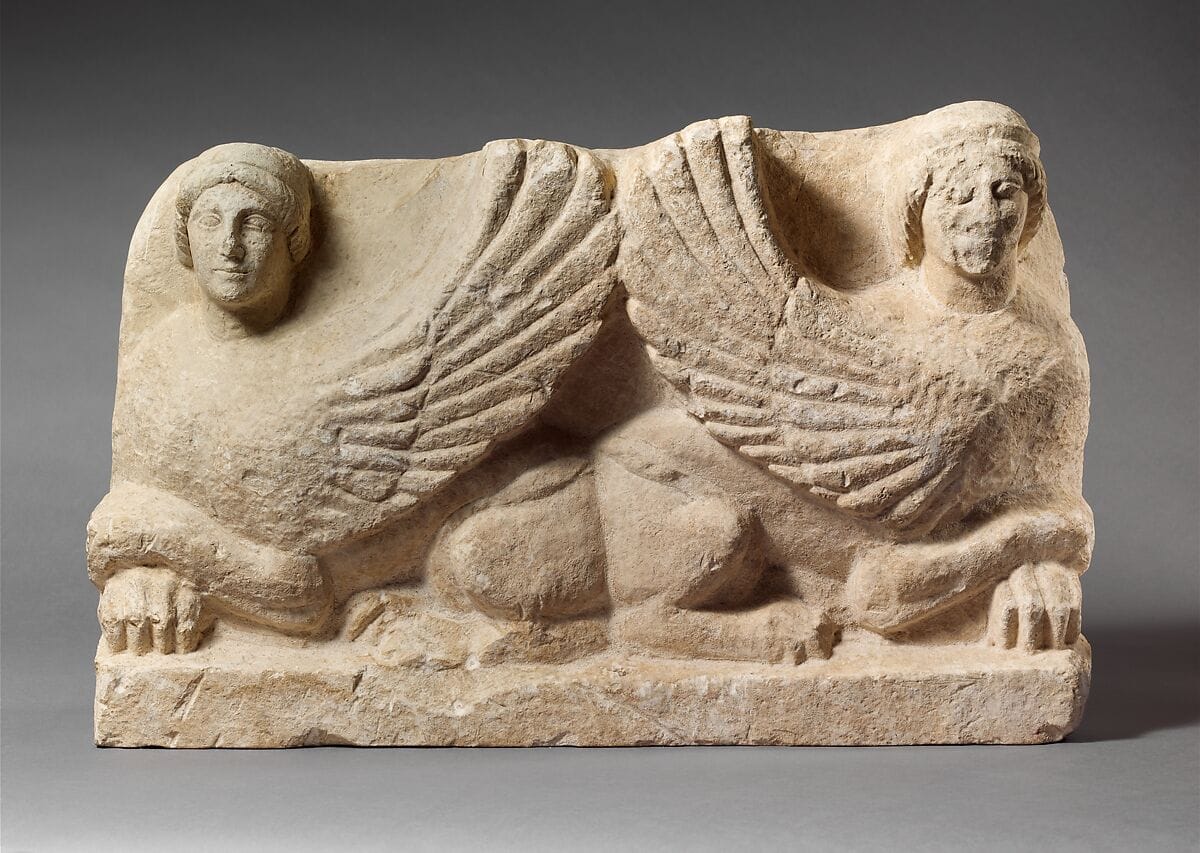
In the 5th century the animal stele continued as a pilaster-shaped monument pairing sphinxes with the "tree of life", and it was soon Hellenized: a small band knotted round the shaft is borrowed from Attic stelae [1, p. 329]. The catalogue's funerary stele with antithetical sphinxes is a finial from the Golgoi necropolis, 35.6 cm high and 55.2 cm wide, with two sickle-winged sphinxes in high relief lying back to back. Hermary dates it to the middle of the 5th century BCE, the Met record to about 475 to 450 BCE; the head on the left sphinx does not belong to its body [1, p. 336].
Classical figured stelae and the banquet
Stelae with frontal human figures begin toward the end of the Archaic period and run through the Cypro-Classical period, while lions, sphinxes and the winged disk persist until at least the second half of the 5th century [1, p. 343]. Both men and women are commemorated. The commonest subject is the banquet, the dead man reclining on a couch, sometimes with his wife and children. Hermary describes the funerary banquet as "unfamiliar to the Greek world of poleis" and notes that it spread through the Achaemenid empire from the end of the Archaic period, in reliefs and in tomb paintings in Anatolia (see Achaemenid Persia). In Cyprus the reclining banqueter already appears on metal bowls of the early Archaic period and on 6th-century statuettes in the round, but in funerary imagery only from the second quarter of the 5th century BCE [1, p. 343].
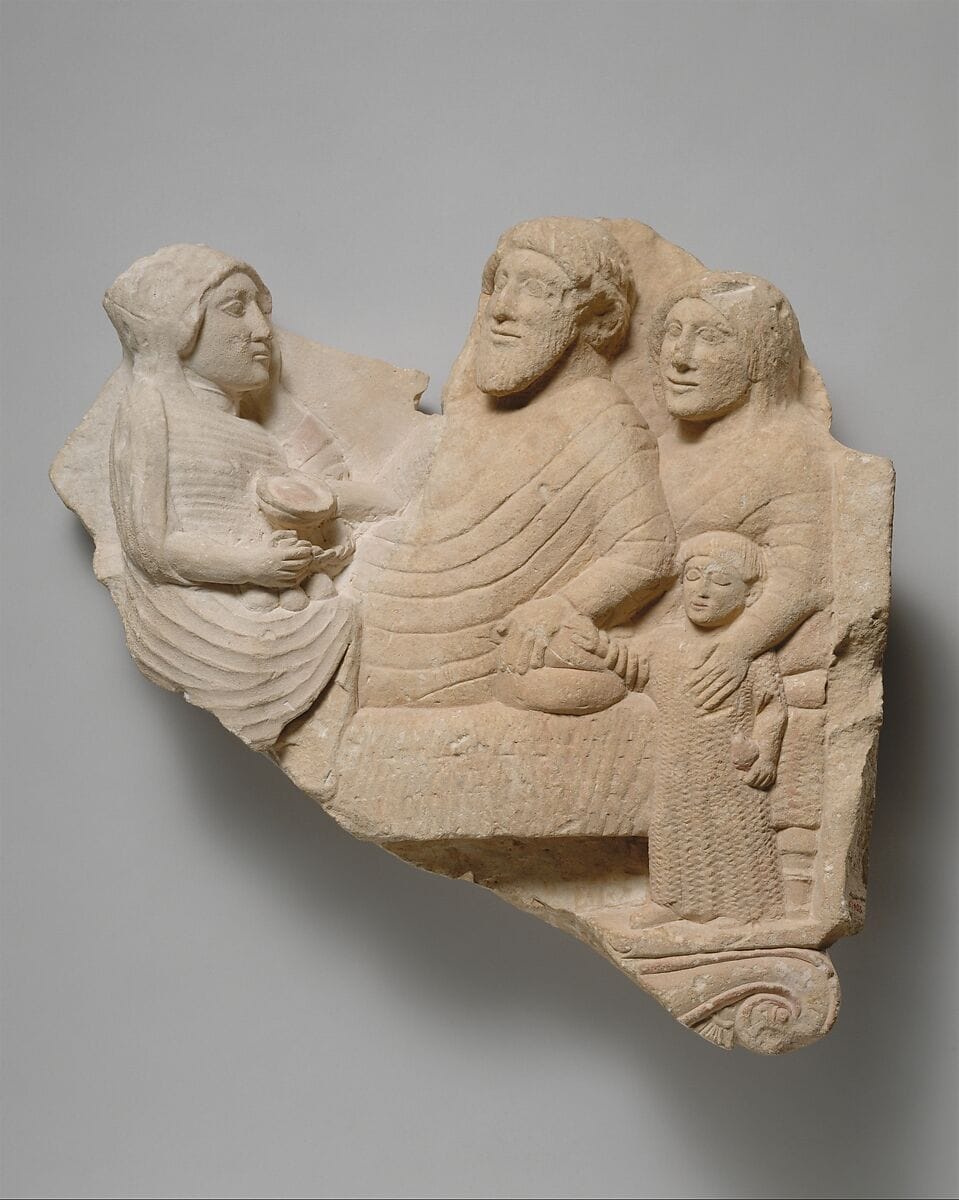
On the early examples the banquet replaces the cavetto finial, squeezed between the lions above and the narrower shaft below; later stelae frame the scene in a rectangle crowned by a palmette or an Attic-style pediment, but keep the banquet small in the upper part [1, p. 343]. A stele now in the Pushkin Museum in Moscow puts a recumbent lion above a banqueting man and a veiled woman [1, p. 343]. The fragment of a grave relief with a banquet scene in the catalogue, from the Golgoi necropolis (50.8 by 57.2 cm), shows a man, a child and two women above a damaged Ionic capital; the cushion, the inside of a phiale, a sleeve and the child's object are still painted red. Hermary dates it to the third quarter of the 5th century BCE [1, p. 344].
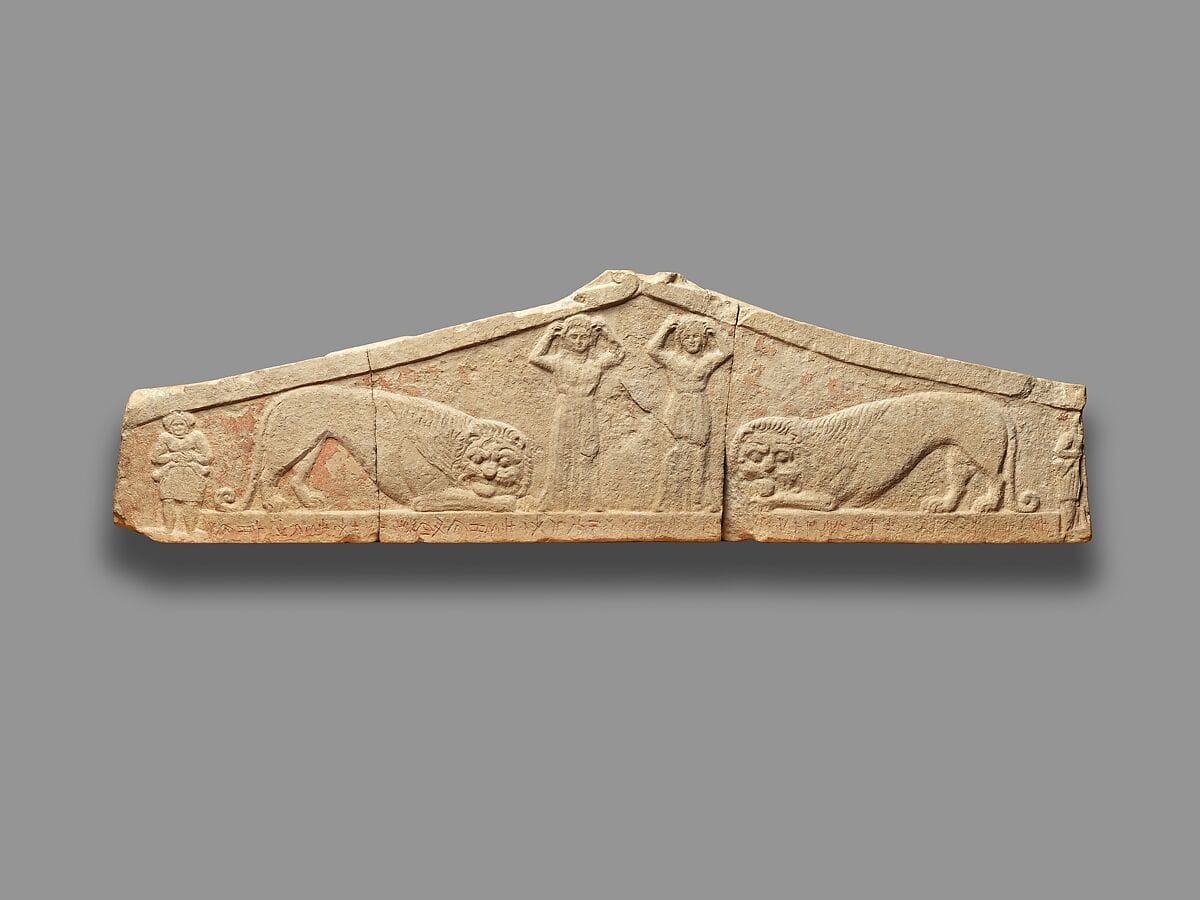
Other Classical stelae show grief directly. A 144.8 cm stele from Golgoi shows a seated mourning woman, compared to the "Penelope" type, and a woman alone is rare in the series [1, p. 345]. The pediment from a funerary stele in the catalogue, 121 cm wide, is the tombstone of Aristokretes, dedicated by his brothers in a syllabic inscription along the lower band. Two lamenting women with loose hair are flanked by crouching lions and small figures holding animals, on a red ground; Hermary places it, with a query, in the second half of the 4th century BCE [1, p. 348]. Inscribed stelae of this kind belong with the island's writing and literacy.
Where the stelae stood
Accounts of the 19th-century excavations suggest that Cypriot funerary sculpture, unlike Greek, did not stand outside over the grave but in the dromos, the corridor leading down to the burial chamber; the original setting of the lions and sphinxes from Tamassos remains uncertain [1, p. 329]. The stele of Karyx from Golgoi, inscribed in the Greek alphabet, probably marked a Greek from outside Cyprus who expected his stele to stand visible above the tomb [1, p. 329]. In the 5th century the range of funerary sculpture widened to figured sarcophagi at Amathus and Golgoi, marble anthropoid sarcophagi in the Phoenician communities at Kition and Amathus, and relief slabs inside built tombs at Pyla [1, p. 329]. For the tombs themselves, see mortuary practices.
Hellenistic and Roman grave reliefs
The end of the city-kingdoms led, in Hermary's words, "it seems, to a near-disappearance" of funerary sculpture, followed by a revival, above all at Golgoi, toward the beginning of the Roman period [1, p. 329]. Elena Poyiadji-Richter's study of the Hellenistic material qualifies this picture: she sees continuous production of grave reliefs with human figures from the Archaic to the Roman period, with an early Hellenistic group of the last quarter of the 4th and start of the 3rd century BCE, few reliefs from the 3rd and 2nd centuries, and Ptolemaic features in faces and hair [3]. Most Hellenistic stelae have a double niche under a pediment with a central rosette; others take the form of a small shrine (naiskos). Of the 24 Hellenistic grave reliefs with figures she knew, 11 came from Golgoi, two each from Amathus, Salamis and Styllos, one each from Arodes, Polis and Mosfiloti, and four from unknown sites [3]. Most were dug up by amateur excavators in the 19th century and removed without record, which makes their dating hard [3].
Dates for individual pieces still move. The Met's funerary monument with a seated woman (74.51.2489) is listed by the museum as Late Hellenistic, 2nd to 1st century BCE, while Hermary and Mertens put it in the early Roman period and give it a Salamis necropolis findspot [1, pp. 348–349]. A heavily restored banquet stele with two young men (74.51.2487), 93.3 cm high in Hermary's measurement, belongs to the Roman revival; the Met dates it to the mid-1st century CE [1, pp. 348–349]. The group of Zoilos in the same collection shows the tradition still alive at the end of the 1st or start of the 2nd century CE [1, p. 329].
Votive reliefs from the Golgoi sanctuary
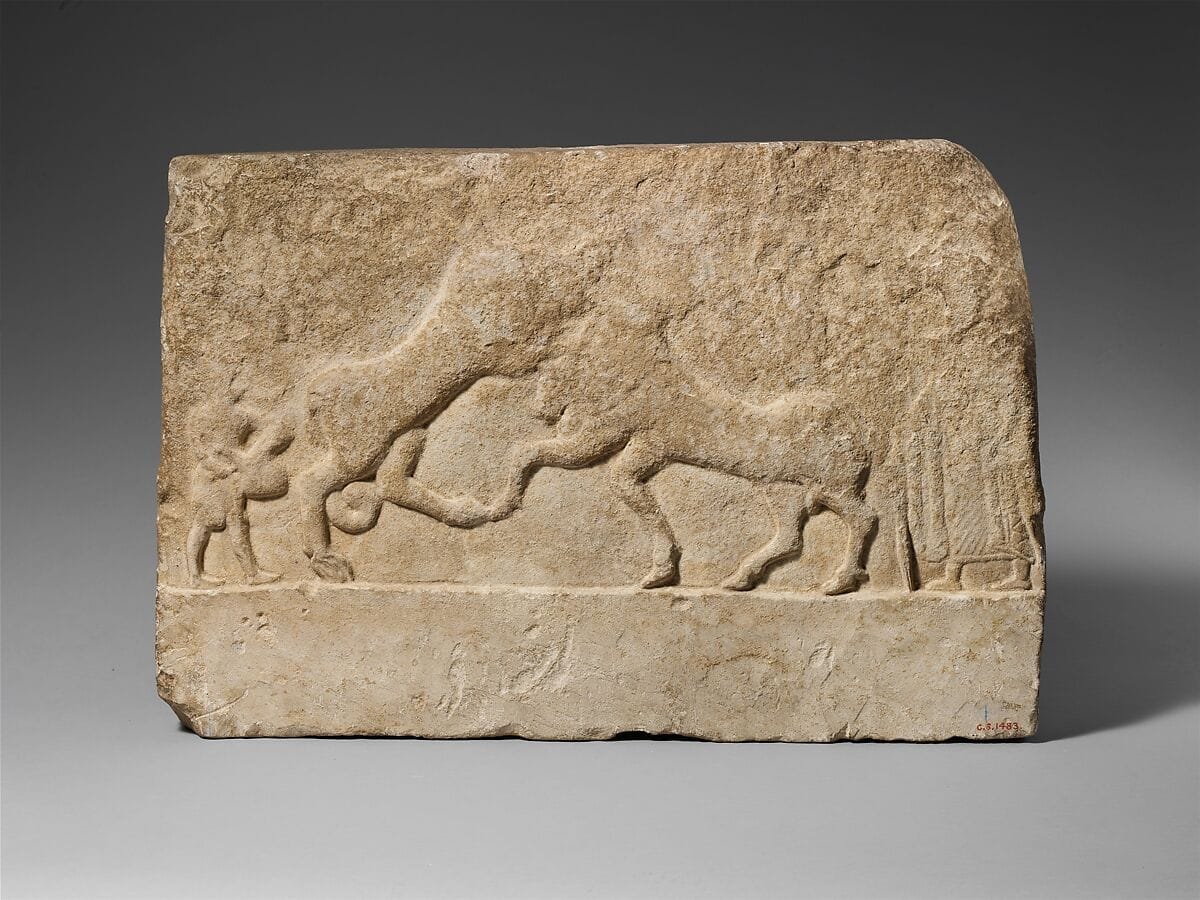
Most Cypriot votive reliefs in museums come from the sanctuary at Golgoi-Ayios Photios, where Apollo received the principal dedications [1, p. 315]. The catalogue's votive relief with a lion killing a bull, 66.7 cm wide and dated to the second half of the 6th century BCE, shows the lion gripping the bovid's throat between two human figures: one in a long garment leaning on what may be a stick, the other a small man in an Egyptianizing kilt. The animal combat is a common motif; what the two figures mean is unclear [1, p. 311]. A companion piece, the votive relief with a "master of lions", shows a long-haired nude figure choking two lions. The head is damaged, so the figure cannot be named; Hermary observes that strangling two lions at once suits "Bes" or a related figure better than Herakles [1, p. 311].
Herakles is still the most frequent mythological figure at the Golgoi sanctuary, though no inscription shows a cult of Herakles or of Melqart there [1, p. 315]. The front of a statue base carved in very low relief on a red-tinted ground shows Herakles taking the cattle of Geryon. Hermary dates it to about 500 to 480 BCE and calls its sculptor "a pioneer in the art of relief on Cyprus and one of the masters of 'the school of Golgoi'", someone who knew Egyptian representations and Attic painted vases [1, pp. 313, 315].
Votive reliefs continued into the Hellenistic period. A late Hellenistic relief with Zeus, Apollo and Hermes carries an inscription in the Cypriot syllabary, a late use of the old script, and a fragment in semi-relief bears an alphabetic dedication by Nikandros for his son Timon [1, pp. 327–328]. The small votive relief of three men in the catalogue, only 18.4 cm high, is said to come from Golgoi and is catalogued as early Hellenistic.
Relief plaques
Small plaques carved with a single part of the body form the last group. From Golgoi-Ayios Photios come a plaque with a right ear wearing a rosette earring, its surface painted red [1, p. 286]; a plaque with breasts and a bunch of grapes, where "the meaning of the grapes is unclear" [1, p. 288]; and a plaque with two eyes and a mouth, its rounded top imitating a face, painted red and probably Hellenistic [1, p. 289]. Hermary and Mertens publish them with the anatomical votives, and they are best read as votive body parts that happen to be made as reliefs. Their Hellenistic dates are all queried by Hermary and Mertens.
Open questions
Three problems run through the study of Cypriot reliefs. The first is dating: early stelae lack archaeological context, and the same object can receive dates a century or more apart from the museum and the catalogue [1, p. 329]. The second is setting: whether stelae stood in the dromos or above ground is inferred from old excavation accounts [1, p. 329]. The third is origin. The funerary banquet arrives in Cypriot tomb sculpture at the moment it spreads across the Achaemenid empire, yet the motif was already familiar on Cypriot metalwork and statuettes [1, p. 343]; Hathor heads and Phoenician capitals point to Egypt and the Levant, while knotted fillets and pediments point to Athens [1, p. 329; 2]. Cypriot funerary sculpture was long neglected; the first study was Veronica Tatton-Brown's in 1986, followed by Elena Poyiadji-Richter in 2003 and Antoine Hermary in 2004 [1, p. 329].
Objects on this page
 Limestone footstoolArchaic II · 500–450 BC
- Limestone funerary stele with antithetical sphinxesClassical · 475–450 BC
- Fragment of a limestone grave relief with a banquet sceneClassical · 475–425 BC
 Limestone votive relief with a lion killing a bull and two human figuresArchaic II · 550–501 BC
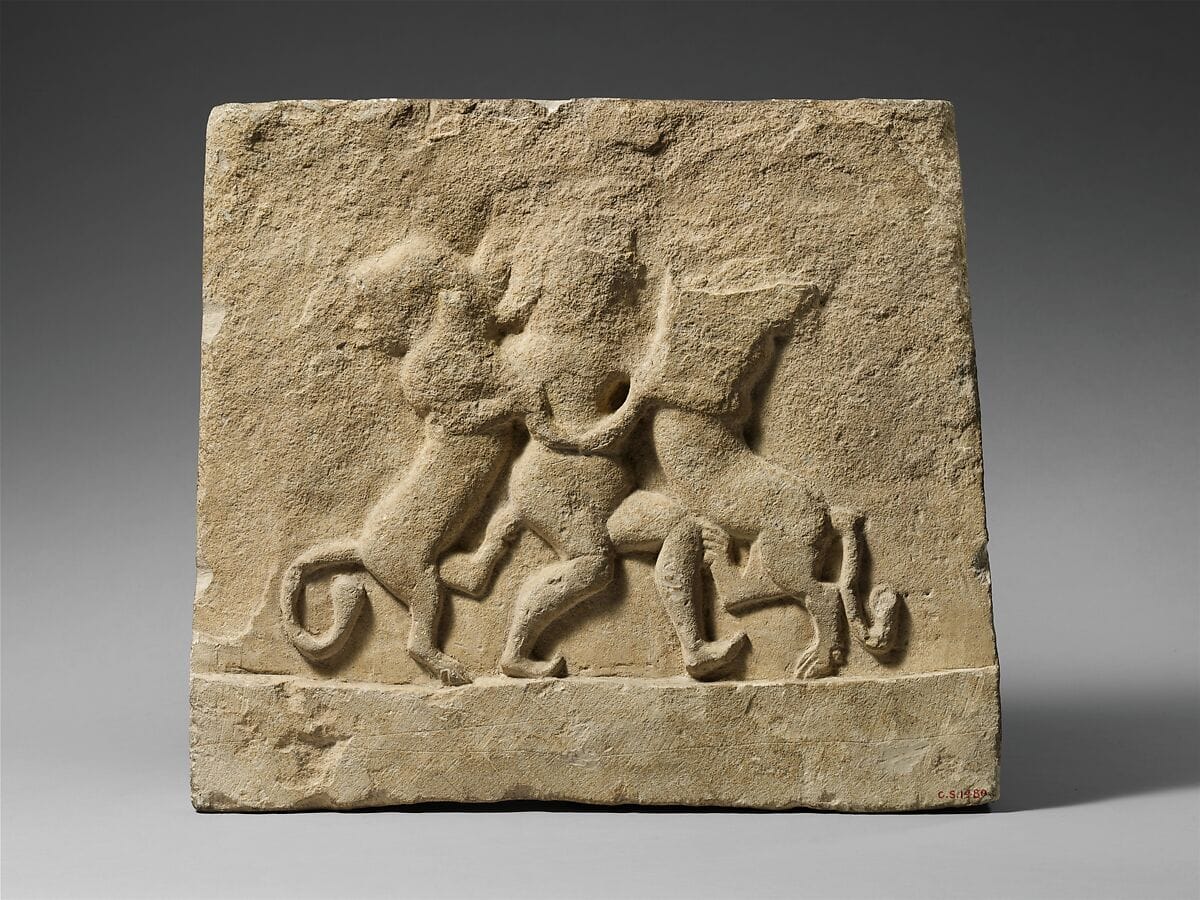 Limestone votive relief with a “master of lions”Archaic II · 550–501 BC
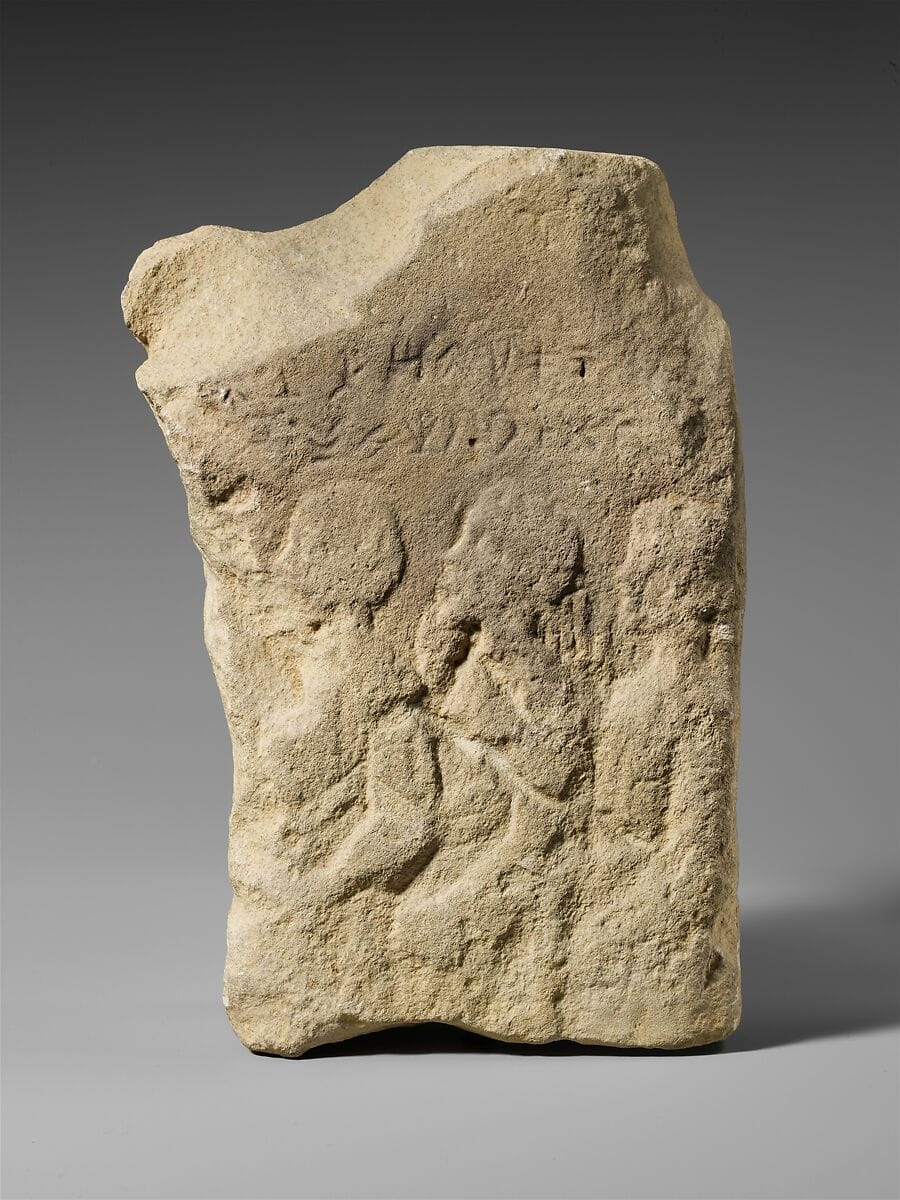 Limestone votive relief of three menHellenistic · 399–200 BC
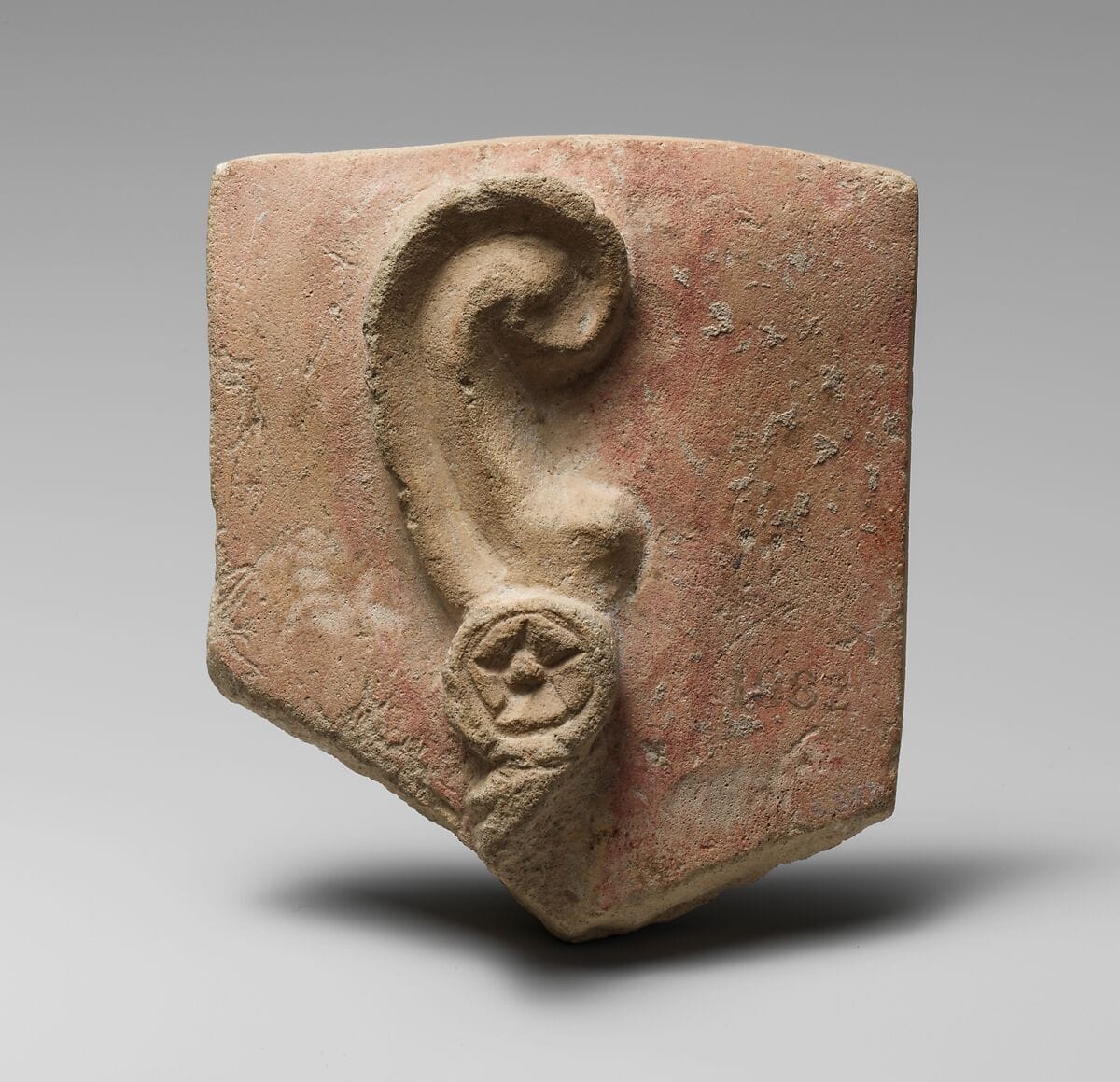 Stone votive relief of an ear with earringHellenistic · 399–200 BC
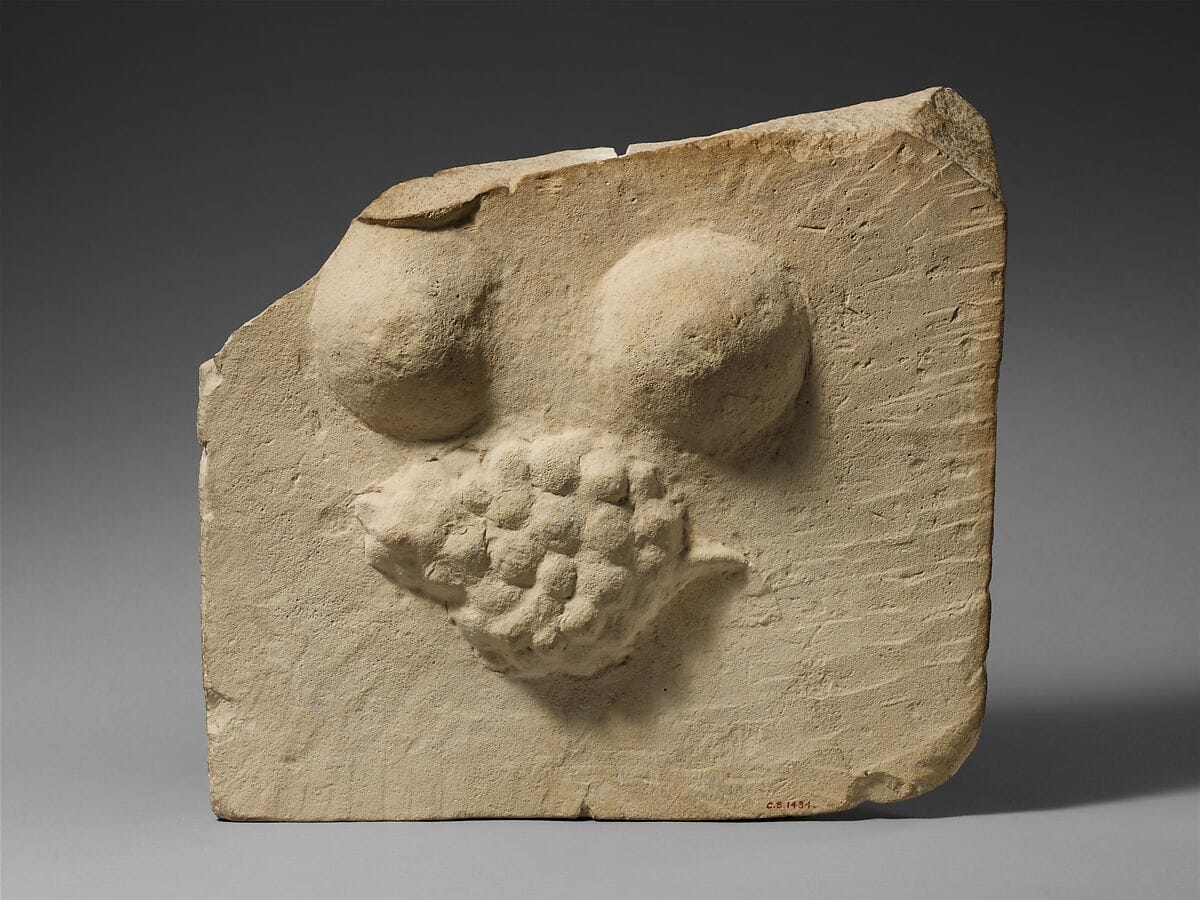 Limestone plaque with breasts and a bunch of grapes in reliefHellenistic · 350–250 BC
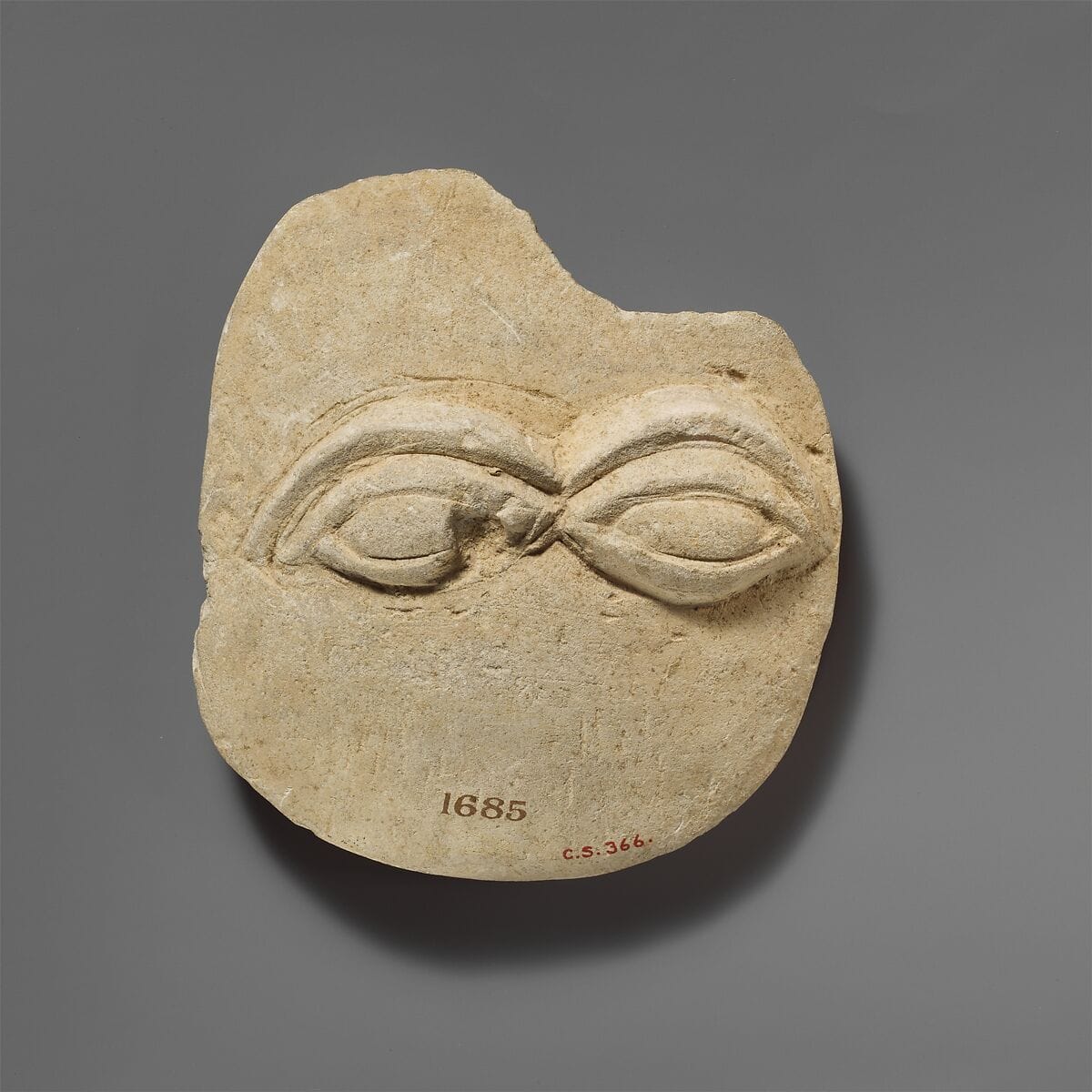 Limestone plaque with two eyes in reliefClassical · 480–310 BC
In the catalogue
References
- 1.Hermary, A., & Mertens, J. R. (2014). The Cesnola collection of Cypriot art: Stone sculpture. The Metropolitan Museum of Art.
- 2.Ulbrich, A. (n.d.). Near Eastern and Egyptian goddess images in Cypriote sanctuaries. In Proceedings of the 2nd International Congress on the Archaeology of the Ancient Near East (Vol. 1). Eisenbrauns.
- 3.Poyiadji-Richter, E. (2012). Funerary portraiture on Hellenistic grave reliefs from Cyprus. In G. Koiner, P. Scherrer, & A. Ulbrich (Eds.), Hellenistic Cyprus: Proceedings of the International Conference, Graz, 14 October 2010 (Keryx 2, pp. 77–90).