
Contents
A seal is a small engraved object, usually of stone, pressed or rolled into a soft surface to leave a design. In Cyprus seals took two main forms: the stamp, with a single small engraved face, and the cylinder, a spool-shaped stone engraved around its curved surface and rolled out to give a continuous frieze [3]. Stamp and cylinder seals "served administrative, legal, and protective purposes" across the ancient Near East [2], and on the island they were also worn, threaded as beads or mounted in gold caps and finger rings [1]. Their history in Cyprus runs in bursts: a few stone stamps in the Late Chalcolithic, a long silence, a flourishing cylinder tradition in the Late Bronze Age, a switch to stamps around 1200 BC, and then the scarabs and scaraboids of the Cypro-Archaic kingdoms. You can see all seals in the catalogue.
Forms and functions
The cylinder seal was a Mesopotamian invention of about 3000 BC that spread across the Near East and reached Cyprus at the beginning of the Late Bronze Age [3]. Each cylinder carries its own design; it is pierced lengthwise so it could be strung, and the finest Cypriot examples were fitted with gold caps and suspension rings [1].
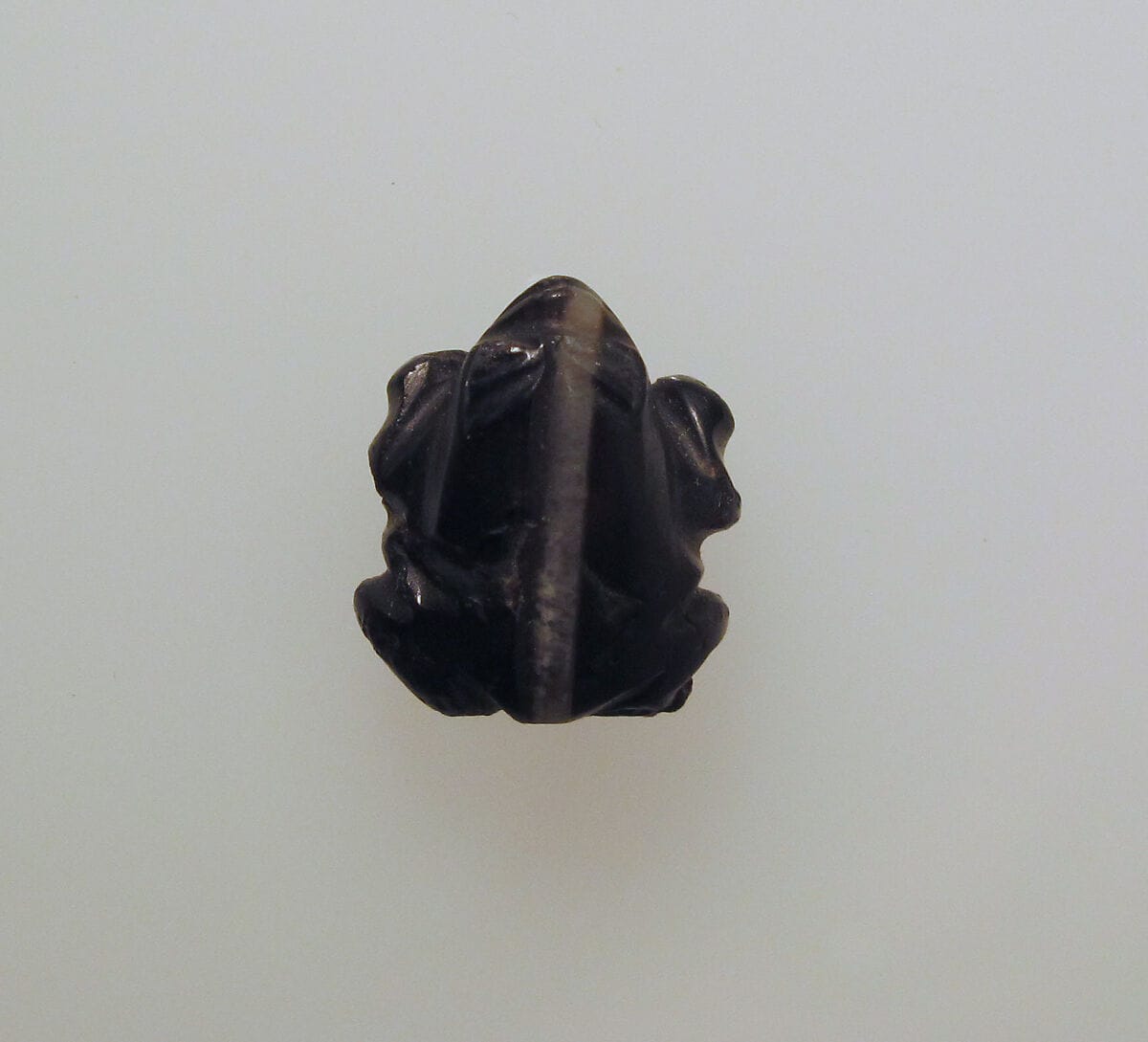
The stamp seal has a single engraved face. Several kinds were used in Cyprus. The conoid, with an oval face and a domed back, is not attested in the Aegean or anywhere else before it appears in Cyprus, and Jennifer Webb and Judith Weingarten regard it as a local innovation [1]. Rarer stamp forms include rectangular stamps, tabloids, head seals and scarabs [1]. The scarab and the related scaraboid take the beetle-backed stamp of Egypt as their model; the scaraboid simplifies the back to a plain dome. Through the Phoenicians these became the commonest seal shapes of the Iron Age (see below).
The difficulty with function in Cyprus is the near absence of sealings, the lumps of clay that seals actually impressed. Apart from one impressed and one unimpressed example from Enkomi, the Bronze Age record has almost none [1]. An administrative role therefore has to be inferred from where seals turn up: in metalworking, textile and olive-oil production areas, alongside weights and balances, and in cult buildings [1]. The same objects also travelled as valuables. Webb and Weingarten describe high-quality seals as having high intrinsic value, "frequently fitted with gold mounts or in jewellery", which is why they belong with the rest of the island's jewellery [1].
The first stamps: Chalcolithic Cyprus
The earliest seals from the island are stone stamps of the Chalcolithic. A limestone stamp with a crosshatched design comes from Late Chalcolithic Period 4 at Kissonerga-Mosphilia, possibly from the building known as the Pithos House, and a second, with linear and curvilinear motifs, was found in Area II at Lemba-Lakkous, probably in a Period 3 context [1]. A fragment of havara from the surface at Mosphilia may be a seal impression [1]. Seal use in the south-west of the island at this time was occasional, and the stamps were not used to mark storage jars: no impressed vessels are known [1].
Then, for some 500 years, there is no evidence for seals at all [1]. They are absent from Philia-phase settlements despite the many Anatolian innovations of that horizon, which may reflect the poor exploration of Philia sites or a genuine lack. Their absence through the Early and Middle Bronze Age is less surprising, since the villages of those periods show no authority above the household. Even the Middle Cypriot III building at Pyrgos, with its storage, copper and olive oil, produced no seals or sealings. A stamp of similar date from Alassa is the first secure glyptic find since the Chalcolithic and almost certainly an import [1].
Cylinder seals of the Late Bronze Age
Cylinders first reached Cyprus in the late 17th century BC as occasional Babylonian, Syrian and Syro-Mitannian imports, apparently without any sealing practice attached [1]. Few belong to Late Cypriot I (c. 1700–1450 BC), but many come from 15th- to 12th-century tombs and settlements [3]. Local production began in the late 16th or early 15th century, "most probably in workshops run by foreign artisans using almost exclusively imported materials", tied to Cypriot participation in Near Eastern trade and perhaps to the Cypriot community at Ugarit (Ugarit and the Levant) [1]. A local tradition inspired by Syro-Mitannian seals took hold in Late Cypriot II (c. 1450–1200 BC) [3].
The earliest securely dated cylinders come from Late Cypriot IB burials in the north-west, at Toumba tou Skourou, Stephania and Ayia Irini. Other early tomb finds come from Enkomi, Hala Sultan Tekke, Dromolaxia, Maroni and Kalavasos [1]. In settlements, sanctuaries and workshops they appear in LC IIA at Ayios Iakovos and Phlamoudhi, in LC IIB at Enkomi and Sanidha, and in LC IIC at Myrtou, Athienou, Kalavasos, Maroni, Kourion and Kition [1]. Enkomi dominates the record: over 60% of securely identified imports and over half of all cylinders with a known findspot come from the site, and Webb and Weingarten have "no doubt that Enkomi was a major centre of seal production throughout the LC period" [1]. Use peaked in LC IIC, and most cylinders from non-funerary contexts were lost or discarded in the 12th century, a sign that the practice was then in decline [1].
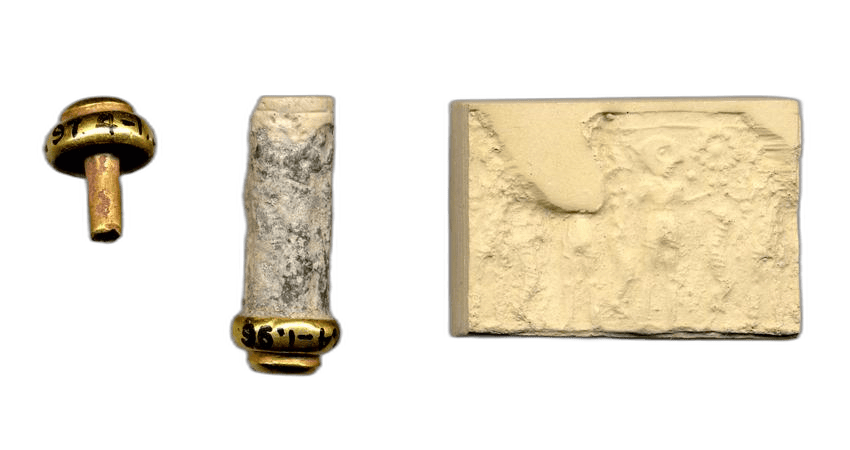
The lapis lazuli cylinder seal from the British Museum's Turner Bequest excavations at Enkomi shows how such seals were worn. Its shallow, worn engraving shows a row of ministrants with inverted animals, a lion and a sun symbol, and it was fitted with hammered gold caps carrying soldered suspension rings, held in place by a tube of gold sheet run through the hole (British Museum 1897,0401.96).
Edith Porada's 1948 study of Late Cypriot cylinders divided them into styles that remain the standard reference, usually reduced to three [1, 3]:
| Style | Material | Typical subjects | Distribution |
|---|---|---|---|
| Elaborate | Hematite; high technical investment | Divine, mythical and semi-narrative scenes; animals presented to deities | Also found outside Cyprus |
| Derivative | Chloritite and other softer stones | Heroic or semi-divine figures: kilted men, robed women with animals | Mainly Cyprus |
| Common | Soft stone, cut with a drill | Bold stylised human figures, animals, cult symbols, ingots | Rarely found outside Cyprus |
The scheme is useful but leaves a good deal out. Many seals fall outside its categories or combine features of more than one, and Webb and Weingarten warn against overstating the distinctions [1, 3]. Non-invasive XRF has identified the softer stones as chloritite or serpentinite [3]. During the 14th and 13th centuries Aegean motifs and conventions became more frequent, especially in the Elaborate Style, which Webb reads as elite status shifting its points of reference towards the Aegean world (Mycenaeans) [1].
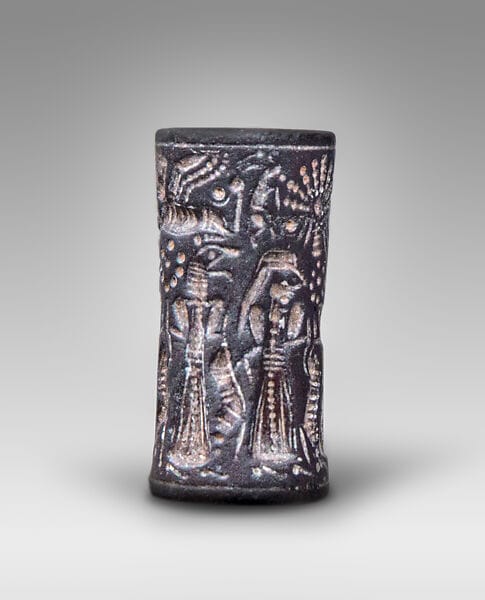
A hematite cylinder seal on loan to the Metropolitan Museum from the Morgan Library, dated c. 1400–1250 BC, has a double register with a seated figure and Potnia Theron ("mistress of animals") figures below winged creatures. It has no recorded findspot, so whether it was cut in Cyprus or imported is open. A Late Cypriot hematite cylinder from the Cesnola collection, Met 74.51.4314, engraved with griffins, an antelope, lions and human figures, shows the kind of crowded animal and figure scene the hard-stone cylinders carried.
Some cylinders carry signs of the Cypro-Minoan script (Writing and literacy) [2].
Recarved seals
Cypriot owners repeatedly shaved down their cylinders and engraved them again, layering a new design over the old one [2]. Joanna S. Smith reads the evidence for this from the stones themselves: an off-centre string hole, uneven height or diameter, and an abraded surface. She calls the result a "seal stratigraphy" [2].
Two groups show the practice in context. In a house in Area I at Kition-Chrysopolitissa, one cylinder (Cyprus Museum I/223/1) lay on Floor IV, dated c. 1300–1190 BC, in an area used for bronzeworking, and a second came from a well; a seal impression from the same house is now in the Larnaca Museum [2]. Tomb 9 in the courtyard held three cylinders, two gold rings and three Egyptian scarabs. On one Kition seal, a double-register scene was recut as an asymmetrical scene of a seated person with a bird of prey [2]. At Kourion-Bamboula excavators found 11 cylinders and 11 stamps; eight of the cylinders were recarved, and all eight had begun with the same design of a striding robed woman, a griffin and a tree. Their find contexts run from LC IIA (c. 1450–1375 BC) to LC IIIA (c. 1200–1125 BC) [2]. Smith ties the design changes around 1200 BC to political change on the island [2].
What were they for?
With almost no sealings, the case for administration rests on context. Smith's reading allows both administrative control in LC IIC–IIIA and votive or personal use [1]. Webb argues that seals of all classes, and above all the Elaborate Style, worked within a wealth-finance system; Common Style seals may have signalled membership of a group or a type of transaction, and their frequent ingot motifs suggest a link to the copper industry [1].
The cylinder-rolled impressions on 13th-century pithoi are a separate matter. Over 40 are published, on at least 27 vessels from six coastal and three inland sites. They were made with larger rollers, probably of wood and up to 7 cm long at Alassa, rather than with stone cylinders, and Webb and Weingarten treat them as markers rather than seals. Their chariots, animals and heroic combats are in an Aegeanising style [1]. The article Cylinder seal impressions in Bronze Age Cyprus covers them in detail.
The stamp returns, c. 1200 BC
Stamp seals came back into use towards the end of the 13th century BC and had replaced cylinders by the end of the Late Bronze Age [1, 3]. The earliest are a rectangular stamp from Apliki, a scarab from a tomb at Yeroskipou, and three conoids from administrative buildings at Kalavasos [1].
The reason is debated. John Boardman linked the new fashion for stamps to Mycenaean immigrants arriving after LH IIIB. Andres Reyes argued that stamps were adopted in administrative and economic, non-religious settings. Webb and Weingarten point out that cylinders and stamps occur together in administrative, industrial and funerary contexts and that stamps also appear in cult buildings, so a broader explanation is needed, and they place the change within movement from the Aegean at the LC IIC–IIIA transition [1]. Whatever the cause, the result was a narrower art: in the 12th and 11th centuries the repertoire shrank to single animals and bucrania, hard-stone engraving stopped, and inscribed seals disappeared for about 500 years [1].
Cypro-Geometric and Cypro-Archaic seals
Few stamps are securely Cypro-Geometric. The Late Bronze Age conoids, tabloids and cylinders found in Cypro-Geometric tombs are probably heirlooms. The one secure group is a set of blue frit conoids with Phoenician connections, probably made at Amathus [1]. Webb and Weingarten find the scarcity puzzling at a time when the island had centralised polities [1].
The Cypro-Archaic period brought a sudden increase in the number and types of seals. Hard stones and inscriptions returned, and there was much experiment, especially in the 7th century. "Roughly 75% of all Cypro-Archaic seals are scarabs or scaraboids, adopted from the Phoenicians", and the early hard-stone seals copy Phoenician devices [1]. Two clay sealings from Archaic Kition suggest some commercial use. Following Reyes, hard-stone seals with Cypriot Syllabic inscriptions, cut in retrograde in the Greek manner with the owner's name in the genitive, protected private property and authenticated private dealings, while the common soft-stone stamps served as votives, talismans, charms or amulets [1]. Webb and Weingarten note the parallels with the Late Bronze Age: foreign models, imports, no bureaucratic use, and close ties to Levantine networks [1].
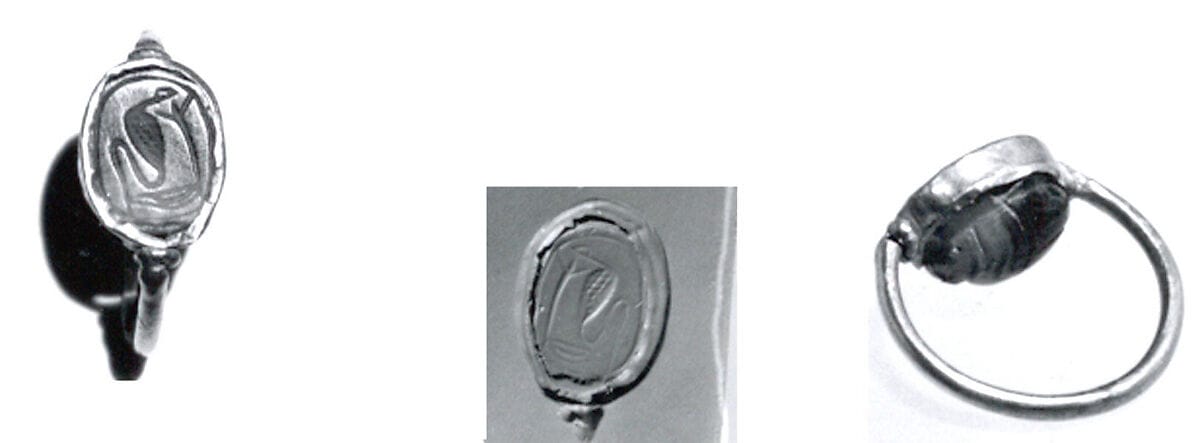
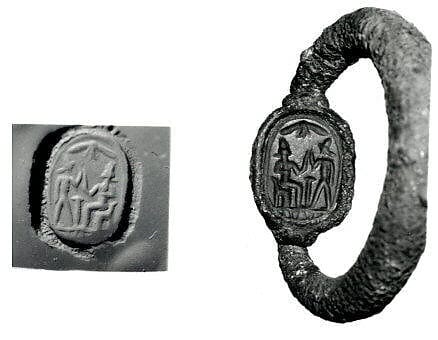
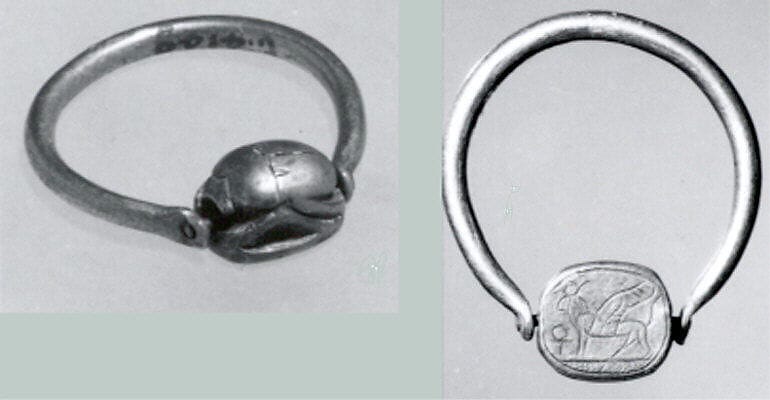
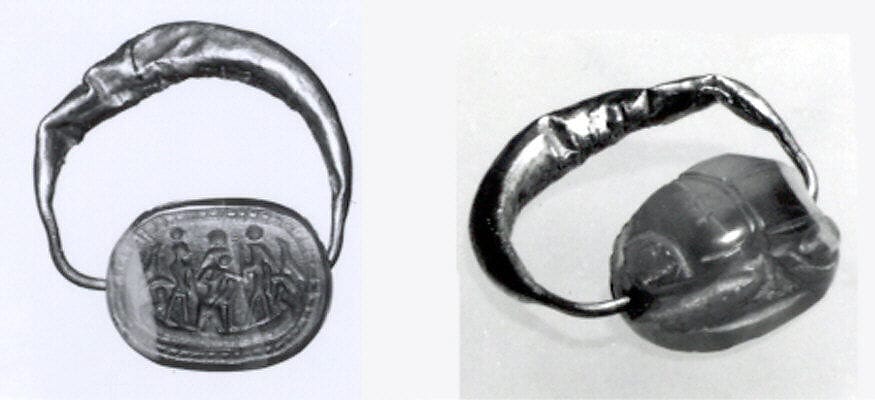
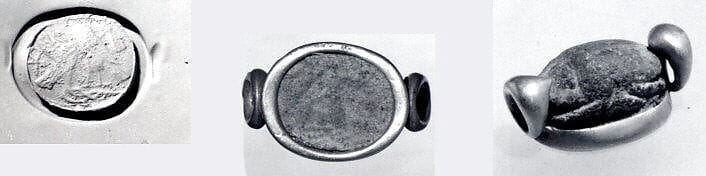
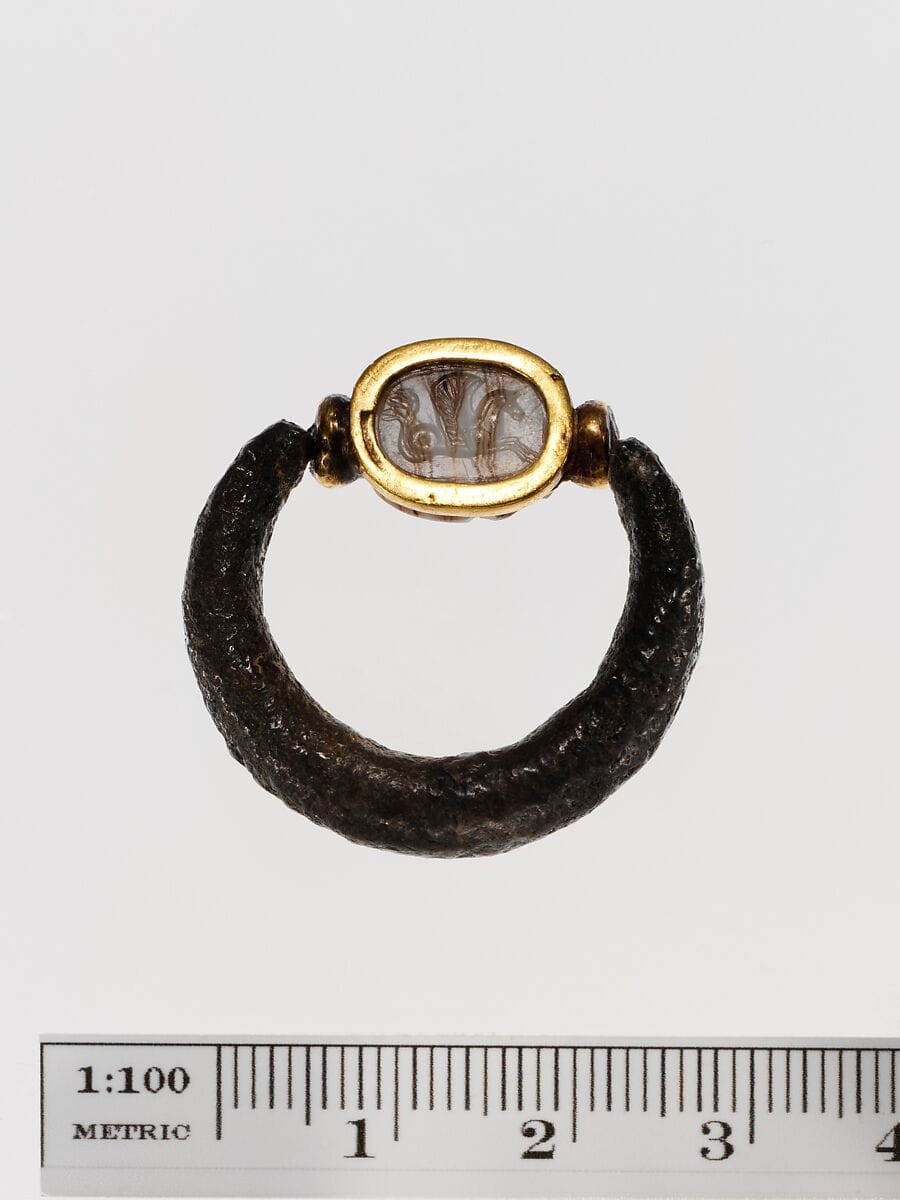
Many Archaic scarabs survive mounted as rings. The Metropolitan Museum's Cesnola material includes a gold ring with an agate scarab cut with a uraeus and a flower, and a silver swivel ring with a sard scarab showing a worshipper before a seated deity, both in tall caps, with a table between them and a winged disc above. Excavated parallels include a scarab from the Swedish excavations at Ayia Irini in the Medelhavsmuseet, an Archaic steatite scarab in the Fitzwilliam Museum, and a sard scaraboid from Amathus and a glass scaraboid from Amathus in the British Museum.
Classical seals
In the Cypro-Classical period some seals used on the island were made by, or attributed to, named Greek artists. Semon, for example, signed a scarab found at Troy [2]. Archaic and Classical seals sometimes carry their owners' names, but most carvers and owners remain anonymous [2]. The gold scaraboid ring in the Metropolitan Museum, dated to the 5th century BC, is engraved with a ram-headed sphinx and an ankh, both Egyptian motifs. Smith describes the art these seals record as "neither precisely Greek nor fully Near Eastern" [2].
How Cypriot seals have been studied
Unlike Aegean seals, Cypriot seals have no central corpus; the material is scattered through site reports, museum catalogues and the volumes of the SIMA series [4]. Before 1971 most seals with any context came from tombs, and the seals collected by Luigi Palma di Cesnola form the core of the Metropolitan Museum's Cypriot holdings, with Max Ohnefalsch-Richter's finds another early source [4].
Edith Porada (1912–1994), a specialist in Near Eastern art, set the terms in her 1948 article on Late Cypriot cylinders, drawing on the British Museum excavations at Enkomi and Maroni, the Swedish Cyprus Expedition's work at Ayios Iakovos and, above all, J. F. Daniel's excavations at Episkopi-Bamboula. She went on to publish the seals from Dikaios's Enkomi excavations and many later specialist reports [4]. Victor Kenna (1899–1978), a naval chaplain and collector interested in the Aegean side of the material, catalogued the Bronze Age Cypriot seals in the British Museum in 1971 (SIMA 20:3) and began the study of the Cyprus Museum's cylinders. Joanna S. Smith judges his well-illustrated introductions "sometimes chaotic", with some misattributions, and notes that most scholars turn to Porada instead [4]. For the Iron Age the standard work is Reyes's The Stamp Seals of Ancient Cyprus (2001), which builds on Boardman's work of 1968; Boardman also published the Cypriot finger rings [4]. Recent work by Smith on recarving and by Jennifer Webb on seal use in the economy has moved attention from style to how the objects were made, reused and handled [1, 2].
Seals in the catalogue
Most of the seals in the catalogue are Cesnola-collection scarabs and scaraboid rings in the Metropolitan Museum (Metropolitan Museum of Art), with Late Bronze Age cylinders from the British Museum's Enkomi excavations. For Egyptian scarabs found at Enkomi and other Late Bronze Age sites, see Egypt; for the tombs where most seals were found, see Bronze Age chamber tombs. The full list is on the catalogue page: see all seals in the catalogue.
Objects on this page
In the catalogue
References
- 1.Webb, J. M., & Weingarten, J. (2012). Seals and seal use: Markers of social, political and economic transformations on two islands. In G. Cadogan, M. Iacovou, K. Kopaka, & J. Whitley (Eds.), Parallel lives: Ancient island societies in Crete and Cyprus (British School at Athens Studies 20, pp. 85-104). British School at Athens.
- 2.Smith, J. S. (2014). Histories of Cypriot art through seal carving. In B. Brown & M. H. Feldman (Eds.), Critical approaches to ancient Near Eastern art (pp. 205-237). De Gruyter.
- 3.Donald, A. Two cylinder seals in the collection of S.O.F.I.A. Foundation and Photos Photiades (Nos 11, 171). Appendix II.
- 4.Smith, J. S. (2012). Resources for the study of seals found on Cyprus. In J. M. Webb & D. Frankel (Eds.), Fifty years on: Evaluating SIMA's contribution to Cypriot archaeology (SIMA 137, pp. 89-101). Åströms Förlag.