
A Cypriot Jar in the Mycenaean Style
A small three-handled jar in the Drakopoulos collection was long taken for an Aegean import. Clay analysis of its class shows that jars like it were made in Cyprus in the 14th century BC, more than a century before Cypriot workshops turned to Aegean-style pottery in bulk.

Alexis Drakopoulos
March 26, 2025·Archeology · History·9 min read


Share


Alexis Drakopoulos is a Greek Cypriot Machine Learning Engineer working in Financial Crimes. He is passionate about Archeology and making it accessible to everyone. About Me.
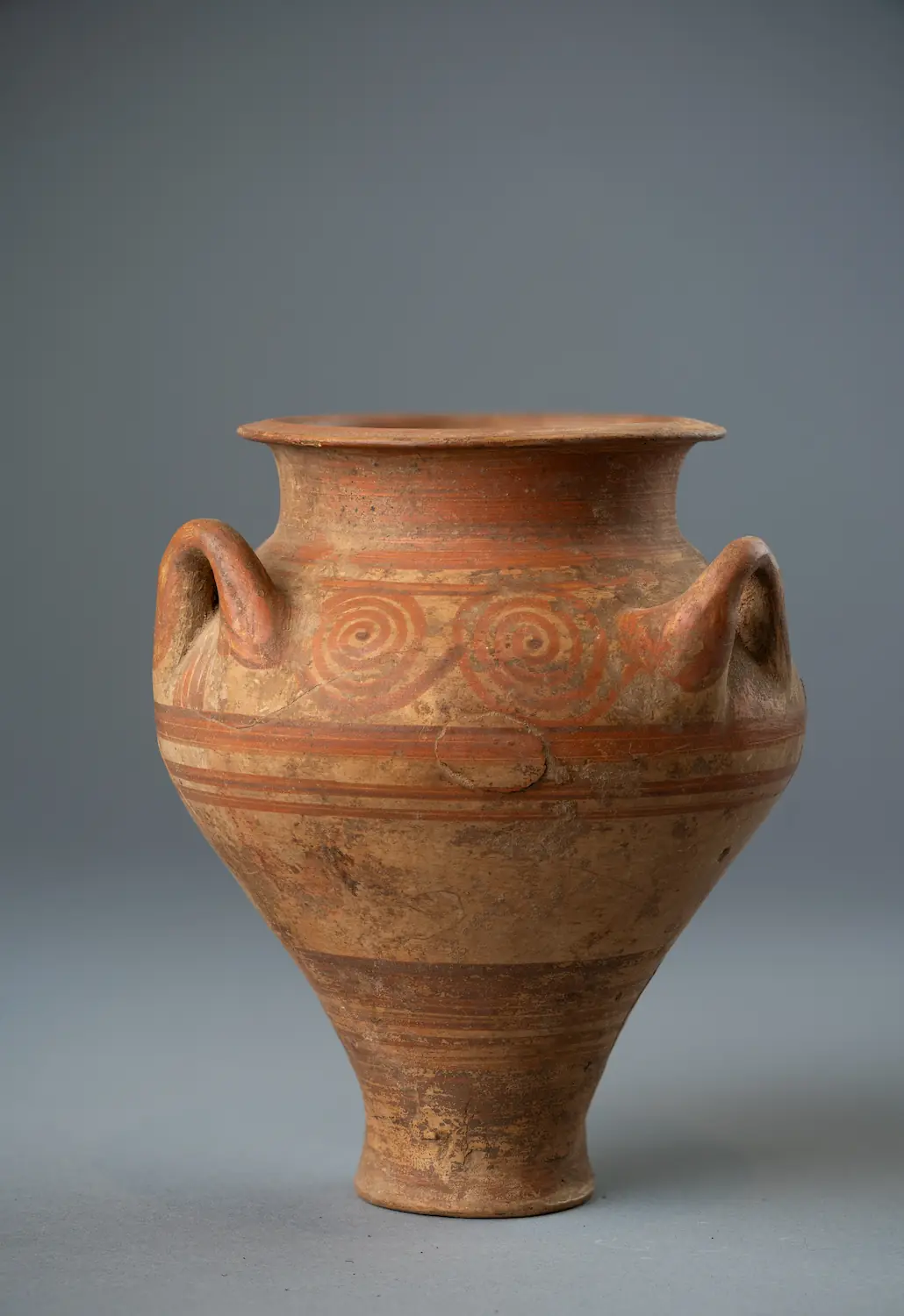
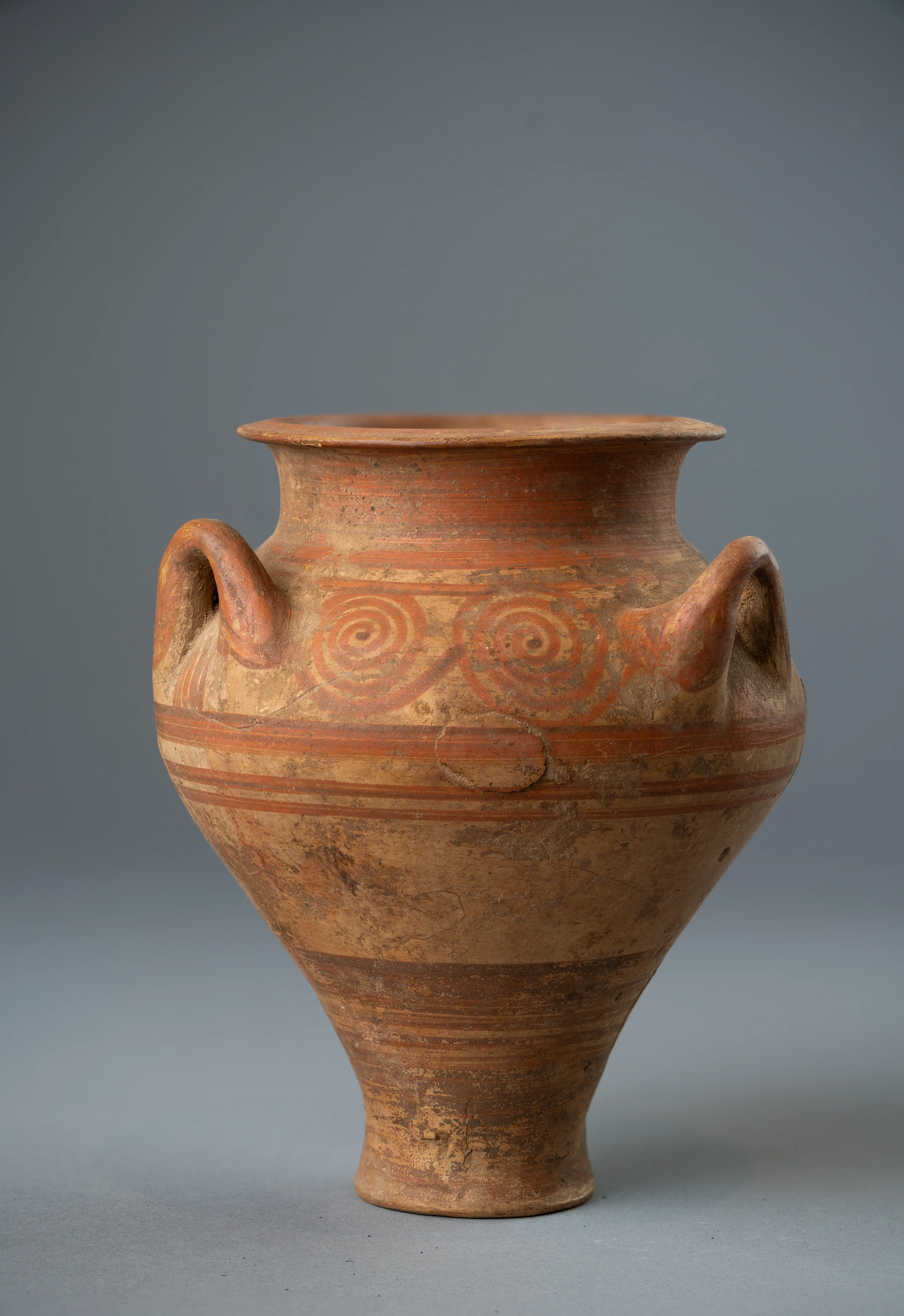
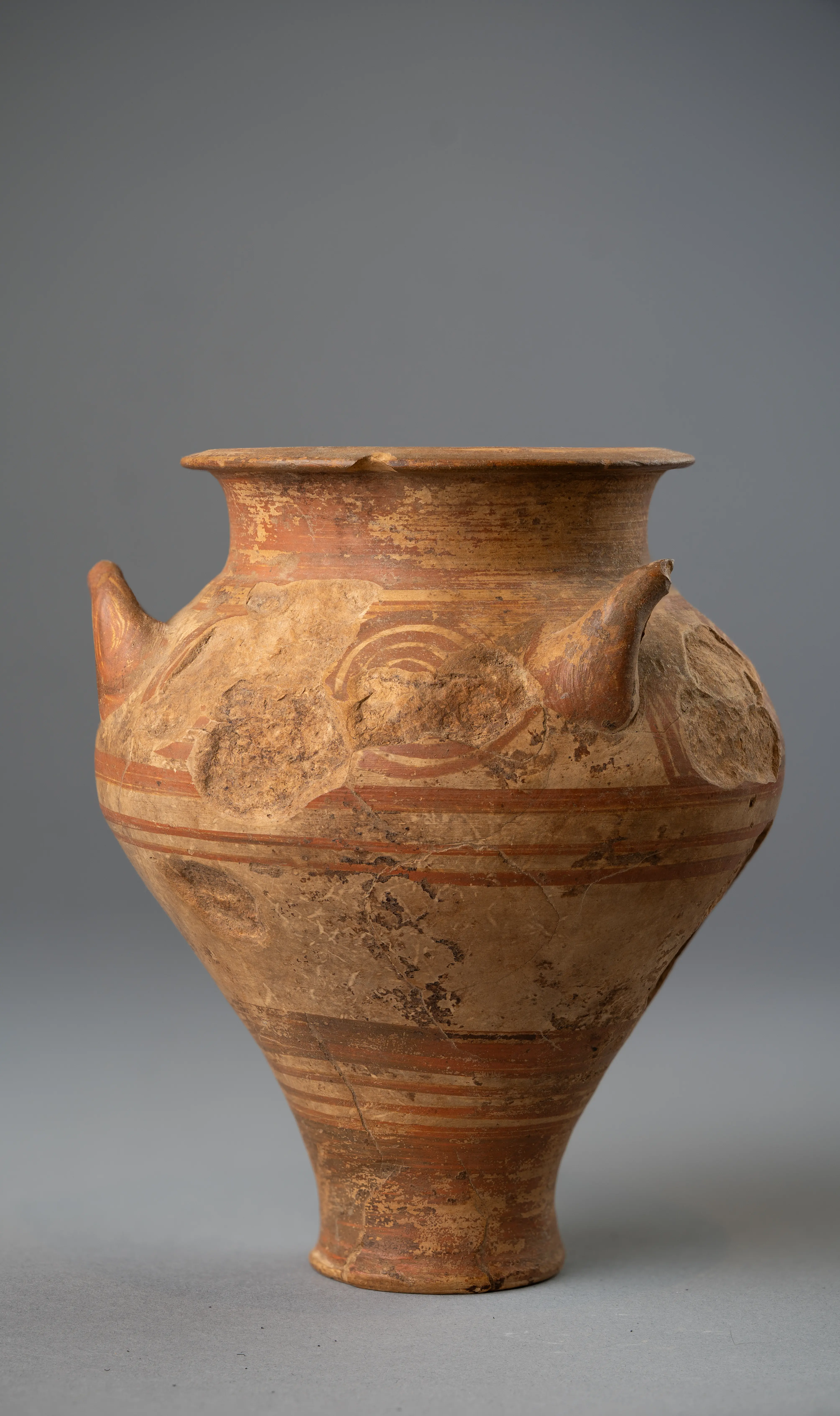
The jar in the Drakopoulos collection stands on a tall, narrow foot that splays at the base. Its body swells to a rounded shoulder, and three small loop handles sit high on that shoulder, projecting like points in profile. The clay is buff to pinkish. Between the handles, on the better-preserved side, runs a frieze of linked spirals in matt orange-red to brown paint, each coil drawn in two or three turns, with groups of horizontal bands below. On the other side the surface has flaked across the shoulder and taken most of the spirals with it.
The jar was once described as an import from the Aegean islands, made at some point between 1400 and 1050 BC. Both halves of that description are now out of date. Jars of this class were made in Cyprus, and they were made in the 14th century BC [1]. The evidence for that comes from a laboratory, and laboratories have a history in this subject: the same kind of analysis that gave these jars back to Cyprus had earlier taken the island's most famous Mycenaean pots away from it.
Copper ports and Aegean pots
In the Late Bronze Age, from about 1650 to 1050 BC, Cyprus was organised around copper and the sea. In the Middle Bronze Age the island's contacts abroad had run mainly through north-coast sites such as Lapithos. Now new coastal towns grew up in the east and southeast. Enkomi, Hala Sultan Tekke and later Kition faced the Levant and Egypt, and they grew rich on the export of Cypriot copper.
The northwest got there first. In Late Cypriot (LC) I, the opening phase of the period, tombs at Ayia Irini-Palaeokastro and at Toumba tou Skourou on Morphou Bay were furnished with the tools of trade. Tomb 21 at Ayia Irini, of LC IA, held seven balance weights, fragments of a scale pan, a cylinder seal and a bronze stylus; Tomb 1 at Toumba tou Skourou held three weights, several possible scale pans and three cylinder seals. Bernard Knapp and Nathan Meyer read these as the burials of merchants, and they count scale pans and a weight from an LC I tomb at Enkomi among the earliest on the island [2]. The houses, metalworking debris and rich tombs of the coastal towns are the setting in which Aegean pottery arrived.
Made in the Argolid
The Mycenaeans were the palace societies of the Greek mainland, and their pottery is dated by its own scheme, Late Helladic (LH). Its peak of export, LH IIIA2 and LH IIIB, corresponds to LC IIA to IIC, roughly the 14th and 13th centuries BC. From LH IIIA2 onward Mycenaean pottery reached every part of Cyprus in quantity. Enkomi, Kition and Hala Sultan Tekke have each produced more than 500 pieces, and a single tomb excavated at Enkomi by the Swedish Cyprus Expedition held 22 Mycenaean kraters [3].
Two families of vessel dominate. The first is the small closed container: the stirrup jar, the flask and the piriform jar, made to carry scented oil. The palace archives of Pylos, written in the Linear B script, record the making of perfumed oils on an organised scale [4]. The second family is the drinking set, centred on the amphoroid krater, a large wine-mixing bowl with a jar-like body, most often painted with a pair of robed figures riding in a horse-drawn chariot. Laerke Recht and Christine Morris count nearly 400 chariot kraters. The Cypriot examples almost rival the Greek ones in number, and the very earliest, of early LH IIIA2, have all been found outside Greece: 22 in Cyprus and two in the Levant [5]. Mainland workshops seem to have been painting these vases for eastern customers.
So many came out of Cypriot tombs that earlier scholars assumed they had been painted on the island, and in 1951 Frank Stubbings imagined colonies of Mycenaean potters there [3]. In the early 1960s Hector Catling's team at Oxford found that the chemistry of most Mycenaean sherds from Cyprus matched the clays of the Peloponnese. Vassos Karageorghis doubted the method and in 1966 sent the analysts 25 numbered fragments, their find-spots in a sealed envelope. Some had been dug at Mycenae and Tiryns, the rest at Kition and Enkomi. Karageorghis's selection, the analysts reported, "was made up entirely of material which, though found in Cyprus, was not made there" [6]. Neutron activation analysis, which fingerprints a clay by some thirty trace elements, later pinned most of the imports to workshops in the Argolid around Mycenae [3].
Some of those vases were marked in the Cypriot fashion. Only a small share of the exported pottery is marked, and Giampaolo Graziadio, following Nicolle Hirschfeld, judges it more likely that Cypriot traders marked their merchandise than that Mycenaean exporters had learned Cypriot habits [7].
Where the pots ended up
Maria Iacovou has a plain explanation for the island's appetite for painted Mycenaean vases. Its own fine wares of the period, handmade Base Ring and White Slip, carried no pictures, and a newly urban society "was attracted to pictorial vases because their own pottery had no imagery" [8].
Most of the imports were found in tombs, and the two families went to different people. Louise Steel showed that the drinking sets, pictorial kraters included, were restricted to the wealthier burials, where the elite folded them into a funerary drinking ritual that already existed on the island. The small oil containers went further down the social scale. Steel found no evidence that they were confined to wealthier burials: "at Kalavasos, if a burial contained only one or two Mycenaean vases these were invariably perfume containers" [9]. Tombs exaggerate the picture. At Kalavasos-Ayios Dhimitrios, Mycenaean wares make up less than 1 per cent of all the pottery, and the island as a whole is little different [10].
Three handles and matt paint
The jar in the collection belongs to a class that Arne Furumark numbered FS 46 and 47 in his Mycenaean shape system (FS stands for Furumark Shape): small, conical, three-handled cousins of the imported piriform jars [11]. Furumark himself described FS 47 as a local variant of FS 46. Graziadio's 2017 study catalogues 122 of these jars. Almost all come from Cyprus, a handful from the Levant and Egypt, and none from the Aegean [1]. In 2003 neutron activation analysis of an FS 47 jar from Hala Sultan Tekke showed that it had been made on the island [12], and a portable X-ray fluorescence programme on the whole class then separated these jars chemically from the genuine imports [1]. With its conical-piriform body and tall, narrow, splaying foot, the Drakopoulos jar fits Graziadio's Shape 47:b, the most numerous of his four sub-shapes [1].
The class began late in LH IIIA1 and was at its height in LH IIIA2. In Cypriot terms that is LC IIA to IIB, about 1375 to 1300 BC, more than a century before Cypriot potters began making Aegean-style pottery in bulk [1].
Imported Mycenaean jars carry a lustrous paint. The Cypriot ones are painted matt, as this one is. Graziadio also found that Cypriot painters habitually drew their running spirals the other way round, linking each coil from its top to the bottom of the next, the reverse of Aegean practice [1]. So much of this jar's frieze is lost that the way its surviving coils are linked has still to be checked on the object.
Close relatives came out of the British Museum's excavations at Enkomi in 1896 [13]. Two of them, from Tombs 66 and 83, stand about 12 cm high on conical feet and carry the reversed spiral [1]. A jar in the State Historical Museum in Moscow is published as one of the three-handled jars "made in Cyprus in imitation of Mycenaean jars" [14].
Who made it
Chemistry fingerprints clay and leaves the potter anonymous. In 1973 Paul Åström, looking at the soft, gritty fabric of these jars, thought them made in Cyprus "possibly by Mycenaeans who settled in the island for a short time" [1]. A whole class with its spiral convention turned round reads more naturally as the work of Cypriot potters with their own workshop habits, and Graziadio counts the reversed spiral among the local traits of the class [1]. The laboratory cannot name the hands, so the question stays open in principle. The painting points to Cypriot ones.
Like their imported models, the jars probably held scented oil or unguent. They went into tombs, often beside imported piriform jars, and they turn up in the graves of people of high or middle rank, never in the poorest. Graziadio sees no sign that families regarded them as poorer substitutes for the imports; "at most, a possible difference can be suggested in terms of particular contents" [1]. What that difference was, nobody yet knows.
After 1200 BC
Late in the 13th century the imports thinned and Cypriot workshops took over. A few Aegean-style bowls already turn up at sites abandoned before the century ended, among them Kalavasos-Ayios Dhimitrios and Maroni-Vournes. Output then grew steeply, until by the middle of the 12th century wheel-made, matt-painted tableware in the Aegean style had replaced Base Ring and White Slip [15]. Penelope Mountjoy and Hans Mommsen's neutron activation study identified eight production centres for it on the island, including Paphos, Kourion, Kition, Enkomi and Sinda [16]. Susan Sherratt reads the change as import substitution: when the Aegean supply failed during the upheavals of the Late Bronze Age collapse, Cypriot potters made their own [17].
For generations this pottery was read as the signature of Greek settlers. Ioannis Voskos and Bernard Knapp describe how its prominence in 12th-century deposits "seems to have cemented a notion that it takes a Mycenaean to make or even use a Mycenaean pot" [10]. Barbara Kling found its sources too mixed, drawn over a long period from the Cyclades, the Dodecanese, Crete, the Levant and Cyprus's own repertoire, to "support interpretations that view this pottery as evidence for the arrival of a massive influx of new settlers from one Aegean source at one time" [18]. Greek speakers did come to Cyprus, and the case for that rests on the island's later Greek dialect rather than on its pots [10]. The course lesson on Mycenaean pots and the end of the Bronze Age follows the story into the Iron Age.
Graziadio has raised one possible thread between the two episodes. Some of the matt-painted three-handled jars, in a soft buff fabric with paint that flakes, look technologically close to the Aegean-style ware of the 12th century, and he suggests they may be its forerunners. He presents this as a hypothesis that still needs its own programme of analysis [1]. If it holds, a jar like this one would stand near the start of the line that turned Cypriot pottery Aegean in look while it stayed Cypriot in manufacture.
References
- 1.Graziadio, G., with Pezzi, E., Dikomitou-Eliadou, M. and Georgiou, A. (2017). The Earliest Production of Aegean-Type Pottery in Cyprus. Pisa: Pisa University Press, pp. 16–25, 157–170.
- 2.Knapp, A. B. and Meyer, N. (2023). Merchants and mercantile society on Late Bronze Age Cyprus. American Journal of Archaeology 127(3), pp. 309–338.
- 3.van Wijngaarden, G. J. (2002). Use and Appreciation of Mycenaean Pottery in the Levant, Cyprus and Italy (ca. 1600–1200 BC). Amsterdam: Amsterdam University Press, pp. 133–136, 162–164, 269–270.
- 4.Shelmerdine, C. W. (1985). The Perfume Industry of Mycenaean Pylos. Göteborg: Paul Åströms Förlag (Studies in Mediterranean Archaeology, Pocket-book 34).
- 5.Recht, L. and Morris, C. E. (2021). Chariot kraters and horse–human relations in Late Bronze Age Greece and Cyprus. Annual of the British School at Athens 116, pp. 95–132.
- 6.Millett, A. and Catling, H. W. (1966). Composition and provenance: a challenge. Archaeometry 9, pp. 92–97.
- 7.Graziadio, G., with contributions by Georgiou, A., Mazzotta, L., Nani, F., Recht, L. and Querci, A. (2025). The Aegean and Cyprus: Interaction Between Two Distinct Cultural Mediterranean Areas from the Third Millennium to ca 1200 BC. Studi ciprioti.
- 8.Iacovou, M. (2006). À contretemps: The Late Helladic IIIC syntax and context of Early Iron Age pictorial pottery in Cyprus. In E. Rystedt and B. Wells (eds), Pictorial Pursuits: Figurative Painting on Mycenaean and Geometric Pottery. Stockholm: Swedish Institute at Athens, pp. 191–203.
- 9.Steel, L. (1998). The social impact of Mycenaean imported pottery in Cyprus. Annual of the British School at Athens 93, pp. 285–296.
- 10.Voskos, I. and Knapp, A. B. (2008). Cyprus at the end of the Late Bronze Age: crisis and colonization or continuity and hybridization? American Journal of Archaeology 112(4), pp. 659–684.
- 11.Furumark, A. (1941). The Mycenaean Pottery: Analysis and Classification. Stockholm: Kungl. Vitterhets Historie och Antikvitets Akademien.
- 12.Mommsen, H., Beier, Th. and Åström, P. (2003). Neutron Activation Analysis Results of Six Mycenaean Sherds from Hala Sultan Tekke, Cyprus. Archaeology and Natural Science 2, pp. 5–10.
- 13.Murray, A. S., Smith, A. H. and Walters, H. B. (1900). Excavations in Cyprus. London: British Museum.
- 14.Karageorghis, V. (2005). Ancient Cypriote Art in Russian Museums. Nicosia: A.G. Leventis Foundation, p. 22.
- 15.Georgiou, A. (2018). From the hand to the wheel: revisiting the transformations of the Late Cypriot ceramic industry of finewares during the 13th-to-12th century BC transition. In I. Caloi and C. Langohr (eds), Technology in Crisis: Technological Changes in Ceramic Production during Periods of Trouble (Aegis 16). Louvain-la-Neuve: Presses universitaires de Louvain, pp. 177–200.
- 16.Mountjoy, P. A. and Mommsen, H. (2015). Neutron activation analysis of Aegean-style IIIC pottery from 11 Cypriot and various Near Eastern sites. Ägypten und Levante 25, pp. 421–508.
- 17.Sherratt, E. S. (1991). Cypriot pottery of Aegean type in LC II–III: problems of classification, chronology and interpretation. In J. A. Barlow, D. L. Bolger and B. Kling (eds), Cypriot Ceramics: Reading the Prehistoric Record. Philadelphia: University Museum, pp. 185–198.
- 18.Kling, B. (2000). Mycenaean IIIC:1b and related pottery in Cyprus: comments on the current state of research. In E. D. Oren (ed.), The Sea Peoples and Their World: A Reassessment. Philadelphia: University Museum, pp. 281–295.