
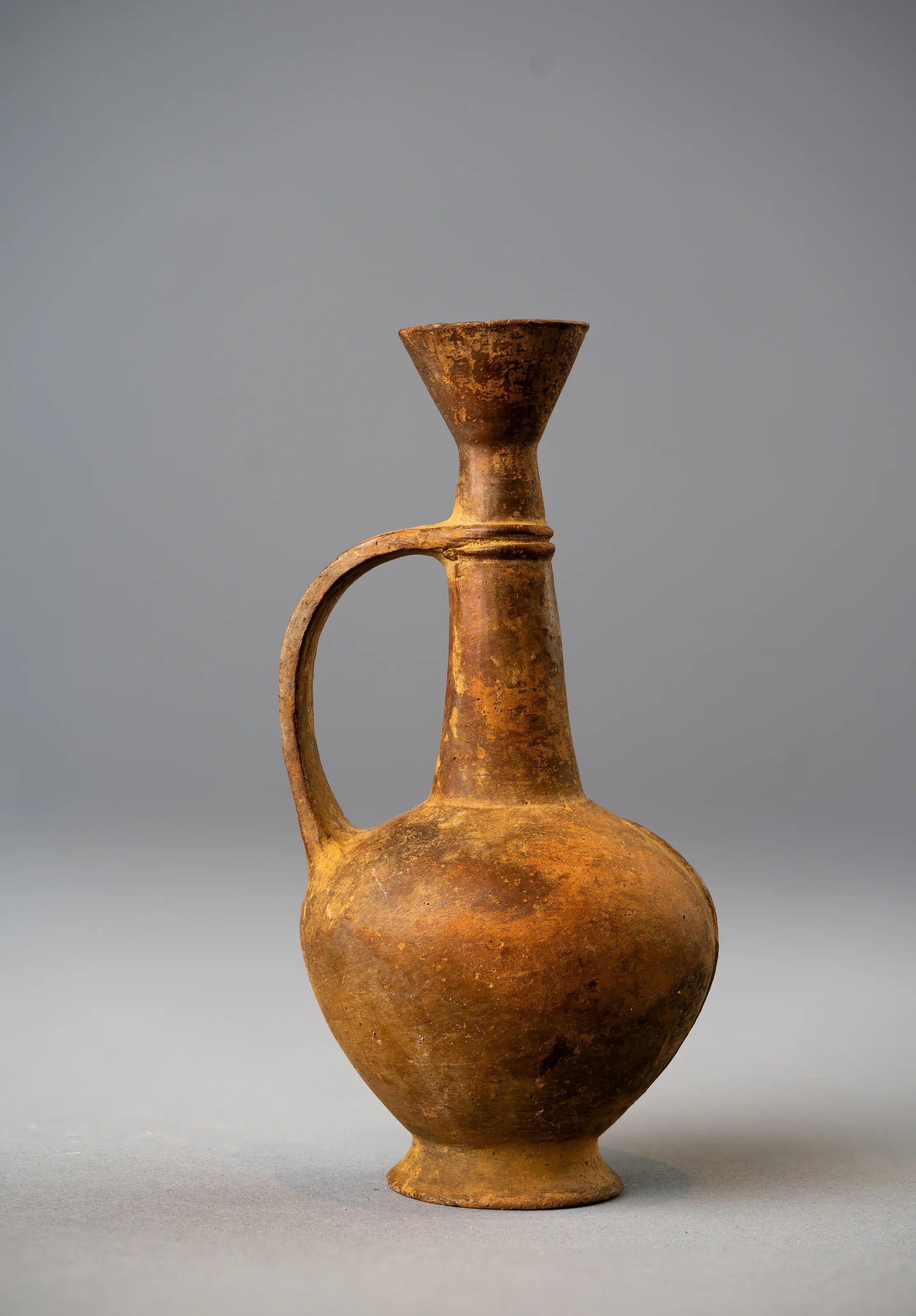
Late Bronze Age II
Base Ring Bilbil Juglet with Funnel Mouth and Neck Ridge
A plain red-fired Base Ring juglet from Late Bronze Age Cyprus, with a deep funnel mouth and a double ridge where the handle joins the neck.
Date
1550 - 1300 BC
Accession No.
JUG-BA-017
Collection
Alexis Drakopoulos
Provenance
- 1965–1969, The Goodman Collection
- 2025–present, Alexis Drakopoulos, London
Late Cypriot IB–IIB, c. 1550–1300 BCE · Base Ring ware, red-fired · Handmade
A slender juglet with a full, rounded body on a neat splaying ring foot. The neck is tall and tapers upward, then opens abruptly into a deep conical funnel mouth with a thin, straight-cut lip. Just below the funnel, a raised double ridge circles the neck, and the upper end of the strap handle is set exactly on it. The handle is thin and makes a tall, narrow loop down to the shoulder. The body and neck are undecorated. The surface is a matt orange to red-brown, darker and more even on the neck, with lighter buff patches and fine pitting where the surface skin has worn. The juglet is complete, with no visible breaks.
Commentary
This is a Base Ring juglet of the bilbil type. The funnel mouth, the tall neck and the ridge where the handle joins the neck are standard features of the ware as Åström classified it [1]. The ridge is usually read as a copy of the collar that fixed a handle to the neck of a metal jug. The body carries neither the relief bands of Base Ring I nor the white paint of Base Ring II, so the piece cannot be placed securely in either group. Plain-bodied bilbils are a recognised variant in Merrillees's classification of the juglets found in Egypt [2]. The crisp profile, the sharply set funnel and the careful neck ridge sit most comfortably in the earlier part of the series, so a range of c. 1550–1300 BCE is given here.
The red colour comes from firing in an oxidising atmosphere. Vaughan's study of Base Ring fabrics identifies an oxidised red group alongside the familiar dark metallic fabrics [3].
A close match in shape and colour is a juglet from Tell Atchana (ancient Alalakh) in the British Museum (WCO24914), catalogued as Base Ring II with a red surface, H. 13.1 cm, and dated 1550–1400 BCE. It has the same funnel mouth and neck ridge. That record pairs a Base Ring II label with a date in the Base Ring I bracket, which shows how loosely the two terms are applied to plain examples. A Base Ring juglet in the Ashmolean Museum (AN1932.150, H. 14.5 cm) repeats the neck ring and funnel. Such juglets travelled widely in the Levant and Egypt [2].
Juglets of this shape held small quantities of oil. Residue analyses of Base Ring juglets have mostly identified plant oils scented with aromatic herbs [4]. The deep funnel would have made refilling easy, while the narrow neck controlled the flow when pouring.
The find-spot is not recorded.
References
- 1.Åström, P. (1972) The Swedish Cyprus Expedition IV:1C. The Late Cypriote Bronze Age: Architecture and Pottery. Lund: Swedish Cyprus Expedition, pp. 137–198.
- 2.Merrillees, R.S. (1968) The Cypriote Bronze Age Pottery Found in Egypt (SIMA 18). Lund: Paul Åströms Förlag.
- 3.Vaughan, S.J. (1991) Material and technical characterization of Base Ring ware. In Barlow, J.A., Bolger, D.L. and Kling, B. (eds) Cypriot Ceramics: Reading the Prehistoric Record. Philadelphia: University Museum.
- 4.Chovanec, Z., Bunimovitz, S. and Lederman, Z. (2015) Is there opium here? Analysis of Cypriot Base Ring juglets from Tel Beth-Shemesh, Israel. Mediterranean Archaeology and Archaeometry 15.
More from the Catalogue
Browse related objects
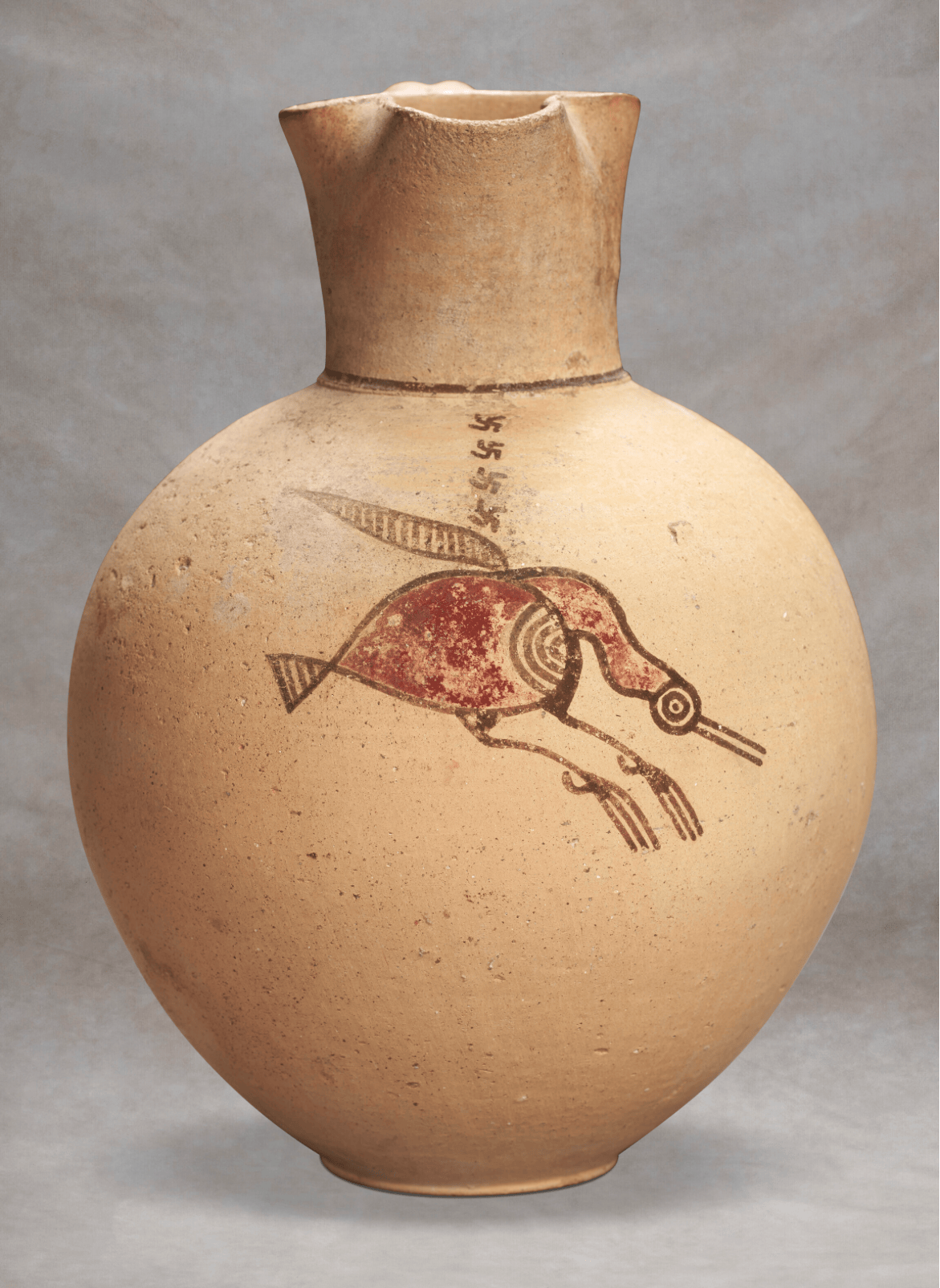
Bichrome Oinochoe
Archaic I
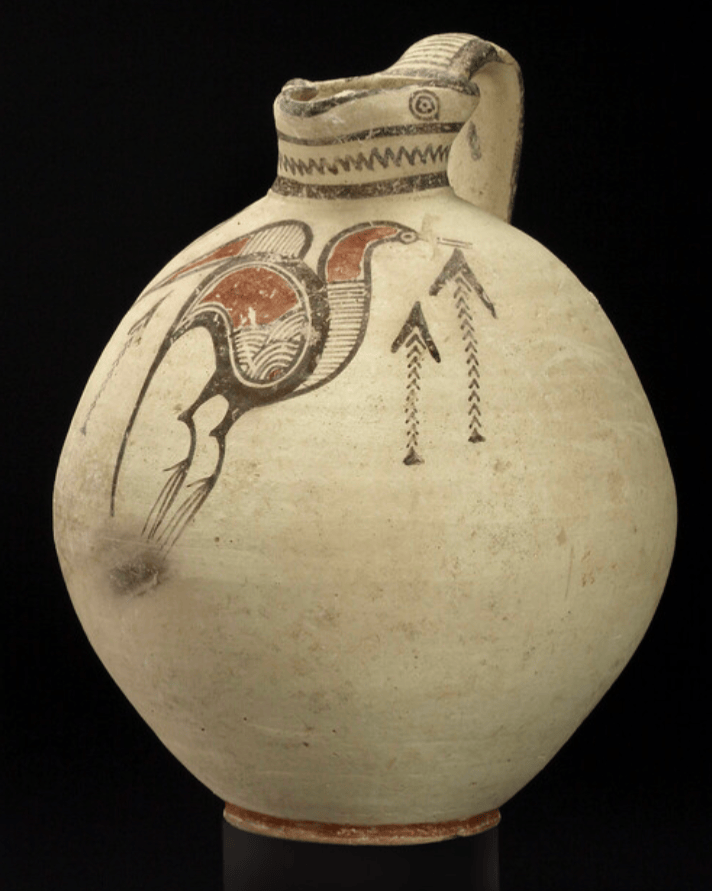
Free-field bichrome jug with image of an Ibis bird and reeds
Archaic
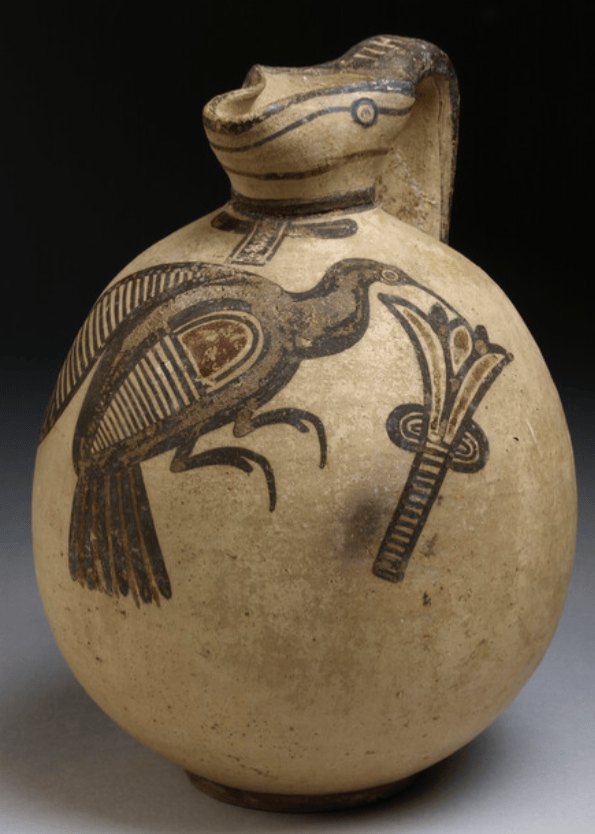
Squat bichrome jug in free-field style with image of bird picking a lotus flower
Archaic
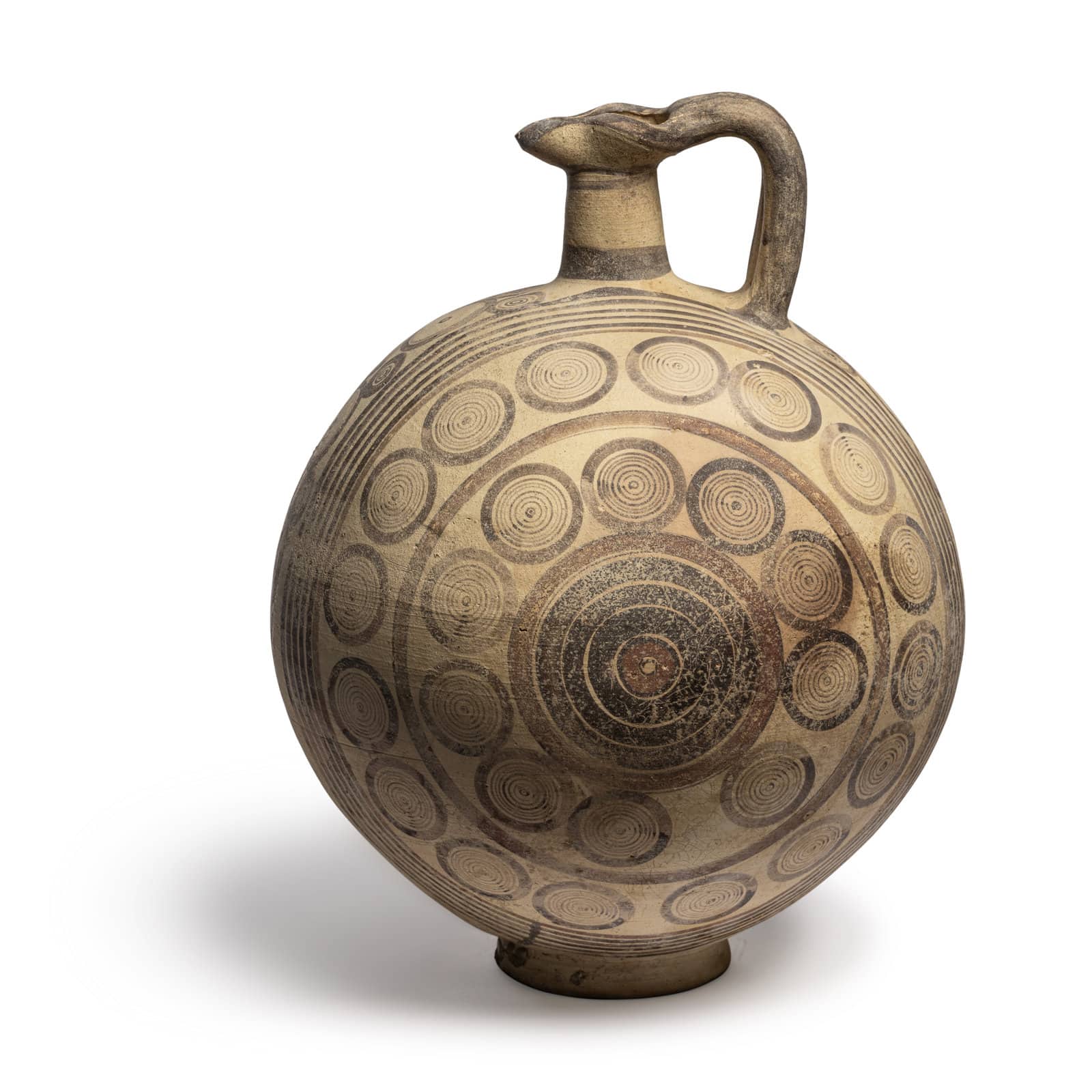
A Cypriot Bichrome-Ware Oinochoe Jug
Archaic I
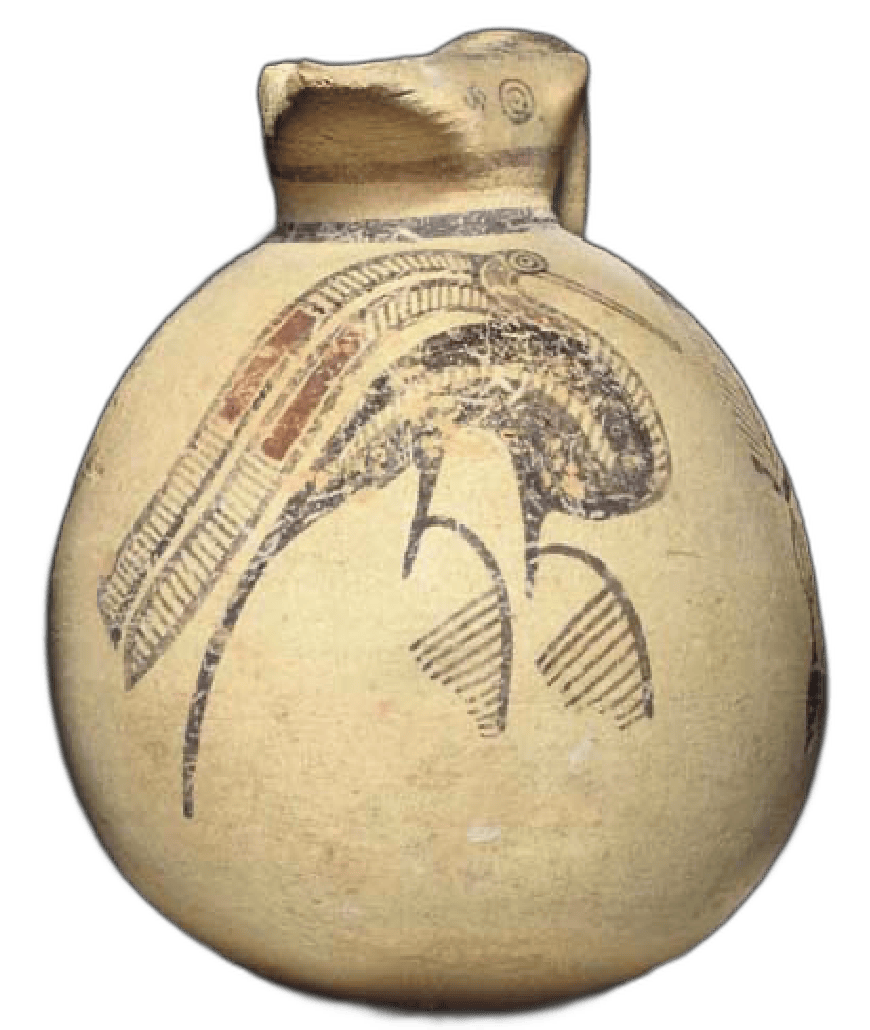
Oinochoe with Free Field Bird
Archaic I
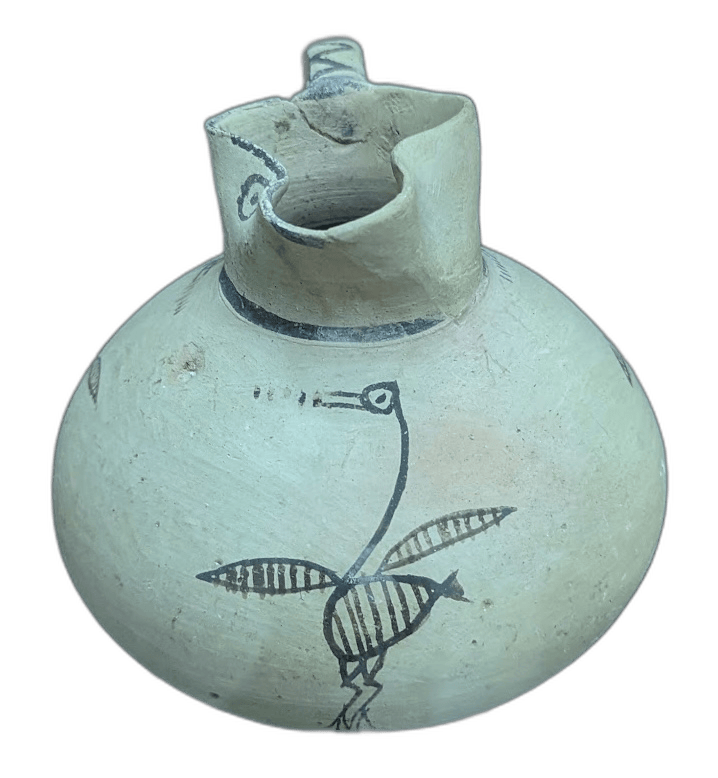
Small Oinochoe with Free Field Bird
Archaic I
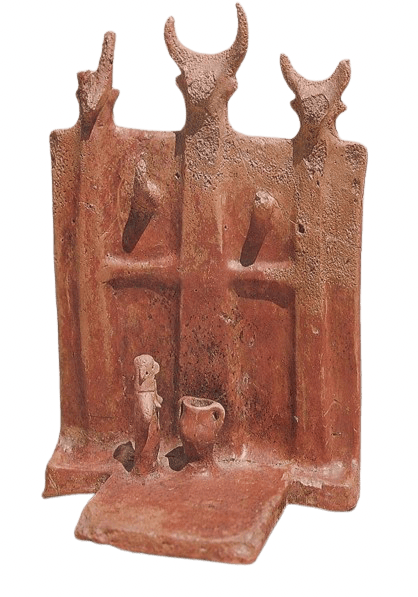
Red Polished Shrine
Middle Bronze Age I
Black-On-Red Geometric Jug Sherd
Geometric II
Bichrome Jug
Geometric
Bichrome Juglet
Geometric
Bichrome Oinochoe
Geometric
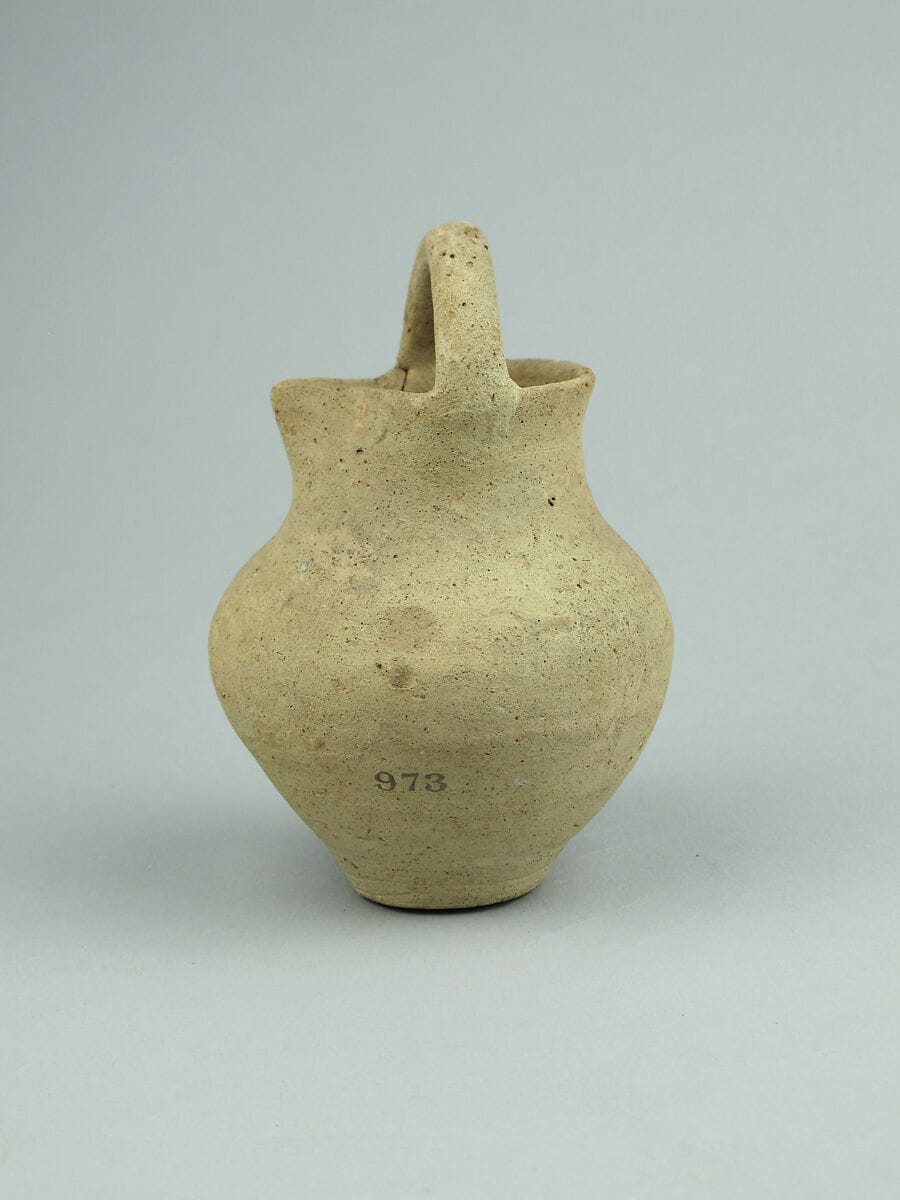
Juglet
Archaic II
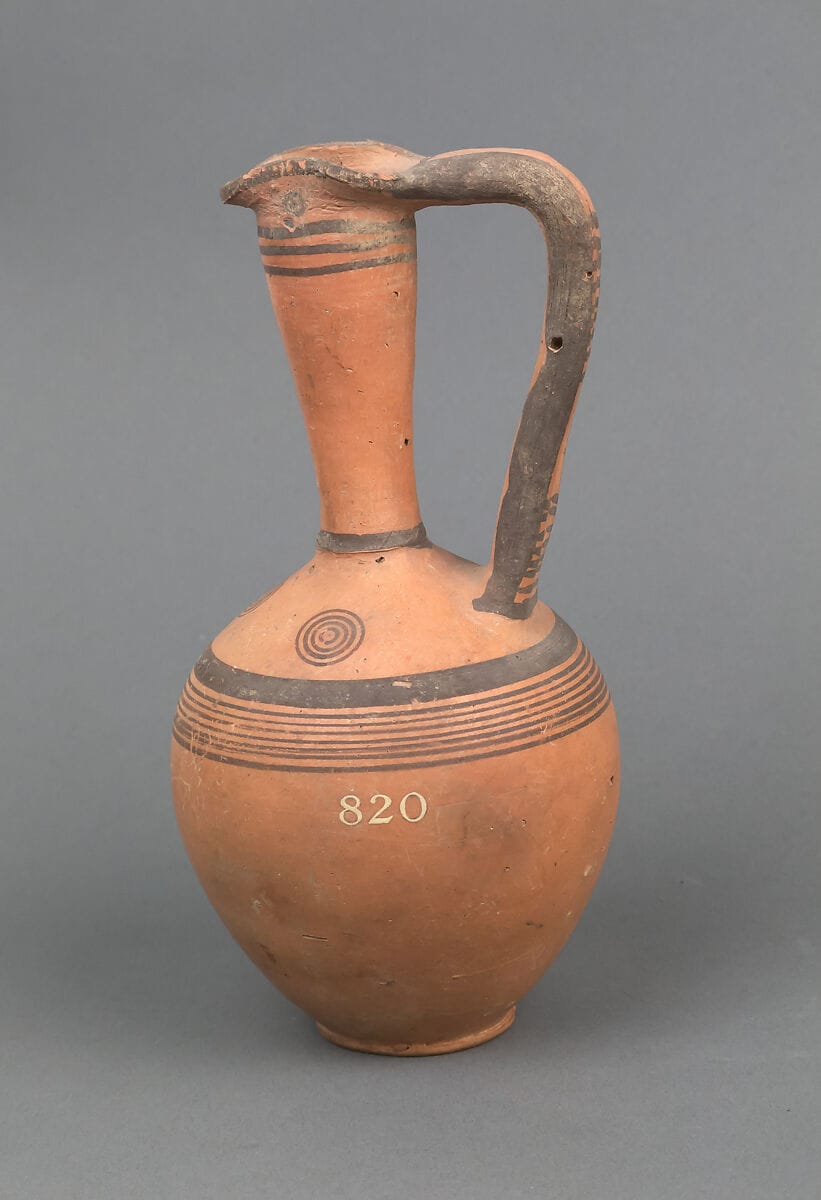
Oinochoe
Geometric III
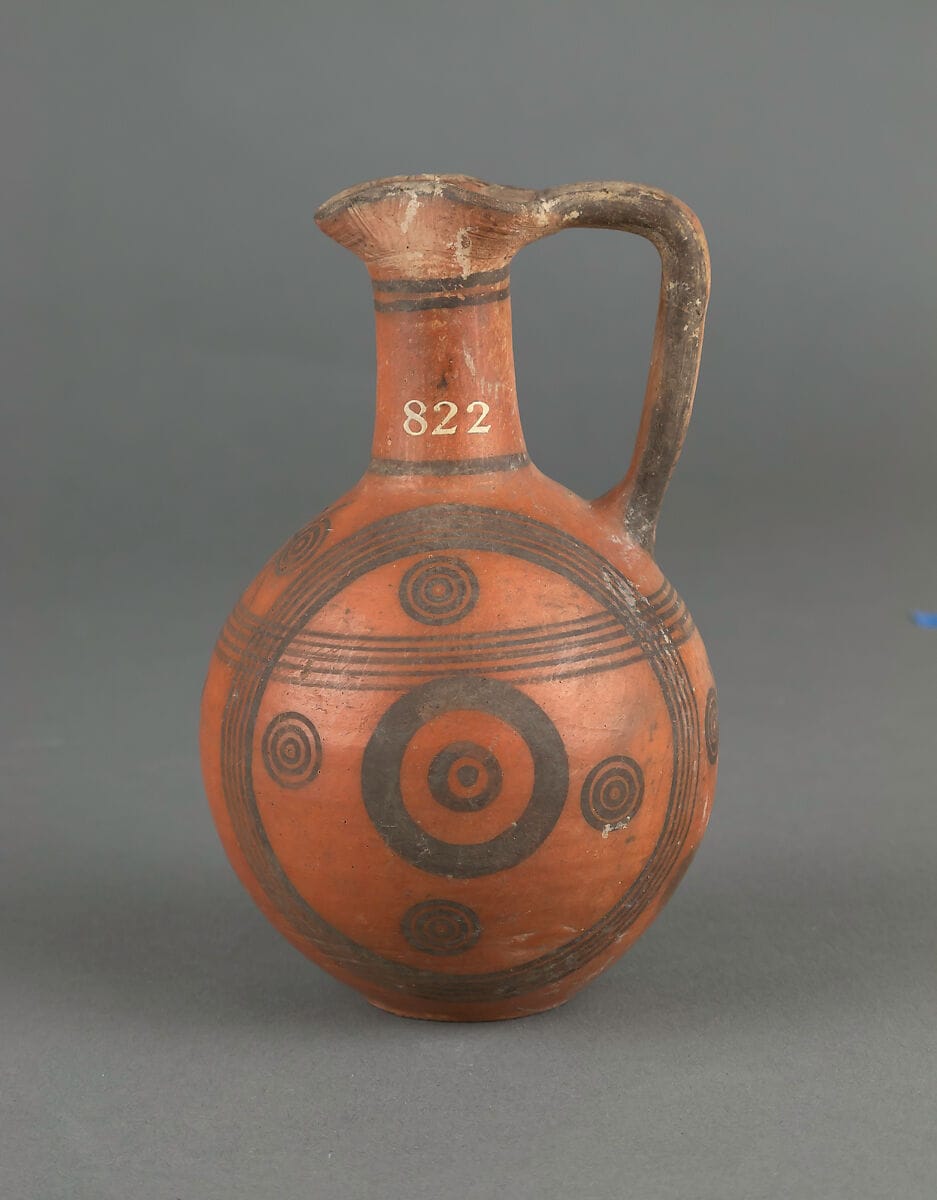
Jug
Archaic I
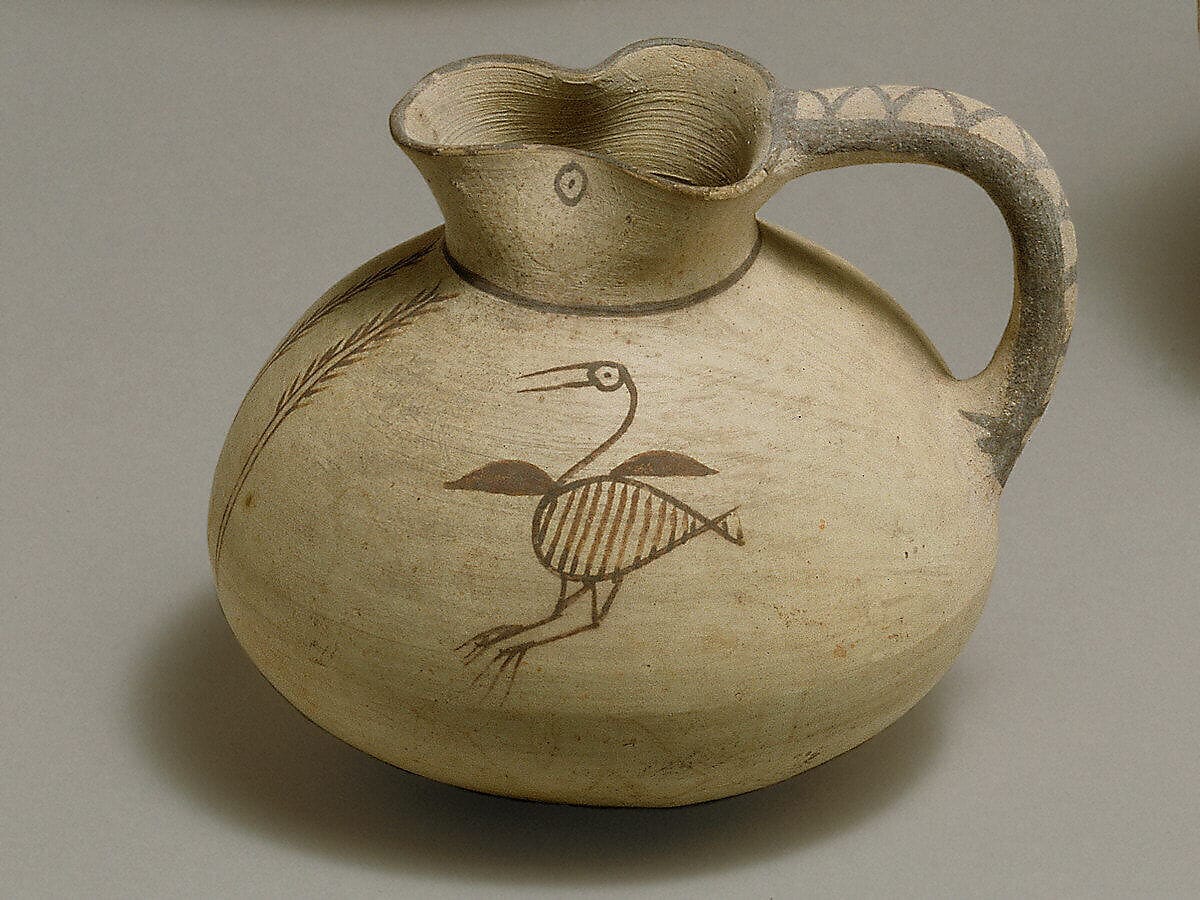
Juglet
Archaic I
Jug
Geometric I
Terracotta jug
Early Bronze Age I
Juglet
Geometric I