
Contents
Glass reached Cyprus in the Late Bronze Age as small perfume vessels formed around a core, and almost everything that survives from the island before the Roman period comes out of tombs. Peter Cosyns counts 66 Late Bronze Age glass pieces from 38 burial contexts at nine sites [1, p. 113]. For the core-formed vessels of the Classical and Hellenistic periods, he and Karin Nys write that "all known contexts are essentially burials", the rare exceptions being a sanctuary at Maroni and the temple of Aphrodite at Amathus [2, p. 234]. The record therefore poses the same problem in every period: whether any of this glass was made on the island. Christopher Lightfoot, cataloguing the Cesnola glass in New York, found "little to suggest that Cyprus was the home of a major glass industry prior to the invention of glassblowing", and identified imports even among the Roman glass [3, p. 17]. This entry follows glass from the Late Bronze Age to the Roman period. The related vitreous material is treated under faience.
Making glass and working glass
Glass objects involve two operations that did not usually happen in the same place: primary production, which fused raw materials into glass, and secondary production, which re-melted and shaped it. Andrea Ceglia describes the Late Antique form of the system: "primary workshops" in the Levant and Egypt made between 8 and 20 tons of glass in a single batch, which was broken into blocks and shipped "to supply the secondary workshops where it was re-melted and shaped" [4, pp. 85–86]. The same division already held in the Bronze Age. Cosyns notes that the Mycenaean palaces probably had secondary workshops, attested by stone moulds and by the word kyanos in the Linear B tablets, while their raw glass came from Egypt and from Mesopotamia and the Levant [1, p. 106]. Arguments for "local" Cypriot glass concern secondary working of imported glass; Cosyns's own proposal for Late Bronze Age Cyprus is of this kind [1, p. 105].
Cyprus differed from the Aegean: its Late Bronze Age tombs "yielded numerous core-formed glass vessels in idiosyncratic shapes but practically lacked characteristic Mycenaean glass beads, pendants and inlays" [1, p. 105]. The line between glass and faience has also been drawn wrongly in the older literature. Porphyrios Dikaios published three glass vessels from Enkomi Tomb 10 as faience, and Edgar Peltenburg showed that various other pieces had been misidentified in the same way [1, pp. 107–108], so older counts of both materials need checking against the objects.
Core-forming, the technique behind every pre-Roman vessel discussed here, is summarised by Cosyns and Nys as a sequence: a core of clay mixed with organic material on a metal rod; glass worked over it with the heat of a furnace above 1000°C; threads of opaque glass applied as decoration; and finally the removal of the rod and the core [2, p. 237]. The two authors also propose that the cores were pressed in moulds to standard volumes, so that an aryballos held one kyathos, or ten kochliaria [2, pp. 239–241]; this remains a hypothesis. Museum catalogues describe the finished decoration as trails "marvered and combed" into festoon or feather patterns.
Raw glass on the move: the Uluburun ingots
The best evidence for how raw glass travelled in the Late Bronze Age comes from a wreck. The Uluburun ship, which sank off Kaş in Turkey in the fourteenth century BCE, carried "a large consignment of glass ingots", long assumed to come from Mesopotamia or Egypt [5, p. 295]. C. M. Jackson and P. T. Nicholson analysed three of them, two deep blue ingots coloured with cobalt and one turquoise ingot coloured with copper, and concluded that their composition "for the first time securely demonstrates" an origin consistent with Egypt [5, pp. 295, 300]. They cite the Amarna excavations of the 1990s, where primary production is "likely", and Qantir as the known Egyptian glass factories [5, p. 295].
The sample is small: the paper quotes Walton and colleagues on "the 175 ingots" from the wreck, and the authors warn that "analysis of more ingots may show that some were of Near Eastern origin" [5, pp. 295, 300]. For Cosyns the wreck shows raw glass distributed as ingots "from Egypt and the Levant ... in order to supply secondary glass workshops" [1, p. 106], within a network in which Cyprus was "a highly dynamic hub" during the fifteenth to thirteenth centuries BCE [1, p. 105]. The ingots put Egyptian and possibly Levantine raw glass into the same fourteenth-century trade; no ingot has been matched chemically to a Cypriot vessel.
Late Bronze Age core-formed vessels: corpus, shapes and tombs
The corpus has grown with each survey. Schlick-Nolte in 1968 recorded 21 vessels from seven coastal sites; L. Åström in 1972 listed 48 pieces from 11 sites; Cosyns's inventory "encompasses 98 core-formed glass vessels from Cyprus", 94 of them of known provenance and 70 from an identified context, at 15 sites [1, pp. 109–110]. They "occur all over the island, though the northern coast has not yielded much". Nearly half come from Enkomi, with 35 pieces, while Hala Sultan Tekke, Kition and Kourion have produced up to 18 pieces apiece. Of 30 pomegranate jars, 19 are from Enkomi [1, p. 112]. The one inland outlier is a krateriskos that Cesnola reportedly found in a tomb at Idalion [1, pp. 111–112], now the Metropolitan Museum's krateriskos 74.51.352, catalogued as "Egyptian or Cypriot" and dated about 1400 to 1350 BCE.
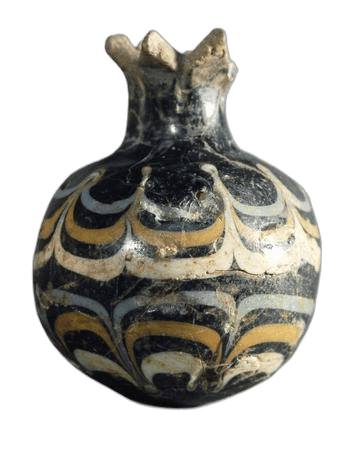
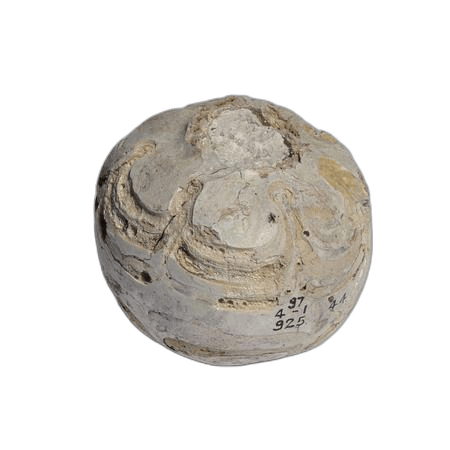
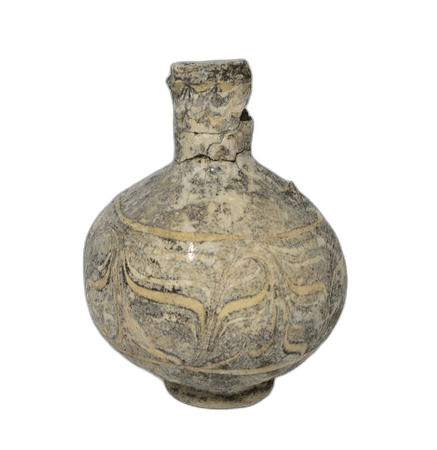
Pomegranate jars are the largest single class in Cosyns's corpus. The British Museum's pomegranate flask 1897,0401.1052, from the museum's Turner Bequest excavations at Enkomi, is 8.5 cm high and dated about 1340 to 1200 BCE. It is of clear brown glass with opaque white, light blue and orange trails, combed into upright festoons on the upper body and inverted festoons on the lower. Its splayed rim is formed by six triangular, pointed calyx-tips; the body is broken and mended, with one side and the bottom restored in plaster. A second Enkomi flask, 1897,0401.925, has lost its rim and neck and is completely devitrified. A pomegranate jar in the Pierides collection at Larnaca, discussed in the entry on the Pierides family, was "incorrectly restored at the neck" [1, p. 111], a reminder that the calyx rims used to classify these vessels are often the part that is missing or rebuilt.
Cosyns divides the shapes into those with Cypriot antecedents and those at home in Egypt [1, p. 112]:
| Group | Shapes | Counts given by Cosyns |
|---|---|---|
| Cypriot shapes | Pomegranate jars and bottles; globular jugs on a base-disc; Base Ring (bilbil) jugs; tubular bottles or kohl-tubes, some crowned with a pomegranate; pyxides; a stirrup jar | 30 pomegranate jars (19 from Enkomi); 4 Base Ring jugs; 5 pomegranate-topped tubular bottles; 4 globular jugs |
| Egyptian shapes | Ovoid amphoriskoi; krateriskoi; lentoid or pilgrim flasks | 17 amphoriskoi; 4 krateriskoi; 3 lentoid flasks |
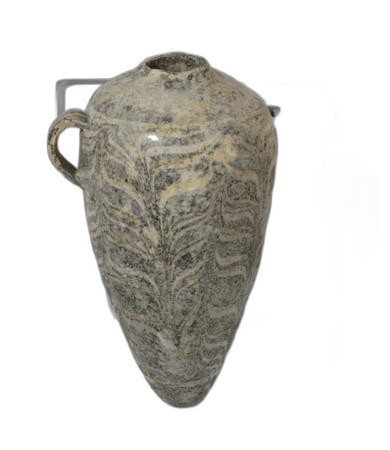
Glass copies of Base Ring jugs reproduce a local ceramic shape in an imported material. The British Museum holds two core-formed vessels from Maroni that show both groups: an amphoriskos, 1898,1201.136, of dark blue glass with a feather pattern in three colours under a whitish weathering crust, and a globular bottle on a base-disc, 1898,1201.135, with a trace of a lip-spout and a handle, which matches Cosyns's Cypriot class of globular jugs on a base-disc (compare the ceramic bottle forms).
Most tombs held a single vessel: 25 of the 38 tombs with glass had only one. A few Enkomi tombs had five or eight, and French Tomb 5 held six pomegranate jars, an amphoriskos and a stirrup jar [1, pp. 113–114]. Two tombs, Toumba tou Skourou Tomb 2 and Kalavasos-Ayios Dhimitrios Tomb 11 (excavated by Alison South), each contained a young adult woman buried with glass, ivory, gold and lapis lazuli and without faience vessels. Cosyns raises a possible link between glass vessels and women in Cyprus, against Egypt, where glass vessels occur "only in tombs of males", but says the observation "needs to be refined" [1, p. 113]. The tombs themselves are described under Bronze Age chamber tombs.
Peltenburg placed the pomegranate vessels in a tight range, from the end of Late Cypriot IIB to early Late Cypriot IIC; Kition Area I Tombs 4/5 and 9 fall in the first half of the thirteenth century BCE; and Toumba tou Skourou Tomb 2 runs from Late Cypriot IB to IIB, the late sixteenth to the late fourteenth century BCE [1, p. 115]. At Kition, Areas I and II have produced many fragments, probably from tombs, "though some glass blocks have been reported in the area" [1, p. 115].
Workshop or import: the Late Bronze Age debate
Whether any of these vessels was formed on Cyprus has divided specialists since 1940 [1, pp. 109–110]. In 1940 Fossing assigned all of them to Egyptian manufacture and rejected Sjöqvist's suggestion of a Cypriot workshop based on the glass copies of Base Ring shapes. Schlick-Nolte in 1968 also treated them as Egyptian imports, while observing that the Cypriot pomegranate jars differ from Egyptian ones and are entirely absent from Egypt. Harden, in 1968 and 1981, thought the pomegranate bottles were probably made in Cyprus: they have shorter necks and a rim "with six to seven pointed calyx tips, whereas the Egyptian ones have eight or more rounded tips", and a double three-festooned trail pattern. Barag, writing in 1970, 1984 and 2003, found no workshop evidence and read all of them as standard Egyptian products, made for export or by Egyptian craftsmen who had moved to Cyprus or the Levant. Peltenburg in 1986 supported local production. Grose in 1989 judged the state of knowledge "premature", allowing only that the globular jug on a base-disc might be Cypriot.
By Harden's criterion, the British Museum's Enkomi flask, with six pointed calyx-tips, falls on the Cypriot side of the line. Cosyns concludes that there was "at least one glass workshop in Cyprus". He rejects Egyptian import for the pomegranate jars, the Base Ring jugs, the globular jugs and the pomegranate-topped tubular bottles, and adds a cylindrical pyxis from Kalavasos-Ayios Dhimitrios Tomb 11, "imitating the well-known Cypriot ivory boxes", and the Enkomi stirrup jar [1, p. 112]. Enkomi's dominance in the corpus "might equally indicate that this large coastal town harboured a glass workshop" [1, p. 112]. He keeps the caveat in view: "we cannot exclude the possibility that these vessel shapes were manufactured elsewhere in the absence of any archaeological evidence of a Late Bronze Age glass workshop in any Cypriot site" [1, p. 112]. As far as we know, no furnace, mould or production waste has been published.
The Egyptian shapes probably reached the island by different routes. The amphoriskoi, rare on the Levantine coast, may have come directly from Egypt; the lentoid flasks, common in Palestine, "very likely arrived" through down-the-line trade [1, pp. 112–113]. The choice of the pomegranate may also be regional. The motif is late and rare in Egyptian art, but in Syria and Cyprus it is connected with Astarte and Aphrodite, fertility and longevity, according to Courtois and colleagues as Cosyns cites them [1, p. 110].
Archaic to Hellenistic: the Mediterranean core-formed groups
Glass vessels are scarce on Cyprus between the end of the Bronze Age and the late sixth century BCE. Lightfoot notes that glass "had limited appeal until late Hellenistic times, when both core-formed and cast glass suddenly became popular" [3, p. 16]. The Cesnola collection has one Egyptian New Kingdom core-formed vessel, one Cypro-Archaic cast alabastron "probably of Phoenician or Assyrian origin", and only nine core-formed vessels in all, of which a single one is Classical [3, p. 17].
The later core-formed perfume vessels belong to the series that Harden divided into three Mediterranean Groups: Group I (525/500 to 400/390 BCE), Group II (400/390 to 300/250 BCE) and Group III (300/250 BCE to 50 BCE or 10 CE) [2, pp. 231–232]. Cosyns and Nys count 198 such vessels from Cyprus, up from the 109 McClellan listed in 1984. More than half, 111, cannot be assigned to a findspot. The known pieces come from only 17 sites, mostly coastal; the inland exceptions are Dali (Idalion) and Athienou (Golgoi) [2, p. 232].
| Mediterranean Group | Date | Examples from Cyprus | Types | Notes |
|---|---|---|---|---|
| Group I | 525/500–400/390 BCE | 34 | 11 | Compare Rhodes, with 113 Group I examples |
| Group II | 400/390–300/250 BCE | 14 | 9 | Mostly Salamis |
| Group III | 300/250 BCE–50 BCE/10 CE | 133 | 14 | Mostly Amathus and Kourion |
| Undatable | 19 |
The table follows Cosyns and Nys [2, pp. 234–235]. Amathus alone accounts for 36 per cent of the inventory (71 examples), or about 61 per cent if the unprovenanced pieces are set aside, and Amathus, Salamis and Marion are the only sites with all three groups [2, p. 234]. The shape range is lopsided: the aryballos, common on Rhodes, in mainland Greece and at Ampurias, is barely present, with two examples [2, p. 234]. Lightfoot offers a reason for the thinness of the Classical record. Cypriots preferred local stone perfume vases of gypsum or calcite, the so-called Egyptian alabaster: Salamis Tomb 113 held one Group II glass alabastron beside 22 local alabaster bottles, "the majority of which are the same shape as the glass" [3, p. 31]. One rare shape, the hydriske, is "well represented in Cyprus" [3, p. 31].
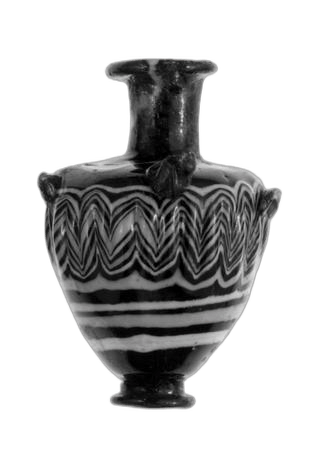
The British Museum's cobalt glass hydriske from Amathus, 1894,1101.318, catalogued as Mediterranean Group 2 and dated about 400 to 275 BCE, is 6.6 cm high, of translucent cobalt blue with opaque white and orange trails in a zigzag panel. Its catalogue notes that one orange trail is "a false attempt" that stops after a quarter-circle.
Groups I and II "were imports into Cyprus" [2, p. 241], and Lightfoot agrees [3, p. 31]. The case for Hellenistic production on the island rests on Group III [2, pp. 241–243]. Amphoriskoi with S-shaped handles and ovoid or fusiform bodies are concentrated on Cyprus, with a limited spread to Rhodes, the southern Levant and possibly Cyrenaica; Cosyns and Nys read this as indicating "production on Cyprus", and the homogeneity of the type as suggesting "production at a single centre". The Met's Cesnola amphoriskos 74.51.320, 17.1 cm high, is a late Hellenistic example. Amathus has 58 late Hellenistic pieces, 43 per cent of the Cypriot material of the period (about 67 per cent if the 49 unprovenanced pieces are excluded), and its tombs contain botched vessels: footed pieces that cannot stand, carinated alabastra with a hole in the lower body, walls patched with a blob of glass. The authors ask what function such pieces could have had "other than a symbolic one" and read them as local products placed in graves. Their historical context is the decline of Rhodes after 168 to 164 BCE, which could have left Cyprus as a redistribution centre. The authors also state that "no glass workshop has yet been detected on the island" [2, pp. 241–243]. (On the site, see the ancient city of Amathus.)
Lightfoot accepts that "a Cypriot production center may have existed at Amathus", but holds that "Cyprus never played a prominent role in the core-formed glass industry". Cast tablewares of the period outclass the core-formed vessels, and he connects their spread to the expansion of the Phoenician and Syrian industry and to the trade that followed Rome's clearance of the pirates in 67 to 66 BCE [3, p. 32]. Phoenicia was a main centre for plain and ribbed cast bowls, which reached Cyprus along the south coast of Asia Minor, and Lightfoot finds no clear Alexandrian influence in the island's glass despite Ptolemaic rule from 294 to 58 BCE [3, p. 17]. Cosyns and Nys observe that late Hellenistic core-formed vessels decline in quality as their makers competed with ceramic perfume containers, "on the brink of a technological revolution" [2, p. 239].
Roman blown glass and the Cesnola collection
Glassblowing, invented in the late first century BCE or early first century CE [3, p. 17], changed the scale of the record. The largest body of Cypriot glass outside the island came from Cesnola, who is said in many sources to have removed some 35,500 objects in the 1870s, about 5,000 of which were lost at sea off Beirut [3, p. 11]. Early counts of his glass disagree: Myres in 1914 listed some 753 glass objects, Richter in 1911 "over 1,700", and another early source 2,900 [3, pp. 15, 21]. The Metropolitan Museum today has about 520 records with 74.51 accession numbers and 579 glass objects with a Cypriot provenance in all, "by far the largest such assemblage ... in the world, outside Cyprus"; Cesnola's Atlas devoted 32 plates to glass [3, p. 16], and about 72 pieces are on display [3, p. 18] (see the Cesnola collection). The de Clercq collection had more than 400 glass objects, about 65 of them Cypriot [3, p. 18].
In the British excavations at Amathus in 1893 and 1894, 48 tombs produced glass in a single four-month season; Cesnola had described the glass there as "always broken but beautifully iridescent" [3, p. 15]. The British Museum holds a twisted glass stirring rod from Amathus (1894,1101.710) of the first or second century CE.
In Roman Cyprus glass became "one of the staple items of daily life": cups, plates, bowls, jugs and bottles, often given as grave offerings. The many blown perfume bottles in tombs may have been bought in bulk, perhaps from the producer of the contents or from whoever organised the funeral rather than from the glassworker [3, p. 17]. Glass beads and inlays imitating gems gave ordinary people rings and earrings [3, p. 17] (compare jewelry).
A few types do look specifically Cypriot [3, p. 18]. Jars with painted saucer lids, most often showing Aphrodite or Eros, are the clearest case: "such lids do seem to be specific to Cyprus". The Metropolitan Museum's bowl with painted lid 17.194.88a,b, of the second century CE, came to the museum as a gift of J. Pierpont Morgan in 1917, and the British Museum has a lid with Eros holding grapes and a pruning hook, given in 1888 by the Cyprus Exploration Fund [3, p. 296]. Vessberg's sack-shaped beakers (his type A.II.α) are among the most numerous Cesnola types, alongside his jugs A.I.α.1 and sack-shaped jars A.II and B.I [3, p. 18]. The Met's Cesnola beaker 74.51.230, of the mid to late second century CE, is an everyday blown vessel of the period.
Imports sit beside them: Lightfoot identifies a painted bottle from Egypt, perhaps Alexandria; a hexagonal jug with Jewish symbols from Palestine; a barrel-bottle base of a group otherwise found only in eastern central Gaul; and a snake-thread flask, now in the Fitzwilliam Museum, of a type made in Cologne or perhaps Syria. Cesnola also found a one-handled cup from the workshop of Ennion, now in the British Museum [3, p. 17]. The mould-blower Aristeas signed himself "the Cypriot", but "it is unlikely that he established his workshop there, and no examples of his glass have been found as yet on Cyprus"; the Cesnola collection has only eleven mould-blown pieces.
The workshops themselves remain elusive. Max Ohnefalsch-Richter reported excavating a glass furnace at Tamassos in 1885, a claim that "remains unsubstantiated" [3, pp. 16–17] (see the Ohnefalsch-Richter article); Lightfoot allows for itinerant glassworkers [3, p. 16]. Olof Vessberg's study of the 1950s asked whether there was "a domestic Cypriote glass manufacture of any importance"; Lightfoot judges that "his conclusions are still valid", and that blown ribbed bowls show "Cyprus had already taken its place in the Empire-wide glass industry by the mid-first century A.D." [3, p. 66]. His verdict on the Roman material is that utilitarian glass was made locally but "does not attest to a major industry that supplied glass to other parts of the Empire", and that "Cypriot glass should not be seen as exclusive and distinctive; rather, it is part of a larger tradition". Its reputation as a regional glass owes much to the volume of its publication, in the 1903 Atlas and in Vessberg's work [3, p. 18].
What the analyses show, and open questions
Chemistry has barely reached Cypriot glass. For Late Antiquity, the raw glass of the eastern Mediterranean falls into a handful of compositional groups: Levantine 1 (Egyptian natron fused with sand from the Belus river near Akko), Levantine 2 (Bet Eli'ezer), Egypt 1, Egypt 2 and the group known as HIMT [4, p. 86]. When Ceglia wrote, the only published Cypriot data were analyses of 19 fragments from the basilica at Maroni-Petrera (Freestone and colleagues, 2002): 13 were Levantine 1, four HIMT and two uncertain, a result he explains by the island's proximity to the Palestinian coast [4, p. 87]. The NARNIA project set out to analyse more than 500 fragments by in-situ UV-vis-NIR spectroscopy from Agioi Pente at Yeroskipou, excavated by Demetrios Michaelides, from Agios Nikolaos at Maroni-Petrera, excavated by Sturt Manning, and from three basilicas at Kalavasos-Kopetra [4, pp. 87–89].
For the Late Bronze Age, we know of no compositional analysis of a Cypriot vessel, and Cosyns describes Cypriot material as having "remained marginal" in the eastern Mediterranean debate [1, p. 108]. No glass workshop of the periods covered here has been identified on the island, so the case for Late Bronze Age secondary working at Enkomi and for a late Hellenistic workshop at Amathus rests on distribution, shape and botched grave goods. Neither the glass blocks reported at Kition nor the raw glass of the pomegranate flasks has been compared with the Egyptian ingots of the Uluburun cargo. The island's other high-temperature crafts are treated under copper metallurgy and pottery kilns and firing.
Objects on this page
References
- 1.Cosyns, P. (2017). The Late Bronze Age core-formed glass vessels in Cyprus: A preliminary report. In L. Bombardieri, M. Amadio & F. Dolcetti (Eds.), Ancient Cyprus, an unexpected journey: Communities in continuity and transition (pp. 105 ff.). Editoriale Artemide.
- 2.Cosyns, P., & Nys, K. (2010). Core-formed glass vessels on Cyprus reconsidered. In S. Christodoulou & A. Satraki (Eds.), POCA 2007: Postgraduate Cypriot Archaeology Conference (pp. 231 ff.). Cambridge Scholars Publishing.
- 3.Lightfoot, C. S. (2017). The Cesnola Collection of Cypriot art: Ancient glass. The Metropolitan Museum of Art.
- 4.Ceglia, A. (2014). Shedding light on the glass industry of ancient Cyprus: Archaeological questions, methodology and preliminary results. In V. Kassianidou & M. Dikomitou-Eliadou (Eds.), The NARNIA Project: Integrating approaches to ancient material studies (pp. 85 ff.). The NARNIA Project and the Archaeological Research Unit, University of Cyprus.
- 5.Jackson, C. M., & Nicholson, P. T. (2010). The provenance of some glass ingots from the Uluburun shipwreck. Journal of Archaeological Science, 37, 295–301. https://doi.org/10.1016/j.jas.2009.09.040