
Contents
In the fourteenth and thirteenth centuries BCE the people of Cyprus bought, used and buried painted kraters showing chariots, bulls, birds and trees. Most of the finest were made in the Argolid in mainland Greece, and they have turned up in Cyprus in such numbers that the island is the main source for the whole class. In the thirteenth century Cypriot potters began to make their own, smaller pictorial kraters, painted mostly with grazing bulls and birds. Scholars call that local class the Rude Style or, more kindly, the Pastoral Style. "Pictorial Style" on this site covers both, and the distinction matters: every object in our catalogue under this heading is a Cypriot Pastoral Style krater, not a Mycenaean import.
The history of the imports, the workshop at Berbati and the scientific work that settled where they were made is told in full in Mycenaean Imports and Local Imitations. This entry summarises the imported style briefly and concentrates on the local kraters. See all Pictorial Style objects in the catalogue, or the wider group of Late Bronze Age painting styles.
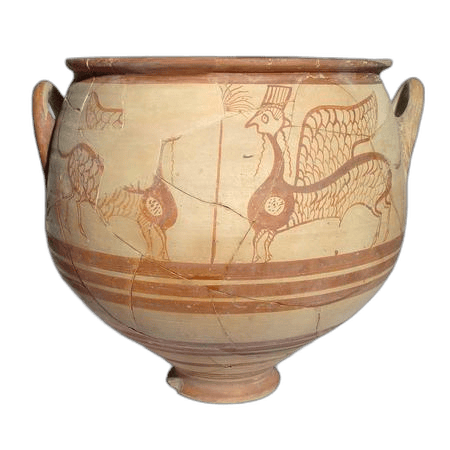
The Mycenaean Pictorial Style in Cyprus
The Pictorial Style flourished in the Aegean during the fourteenth and thirteenth centuries BCE. It "was widely distributed and greatly valued in Cyprus and along the Syro-Palestinian coast", and Anna Lekka calls it "the only available iconography of a high artistic quality on ceramics of this period in the Mediterranean" [1]. Hector Catling put the Cypriot share bluntly: more Mycenaean pictorial pottery "has been found in Cyprus than in the rest of the Mycenaean world put together" [2].
The two main shapes were the amphoroid krater, a tall closed mixing bowl that carried most of the chariot scenes, and the open bell krater, which in the thirteenth century more often carried bulls and birds. The British Museum's Enkomi material shows the range: chariot fragments of LH IIIA, and a LH IIIB bell krater with five stags, all catalogued by the museum as made in Greece. The chariot and horse subjects have their own entry under horses and chariots.
Where these pots were made was argued for decades. The quantity in Cyprus and the Levant persuaded several scholars that they were painted on the island, and Vassos Karageorghis proposed a Cypriot origin for the chariot krater from the tomb at Tel Dan in 1971. In their corpus Mycenaean Pictorial Vase Painting (1982), Emily Vermeule and Karageorghis accepted an Argolid origin for it, and neutron activation analysis by Yellin and Maeir placed it "in the Argolid, very likely in the region of Mycenae or Berbati" [3]. Vermeule and Karageorghis also grouped the kraters by painter; the work of their "Painter 9" has been found at Tell el-Ajjul, Maroni, Miletos, Ialysos, Berbati and Mycenae [3]. Catling concluded that most Mycenaean pottery in Late Cypriot II Cyprus was imported, almost certainly from the Peloponnese, with some imitations made by Cypriot potters "particularly in the later thirteenth century B.C.", and that its abundance reflects "repeated visits of Aegean trading ships during L.C. II, not the presence of Aegean colonies" [2].
Pastoral Style
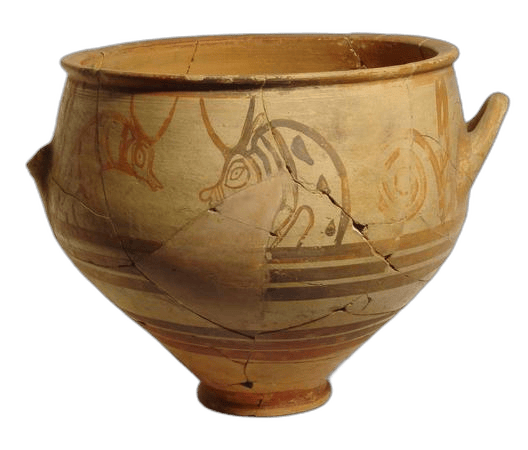
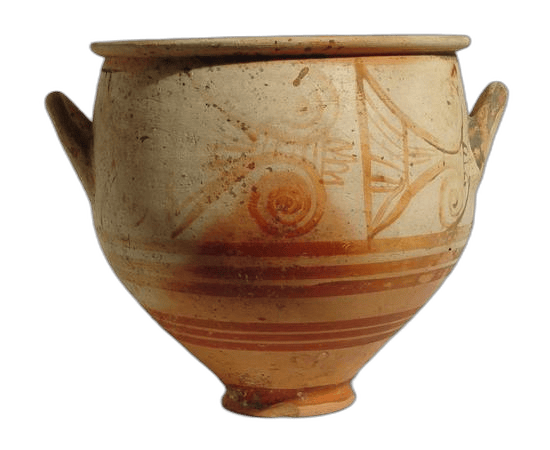
The Pastoral Style is the first Cypriot pictorial pottery made in the Aegean manner. Its vessels are "locally produced ring-base kraters", smaller and narrower at the rim than the LH IIIB bell kraters imported to Cyprus [4, pp. 405–406]. The usual shape is the ring-based krater classified by Arne Furumark as FS 281. Furumark named the class the "Rude Style" to mark its inferior quality and to separate it from the mainland pictorial tradition. Vermeule and Karageorghis renamed it the "Pastoral Style" after its frequent pastoral scenes, such as grazing bulls [4, pp. 405–406]. Both names remain in use, and museum records often add a third: the British Museum files its Enkomi kraters under "Pastoral Style" and under White Painted Wheelmade III, the umbrella term Paul Åström introduced in 1972 for all locally made Aegean-style fine ware [4, p. 405]. See all Pastoral Style kraters in the catalogue.
The style belongs to Late Cypriot IIC, the thirteenth century BCE. Lekka describes it as lasting "for about a century", with the bull as its dominant theme, and notes that sporadic examples from Level IIIA at Enkomi show "the most conservative potters" still making pictorial pottery of the old kind "as late as the first decades of the 12th century BC" [1]. At Sinda, Furumark placed a fragmentary Rude/Pastoral krater with a bull in the transitional phase between the destruction of Period I and Period II, late LC IIC to early LC IIIA [4, p. 417]. The safest summary is a mainly late thirteenth-century style with a short tail into the first decades of LC IIIA. The British Museum dates its Enkomi examples 1250 to 1200 BCE.
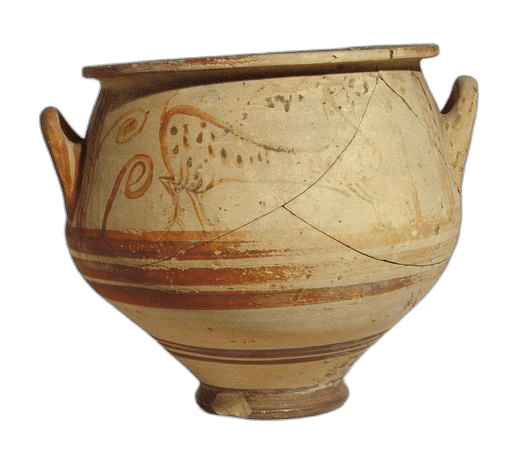
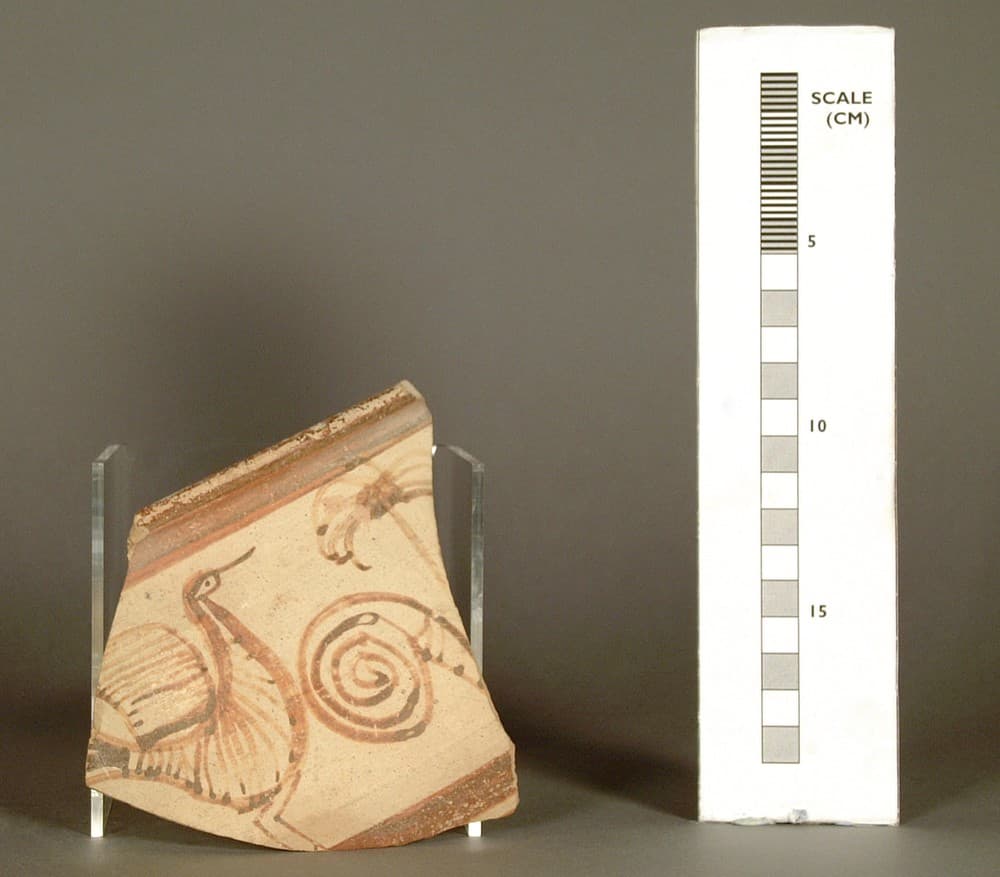
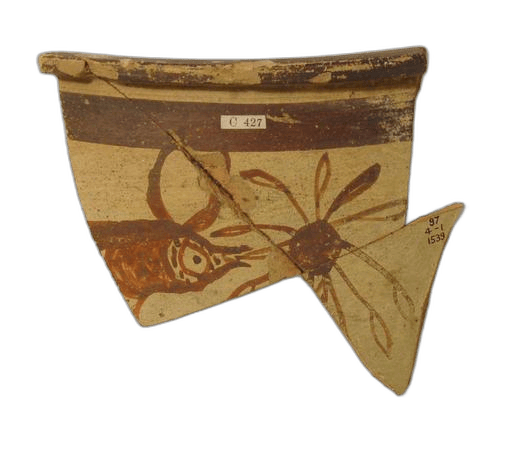
The subjects are few. The bull dominates, drawn in outline with its body filled with linear motifs: lattice, spots, drops or hatching [1]. He grazes, sniffs leaves, or eats from a tree; a hatched mound under his muzzle is probably fodder. Long-necked birds are the second subject, standing in pairs or flying in a row, and goats appear with trees and spirals. Running spirals, volutes and "spiral trees" fill whole kraters or the reverse of figured ones. Lekka stresses what is missing: "Human figures are not included, nor do we encounter those narrative scenes that characterize the work of Mycenaean vase painters" [1]. The rare exceptions show Near Eastern borrowing, such as the antithetic sphinxes on an Enkomi krater and the two confronting lions on a krater from Angastina [4, p. 417].
| Subject | Typical rendering | Example |
|---|---|---|
| Bull | Outline body filled with lattice, spots or drops; grazing or feeding from a tree | [4152](/artifact/4152-pastoral-style-bell-krater), [4140](/artifact/4140-furumark-bell-krater) |
| Bull protomes | Foreparts only, beside a spiral | [4151](/artifact/4151-pastoral-style-bell-krater) |
| Birds | Long-necked, in pairs with a mound between or in a flying row | [4153](/artifact/4153-pastoral-style-bell-krater), [4142](/artifact/4142-pastoral-style-bell-krater) |
| Goat | Large spots, with a tree in front and spirals behind | [4154](/artifact/4154-white-painted-bell-krater) |
| Sphinxes, lions | Antithetic pair flanking a tree; confronting pair | [4150](/artifact/4150-pastoral-style-bell-krater) |
| Linear | Running spirals, volutes, spiral trees, cross-hatched triangles | Reverse of many figured kraters |
Find contexts
Nearly every complete Pastoral Style krater comes from a tomb. At Enkomi, kraters with bulls, goats, birds and spirals came from Tombs 12, 68, 96 and 98 [4, p. 409]. Tomb 1 at Angastina, in the Mesaoria, in use from LC IIA to the end of LC IIC, held "no less than seven ring-based kraters of Rude/Pastoral Style (FS 281)", two of them figured: one with a bull on one side and two goats on the other, the other with the confronting lions. The rest carried spiral trees, net patterns, cross-hatched triangles and running spirals [4, p. 417].
At Klavdia-Tremithos, near Larnaca, the British Mission cemetery of 1899, whose latest burials are LC IIC, produced a complete krater with an elongated outline bull [4, p. 428]. A plundered chamber tomb at Pyla-Verghi held five Rude/Pastoral kraters, three of them with bulls with "exaggeratedly elongated bodies, shown feeding from trees" [4, p. 430]. At Sinda the bull krater mentioned above came from Tomb 1, and Aegean-style pottery became "much more popular" in the following Strata II and III [4, p. 417].
Interpretation and debates
Three arguments run through the literature. The first concerns quality and origin. Furumark's "Rude" was a verdict on draughtsmanship, and for a long time the local kraters were read as a provincial dilution of the Mycenaean style. The renaming as "Pastoral" described the subjects rather than judged them [4, pp. 405–406]. Laboratory work on the imported kraters, summarised in the Mycenaean imports entry, confirmed that the Rude Style fabric differs from the mainland Pictorial fabric.
The second is chronological labelling. Porphyrios Dikaios called the Aegean-style pottery of Enkomi Level IIIA "Mycenaean IIIC:1b", a name Furumark had introduced from Sinda, and the same vessels were later published as IIIC:1b in one place and Late Mycenaean IIIB in another [4, p. 405]. Mountjoy's 2018 corpus phases the Cypriot material on the Mycenaean sequence; Artemis Georgiou criticises that as a Mycenaean-centred view and prefers Late Cypriot phase names [4, pp. 406–407].
The third is historical. An older reading took the start of local Aegean-style production as the arrival of Mycenaean settlers. Georgiou argues for continuity with the import trade, with Cypriot potters adapting Aegean shapes and adding Cypriot and Levantine elements [4, p. 404], and Catling had already rejected "the presence of Aegean colonies" for the period of the imports [2].
The pictorial tradition after the Pastoral Style
When Aegean imports stopped in the twelfth century, "Cypriot potters develop their own pictorial pottery" [1]. P. Fischer divided White Painted Wheelmade III into Pictorial and Geometric groups; the pictorial pottery of this phase is known from Enkomi, Kition, Alassa, Hala Sultan Tekke, Kourion, Palaepaphos and Maa. Birds are the commonest subject, with fish, horses, bulls, boars, dogs, goats and deer, palm trees and lotus, and a few human figures, among them warriors at Hala Sultan Tekke and an archer on a four-handled krater from Enkomi [1]. In Lekka's view these twelfth-century painters "followed the tradition of the Cypriot Pastoral Style" [1]. A single White Slip II krater from Kalavasos-Ayios Dhimitrios, with birds on either side of a cross-hatched motif, is the only pictorial piece in that otherwise linear handmade ware [1].
The eleventh-century continuation, studied by Maria Iacovou in The Pictorial Pottery of Eleventh Century BC Cyprus (1988), is covered under Proto-White Painted ware, and the Iron Age figured jugs under free-field art.
In the catalogue
The catalogue holds eight Pastoral Style kraters in the British Museum, seven from Enkomi and one from Klavdia, and a fragment in Glasgow. The Furumark bell krater from Klavdia, 28.5 cm high, is a complete FS 281 krater with brownish-red lustrous paint and a bull sniffing leaves on each side. The largest, a bell krater 36.6 cm across (British Museum record), pairs a spotted bull with two sphinxes flanking a tree. A smaller krater with a sketchily drawn bull (record) repeats the bull and its fodder mound on both sides, and a rim fragment in the British Museum shows a bull eating a tree or flower. The bird kraters are represented by a krater with four birds in flight.
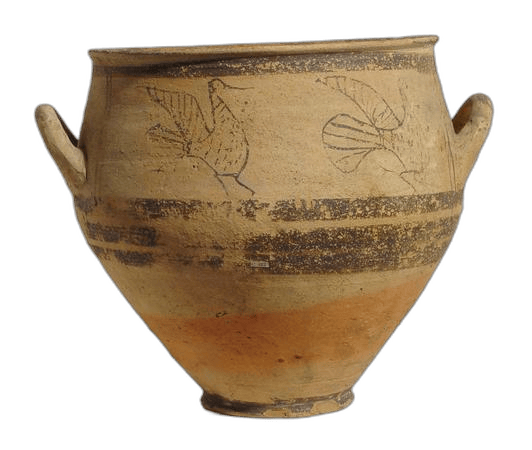
The Hunterian Museum in Glasgow has a rim and body sherd catalogued as a "Rude style bell krater fragment", the older name surviving in a museum register. No piece in the Drakopoulos collection belongs to the class.
Summary
The Pictorial Style reached Cyprus as Argolid-made chariot and bull kraters in the fourteenth and thirteenth centuries BCE. In LC IIC Cypriot potters answered with their own smaller ring-based kraters, painted with bulls, birds, goats and spirals and without the human figures and narratives of the imports. Called Rude by Furumark and Pastoral by Vermeule and Karageorghis, these kraters were made mainly in the late thirteenth century, lingered into early LC IIIA, and stand at the head of the Cypriot pictorial tradition that ran on through White Painted Wheelmade III and Proto-White Painted into the Iron Age.
Objects on this page
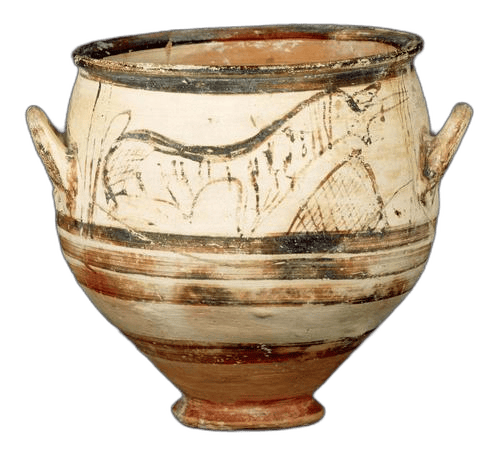 Pastoral Style Bell KraterLate Bronze Age II · 1250–1200 BC
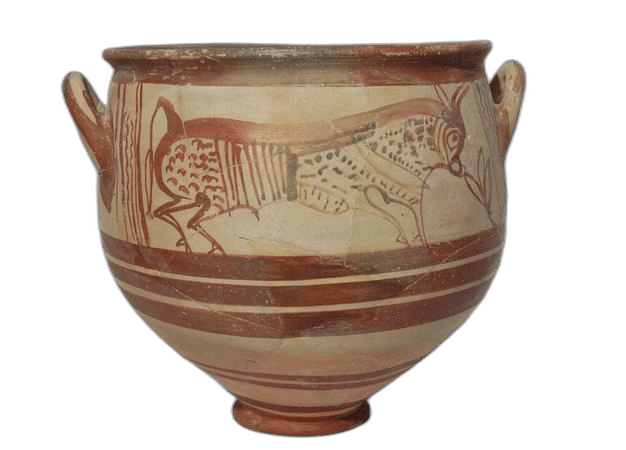 Furumark Bell KraterLate Bronze Age II · 1275–1200 BC
 Pastoral Style Bell KraterLate Bronze Age II · 1250–1200 BC
- Pastoral Style Bell KraterLate Bronze Age II · 1250–1200 BC
 Pastoral Style Bell KraterLate Bronze Age II · 1250–1200 BC
 White Painted Bell KraterLate Bronze Age II · 1250–1200 BC
- Pastoral Style Bell KraterLate Bronze Age II · 1250–1200 BC
 bell kraterLate Bronze Age II · 1400–1200 BC
In the catalogue
References
- 1.Lekka, A. (2021). Aegean elements in Cypriot pictorial pottery of the 12th century BC. In E. Karantzali (Ed.), The Periphery of the Mycenaean World: Recent Discoveries and Research Results (Proceedings of the 3rd International Interdisciplinary Colloquium, Lamia 2018) (pp. 101–110). Athens.
- 2.Catling, H. W. (n.d.). Cyprus in the Neolithic and Bronze Age Periods. The Cambridge Ancient History, revised edition of Volumes I and II. Cambridge: Cambridge University Press.
- 3.Yellin, J., & Maeir, A. M. (1992). The origin of the pictorial krater from the 'Mycenaean' tomb at Tel Dan. Archaeometry, 34(1). https://doi.org/10.1111/j.1475-4754.1992.tb00474.x
- 4.Graziadio, G. (2025). The Aegean and Cyprus: Interaction between two distinct cultural Mediterranean areas from the third millennium to ca 1200 BC (Studi ciprioti). Edizioni Ca' Foscari. With contributions by A. Georgiou, L. Mazzotta, F. Nani, L. Recht and A. Querci; § 6.4.3, "Local Production of Aegean-Style Pottery During the Late Cypriot IIC Period", is by Artemis Georgiou.