
Contents
Cyprus "was, and still is, an important waypoint for migratory birds", as Alicia Dissinger puts it in her 2017 dissertation on Cypro-Archaic bird iconography [1, p. 261]. Birds were hunted by the first people known on the island, modelled in clay on Early and Middle Bronze Age pots, left almost unpainted by Late Bronze Age potters, and then painted in growing numbers from the end of the Bronze Age until, in the Cypro-Archaic period (about 750 to 475 BC), "images of birds became common in the art of Cyprus" [1]. This entry follows that sequence: the bones first, then the modelled birds of the Red Polished potters, the arrival of painted birds, the free-field bird of the Archaic jugs, Dissinger's three kinds of bird and where each was deposited, and finally the dove, which belongs to the sanctuaries and to later Aphrodite and should be kept apart from the bird on a tomb jug. The wider setting is described under climate and landscape.
The birds of the island
The oldest bird bones from Cyprus come from Akrotiri-Aetokremnos, the rock shelter on the south coast where hunters met the island's dwarf fauna (see Cyprus before humans). In the site report edited by Alan Simmons, Cécile Mourer-Chauviré calls it "the oldest avifaunal collection known from Cyprus" and "one of the largest bird bone collections from any Early Holocene East Mediterranean archaeological site" [2, p. 170]. It comprises 3,205 bird bone fragments, of which 529 could be identified, from a minimum of 73 individual birds (the smallest number of animals that could account for the bones); 64.7% of the material came from Stratum 2 [2, p. 170]. Dissinger, summarising the same report, dates the assemblage to about 10,000 years before the present [1, p. 17].
One bird dominates. The great bustard (Otis tarda), a heavy ground-dwelling bird of open country, is represented by 349 fragments from 65 excavation units, an "extraordinary abundance" which, Mourer-Chauviré concludes, "indicates that it was extensively hunted by the first inhabitants of the island" [2, p. 170]. Her table separates 181 bones from males (at least 24 birds) and 152 from females (at least 14) [2, p. 171]. Geese come next (24 bones of greylag or bean goose from at least eight birds, and 54 more identified only as Anser), then little owl (22 bones), crow or rook (9), shag (8), teal (5) and rock or stock dove (5 bones, at least three birds). Single bones represent black-necked grebe, shearwater, harrier, water rail, short-eared owl, a thrush and a small passerine [2, p. 171]. The shag, she notes, is a resident breeder at Akrotiri. From these birds she reconstructs a local setting that was "very open, with grasslands and marshes, and with seabirds nesting in the cliff and migratory birds wintering on the shores of the Akrotiri salt lake or lagoon" [2, p. 178].
After Aetokremnos the record thins sharply. Mourer-Chauviré lists what the Neolithic villages had produced by the time of her report: wood pigeon, carrion crow and white stork at Khirokitia (identified by Pichon in 1984), rock dove and a small duck from the same site (Watson and colleagues, 1977), a probable wood pigeon at Kalavasos-Tenta, a single bone at Sotira-Teppes and 16 unidentified bones at Ayios Epiktitos-Vrysi [2, p. 178]. For the Bronze and Iron Ages we know of no comparable bird-bone studies, so the birds of later periods are known mainly through the images people made of them. The Neolithic and later diet is covered under food and diet.
Modelled birds on Red Polished pottery
The earliest images of birds are the small clay birds that Early and Middle Bronze Age potters set on their vessels. Vassos Karageorghis gathers them as Group XII, "Bird figures attached to vases", in the first volume of The Coroplastic Art of Ancient Cyprus [3]. "Birds have always been a popular motif in both the coroplastic art and vase-painting of ancient Cyprus," he writes; "it is an easy enough motif to render as its form can be schematized" [3, p. 162]. The Early and Middle Cypriot coroplast used it "either as a convenient decorative motif by itself or in association with human and animal figures" [3, p. 162].
The commonest arrangement puts birds on the rim of an open bowl. "Birds are frequently attached to an open bowl as though they are about to drink from it" [3, p. 162]. Legs were hard to model and fire, so the birds sit on short stems or directly on the rim. Karageorghis notes that the bowls with a known provenance "were found in tombs at Vounous, a fact which illustrates the popularity of this motif in the region", and that the stemmed bowls in the group (XII.3 to 5) offer "no evidence for possible 'cultic' associations" [3, p. 162]. Other forms in the group include composite vessels with birds on handles or on the bars joining several bodies (XII.23 to 26), a jug with a bird on the shoulder (XII.27), and tulip bowls with two bird protomes, among them XII.29 from Aghirda in the Cyprus Museum and XII.30 from Vounous Tomb 67, now in the Louvre (AM 2732) [3, p. 161]. Tulip bowls with bird lugs were "very popular in the Vounous area during the ECI period" [3, p. 162]. A few detached birds survive on their own (XII.31 to 35), including one from Vounous Tomb 40 and a Black Polished bird from Kalopsidha [3, p. 161].
Karageorghis also picks out individual hands. Three vessels from the south coast (XII.19 to 21), which he gives to one potter-coroplast, have birds perched on the bars between their necks, and two others (XII.23 and 24) are by a potter who "playfully placed a small bird figurine on top of the high basket handle" [3, p. 162]. Most of these birds carry no marks of species. Karageorghis quotes Desmond Morris's judgement that "the formalized body of the birds does not usually allow any identification of the species", and he calls them "a standard generalized type", with one exception: the birds on bowl XII.6, which have a "distinctly vulturine shape" [3, p. 162].
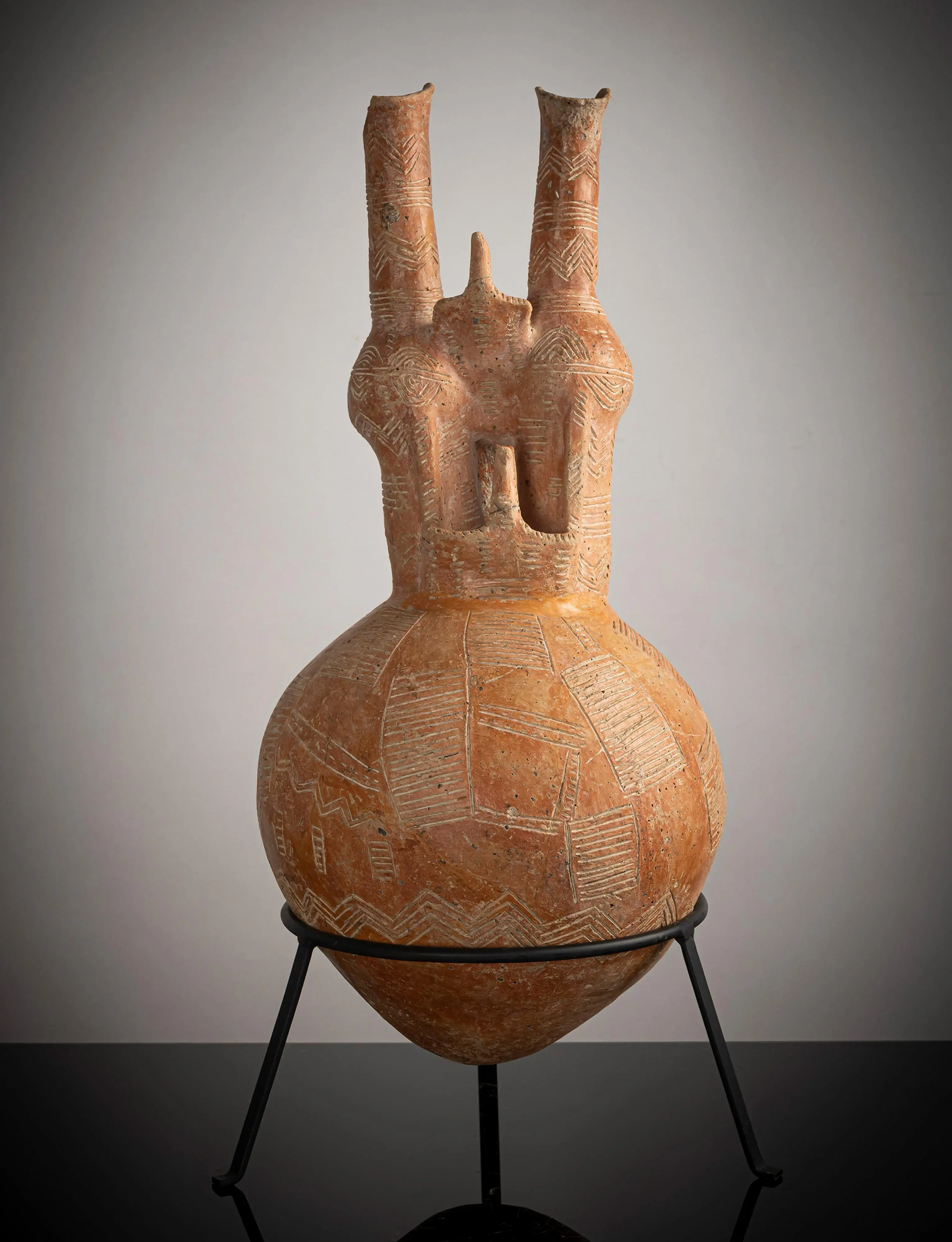
Birds also appear on the large double-necked jugs of the north coast. The most elaborate, from Vounous Tomb 19 (no. 10), is 63 cm high, with a human couple and horned animals in relief and a bird in the round on the bridge between the necks; Karageorghis lists it as XIII.1 [3, p. 163]. A double-necked jug in this site's collection (shown here) carries two modelled birds between its necks and incised decoration over the body; its type and parallels are discussed in Two Birds, Two Necks. Its birds are of the kind Dikaios treated as ornament (see below). For the other animals and people modelled on these vessels, see Red Polished zoomorphic vessels and complex vessels.
Ornament or attribute: Dikaios and Karageorghis
Porphyrios Dikaios, who excavated at Vounous in 1931 and 1932, was the first to ask what these birds meant, and his answer depended on the vessel [4, pp. 126-127]. He sorted the bird-decorated pots into three classes. The first is a bowl from Tomb 36 with a horned head, probably a bull's, together with two birds and two snakes; here, he suggested, the bird "represents a third attribute" beside the bull and the snake [4, p. 126]. The second class he called "of more documentary character". On the Tomb 19 double-necked jug, "Between the two necks there is a bird modelled in the round, and in front of it, placed on the upper part of the handle, is a small cup. The bird appears to drink or eat from the small cup", close to a man-and-woman group whose attitude, for Dikaios, suggested fertility [4, p. 126]. A pyxis from Tomb 37 has birds either side of the mouth and a human couple on the lid. On these two pieces he proposed that "the fertilizing power of human nature is brought into connexion with the bird, which may be another attribute in addition to the bull and the snake" [4, p. 127].
The third and largest class, the small hemispherical bowls, the large bowls and the stemmed goblets, he read differently: "The birds appearing on the rim of bowls, small or large, may be simply of ornamental character" [4, p. 127]. He saw no reason "to attach to the birds any symbolical meaning", and he said the same of the birds on the goblets and "of the upper part of the bird placed between the two necks of the incised jug on pl. xxv, c", a double-necked jug from Tomb 46A. He suggested that "the different attributes developed into mere ornamental motifs" [4, p. 127]. The site's article on the collection's double-necked jug takes the Tomb 46A jug as the type-piece for its shape, and Dikaios's reading of that bird as ornament is the one followed here for the collection piece. The tombs and their offerings are described in Vounous and Early Bronze Age burial.
Half a century later Karageorghis went further. Of the birds on bowl XII.1 he asked whether they are pigeons, and answered: "It is tempting to attribute a symbolic meaning to birds, as in their association with fertility (e.g. in later times when doves were associated with the cult of Aphrodite ...), but there is no justification for such a concept during the prehistoric period" [3, p. 162]. The source he cites for the later dove-and-Aphrodite link is a 1962 study by Stewart. Read together, the two scholars leave only Dikaios's two scene-bearing vessels, the Tomb 19 jug and the Tomb 37 pyxis, as possible exceptions to a general rule that the Bronze Age bird on a pot was decoration.
From clay to paint
When painted birds began is the subject of J. L. Benson's 1975 study of birds on Cypro-Geometric pottery [5]. His starting point is an absence. The natives of the Late Bronze Age "did not, in effect, have the habit of depicting birds on their pottery", although they were in contact with Mycenaeans, Syrians and Philistines who did [5, p. 129]. He found "little or no interest in the depiction of birds on the part of native Bronze Age potters", while warning that an argument from absence has limits; when Late Bronze Age potters made animal vases they favoured bulls [5, p. 130].
In Benson's account bird-painting "apparently had its origin" in the merging of Mycenaean settlers with the native population. "It is not until the inception of Proto-White Painted ware that bird vases ... enjoy a certain currency in tomb groups, corresponding in their general format to Greek prototypes" [5, p. 130]. He knew of only about three Proto-White Painted pictorial pieces, all with birds, the finest a kalathos (a deep flaring bowl) from Kouklia, the site of Palaepaphos. Its painter "started with a rough impression of Syro-Palestinian bird types and proceeded very independently with more interest in decorative effect than in organic niceties" [5, p. 132]. The Proto-White Painted birds have reserved bodies, straight legs and "wire" tails, and the straight legs "became a consistent Cypro-Geometric feature" [5, p. 132].
Into the Cypro-Geometric period birds were "not particularly numerous in the earlier part", but one later workshop "heralds the continuation of the bird motif into the Cypro-Archaic period in a much broader stream" [5, p. 129]. Dissinger traces one convention of the later birds, a single wing raised above the back, to images that "began with CG III" [1, p. 127]. Birds were also made as vessels in this period. The British Museum has a small bird-shaped askos from Gastria (1982,0729.140), 12.2 cm long, with the head forming the mouth, three feet and black lattice triangles, dated 1050 to 750 BC, and a Bichrome bird askos (1904,0204.621) whose trefoil mouth forms the head, with a handle on the back. The Metropolitan Museum's White Painted askos in the shape of a water bird, 15.9 cm long, is catalogued as Late Cypriot IIIB.
The broad sequence:
| Period | Medium | What survives | Source |
|---|---|---|---|
| Akrotiri-Aetokremnos, c. 10,000 years ago | Bones | At least 73 birds; great bustard dominant, hunted | Mourer-Chauviré [2] |
| Neolithic | Bones | A few bones: wood pigeon, crow, white stork, rock dove, duck | Mourer-Chauviré [2] |
| Early and Middle Cypriot | Modelled clay on Red Polished vessels | Birds on bowl rims, handles, bars between necks; tulip-bowl protomes; mostly Vounous | Karageorghis [3]; Dikaios [4] |
| Late Cypriot | Painted pottery | Almost no native painted birds; animal vases favour bulls | Benson [5] |
| End of the Bronze Age (Proto-White Painted) | Painted pottery | Bird vases in tomb groups; Kouklia kalathos | Benson [5] |
| Cypro-Geometric | Painted pottery; bird-shaped askoi | Birds with straight legs; raised-wing convention from CG III | Benson [5]; Dissinger [1] |
| Cypro-Archaic, c. 750 to 475 BC | Painted vases, terracottas, limestone | Raptors, songbirds and waterfowl; free-field jugs | Dissinger [1] |
| Cypro-Classical and later | Limestone | Doves as sanctuary dedications; votaries holding doves | Vienna catalogue [6]; Met records |
The free-field bird
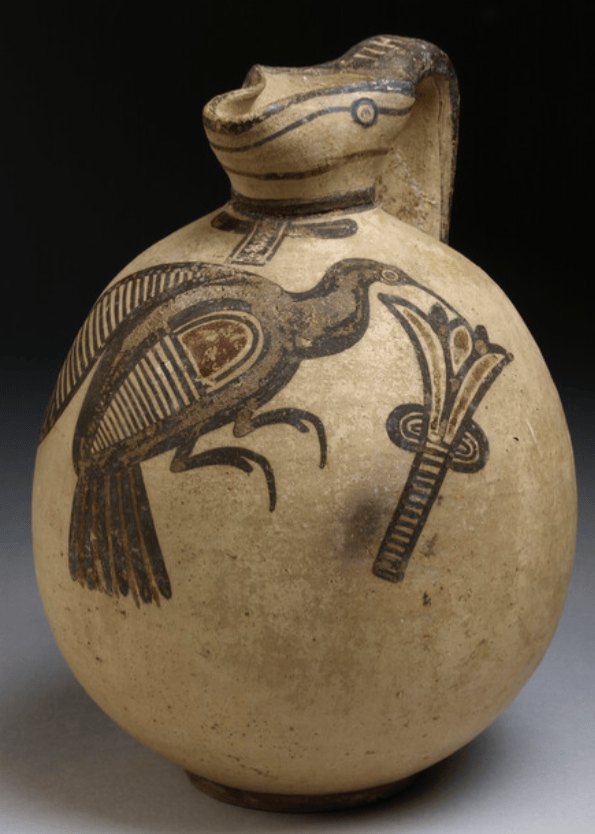
The painted bird reached its widest use on the Cypro-Archaic jugs decorated in the free-field style (see also Cypriot free-field art). Many of the jugs Dissinger discusses are Bichrome IV. Dissinger's catalogue shows how often the bird is paired with other signs: 287 of her vases add ornament beside it, including swastikas, lotuses, chevrons and chevron arrows [1, p. 134].
The Ashmolean Museum holds two good examples. A Bichrome jug with an ibis and reeds (AN1969.645), 24.7 cm high, is recorded from the Sinda region and was purchased in 1969; a squat Bichrome jug with a bird picking a lotus flower (AN1967.1088), 19.5 cm high, was purchased in 1967. Some of the painted birds can be named. Dissinger identifies the great crested grebe, with its crest tufts, on a Bichrome IV barrel jug in Edinburgh (V.Jb.285), on a Bichrome IV jug in the Cyprus Museum (V.J.121), and on six terracotta figurines, where the tufts are two small balls of clay [1, pp. 258-259]. A recurring scene shows a waterfowl with a fish: Dissinger's catalogue includes a Bichrome IV jug in the Cyprus Museum (V.J.122) and the so-called "CAARI bird" with a fish in its beak, and another waterfowl-and-fish jug in the Pitt Rivers collection (V.J.180), both catalogued with reference to group XXV of Karageorghis and des Gagniers's 1974 corpus [1, pp. 333-342].
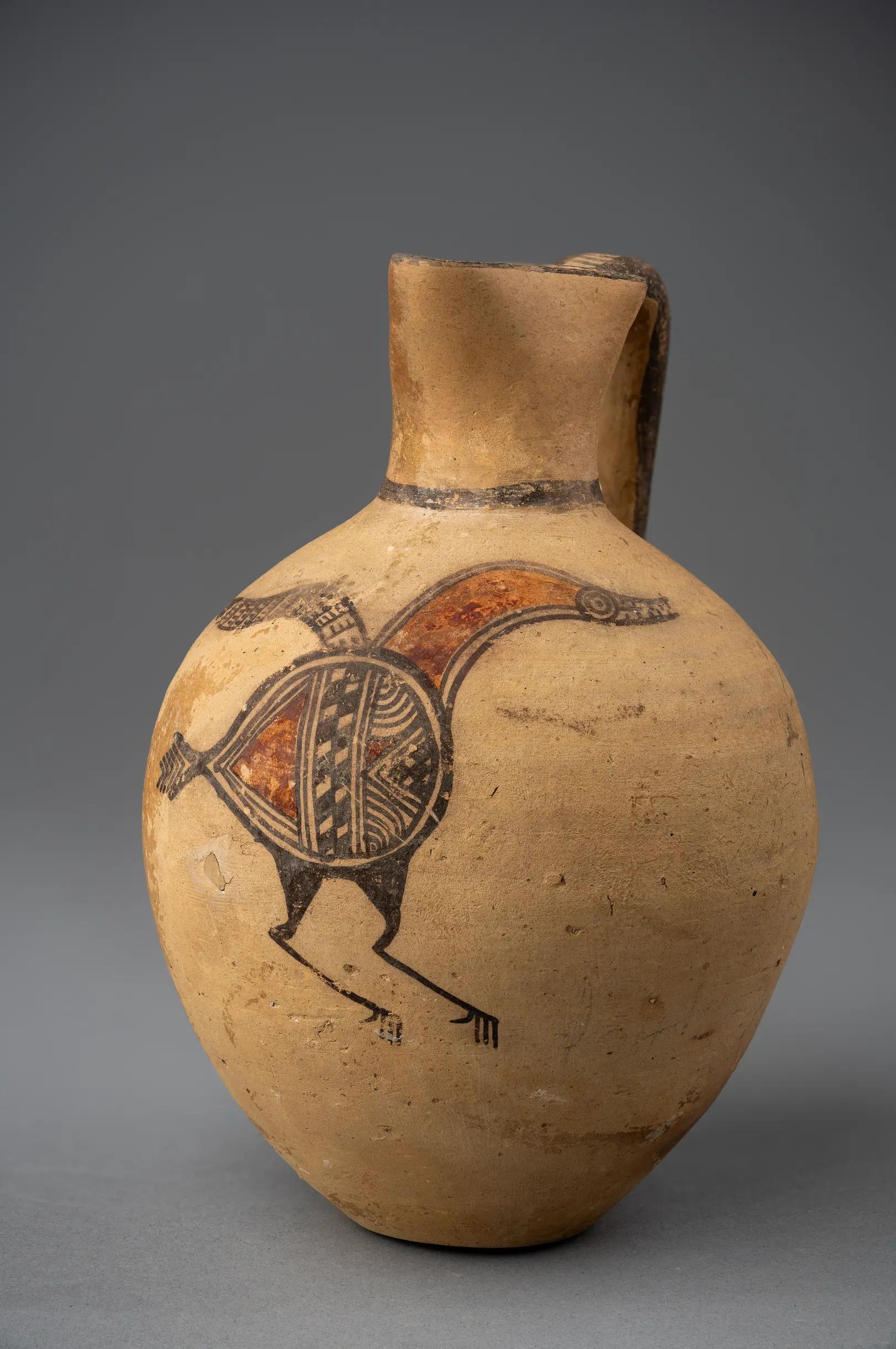
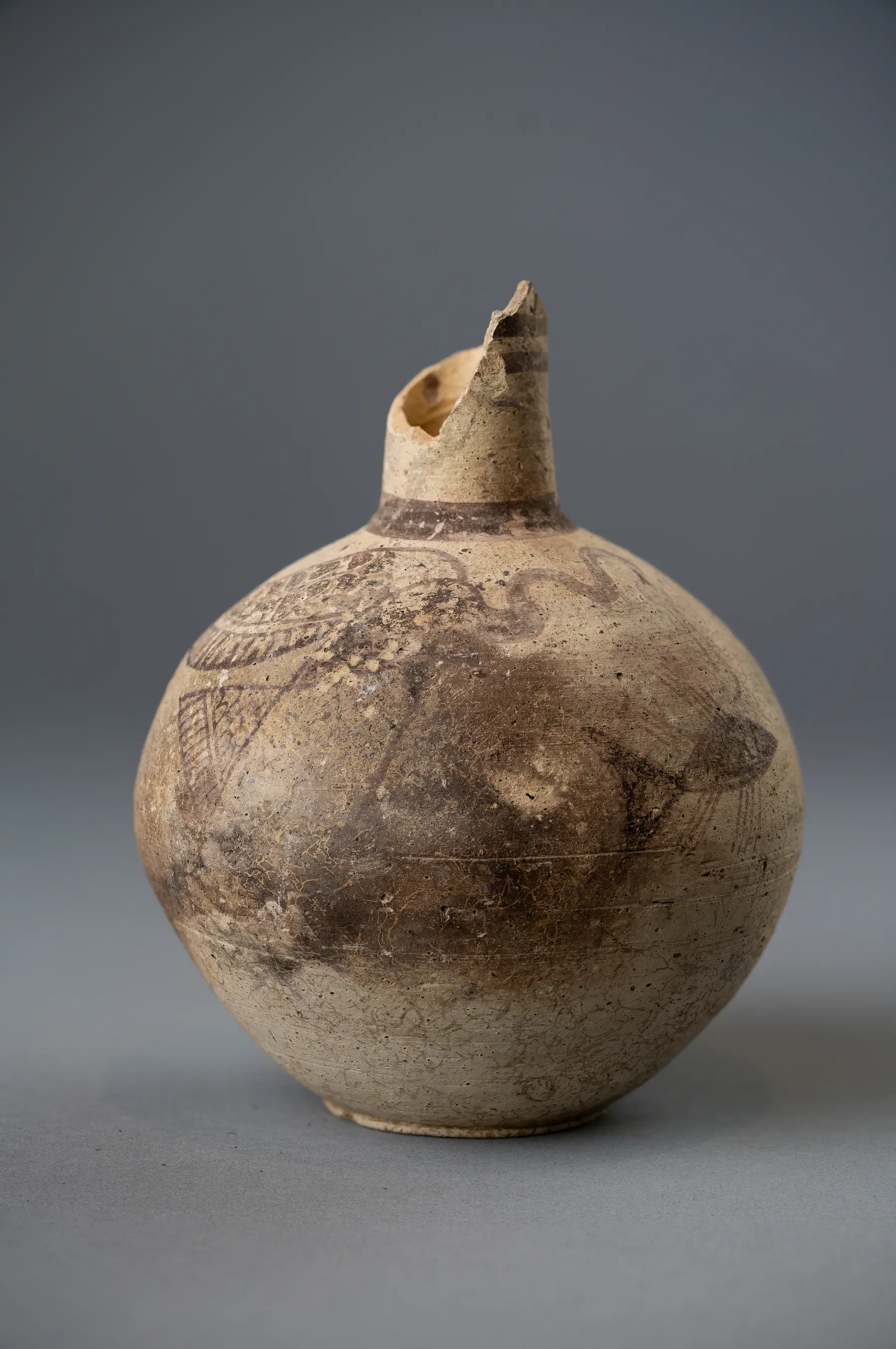
This site's collection has two free-field bird jugs. The first, shown at the head of this page, is a small free-field bird oinochoe, 17 cm high, on which a bird reaches down towards a fish. The decoration was originally Bichrome; most of the damage to the surface is modern, from a fire that burned the collection it was in. The bird-and-fish scene is the waterfowl-with-fish subject of Dissinger's catalogue, and the jug is best described as a Cypro-Archaic free-field jug. The second, shown here, is a 23 cm free-field oinochoe with a single painted bird on the shoulder. It was once in the Lawrence-Cesnola collection and then in General Pitt-Rivers's museum in Dorset; its history of ownership is told in A Bird in the Hand. Both belong to the Drakopoulos collection.
Three kinds of bird, three contexts
Before Dissinger, she notes, "most scholars have noted the birds in passing, and interpreted them as added decoration" [1]. Her dissertation set out to build a typology based on the kind of bird shown, to assemble a representative sample of Cypro-Archaic bird images, and to ask what the images meant. She identifies three types in the repertoire: "Birds of prey, songbirds, and waterfowl". She treats sculpted and painted birds separately and compares the contexts in which each was deposited [1].
Each type, she argues, was "deposited and used in particular ways" [1]. "The rarely created birds of prey were primarily deposited within private cultic contexts, suggesting they may have been apotropaic devices or manifestations of power." "Representations of songbirds are mainly associated with ritualistic paraphernalia and have been found in sanctuaries." "Waterfowl portrayals are most commonly discovered in mortuary assemblages, insinuating a relationship between the bird and conceptions of death" [1]. The meanings, in her view, came from what people knew of the living birds [1].
The waterfowl is the most consistent of the three. Dissinger calls Cypro-Archaic waterfowl "a homogeneous group with consistent iconography"; painted and terracotta waterfowl share the same wing patterns, which suggests shared workshops or a shared visual vocabulary [1, pp. 257-258]. Images of waterfowl "have been discovered mainly in tomb contexts", and they occur in graves more often than songbirds and raptors [1, pp. 258, 260-261]. Her explanation is that "the migratory nature of the waterfowl allowed the animals naturally to become associated with the concept of the liminality of the soul and its journey" [1, p. 258]. A second idea, that the birds' loud calls made them protective, she offers as a hypothesis; her suggestion that the grebe carried a fertility meaning is hedged with a "may" [1, pp. 259-261].
In the sanctuaries the balance changes. Of the objects in her sample with secure find contexts, "68% ... were discovered in sanctuaries", a figure she recognises is shaped by which sites were excavated, and "most of the birds deposited in sanctuaries, and avifaunae shown with offerants, are identified as songbirds" [1, p. 262]. Statues of worshippers holding a bird she reads as showing the bird as a gift to the deity [1, p. 263]. The limestone sculpture of these sanctuaries is covered under Archaic limestone statuary. Bird bones found in tombs she interprets as food offerings or the remains of funerary feasts [1, p. 262].
Doves and the goddess
The dove belongs to a different strand of evidence from the free-field jug bird, and the two are easily run together. The Kunsthistorisches Museum in Vienna has a limestone dove (Antikensammlung I 636), 10.5 cm high and 15 cm long, its feathers scored and its body painted in bands of red and black, dated to the Cypro-Classical period, 5th to 4th century BC [6, cat. no. 100]. It came from a sanctuary at Amathus and was bought in 1890 from Max Ohnefalsch-Richter. The catalogue entry notes that "white doves held especial importance in the cult of Astarte and related goddesses, one of whom was Aphrodite. Her sanctuary in Paphos on Cyprus was famous for its tame doves", and that doves had been "domesticated by the 3rd millennium B.C. in Egypt and the Near East" [6, cat. no. 100].
The Metropolitan Museum's Cesnola collection has comparable limestone pieces: a small statuette of a dove (74.51.2722), 8.1 cm, dated to the 4th century BC; a right hand holding a dove (74.51.2719); and a male votary holding a dove and an apple (74.51.2725), 69.9 cm high, dated to the Hellenistic period, 3rd to 1st century BC. The votary with his dove matches the Archaic worshippers holding birds whom Dissinger reads as bringing the bird as a gift to the deity [1, p. 263]. See also the Cypro-Classical period.
The dove of the sanctuaries and of Paphian Aphrodite does not explain the bird on a free-field jug. The jug birds most often found in graves are waterfowl, and Dissinger links them with death and the passage of the soul [1, pp. 257-258]; the doves in stone are Classical and later votives from sanctuaries. Karageorghis makes the same point for the Bronze Age: the dove's link with Aphrodite belongs to "later times", and he found "no justification" for reading a fertility symbol into the Bronze Age birds on Red Polished bowls [3, p. 162].
Open questions
The largest open question is how far the images match what people did with living birds. Dissinger states that "birds were known as sacrificial victims on Cyprus" and that the bird bones from sanctuaries "typically belong to songbirds and waterfowl" [1, p. 263]. That is her reading of the faunal reports she cites, and the scale of bird offerings remains an open question until those reports are compared directly.
Several of Dissinger's interpretations are offered as hypotheses: raptor dedications as signs of prestige or power, waterfowl votives as wishes for fertility (which she calls "uncertain"), and the apotropaic value of loud-calling birds [1, pp. 261-263]. Species identification is another limit. Karageorghis and Morris agree that most Bronze Age birds cannot be named [3, p. 162], and only a minority of the Archaic painted birds, such as the grebe and the ibis, carry enough detail to identify. The bone record between the Neolithic and the Iron Age is thin, and which birds Bronze Age Cypriots hunted, kept or ate remains an open question.
Objects on this page
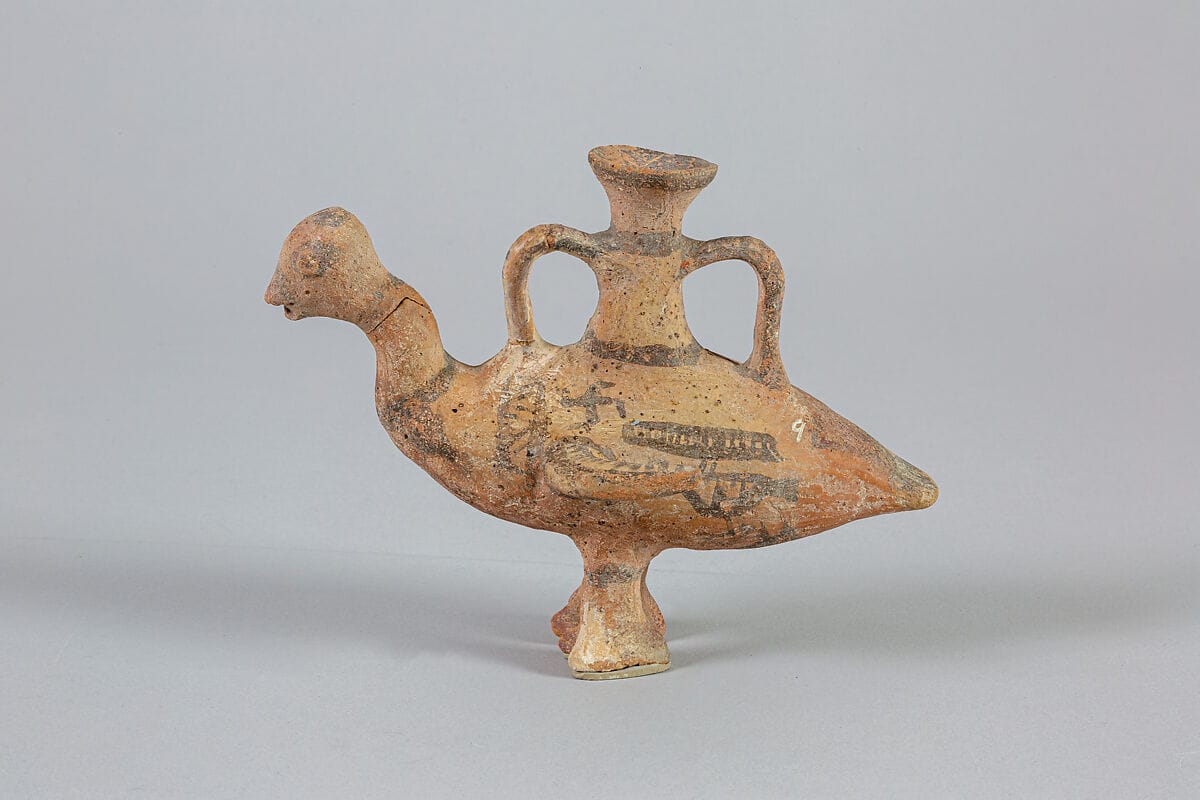 Terracotta askos in the shape of a water birdLate Bronze Age III · 1100–1001 BC
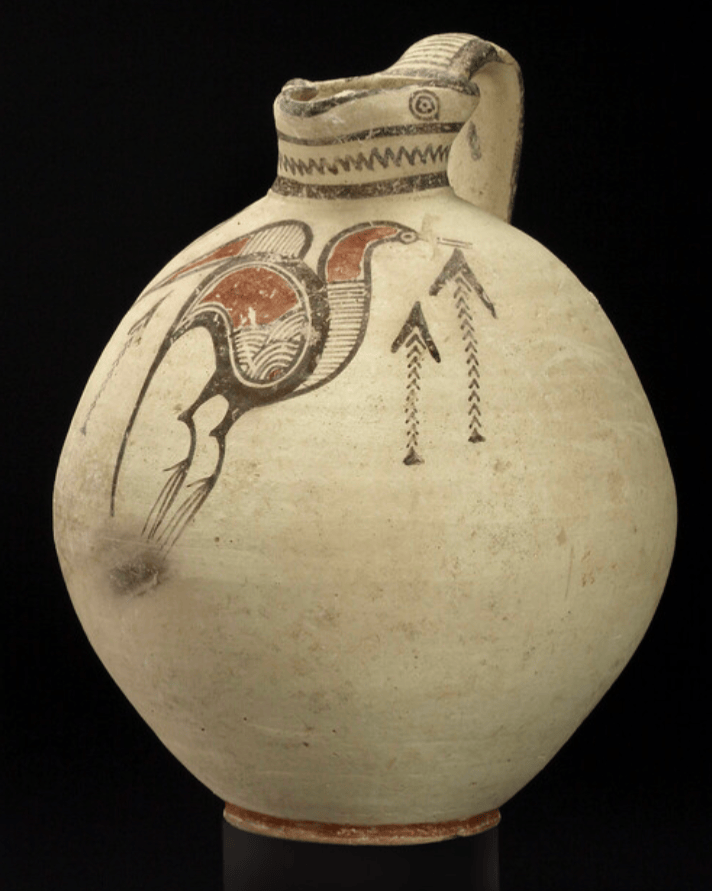 Free-field bichrome jug with image of an Ibis bird and reedsArchaic · 750–475 BC
 Squat bichrome jug in free-field style with image of bird picking a lotus flowerArchaic · 750–475 BC
 Bichrome IV Jug with a Waterfowl Catching a FishArchaic I · 750–600 BC
- Bichrome IV Trefoil Jug with a Striding BirdArchaic I · 750–600 BC
References
- 1.Dissinger, A. M. (2017). Cypro-Archaic bird iconography: Types, uses, and meanings (Doctoral dissertation). University of Virginia, McIntire Department of Art.
- 2.Mourer-Chauviré, C. (2002). Avifauna. In A. H. Simmons, Faunal extinction in an island society: Pygmy hippopotamus hunters of Cyprus (Interdisciplinary Contributions to Archaeology), chapter 7. New York: Springer US.
- 3.Karageorghis, V. (1991). The coroplastic art of ancient Cyprus I: Chalcolithic to Late Cypriote I. Nicosia: A. G. Leventis Foundation.
- 4.Dikaios, P. (1940). The excavations at Vounous-Bellapais in Cyprus, 1931-2. Archaeologia, 88, 1-174.
- 5.Benson, J. L. (1975). Birds on Cypro-Geometric pottery. In N. Robertson (Ed.), The archaeology of Cyprus: Recent developments (pp. 129-150). Park Ridge, NJ: Noyes Press.
- 6.Bernhard-Walcher, A., Dembski, G., Gschwantler, K., & Karageorghis, V. (1999). Die Sammlung zyprischer Antiken im Kunsthistorischen Museum / The collection of Cypriote antiquities in the Kunsthistorisches Museum (W. Seipel, Ed.). Vienna: Kunsthistorisches Museum; Milan: Skira.