
Contents
Every Cypriot pottery shape on this site fits one of nine descriptive buckets, and "complex" is the tenth, reserved for vessels that refuse to be one thing: bowls fused in fours and sevens under a single handle, jugs with two or three necks, hollow rings carrying miniature jars, and animal-bodied containers whose head is also the spout. Desmond Morris, whose 1985 survey remains the only attempt to classify these forms as a group, sorted 279 examples into three themes, the ring vessel, the multi-unit vessel and the subsidiary-unit vessel, and found 57, 188 and 34 of each [1, pp. 78–79]. The class is overwhelmingly Early and Middle Bronze Age, overwhelmingly Red Polished, and almost entirely from tombs, above all the north-coast cemeteries of Vounous and Lapithos. It is also the class most often given a Greek name it does not deserve. This entry sets out the three themes, the kernos problem, the run of each form across the periods, and what can and cannot be said about use.
Definition: Morris's three themes
Morris's classification starts from the observation that the potters who made these vessels "restricted themselves to three main themes" and that within each theme they "explored all sorts of compositional possibilities" while the themes themselves were "held firmly in check" [1, p. 77]. A ring vessel is a hollow or solid clay ring, horizontal or vertical, carrying small bowls, jars, a spout or nothing at all, sometimes on three or four legs. A multi-unit vessel multiplies one element of an ordinary pot: two or three necks on a jug, two to seven bodies on a jar, two to nine bowls under one handle, twin spouts on a bowl, duplicated handles. A subsidiary-unit vessel is a full-size pot with miniature pots sprouting from its shoulders or rim [1, pp. 77–79]. Morris's own summary of the second theme is the best one-line definition of the class: "keep faith with the old, simple shapes, but let them breed" [1, p. 78].
The standard excavation typologies handle the same objects piecemeal. At Vounous, Porphyrios Dikaios catalogued composite vases within his Red Polished type series, describing for instance "three deep bowls, each with a long cylindrical foot; basket handle over them," 14 cm high, as Type III b, and "four hemispherical bowls, surmounted by tall ladder-shaped handle," incised, as Type II a [2]. James Stewart's Corpus placed the decorated deep bowls with rim protomes under Type XXV A and B and the stemmed "bowl/animal vessels" that carry miniature tulip bowls and protomes under Type XXV C [9, pp. 344–345]; the multi-necked jugs and multiple bowls fall under other numbered jug and bowl types. Neither scheme treats "complex" as a category, which is why the site's tenth bucket exists.
Kernoi
The word most often attached to these vessels, in dealers' catalogues and older museum labels alike, is kernos. Morris devoted two pages to showing why it misleads. The Greek kernos, as Athenaeus describes it, was an earthenware vessel "having in it many little cups fastened to it" in which white poppies, wheat, barley, pulse, lentils and other first-fruits were carried and tasted at a festival; Jane Harrison called it "a separator," a vessel in which different grains could be kept apart [1, p. 77]. Cretan examples run to twenty-five and even forty-one small vases. The Cypriot vessels fail this definition on two counts. First, no Cypriot composite exceeds nine units [1, p. 78]. Second, and decisively, the Early Bronze Age Red Polished rings are frequently hollow, with the small bowls connected to the interior of the ring by basal apertures, so that liquid poured into one bowl finds its level in all of them. "The hollow Cypriot rings with their connecting bowls are clearly not intended as separators and therefore cannot be given the name of kernos" [1, p. 78]. The same objection applies to the multi-unit vessels: twin-necked jugs have one internal space, several three- and four-bodied jugs fuse to a single spout, and some two-necked vessels have spouts at opposite ends "making pouring virtually impossible" [1, p. 78]. Only the multi-bowl vessels with separate, unconnected bowls could work as a kernos does, and Morris allows that these "may indeed have held separated, varied offerings" [1, p. 78].
The name has nevertheless stuck to the Iron Age ring vases, which museums still catalogue as ring-kernoi. Two Cesnola pieces in New York show the type: a Cypro-Archaic I annular body carrying five miniature vases (Met 74.51.688, 10.5 cm high, 18.1 cm across) and a Cypro-Archaic II ring with five miniature oinochoai (Met 74.51.687, 10.8 cm high). Whether these later, Levantine-influenced rings functioned like Greek kernoi is a separate question from the Bronze Age ones, and the label should be read as a museum convention rather than a functional identification.
On this site a kernos is a vessel with several small cups or bowls joined on a common ring or base; a hollow ring with only a spout or neck is a ring vase (next section). The kernoi in the catalogue mix both of the groups Morris separated. The Iron Age ring-kernoi include Met 74.51.688 and a Proto-White Painted triple vessel in the Ashmolean, of the Proto-White Painted horizon at the start of the Iron Age. The Bronze Age pieces filed under the same word, such as the Early Bronze Age four-bowl hanging server once in the Cyprus Museum of Jacksonville and a Pierides Museum Red Polished bowl with ladder handle, are multi-bowl vessels in Morris's terms and are described under that heading below.
Ring vases
The ring theme has the longest life and the least clear ancestry. Morris found it "erupts suddenly in the Chalcolithic," in a single Red-on-White ring on three short legs from Ambelikou-Ayios Georghios, described by Dikaios as a "tripodic ring stand," and thought it probably was just that: a circular stand for a round-bottomed pot, not a vessel [1, pp. 77, 80]. The Early Bronze Age rings are different objects. A Red Polished ring on three legs from Lapithos Tomb 322 (Chamber D, no. 1), 20 cm high and 19.5 cm across, carries three small hemispherical bowls, one above each leg, with a band of incised diamonds; it is one of eight bowl-carrying Red Polished rings from north-coast sites [1, p. 80; 6, no. 1502]. The Medelhavsmuseet in Stockholm holds a later piece from the same cemetery, a Red Polished III ring-vase from Lapithos Tomb 320 (L. 320:129), 17.6 cm high and 23.5 cm across, which carries bowls and jugs on the ring and is dated in the museum record to Middle Cypriot II. The earliest spouted ring, from Vounous Tomb 56, is a ring on three legs with a cutaway-beak spout and basket handle in relief-decorated Red Polished ware, and unlike most of its successors "could be used as an efficient pouring jug" [1, p. 81].
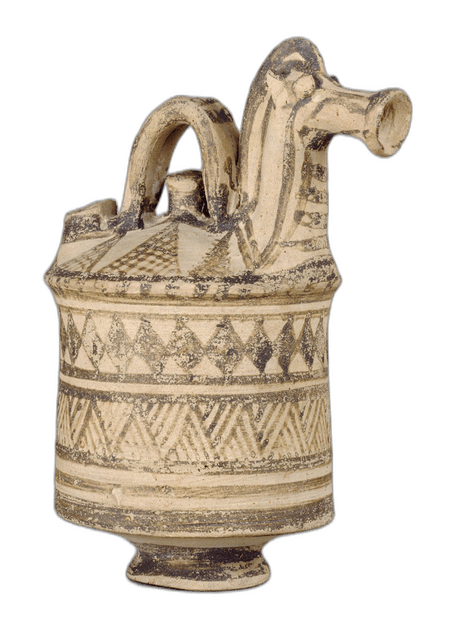
From there the spouted ring runs in an unbroken line: five handmade White Painted examples of the Middle Bronze Age, among them an Ashmolean ring on three stump feet, 15.5 cm high, with cross-hatched panels and vertical diamonds on the body [1, p. 81; 7, no. 29]; Base Ring ware rings of the Late Bronze Age with human, goat or animal-headed spouts; and wheelmade White Painted and Bichrome rings of the Early Iron Age, usually with a bull-headed spout and a basket handle, and with one to four miniature jugs, jars or bowls standing on the ring, sometimes joined by modelled pomegranates or a bird [1, p. 80]. A Late Cypriot III ring probably from Enkomi, 10 cm high and 22 cm across, with three miniature vases and a bull's protome, all summarily striped, is in the Cyprus Museum (inv. 1935.XII-24.1) [6, no. 1650]. The vertical ring, a hollow ring-shaped flask with one spout and one or two handles, appears in the Middle Bronze Age and continues into the Iron Age "varying little as it goes" [1, p. 78]. Gjerstad noted a stemmed askos in Bichrome I that is a "trick vase," a reminder that some Iron Age plastic vessels were built to surprise rather than to serve [8]. Morris's honest conclusion is that the ring vessels "do not look like a homogeneous group with a single tradition," and that functionally "they clearly differ widely from one another" [1, p. 78].
To recognise a ring vase, look for a hollow annular body that is itself the container, with a spout or a neck and usually a handle; once small cups stand on the ring the catalogue calls it a kernos. The ring vases in the catalogue follow the sequence above. A handmade spouted ring in New York, Met 74.51.1041, 10.8 cm high, is dated by the museum to the Middle Cypriot period, 1900 to 1600 BC (museum record). The Ashmolean's White Painted III–IV ring vase in string-hole style belongs to the same Middle Bronze Age line, and the Iron Age vertical ring flask is represented by a British Museum Black-on-Red ring-flask and a Black-on-Red ring jug in the Pierides Museum, Larnaca (see Black-on-Red ware).
Multi-unit vessels: bowls, necks and bodies
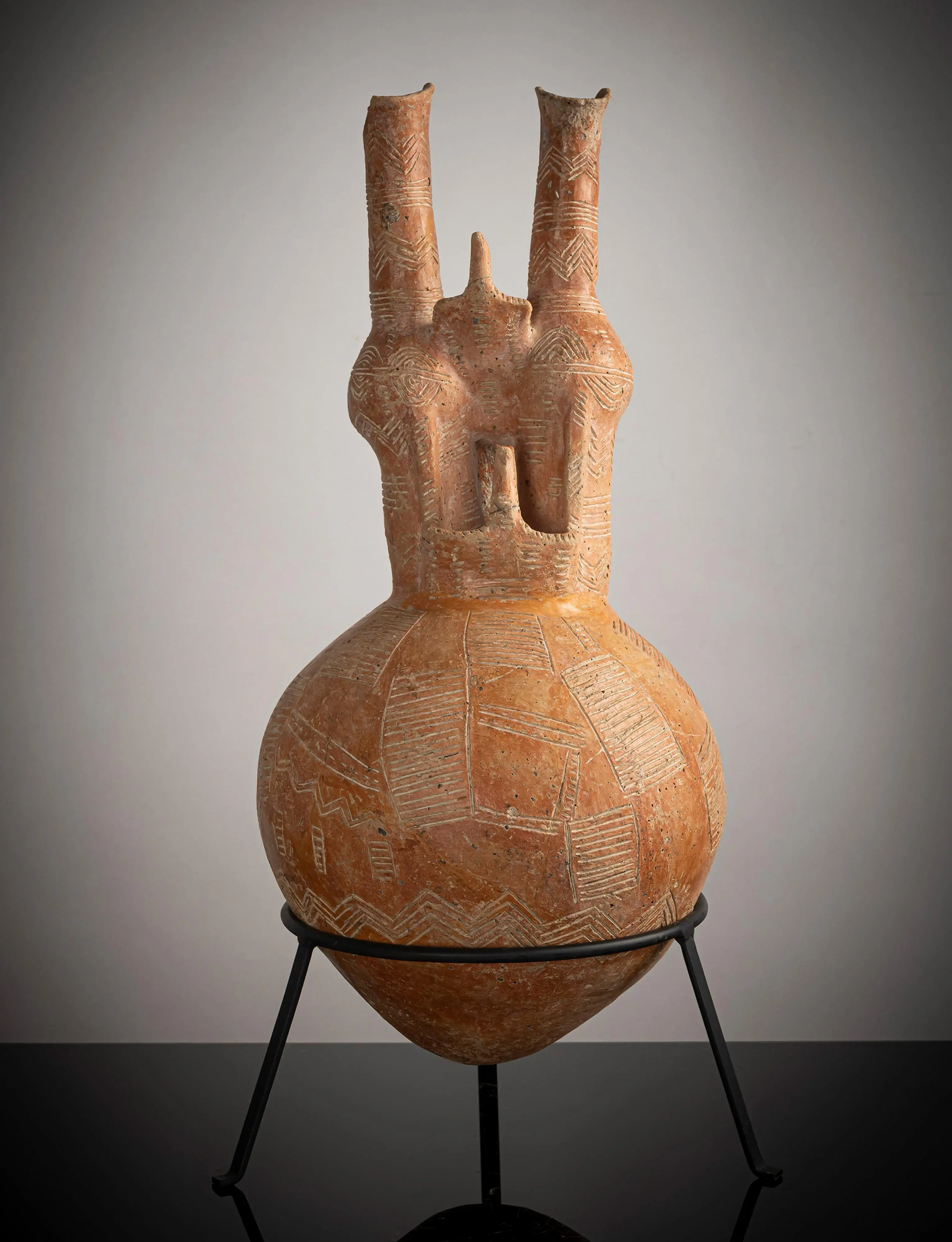
The multi-bowl vessel is the form most people picture when they think of a Cypriot composite. Two to nine small hemispherical bowls, often each on a short cylindrical stem, are set in a ring or a row and joined by a tall basket or ladder handle rising from the centre. The National Archaeological Museum in Athens has two textbook pieces of Early Cypriot III to Middle Cypriot II date: inv. 11908, five bowls encircling a sixth, without stems, 11.5 cm high, and inv. 11909, six stemmed bowls around a seventh with a tall rectangular basket handle, 15 cm high; the catalogue comments that "it is doubtful whether they had any practical use" [3, cat. 24–25]. A Cesnola composite in New York (Met 74.51.1304, 9.1 cm high) has all seven bowls and the handle made from one piece of clay, and the British Museum holds a four-bowl Red Polished multiple with a bridged loop handle and incised zigzags (1993,0406.1). The Fitzwilliam's four-bowl composite from Dhikomo, in Red Polished III, is 26.1 cm high [5, cat. 22]. The largest are architectural: the composite bowl from Vounous Tomb 48 (no. 2), 46 cm high in the Cyprus Museum, has four hemispherical bowls sharing a handle in the form of a long plank-shaped figurine that ends in a woman holding an infant [4, fig. 35]. Morris illustrates two-bowl vessels from Vounous Tomb 22 (no. 38, 20 cm high) and Tomb 137 (no. 22, 25.4 cm high), noting that these "always have a centre handle which helps to strengthen their fusion," and a seven-bowl ring in Berkeley, six bowls around a central seventh, whose handle survives only as two stumps [1, pp. 92, 94]. The form continued in White Painted: a Middle Cypriot II–III double bowl in the Drakopoulos collection joins two small globular bowls along their sides under one tall, narrow loop handle that ends in a forked finial.
Multi-necked jugs are the second large group. Morris traced 42 twin-necked jugs, all Early and Middle Cypriot, plus three-necked and "opposing-neck" jugs whose necks rise from opposite ends of a low horizontal body [1, pp. 84–90]. The largest are the Vounous giants of 55 to 71 cm published by Dikaios and the Stewarts. The Drakopoulos collection's Red Polished double-necked jug with two modelled birds, about 57 cm high, belongs to this north-coast group: two flat, plank-like birds stand one above the other between its necks, where the published parallels carry one, and it is discussed with its Louvre twin in the site's article Two Birds, Two Necks. The south-coast Red Polished workshops made a smaller, bird-bearing version. The two-necked and three-necked Red Polished plank figures in the Drakopoulos collection show the same habit of doubling applied to the human form. Multi-body jugs and jars (two bodies side by side or one riding on the other, three, four in a square or pyramid, exceptionally seven), twin-spouted bowls and multi-handled vessels complete the theme [1, pp. 84–90]. A Late Bronze Age example of the paired body is the Base Ring II double juglet in the Drakopoulos collection: two juglets, each with its own body and ring foot, pressed together at shoulder and belly, their necks joined at the top by an arching bridge. Morris reads a possible symbolism of "mixing" into the bodies fused to a single spout, and immediately concedes the idea "is grasping at straws" [1, p. 79].
Subsidiary-unit vessels and the "ritual set"
The third theme is the shortest-lived: full-size jars and jugs with miniature vessels sprouting from shoulders or rim, all Early or Middle Bronze Age. Morris noticed that the offspring are nearly always of two types, cutaway-beak jugs and shallow bowls, regardless of the parent vessel, so that even a round-spouted parent carries a cutaway-spouted juglet, and in one case the parent is dispensed with and the miniature set stands on a kind of offering table [1, p. 79]. He reads this as the display in miniature of a "ritual set," a milk bowl and a pouring jug, and hence of some "liquid rite," while admitting there is no way at present to choose between libation, first-fruits, thanksgiving or any other candidate [1, p. 79]. The great spouted ritual jars from Kotchati and Margi with stemmed bowls and birds on the shoulders, and the Vounous Bowl of Tomb 22 with its modelled enclosure scene set inside an ordinary spouted bowl, sit at the top of this class; Steel's inventory of Tomb 22 shows the bowl deposited alongside one composite vase and one ring vase, fourteen plain hemispherical bowls, three incised juglets and a cooking pot [11]. The scenic bowl is discussed with the tulip bowls under bowls.
Zoomorphic askoi: a border case
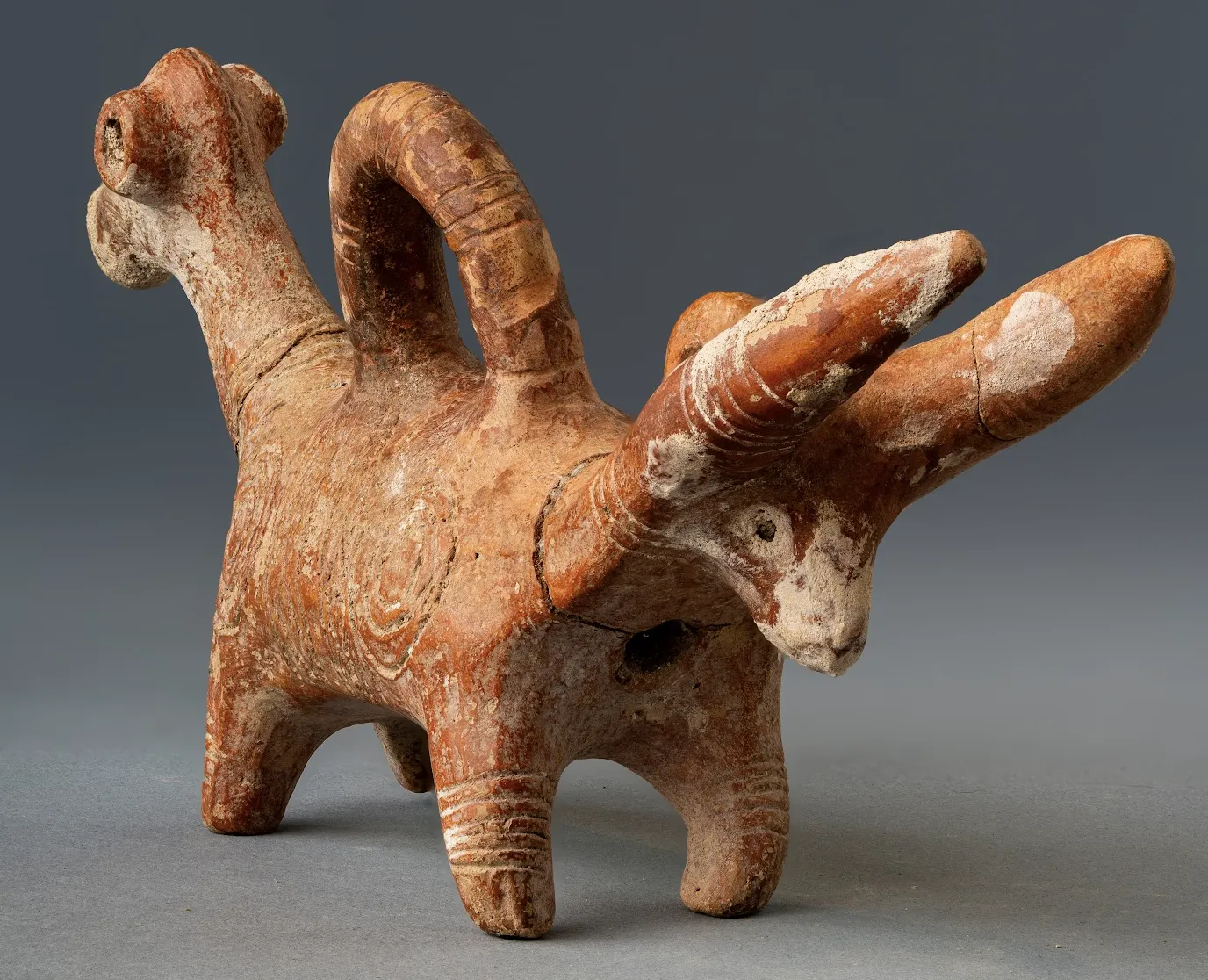
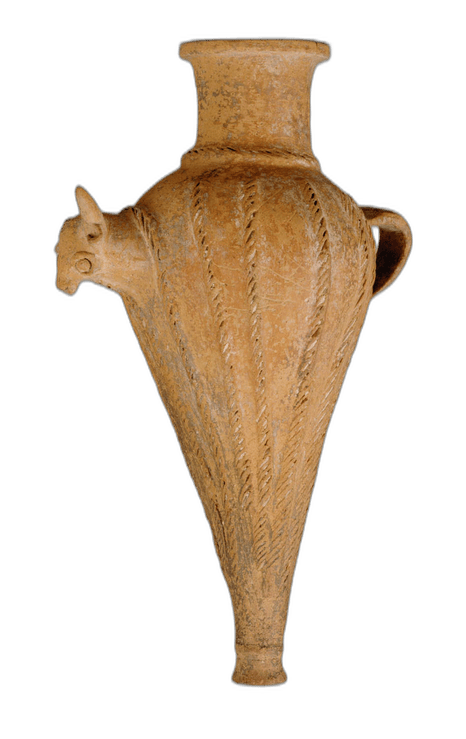
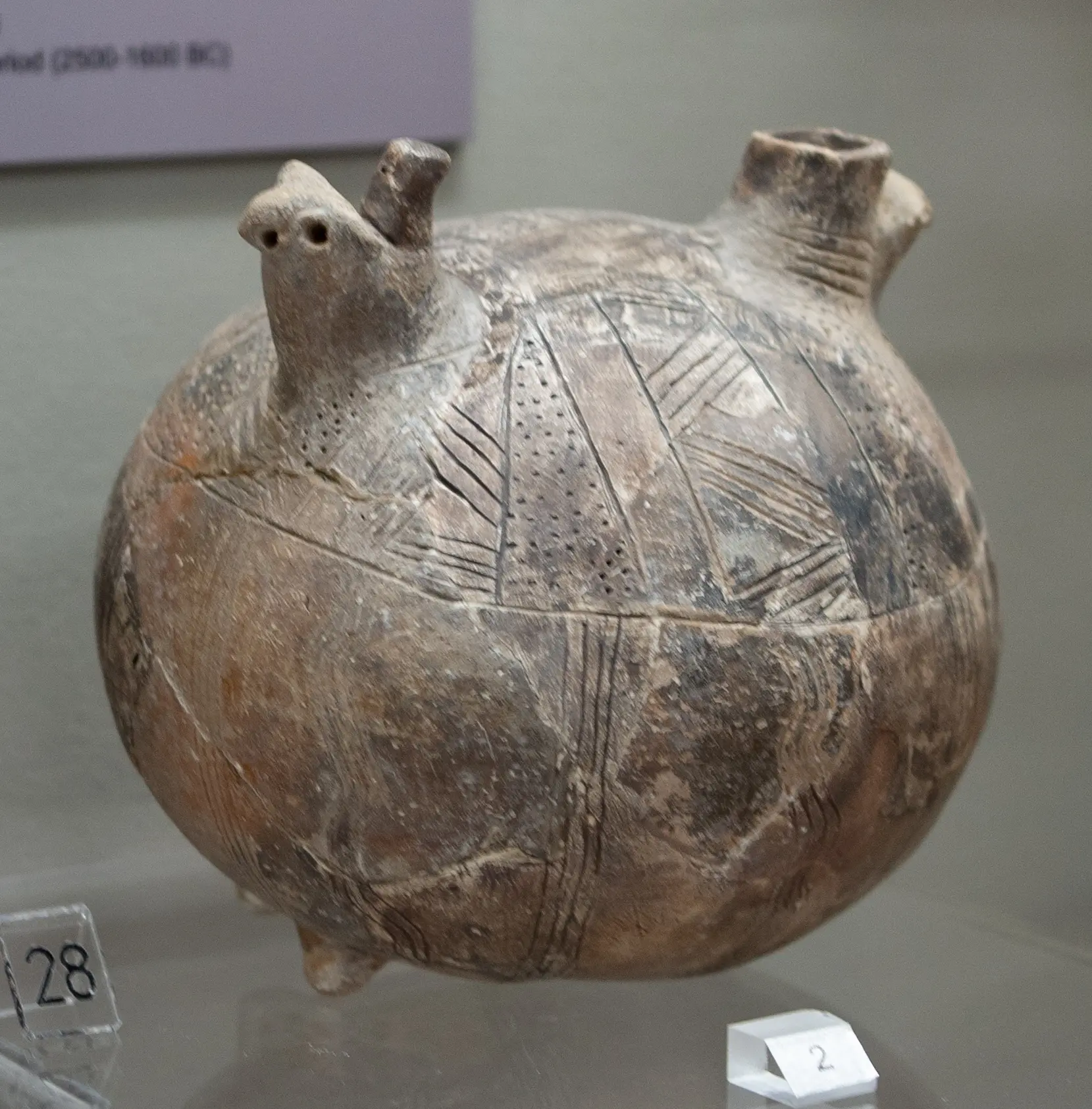
Animal-shaped vessels are not multi-unit in Morris's sense, but on this site they are sorted as complex because they are neither jug nor bowl. The Cypriot askos of the Early Cypriot III to Middle Cypriot I transition has a bulky body on four short legs, a basket handle, and an animal head, most often a bull, that doubles as the spout; the Fitzwilliam's example, 20.7 cm high, has modelled dewlap, tail and genitals [5, cat. 23]. "Boat-shaped" askoi carry a horned head at each end, so that the two protomes are the two spouts. The Drakopoulos collection's bicephalic Red Polished askos, with a bull's head at one end and a long-eared head at the other, is the subject of the site's article The Bull Was a Newcomer, where its Ashmolean and Louvre comparanda are set out. Zoomorphic rings belong to the same impulse: from the Late Bronze Age onward, Morris observes, "the focus of attention is in the animalized nature of the vessel," and the ring's function as a container "often seems to be almost perfunctory, as though it is a ritual necessity that has become a chore" [1, p. 78].
Chronology at a glance
| Theme | Chalcolithic | Early–Middle Cypriot | Late Cypriot | Iron Age |
|---|---|---|---|---|
| Horizontal plain ring | Ambelikou tripod ring stand (unique) | Red Polished rings with 3–5 bowls, ± legs (8 known) | Black-on-Red ring with bowls (1 known) | |
| Horizontal spouted ring | Vounous T.56 (RP); 5 handmade White Painted rings | Base Ring rings, animal- or human-headed spouts | White Painted and Bichrome rings with bull-headed spouts, miniature vases, pomegranates | |
| Vertical ring flask | Handmade White Painted, Drab Polished | White Painted Wheelmade | White Painted, Bichrome, Black Slip Grooved | |
| Multi-bowl vessel | 2 to 9 bowls, basket or ladder handle (RP, WP) | |||
| Multi-neck and multi-body jug | Twin- and triple-necked jugs (42 twin-necked traced); 2 to 7 bodies | Composite flasks in Bichrome (2 to 3 units, one of 7) | ||
| Subsidiary-unit vessel | Miniature jugs and bowls on shoulders and rims; scenic bowls | |||
| Zoomorphic askos | Four-legged bull, goat and bird askoi; two-headed askoi | Base Ring bull vessels | Bird askoi, animal-headed spouts |
The counts and period ranges are Morris's [1, pp. 79–80] and rest on what he happened to record rather than on a census; they are indicative, not complete.
Function and the debates
Three positions are in play. The oldest is the cult reading: Dikaios and the excavators of the 1930s saw in the Vounous composites, the bulls and the snakes the equipment of a fertility religion, and the word "cult vessel" entered the literature from their reports [2]. Morris's collector's reading is the opposite: the complex shapes represent "creative exuberance," "playful inventiveness," the potters "having fun with clay" on occasions when everyday wear was unimportant "and fancy embellishments were at a premium for purposes of mourner status-display" [1, p. 79]. He allows that the subsidiary-unit vessels, with their fixed pair of miniature shapes, "strongly suggest that a ritual significance is intended," and that the hollow ring vessels must have held liquid, perhaps as multiple oil lamps, "but other explanations make even less sense" [1, pp. 78–79]. The current position, argued by Jennifer Webb and David Frankel from the burial data, sits between the two. The Vounous figurative vessels show no obvious wear before burial, their fragile forms and the labour invested in them make daily use unlikely, and they were made for deposition in tombs; the imagery, dominated by horned cattle, is read as a cattle-centred funerary cosmology performed at the graveside rather than as evidence for gods [10]. Priscilla Keswani's model of Early and Middle Cypriot funerals as arenas of hospitality and competitive display supplies the social setting in which a seven-bowl vase or a 71 cm twin-necked jug earns its cost [12]. On this reading Morris's "status display" and the excavators' "ritual" are the same event seen from different ends: the vessel was costly, it was made to be seen once, and it was buried.
What the evidence does not settle is content. Nothing has been published on residues from Cypriot composite vessels, and the hollow rings that would be the natural candidates for analysis are mostly century-old museum pieces cleaned long ago. Morris's lamp hypothesis, the libation hypothesis and the first-fruits hypothesis therefore remain equally untested.
Find contexts and the modern market
The distribution is almost wholly funerary and almost wholly northern. Vounous supplied the earliest ring, the great composite bowls, the twin-bowl vessels and the giant multi-necked jugs; Lapithos supplied the bowl-carrying rings and many of the composites in Stockholm and Nicosia; Dhikomo, Margi and Kotchati supplied single spectacular pieces [1, pp. 80–81, 92–94; 2; 5, cat. 22]. Settlement sherds of composite vessels are rarely recognised, since a broken stemmed bowl or a basket handle looks like any other bowl or handle. The Late Bronze Age ring from Enkomi and the Iron Age ring-kernoi of the Cesnola collection have no recorded tomb, which is the usual condition of nineteenth-century finds. Because the class is showy and small, it has also been a favourite of the trade: the multi-bowl vessel that passed through the Cyprus Museum of Jacksonville sale, catalogued as "possibly from Lapithos," is a recent example, and a reminder that many composites in private hands have a find-spot supplied by analogy rather than record. The site's articles on private collecting and how Cyprus's past was sold give the background.
Anthropomorphic vessels
The next five sections cover what the catalogue files as special and ritual vessels. They stand outside Morris's three themes, several are made of stone or bronze rather than clay, and they are gathered here because they are neither jug nor bowl, not because they form a single tradition.
An anthropomorphic vessel is one whose body, neck or spout is modelled as a human figure or head. The Cypriot examples fall into separate groups with nothing in common beyond the idea. The earliest are Chalcolithic. At the Middle Chalcolithic cemetery of Souskiou-Vathyrkakas near Kouklia, a cemetery of deep shaft tombs, the Department of Antiquities' campaigns of 1991 to 1997 found a pottery vessel in the form of a pregnant woman in a multiple burial of an adult with three small children and a possible adolescent; it is displayed in Room 1 of the Cyprus Museum [13]. Diane Bolger suggests that a hollow Red-on-White figurine from Kissonerga (KM 1475) may have been a vessel of the same kind, and reads both with the Kissonerga figurine of a woman seated in labour as part of birth rituals [13].
In the Bronze Age the figure is usually attached to a vessel rather than forming it. A pair of Black Polished jugs from Vounous Tomb 71 is joined by a plank figurine, and a Red Polished bowl from Politiko-Lambertis carries four seated figures on its rim [14]. In the Iron Age the face moves to the neck or shoulder of a jug: a Cypro-Archaic I jug with a female head in New York is 8.3 cm high and dated by the museum to 750 to 600 BC. Painted heads of the Egyptian goddess Hathor appear on Iron Age vases, and the Department of Antiquities' exhibition catalogue Ancient Cyprus: Cultures in Dialogue identifies her with the Cypriot great goddess later called Aphrodite [15, p. 252]. The latest group is Hellenistic and mould-made, such as the Cesnola vase in the form of a sleeping Black African youth, 20.8 cm high, which the Metropolitan Museum dates to the third or second century BC (museum record). The anthropomorphic vessels in the catalogue also include British Museum White Painted bottles in human form such as this one.
Arm-shaped vessels
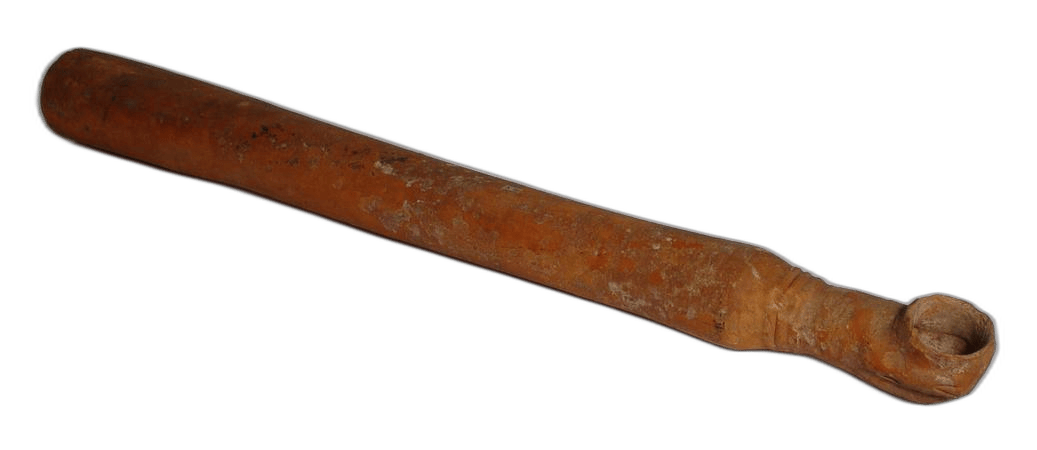
The arm-vessel is a Late Bronze Age form in Red Lustrous Wheelmade ware, a fine red-orange fabric with a red, highly burnished slip [16]. It has a long tubular body, between about 29 and 85 cm long, narrowing to an aperture at one end and standing on a small button, disc or ring base at the other. At the aperture a "wrist", often of three moulded ridges, leads to a small hemispherical bowl held in a sculpted right hand with modelled fingernails. The body does not imitate the musculature of an arm. Eriksson's 1993 study described the body as wheelmade; Louise Steel, from handling the pieces, argues that it was built by hand from thick coils [16].
Arm-vessels are rare in Cyprus. The largest group is six from the "sanctuary" at Ayios Iakovos-Dhima north of Enkomi, dated to Late Cypriot IIA, found beside a bathtub set in a plaster floor. Single examples come from Episkopi-Bamboula, Kourion Site D Tomb 102, Ayia Paraskevi, Maroni Tomb 7 and the Enkomi tombs, and Kalavasos Tomb 14 held three complete pieces and sherds of a fourth [16]. Far more come from central Anatolia, above all Boğazköy-Hattusa, and from Kilise Tepe in Cilicia, with a few at Alalakh, Ugarit and Tell Abu Hawam. Steel concludes that the form was made for the Hittite market and not for the usual Cypro-Levantine exchange [16]. Function is open: Anatolian scholars call them "libation arms"; Steel has proposed perfumed oil, possibly for anointing the dead, since the Cypriot pieces are nearly complete and appear to have been kept and then buried [16]; Vassos Karageorghis thought they were possibly incense burners used in religious ritual [17, p. 60]. All four arm-shaped vessels in the catalogue are in the British Museum, among them this arm vessel and a hand cup. See also the Late Bronze Age.
Thymiateria
A thymiaterion is an incense burner: a small bowl, usually on a stem, legs or a supporting figure, in which incense was burnt. In Cyprus most are limestone or bronze, so the catalogue term crosses materials. The best-known group is the limestone thymiaterion in which the bowl rests on a polos worn by a sphinx. The Cesnola example in New York, said by Cesnola to come from a tomb at Kythrea, is 23.7 cm high with a bowl 12.6 cm across. Karageorghis dates the group to the beginning of the fifth century BC, notes that its members are richly painted in red and show the influence of Greek art, and observes that all the bowls show signs of burning. He takes them as incense burners in sanctuaries, probably of female divinities, and suggests that versions with a ram in place of the sphinx served a male divinity [17, pp. 238–239]. The British Museum's limestone ram incense burner is of that second kind.
Smaller limestone burners on three or four legs, sometimes catalogued as miniature altars, form a separate class. The Metropolitan Museum dates its four-legged burner, 10.2 cm long, to the sixth century BC (museum record), and its three-legged burners more broadly to the Hellenistic or Roman period. The thymiateria in the catalogue also include a bronze thymiaterion from the Cesnola collection and a thymiaterion supported by a figure of Baal Hammon in the Royal Ontario Museum.
Tripods and stands
Cypriot bronze stands come in two forms. The rod tripod has three feet carrying a ring decorated with ridges, spirals or figured scenes; the four-sided stand is an open box of horizontal, vertical and diagonal struts on feet or wheels, crowned by a ring, with panels often filled with openwork figures of processions, chariots, sphinxes and fights of lions, bulls and griffins [18]. The ring shows that a vessel, probably a bronze bowl, was set on top. They appear at the end of the Late Bronze Age, in Late Cypriot IIC, and continue into the Iron Age, found mainly in tombs and hoards across the Levant, the Aegean, Italy and Sardinia; more than half of the known examples come from Cyprus [19]. A rod tripod from Skales Tomb 49, of Cypro-Geometric I, was already an heirloom when it was buried [15, p. 140].
Hector Catling's study of Cypriot bronzework (1964) remains the foundation. He treated all stand types as one group and argued for a few closely guarded workshops, with the later examples kept as heirlooms; others have argued that rod tripods went on being made longer, and outside Cyprus [19]. The relative order of rod and strut tripods, and the twelfth-century dating of many stands, depend on a small number of closed contexts, which is why the sequence is still argued [20, p. 109]. George Papasavvas argues that the stands were cast whole in a single operation from composite wax models [18]; the technology is covered under copper metallurgy. The tripods and stands in the catalogue bundle these bronzes, such as the Cesnola bronze rod tripod, with bronze lampstands and small terracotta and chlorite tripods that belong to other traditions and are grouped only by form.
Miniature vessels
A miniature vessel is a pot small enough to have no practical use as the shape it copies: amphoriskoi, jugs, jars, dinoi and ladles a few centimetres high. In the Bronze Age the habit appears in Morris's subsidiary-unit vessels, where miniature jugs and bowls stand on the shoulders and rims of full-size pots and form what he reads as a "ritual set" [1, p. 79]. Freestanding miniatures of the Iron Age are usually explained as votive offerings in sanctuaries or as tomb gifts, but the Cypriot material has not been studied as a class and the function of individual pieces depends on a find context that most museum examples lack. The miniature vessels in the catalogue are mostly Cesnola pieces in New York, such as a miniature dinos and a miniature jug, with a British Museum Bichrome V miniature jar in Bichrome ware.
Summary
The Cypriot complex vessel is best understood as a set of transformations applied to ordinary shapes: a bowl multiplied, a jug given two necks, a ring given a spout, a jar given children. Morris's three themes remain the only systematic classification, and his warning against the word kernos still needs repeating in every museum label that uses it. The forms are concentrated in the Early and Middle Bronze Age tombs of the north coast, where they were made for burial and not for use, and they reappear in thinner, animal-headed form in the Late Bronze Age and Iron Age rings. Whether they carried oil, milk, wine or nothing at all is unknown; that they carried cost, and were meant to be seen carrying it, is the one point on which the collector, the excavator and the modern analyst agree.
Objects on this page
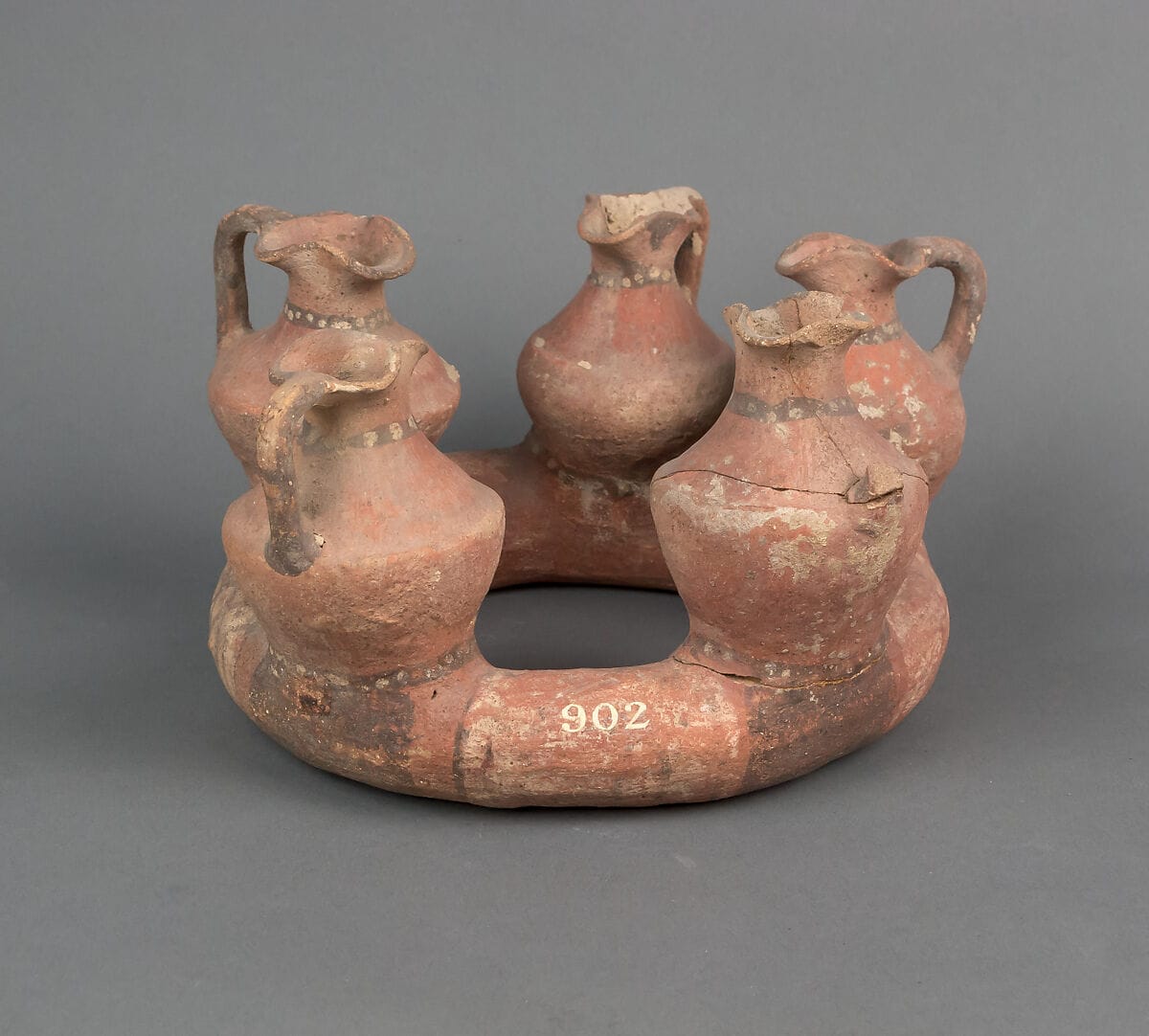 Ring-kernosArchaic II · 600–480 BC
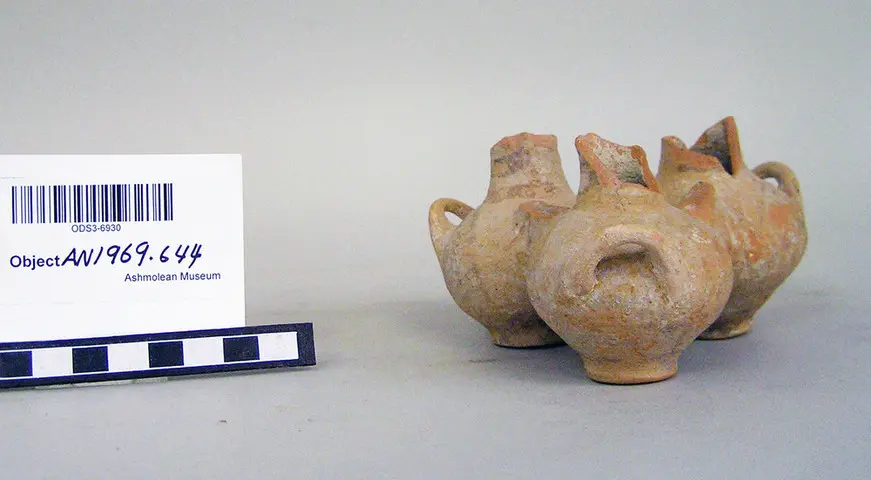 Proto-White Painted triple vessel, or kernosLate Bronze Age III · 1200–1050 BC
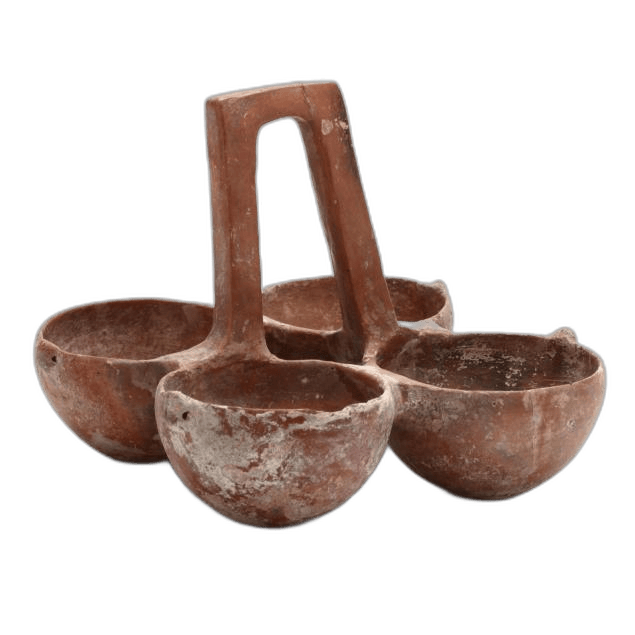 Cypriot Early Bronze Age Four-Bowl Hanging ServerChalcolithic · 2525–2475 BC
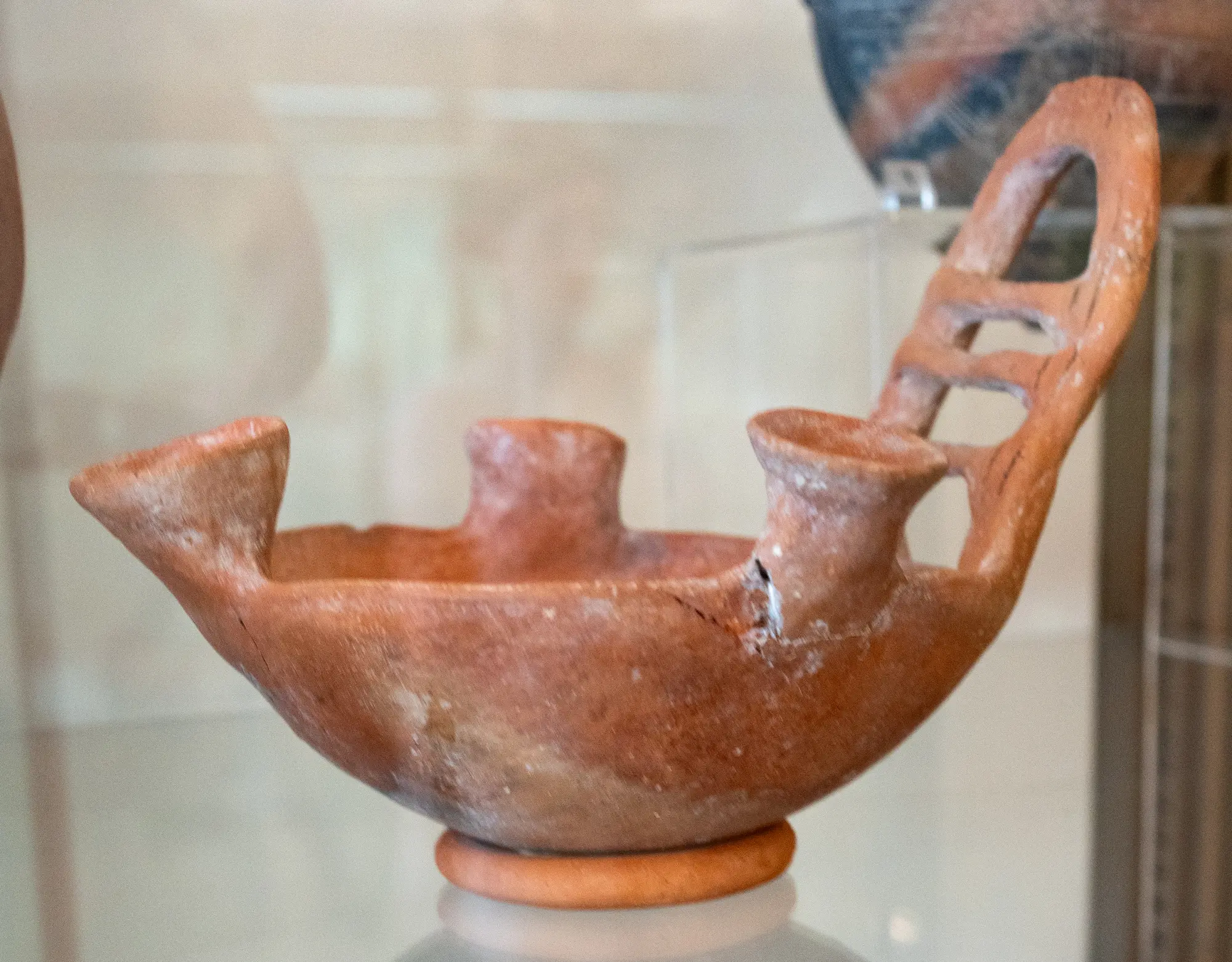 Red Polished Ware Bowl with Ladder HandleEarly Bronze Age II · 2200–1600 BC
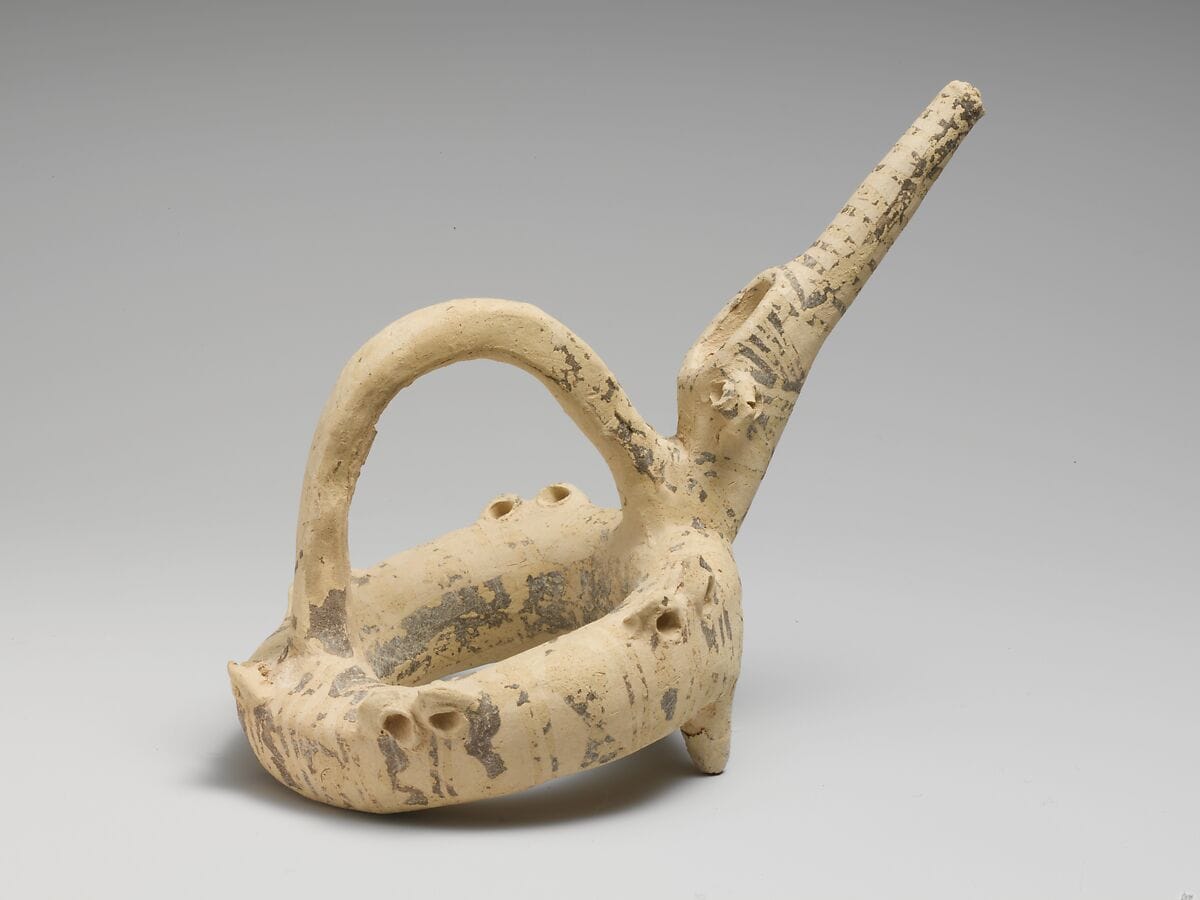 Terracotta ring-vaseMiddle Bronze Age II · 1900–1600 BC
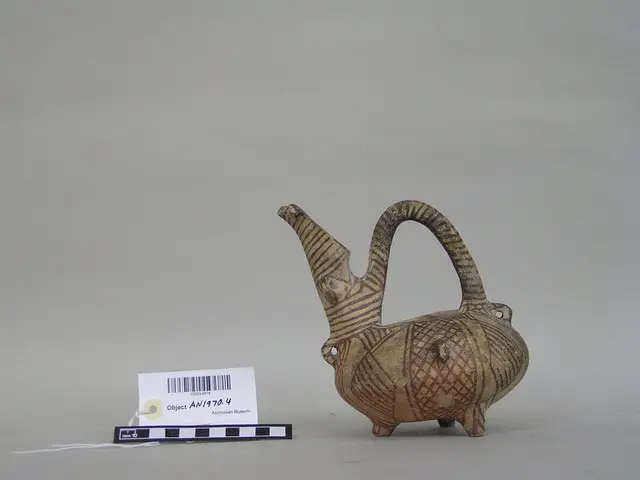 White Painted III-IV ring vase in string-hole styleMiddle Bronze Age II · 1850–1750 BC
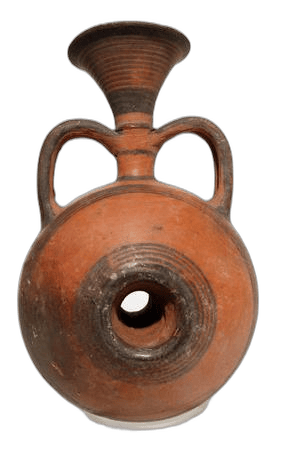 Black-on-Red Ring-flaskGeometric II · 900–700 BC
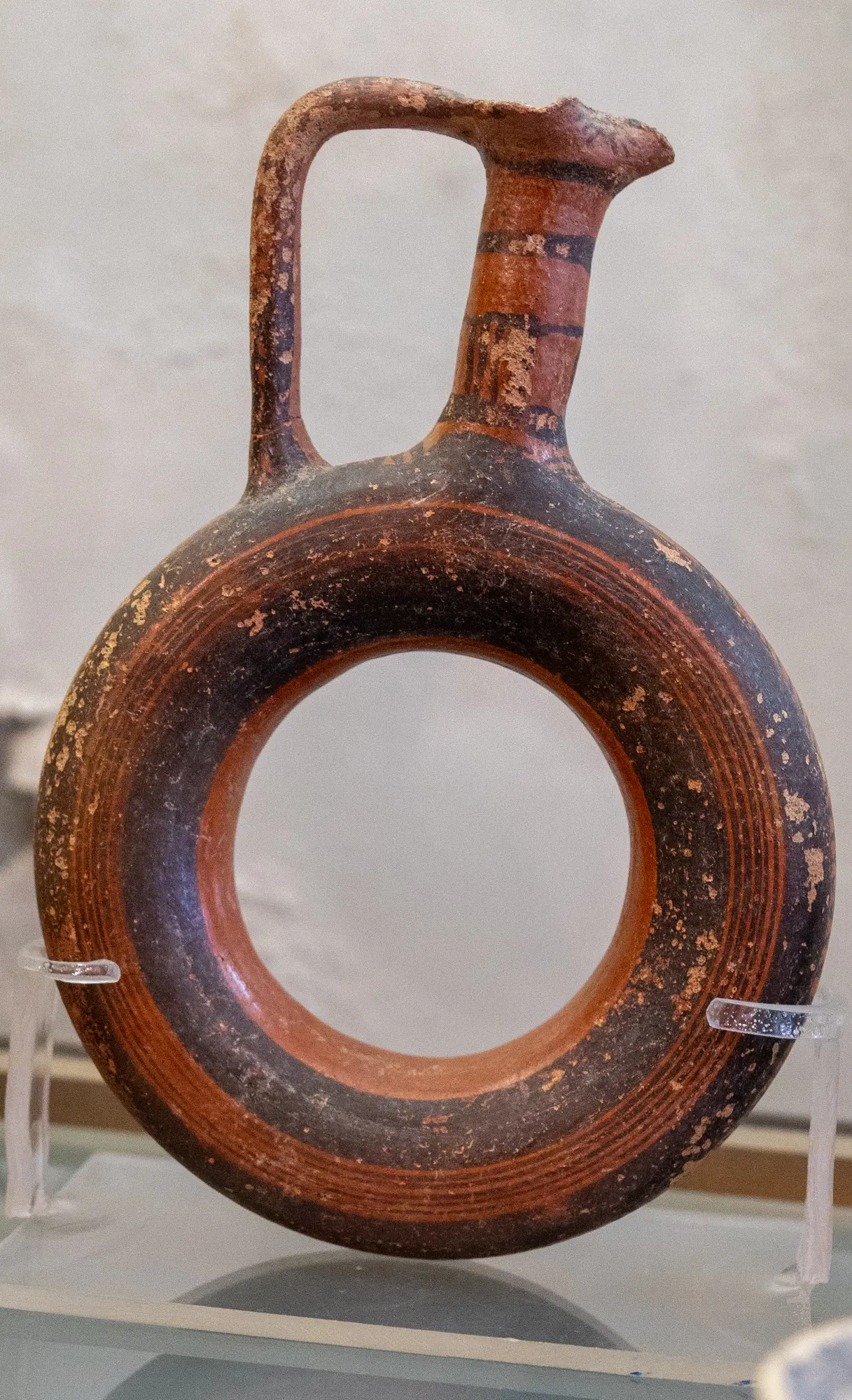 Black on Red ware Ring JugGeometric · 1050–600 BC
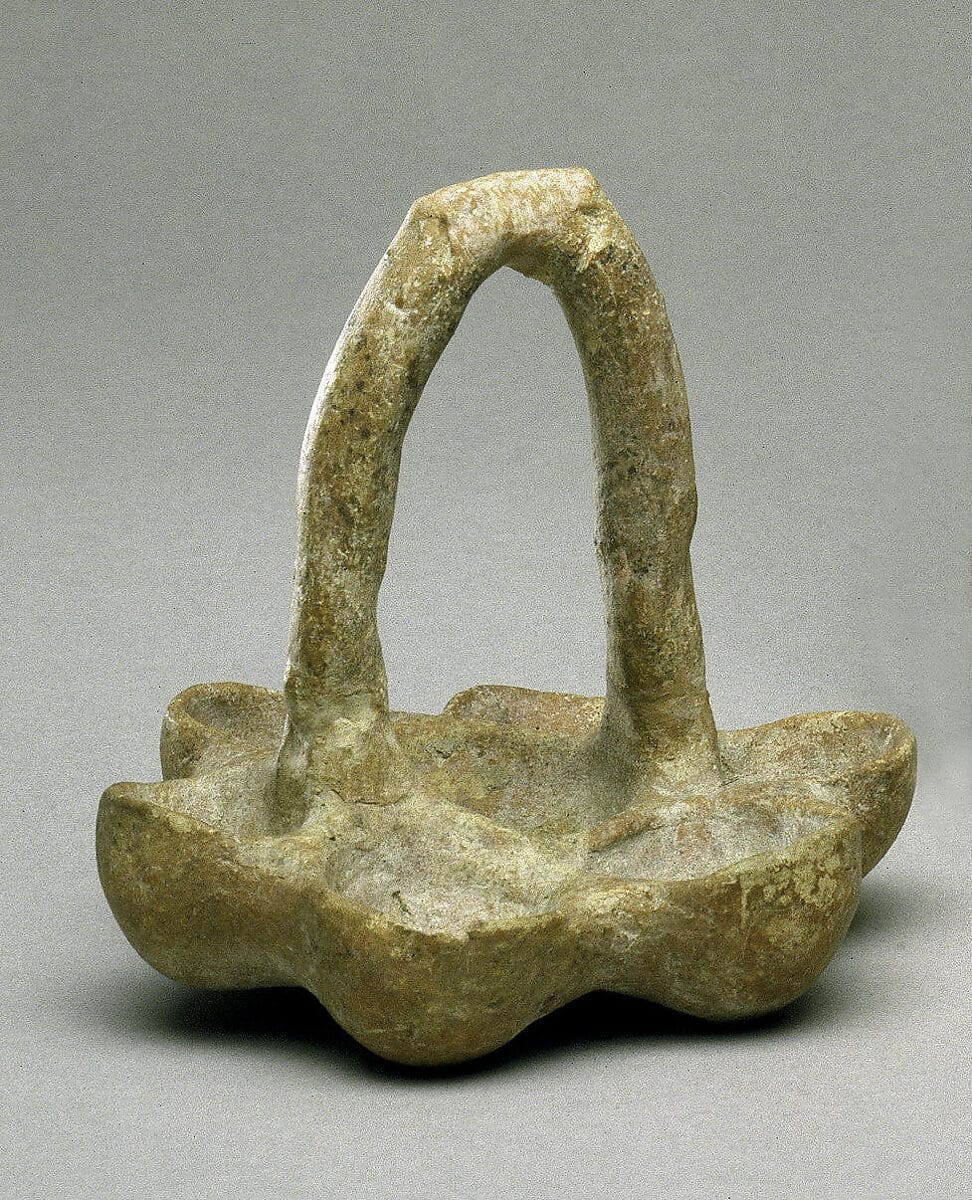 Terracotta composite vaseEarly Bronze Age I · 2500–1600 BC
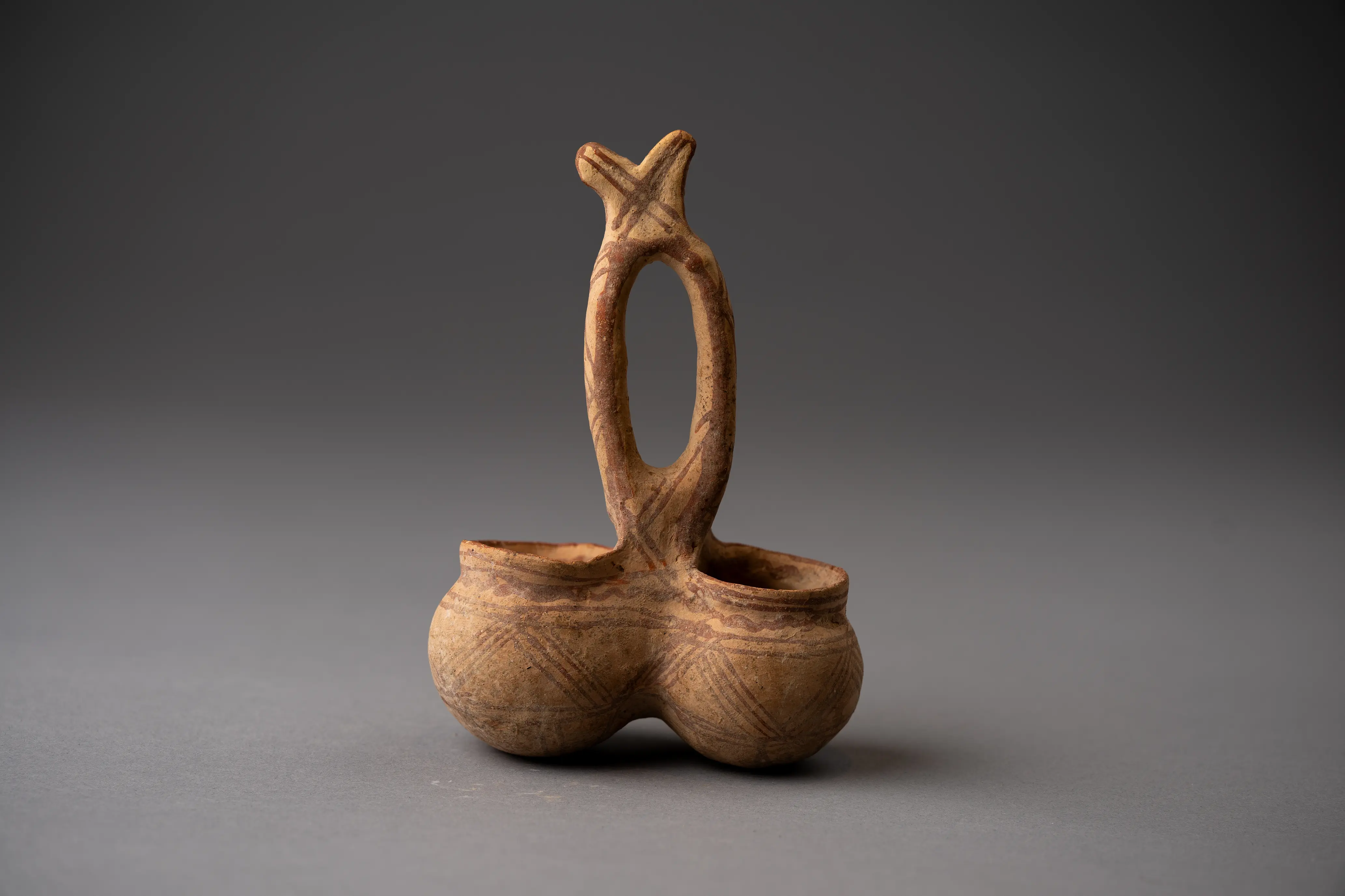 White Painted Double Bowl with Tall Loop HandleMiddle Bronze Age II · 1850–1650 BC
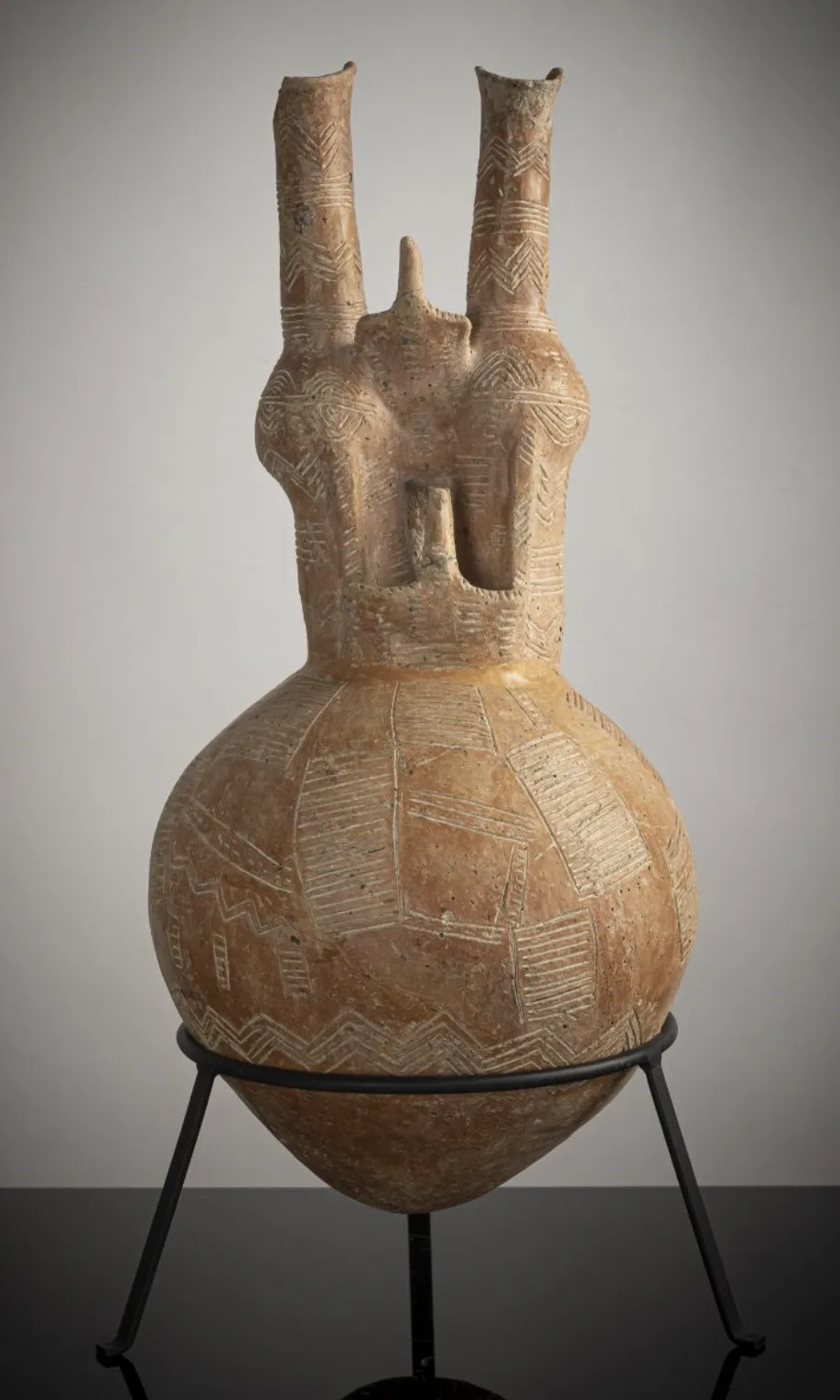 Red Polished Double-Necked Jug with Two Modelled BirdsEarly Bronze Age II · 2300–2000 BC
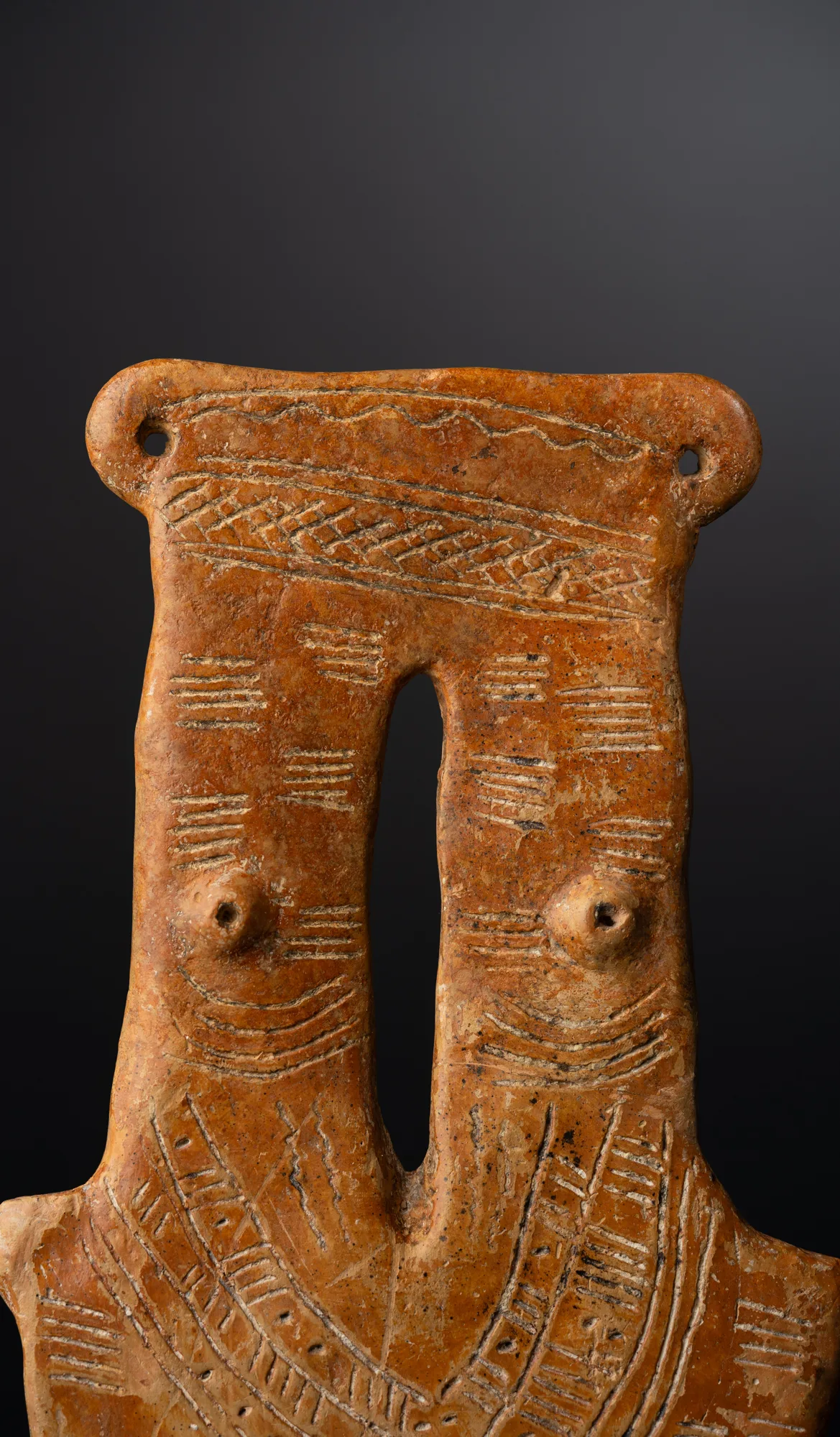 Red Polished Two-Necked Plank FigureMiddle Bronze Age I · 2000–1850 BC
and 16 more objects mentioned on this page
In the catalogue
References
- 1.Morris, D. (1985). The Art of Ancient Cyprus, with a Check-list of the Author's Collection. Oxford: Phaidon.
- 2.Dikaios, P. (1940). The excavations at Vounous-Bellapais in Cyprus, 1931–2. Archaeologia, 88, 1–174.
- 3.Karageorghis, V. (2003). Ancient Cypriote Art in the National Archaeological Museum of Athens. Athens: A. G. Leventis Foundation.
- 4.Karageorghis, V. (1982). Cyprus from the Stone Age to the Romans. London: Thames and Hudson.
- 5.Karageorghis, V., Vassilika, E., & Wilson, P. (1999). The Art of Ancient Cyprus in the Fitzwilliam Museum, Cambridge. Nicosia: A. G. Leventis Foundation.
- 6.Buchholz, H.-G., & Karageorghis, V. (1973). Prehistoric Greece and Cyprus: An Archaeological Handbook. London: Phaidon.
- 7.Brown, A. C., & Catling, H. W. (1980). Ancient Cyprus. Oxford: Ashmolean Museum.
- 8.Gjerstad, E. (1948). The Swedish Cyprus Expedition, Vol. IV, Part 2: The Cypro-Geometric, Cypro-Archaic and Cypro-Classical Periods. Stockholm: The Swedish Cyprus Expedition.
- 9.Stewart, J. R. (1962). The Early Cypriote Bronze Age. In P. Dikaios & J. R. Stewart, The Swedish Cyprus Expedition, Vol. IV, Part 1A (pp. 205–401). Lund: The Swedish Cyprus Expedition.
- 10.Webb, J. M., & Frankel, D. (2010). Social strategies, ritual and cosmology in Early Bronze Age Cyprus: An investigation of burial data from the north coast. Levant, 42(2), 185–209.
- 11.Steel, L. (2013). The social world of Early-Middle Bronze Age Cyprus: Rethinking the Vounous Bowl. Journal of Mediterranean Archaeology, 26(1), 51–73.
- 12.Keswani, P. (2004). Mortuary Ritual and Society in Bronze Age Cyprus. London: Equinox.
- 13.Bolger, D. (2003). Engendering Aphrodite: Women and Society in Ancient Cyprus. ASOR Archaeological Reports; CAARI Monographs 3. American Schools of Oriental Research.
- 14.Karageorghis, V. (1991). The Coroplastic Art of Ancient Cyprus, I: Chalcolithic to Late Cypriote I. Nicosia: A. G. Leventis Foundation.
- 15.Pilides, D., & Papadimitriou, N. (Eds.) (2012). Ancient Cyprus: Cultures in Dialogue. Nicosia: Department of Antiquities, Cyprus.
- 16.Steel, L. (2018). Another look at Red Lustrous arm-vessels. In L. Crewe, L. Hulin & J. Webb (Eds.), Structures of Inequality: Studies in Honour of Alison K. South (Studies in Mediterranean Archaeology Pocket-book 187, pp. 197–210). Jonsered: P. Åströms Förlag.
- 17.Karageorghis, V. (2000). Ancient Art from Cyprus: The Cesnola Collection in The Metropolitan Museum of Art. New York: The Metropolitan Museum of Art.
- 18.Papasavvas, G. (2004). Cypriot bronze stands and their Mediterranean perspective. Revista d'Arqueologia de Ponent, 14, 31–59.
- 19.Hemingway, S., & Harrison, P. (1996). Minoan metalworking in the Postpalatial period: a deposit of metallurgical debris from Palaikastro. Annual of the British School at Athens, 91, 213–252.
- 20.Bass, G. F. (1967). Cape Gelidonya: A Bronze Age Shipwreck. Transactions of the American Philosophical Society, n.s. 57(8). Philadelphia: American Philosophical Society.