
Contents
A snake in Cypriot art is usually a strip of clay. On the large Red Polished jugs and bowls buried in the Early Bronze Age cemetery at Vounous, a raised band that bends from side to side runs round the rim or down the neck, and the excavators called it a snake. Two thousand years later the animal reappears in the round: coiled on a limestone altar, wrapped round the shoulders of a terracotta flute player, laid along the lid of a sarcophagus. This entry covers both: the relief bands read as snakes on Bronze Age pottery, and the modelled and carved snakes of the Iron Age. Painted wavy bands without a snake reading belong to wavy lines. The catalogue groups every object carrying the motif on one page: see all snakes in the catalogue.
Definition and how to recognise a snake
On Bronze Age pottery the snake is applied relief: a roll of clay pressed onto the surface in a wavy or zigzag course, sometimes notched or incised across its back. It can encircle a vessel below the rim, run vertically down the neck or body, or hang from a handle or projection. Porphyrios Dikaios, publishing his 1931-32 Vounous excavation, listed "snake ornament" as its own category of decoration, separate from "rope ornament", and one large bowl carries both: "Snake and rope ornament all round below the rim and snakes pendent from below the projections. Snake ornament on the handle" [1, p. 34].
The identification is a reading, and the band rarely shows a head. Vassos Karageorghis, describing a Red Polished jug from Kotchati, wrote of "the wavy band in relief (a snake motif?)" with the question mark in his text [2]. Some later bands do show heads: a Late Cypriot I bowl in the Metropolitan Museum has a sinuous relief band "ending in snakes' heads" (Terracotta bowl). The safer working rule is to call a wavy relief band a snake when its maker gave it a head or set it in a scene with animals, and otherwise to call it a band "of the kind usually read as a snake".
| Period | Form | Typical setting |
|---|---|---|
| Early Cypriot to Middle Cypriot I | Applied wavy or zigzag relief band | Red Polished jugs, bowls and cups from tombs |
| Late Cypriot I | Applied wavy bands, coiling snakes, bands with heads | Proto Base Ring and Base Ring juglets and bowls |
| Cypro-Geometric | Applied 'snake' along the handle | Proto-White Painted jugs |
| Cypro-Archaic to Cypro-Classical | Modelled and carved snakes | Terracotta figures, limestone altars, footstools, sarcophagus lids |
Early Bronze Age Red Polished
The relief snake belongs to the decorated Red Polished pottery of the Early Bronze Age. Karageorghis lists "human figures, quadrupeds, birds, bucrania, and snakes" among the motifs applied "in relief or in the round", and dates the Metropolitan Museum's decorated Red Polished vessels to Early Cypriot III or slightly later, Middle Cypriot I [3, p. 42].
Vounous gives the fullest set. Dikaios recorded a wide bowl with "snake ornament all round near the rim and stripes enclosing snake pendent from the handles" [1, p. 10], a jug with "snake ornament, and straight stripes in relief on the neck" [1, p. 12], and an oval jug with a pointed base, a "snake band in relief round the upper part of the body" and two horned animals in relief by the base of the neck [1, p. 64]. Summing up his types, he wrote that the cups are hemispherical and "occasionally" have an open spout and "a snake in relief", and that Type I jugs have "snake ornament round the upper part" [1, p. 108]. Tomb 36 held a large bowl with bulls' heads from whose throats relief snakes hang [1, p. 122]. A large jug from Tomb 11, 58 cm high and now in the Cyprus Museum, has a stag in relief on the neck and three more stags on the body, separated by vertical "snake" motifs [4, p. 22; 2]. The British Museum's Red Polished jug from Vounous has an applied snake down either side of its neck.
The motif was not confined to the north coast. At Sotira-Kaminoudhia in the south, a globular Red Polished jug (P106) from Unit 8 in Area C has a relief "snake" on its body, which the excavators described as "unusual" [5, p. 204]. On large Red Polished pottery from Lapithos "the relief bands ... are sometimes formed like snakes" [6, p. 10].
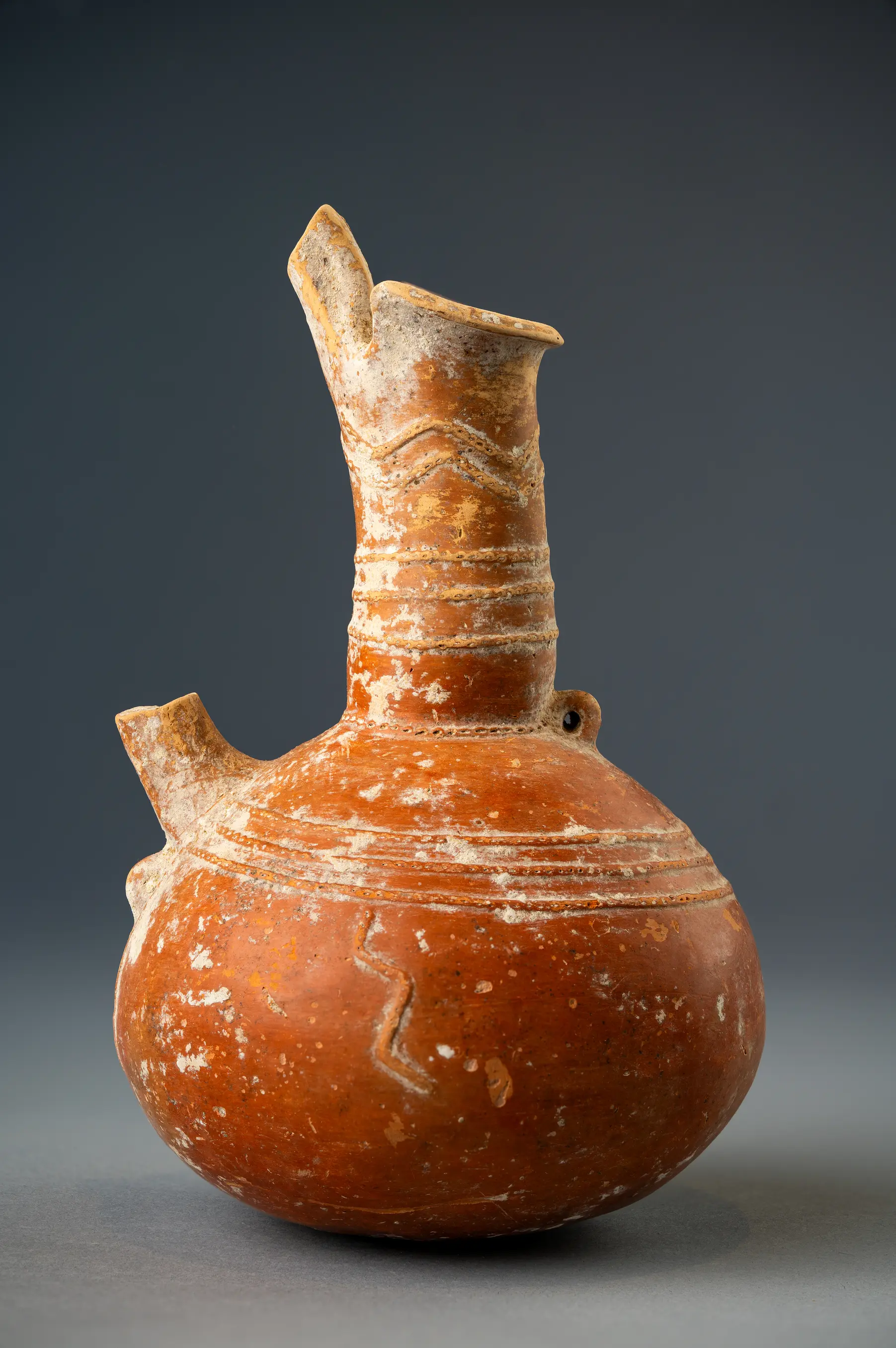
A Red Polished spouted jug with relief bands and a snake in the Drakopoulos collection (right), of c. 2100 to 1850 BCE and ex-Goodman Collection (acquired 1965 to 1969), shows the motif at small scale. Three notched relief bands ring the shoulder and three more the neck, a doubled chevron is laid on near the top of the neck, and below the shoulder spout a single vertical zigzag of applied clay runs down the body. It has no head; it is the kind of band the Vounous excavators called a snake, set vertically as on the Tomb 11 jug.
Late Bronze Age Proto Base Ring and Base Ring
In the Late Bronze Age the relief snake passes to the handmade Base Ring family. A Proto Base Ring juglet from Palaepaphos-Teratsoudhia Tomb 288, 10 cm high, is "decorated with two horizontal wavy bands or 'snake' motifs opposed on body opposite handle" [7, p. 14]. Two Late Cypriot I vessels in the Metropolitan Museum's Cesnola collection, dated c. 1600 to 1450 BCE, carry the motif more literally: a terracotta juglet, 12.5 cm high, decorated with coiling snakes in relief, and the terracotta bowl with a horned handle and a sinuous band ending in snakes' heads.
These snakes entered the argument over whether Base Ring juglets imitate the opium poppy capsule. Asked about snake motifs on such jugs, Robert Merrillees said they raised "several ticklish stylistic questions", and that these ornaments, like a relief and painted decoration on transitional Base Ring I-II, "owe more to purely ceramic invention than they do to their organic prototype" [8, p. 83]. The rest of that debate is set out on the Base Ring ware page.
Iron Age snakes
At the start of the Iron Age the snake becomes a handle ornament. In the Palaepaphos-Skales cemetery Karageorghis published Proto-White Painted jugs with a "vertical raised handle from rim to shoulder with applied 'snake' along the middle", with transversal painted strokes across the snake's back [9, p. 87]; a second jug in the same report, 20 cm high, has a flat raised handle with the same applied snake [9, p. 131]. These belong with the wider Proto-White Painted ware of the Cypro-Geometric transition.
From the Cypro-Archaic period the snake is more often modelled in the round. At the sanctuary of Ayia Irini, excavated by the Swedish Cyprus Expedition, a terracotta figure of c. 800 to 700 BCE, 36.2 cm high, with a painted beard, female breasts and raised arms, has a snake curling round its back with its head resting on the left shoulder (Medelhavsmuseet A.I. 2316) [10, p. 94]. Dikaios noted that some of the Ayia Irini "Minotaurs" are "entwined with snakes", and that one holds a snake up by the side of his head [1, p. 123]. The Metropolitan Museum has a Cypro-Archaic I standing male flute player with a serpent around his shoulders, 9.5 cm high (catalogue entry), and a terracotta snake figurine of the 5th century BCE, 14.5 cm long.
In the Cypro-Classical period the snake appears in limestone. The Cesnola collection includes a small altar or pedestal with a coiled snake, 7 cm across, of the 5th century BCE; a footstool of the first half of the 5th century, 20 by 72.2 cm, carved with goats, lions and snakes; and two fragments of a sarcophagus lid with snakes of the same date (the Met record for 74.51.2615 describes a coiled snake).
What did the snake mean?
The question has four answers in the literature, and none has displaced the others.
The cult reading is Dikaios's. In 1940 he wrote that the snake "already appears in the Early Bronze Age, during which it is represented in relief most frequently on the Red Polished vases offered in tombs", and that its meaning "seems to be connected with a cult of the chthonian deities" [1, p. 122]. Because the horned relief figures on the wall of the clay enclosure model from Vounous hold snakes, he argued that the snake was also tied to a fertility cult and so appears together with the bull [1, pp. 122-123]. He rejected Einar Sjöqvist's view, formed on the Ayia Irini material, that this second role was an Archaic development, and noted that Sjöqvist had surveyed the snake's possible roles as Heilgott (healing god), house-god, astral god, enemy of the light or chthonian deity [1, p. 123]. Dikaios also suggested that symbols such as the snake were introduced through closer contact with the Asiatic mainland, and treated the parallels with Minoan Crete as possibly coincidence and independent development [1, p. 125]. The Cyprus Museum guide repeats the chthonic reading: "We know that the snake is a symbol of the chthonic deities and is a popular motif on the pottery of the Early Bronze Age" [4, p. 22]. Karageorghis paired the motifs on the Cesnola vessels, relating the bucranium to life and the stylised snake to death [3, p. 42].
A second reading makes the snake a guardian. In a study of the old Swedish excavations at Lapithos, the snake on Red Polished grave pottery "is to be considered as a protector of the deceased and his belongings" [6, p. 10].
The third reading is deflationary, and it comes from Karageorghis himself. Of the Kotchati jug with oxen, goats and a possible snake he wrote that "it seems likely that the potter-coroplast simply made use of those motifs which were current in the repertory of vase decoration, without having any specific meaning in mind" [2]. Merrillees's answer on Base Ring jugs is the fourth: the snake there "could also be explained ... as something that was just simply added by the potter in its own right", a ceramic invention with no meaning outside the pot [8, p. 84].
These readings are not equally supported by the objects. Where a band has no head, its identity as a snake rests on the excavator's eye. The Tomb 36 bowl and the enclosure model, where snakes hang from bulls or are held by figures, are the strongest evidence that some potters meant a snake and meant it to go with the bull. The fuller discussion of those Vounous scenes, including the reading of the enclosure as a village scene, is in Vounous and Early Bronze Age burial.
Snakes in the catalogue
The catalogue holds about 45 objects tagged with the motif, across the whole span covered here: Early Bronze Age Red Polished vessels led by the Drakopoulos spouted jug and the British Museum's Vounous snake jug, Late Cypriot I juglets and bowls, and the Archaic terracottas and Classical limestones of the Cesnola collection at the Metropolitan Museum. See all snakes in the catalogue. Related pages are Red Polished zoomorphic vessels, tulip bowls and cult vessels and zigzags.
Objects on this page
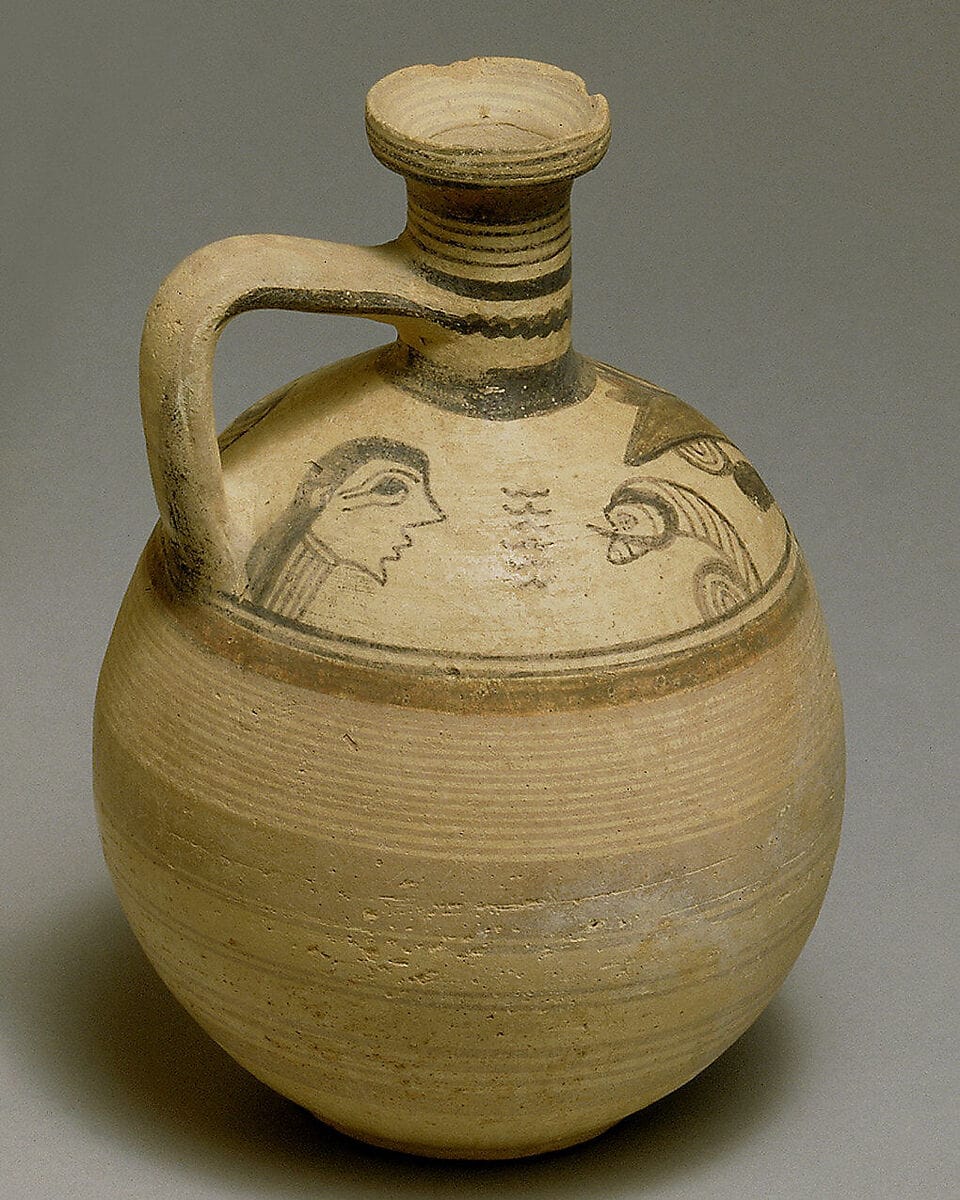
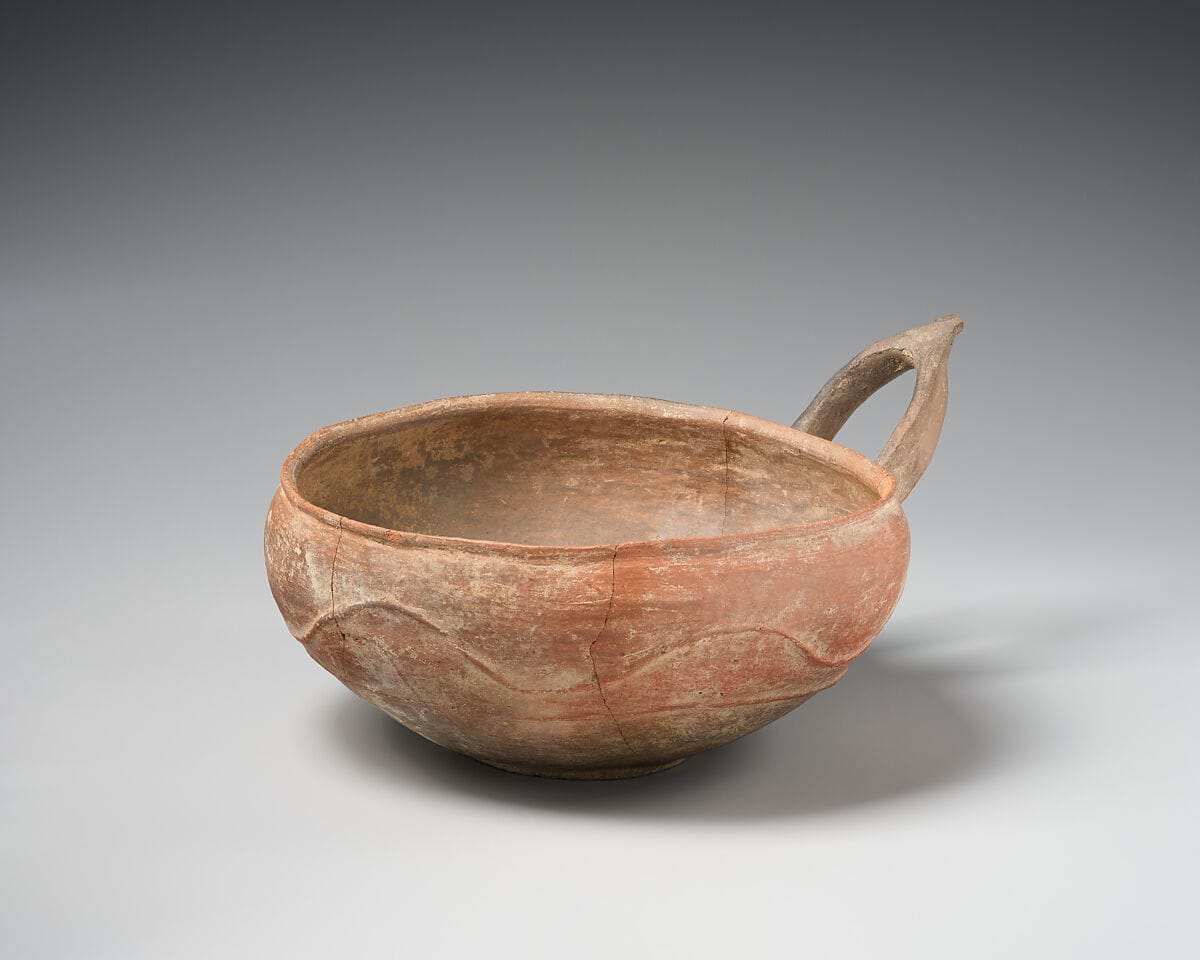 Terracotta bowlLate Bronze Age I · 1600–1450 BC
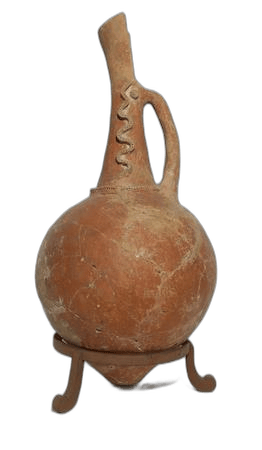 Red Polished Snake JugEarly Bronze Age II · 2300–2100 BC
- Red Polished Spouted Jug with Relief Bands and a SnakeEarly Bronze Age III · 2100–1850 BC
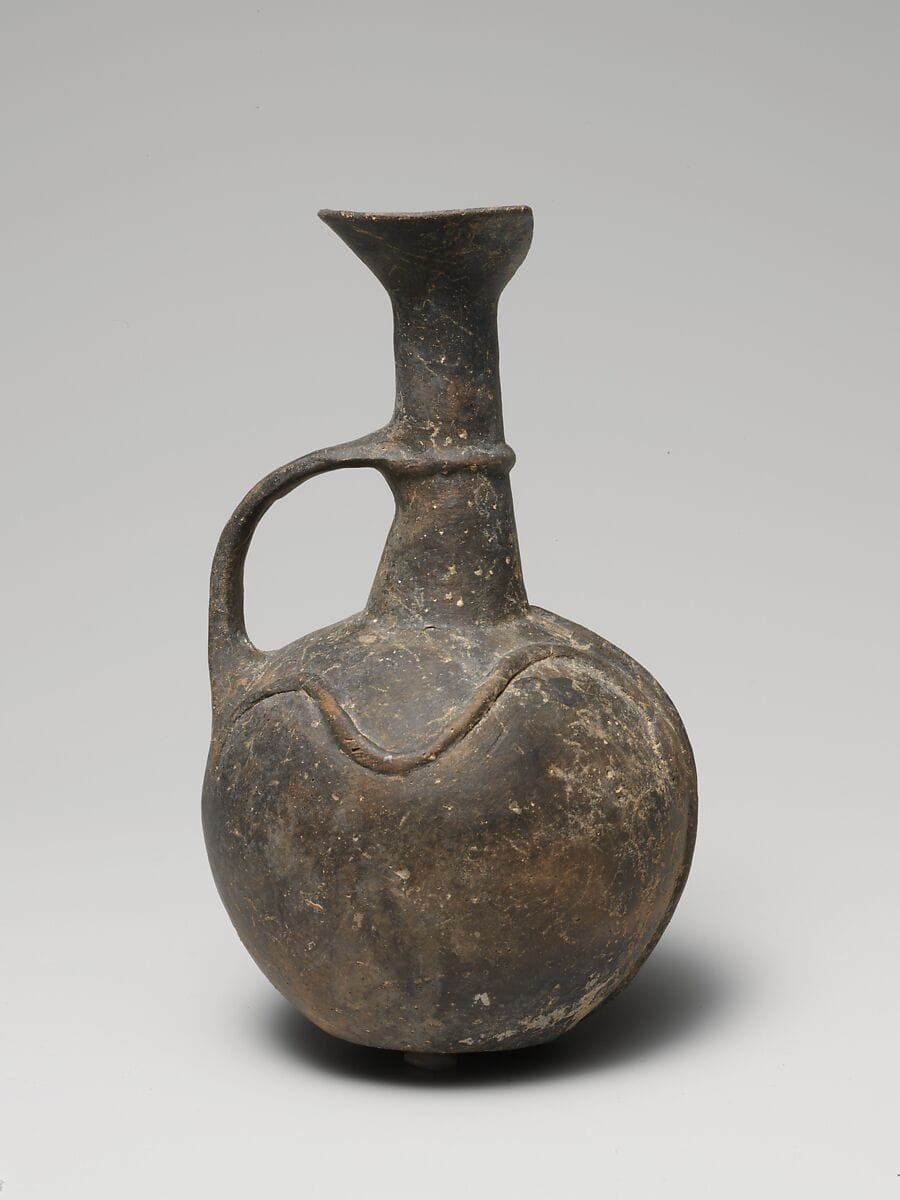 Terracotta jugletLate Bronze Age I · 1600–1450 BC
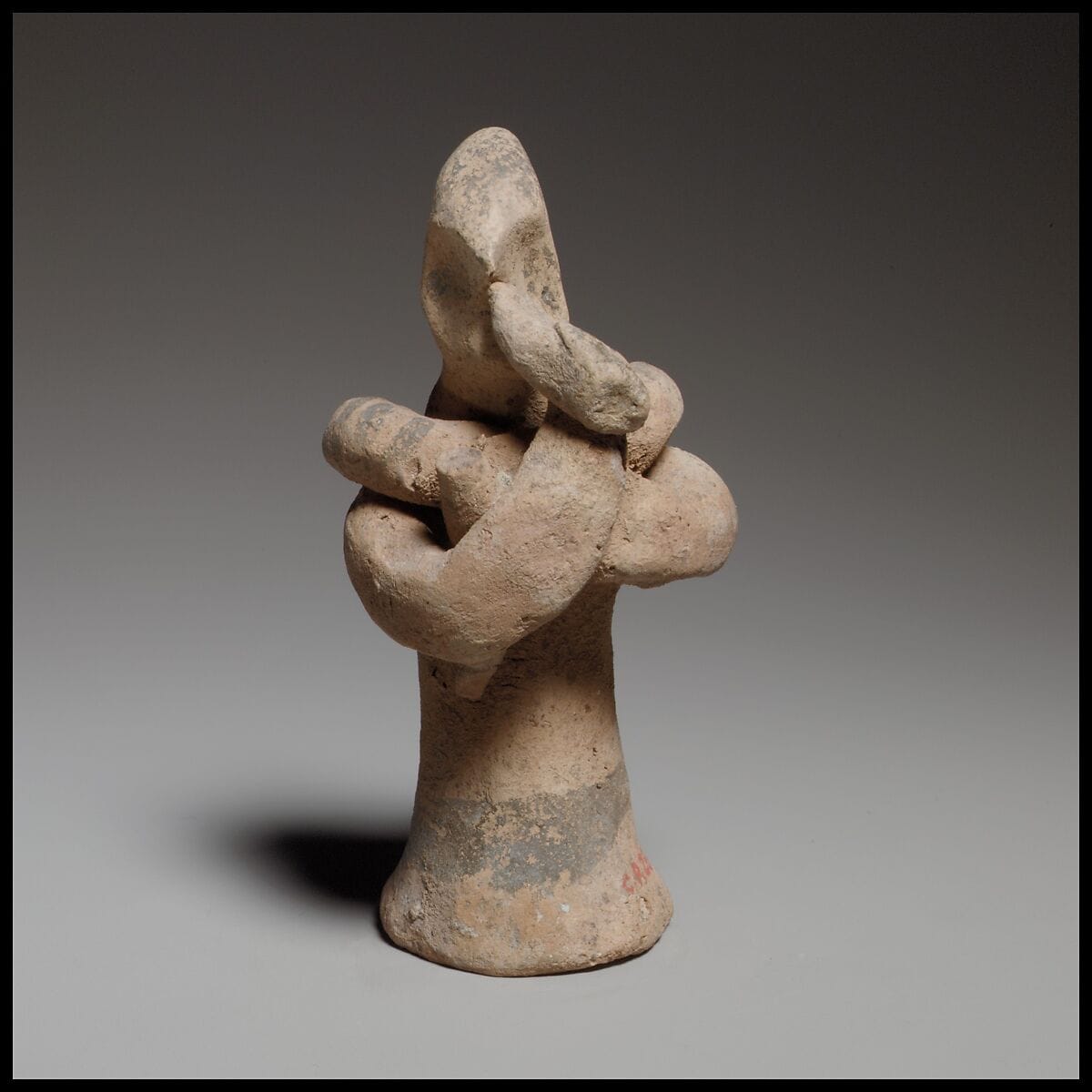 Standing male flute player with a serpent around his shouldersArchaic I · 750–600 BC
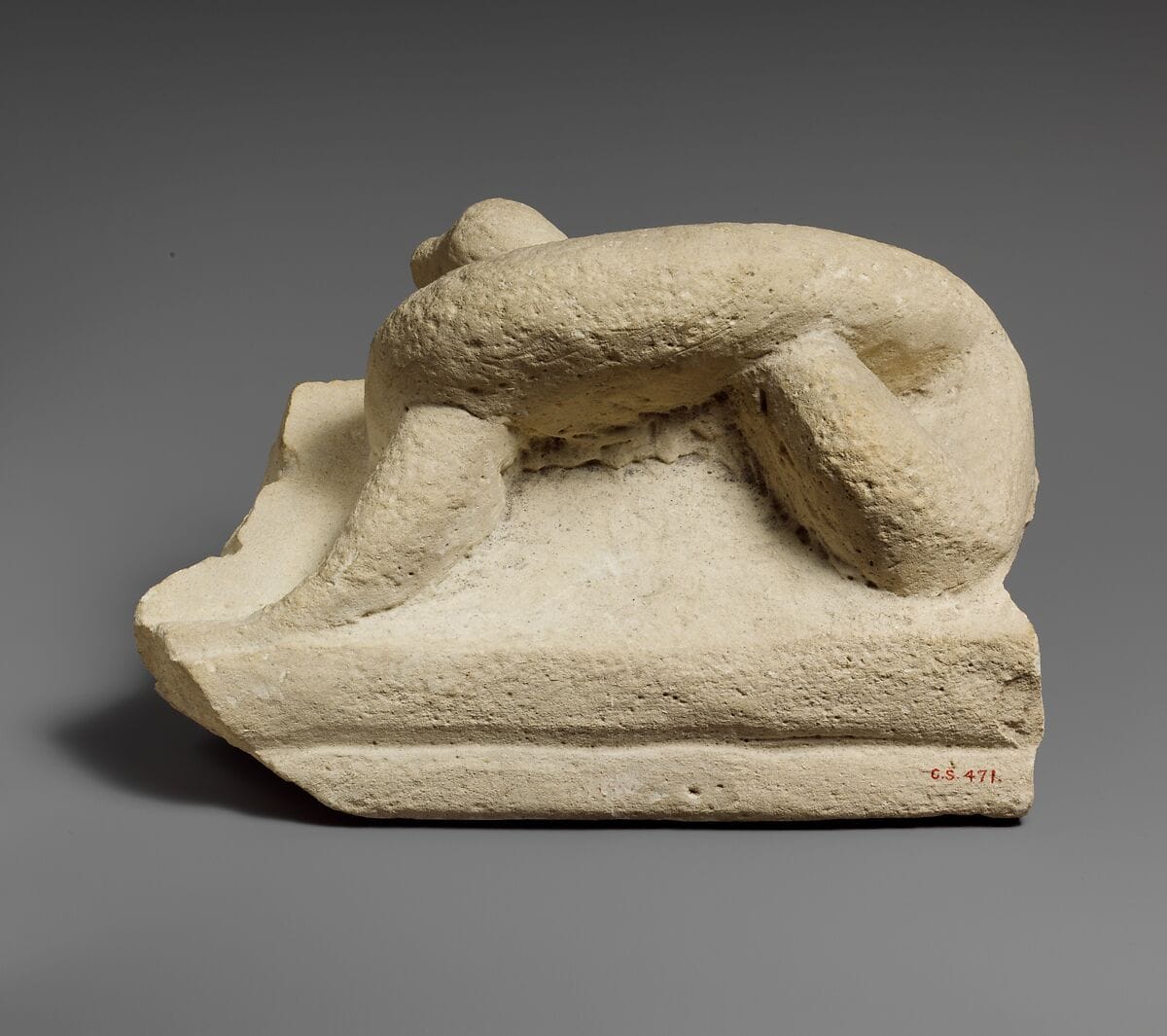 Two fragments of a limestone sarcophagus lid with snakesArchaic II · 500–450 BC
In the catalogue
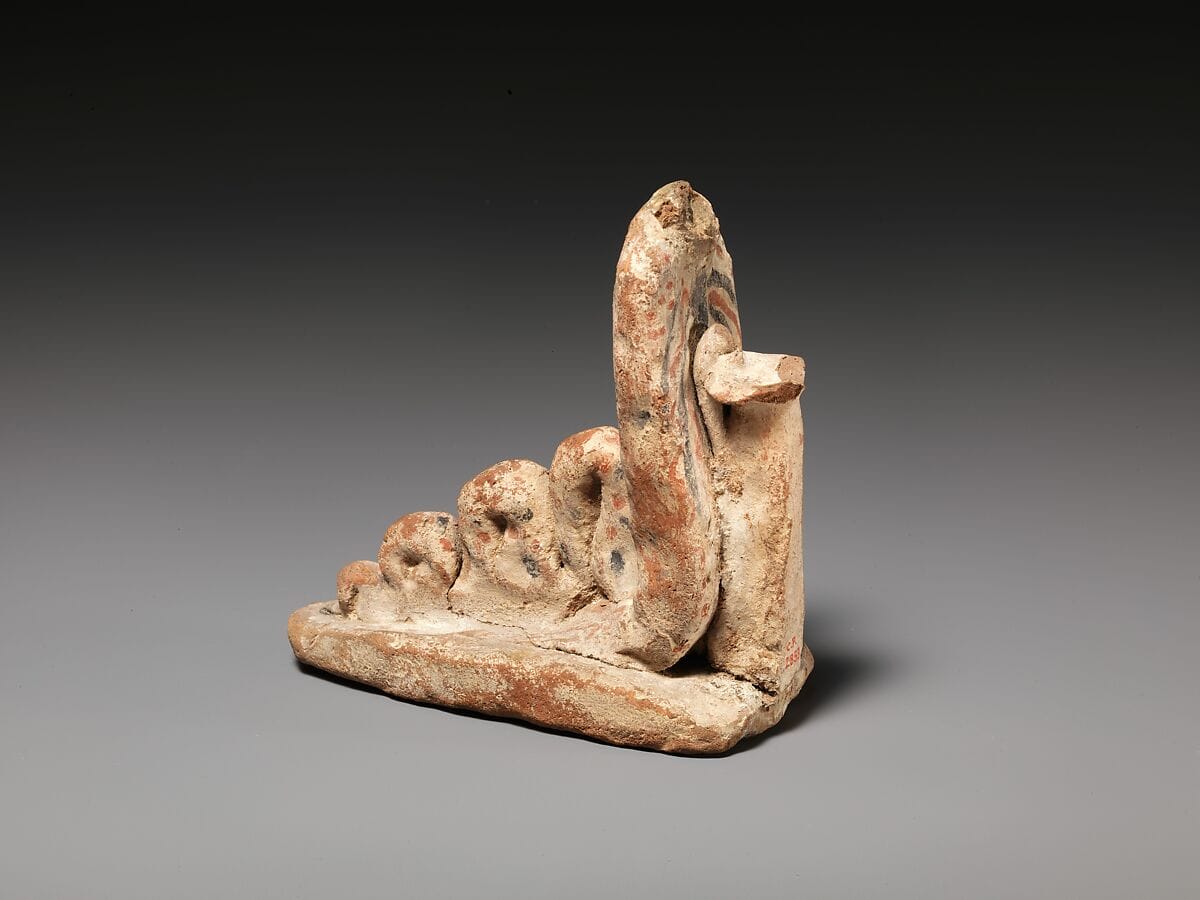
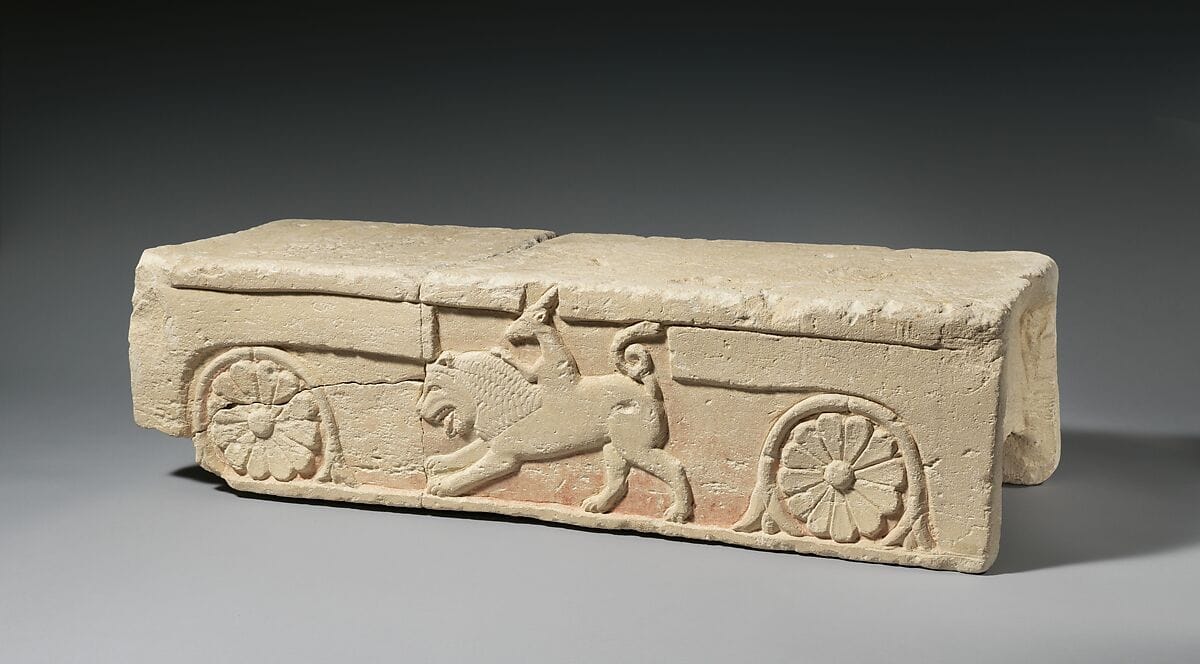
References
- 1.Dikaios, P. (1940). The excavations at Vounous-Bellapais in Cyprus, 1931-32. Archaeologia, 88, 1-174.
- 2.Karageorghis, V. (1991). *The coroplastic art of ancient Cyprus, I: Chalcolithic to Late Cypriote I*. A. G. Leventis Foundation.
- 3.Karageorghis, V., Mertens, J. R., & Rose, M. E. (2000). Ancient art from Cyprus: The Cesnola Collection in the Metropolitan Museum of Art. The Metropolitan Museum of Art.
- 4.The Cyprus Museum, Nicosia (n.d.). Museum guide.
- 5.Swiny, S., Rapp, G., & Herscher, E. (Eds.). (2003). Sotira Kaminoudhia: An Early Bronze Age site in Cyprus (CAARI Monograph Series 4). American Schools of Oriental Research.
- 6.From excavation to exhibition: Problems in presenting the Swedish excavations at Lapithos-Vrysi tou Barba (n.d.).
- 7.Palaepaphos-Teratsoudhia Tomb 288 (c. 1650 BC) (n.d.). Excavation report.
- 8.The Cypriot Bronze Age (n.d.). Discussion with R. S. Merrillees and L. Giddy.
- 9.Karageorghis, V. (1983). Palaepaphos-Skales: An Iron Age cemetery in Cyprus. Universitätsverlag Konstanz.
- 10.Christou, S. (n.d.). Sexually ambiguous imagery in Cyprus from the Neolithic to the Cypro-Archaic period.