
Contents
A cup is a small open vessel for drinking, usually with one or two handles. The catalogue gathers about 120 objects under the name, from Middle Bronze Age handled cups to the Greek-derived skyphos and kantharos of the Iron Age. No ancient Cypriot names for these pots survive, and the line between a cup and a small bowl is a modern convention: as the shapes overview explains, most of the vocabulary is borrowed from the study of Greek vases. This page follows the drinking cup through the Cypriot sequence and gives the two named types, the skyphos and the kantharos, their own sections. See all cups in the catalogue.
What counts as a cup
The working rule on this site is simple: a cup is small, open and made to be held in one hand and drunk from, while a bowl may be larger, may lack handles and may have served for food. The rule is fuzzy at the edges, and Cypriot specialists say so. Susan Sherratt, writing on the Late Bronze Age, found that the many small wheelmade bowls of the period were "probably" drinking vessels, and that functionally they are hard to separate from skyphoi [2]. The skyphos itself, a deep two-handled drinking bowl, is discussed on both this page and the bowl page, because it sits on the boundary. The kylix (a shallow cup on a tall stem) and the mug also appear in the excavation literature; the catalogue counts them as cups.
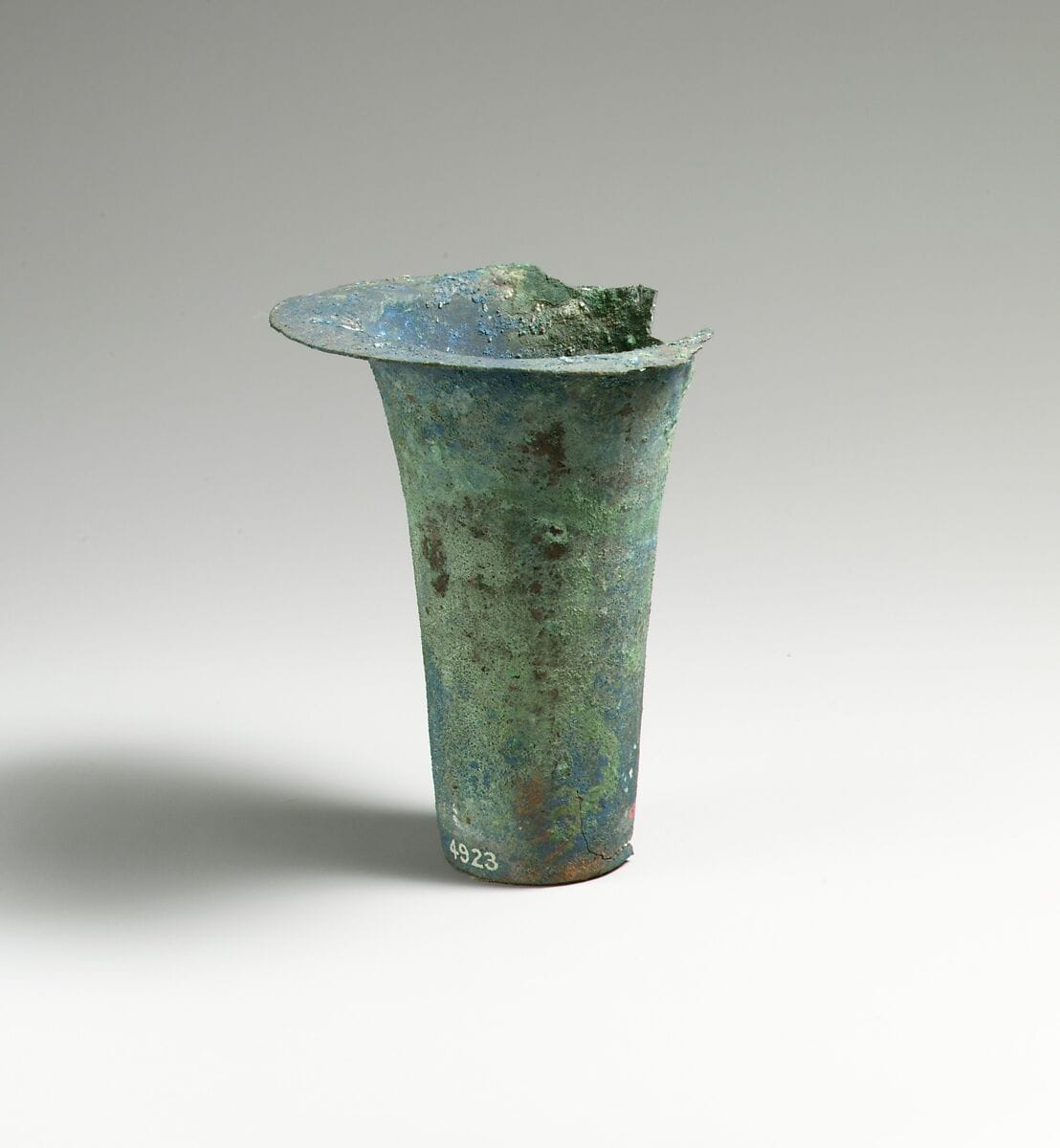
Cups also came in metal. The Metropolitan Museum holds two bronze cups from torch-holders, dated in the catalogue to the sixth century BC, which are cup-shaped fittings rather than drinking vessels. They are listed under the shape because the record calls them cups, and they show how loosely the word is used.
Bronze Age cups
Handled cups are well represented among the Bronze Age pots in museums. The Ashmolean Museum has a Red Polished cup from Leontari Vouno near Nicosia, Early Cypriot (about 2500 to 2000 BC), 8.3 cm high, allocated to Oxford by the Cyprus Exploration Fund in 1888, and a second Red Polished cup of the Middle Cypriot period (about 1900 to 1600 BC), 9.5 cm high. Both are handmade in Red Polished ware, the dominant fabric of the Early and Middle Bronze Age.
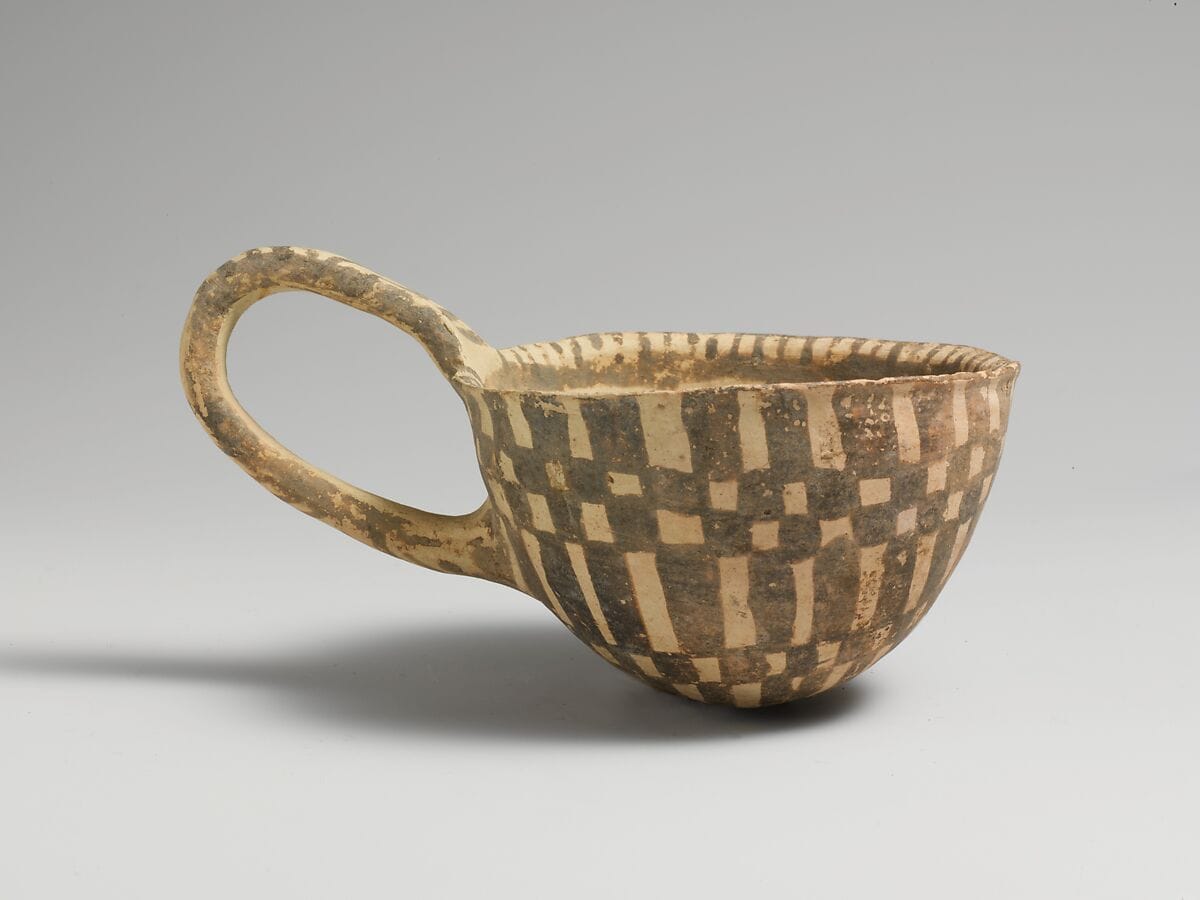
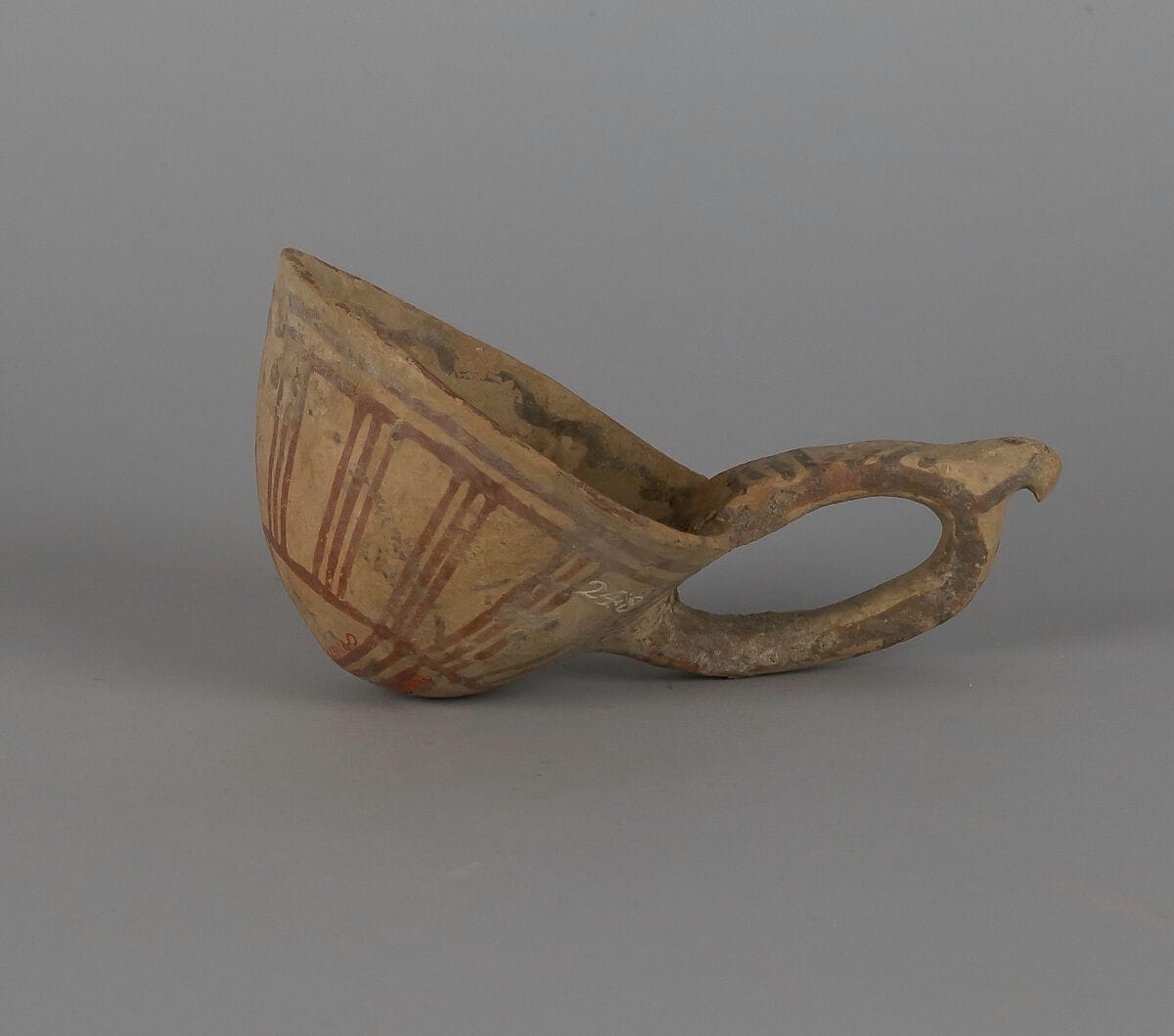
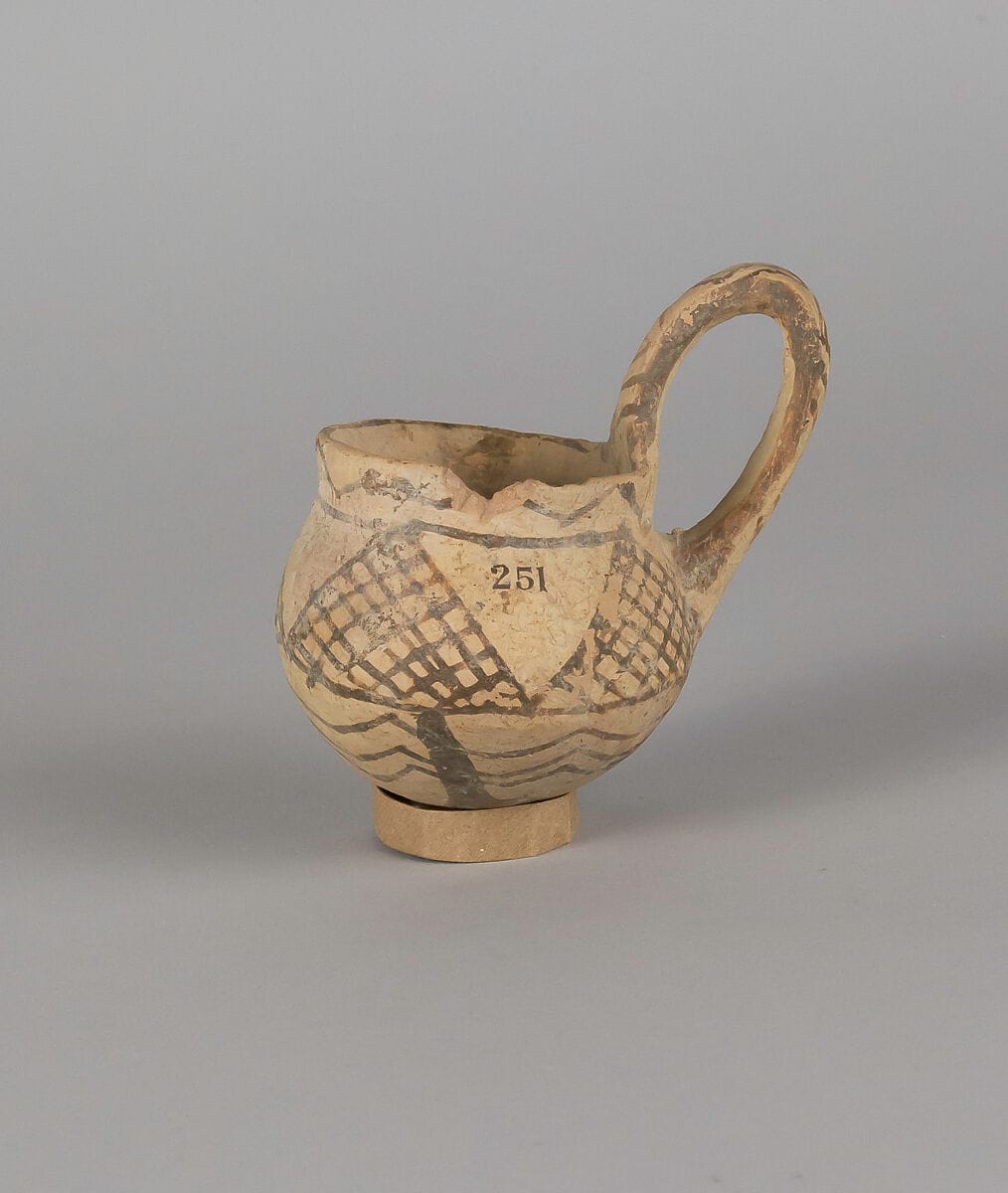
The Cesnola collection in the Metropolitan Museum adds several small Middle Cypriot cups. A loop-handled cup only 5.6 cm high carries a chequer pattern, and a cup with a horned handle has vertical painted bands; a third cup, 8.1 cm high, has a vertical handle and is painted with lozenges and wavy lines. The painted decoration places them in the White Painted tradition, but the Cesnola records give no findspots, and their dates rest on the museum's classification.
Late Bronze Age drinking sets
In the Late Bronze Age drinking took on a social weight that the pottery makes visible. Sherratt describes imported Aegean drinking sets of "decorated kraters, jugs, kylikes (or chalices) or mugs, small bowls or cups", which may have been prized as exotic goods or used as cheaper substitutes for sets in precious metal [2]. It was elements of these drinking sets, more than storage containers, that Cypriot potters first made in a ware of Aegean type, White Painted Wheelmade III.
The range of small drinking bowls in that ware is very wide, modelled on Aegean, Cypriot and probably metal prototypes, with some unusually small examples from Kition Tomb 9 and the Palaepaphos-Eliomylia tomb [2]. Kylikes, chalices and mugs entered the wheelmade repertoire early, on the evidence of Kalavasos-Ayios Dhimitrios, Pyla-Kokkinokremos and the Kition tombs, while a new "semiglobular cup" appears at Enkomi in Level IIIB [2]. Over the same years the handmade bowls of White Slip and Base Ring were supplemented and gradually replaced by the wheelmade bowls, skyphoi among them [2]. The Mycenaean imports and local imitations page covers the imported side of this story.
Cypro-Geometric drinking sets
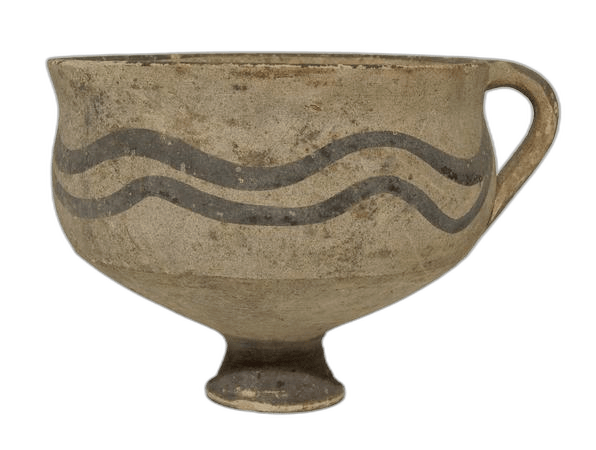
The tombs of Palaepaphos-Skales show cups at the centre of the burial kit in Cypro-Geometric I. Vassos Karageorghis and Eustathios Raptou describe cups with double-curving sides and a conical splaying foot as a very popular type at Palaepaphos and part of the funerary drinking set, with minor variations in the foot and two horizontal wavy bands round the body [3, Tomb 185]. In the same tomb a kylix with a ridged stem "no doubt formed part of the 'drinking set' in the tombs of the aristocratic elite"; the excavators call it an Aegean shape favoured by Aegean immigrants in Late Cypriot IIIB and Cypro-Geometric times [3, Tomb 185]. A small bowl with two horizontal handles and a splaying foot is one of the commonest Cypro-Geometric I types, twelve of them in a single tomb, and bronze footed bowls and a bronze kylix show that the set also existed in metal [3, Tomb 185].
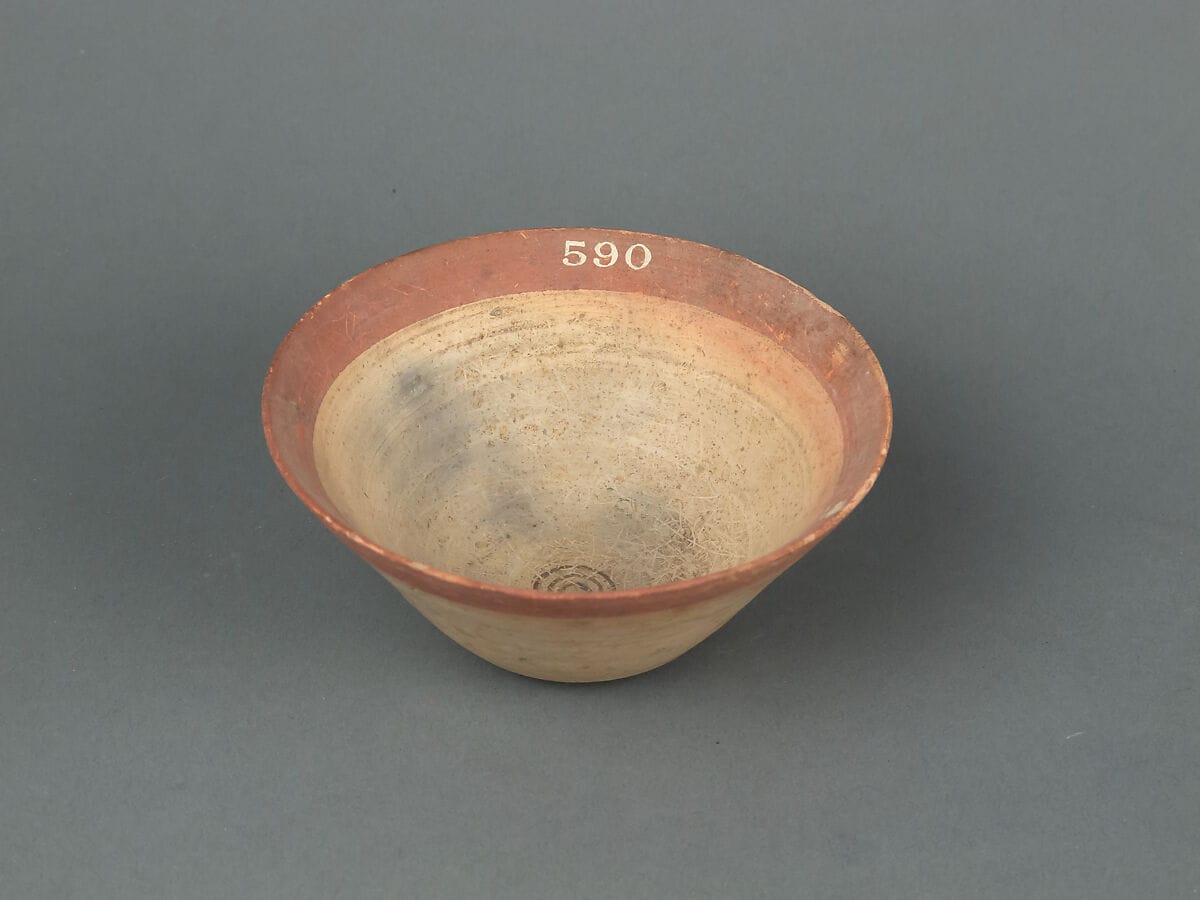
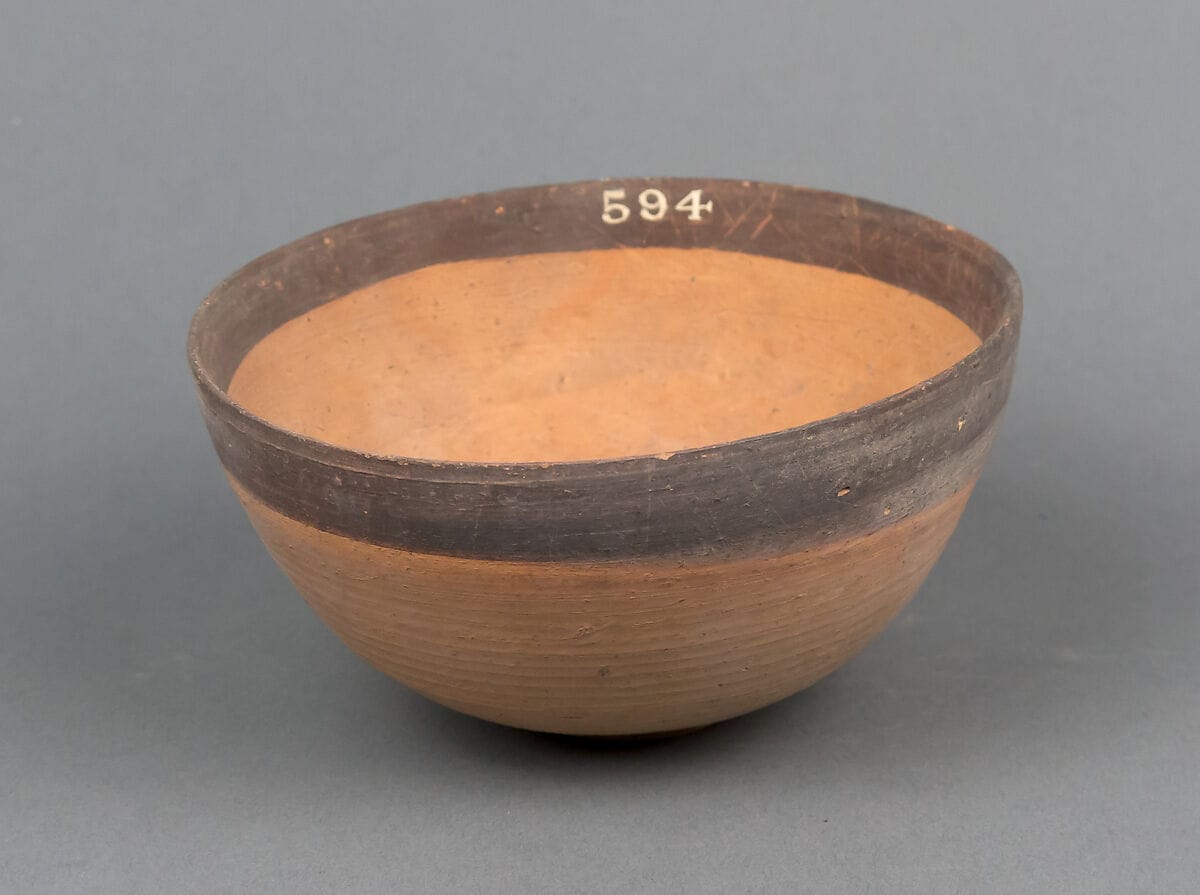
A White Painted footed cup from Kourion in the British Museum (1982,0729.391), dated about 1050 to 900 BC, fits this description closely: a deep body with a slightly double-curved profile, a low conical foot, one handle and a pair of wavy lines on the shoulder. A deep cup of thin ware with a broad red band on the lip, in the Metropolitan Museum, is dated by the museum to about 1125 to 1050 BC, at the turn from Bronze Age to Iron Age.
Skyphoi
The skyphos is a deep drinking cup with two horizontal handles near the rim, usually on a low foot. The name is Greek and is applied to Cypriot pots by convention. See all skyphoi in the catalogue.
In Late Bronze Age Cyprus the shape is the bell-shaped deep bowl with two horizontal loop handles of White Painted Wheelmade III, which replaced much of the older handmade drinking pottery [2]. Its Iron Age history is bound up with Greek imports. Nicolas Coldstream judged that "the skyphos was the only Greek Geometric shape to make any sustained impact" on Cypro-Geometric pottery, which had plenty of drinking shapes of its own; the two-handled standed bowl of Cypro-Geometric III is "the distant cousin of the Greek Geometric skyphos", both descended from the Mycenaean IIIB deep bowl [1, p. 23]. Cypriot potters imitated the Greek skyphos, and the imitations had a limited vogue through the eighth, seventh and early sixth centuries, later influenced by East Greek "Ionian cups", but the skyphos never became the favourite drinking vessel of Cyprus [1, p. 23].
The earliest local imitation Coldstream knew comes from Amathus and dates "well back in the 9th century": a large and clumsy Bichrome copy of a Euboean pendent-semicircle skyphos with the semicircles drawn freehand [1, p. 23]. Early imitations of Aegean Middle Geometric skyphoi may keep the solid painted interior and the hatched meanders, but already add Cypriot touches such as concave chevrons and Bichrome colour; from the late eighth century the Cypriot versions drop the painted interior for groups of fine lines inside the lower body, and Bichrome becomes normal [1, p. 23]. The first Greek imports at Amathus are a skyphos and a cup of the late tenth century from one tomb, and Amathus went on to receive more Greek Geometric pottery than any other kingdom, while the fifty or so tombs at Skales produced none [1, p. 24]. Coldstream concluded that local copies do not by themselves show that Aegean Greeks lived in Cyprus [1, p. 23]. Nota Kourou reads two Attic Late Geometric I skyphoi from Amathus Tomb 443 as "the last flourish of the custom of the imported dinner set in Cyprus" [4, p. 83]. More on the city is in The Ancient City of Amathus.
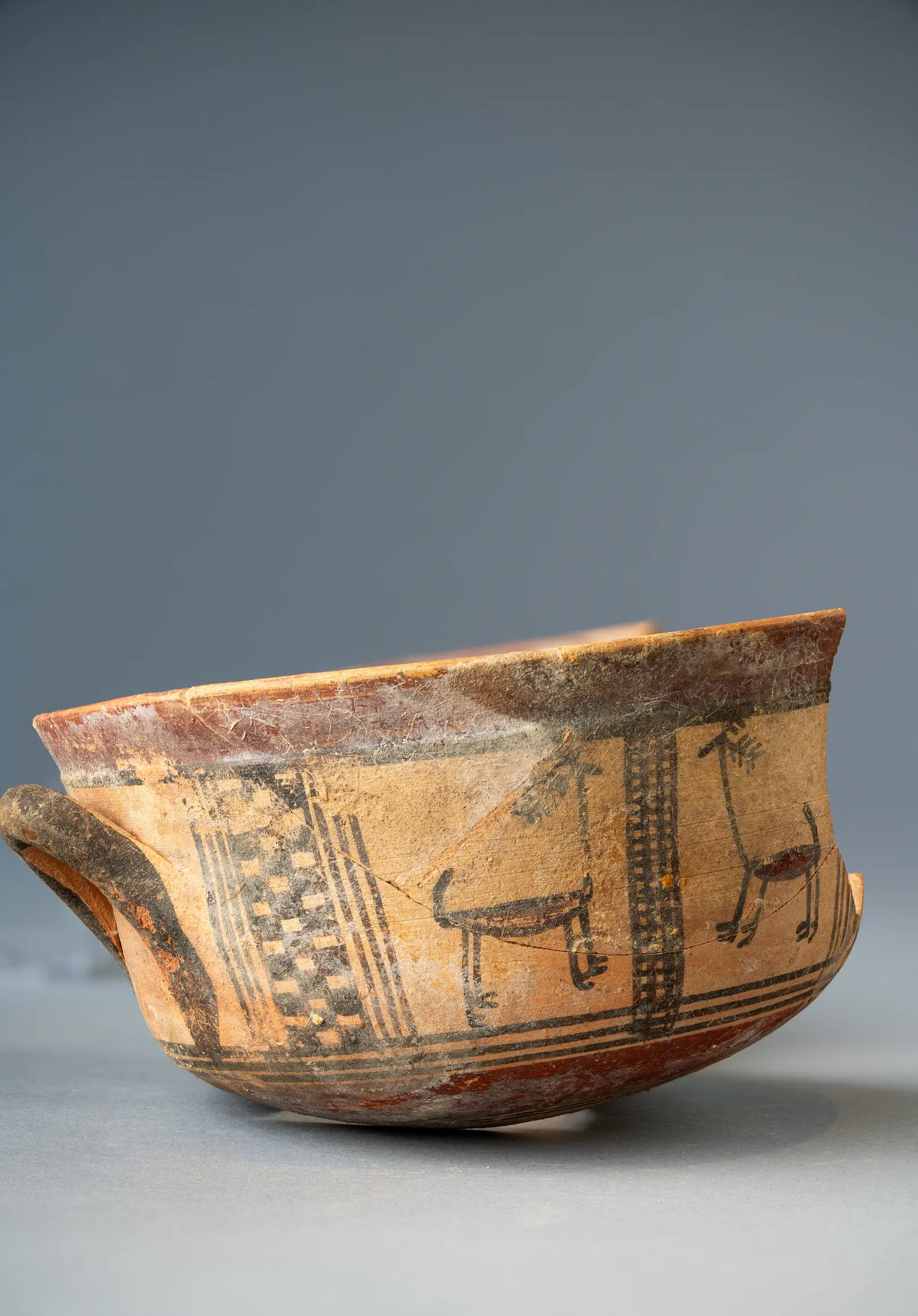
The Drakopoulos Bichrome skyphos with stags in metopes, probably Cypro-Archaic I (about 750 to 600 BC), shows the Greek Geometric panel scheme in Cypriot hands. It has a rounded lower body, a tall flaring rim zone washed red-brown, and horizontal loop handles painted dark; between chequer and ladder panels stand antlered stags, with the second colour on their bodies and on the rim. The same collection has two fragments of a White Painted deep bowl of about 800 to 700 BC, each with a horizontal loop handle and a panel of vertical lines, from the Iron Age descendant of the skyphos.
Museum examples cover the whole range. The Metropolitan Museum has a small skyphos of about 725 to 700 BC, 7.3 cm high, which the museum compares with a probably Euboean cup from Sicily and suggests may be a Cypriot imitation, and a second skyphos, 8.9 cm high, catalogued as a Cypriot imitation of an Attic prototype of Cypro-Geometric III to Cypro-Archaic I. The British Museum's Bichrome Red skyphos, bought from Cesnola, has a lattice band round the neck and panels of rosettes and quatrefoils (see Bichrome Red ware). The Ashmolean has a Cypro-Geometric Bichrome skyphos, 8.2 cm high and 11.5 cm across, and the Medelhavsmuseet in Stockholm a Bichrome III skyphos from Stylli Tomb 10, Cypro-Archaic I (700 to 600 BC), 10 cm high, excavated by the Swedish Cyprus Expedition in 1930.
Kantharoi
The kantharos is a two-handled drinking cup whose handles rise high, often on a tall foot. It is rare in Cyprus, and the catalogue has a single example. See all kantharoi in the catalogue.
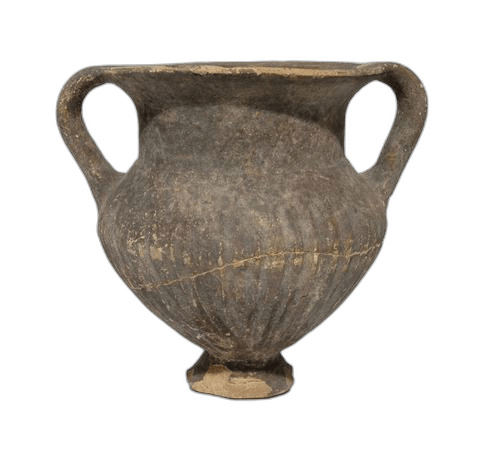
That example is the British Museum's Black Slip kantharos (1894,1101.548), found during the Turner Bequest excavations at Amathus. It is wheelmade, 14 cm high, with a biconical body ribbed vertically, a flaring ring base, a tall cylindrical neck and two opposed loop handles, in sandy buff clay under a black slip. The museum assigns it, with a question mark, to Black Slip I or II and dates it to about 1050 to 900 BC, in Cypro-Geometric I and II; the ribbing suggests a metal model, but no study of the piece has been published.
Imported kantharoi reached Cyprus too. Kourou lists a figured Attic kantharos from Kition Tomb 11 among the few Attic pieces connected with the imported dinner set [4, p. 83]. Much later, the Medelhavsmuseet holds a complete black-glazed kantharos from Marion Tomb 36, 9.1 cm high, of the Cypro-Classical II period (400 to 325 BC), excavated by the Swedish Cyprus Expedition.
Named examples
| Vessel | Ware and date | Collection and number | Size |
|---|---|---|---|
| Cup, Leontari Vouno | Red Polished, Early Cypriot | Ashmolean AN1888.1257 | H 8.3 cm |
| Cup | Red Polished, Middle Cypriot | Ashmolean AN1994.13 | H 9.5 cm |
| Loop-handled cup with chequer pattern | Middle Cypriot | Metropolitan Museum 74.51.1116 | H 5.6 cm |
| Skyphos | Bichrome, Cypro-Geometric | Ashmolean AN1970.1061 | H 8.2 cm |
| Skyphos, Stylli Tomb 10 | Bichrome III, Cypro-Archaic I | Medelhavsmuseet St. 010:016 | H 10 cm |
| Skyphos with stags in metopes | Bichrome, probably Cypro-Archaic I | Alexis Drakopoulos Collection BWL-AR-001 | |
| Kantharos, Amathus | Black Slip I or II (?), c. 1050–900 BC | British Museum 1894,1101.548 | H 14 cm |
| Kantharos, Marion Tomb 36 | Black-glazed, Cypro-Classical II | Medelhavsmuseet M. 036:008 | H 9.1 cm |
Summary
The Cypriot cup is a family defined by use more than by form. Handmade handled cups in Red Polished and White Painted ware belong to the Early and Middle Bronze Age; in the Late Bronze Age, Aegean drinking sets prompted a flood of small wheelmade drinking bowls, kylikes and mugs; and in Cypro-Geometric I the footed cup and kylix formed a funerary drinking set at Palaepaphos-Skales. The skyphos arrived with Greek imports and was copied in Bichrome from the ninth century, without displacing the local drinking shapes, and the kantharos remained rare, known from a Black Slip piece at Amathus and from Attic and later black-glazed imports. Where cups end and bowls begin is a matter of convention, and the bowl page covers the larger members of the family.
Objects on this page
 Cup from a torch-holderArchaic II · 599–500 BC
 Terracotta loop-handled cupMiddle Bronze Age II · 1900–1600 BC
 CupMiddle Bronze Age I · 2000–1600 BC
 CupBronze Age · 3200–1050 BC
 White Painted Footed CupGeometric I · 1050–900 BC
 CupLate Bronze Age III · 1125–1050 BC
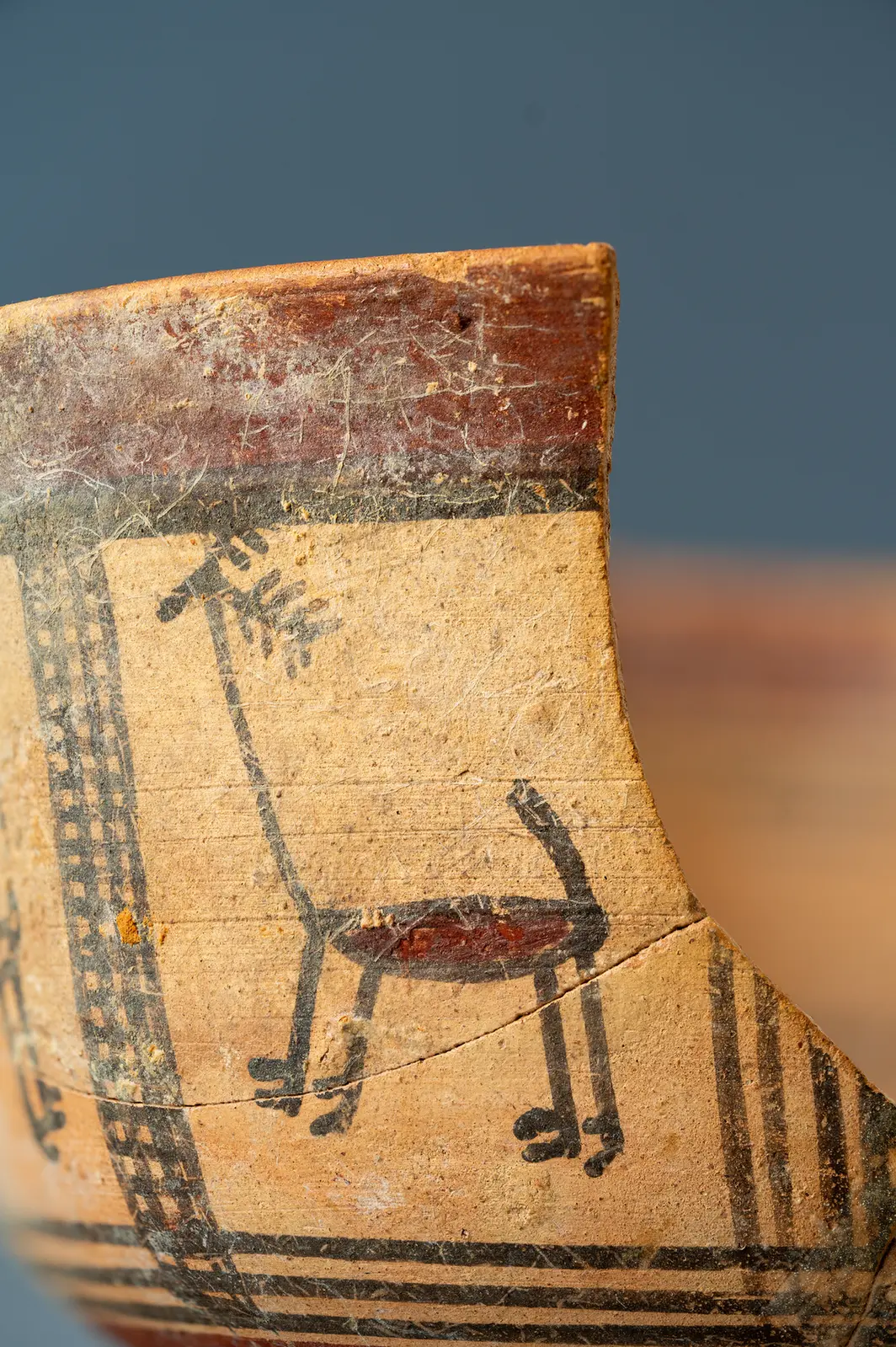 Bichrome Skyphos with Stags in MetopesArchaic I · 750–600 BC
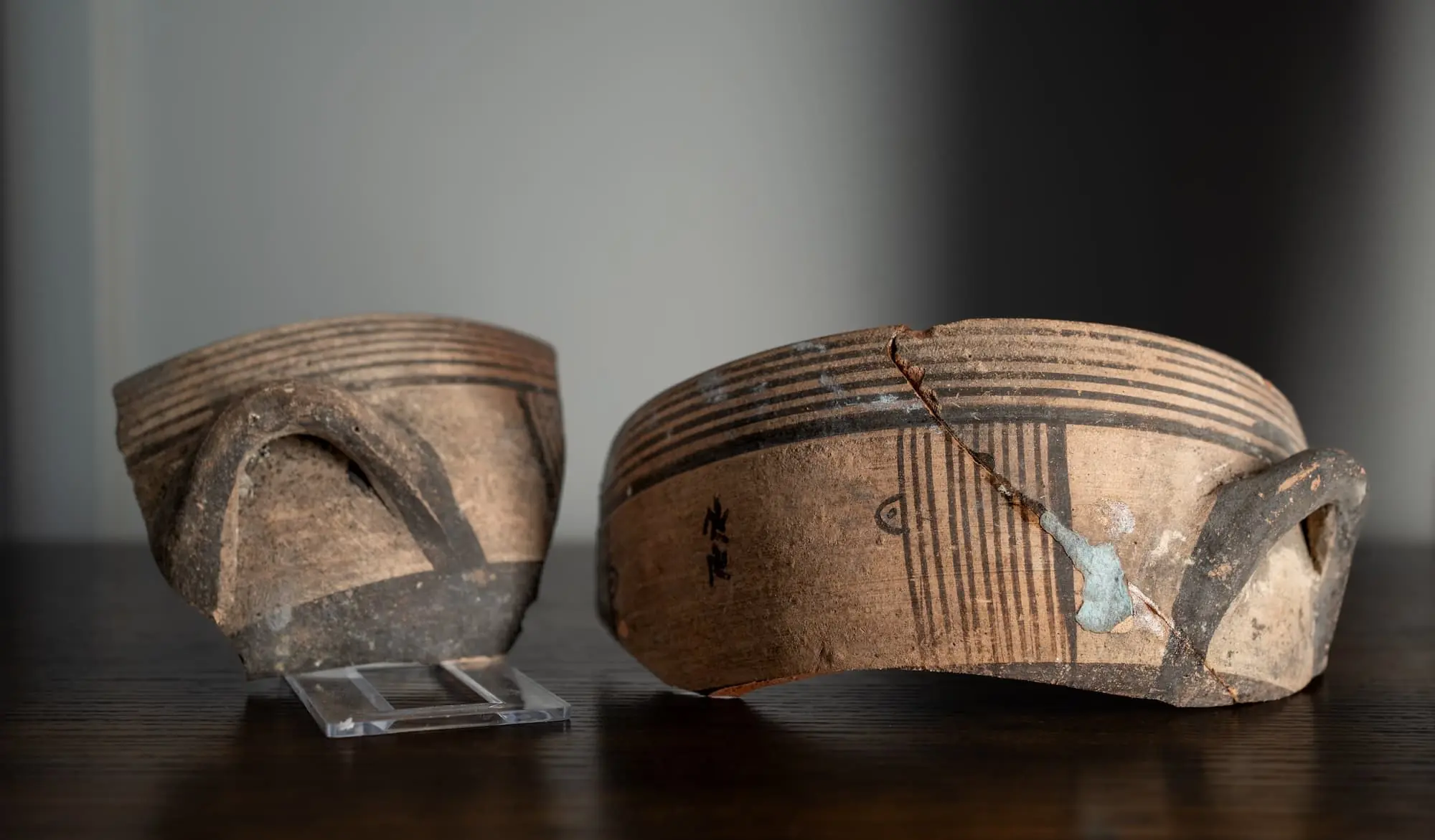 Two Fragments of a White Painted Deep Bowl with Panel DecorationGeometric III · 850–600 BC
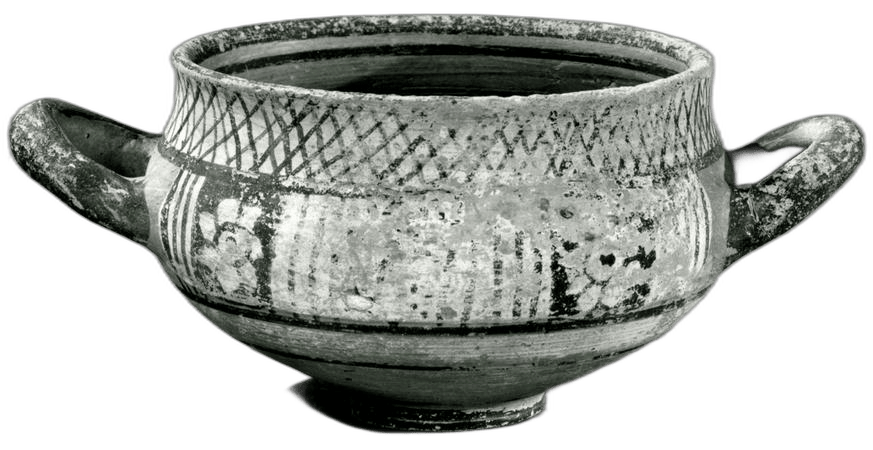 Bichrome Red Skyphos BowlArchaic I · 750–600 BC
- Black Slip CantharosGeometric I · 1050–900 BC
In the catalogue
References
- 1.Coldstream, J. N. (2009). Cypriot taste in early Greek ceramic imports. Ancient West & East, 8, 21–36. https://doi.org/10.2143/AWE.8.0.2045836
- 2.Sherratt, E. S. (1991). Cypriot pottery of Aegean type in LC II–III: Problems of classification, chronology and interpretation. In J. A. Barlow, D. L. Bolger & B. Kling (Eds.), Cypriot Ceramics: Reading the Prehistoric Record (University Museum Monograph 74, pp. 185–198). Philadelphia: University Museum.
- 3.Karageorghis, V., & Raptou, E. (2016). Palaepaphos-Skales: Tombs of the Late Cypriote IIIB and Cypro-Geometric Periods (Excavations of 2008 and 2011). Nicosia: The Cyprus Institute.
- 4.Kourou, N. (2019). Cyprus and the Aegean in the Geometric period: The case of Salamis. In S. Rogge, C. Ioannou & T. Mavrojannis (Eds.), Salamis of Cyprus: History and Archaeology from the Earliest Times to Late Antiquity (Schriften des Instituts für Interdisziplinäre Zypern-Studien 13). Münster: Waxmann.