
Cypriot Pottery Replicas and Fakes: Is My Piece Real?
Most doubtful Cypriot pots are honest souvenirs or restored originals. How to tell replicas, repairs, forgeries and ancient copies apart, and what TL can prove.

Alexis Drakopoulos
October 3, 2026·Guides · Collecting · Ceramics·17 min read


Share


Alexis Drakopoulos is a Greek Cypriot Machine Learning Engineer working in Financial Crimes. He is passionate about Archeology and making it accessible to everyone. About Me.
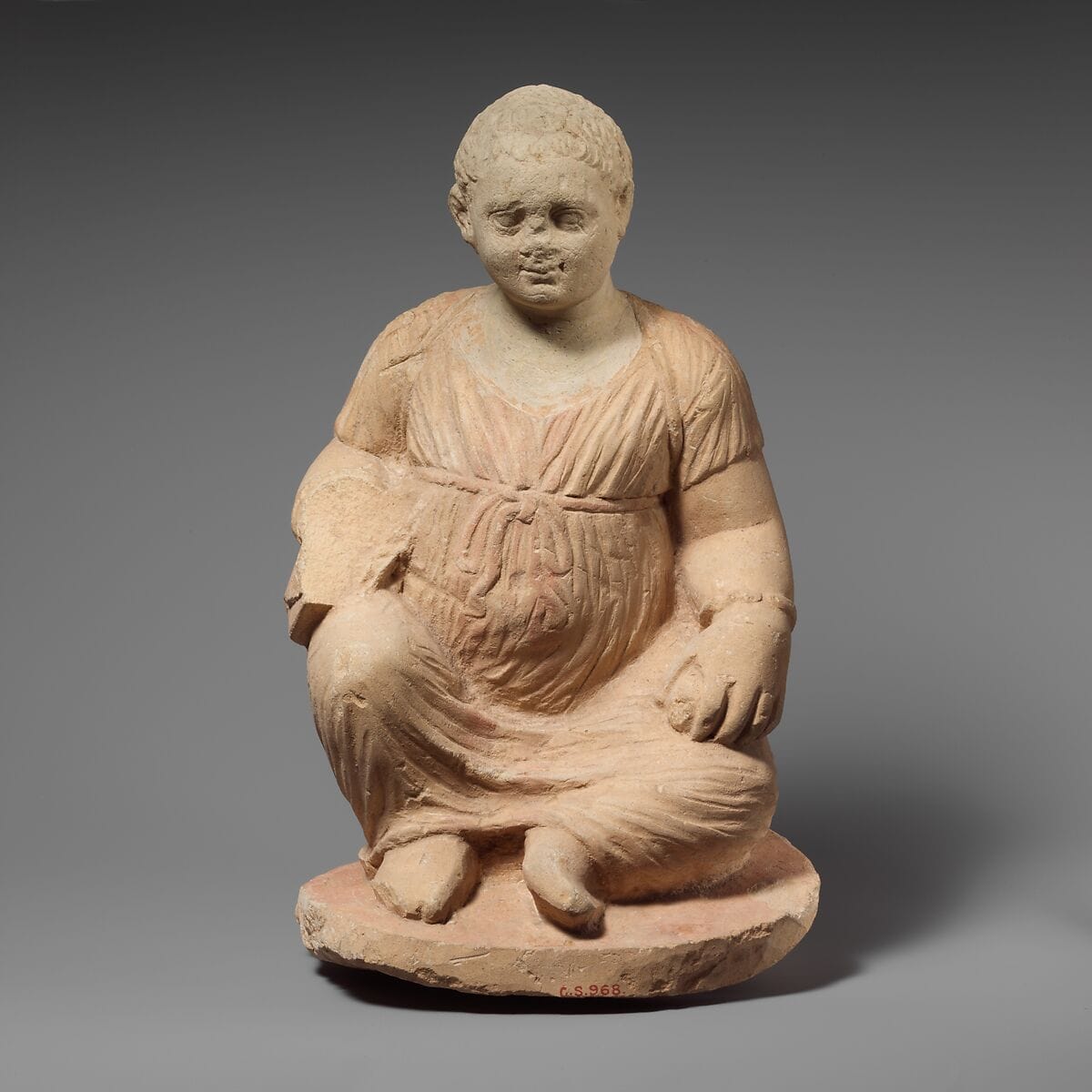
In December 1868 the British Museum wrote to Robert Hamilton Lang, a banker and sometime acting British consul in Cyprus, about a rumour that forgery of antiquities was increasing on the island. Lang thought the rumour had picked the wrong crime. "I think that forgery is scarcely the word," he replied. What people had heard about was "the getting up of certain pieces" by the American consul, Luigi Palma di Cesnola, who was "very clever in the re-arrangement of pieces" and carried it too far: "He adds a nose for example where it is wanted and so well that to an inexperienced eye the addition can scarcely be detected." In fairness, Lang added, "he only acts on really ancient pieces." [1]
The statuette at the top of this page shows what he meant. It is a Hellenistic limestone temple girl from Cesnola's collection, now in the Metropolitan Museum of Art, and the Met's own entry says her head "is that of a boy, does not belong and has been attached incorrectly to the body." Both parts are ancient. The figure as you see it was assembled in the nineteenth century.
Doubtful Cypriot pots and figures fall into four groups: a modern replica or souvenir, a genuine piece that has been restored or assembled, a modern forgery, or an ancient vessel made somewhere other than Cyprus. This guide explains how to tell them apart, what you can safely check at home, and what a laboratory test such as thermoluminescence can and cannot settle.
Is my Cypriot pot real, a replica or a fake?
Most likely it is either a modern replica that was sold honestly as one, or a genuine ancient piece that has been repaired, completed or "improved." Outright forgery exists, but it clusters in a few expensive classes, above all figural Red Polished ware and plank figures, and it is much rarer among ordinary jugs and bowls.
The best witness is Vassos Karageorghis, Director of the Department of Antiquities from 1963 to 1989. Asked in 1983 whether forgery was a problem in the Cypriot trade, he said: "No. Except for jewelry, fakes are virtually unknown." [2] By 1991, in The Coroplastic Art of Ancient Cyprus, he was naming fakes of Early Bronze Age figurines in print [3]. Both statements were fair to their moment: plain Bronze Age pots were plentiful and cheap, and the fakes he named were all of rare figural types.
Who made replicas of ancient Cypriot pottery?
Government craft workshops, private studios working with museums, museum shops and small town potteries, mostly for visitors. The Cyprus Handicraft Service's centre in Strovolos, Nicosia, was set up after 1974 to give work to craftspeople displaced by the invasion, and its shop sells ceramics and "ancient figures" beside embroidery and copperwork [4]. Studio Ceramics Workshops in Larnaca, founded in 1991 by Efthymios and Ingela Symeou, makes replicas "of the prehistoric and ancient world of Cyprus" and has worked with the Department of Antiquities, the Pierides Museum and the Leventis Municipal Museum [5]. Museum shops sell copies of the best-known pieces, among them the Vounous bowl, the Early Bronze Age clay model of a walled enclosure full of people and animals in the Cyprus Museum. A family "Vounous bowl" is almost certainly one of these copies.
When the ethnoarchaeologist Gloria London recorded Cypriot potting in 1986, the male potters worked "in or near urban centers," making wheel-thrown and press-moulded "glazed and plain wares for local use and for the tourist market" [6]. In the villages of Kornos and Foini, women still coiled red water jars and cooking pots by hand: folk pottery made for use, which nobody intended to pass off as ancient.
Do replicas carry a stamp or mark?
Often, though there is no single official mark to rely on. Look for a maker's signature or initials, a stamped workshop name, the word "Cyprus," "copy" or "replica," a shop label, or a felt pad glued under the base. Labels fall off, and after a house move or two the piece is simply "the old Cypriot jug."
A group sold by Leland Little Auctions in North Carolina on 15 June 2018 (lot 2465) shows how such pieces resurface: eight earthenware "Antique Cypriot Pottery Reproductions" with an "antiqued finish," two of them signed "Sofronia," from a private American collection that called itself "The Cyprus Museum" [7]. Only the word "Reproductions" told the truth. In any catalogue, "Cypriot style," "-type" and "in the manner of" mean the cataloguer declines to vouch for the age.
How can I tell a modern replica from an ancient Cypriot pot?
Look at how it was made and fired. Bronze Age Cypriot wares such as Red Polished, Base Ring and White Slip were built by hand and fired at low temperatures in open fires or simple kilns; most replicas are thrown on a wheel or cast in a mould and fired evenly in an electric or gas kiln.
| Feature | Ancient Cypriot (Bronze Age handmade wares) | Typical modern replica |
|---|---|---|
| Forming | Coil or slab built; walls vary in thickness; finger-smoothing and uneven joins inside closed shapes | Wheel-thrown or slip-cast: even walls, spiral throwing rings inside, a perfectly round rim |
| Base | Rounded, smoothed or roughly finished, worn at the points where it stood | String-cut flat base with swirl marks, neat trimmed foot ring, felt pad, signature or label residue |
| Firing | Low and uneven: mottled colour, fire clouds, often a grey core where a chip shows the break | Even kiln firing: one colour throughout, a hard body, often a clear ring when flicked |
| Surface | Red Polished: burnished slip with visible polishing facets. Base Ring: thin, hard, almost metallic fabric. White Slip: thick, chalky slip with dark painted "ladder" bands | Acrylic or unfired paint with brush ridges or sheen; stain, wax or shoe polish for "age"; glazed interiors |
| Incision and white fill | Cut into leather-hard clay before firing; soft-edged grooves; lime fill patchy and partly lost | Crisp, sharp-edged lines; bright, even white paste sitting on or over the edges |
| Weight | Fine handmade wares, Base Ring especially, are often thin and light for their size | Thick and heavy, or slip-cast and uniformly light |
| Deposits and wear | Burial crust lodged in crevices and incisions, root marks, wear where the pot stood and was handled | "Dirt" that washes off, crust spread evenly even across breaks, wear in odd places |
The wheel test only works for the Bronze Age. From the Cypro-Geometric period onward (after about 1050 BC) Cypriot potters threw most fine wares, including Bichrome, Black-on-Red and Iron Age White Painted, on the wheel, so throwing rings inside a Cypro-Geometric or Cypro-Archaic jug are expected. For the ware-by-ware features, see how to identify ancient Cypriot pottery.
What does a restored or "made-up" Cypriot piece look like?
A restored piece is a genuine ancient object with modern material added: glue, plaster, new paint, sometimes a part taken from another object. Museums restore openly; trouble starts when the work is hidden, or when the modern part outweighs the ancient one.
The habit is as old as Cypriot collecting. The Met's catalogue of Cesnola's stone sculpture says that he and his assistants "did not hesitate to put heads and limbs on bodies to which they did not belong," rebuilt statues from fragments that did not belong together, and occasionally added modern parts, "thus creating real fakes" [8]. The New York dealer Gaston Feuardent made much the same charge in 1880; Cesnola won the libel trial that followed in 1884, but today's catalogue bears Feuardent out on the facts.
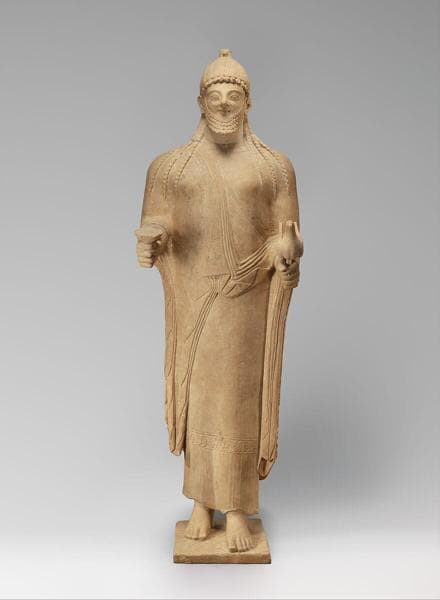
The limestone priest from Golgoi, over two metres tall, has a modern base and feet, and the bird in his hand "is heavily restored and probably does not belong to the sculpture."
Painted pottery received the same treatment. In 1885 Georges Perrot published a painted vase from Ormidhia, by then in New York, as "one of the most precious relics of Cypriote art," working from a drawing by the artist E. Wallet. In 1954 John Myres showed that the figure scene Perrot admired had been painted on in modern times, modelled on the surviving scene on the other side, and later cleaned off again. Repainting of that kind, Myres wrote, was "not so heinous an offence in Cesnola's generation as in our own" [9].
The twentieth-century trade had its own repertoire. In The Art of Ancient Cyprus (1985) the zoologist and collector Desmond Morris, drawing on his conservator Kathleen Kimber, listed three "tricks of the trade": smearing a false encrustation over fractures so that a pot looked as if it would clean up whole; leaving one small flaw on show to draw the eye from a large one hidden elsewhere; and assembling "hybrid" objects from parts of different originals, with the join concealed under artificial crust [10]. The usual hybrid is the neck of one vessel married to the body of another. His "Oxford Bowl" carried a darker crust that was "ancient and genuine" and a whitish one applied "to cover over a number of cracks and breaks," which he called "a well-known 'dealers' trick'" [10]. Two crusts of different colour, one of which fills or stops at a crack, is the pattern to look for.
In the hand, restoration shows as a line of slightly different colour or sheen, paint that runs unbroken across a break (ancient paint broke with the clay), plaster visible inside the vessel, or one zone, such as a neck or a figure panel, fresher than the rest. Under a longwave ultraviolet torch (365 nm), modern adhesives, fills and overpaint usually glow differently from fired clay, though some modern materials are chosen to match, so UV screens and never proves. Leave solvents and scrapers to conservators: a swab can lift genuine unfired pigment from a terracotta, and the restoration may be what holds the pot together.
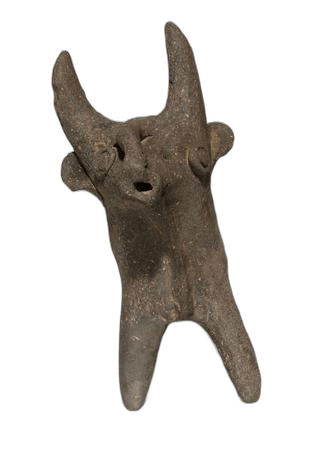
The British Museum's Base Ring bull rhyton from its Turner Bequest excavations at Episkopi-Bamboula has a restored front right leg, and the museum's record says so. That is restoration done properly: recorded and in proportion. A pot with one glued handle and a pot that is half plaster are different objects with different values; what is my Cypriot antiquity worth? explains how condition and restoration move price.
Which Cypriot antiquities are most often faked?
Early Bronze Age figural Red Polished pieces and plank figures carry the highest risk. Stone figures are harder to settle because no laboratory can date them. Ordinary pots are rarely faked from scratch.
Writing on Red Polished plank-shaped figurines in 1991, Karageorghis identified a figurine that had appeared in New York in 1989 (catalogued by Demirjian as no. 57) as a fake, probably by the same person who had incised two plank figures on a Red Polished bowl (no. 56 in the same catalogue). He pointed to another fake "possibly by the same 'artist'" sold as lot 191 at Christie's on 12 December 1989 [3]. Decoration added to a plain ancient pot is hard to catch, because the clay itself passes a laboratory test. Publication and a sale through a well-known house authenticate nothing; doubt belongs first with a unique, unparalleled figural Red Polished piece that has no recorded history. See the documented plank figures and Red Polished zoomorphic vessels for comparison.
Cypriot types have also been copied in the wrong material. Oscar White Muscarella records three stone "idols" with beaked heads, copied from a Base Ring clay figure type "usually associated with Cyprus"; Henri Seyrig reported that one was "made in a forger's shop in Beirut" and that he had watched another being made [11]. For Chalcolithic cruciform figurines in picrolite and for stone plank figures, authentication rests on an expert's examination and the object's documented history.
With figurines in clay or stone the commoner problem is assembly: the Met's catalogue records Cesnola statuettes that received heads "whose pertinence is erroneous or doubtful," some removed only recently [8]. Ask of any figure whether the head belongs to the body and whether the paint has been refreshed. Value can be added with a few letters, too: a Cesnola object published in the 2021 Turin exhibition catalogue carries a Cypro-syllabic inscription that scholars unanimously regard as modern, copied from drawings printed in 1873 and 1874 [1].
Base Ring bulls are a useful contrast. Genuine examples are common and modestly priced (a Base Ring bull askos sold at Bonhams in London on 22 October 2013 for £625 including premium [12]), so faking them pays poorly; the usual issues are restored legs, horns and spouts, as on the British Museum bull above. Selling fakes is a police matter in Cyprus too: "Man remanded for selling fake antiquities" ran a Cyprus Mail headline on 6 October 2018 [13].
Can a pot be ancient but not Cypriot?
Yes. Potters in Canaan, Syria and Egypt copied Cypriot wares in the Late Bronze Age, and such a copy is genuinely around 3,300 years old and will pass a thermoluminescence test.
Local imitations of Base Ring jugs are widespread in Canaan, especially in the 13th century BC, and turn up in tombs beside genuine Cypriot imports [14]. Sarah Vilain's 2022 survey lists at least ten wheel-made, red-burnished juglets in Base Ring shape at Tell Kazel in Syria, standing beside Cypriot imports, and a Base Ring-type juglet from Tell Shamiyeh whose clay is "clearly non-Cypriot"; even there, she notes, "without petrographic analysis, it cannot be determined whether it was locally made" [15]. In Egypt during the 18th Dynasty potters made faithful copies of Cypriot juglets in Nile silt and marl clay, and stone carvers made Base Ring jugs in Egyptian alabaster and serpentine: one from the tomb of three foreign wives of Thutmose III still held hardened ointment [15]. In 1968 Robert Merrillees warned that one type listed as Cypriot White Slip I was in "form, style of decoration and fabric" Egyptian [16]. Traffic ran the other way too: Cypriot potters made their own versions of Mycenaean pottery.
An "imitation Base Ring" juglet is a real ancient object in its own right, and only fabric analysis and an expert eye separate it from a Cypriot one. Its legal history belongs to the country it came from; what to do with inherited antiquities covers non-Cypriot pieces.
What does a thermoluminescence (TL) test prove?
TL tells you roughly when the clay was last heated to several hundred degrees, which is enough to separate an ancient pot from a wholly modern one. It cannot tell you whether the pot is Cypriot, whether its decoration is original, or whether every part belongs.
Fired clay stores energy from natural radiation, and heating releases it as light that a laboratory can measure; our guide to thermoluminescence dating explains the physics. An accredited sampler drills a few tiny holes in unglazed, out-of-sight places (inside a foot ring, under a rim), and the certificate states that the sample is "consistent with" an age range several centuries wide. The method has a strong record against wholesale forgery: when Oxford tested pots and figurines in the Hacılar style of prehistoric Turkey, bought by museums and collectors, 48 of 66 pots proved modern [17].
What a TL pass cannot do:
- Detect added decoration. Incision, paint, white fill or an inscription added to a plain ancient pot passes, as in Karageorghis's incised Red Polished bowl.
- See a composite, unless the sampler drills each part. A genuine body with a modern neck or head passes if only the body is sampled; ask for every component to be tested.
- Say "Cypriot." An Egyptian or Canaanite copy fires as ancient.
- Date stone or metal. Limestone heads, picrolite figures and stone plank figures cannot be TL tested.
- Survive reheating. A pot caught in a house fire or refired in a kiln has its clock reset.
- Rule out deliberate irradiation, which forgers have used to give a modern pot an ancient signal; good laboratories test for it.
- Supply a history of where a pot was found or how it left Cyprus. For that, see export licences, seals and labels and brought home from Cyprus.
As of 2026, Oxford Authentication, to take one laboratory as an example, charges from about £200 plus VAT per pottery object in the UK, sampling included, and more in Europe and the United States, where the sampling agent's fee is extra [18]. A laboratory owned by a business that sells the objects it tests cannot give an independent opinion. A test earns its cost when a ceramic of some value, such as a figural Red Polished piece or a large painted amphora, might be wholly modern; for an obviously wheel-thrown souvenir, keep the money.
What other tests are there?
Petrography, a thin slice of the pot under a polarising microscope, identifies the mineral grains in the clay and so its source; it is the test Vilain says the Tell Shamiyeh juglet still needs, and it destroys a small sample. Chemical analysis (XRF, PIXE, neutron activation) compares clay or pigment with reference groups. X-radiography and CT scans show internal joins, fills and pins, and whether a vessel was coiled or thrown, without drilling.
What can I check at home?
You can rule out most souvenirs and spot most old restorations with a torch, a magnifier and good light. Do not wash, scrape, soak or apply solvent to anything: crusts are evidence, and some genuine surfaces come off with water.
- Look underneath for a signature, initials, "Cyprus," "copy" or "replica," a workshop stamp, glue or felt residue, or a price label in Cyprus pounds. A string-cut swirl on a flat base means wheel-made: normal for Iron Age wares, a warning on Red Polished, Base Ring or White Slip.
- Look inside with a torch. Throwing rings spiralling up the inside of a "Red Polished" or "Base Ring" jug mean modern; finger-smoothing and uneven coils fit handmade.
- Check incision and white fill with a magnifier: soft edges and fill sitting in the groove, or crisp edges and paste on top?
- Check colour at any chip. One even colour throughout with no mottling suggests a modern kiln; ancient open-fired wares are often mottled, with grey cores.
- Check joins and paint in raking light: lines, colour shifts, paint crossing breaks, one zone fresher than the rest.
- Check the crust. One deposit with one history, or two different deposits, one of them covering a crack?
- Use a 365 nm UV torch in a dark room. Patches that glow differently usually mean repair or overpaint.
- Weigh it in your hand: a small "Base Ring" juglet that is thick and heavy for its size is suspect.
- Find the paper. A shop receipt, a Handicraft Service bag or a museum-shop box settles "replica" at once; an old export licence, a lead seal or a dealer's label points the other way.
- Photograph the base, the inside and any repairs, in normal and UV light, and send us photos.
This is general information about objects and testing, not legal advice.
Home checks reliably catch tourist replicas and heavy old restoration. They cannot exclude a skilled forgery, a genuine pot with added decoration, a well-made composite or an ancient copy made in Canaan or Egypt. For those the route is a specialist's examination in the hand; then, for pottery, TL with each component sampled, and petrography if the question is Cypriot or Levantine. For stone there is no laboratory shortcut, and a limestone head is still judged by eye, tool marks and documented history, much as Lang judged Cesnola's noses in 1868.
References
- 1.Letter of R. H. Lang to the British Museum, 22 December 1868 (Greek and Roman Department, Original Letters 1861-1868, no. 411), quoted in L. Bombardieri and E. Panero (eds), Cyprus: Crossroads of Civilizations. Exhibition catalogue, Musei Reali, Turin (2021), p. 44; on the forged syllabic inscription, p. 273.
- 2.Interview with Dr. Vassos Karageorghis, Director of the Department of Antiquities of Cyprus. (1983). Journal of Field Archaeology, 10, p. 17.
- 3.Karageorghis, V. (1991). The Coroplastic Art of Ancient Cyprus I: Chalcolithic to Late Cypriote I (p. 98). A. G. Leventis Foundation.
- 4.Homo Faber (2022). Visit the Cyprus Handicraft Center. 2022.homofaber.com; Deputy Ministry of Tourism, Cyprus Handicraft Centre, visitcyprus.com (accessed October 2026).
- 5.The Cyprus Institute, Face2Face project consortium: Studio Ceramics Workshops, Larnaca. face2face.cyi.ac.cy (accessed October 2026).
- 6.London, G. (1991). Ethnoarchaeological evidence of variation in Cypriot ceramics and its implications for the taxonomy of ancient pottery. In J. A. Barlow, D. L. Bolger and B. Kling (Eds.), Cypriot Ceramics: Reading the Prehistoric Record (University Museum Monograph 74). The University Museum, University of Pennsylvania.
- 7.Leland Little Auctions, Hillsborough, NC, 15 June 2018, lot 2465, 'Group of Antique Cypriot Pottery Reproductions'.
- 8.Hermary, A., & Mertens, J. R. (2014). The Cesnola Collection of Cypriot Art: Stone Sculpture (p. 21). The Metropolitan Museum of Art.
- 9.Myres, J. L. (1954). A Painted Graeco-Phoenician Vase from Ormidhia in Cyprus. American Journal of Archaeology, 58(1), 39-44.
- 10.Morris, D. (1985). The Art of Ancient Cyprus (pp. 273, 368). Phaidon.
- 11.Muscarella, O. W. (2000). The Lie Became Great: The Forgery of Ancient Near Eastern Cultures (p. 212). Styx.
- 12.Bonhams, Knightsbridge, Antiquities, 22 October 2013, lot 137 (Base Ring bull askos).
- 13.Cyprus Mail, 'Man remanded for selling fake antiquities', 6 October 2018.
- 14.Killebrew, A. E. (2005). Biblical Peoples and Ethnicity: An Archaeological Study of Egyptians, Canaanites, Philistines, and Early Israel, 1300-1100 B.C.E. (p. 167 n. 70). Society of Biblical Literature.
- 15.Vilain, S. (2022). Towards a reassessment of Levantine and Egyptian jugs and juglets related to Cypriot Base Ring Ware. In G. Bourogiannis (Ed.), Beyond Cyprus: Investigating Cypriot Connectivity in the Mediterranean from the Late Bronze Age to the End of the Classical Period (AURA Supplement 9, pp. 141-152).
- 16.Merrillees, R. S. (1968). The Cypriote Bronze Age Pottery Found in Egypt (Studies in Mediterranean Archaeology 18, p. 14). Lund.
- 17.Aitken, M. J., Moorey, P. R. S., & Ucko, P. J. (1971). The Authenticity of Vessels and Figurines in the Hacilar Style. Archaeometry, 13(2), 89-141.
- 18.Oxford Authentication, TL testing prices, oxfordauthentication.com/tl-testing-prices (accessed October 2026).