
Contents
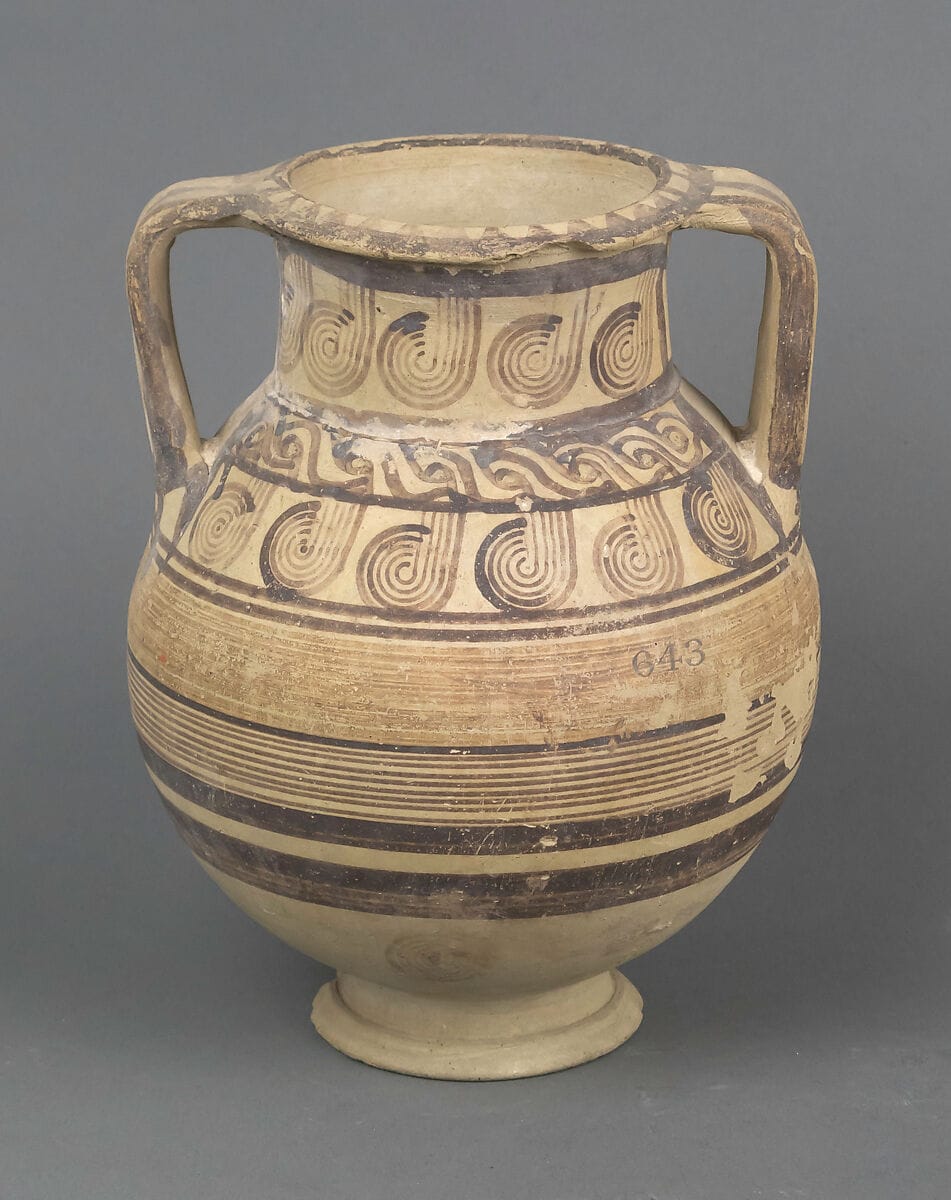
Two band ornaments that look alike at a distance share this page. The first is the running spiral: a row of coils, each joined to the next by a curving stem, which Cypriot potters took from Mycenaean pottery in the Late Bronze Age. The second is the guilloche, a band of two or more lines twisted round one another like a plait or a cable, which returned to Cypriot pottery in the Cypro-Archaic period from the Near East [1, p. 182]. The two have different homes, different dates and different meanings for the people who used them, and the catalogue term guilloche and spiral groups them only because a running spiral and a cable band can be hard to tell apart in a short museum description. You can see all guilloche and spiral objects in the catalogue. The site's own collection holds a good example of each: a small Cypriot three-handled jar with running spirals and a large Bichrome IV amphora with a cable band under its lotus frieze.
Telling them apart
A running spiral is built from separate coils. Each coil is drawn as a spiral or as two or three concentric turns, and a single stem leaves one coil and enters the next, so the band reads as a chain of discs linked by S-curves [2, pp. 61, 164]. A guilloche has no discs. Its lines cross and recross, leaving a row of small eyes (often filled with a dot) between the crossings, and it can run horizontally round a pot or stand upright in a panel [1, p. 182]. A third thing, the spiral as an object, also turns up under this catalogue heading: Bronze Age gold wire coiled into small ornaments, spirals in shape that were never painted motifs.
| Form | What it looks like | Main period in Cyprus | Where it came from |
|---|---|---|---|
| Running spiral | Coils joined by curving stems in a continuous band | Late Bronze Age | Mycenaean and Minoan pottery |
| Reversed running spiral | As above, stems leaving the top of each coil | Late Bronze Age | Local Cypriot variant |
| Spiral tree | Vertical lines with two or three spirals on each side | Late Bronze Age, echoed later | Local Cypriot motif |
| Guilloche (cable band) | Interlaced lines with eyes between the crossings | Cypro-Archaic I | Syria and the Near East |
| Wire spiral | Gold wire coiled into turns | Late Bronze Age | Small personal ornaments |
The running spiral in the Late Bronze Age
The running spiral reached Cyprus on imported Mycenaean pots. Frank Stubbings, cataloguing the Mycenaean pottery of the Levant in 1951, described a deep bowl from the British Museum's Tomb 69 at Enkomi as "decorated with a running spiral" and found it "fairly close to one from Prosymna" in the Argolid [3, pp. 47, 50]. He noted that on Rhodes linked spirals of the Greek kind were "usually confined to shallow one-handled cups", and that the running spiral on some of the cups he grouped as types 218 and 219 "is little removed from Myc. II examples except in the disuse of added white paint" [3, pp. 49–50]. Hooked spirals on a pyxis from Enkomi Tomb 3 belong to a related family, discussed under wavy hooks.
The Ashmolean Museum's piriform jar AN1896-1908.AE.295 from Mycenae, dated LH IIIA2 (c. 1375–1300 BC) and 35 cm high, shows the Aegean model, a jar of the same family painted with running spirals. Jars of this family were among the imports that Cypriot workshops set out to copy (see Mycenaean imports and local imitations and the Mycenaean culture entry).
Giampaolo Graziadio's 2017 study of the earliest Aegean-type pottery made in Cyprus treats the running spiral as one of the main motifs of the local three-handled jars. His Decorative Scheme 1 combines running spirals (Furumark's motif 46) with a dotted line (motif 41) and "iris buds" as fillers; since running spirals linked to iris buds occur in Crete, he allows that "a Minoan influence" is possible [2, p. 61]. A jar from Klavdhia, found in 1899 and now in the Cyprus Museum (A 1676, his cat. 42), hybridises the running spiral with a stemmed spiral, which he reads as "indicative of a local style"; its trefoil rock-work fillers find parallels on Aegean running spirals of LH IIIA2 [2, p. 61]. A jar from Kourion Tomb 55 (cat. 44) carries instead "a much abbreviated Palace Style composition" [2, pp. 61, 165]. The curve-stemmed spiral (Furumark motif 49) is rarer on the island in its Aegean form: Graziadio counts only two imported piriform jars of shape FS 44 with it, while a three-handled jar from Dhekelia Steno (cat. 39) carries a version of the same motif [2, p. 62].
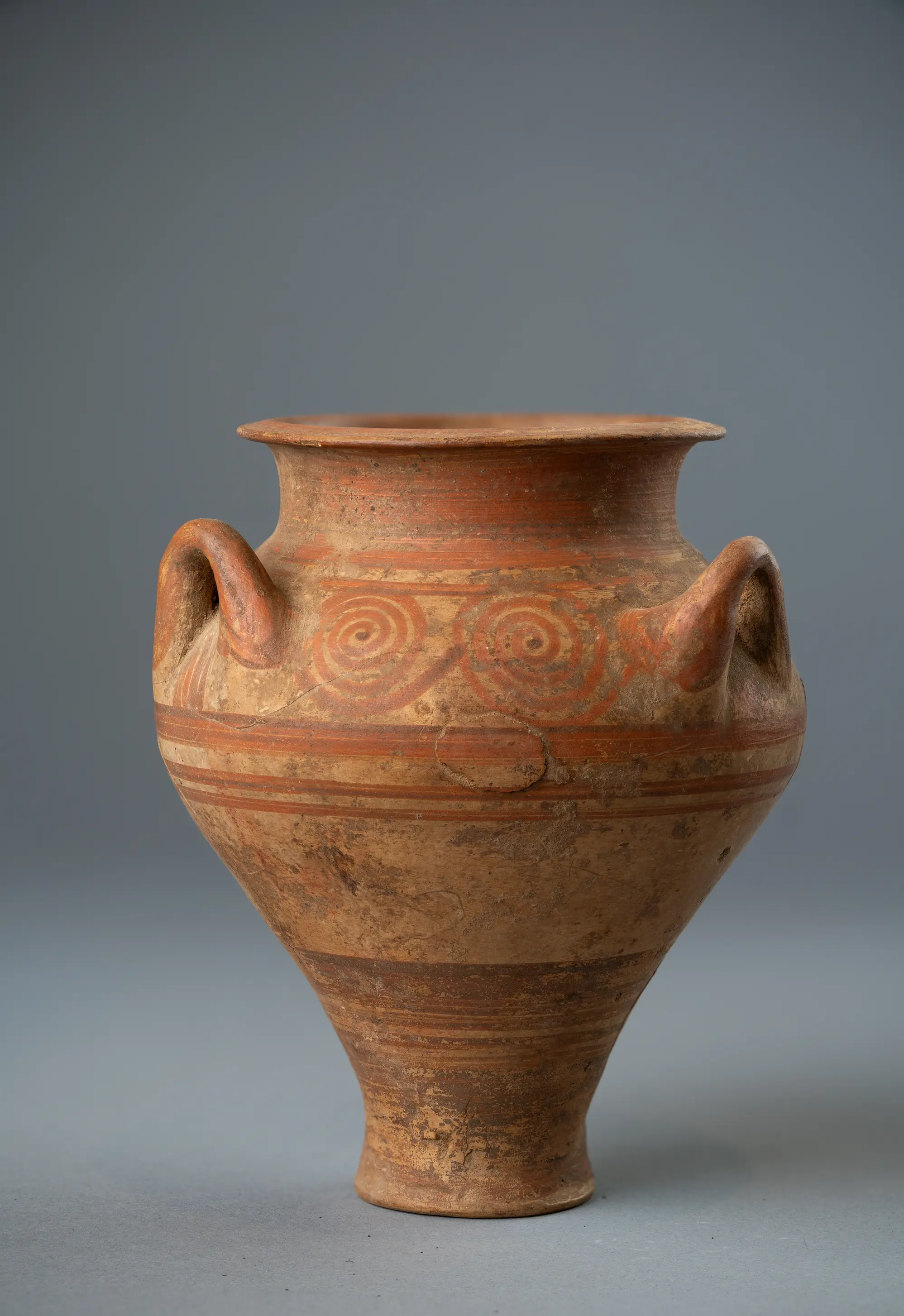
The Cypriot three-handled jar with running spirals in the Drakopoulos Collection is a small example of the class, dated Late Cypriot IIA–IIB (c. 1375–1300 BC). A frieze of linked spirals, each coil drawn in two or three concentric turns, runs between the handles above groups of bands. The paint is matt, not the lustrous paint of the imports, and much of the frieze on one side has flaked away, so whether the coils are linked in the Cypriot reversed manner cannot be settled from the surviving surface.
Cypriot spirals: reversed stems and the spiral tree
Graziadio picks out several habits that separate the Cypriot painters from their Aegean models. Their running spirals are often "of a reversed type", with the stems descending from the top of each coil; a smaller spiral sometimes interrupts the row; and a wavy line may run underneath [2, p. 164]. The reversed curve-stemmed spiral (motif 49, versions 22–23 in Furumark's scheme) is the main motif on many of the jars of his Shapes 46 and 47, and he counts it among the distinctive Cypriot traits of the production [2, p. 164].
The clearest local invention is what he calls the "spiral tree": two vertical lines with two or three spirals springing from each side. Graziadio calls it "a real Cypriot motif" and follows its echoes into the later Pastoral or Rude Style kraters and into Cypriot glyptic, while allowing that Mycenaean floral designs may lie behind it [2, p. 164]. Double and triple diverging stemmed spirals on other jars may be simplified versions of the Mycenaean papyrus or of the "Myc. III flower" (motif 18), or simplified spiral trees; the double diverging spirals of his Scheme 4:A "were maintained in the repertoire" of White Painted Wheelmade III [2, p. 165].
Furumark's numbers and their critics
Nearly every publication of Late Bronze Age spirals uses the motif numbers that Arne Furumark set out in 1941: FM 46 for the running spiral, FM 49 for the curve-stemmed spiral, FM 51 for the stemmed spiral [2, pp. 61–62]. Graziadio notes that Furumark distinguished 28 versions of FM 49 alone, grouped as a normal type (versions 1–21), a reversed type (22–23) and others, and that the normal type was very common in LH IIIA1, including on piriform jars and on the shallow cups (FS 220) found in Cyprus [2, p. 62].
The numbers have critics. A contributor to the 2011 volume of papers for Jeremy Rutter points out that FM 46 includes so-called "pictorializations", which Furumark saw as assimilated to the Myc. III flower, and "curtailed forms" that have "no trace of any spiral whatsoever" [4, p. 290]. They sit under the running spiral only because Furumark believed they had developed from it, an evolutionist assumption the author finds odd to apply to pots made by human potters [4, p. 290]. For Cypriot material the warning is practical: an FM 46 label on a sherd says what Furumark thought the design descended from, and a description of the actual drawing is still needed.
The guilloche in Cypro-Archaic pottery
Einar Gjerstad, publishing the Swedish Cyprus Expedition's Iron Age pottery in 1948, listed the guilloche with the rosette, the open palmette, the sacred tree, the lotus, sphinxes and hunting and chariot scenes as ornaments of Cypro-Archaic I pottery "of Oriental derivation" [1, p. 182]. "The home of the guilloche-pattern is the Near East", he wrote, from where it reached Egypt in the Middle Kingdom and the Aegean in Late Mycenaean times; in Late Cypriot Cyprus it also appears on metalwork [1, p. 182]. It is absent from Protogeometric and Geometric Greece, and in Cyprus "this ornament disappears in the Early Iron Age", so its return in Cypro-Archaic I needed explaining [1, p. 182].
Gjerstad's answer had two parts. The guilloche is used on Cypriot pottery "either horizontally as an encircling band or vertically often combined with rosettes in a metope decoration" [1, p. 182]. The horizontal band is common on Phoenician metal bowls; the vertical use is characteristic of Syrian art and already appears on Syrian cylinder seals of the second millennium, so "Syria is thus indicated as the land whence the Cypriotes received the guilloche pattern" [1, p. 183]. He also judged it "partly of textile derivation", because the guilloche and the rosette form a single decorative unit and ornaments of the same kind are painted on the dress of terracotta figures [1, pp. 182–183]. The two explanations are compatible: a Syrian ornament could reach Cypriot potters through cloth as easily as through bowls. Gjerstad's link with painted dress is followed further under lattice and checkerboards.
On the pots, the guilloche is mostly a border. A Bichrome IV jar of the seventh century BC in the Pierides Foundation Museum, Larnaca, 15.5 cm high, has hatched meanders between the handles with "a horizontal frieze of guilloche pattern" above and below, and a stylised lotus under each handle [5, p. 145]. The British Museum's Bichrome amphora 1982,0729.279 from Gastria, 52 cm high and dated 750–475 BC, combines lotus flowers on the shoulder with guilloche and rosettes on the neck, the metope pairing Gjerstad described.
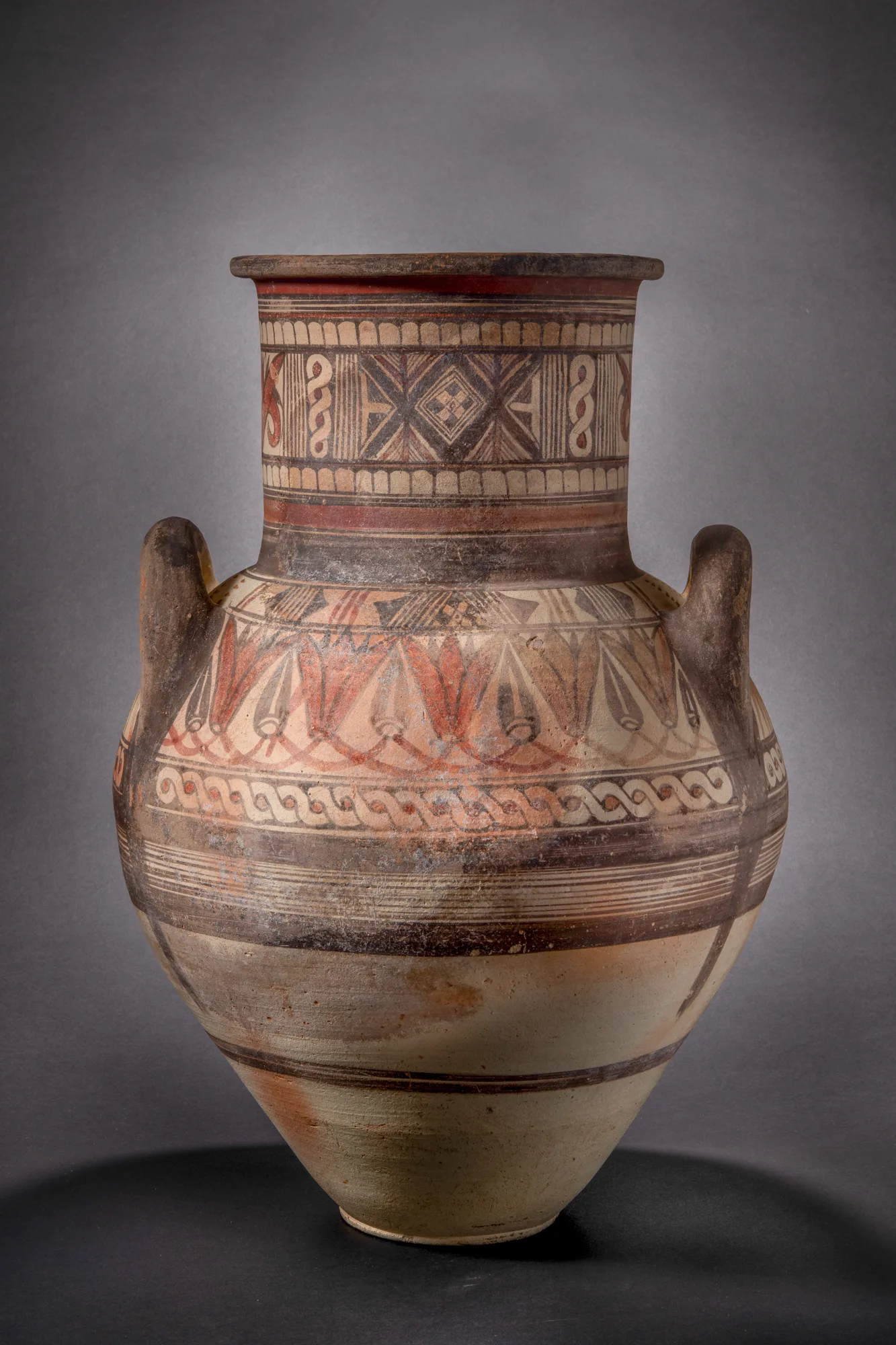
The Drakopoulos Bichrome IV amphora with a lotus-and-bud shoulder frieze, of Cypro-Archaic I and probably the seventh century BC, uses the guilloche in the same subordinate way. Below the hanging chain of lotus flowers and buds comes a narrow cable band, then close-set fine lines between broad bands; its neck panels are flanked by columns of running S-spirals. A Cesnola amphora in the Metropolitan Museum, 74.51.981, 51.3 cm high, has the same pairing of lotus flowers and buds with a cable pattern on the neck. Two Met dinoi carry the band on a different shape: 74.51.444, Cypro-Archaic I, with bands, guilloche and a zone of rosettes and triangles, and 74.51.699, Cypro-Archaic II, with guilloche and two zones of curl ornament. The Cypro-Archaic guilloche belongs with the lotus flowers and sphinxes of Gjerstad's Oriental repertoire, and it is usually seen next to them.
Guilloche on metal bowls
Gjerstad's point that the horizontal guilloche is at home on Phoenician metal bowls can be seen on a chased bronze bowl of the Cypro-Archaic period in the Metropolitan Museum (74.51.5616), 30.8 cm across. Its slightly recessed central tondo holds a rosette framed by a guilloche, on which four wild goats stand before a stylised stand of papyrus; the Met groups it with chased bowls in which Egyptianising motifs are especially evident. Here the guilloche is a ground line as well as a frame, the role it plays on the pottery metopes in a simpler form. A two-handled red-slipped skyphos in the same collection, catalogued as Geometric (74.51.591), carries "degenerate meander and guilloche patterns", a reminder that museum dates for individual pieces do not always sit neatly with Gjerstad's account of an Early Iron Age gap.
Spirals that are not painted
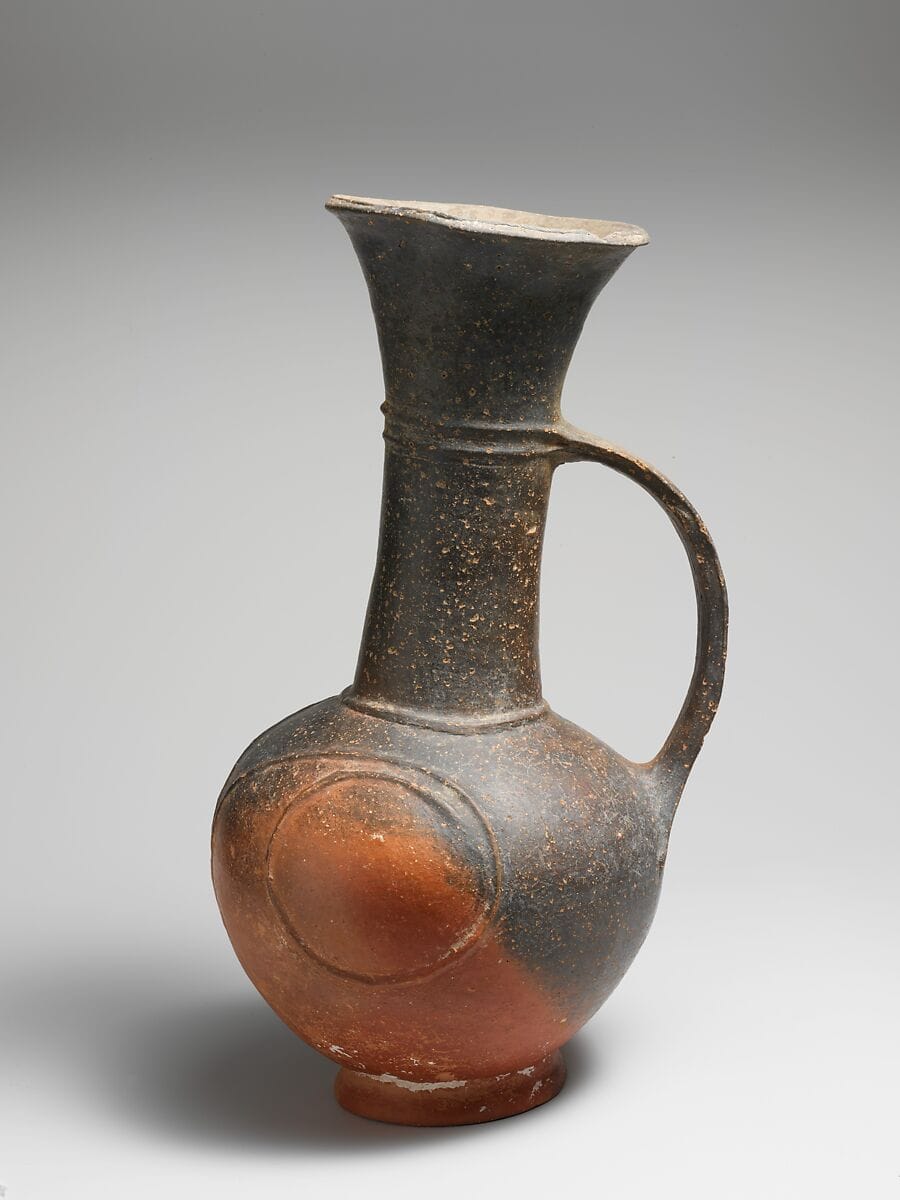
Two further groups appear under the catalogue term. The first is relief: a Late Cypriot I jug in the Met (74.51.1090), with a funnel-shaped mouth, has spiral bands modelled in relief on the body. The second is jewellery. The Met's Cesnola Collection includes several small gold spirals of the Late Bronze Age (c. 1600–1100 BC), made of plain wire coiled in turns; the gold spiral 74.51.3072 has two turns and is 2.5 cm long. They are small ornaments, possibly earrings, and have nothing to do with painted decoration, but museum records that use the word "spiral" place them beside the pots.
The Early Bronze Age Red Polished jug in the Drakopoulos Collection with concentric circles and chevrons is sometimes grouped with spiral-decorated pieces. Its incised ornament is made of concentric circles, and it is treated under circles.
Dating and use
As a working guide: a band of linked coils on a wheel-made Aegean-type jar points to the fourteenth and thirteenth centuries BC, with reversed stems and spiral trees marking Cypriot work; a true interlaced guilloche on Bichrome or Bichrome Red pottery points to Cypro-Archaic I, roughly 750–600 BC, and occasionally later, as on the Met dinos of Cypro-Archaic II. The spiral survived the end of the Bronze Age in the island's own wheel-made wares, while the guilloche, on Gjerstad's account, disappeared and came back with the Oriental ornament of the Archaic period [1, p. 182; 2, p. 165]. For the wider setting, see Bichrome ware, amphorae, jars and the article on the Cypro-Mycenaean jar.
Objects on this page
- Cypriot Three-Handled Jar in the Mycenaean Style with Running SpiralsLate Bronze Age II · 1375–1300 BC
- Bichrome IV Amphora with a Lotus-and-Bud Shoulder FriezeArchaic I · 750–600 BC
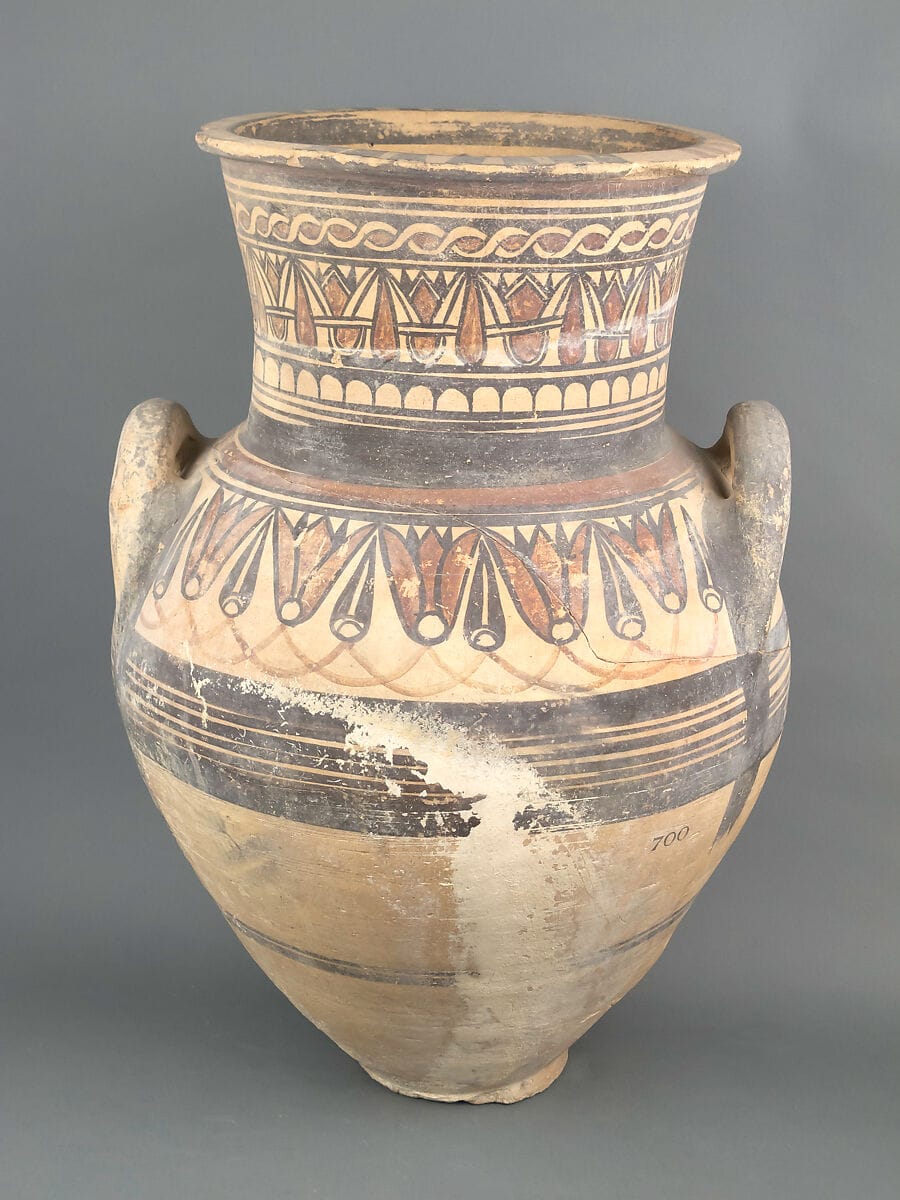 AmphoraArchaic I · 750–600 BC
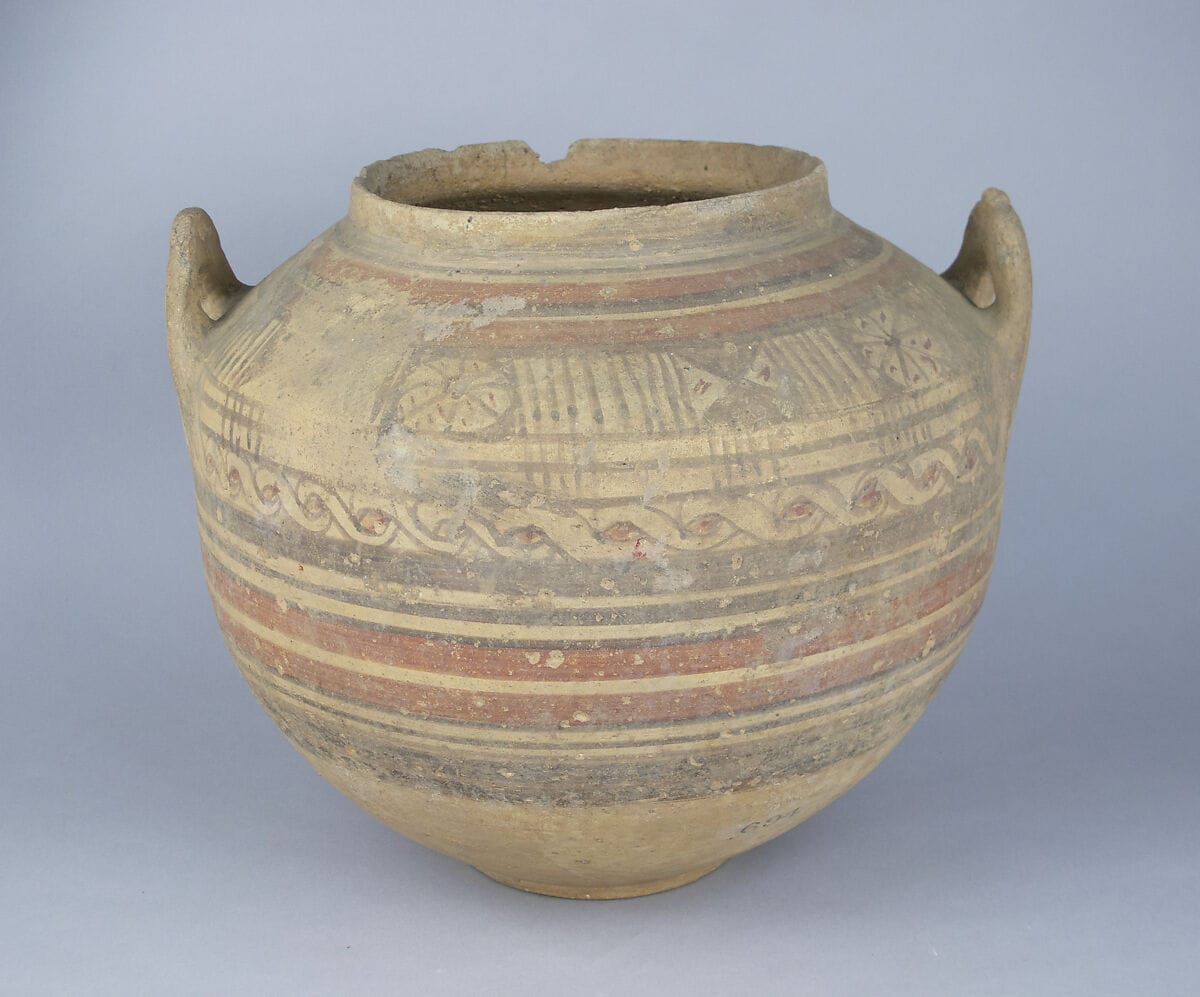 DinosArchaic I · 750–600 BC
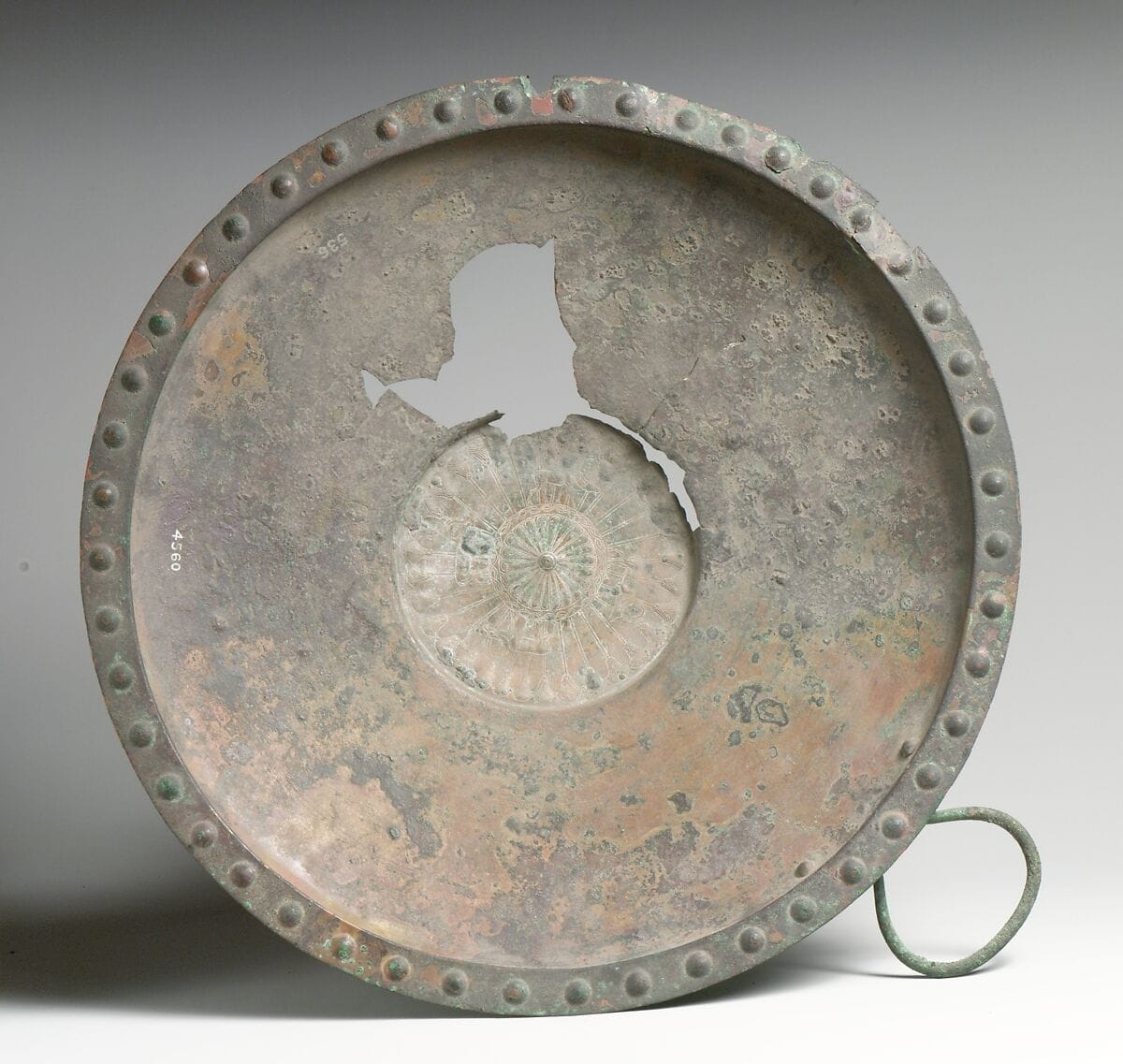 Bronze bowlArchaic I · 699–600 BC
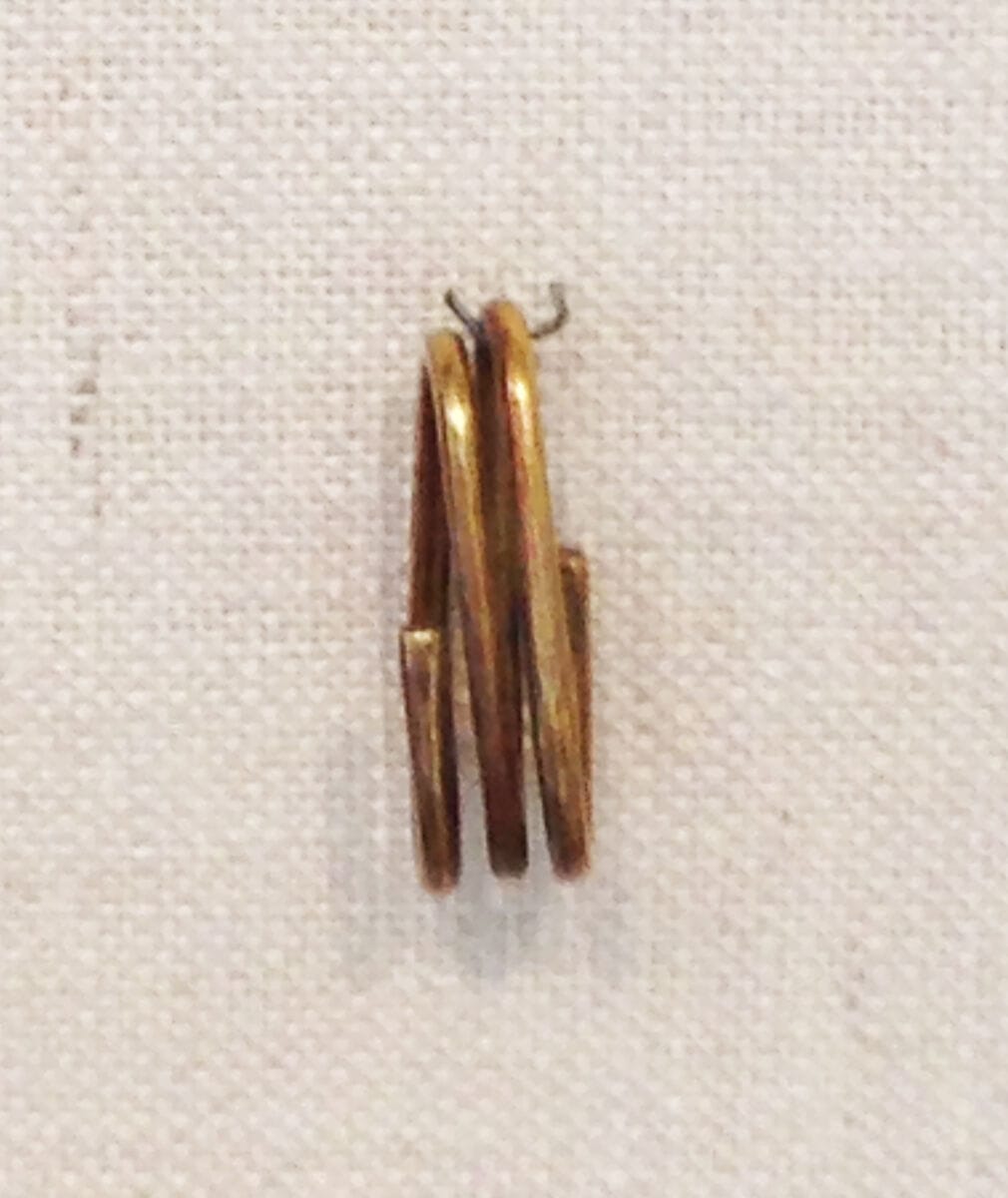 Gold spiralLate Bronze Age II · 1600–1100 BC
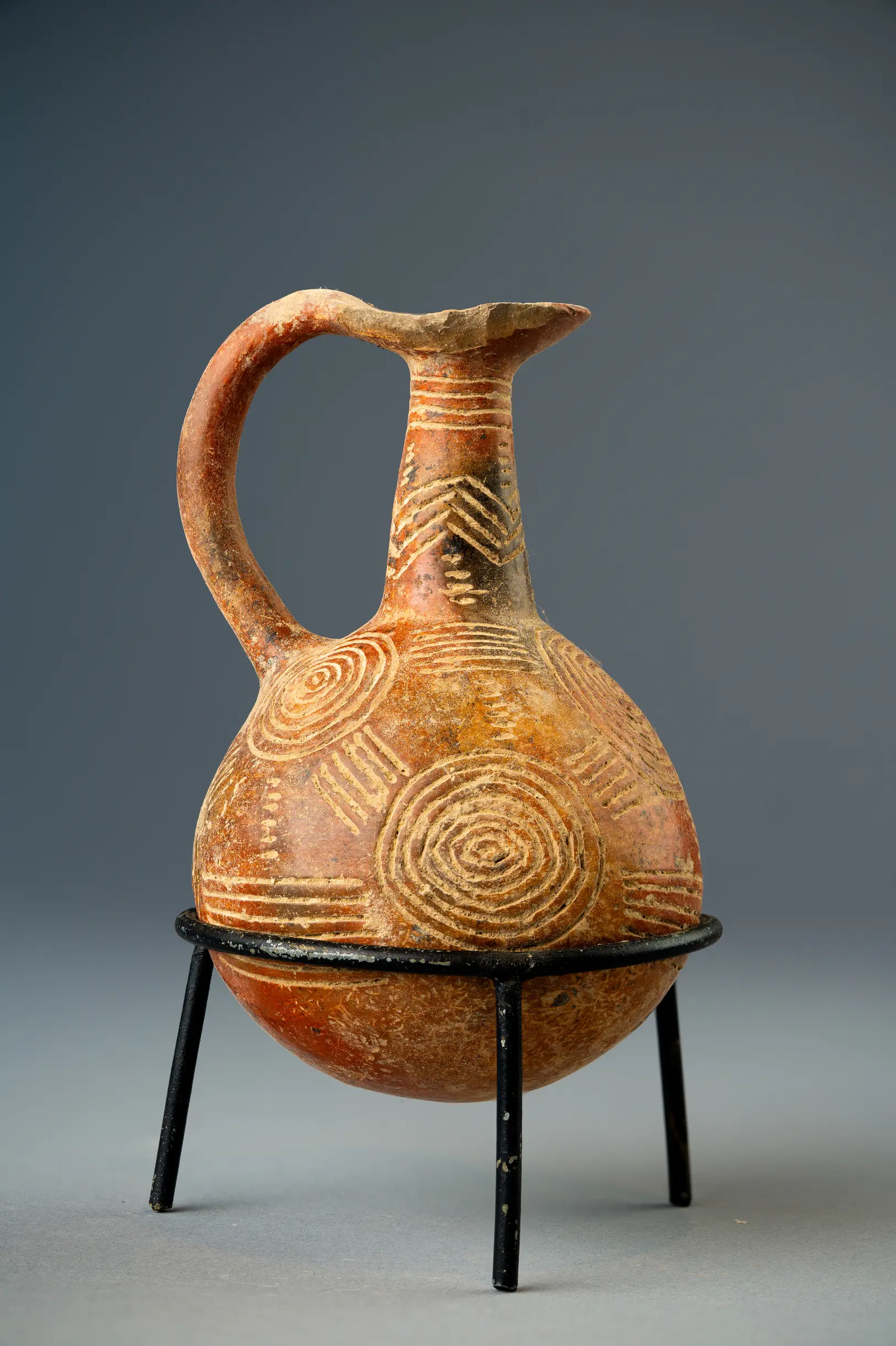 Red Polished Beak-Mouthed Jug with Concentric Circles and ChevronsEarly Bronze Age III · 2100–1850 BC
In the catalogue
References
- 1.Gjerstad, E. (1948). The Swedish Cyprus Expedition, Vol. IV, Part 2: The Cypro-Geometric, Cypro-Archaic and Cypro-Classical periods. Stockholm: The Swedish Cyprus Expedition.
- 2.Graziadio, G., with Pezzi, E., Dikomitou-Eliadou, M., & Georgiou, A. (2017). The earliest production of Aegean-type pottery in Cyprus. Pisa: Pisa University Press.
- 3.Stubbings, F. H. (1951). Mycenaean pottery from the Levant. Cambridge University Press.
- 4.Gauß, W., Lindblom, M., Smith, R. A. K., & Wright, J. C. (Eds.). (2011). Our cups are full: Pottery and society in the Aegean Bronze Age. Papers presented to Jeremy B. Rutter on the occasion of his 65th birthday (BAR International Series 2227). Oxford: Archaeopress.
- 5.Karageorghis, V. (1981). Ancient Cyprus: 7000 years of art and archaeology. Athens: Ekdotike Athenon.