
Contents
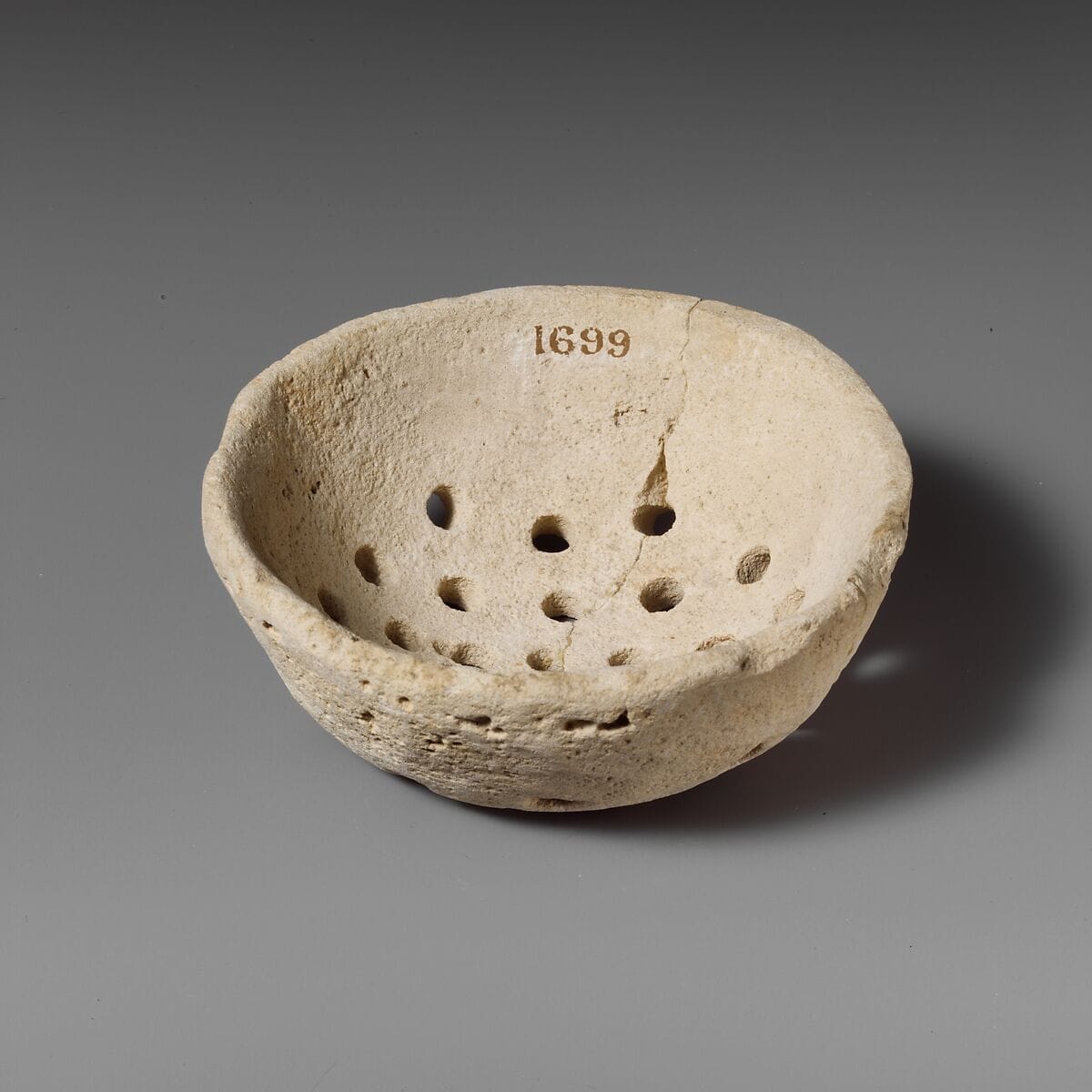
A stone vessel is a container ground, pecked or carved out of a block or pebble of stone. In Cyprus they matter at two quite different moments. In the aceramic Neolithic, at Khirokitia and its neighbours, stone bowls were the ordinary household container, made from river pebbles long before pottery took hold. Several thousand years later, in the Late Bronze Age, stone came back as a material for small, valuable vessels: Egyptian-style travertine jugs and jars, local gypsum copies of Mycenaean pots, and miniature chloritite amphorae and mortars made at Enkomi. Alabastra and marble votive bowls carry the class into the Iron Age. You can see all stone vessels in the catalogue.
](https://cdn.ancientcyprus.com/single-artifacts/74.51.5107.jpg)
Materials and terms
Cypriot stone vessels were made from a small set of rocks, and the names used for them are not always mineralogically exact. The Neolithic bowls are mostly andesite, with dolerite, diabase, basalt and some limestone, all taken from river beds [1]. The Late Bronze Age soft-stone vessels are gypsum and chloritite (older books say steatite), a chlorite-rich rock from the Troodos, the same mountains that hold the island's copper [6, pp. 171, 173].
The hardest term is "alabaster". Museum labels and excavation reports use "Egyptian alabaster" for a hard, yellowish, banded calcareous stone, which geologists call calcite or travertine. Vassos Karageorghis notes that this name is a convention and that stone of this type cannot be found on Cyprus [7, p. 86]. Gypsum, the softer true alabaster, does occur on the island, and Late Cypriot workshops used it [6, p. 171]. A label reading "alabaster" in the catalogue may therefore mean either stone; only the hardness and texture of the object settle it.
Neolithic: the Khirokitia stone vase industry
Porphyrios Dikaios, who excavated Khirokitia in five campaigns between 1936 and 1946, called the stone vase industry "the chief feature of the Khirokitia culture" [1]. It sets the Neolithic village apart from the later pottery-using cultures of Sotira and Erimi. An early attempt to make pottery at Khirokitia seems to have been dropped, and when well-made pottery did arrive, rather suddenly at the end of the settlement, stone vessels still outnumbered it until the site was abandoned [1; 2, p. 97]. Stone-only levels also turned up at Troulli on the north coast and at Kalavasos-Tenta, and a few typical Khirokitia fragments came from the islet of Petra tou Limniti [1].
The repertoire is narrow. Bowls predominate, with smaller numbers of dishes, trays, ladles and mortars; there are no deep or necked shapes of the kind made in stone in western Asia or Egypt [1]. Weinberg, reviewing the report in 1957, read the open shapes as copies of basket, wood and leather prototypes, and noted that the vessels were chipped and ground, with no drilling [2, p. 97]. Decoration is in relief or, less often, incised; a short spout on one Khirokitia bowl is an early instance of a feature that recurs later [4, p. 25].
Winkelmann points out that no island-wide study of the raw materials of Neolithic stone vessels exists, so Khirokitia has to stand as the case study. There, about half the vessels are andesite, 39% diabase and about 8% limestone, all locally available, and picrolite also appears among the vessel stones [3, p. 93]. Dikaios linked the choice of rock to geography: andesite pebbles come from river beds like the one that skirts Khirokitia [5].
| Site | Period | Main vessel stones | Forms |
|---|---|---|---|
| Khirokitia | Aceramic Neolithic | Andesite (c. 50%), diabase (39%), limestone (c. 8%) | Bowls, dishes, trays, ladles, mortars |
| Sotira-Teppes | Ceramic Neolithic | Limestone; a single andesite fragment | Small shallow bowls only |
| Kissonerga-Mylouthkia | Chalcolithic (with residual earlier pieces) | Limestone, calcarenite, diabase | Deep and shallow bowls, a miniature dish, spouted bowls |
| Lemba | Chalcolithic | Limestone and calcarenite | Bowls |
Ceramic Neolithic and Chalcolithic: a fading craft
Once pottery took over, stone vessels shrank to a minor class. At Sotira, Dikaios found that the only stone vessel shape was the small shallow bowl, almost all in limestone, with one andesite fragment. He suggested two reasons: the lack of an andesite-bearing river near the site, and an industry by then "out of fashion except for utensils of special use", when clay vessels could be made quickly and in quantity [5].
In the Chalcolithic, stone bowls are still common on some sites. Carolyn Elliott's study of the ground stone from Kissonerga-Mylouthkia, excavated by Edgar Peltenburg's project, found well-made bowls in quantity, most of them limestone gathered from the water-smoothed rocks of the local marine terrace [4, p. 25]. At Lemba only limestone and calcarenite were used for bowls; at Mylouthkia and Mosphilia a few bowls were diabase, carefully shaped and polished, as was a bowl from Kalavasos-Ayious. Dikaios had already noted small, finely worked "andesite" bowls at Erimi-Pamboula [4, p. 25]. A limestone bowl from Mylouthkia carries incised decoration, two bowl fragments have spouts whose perforation was never finished (they presumably broke in the making), and one diabase bowl from Mosphilia has a perforated lug [4, p. 25]. Elliott saw the Mylouthkia industry as "firmly rooted in the Neolithic tradition" while noting the absence there of the Neolithic bowls with relief decoration [4, p. 33]. In the same period the softer picrolite went mainly into figurines and pendants (see Neolithic and picrolite figurines and cruciform figurines); Winkelmann describes picrolite as of very little relevance in the Neolithic but popular in the Chalcolithic [3, p. 94].
Bevan's survey of Bronze Age stone vessels treats Cyprus as relatively isolated until the later second millennium BCE [6, p. 170]. No distinctive stone-vessel industry of the Early or Middle Bronze Age is described in the literature summarised here.
Late Bronze Age imports: travertine vessels
Bevan ties the island's renewed interest in stone vessels to the growth of the Cypriot copper industry [6, p. 170; see copper metallurgy]. The first clear Egyptian stone vessel imports appear in Late Cypriot I–II, and most come from Late Cypriot IIA2–IIIA1 contexts, the span from the Amarna period to the end of Egypt's 19th Dynasty [6, p. 170]. The shapes suit Cypriot taste. Bevan counts at least nine travertine jugs and juglets in Base Ring style, eleven copies of Mycenaean-style kraters, and many vessels modelled on the Canaanite jar, often with duck-shaped handles [6, p. 170]. He suspects that true imports were supplemented by Levantine or local versions. Travertine is concentrated at Enkomi and in the communities of the south coast: Enkomi French Tomb 2, for instance, held Cypriot and Mycenaean pottery with travertine footed jars, tazze and a duck-headed bowl [6, p. 170].
Karageorghis dates the "alabaster" vases of the Cesnola Collection to Late Cypriot II–III tombs, notes that they may have been imported from Egypt or Syria, and lists among their shapes the Base Ring jug, the Mycenaean-type amphora and an Egyptian loop-handled type [7, p. 86]. The one-handled jug illustrated here, Met 74.51.5107, is a globular calcite jug with a disk foot. It is the single Cesnola piece that Lilyquist accepted as Egyptian "in all respects, except for its solid flat-bottomed foot"; she judged most of the other calcareous vases in the collection Cypriot, and one Palestinian [7, p. 86].
The Cyprus Museum and the Royal Museums of Art and History in Brussels both hold Enkomi alabastra that copy the Egyptian and Near Eastern storage jar with duck-shaped handles (Brussels A 123; Cyprus Museum A 140). The catalogue of the 2012 exhibition Ancient Cyprus: Cultures in Dialogue, edited by Despina Pilides and Papadimitriou, describes Enkomi as receiving more alabaster vases from overseas than any other contemporary site, as prestige goods sent in exchange for copper [8, p. 162].
Late Bronze Age local production: gypsum and chloritite
Alongside the imports, Cypriot workshops made their own stone vessels. Gypsum vessels are known from Kition and Enkomi in three main types: tazze copying the travertine tazze, and three-handled alabastra and jars copying Late Helladic IIIA2–B Mycenaean pottery. Gypsum versions of Base Ring and White Shaved juglets also exist [6, p. 171]. In a tomb at Kalavasos-Mayia, a Late Helladic IIIB stirrup jar, a gypsum alabastron and a miniature stone mortar and pestle lay near a woman's head, which Bevan reads as a cosmetic set [6, p. 171].
Chloritite starts early but expands at the end of the Late Bronze Age, as gypsum becomes rarer [6, p. 171]. The late chloritite products are miniatures of Mycenaean-style pots and of ivory or metal forms: bowls, lugged tubes, amphorae, kraters, larnakes and tripod mortars. Their distribution is dominated by Enkomi, and an unfinished miniature amphora found there confirms the town as a production centre [6, p. 172]. Decoration is incised: hatched bands, triangles, compass-drawn spirals and dot-and-circle, matching ivory, bone and wood; carinations, arcading and handle attachments copy metal vessels [6, p. 173]. Chloritite came from the Troodos copper zone and, being heat-resistant, was also used for jewellery moulds and tuyère nozzles [6, p. 173]. Only the tripod mortars, perhaps for grinding cosmetics, travelled beyond the island [6, p. 172].
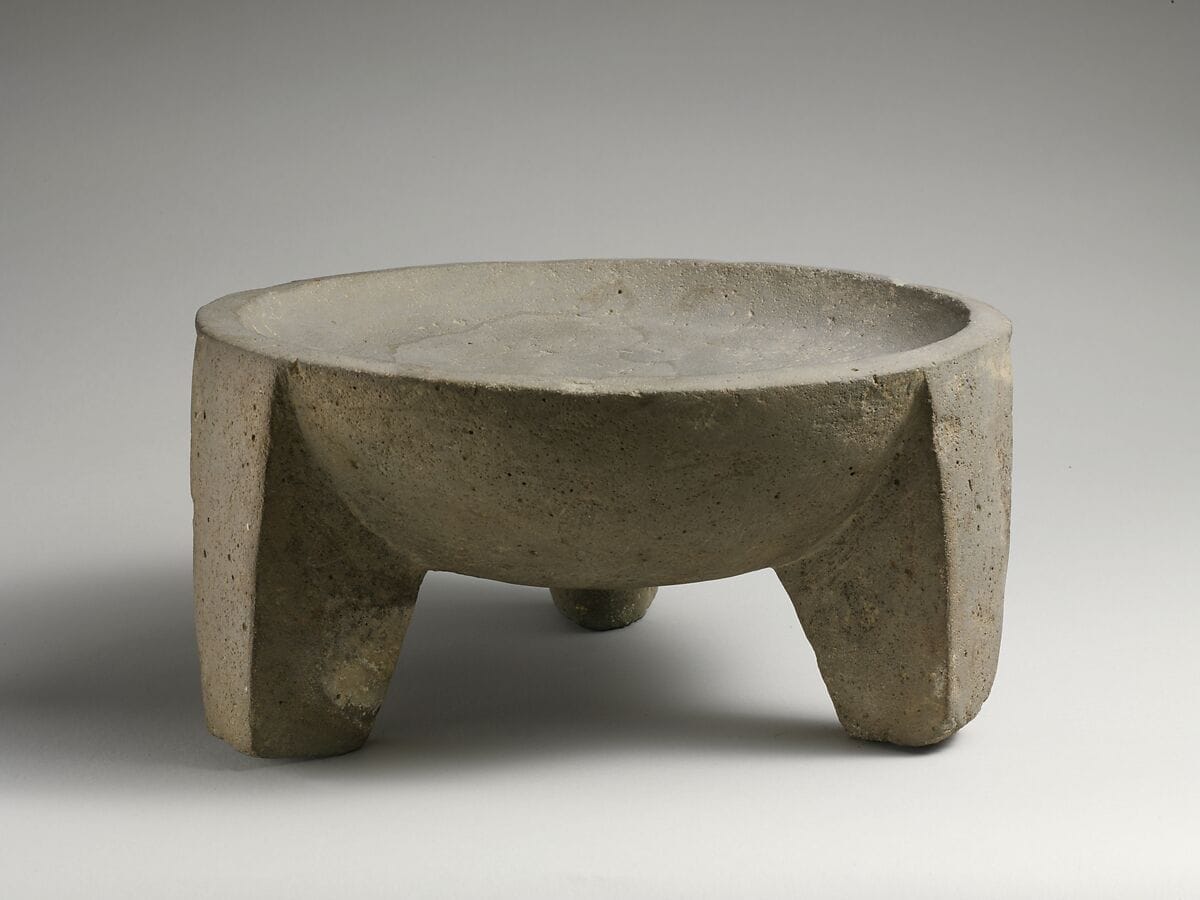
Karageorghis puts most locally made stone vases in Late Cypriot IIIA–IIIB tombs: miniature steatite amphoriskoi, jars, bowls and bathtubs with engraved linear patterns, gypsum and limestone amphorae, and tripod bowls or mortars of andesite or steatite [7, p. 86]. The Met's three-legged basalt mortar, 12.2 cm high and 24.3 cm across, belongs to this tripod family, though the identification of the stone is the catalogue's. A stone cup with compass-incised decoration from Limassol (Limassol District Museum LM 1066/1, 12th century BCE) is published with the evidence for a workshop at Enkomi, Room 13A, Floor IIIA, where an unfinished stone mace-head and diabase pounders were found [8, p. 162].
The richest single context is an unplundered Late Cypriot III chamber tomb at Kition, published by Vassos Karageorghis in 1960. Its three adults were accompanied by four lugged gypsum jars with dense incised decoration and a vessel copying a metal jar, cached near a head. Bevan suggests the lugs allowed the jars to be hung or shaken, perhaps to mix perfumed oil or a narcotic, and presents this as a possibility [6, p. 174].
Iron Age: alabastra and votive bowls
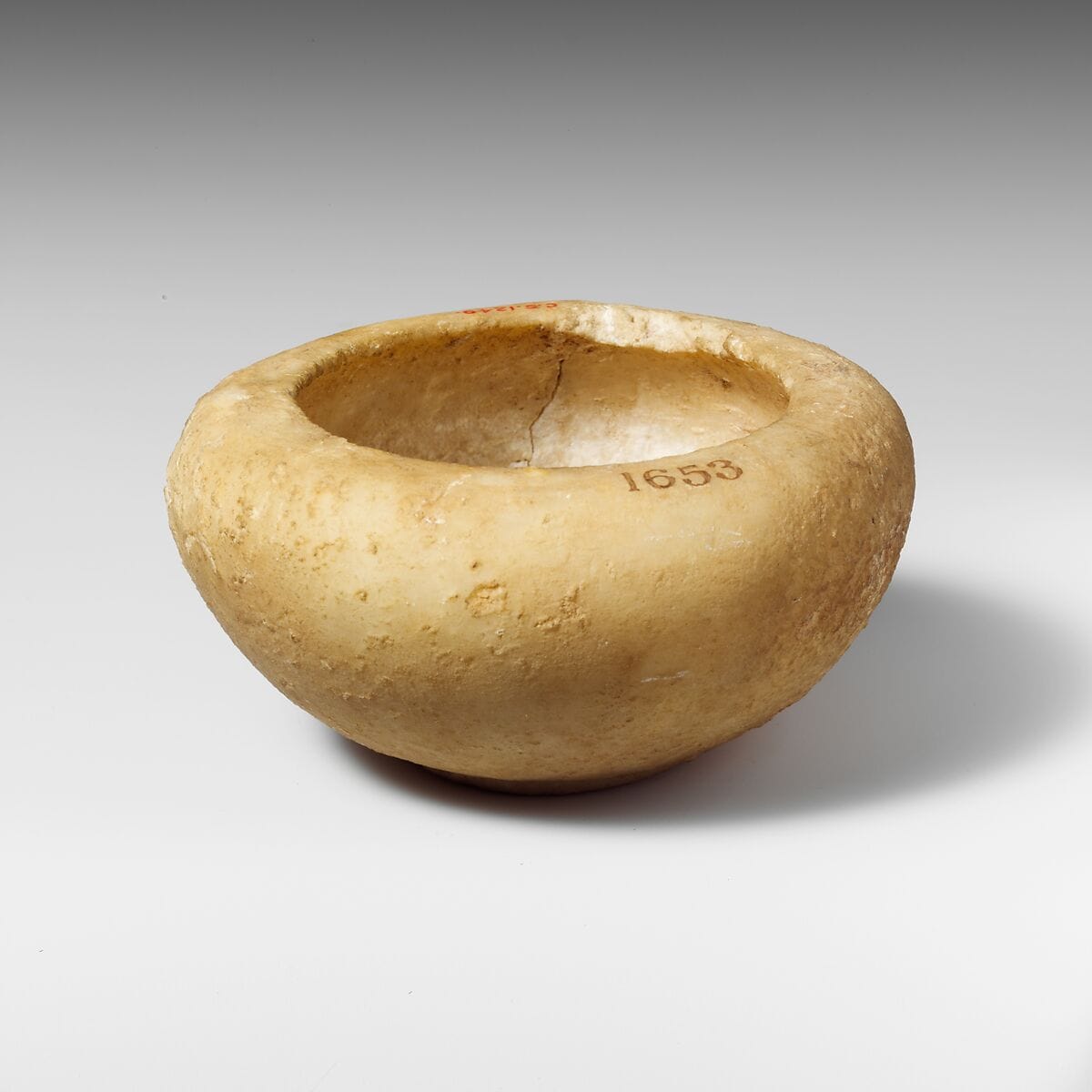
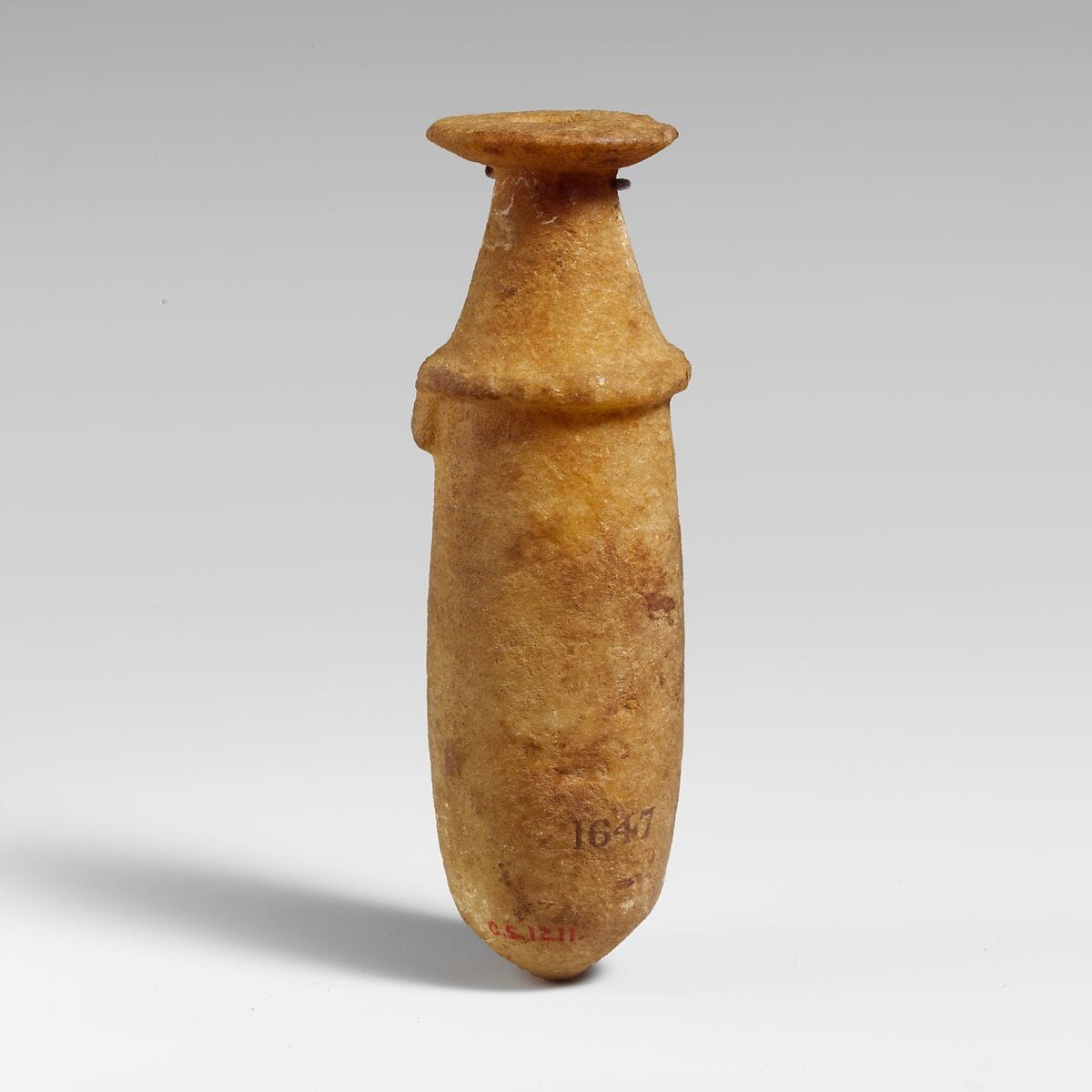
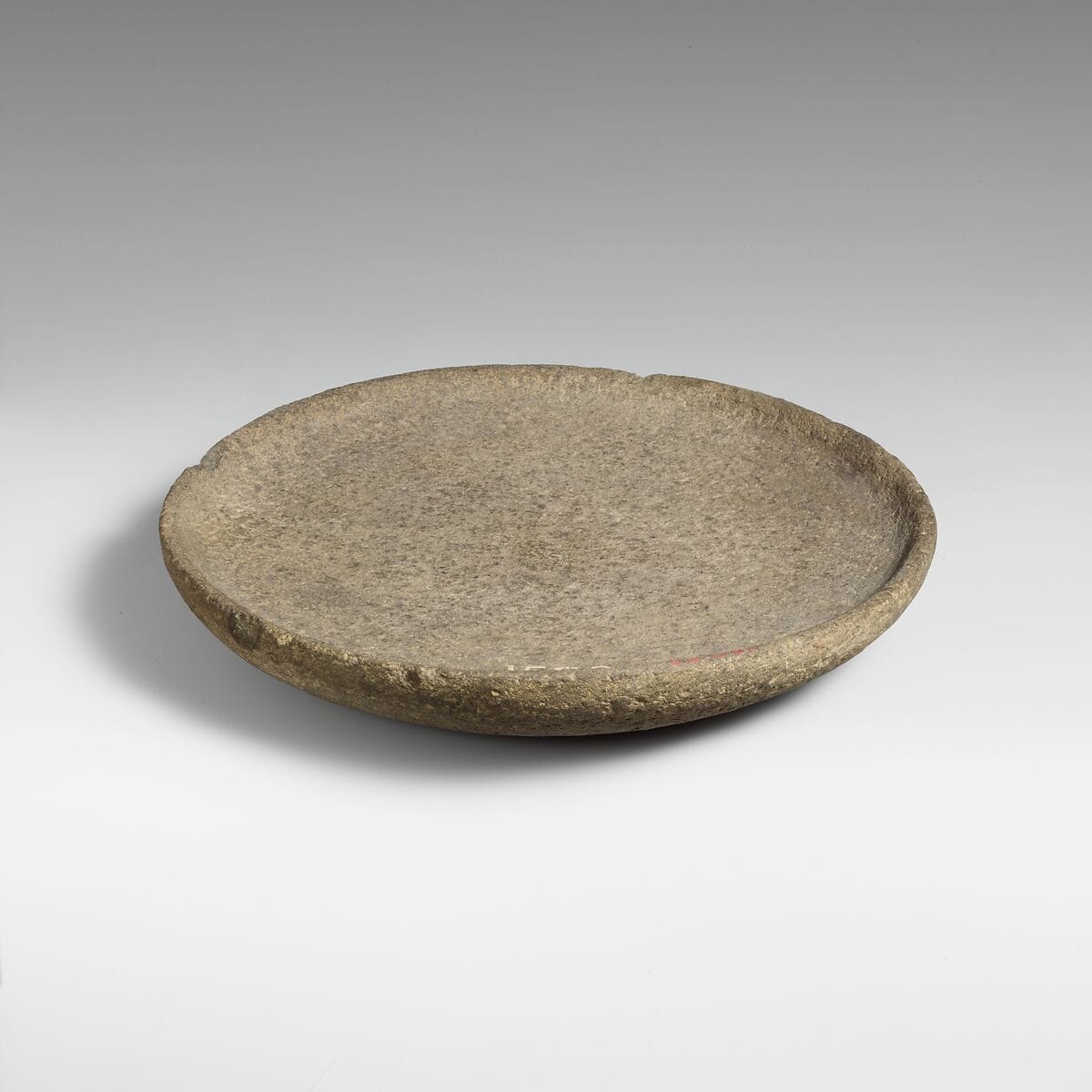
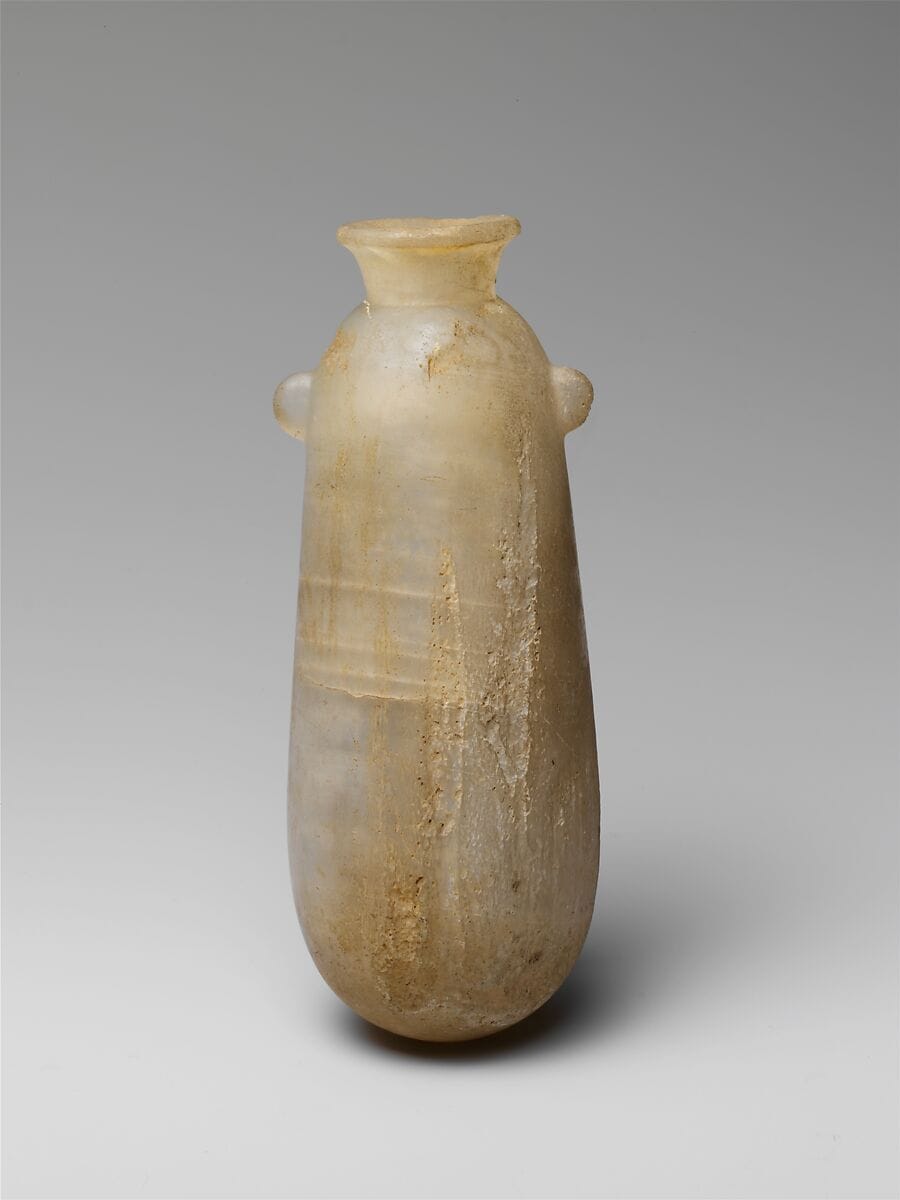
Bevan notes that some chloritite and gypsum vessels belong to the very end of the Bronze Age or the early Iron Age, though their chronology is "a little imprecise" [6, p. 171]. After that the evidence thins. Small alabastra remain in use: the Swedish Cyprus Expedition found several at Vouni, now in the Medelhavsmuseet, Stockholm, including V. 001:062 from Tomb 1 (Cypro-Classical, 8 cm high), V. 006:004 from Tomb 6 and V. 458 from Room 13 of the palace, both Cypro-Classical II. The Met's narrow, round-bottomed alabastron, 10.8 cm high, and its shallow alabaster bowl are catalogued as Archaic or Classical.
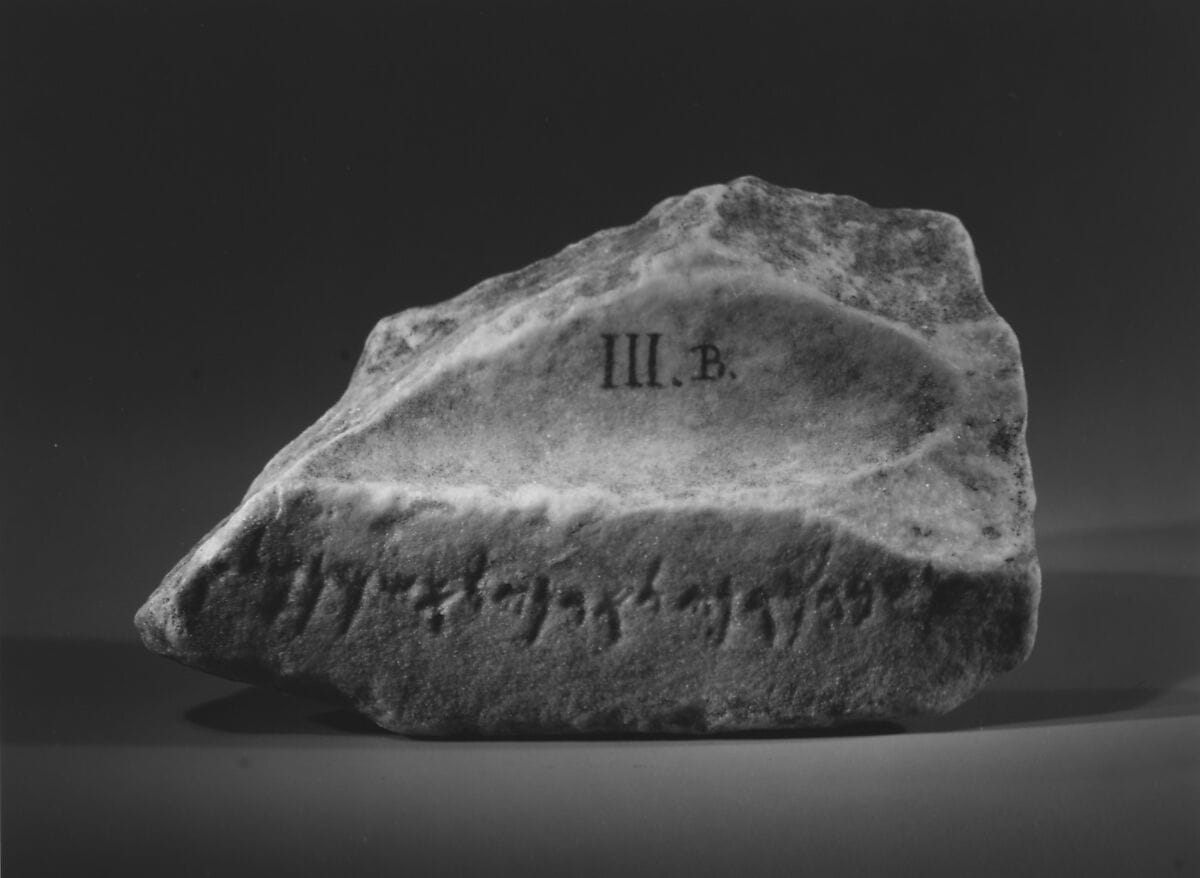
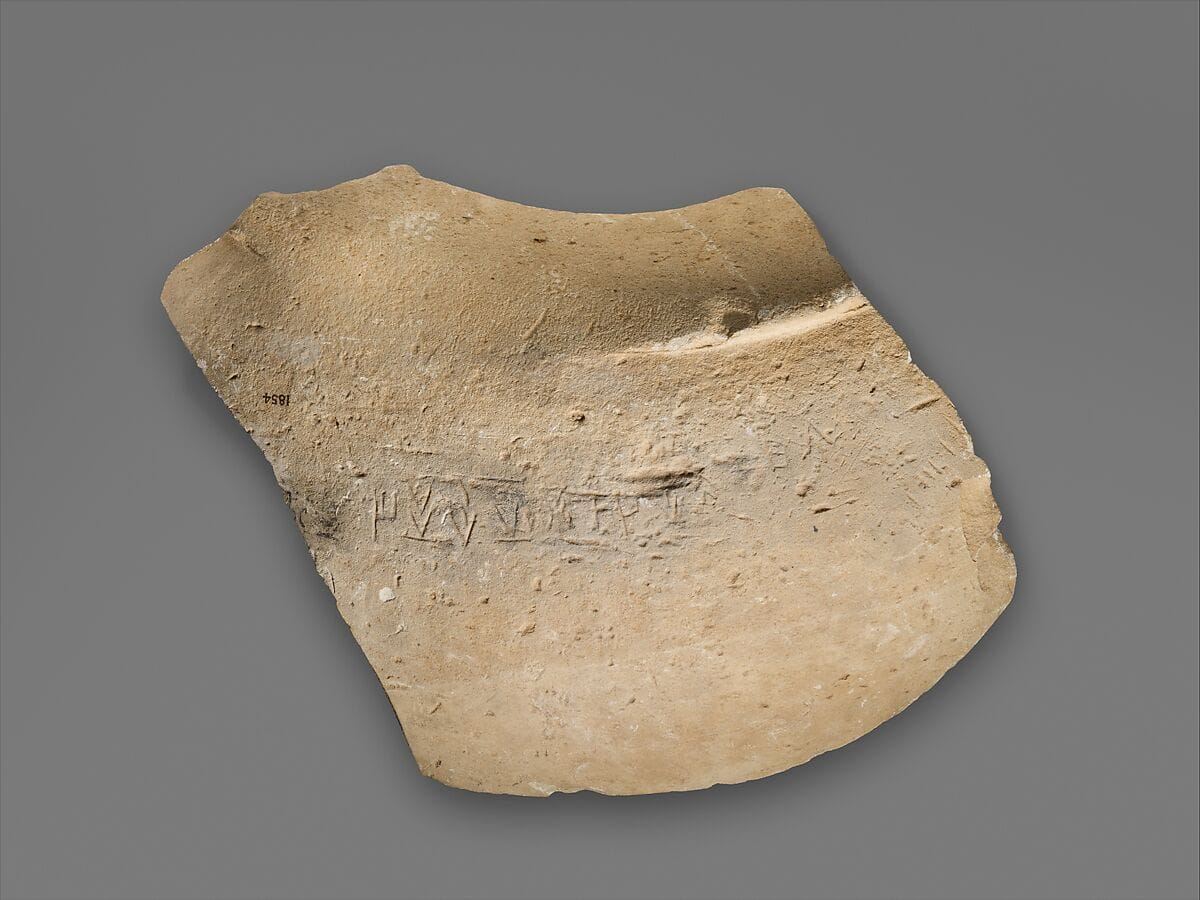
Phoenician Kition adds a different use: stone bowls as dedications. Bombardieri and Cannavò published a marble fragment in Turin with part of a Phoenician dedication to Eshmun-Melqart, which they interpret as a votive stone bowl from a late Classical sanctuary at Kition [9]. The Met holds a marble bowl fragment with a Phoenician inscription, 14 cm across, recorded as from the sanctuary of Eshmun-Melqart at Kition and dated to the 4th century BCE; it belongs to the same practice, though it is a separate piece.
Debates
Three questions run through the literature. The first is origin. "Egyptian alabaster" vessels found in Cyprus may be Egyptian, Levantine or Cypriot work in imported stone. Karageorghis notes Lilyquist's argument that much of the stone may not be Egyptian at all, and that an "international style" in the Late Bronze Age could have encouraged local carving; he concludes that the question stays open until quarries, objects and isotope analyses are tied together [7, p. 86].
The second is where the local workshops were. Bevan and the Cyprus Museum catalogue both point to Enkomi, from its unfinished pieces and workshop floor [6, p. 172; 8, p. 162], but gypsum outcrops are widespread on the island, so Kition and other towns could have worked it too [6, p. 171].
The third is function. Small closed vessels and tripod mortars suit cosmetics and perfumed oil, and the Kalavasos and Kition tomb groups place them by the head of the dead [6, pp. 171, 174]. For the Neolithic andesite bowls, function has not been settled in the published work.
Stone vessels in the catalogue
The site's catalogue is drawn mostly from the Cesnola Collection at the Metropolitan Museum, and Cesnola's records rarely give a findspot, so most pieces can only be placed by shape and stone. The Drakopoulos collection has no stone vessels. Larnaca District Archaeological Museum holds a Neolithic milling stone and bowl (inv. 8359) and a small Neolithic stone bowl (inv. 8367). For related crafts, see faience, another material used in Late Bronze Age Cyprus for small precious containers, and the Late Bronze Age period page.
Objects on this page
In the catalogue
References
- 1.Dikaios, P. (1953). Khirokitia: Final report on the excavation of a Neolithic settlement in Cyprus on behalf of the Department of Antiquities, 1936–1946. Oxford University Press.
- 2.Weinberg, S. S. (1957). [Review of Khirokitia, by P. Dikaios]. American Journal of Archaeology, 61(1), 96–98. https://doi.org/10.2307/501090
- 3.Winkelmann, C. (2020). The Neolithic and Chalcolithic figurines of Cyprus. Zaphon.
- 4.Elliott, C. (1983). Kissonerga Mylouthkia: An outline of the ground stone industry. Levant, 15(1), 11–37. https://doi.org/10.1179/lev.1983.15.1.11
- 5.Dikaios, P. (1961). *Sotira: A Neolithic settlement in Cyprus*. University Museum, University of Pennsylvania.
- 6.Bevan, A. (2007). Stone vessels and values in the Bronze Age Mediterranean. Cambridge University Press.
- 7.Karageorghis, V., Mertens, J. R., & Rose, M. E. (2000). Ancient art from Cyprus: The Cesnola collection in The Metropolitan Museum of Art. The Metropolitan Museum of Art.
- 8.Pilides, D., & Papadimitriou, N. (Eds.). (2012). Ancient Cyprus: Cultures in dialogue. Department of Antiquities, Cyprus.
- 9.Bombardieri, L., & Cannavò, A. (2016). A Phoenician inscription from Cyprus in the Cesnola Collection at the Turin University Museum of Anthropology and Ethnography. Kadmos. https://doi.org/10.1515/kadmos-2016-0003