
Enkomi Tomb 66: The Tomb with Lamps on Its Walls
In 1896 British Museum diggers at Enkomi opened a stone-built tomb with a copper lamp wedged into its wall and a silver bowl hung from a bronze pin. It is the only intact built tomb ever found at the site, and its fittings suggest the living came back.

Alexis Drakopoulos
April 13, 2024·Artifact·11 min read


Share


Alexis Drakopoulos is a Greek Cypriot Machine Learning Engineer working in Financial Crimes. He is passionate about Archeology and making it accessible to everyone. About Me.
In 1896, diggers working for the British Museum at Enkomi opened a tomb that still had lamps mounted on its walls. Two bronze pins held a clay lamp on one side of the doorway; on the other, a copper lamp had been driven by its handle into a crack between the ashlar blocks. More bronze pins stuck out of the walls elsewhere, and the published account says they were there "for the suspension of objects, including the silver bowl" [1; 3, p. 36]. Someone had fitted this room out for visitors, and the visitors were expected back.
The tomb is British Tomb 66, one of 100 tombs the Museum opened that season in the Late Bronze Age town of Enkomi, near the east coast of Cyprus. The work was paid for from the bequest of Miss E. T. Turner, and the finds were divided: two thirds went to London, the rest to the Cyprus Museum [1; 3]. The official publication of 1900, Excavations in Cyprus by A. S. Murray, A. H. Smith and H. B. Walters, set out to illustrate a sample of the more "important" finds, and it published no tomb in full [1]. Tomb 66 fared better than most. The field notebook kept by Percy Christian describes it at unusual length, and 93 of its objects were drawn or photographed for the 1900 volume [1; 4]. In 2009 Lindy Crewe, who had worked on the Enkomi material as a curator at the British Museum, re-catalogued the whole group and asked what the lamps and pins were for [1]. Most of what follows comes from her study.
A stone room among the houses
Most of the roughly 185 tombs dug at Enkomi by all the missions are chamber tombs, cut into the soft limestone bedrock and entered from a sunken passage, the dromos. Besides these, the British Museum found one tholos, Tomb 71, and four built tombs, Tombs 1, 11, 12 and 66, walled with finely cut ashlar blocks and roofed with two or three rough slabs [1]. Christian's notebook records a roof of three large flat stones, a room 7 feet high, and a "stone platform along the end opposite door and 1 side" [1; 4]. When the French mission found the tomb again in 1963 to 1965, renaming it TPT 1322, they measured the chamber at 2.9 by 2.5 m and the doorway at 0.9 by 1.05 m. Of the built tombs with recorded measurements it is the largest [1]. The door, Murray and his colleagues wrote, "was of two stones overlapping each other" [3, p. 36].
The French plan shows the tomb in the district they called Quartier 4E, among houses and workshops, with two more built tombs close by [1]. Tombs of cut stone built beneath houses are a feature of Ugarit on the Syrian coast, and Priscilla Keswani reads the Enkomi group as probably inspired by them, though built with less skill than the fully corbelled Syrian tombs [2, p. 115]. Nobody had grasped in 1896 that the graves lay inside a town. That was recognised only when Claude Schaeffer visited in 1934, and Crewe suspects he saw it because he had recently made the same mistake at Minet el-Beida, the harbour of Ugarit, where he had taken a settlement for a cemetery [1].
The obvious guess is that a stone tomb beneath a house belonged to a king. Keswani resists it. The clustering of the ashlar tombs beside large, well-built houses points to important families, but rock-cut tombs of equal or greater wealth turn up elsewhere at Enkomi, among them British Tombs 19, 67 and 93 and Swedish Tomb 18 [2, p. 115].
Gold, glass and faience
The British Museum registered 139 objects from Tomb 66, and Crewe's catalogue runs to 131 entries [1]. Gold personal ornaments are the largest class: strips of gold foil that served as diadems or mouthpieces (one reddish strip is stamped with a mouth at its centre), dress pins, earrings, finger rings, and beads now restrung as a necklace with two carnelians. The gold that could be weighed comes to 283 g; Crewe puts the true figure at about 325 g, because some pieces could not go on the scale. One of them is a gold bowl 12.3 cm across, restored from three fragments, which was once taken for a mask. Its only match is a bowl from Swedish Tomb 17 [1]. On gold alone Tomb 66 ranks among the four richest tombs at Enkomi, with British Tombs 19 and 93 and Swedish Tomb 18, though British Tomb 93, a chamber tomb with around 1,430 g of gold, outweighs it several times over [1].
Two of the rings came from abroad. One, probably Egyptian or made in the Egyptian manner, has a swivelling bezel set with a faience scaraboid. The other, catalogued as Late Helladic III work from the Aegean, has a worn oval bezel engraved with a quadruped looking back over its shoulder and a rosette above its hindquarters [1].
The pottery leans just as heavily on imports. Of the 44 registered vessels, roughly 70% are Mycenaean imports, 18% are local and 11% come from elsewhere: a Late Minoan stirrup jar from Crete, three Tell el-Yahudiyeh juglets, and two blue-glazed pottery bottles of about 1300 to 1180 BC that may have been made at Ugarit [1]. The only other piece of that Syrian ware from Enkomi came from Tomb 12, another of the built tombs [1]. The figures need a caution, because the 1900 team cared little for Cypriot pots, which they dismissed as "common ware of a dull colour with moulded, incised, or rudely painted patterns, which point back to an origin in primitive times" [1; 3, p. 7]. For this tomb, though, the notebook lists 39 vessels and 44 were registered, so Crewe thinks most or all of the pottery came home [1].
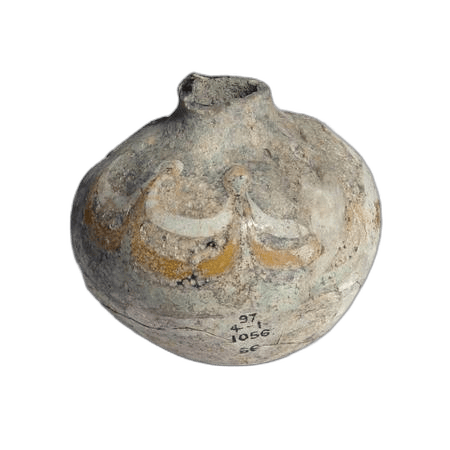
The glass and faience are what set the group apart. There are two core-formed glass flasks in the shape of pomegranates, dated to Late Cypriot IIC, and a lentoid flask and two amphoriskoi of glass trailed in white, blue and orange or yellow, which Crewe dates to the late 18th or 19th Dynasty of Egypt [1]. The faience includes a bowl modelled as a lotus flower, a mortar and pestle, a bucket-shaped vessel probably from Mesopotamia, and a cylinder seal, probably Mitannian, engraved with two sacred trees flanked by rearing animals [1]. Five of the six amber beads recovered in the whole British Museum excavation came from this one tomb [1].
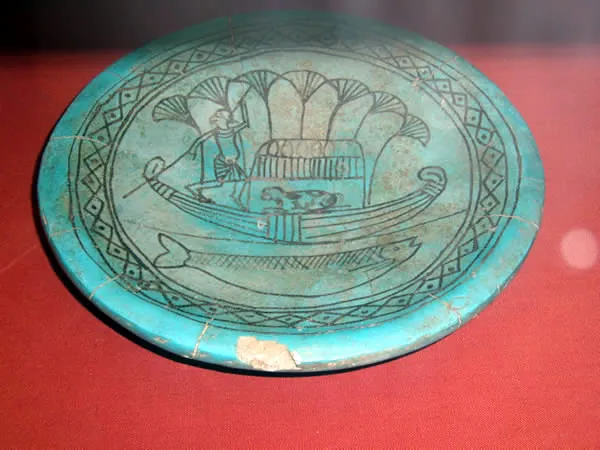
The most unusual of the vitreous pieces is a faience dish 23 cm across, painted in black with a man punting a papyrus boat, a bull or cow sitting under a canopy on board and a fish swimming below. Crewe knows of no other vessel like it, and she leaves its origin open: Egyptian New Kingdom work, or a Late Cypriot IIC piece made in the Egyptian manner [1].
Metal fills out the group: nine vessels of gold, silver and bronze, a socketed bronze spearhead and five bronze daggers [1].
Three juglets two hundred years too old
Dating any Enkomi tomb is awkward. Many were used for centuries, and flooding, collapsed roofs, looting and the digging methods of the 1890s have all muddled the evidence. Late Bronze Age Cypriots also reopened tombs and moved bones and grave goods elsewhere, so an object's date need not be the tomb's [1; 2, pp. 217-218].
Tomb 66 has its own trap. The three Tell el-Yahudiyeh juglets, small dark imported jugs of a type at home in the Levant and Egypt, were registered in 1897 as finds from this tomb. They sat outside the main run of numbers, however, and the 1900 volume illustrated two of them as coming from unknown tombs [1]. Later scholars, working from the publication, dated the tomb by its Late Cypriot II material alone; Paul Åström put the construction of the built tombs in LC IIB [1]. The juglets belong to the Middle Cypriot III to Late Cypriot IA horizon, around the town's earliest occupation, and they are the only objects in the tomb that are certainly that early [1].
Crewe weighs two explanations. The juglets might have been heirlooms kept in a house for generations, but at Enkomi such juglets seem to have been purely funerary, and sherds of them are very rare in the settlement. She prefers the second reading: the juglets, and perhaps some of the bronze weapons, were taken out of an older tomb, abandoned when the town spread over it, and reburied in Tomb 66, at least two centuries after they were imported [1]. On that view the family who built Tomb 66 claimed descent from the town's first settlers, or wanted to be seen to.
Set the juglets aside and the rest of the group runs from LC IIA2 to LC IIIA, with most of the Mycenaean pottery in the LH IIIB style and only one jar as early as LH IIIA1 to 2, perhaps itself an heirloom [1]. Crewe concludes that the built tombs were constructed in Late Cypriot II (c. 1450 to 1200 BC), in IIB or early IIC, and used for a short while into IIIA at most. If so, the Enkomi builders may have used ashlar masonry for tombs before they used it in buildings [1].
The lamps and the pins
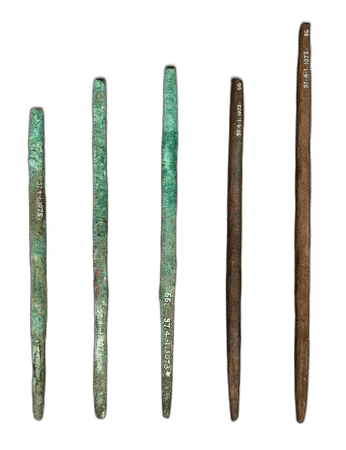
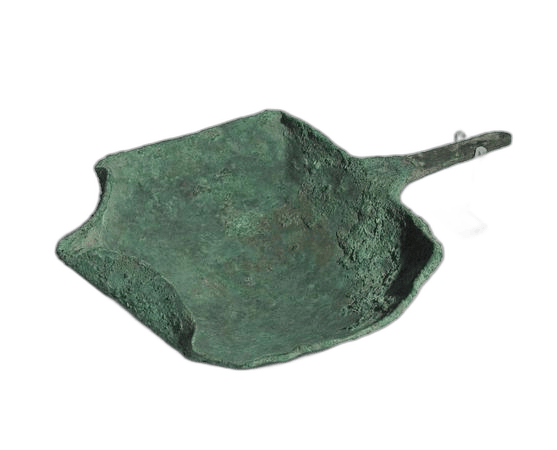
The five bronze nails survive in London. They are 17.3 to 22.3 cm long, slightly polygonal in section, shaved down their length and hammered flat at the head [1]. The copper lamp is there too: 23.2 cm long, with a roughly square body raised by hammering, a narrow flat handle and a front edge pinched into a wick-rest. Analysis at the British Museum found 97.5% copper and 1% arsenic. Crewe knows of no other lamp of this type [1]. The clay lamp on the other side of the door was not kept. Christian called it a "crooked hat lamp, very black", which Crewe takes for the standard trefoil-mouthed clay lamp with a round base [1; 4]. Lamps of any kind are uncommon in Late Cypriot tombs.
The silver bowl hung on the wall is hemispherical, 20.9 cm across, with a horizontal loop handle shaped like a wishbone and fixed with rivets, and a row of engraved double circles on the rim. Crewe lists it as Late Helladic III work [1]. Nowhere else in Cyprus has anyone recorded objects hung on a tomb wall or lights fixed in a tomb, although Crewe allows that wooden pegs, which would have rotted, may once have been common [1].
Her reading starts from the effort involved. Fixing lamps on both sides of a door makes sense if people came into the room often, or stayed long. The door of two overlapping stones, one smaller than the other, may have been built to open easily, and a house standing over the tomb gave it a privacy that heavy blocking normally provided [1]. Ordinary chamber tombs, by contrast, were dark and cramped, averaging about 1.3 m in height, and Crewe doubts that long rituals were held in them [1]. Tomb 66 has room for several people to sit or stand, and a bench along two walls that could have served the living or held the dead [1].
The comparison she draws is with Syria. In the royal tomb at Qatna, excavators found storage and serving vessels and animal bones on and under stone benches, the debris of kispum, the memorial meal shared with the dead; at Ugarit a royal funerary text, RS 34.126, records offerings for the dead [1]. Tomb 66 is mostly storage and serving vessels besides its jewellery: 21 juglets and small closed pots that may have held scented oil, 43 serving vessels, and at least two drinking sets of krater, jug and cups [1]. A bowl hanging on the wall was probably no single dead person's property, which is why Crewe wonders whether it served in some form of kispum [1].
Crewe put a question mark in her title, and it belongs there. Funerary feasting is well attested in Cyprus from the Early Bronze Age onwards, but as she points out, nothing shows it took place inside tombs [1]. The built tombs did not last. After Late Cypriot IIC, Enkomi buried its dead in shallow shaft graves, mostly one person to a grave, and Crewe sees the stone tombs as a short-lived local imitation of Syrian practice [1]. The case for feasting in Tomb 66 rests on two lamps, five nails and a silver bowl, and on a notebook that says nothing at all about the bodies.
References
- 1.Crewe, L. (2009). Feasting with the dead? Tomb 66 at Enkomi. In T. Kiely (Ed.), Ancient Cyprus in the British Museum: Essays in honour of Veronica Tatton-Brown (British Museum Research Publication 180, pp. 27-48). London: British Museum.
- 2.Keswani, P. (2004). Mortuary Ritual and Society in Bronze Age Cyprus (Monographs in Mediterranean Archaeology 9). London: Equinox.
- 3.Murray, A. S., Smith, A. H. and Walters, H. B. (1900). Excavations in Cyprus (Bequest of Miss E. T. Turner to the British Museum). London: Trustees of the British Museum.
- 4.Tatton-Brown, V. (2003). Enkomi: The Notebook in the British Museum. Cahiers du Centre d'Études Chypriotes 33, 9-66.