
Contents
Handmade White Painted ware, the light-slipped, dark-painted pottery of the Middle Bronze Age, is sorted in two ways. The first is a numbered series, WP I to WP VI, set up by the Swedish Cyprus Expedition. The second, laid over it, is a set of named "styles": groups of pots that share a decorative scheme and, often, a region. Most of the names come from Paul Åström, first in The Middle Cypriote Bronze Age (1957) and then in his 1966 report on the excavations at Kalopsidha in the eastern Mesaoria, where he isolated several new styles from tens of thousands of sherds [1]. David Frankel tested the system in 1974. He pointed out that most of the styles have "a purely decorative definition, although they are defined in the overall ware system", and that one of them, the String-hole Style, rests partly on a feature of the pot's shape rather than its paint [2, p. 20]. This page sets out each named style, its date, where it was made and found, and the examples in the catalogue. You can see all Bronze Age White Painted styles in the catalogue.
The styles at a glance
The ware numbers below are those given in the literature for each style. Some styles carry two ranges because different authors assign them differently; the sections below explain each case.
| Style | Ware stages | Main region | Key source |
|---|---|---|---|
| Latticed Diamond | WP I; WP III-IV | North coast (Lapithos) | Russell, p. 616; Gagné, p. 284 |
| String-hole | WP I; WP III-V | Central Mesaoria (Politiko), east | Frankel, p. 20; Gagné, p. 333 |
| Wavy Line | WP I; WP III-IV | Karpass; Kalopsidha | Cook, p. 14; Russell, p. 616 |
| Framed Caduceus | WP II-III | East | Åström 1966, p. 16 |
| Pendent Line | WP III-IV | East (Kalopsidha, Kythrea) | Frankel, p. 63 |
| Cross Line | WP IV-VI | East (Kalopsidha) | Russell, p. 616 |
| Tangent Line | WP V | Kalopsidha; Kazaphani | Åström 1966, p. 93 |
| Eyelet | WP V | Kalopsidha | Gagné, p. 309 |
| Framed Broad Band | WP V | East (Kalopsidha, Enkomi) | Åström 1966, p. 94 |
| Coarse Linear | WP VI | Kalopsidha, Enkomi, Athienou | Åström 1966, p. 94 |
| Soft Triglyphic | WP VI | Kalopsidha, Enkomi, north and west | Gagné, p. 307 |
| Composite ware | Bowls with WP interior | Kalopsidha, Enkomi | Jones, p. 308 |
Absolute dates differ from museum to museum. The Ashmolean and the Department of Antiquities give Middle Cypriot III as c. 1725-1650 BCE [3, p. 114], while the British Museum dates most of the styled pieces in this catalogue between 1750 and 1550 BCE. The stratigraphy at Kalopsidha runs from Early Cypriot III to Late Cypriot I, which is why so many of the later styles were first defined there [4, p. 300].
Pendent Line Style
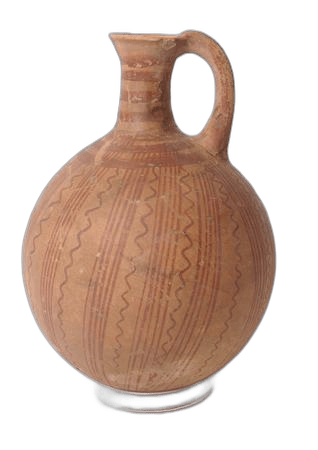
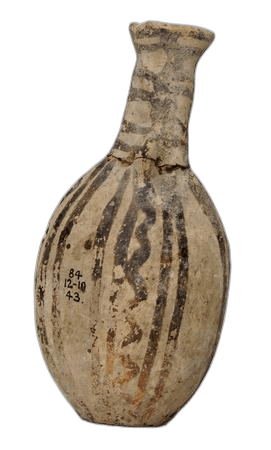
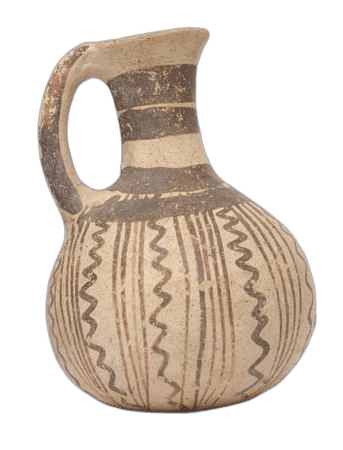
The Pendent Line Style (PLS) is the best known Middle Cypriot style and the one with most examples in the catalogue. Its classic form is a jug with a globular body, a concave neck and a handle from rim to shoulder [1, p. 25], painted with lines that hang from the neck down the body. A good example is the British Museum's Pendent Line jug (right), 29 cm high, in fine buff clay with purple-red paint: vertical wavy lines framed by groups of straight lines run from shoulder to base, under bands round the neck. On bowls the same painters put a horizontal wavy line between straight ones, so "pendent" really describes the jugs [1, p. 92]. The style also went onto other shapes: the British Museum has a bird-shaped askos with wavy pendents and encircling lines, and string-holed pendent bottles.
The style belongs to WP III-IV, in Middle Cypriot III [5, p. 616]. Frankel called it "fairly characteristic of the Eastern sites" and suggested it grew out of WP I decoration, "perhaps by way of the Framed Caduceus Style" [2, p. 63]. It is abundant at Kythrea and Kalopsidha, and Gagné considers that it may have originated at either [4, p. 333]. It also travelled: Åström noted Pendent Line and Cross Line jugs in quantity in Syria, at Dhahrat el-Humraiya and in a tomb group at Kassabine where they make up nearly half the pottery, and at Ras Shamra (Ugarit) [1, pp. 142-143]. See Ugarit and the Levant.
Its relation to the Cross Line Style is the main argument in the classification of these wares. Åström read the eastern styles as a sequence, Framed Caduceus, then Pendent Line, then Cross Line. His evidence was a jug from Kythrea Tomb 1 (Cyprus Museum A 796) that combines both schemes, and transitional sherds from the lowest undisturbed levels of Trench 9 at Kalopsidha [1, p. 87]. Frankel rejected this "simple genetic relationship": the two styles may be partly contemporary, and pots that mix them are better explained as combinations [2, p. 63; 5, p. 616]. See all Pendent Line Style pieces in the catalogue.
Cross Line Style
The Cross Line Style (CLS) covers the body with "intersecting groups of three to nine parallel lines arranged obliquely", with broad horizontal bands at the shoulder and neck. Its commonest shapes are a jug with a vertical handle and a bottle with two string-hole handles at the base of the neck. The fabric is red-brown, slipped, and painted in matt or lustrous black, red-brown or red. About 6% of Cypriot White Painted jugs and bottles are in this style, but at Kalopsidha it accounts for over half the jugs [5, p. 616]. The British Museum's Cross Line bottle from Enkomi, 9.8 cm high, is the bottle form exactly, with string-hole projections either side of the neck and sets of crossed oblique lines in orange-brown to brown.
Åström divided the Kalopsidha material into four substyles: a close net of five to nine groups of lines; a scheme of encircling groups forming a cross in front of and below the handle; a Framed Cross Line with vertical divisions, which he thought might have been inspired by Bichrome Wheelmade decoration; and a loose version in which the lines barely cross, transitional to the Coarse Linear Style [1, p. 88; 4, pp. 304-306]. Trench 9 at Kalopsidha produced 21,021 Cross Line sherds, the third commonest class after Plain White Handmade and Monochrome. Their paint is red low in the deposit and becomes black and careless higher up [1, p. 87].
Cross Line sherds start in Stratum 3 (Middle Cypriot II-III) at Kalopsidha and peak in Strata 1-2 (Middle Cypriot III); a few vessels run into Late Cypriot I [5, p. 616]. The style is eastern: Kalopsidha, Milia, Nitovikla and Kythrea, with one import at Lapithos [5, p. 616]. Abroad it reached Ras Shamra [1, p. 143], Tell Mevorakh in the southern Levant [6, p. 99] and Kommos on Crete, where a WP IV-VI Cross Line vessel was found [5, p. 616]. See all Cross Line Style pieces in the catalogue.
Wavy Line Style
The name is used for two different groups. The first is a regional style of the Karpass peninsula. The British Museum's guide describes "a more free and open 'Wavy Line' style" as "the particular feature of the Karpas Peninsula", against the simpler vertical straight and wavy lines of the east [7, p. 14]. Russell lists it as a WP I style [5, p. 616]. Frankel traced the Wavy Line styles back to the unconnected incised decoration of Red Polished and to WP I painting [2, p. 63].
The second is Åström's "Alternating Broad Bands and Wavy Lines", a WP III-IV fabric he isolated at Kalopsidha [4, p. 300]. When a catalogue entry says "Wavy Line Style" it usually means the Karpass group; the Kalopsidha style is normally given its full name. The motif itself, across all periods, is on the wavy lines page. There are no examples in the catalogue yet; the Wavy Line Style term page will list any that are added.
Framed Broad Band Style
Åström called the Framed Broad Band Style (FBBS) "a characteristic East Cypriote style". Broad painted bands are framed by one to four thin lines on either side, sometimes flanked by oblique parallel lines. The clay is rather coarse, buff or greenish, and the paint matt black or red. Trench 9 at Kalopsidha gave 25 sherds. Some pots mix it with Cross Line, such as Cyprus Museum A 803 and a jug in Sarajevo. Fragments from Ayios Iakovos and Enkomi are in the Ashmolean. In Åström's words the style "originates in Middle Cypriote III and carries on into Late Cypriote" [1, p. 94]. He placed it in WP V, and a WP V Framed Broad Band amphora came from Athienou [8, p. 44]. It also occurs at Hala Sultan Tekke and Toumba tou Skourou [4, p. 358]. Framed Broad Band Style in the catalogue.
Tangent Line Style
Åström named this style at Kalopsidha "tentatively Tangent Style, since the parallel horizontal lines on the shoulders are only tangent to, never overlap the vertical lines in front and on the sides" [1, p. 93]. Only juglets were found, 146 sherds in all, painted in the same technique as Cross Line, and Gagné treats it as related to that style [4, p. 307]. A complete specimen from the Swedish excavations was already published in 1957 [1, p. 93]. The style was popular at Kazaphani, and the Kythrea Tomb 1 jug carries it on a different shape, so Gagné doubts it was purely an eastern product [4, p. 307]. Åström listed examples abroad at Gezer, Ras Shamra and Megiddo [1, p. 94]. Tangent Line Style in the catalogue.
Composite ware
Composite ware is a finish rather than a painted scheme: bowls with a monochrome exterior in Black or Red Slip and a White Painted interior, "noticed particularly at Kalopsidha and also at Enkomi" [9, p. 308]. A Kalopsidha sherd combines a Red Slip outside with a WP IV inside [1, p. 149], and the Framed Caduceus pattern appears on Composite bowls as well as on jugs [1, p. 16]. Åström thought the wide Composite bowls were made at Kalopsidha [1, p. 142]. A Composite Red Slip and White Painted bowl was found at Athienou [8, p. 44]. The ware was exported to the Levant: Maguire records a WP Composite rim sherd from the Middle Bronze IIA glacis at Tell Akko, Red Slip and White Painted Composite at Tell el-Kabri, and Black Slip and White Painted Composite at Megiddo [6, pp. 65, 92, 99].
The term has nothing to do with the multi-bodied pots also called "composite". The Metropolitan Museum's double-bodied flask said to be from Alambra, with string holes and four feet, is a composite shape in the String-hole Style. Composite ware in the catalogue.
Framed Caduceus Style
The Framed Caduceus Style is a WP II-III style [5, p. 616], the earliest of Åström's eastern sequence. He defined it in 1957 and noted that the pattern occurs "both on jugs and on Composite Ware bowls" [1, p. 16]; he believed it was made at Kalopsidha [1, p. 142]. The scheme is built from closely spaced wavy and straight lines. For Frankel it is the likely bridge between WP I decoration and the Pendent Line Style, and he allowed for a "later redevelopment of the Framed Caduceus and breakdown of the Cross Line Style" [2, p. 63]. No pieces in the catalogue are yet classed in it. Framed Caduceus Style in the catalogue.
Latticed Diamond Style
The Latticed Diamond (or Latticed Lozenge) Style fills panels with latticed lozenges. Russell lists a WP I Latticed Diamond Style [5, p. 616], while Hadjicosti, as summarised by Gagné, assigns vessels to a WP III-IV Latticed Diamond style [4, p. 284]. Gagné's "lattice panel" group includes Lapithos jugs so close to one another (A 728 and C.40) that they may be the work of one potter and painter, with small pierced lugs either side of the neck [4, p. 284]. Frankel saw the open lattices of Red Polished at Bellapais-Vounous as a source for the triangles and lozenges of the Karpass painters [2, p. 63].
The British Museum's Latticed Diamond spouted bowl, 10.2 cm high, has a high handle opposite a tubular spout, a checkerboard lattice on the body and zigzags on the rim. The catalogue also has a bottle and a spherical bottle. The Drakopoulos White Painted II jug with lattice panels uses the same kind of panel on an earlier ware stage. For the motif in general see lattice and checkerboards. Latticed Diamond Style in the catalogue.
String-hole Style
The String-hole Style is named after the pierced lugs on the necks of small jugs, juglets and flasks, made by pushing a pointed tool, perhaps a reed, through the clay from back to front [4, p. 284]. A spout and three stubby feet are typical of the jugs [4, p. 288]. Frankel thought it "perhaps the least satisfactory" of the styles, because it uses an attribute, "at least originally functional", as a decorative criterion, though it may be seen as an attempt to define one mode of production [2, p. 20]. Russell gives a WP I Stringhole Style [5, p. 616]; Hadjicosti places String Hole vessels in WP III-V [4, p. 284].
Gagné identifies small String-hole jugs as the main product of a Mesaoria production centre. A group unique to Politiko, two of them with double spouts and all with rows of cross-hatched triangles, is probably the work of a small group of potters [4, pp. 333, 394]. A dated example is the Ashmolean's miniature WP IV String-hole juglet (AN1896-1908 C.59) from Kalopsidha Tomb 11, 8.45 cm high, with three knob feet and a tubular spout, placed in Middle Cypriot III [3, p. 114]. The Royal Ontario Museum dates its String-hole jug to about 1800-1600 BCE and has a WP III-V String-hole juglet of Middle Cypriot II-III.
This is the largest style in the catalogue, with 30 pieces. The British Museum's String-hole juglet, 11.5 cm high, has two string-holes on the neck, a beaked mouth and diagonal lines in triangular and rectangular panels in fugitive black paint. There are also string-hole flasks and a string-hole askos. See all String-hole Style pieces in the catalogue.
Eyelet Style
The Eyelet Style is a WP V style Åström isolated at Kalopsidha. Its scheme is "one or more circles with one or more dots in the centre", on thin-walled jugs and bowls [4, p. 309]. One bowl from layer 71 has the eyelets inside; another has them outside with framed zigzags and cross-hatched triangles [4, p. 309]. Crossing lines also occur in this style [1, p. 93]. Pieces were found in Syria and at Enkomi, Ayios Iakovos, Milia and Livadhia, but Kalopsidha is the only certain source, so Åström took it to be the production centre [4, p. 309]. Eyelet jugs at Ras Shamra resemble the Kalopsidha pots [1, p. 143], and WP V Eyelet sherds came from Stratum III at Athienou [8, p. 43]. Eyelet Style in the catalogue.
Coarse Linear Style
Åström placed the Coarse Linear Style in WP VI. It occurs on juglets and bowls from surface and Late Cypriot layers at Kalopsidha, and "it is significant that no sherds came from a Middle Cypriote layer". The clay and slip are fairly coarse, greenish, buff or reddish, and the decoration is broad vertical lines in matt black or red [1, p. 94]. Gagné treats it as the last of the Cross Line substyles and suggests the crude painting may be the work of learners, "possibly children" [4, pp. 306-307]; that is her hypothesis. Two Coarse Linear juglets came from Athienou [8, pp. 43-44], and the style is also found at Enkomi [4, p. 307]. The catalogue example is a British Museum WP VI juglet from Maroni, 9.8 cm high, with a tubular spout and black linear decoration on a drab ground. Coarse Linear Style in the catalogue.
Soft Triglyphic Style
The Soft Triglyphic Style is the last handmade White Painted, of WP VI and the Late Bronze Age. "Soft" refers to the fabric: very soft, usually buff and sometimes greenish. The neck and handle are often trimmed with a flat tool [4, p. 307]. The style appears mainly on jugs, with at least one bowl and a figurine. Its decoration is close to Coarse Linear, with vertical lines predominating [1, p. 87; 4, p. 307]. Gagné suggests an origin at Kazaphani or Toumba tou Skourou near Morphou; it occurs at Kalopsidha and Enkomi and at northern and western sites [4, pp. 307, 335]. At Athienou WP VI Soft Triglyphic juglets in buff clay with brown or black decoration came from Strata III and II [8, pp. 43-44].
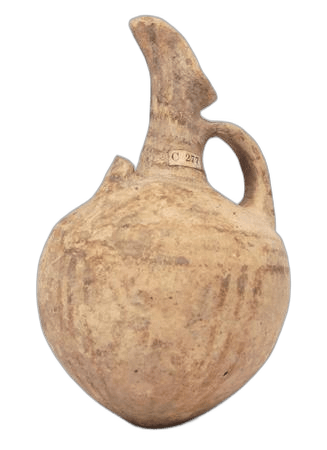
The catalogue has three pieces. The British Museum's Triglyphic juglet from Dhali (right), 10.7 cm high, has a piriform body, a pinched mouth and chevrons with vertical parallel lines in brown. A small Triglyph jug, 7.5 cm high, has groups of three vertical lines on the body, the "triglyphs" of the name. A Drakopoulos piece of the same ware stage, a WP VI owl-headed rattle, shows the fabric used for a figural object. After this the White Painted name passes to wheelmade pottery; see Wheelmade White Painted and White Slip for the wares that followed. See all Soft Triglyphic Style pieces in the catalogue.
Using the styles
The styles are best used as labels for decorative schemes with a known geography and a broad date, not as a fine clock. Frankel's critique still stands: Pendent Line and Cross Line overlap, the String-hole Style is defined by a lug, and the same name (Wavy Line, Latticed Diamond, String-hole) can be given to WP I and to WP III-V pots. Their main use is in tracing production and trade. Gagné's study shows Kalopsidha as a centre for Cross Line, Eyelet and Coarse Linear, and the central Mesaoria for String-hole jugs [4, pp. 333-334, 394]. Åström's finds from Ras Shamra and Maguire's Levantine sherds show eastern Cypriot styles reaching Syria and Palestine in Middle Cypriot III [1, p. 143; 6]. For the wider setting see Middle Bronze Age village life and Bronze Age chamber tombs.
Objects on this page
- White Painted Pendant Line JugMiddle Bronze Age III · 1750–1550 BC
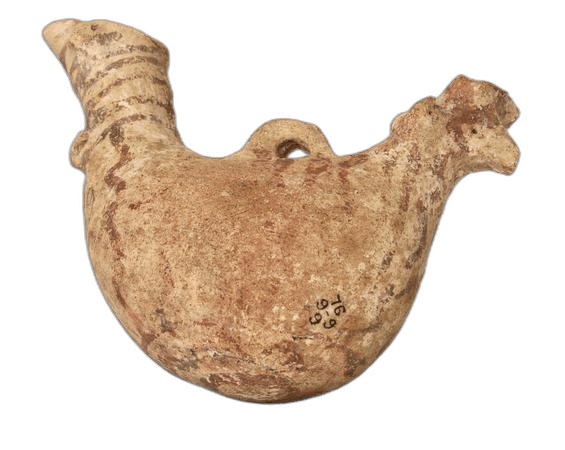 White Painted Bird AskosMiddle Bronze Age II · 1850–1650 BC
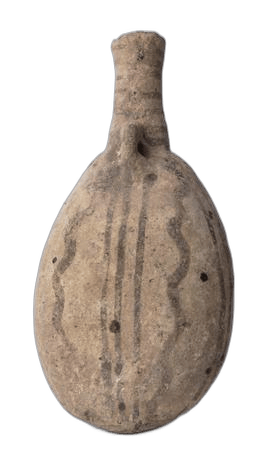
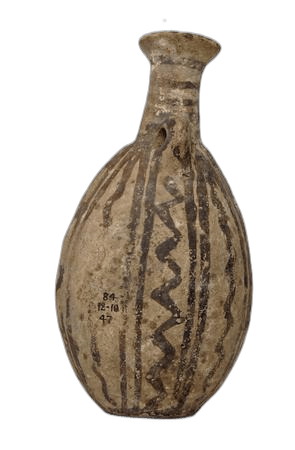 White Painted Pendent BottleMiddle Bronze Age II · 1850–1650 BC
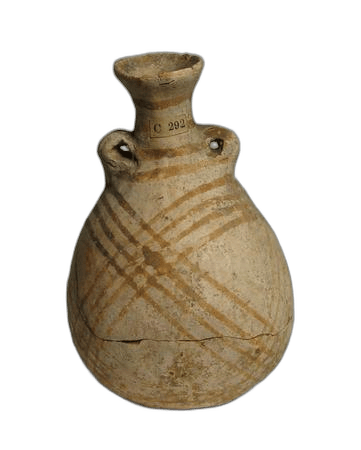 White Painted Cross Line BottleMiddle Bronze Age III · 1750–1550 BC
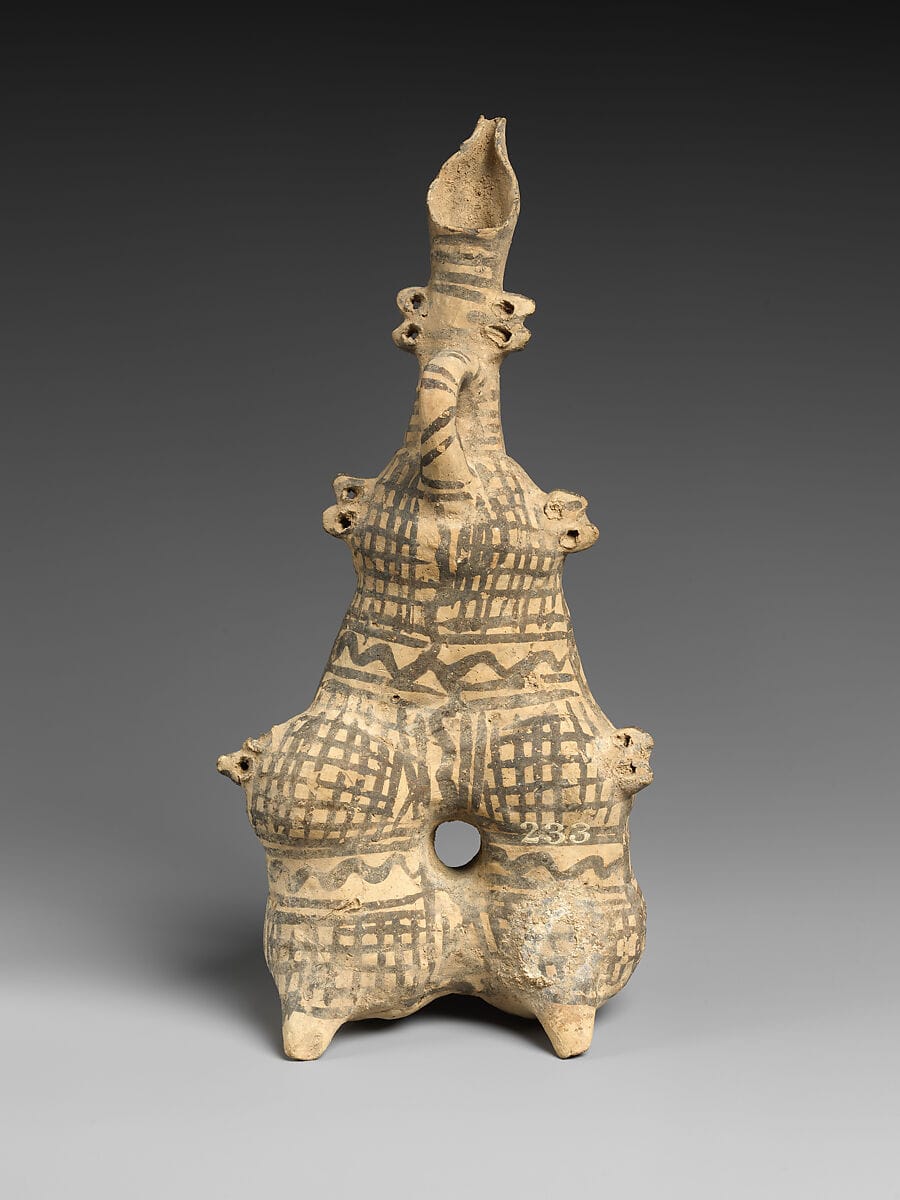 Terracotta composite jugMiddle Bronze Age II · 1800–1725 BC
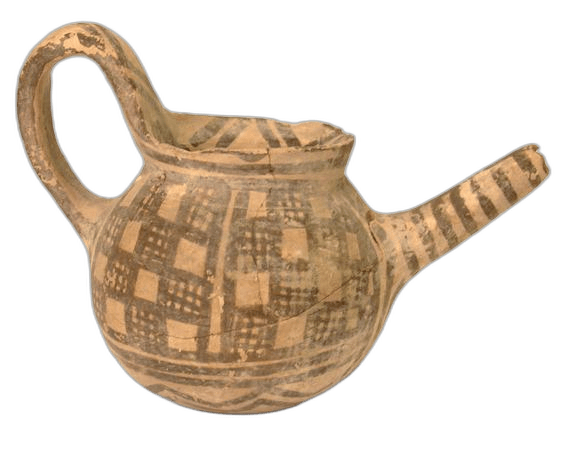 White Painted Lattice BowlMiddle Bronze Age I · 1950–1650 BC
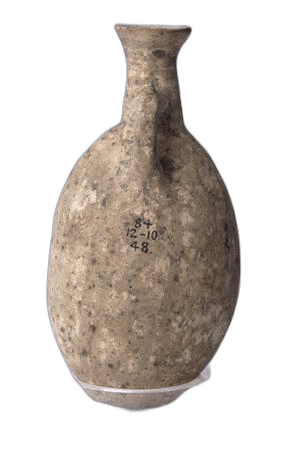
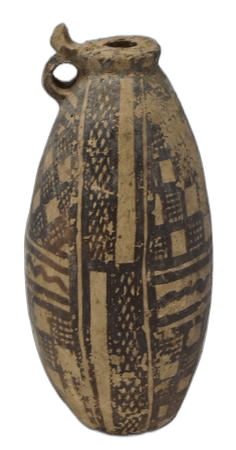 White Painted BottleMiddle Bronze Age II · 1900–1650 BC
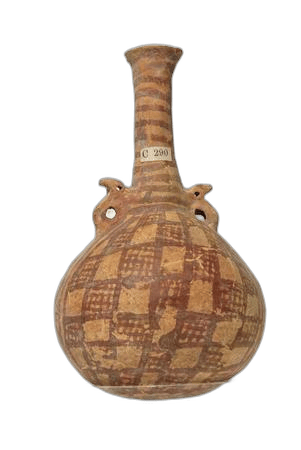 White Painted Spherical BottleMiddle Bronze Age II · 1850–1650 BC
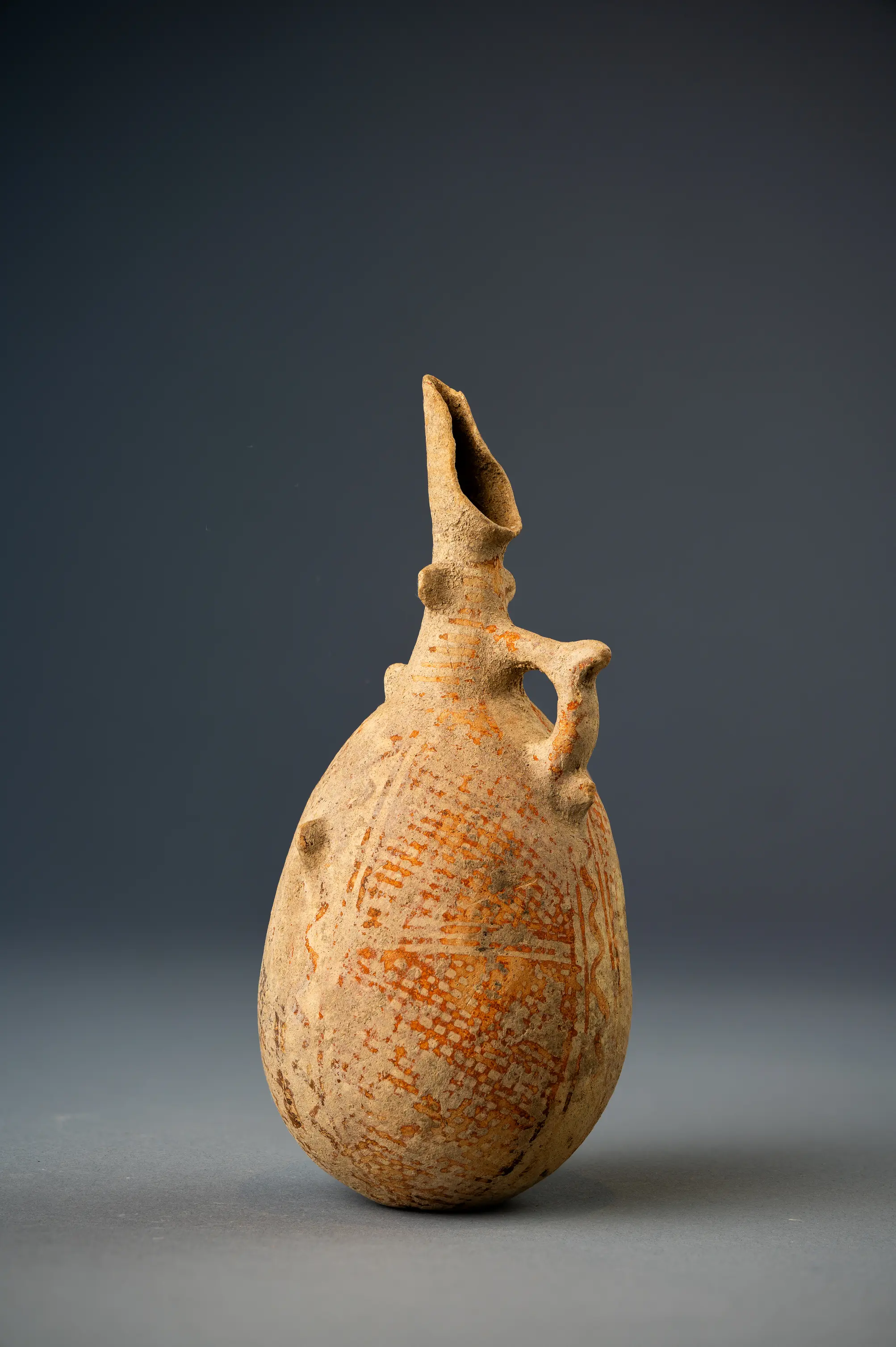 White Painted II Jug with Cut-away Neck and Lattice PanelsMiddle Bronze Age I · 2000–1800 BC
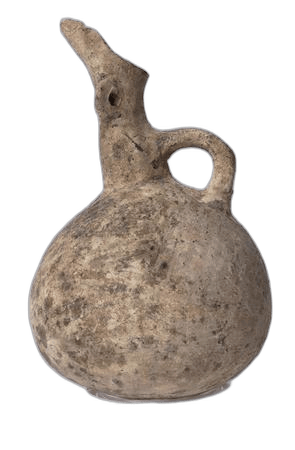 White Painted String-hole JugletMiddle Bronze Age II · 1850–1650 BC
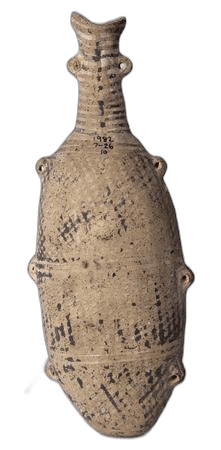 White Painted String-hole FlaskMiddle Bronze Age II · 1850–1650 BC
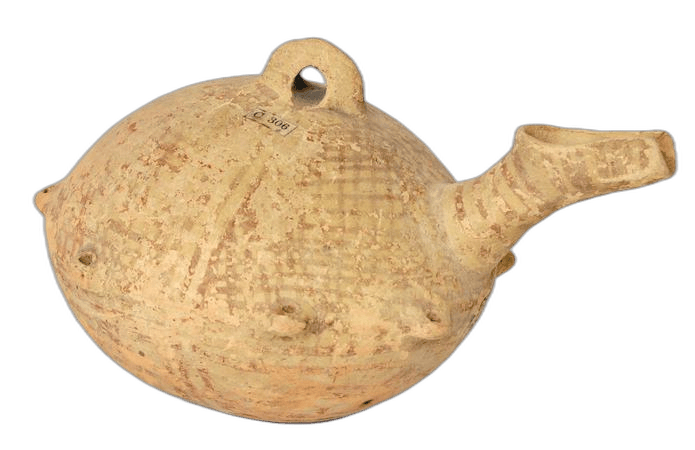 White Painted String-hole AskosMiddle Bronze Age II · 1850–1650 BC
and 4 more objects mentioned on this page
In the catalogue
References
- 1.Åström, P. (1966). Excavations at Kalopsidha and Ayios Iakovos in Cyprus (Studies in Mediterranean Archaeology 2). Lund.
- 2.Frankel, D. (1974). Middle Cypriot White Painted pottery: An analytical study of the decoration (Studies in Mediterranean Archaeology 42). Göteborg: Paul Åströms Förlag.
- 3.Pilides, D., & Papadimitriou, N. (Eds.). (2012). Ancient Cyprus: Cultures in dialogue. Department of Antiquities, Cyprus.
- 4.Gagné, L. A. C. (2012). Middle Cypriot White Painted ware: A study of pottery production and distribution in Middle Bronze Age Cyprus [Doctoral dissertation, University of Toronto].
- 5.Russell, P. J. (n.d.). A Middle Cypriot jug from Kommos, Crete. In Temple University Aegean Symposium: A compendium (pp. 615-618). Temple University.
- 6.Maguire, L. C. (1990). The circulation of Cypriot pottery in the Middle Bronze Age [Doctoral dissertation, University of Edinburgh].
- 7.Cook, B. F. (Ed.). (1979). Cypriote art in the British Museum. British Museum Publications.
- 8.Dothan, T., & Ben-Tor, A. (1983). Excavations at Athienou, Cyprus 1971-1972 (Qedem 16). Institute of Archaeology, Hebrew University of Jerusalem.
- 9.Jones, R. E. (1986). Greek and Cypriot pottery: A review of scientific studies (Fitch Laboratory Occasional Paper 1). British School at Athens.