
Archaic I
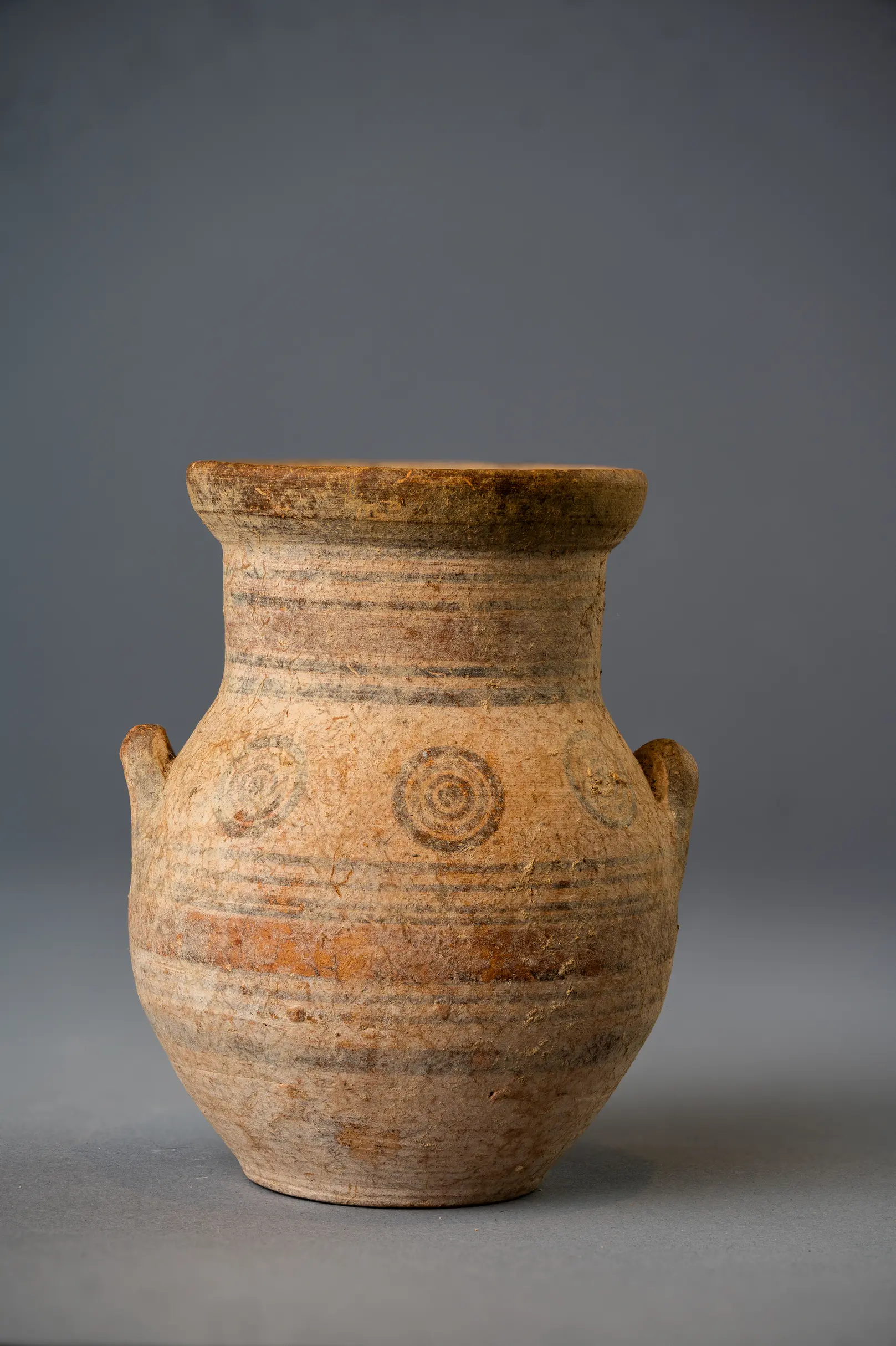
Bichrome IV Amphoriskos with Concentric Circles
Small Cypriot Bichrome amphoriskos with a disc rim and stubby shoulder handles, painted with groups of concentric circles on the shoulder and red and black bands. Cypro-Archaic I.
Date
750 - 600 BC
Accession No.
JAR-GE-003
Collection
Alexis Drakopoulos
Provenance
- 1965–1969, The Goodman Collection
- 2025–present, Alexis Drakopoulos, London
Cypro-Archaic I, c. 750–600 BCE, possibly into Cypro-Archaic II · Bichrome IV ware · Wheel-made
A small amphora with an ovoid body on a flat base, a tall cylindrical neck and a broad, flat disc rim that overhangs the neck. Two stubby upright loop handles sit on the shoulder. The buff surface shows the potter's wheel ridges clearly under the paint. The neck carries groups of fine black lines with a faded red band between them. Around the shoulder, between the handles, float isolated groups of concentric circles, each drawn with a multiple brush around a central dot. They are not all the same size, and one is sharper than its neighbours. Below them, bands of fine black lines frame a broad band of orange-red at the belly, and further lines run down to the base. The top of the rim is painted.
The surface is pitted and flaked, with patches of lost paint and fine root marks.
Commentary
The black and red on a light ground make this Bichrome ware, and the isolated concentric circles on the shoulder place it in the "circle style". Gjerstad saw the concentric circle arrive at the start of Cypro-Geometric III and become the leading ornament of Cypro-Archaic I. He assigned the circle style mainly to the western and northern workshops around Marion and Lapithos, against the rectilinear and lotus style of the east and south [2]. The handles stand on the shoulder, and the small scale makes the vessel an amphoriskos.
Bichrome stage numbers track the period, so Bichrome IV corresponds to Cypro-Archaic I [1]. The flat disc rim, the tall neck and the circle scheme all fit that stage, conventionally c. 750–600 BCE. The start of the period is itself a negotiated figure, placed at 700, then 725, then 750 by successive scholars [3]. The close parallels come from Marion in western Cyprus. The Swedish Cyprus Expedition found Bichrome IV amphorae with circle groups on the shoulder in Marion Tomb 72 (Medelhavsmuseet, Stockholm, M.072:046, H. 14.5 cm) and Tomb 62 (M.062:036, H. 23 cm) [4]. Both came from Cypro-Archaic II contexts, which suggests the type stayed in use, or at least in circulation, after 600 BCE. A still closer match in scheme is an amphoriskos at Harvard Art Museums (1920.44.99, H. 13 cm). It came from the Cesnola collection and carries the inscription "Cyprus di Cesnola 1874" on its base, and it has concentric circles between the handles in red and dark brown paint [5]. The Marion finds agree with Gjerstad's western attribution of the style. For a piece without a find-spot, that is a regional likelihood only.
Amphoriskoi of this size are table and grave-offering vessels, containers for small quantities of oil, perfume or wine. They are common in the chamber tombs of the period.
References
- 1.Gjerstad, E. (1948) The Swedish Cyprus Expedition IV.2: The Cypro-Geometric, Cypro-Archaic and Cypro-Classical Periods. Stockholm: Swedish Cyprus Expedition, chapter on the pottery (White Painted and Bichrome wares).
- 2.Gjerstad, E. (1948) The Swedish Cyprus Expedition IV.2. Stockholm: Swedish Cyprus Expedition, chapter on the pottery (the western circle style and the eastern style).
- 3.Núñez, F.J. (2018) 'The beginning of the Cypro-Archaic I period: a revision proposal', in Beyond Cyprus (AURA Supplement 9). Warsaw, pp. 352–355.
- 4.Medelhavsmuseet, Stockholm, M.072:046 (Marion Tomb 72, H. 14.5 cm) and M.062:036 (Marion Tomb 62, H. 23 cm), amphorae of Bichrome IV ware from Cypro-Archaic II contexts, museum records.
- 5.Harvard Art Museums, Cambridge, MA, 1920.44.99, amphoriskos, gift of Elizabeth Gaskell Norton and Margaret Norton, 1920, museum record.
More from the Catalogue
Browse related objects
Amphora
Archaic II
Amphora
Geometric I
Amphora
Archaic II
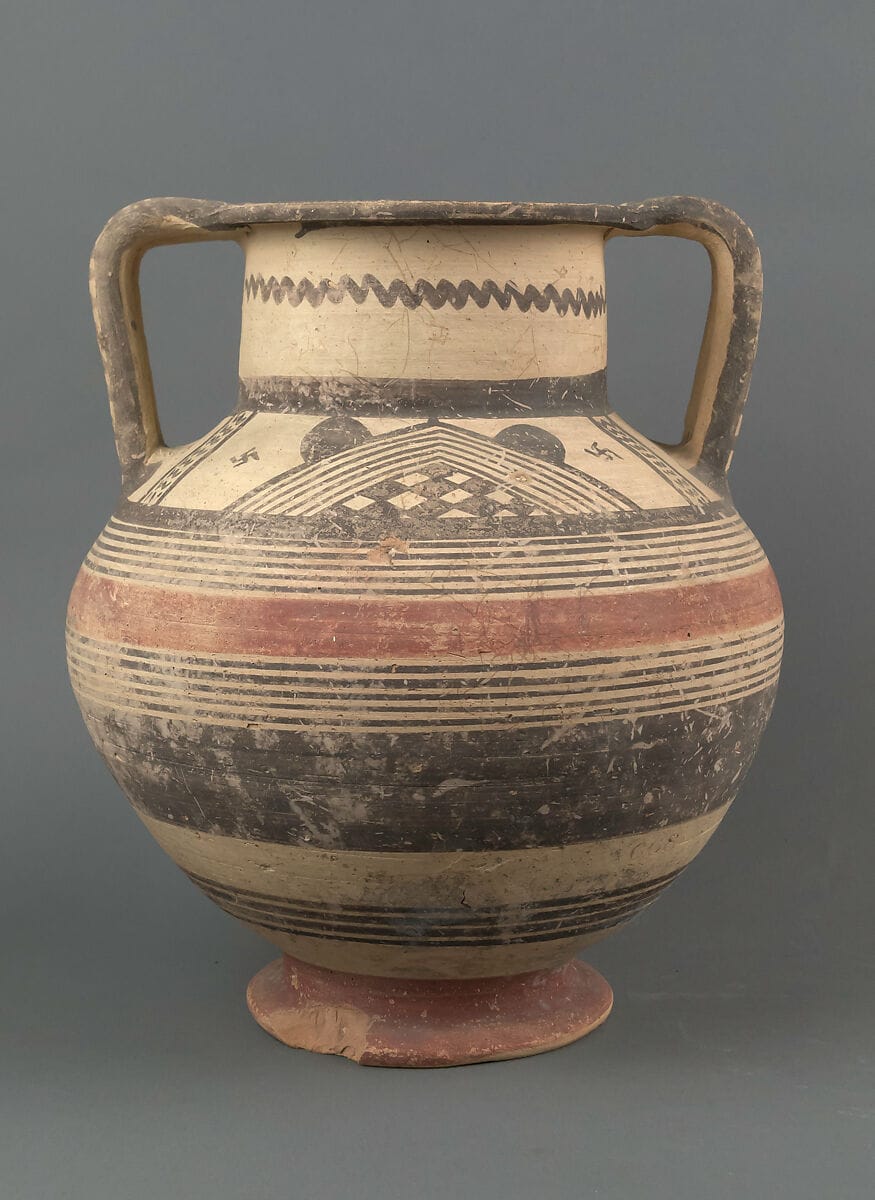
Amphora
Archaic I
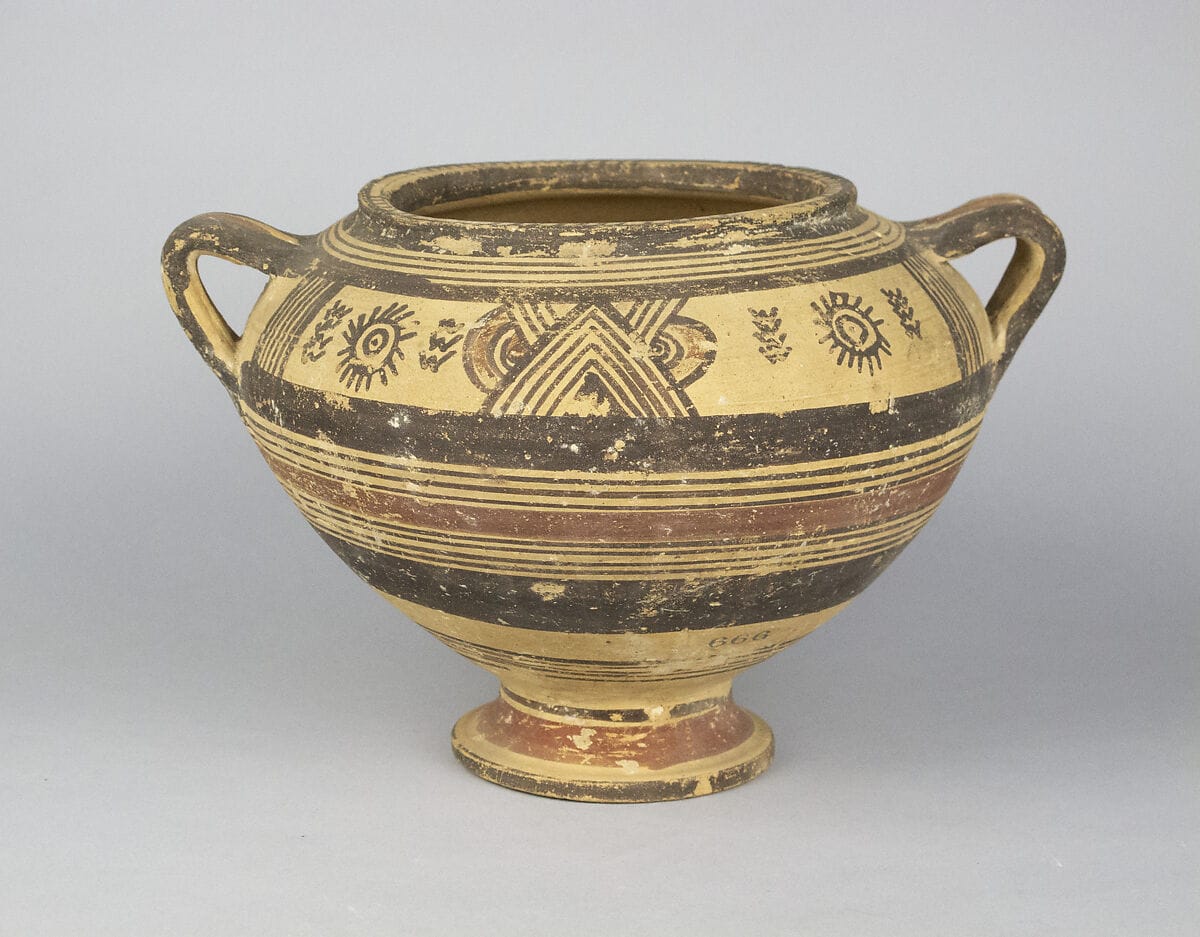
Dinos
Archaic I
Amphoriskos
Geometric III
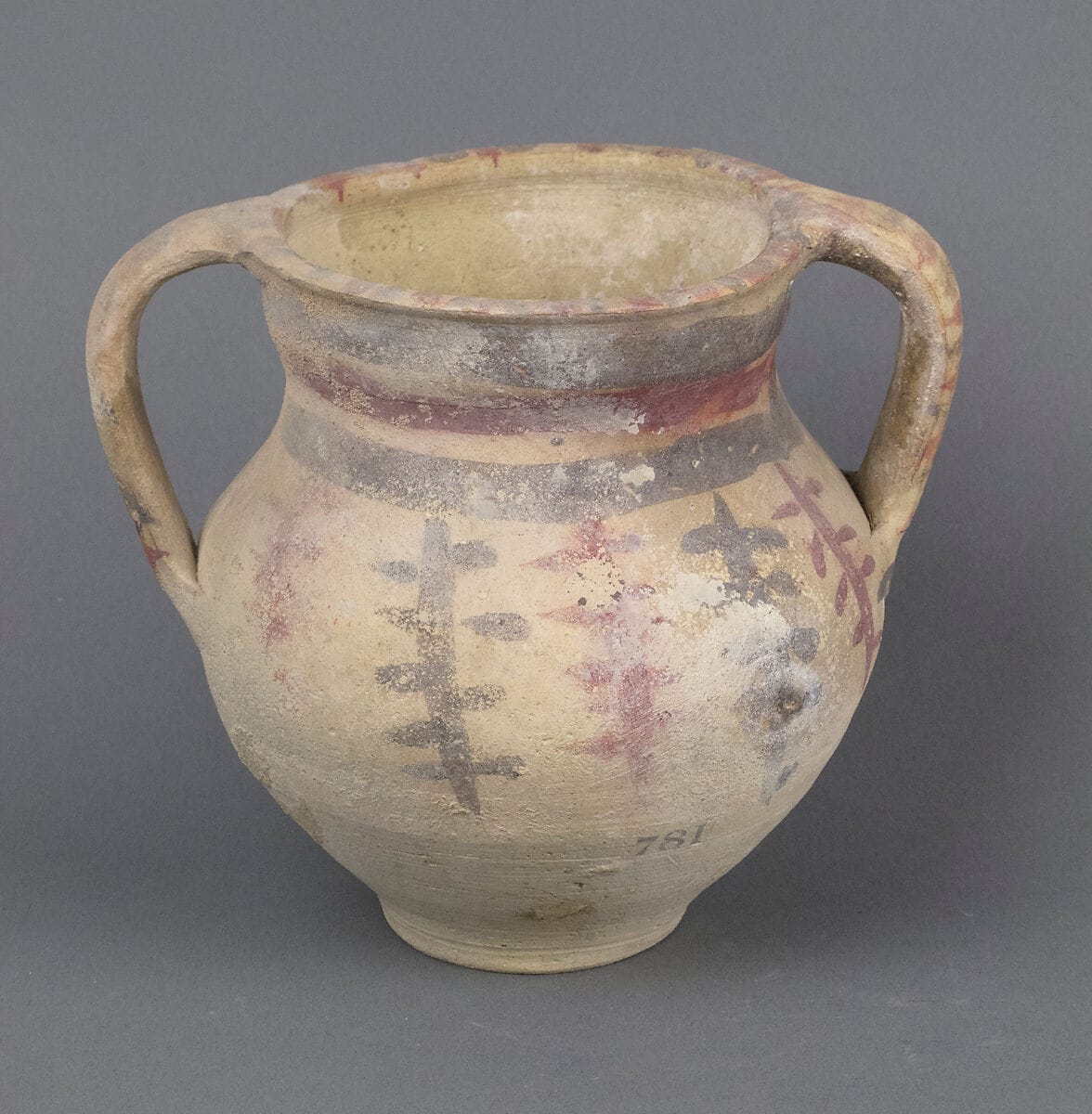
Amphoriskos
Archaic II
Limestone statuette of a boy holding an amphora
Hellenistic
Terracotta krater
Late Bronze Age III
Krater
Geometric I
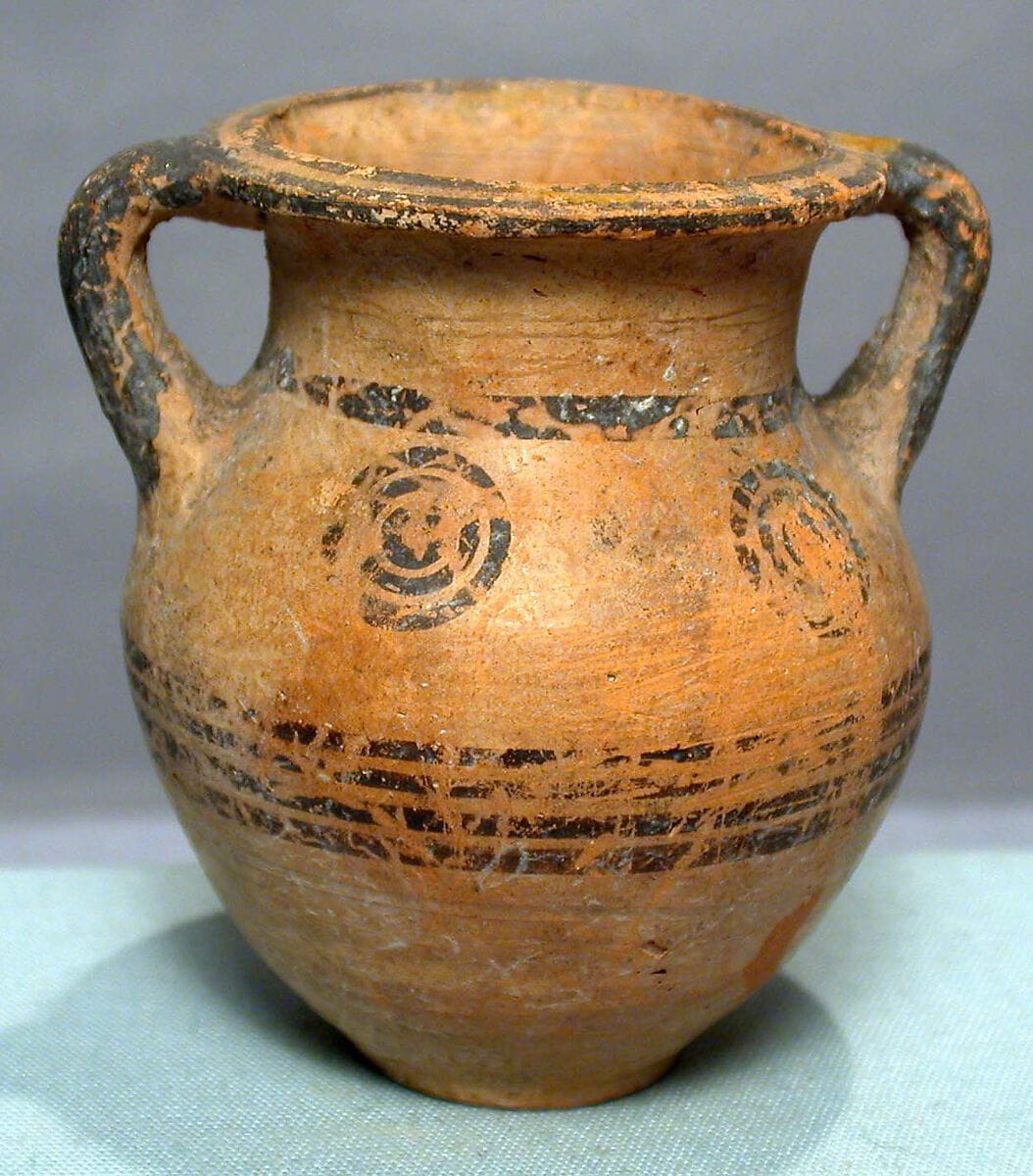
Terracotta miniature amphora
Geometric III
Amphora
Late Bronze Age III
Amphora
Archaic II
Krater
Late Bronze Age III
Dinos
Archaic I
Amphora
Archaic
Terracotta amphora
Middle Bronze Age II
Amphora
Bronze Age