
Contents
A rosette is a flower seen from above: a central dot or disc with petals, leaves or dots radiating evenly round it. On Cypriot painted pottery it is one of the ornaments that arrive, or arrive again, at the start of Cypro-Archaic I. Einar Gjerstad listed "the guilloche and rosette pattern, the network of rosettes, the open palmette, sacred tree, and lotus ornaments" among the decorations of that phase that were "of Oriental derivation" [1, p. 182]. The same flower had been carved on ivory, cast in metal and stamped on gold in Cyprus for centuries before potters began to paint it, so the motif has two histories that meet in the seventh century BC.
This entry covers the rosette as a pattern on vases and, more briefly, on the other objects that carry it. The lotus flower, whose centre is sometimes filled with a rosette, has its own entry under Lotus Flowers. You can see all rosettes in the catalogue: more than sixty objects, from Late Bronze Age ivories to Archaic earrings.
Telling one rosette from another
Gjerstad separated several kinds of rosette in the Iron Age pottery of Cyprus, and his distinctions are still the simplest way to describe what is on a pot [1, pp. 183, 192].
| Type | Description | Date in Cyprus | Source suggested by Gjerstad |
|---|---|---|---|
| Solid eight-leaved rosette | Eight solid petals round a centre | Cypro-Archaic I onward | Assyrian type, probably transmitted from Syria |
| Network of six-leaved rosettes | Rosettes linked into an all-over net | Cypro-Geometric III B onward | Assyria and Phoenicia |
| Rosette in concentric circles | Rosette framed by rings | White Painted I; again from Cypro-Archaic I | Mycenaean, later Cycladic |
| Rosette metope | Rosette set between vertical guilloche bands | Cypro-Archaic I | Textile and Near Eastern ornament |
| Dot rosette | Ring of dots round a central dot | Iron Age | Listed among Rhodian-group ornaments |
The solid eight-leaved rosette is the commonest. Gjerstad noted that "the Assyrian rosettes have often more than eight leaves", but he took "only the eight-leaved rosette into consideration, since that type is the one represented in Cyprus" [1, p. 183]. The network of six-leaved rosettes, in which each flower shares its petals with its neighbours to form an all-over pattern, was in his words "a popular ornament in Assyria and Phoenicia" and also appears on the metal bowls of the period and on the painted dress of terracotta statues [1, p. 183]. The rosette inscribed in concentric circles belongs to an older, Aegean line, discussed below.
On a vase the rosette is easy to confuse with three neighbours. A lotus flower seen in profile may have its centre "latticed or decorated with a rosette" [1, p. 189], in which case the rosette is part of the flower and belongs to the lotus. A star has pointed rays without a central disc. A set of concentric circles with a dotted or petalled centre counts as a rosette in circles only when the inner unit has distinct petals or dots arranged round a hub.
Before the painted rosette
The motif was known in Cyprus long before Archaic potters used it. Gjerstad pointed out that the rosette "is represented in Late Cypriote and used to decorate specimens of the metal work. It is also found on gold discs from Cypro-Geometric I-III, so that the ornament is continuously represented in Cyprus from the Late Bronze Age to Cypro-Archaic I, when it appears in the decoration of the pottery" [1, p. 183].
The Late Bronze Age evidence is mostly small and precious. Engraved ivory discs are "the most common object of ivory found in Late Cypriot II-III tombs" [2, p. 83], and several in the Cesnola collection carry a rosette. The Metropolitan Museum's ivory disk 74.51.5216, of hippopotamus ivory and 5.6 cm across, is dated c. 1600 to 1050 BC, and appears in the catalogue as Ivory disk with rosette; a smaller disc of 5.1 cm (74.51.5220) is another of the set. A gypsum ladle held by a nude girl, of Late Cypriot III (c. 1200 to 1050 BC) and said to come from Amathus, has "a rosette in relief" at the bottom of its bowl (Met 74.51.5119) [2, p. 88]. Cylinder seals of the fourteenth and thirteenth centuries show a lion beneath a dot rosette beside a sun disc in a crescent, with related seals from Alassa, Hala Sultan Tekke and Minet el-Beida [2, p. 83].
The rosette in concentric circles has a separate pedigree. Gjerstad traced it to Mycenaean tradition: it survives in White Painted I of the early Cypro-Geometric period, then disappears, and returns at the beginning of Cypro-Archaic I. For the reintroduction he thought Cycladic, specifically Theran, influence more likely than Rhodian [1, p. 192]. By Cypro-Geometric III the influence of the Eastern style was already visible in the circle style of the west through "the intrusion of lotus and rosette ornaments" [1, p. 52].
The rosette on Cypro-Archaic Bichrome
In Cypro-Archaic I the rosette becomes a regular part of the painter's repertoire, above all in Bichrome ware, where black outlines and red fills suit a petalled flower. Rosettes also appear in the repertoire of Bichrome Red. Gjerstad observed that the rosette is "often syntactically combined with vertical guilloche bands into a metope pattern" [1, p. 183]: the frieze is divided into panels, and a rosette fills alternate panels between bands of other ornament.
.](https://cdn.ancientcyprus.com/collections/drakopoulos/archaic/DSH-AR-001_13.webp)
The large Bichrome plate from Salamis in the Drakopoulos collection shows the metope scheme at a large scale. It is 53 cm across and dates to Cypro-Archaic I to II. Inside a rim band of breaking waves runs a frieze of metopes in which eight-petalled rosettes alternate with chequer and cross-hatched panels; narrower bands of dog-tooth, lattice and hatched triangles follow, and a broad ring frames a central tondo that once held a figured scene. Here the rosette panels alternate with lattice and chequer panels in place of guilloche, a variant of the same metope syntax. The plate was reassembled from large fragments and one sector of its painting is a modern restoration; the rosette frieze elsewhere is ancient. It is attributed to the workshops of Salamis on the east coast.
The Cesnola collection in New York has several rosette-decorated Bichrome vessels of the same phase, among them a dinos 26.8 cm high dated 750 to 600 BC (Met 74.51.444), a smaller dinos of 17.5 cm (Met 74.51.448) and an amphora (Met 74.51.445). See also the amphora entry for the shape. In the free-field painting of the same period, small rosettes also serve as filling ornament round a principal figure (see Free-Field Art).
Where the pattern came from
Gjerstad weighed two explanations. The first is continuity: the rosette was already present in Cyprus on metalwork and gold from the Late Bronze Age through the Cypro-Geometric period, so potters could have borrowed it from local goldsmiths and ivory carvers. The second is renewed contact with the east. He concluded that the painted pottery rosette was "more likely of foreign derivation", reflecting fresh influence from Syria, where the eight-leaved rosette was "a characteristic Assyrian ornament, which is also represented in Syrian art" in the first millennium BC [1, p. 183]. He was careful to say that the ornament was not originally Assyrian: "it occurs in Egypt already at the time of the Old Kingdom, and is also represented in Mycenaean art" [1, p. 183].
Textiles are the likely intermediary. Gjerstad pointed to similar ornaments painted on the dress of terracotta sculptures and argued that the rosette-and-guilloche metope behaves like a unit of woven or embroidered pattern transferred to clay [1, p. 183]. In the Archaic period, he wrote, Cyprus and Syria "formed in many respects one single area of culture" [1, p. 182], and the arrival of the rosette alongside the lotus, the palmette and the sacred tree fits that picture. The Phoenicians and the Neo-Assyrian Empire entries describe the political setting.
The rosette also travelled west. A solid rosette of eight or more leaves appears in Proto-Corinthian, Proto-Attic, Theran and Rhodian art, and its derivation from Assyrian art is "generally agreed". Whether Cyprus played a part in passing it to the Greek world, Gjerstad judged, "it is impossible to say" [1, p. 190]. He did think the Cypriot lotus, with its recurved petals and rosette centre, influenced the Rhodian lotus [1, p. 189].
Rosettes beyond pottery
The rosette is common outside pottery as well. In Archaic limestone sculpture, "young beardless male figures, characterized as princes, wear typical Cypriot short trousers, often decorated with a rosette in relief ... and a diadem, also adorned with rosettes" [2, p. 121]. The examples Karageorghis cites, of the early and mid-sixth century BC, are said to come from the sanctuary at Golgoi, though their heads may not belong to their bodies [2, p. 121]. The catalogue's limestone head of a beardless male with a diadem, also from the Cesnola collection, belongs to the same family of diademed youths. The polychromy of such diadems is discussed under Limestone Polychromy.
Metalwork carries the motif too. A silver bowl of c. 675 to 625 BC, said to be from Kourion, has a rosette medallion at its centre framed by a lotus frieze and a band of sphinxes and griffins, and a Cypriot syllabic inscription naming its owner (Met 74.51.4552) [2, p. 200]. A bronze mace head from the Kourion Treasure is ribbed on its sides as a "convex eight-petaled rosette", a Near Eastern type (Met 74.51.5594) [2, p. 179]. Gjerstad records rosette-shaped beads, pendants and amulets in Archaic tombs, double-cylindrical beads with rosette ornament and a cloisonné rosette bracelet with lion-head end plates [1, pp. 120-125]. The electrum earring with lobes and rosettes in the Metropolitan Museum (74.51.3248, sixth century BC) is a small Cypriot example. More on jewellery metals is in Metals Beyond Copper, and on dress ornament in Clothing and Dress.
What the rosette meant
The rosette is sometimes read as a sun, a star or a goddess's flower. None of the works cited here gives it such a meaning in Cyprus. Gjerstad treats it as ornament: a pattern of Near Eastern derivation that moved between textiles, metalwork and painted pottery, and that was used to fill metopes, frame figures and decorate the centres of bowls [1, pp. 182-183]. On the diadems and trousers of the figures Karageorghis calls princes it is part of a costume, and the sculptures themselves say nothing about whether the flower carried a further sense. Until a context ties it to a specific cult or deity, the safest reading is decorative.
In short
The rosette was present in Cyprus from the Late Bronze Age on ivory, seals, metal and gold. On painted pottery, apart from the concentric-circle rosette of White Painted I, it becomes common only in Cypro-Archaic I, chiefly in Bichrome ware, as a solid eight-leaved flower, a network of six-leaved flowers or a metope filler. Gjerstad derived the painted form from Syrian and Assyrian ornament, probably by way of textiles, while recognising its local antecedents. For related ornaments see Lotus Flowers, Plants, Circles and the Motifs overview.
Objects on this page
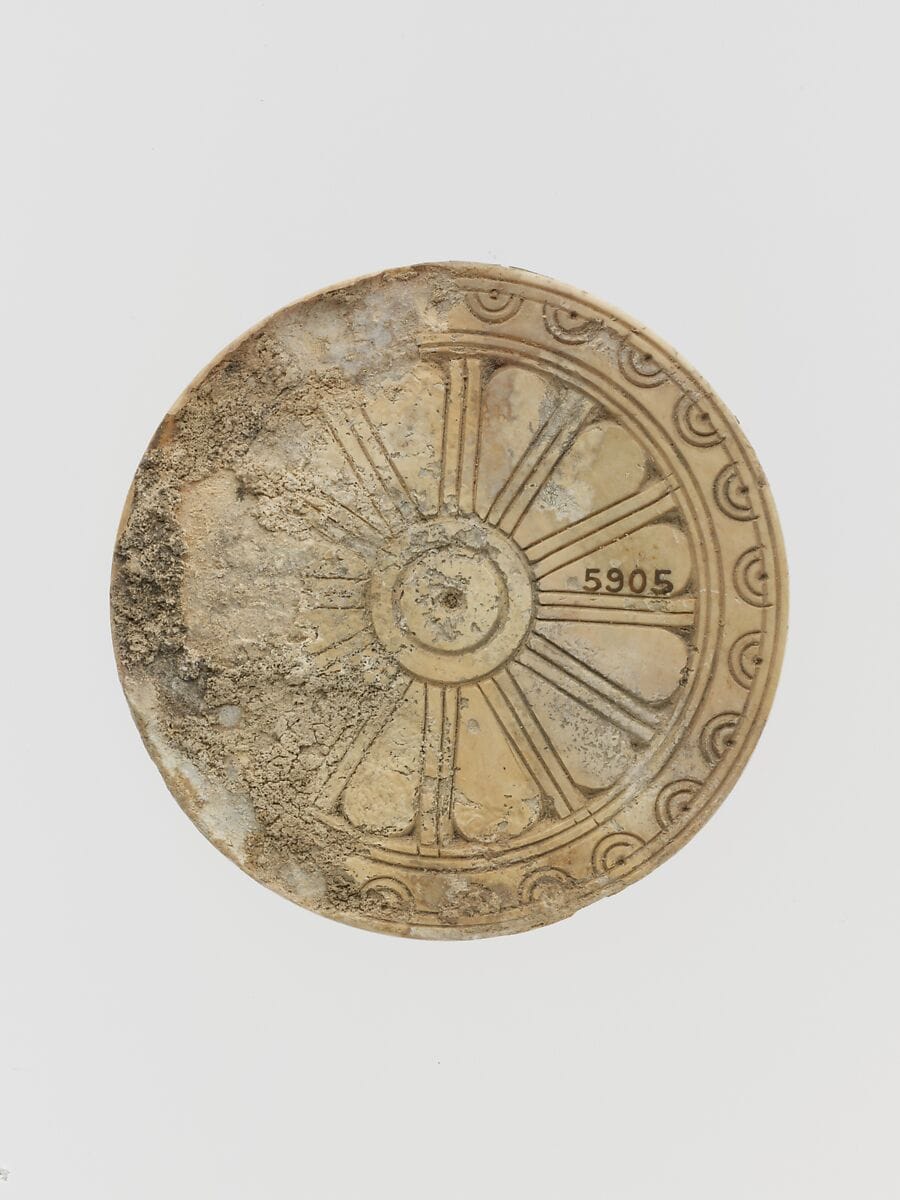 Ivory disk with rosetteLate Bronze Age II · 1600–1050 BC
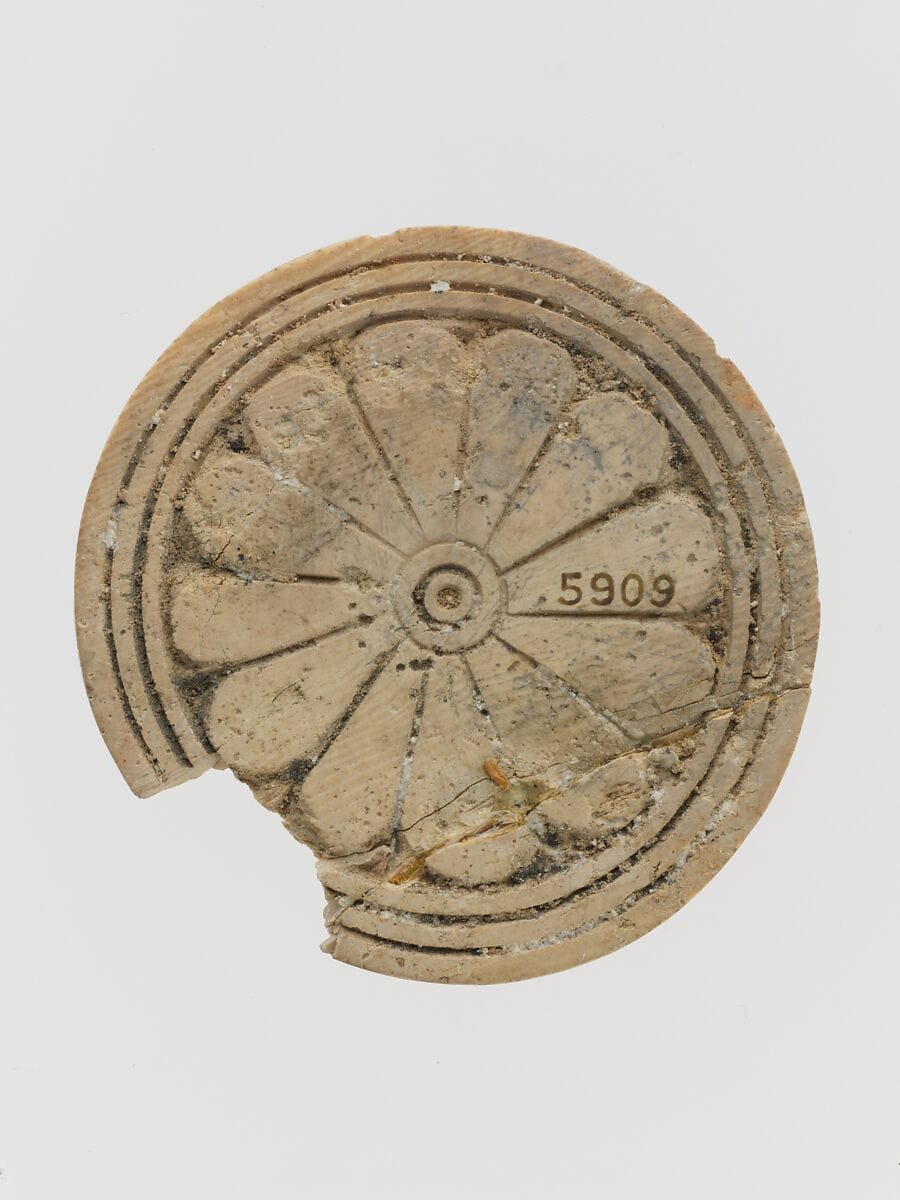 Ivory disk with rosetteLate Bronze Age II · 1600–1050 BC
- Large Bichrome Plate from Salamis with a Wave Band and Rosette MetopesArchaic I · 700–550 BC
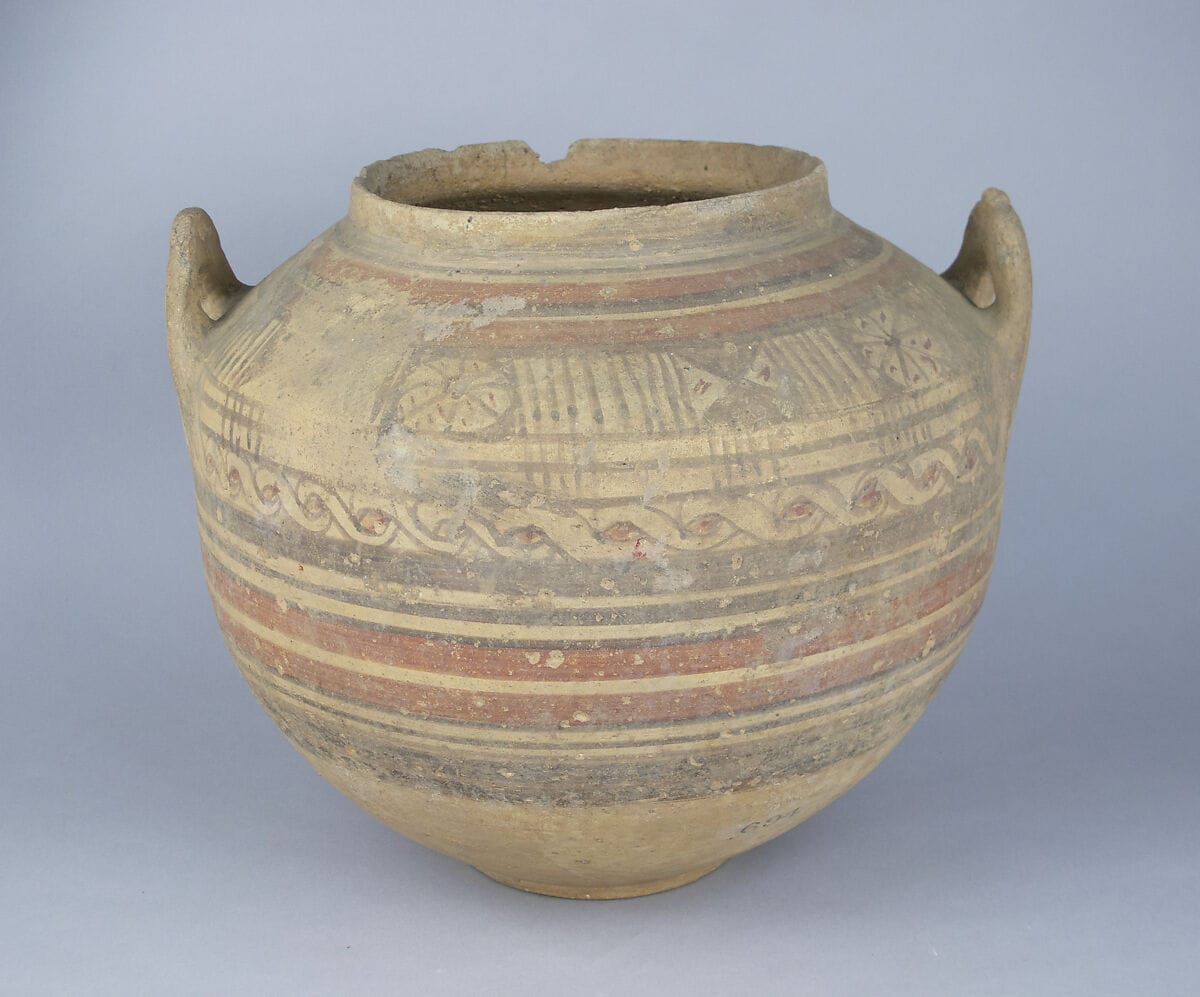 DinosArchaic I · 750–600 BC
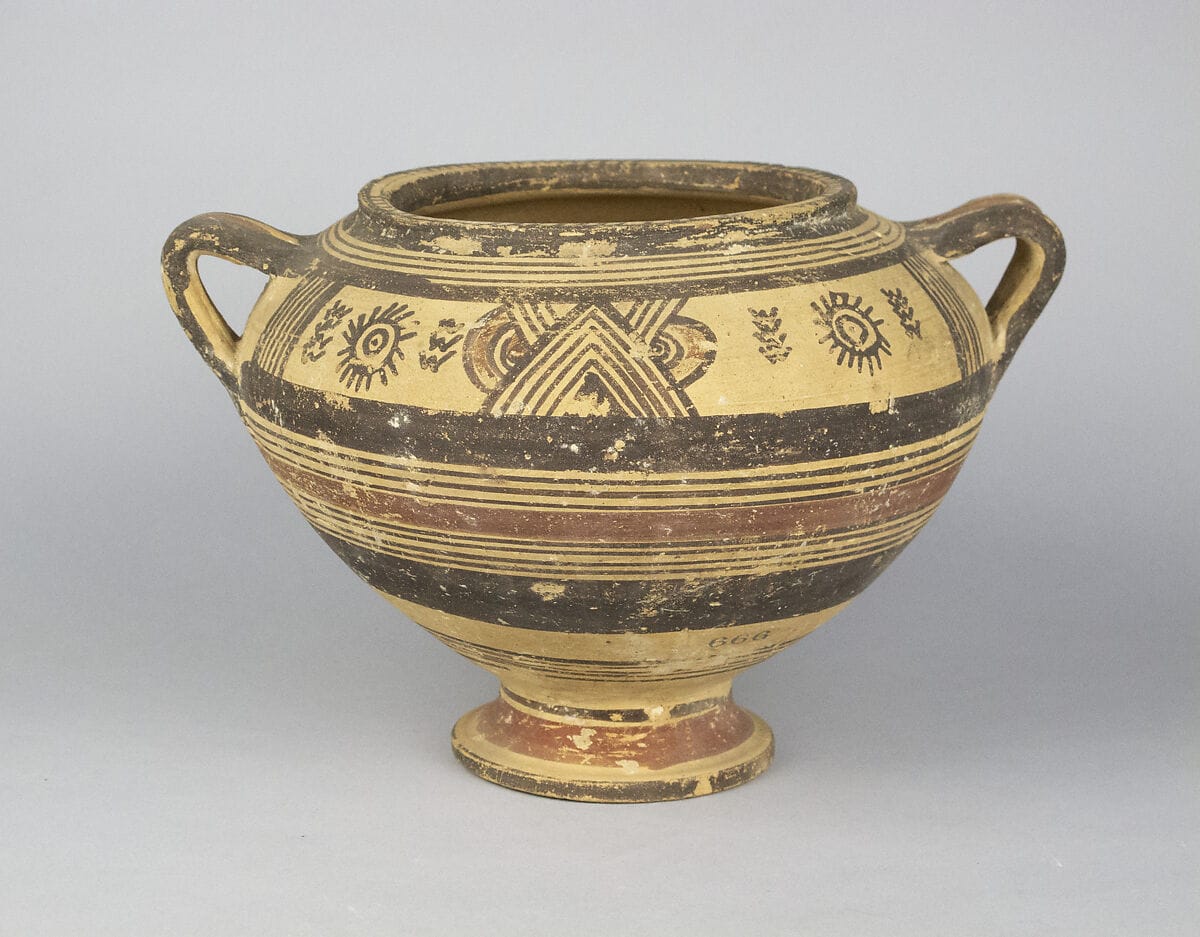 DinosArchaic I · 750–600 BC
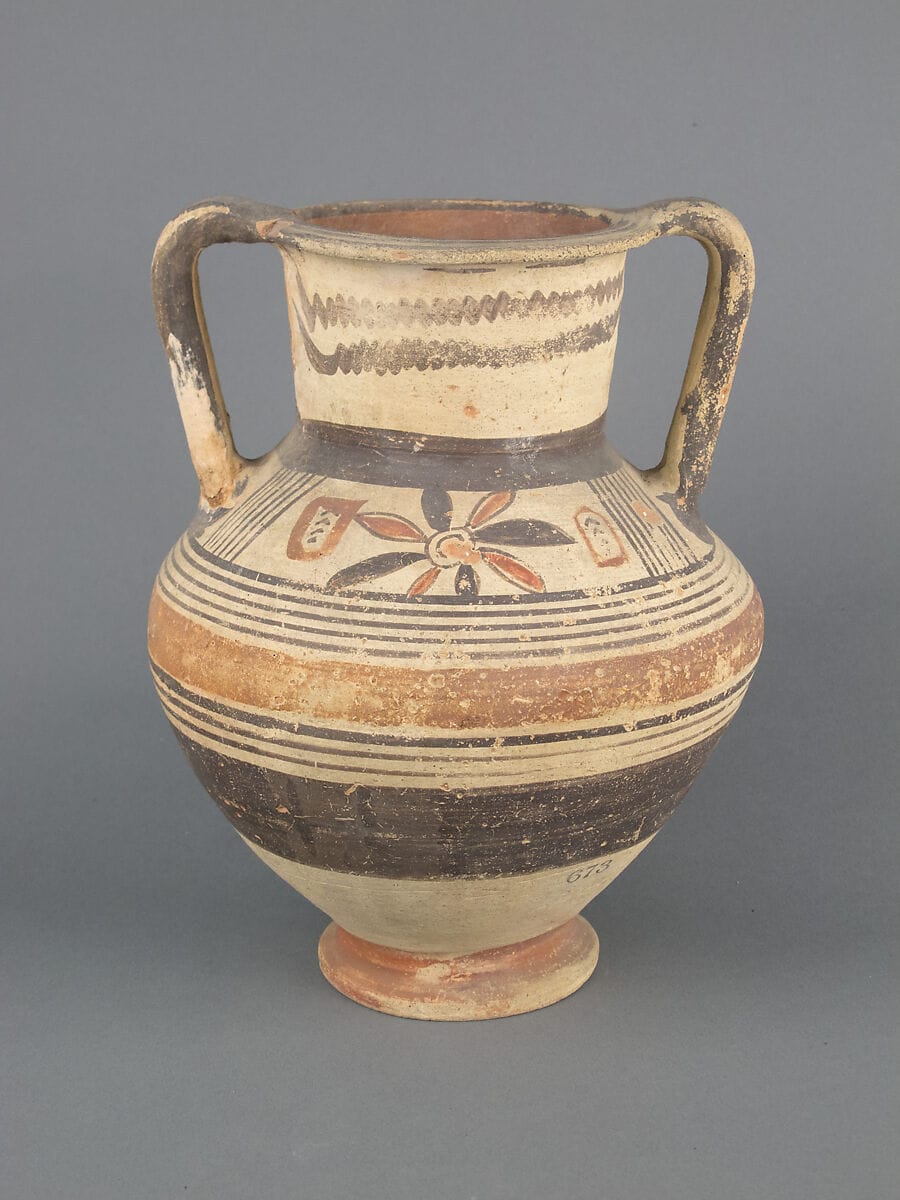 AmphoraArchaic · 750–480 BC
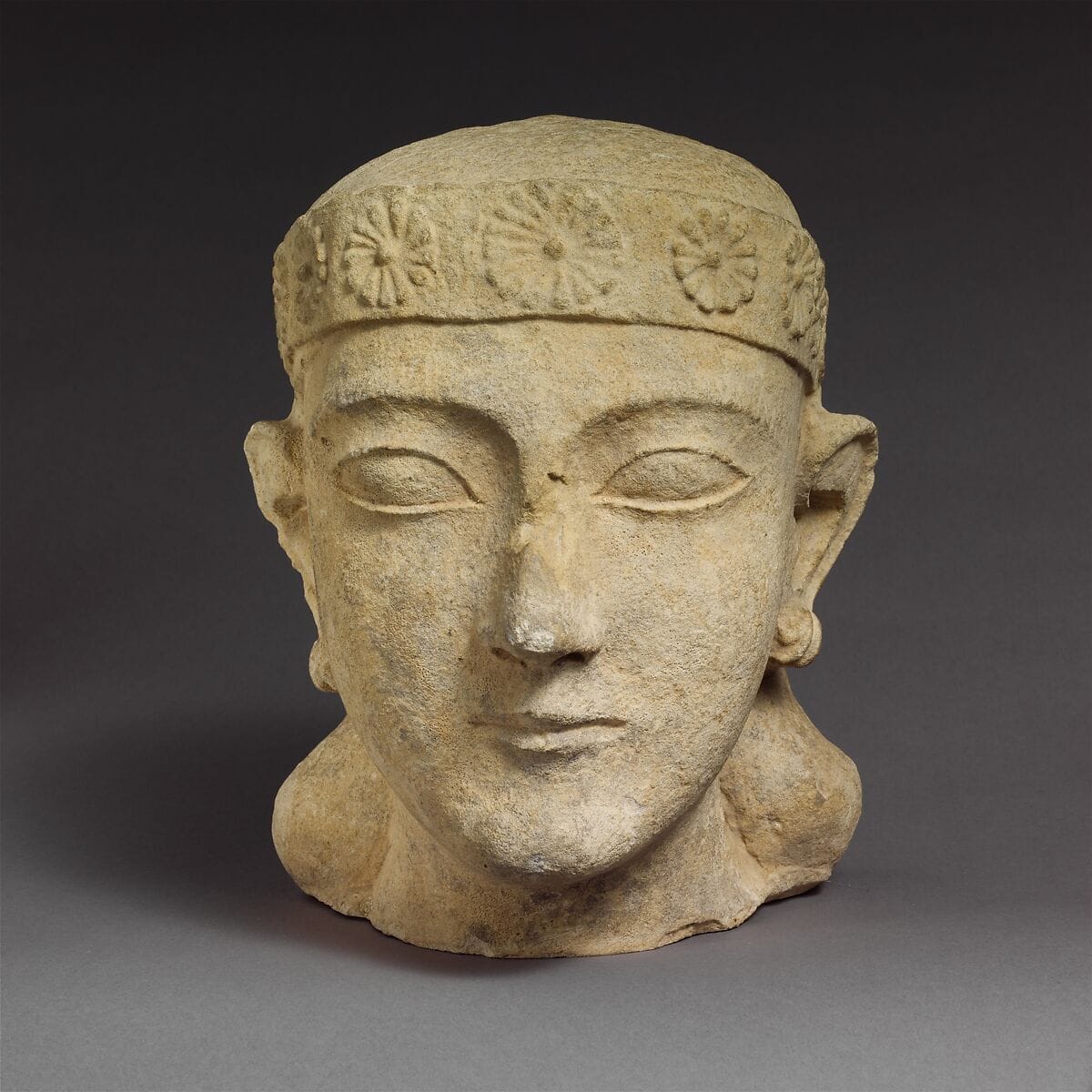 Limestone head of a beardless male with a diademArchaic II · 560–540 BC
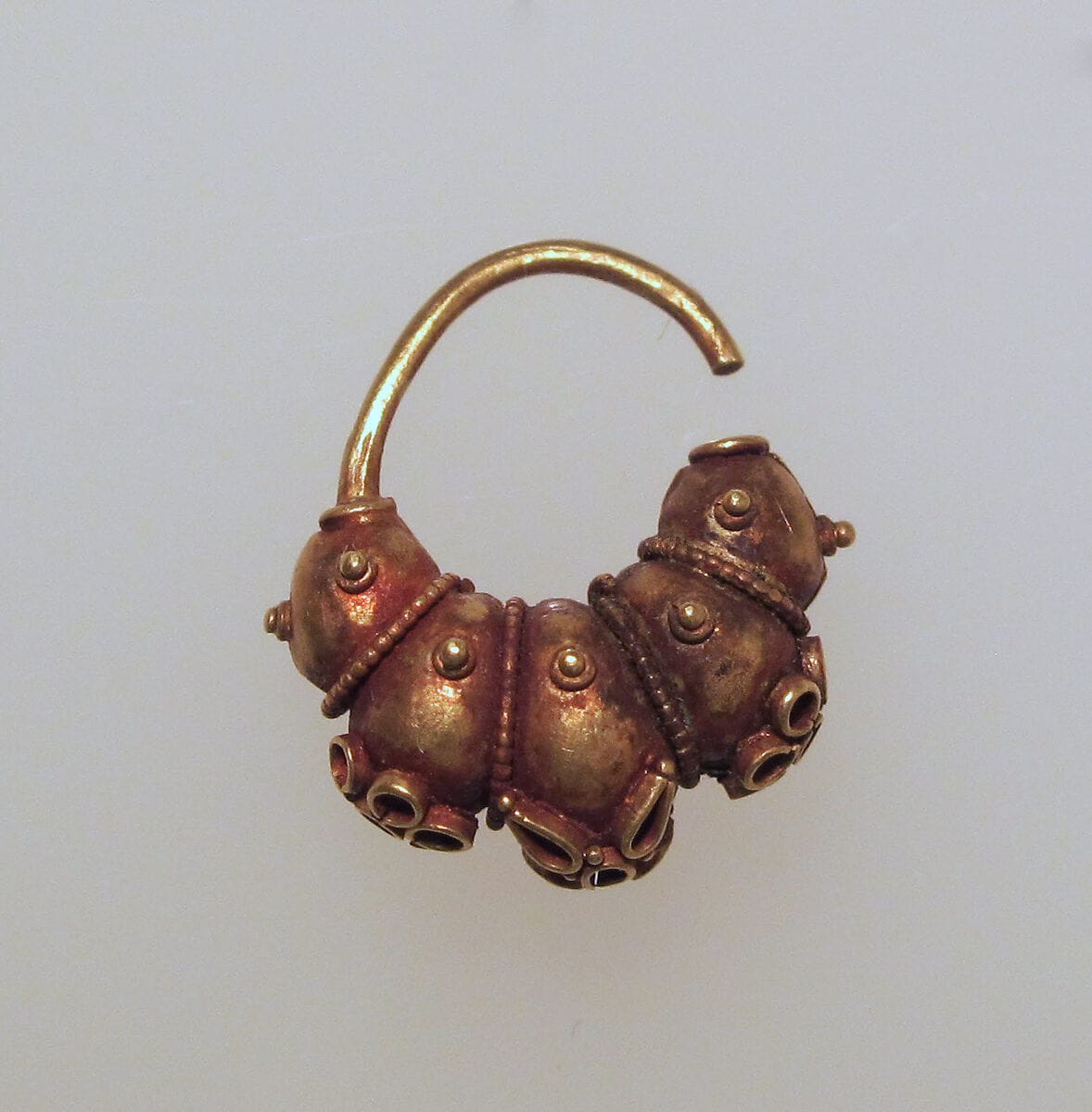 Electrum earring with lobes and rosettesArchaic II · 599–500 BC
In the catalogue
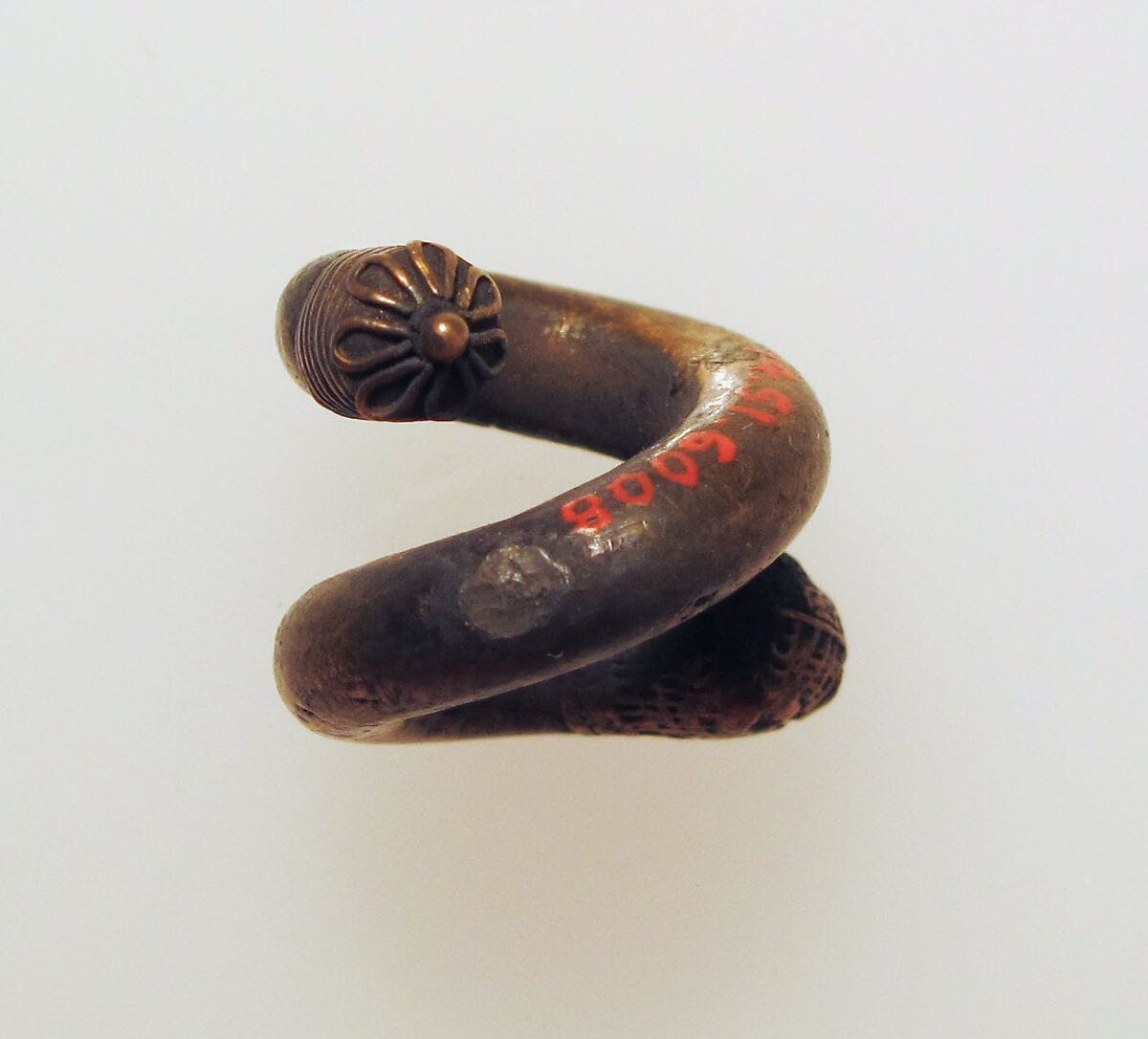
References
- 1.Gjerstad, E. (1948). The Swedish Cyprus Expedition, Vol. IV, Part 2: The Cypro-Geometric, Cypro-Archaic and Cypro-Classical Periods. Stockholm: The Swedish Cyprus Expedition.
- 2.Karageorghis, V., Mertens, J. R., & Rose, M. E. (2000). Ancient Art from Cyprus: The Cesnola Collection in The Metropolitan Museum of Art. New York: The Metropolitan Museum of Art.