
Contents
On a limestone finial in the Metropolitan Museum, carved in the second quarter or middle of the sixth century BCE, a lion and a bearded male sphinx sit back to back. The sphinx wears the double crown of Egypt, and traces of red and blue paint survive on its wings [1, p. 271]. Antoine Hermary and Joan Mertens read the pairing as political: "The sphinx being an image of the Egyptian pharaoh's supernatural power and the lion the royal animal par excellence, the iconography seems to be associated with the glorification of the ruler" [1, p. 272]. The piece (see it here) sums up this group of creatures in Cyprus: borrowed from Egypt and the Near East, attached to kings, tombs and sanctuaries, and carved, cast, engraved and painted in every medium the island used.
This entry sits among the pottery motifs, and it starts from the vases, but the vases are a small part of the story. Most of the lions, sphinxes and griffins in the site's catalogue are Archaic and Classical limestone sculptures, silver bowls and gold jewellery from the Cesnola Collection. Painted sphinxes on Cypro-Archaic pots are treated more fully under Free-Field Art, and sphinx thrones under Furniture. No piece in the Drakopoulos collection carries any of these creatures.
Lions
In Cypriot sculpture the lion appears from the Archaic period on. Einar Gjerstad, sorting the limestone lions that Luigi Palma di Cesnola had published, called two of them "evidently the earliest hitherto found" and assigned them to his Proto-Cypriote style, with later lions in the Neo-Cypriote, Archaic Cypro-Greek and Sub-Archaic styles [2]. He also argued that "the Proto-Cypriote type of lion" travelled from Cyprus to other parts of the Mediterranean [2]. A crouching limestone lion in the Met, 74.51.2637, is dated about 700 to 650 BCE.
Guardians of tombs. The clearest context comes from Politiko, ancient Tamassos. Four lions and two sphinxes, late seventh century BCE, were found near three built "royal" tombs, and were "probably funerary statues placed in pairs at the entrances" [6, p. 103]. The lion now in the Cyprus Museum (1997/VII-15/5) stands 71 cm high. Its mouth gapes with the tongue hanging out "in an apotropaic fashion," and much of its paint survives: red for the eyes, ears, tongue and gums, blue for the mane. The back was left unworked, so it was made to be seen from the front [6, p. 103]. Hermary and Mertens add a caution that applies to many Cypriot lions: the Tamassos statues' "findspots did not necessarily correspond to their original locations" [1, p. 272].
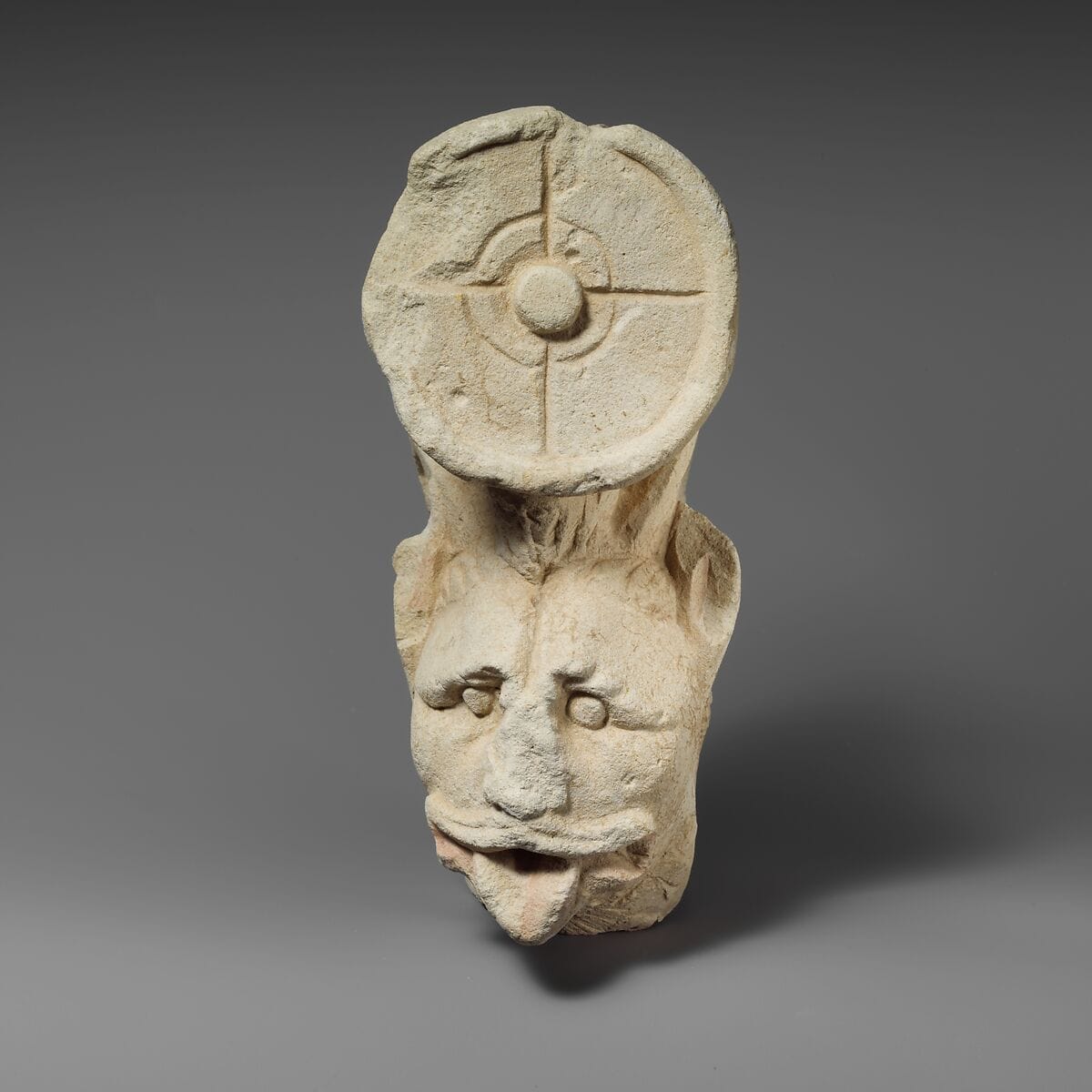
Crowning stelai and columns. Lions also sat on top of monuments. Besides the lion-and-sphinx finial, the Met holds lion heads from the same reported findspot, among them 74.51.2635 (late sixth or early fifth century BCE), which Hermary and Mertens think came from votive stelai or columns [1, p. 272]. The findspot itself, the sanctuary of Golgoi-Ayios Photios, is marked with a query: Cesnola confused sanctuary and necropolis finds elsewhere, and his attributions are often unreliable.
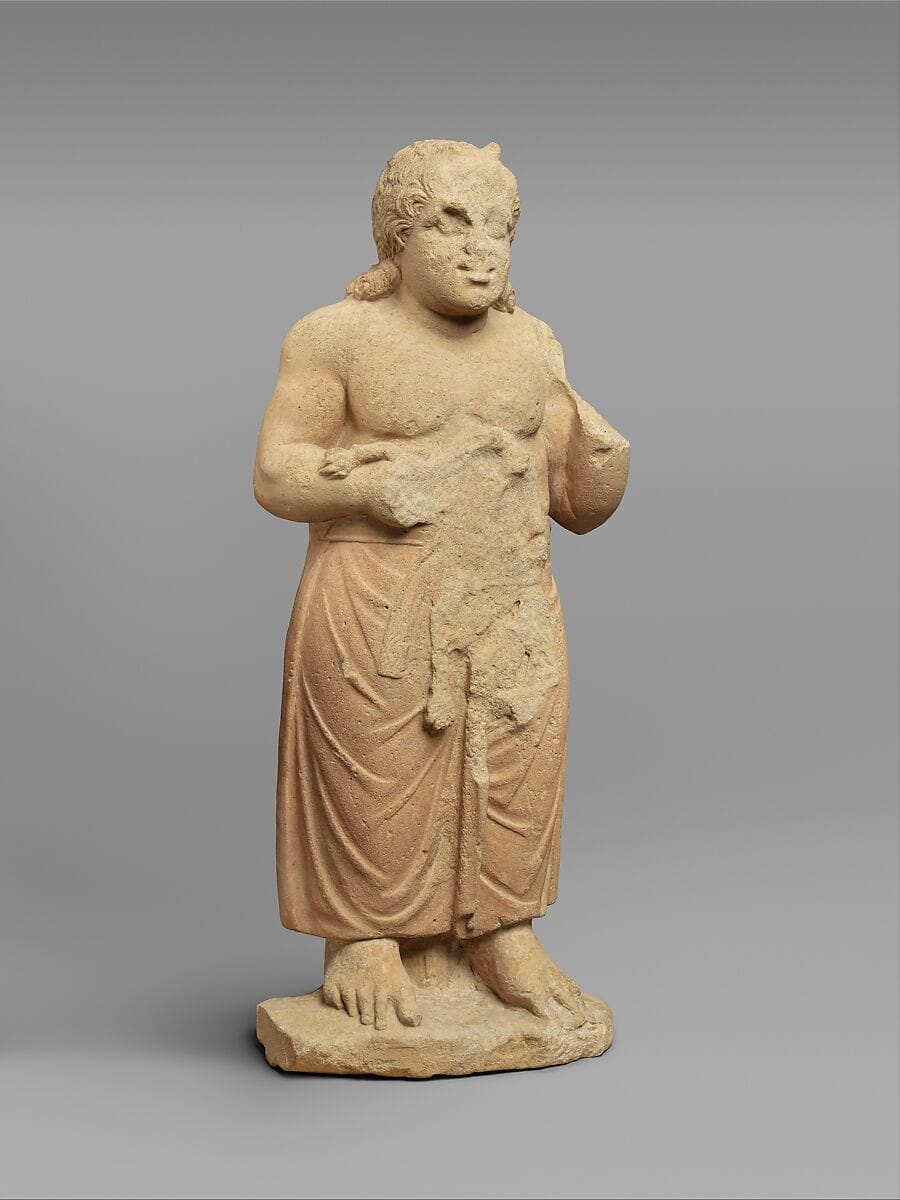
The master of lions. A man holding or subduing a lion is the commonest lion scene in Cypriot sculpture. A relief in the Met, 74.51.2875, of the second half of the sixth century BCE, shows the type (catalogue page). In Cyprus, Gjerstad noted, "the lion-man is represented as Herakles" [2]. Hermary and Mertens describe how dedications at Golgoi and Idalion present Herakles as the image of a local god, "guarantor of royal power and of the protection of the territory, as well as the fertility of both the soil and the flocks," before the sanctuary of Kition-Bamboula "became filled with statues of the 'master of the lions'" [1, p. 227]. The god behind the type is discussed in Melqart. One late example, their Cat. 320, is a Herakles holding a small lion, 54 cm high, of the second half of the fourth century BCE, with a face "derived from the style of Skopas" [1, p. 241]. The catalogue's own statuette of Herakles holding a lion belongs to the same Classical series. A further Golgoi relief in the catalogue, with a lion killing a bull and two human figures, shows the predator scene in Archaic stone.
Lions on pots. Painted lions are rare on Cypriot vases, and no early Cypro-Archaic Bichrome example is cited in the standard literature. The scene that does appear is the lion attacking a bull. Gjerstad placed it among the motifs of late Bichrome Red that show "influence of the contemporary Greek vase-painting," alongside stags, oxen and sphinxes [2]. In the Cypro-Classical repertoire he grouped the lion attacking a bull with "sphinxes of the Greek type" and olive and laurel wreaths, motifs that "clearly indicate Red Figured designs" [2]. A carved rectangular box in the Cyprus Museum shows the related lion attacking a stag [2].
Lions in metal and gold. On the Met's silver-gilt bowl 74.51.4554, of about 725 to 675 BCE and 16.8 cm across, lions take part in battle scenes alongside a sphinx (catalogue page). In later jewellery the lion shrinks to a head: gold lion-head terminals finish spiral earrings such as the Classical earring with a gold lion head. Gjerstad compared Cypriot animal-head terminals with bracelets of the Persian-period Oxus treasure, which end "in the heads of lions, lion-griffins, ibexes" [2].
Sphinxes and griffins
The sphinx is the most frequent of the three creatures in Cyprus and the one with the longest history there. Carole D'Albiac called it "this most well-loved ... and, I believe, truly Cypriot of monsters" [3, p. 297]. She even raised the question of whether a human-headed, animal-bodied vase from Chalcolithic Souskiou should count as a "proto-sphinx," a thousand years before any imported sphinx is known to have reached the island [3, p. 297].
Late Bronze Age. The first true sphinxes arrived on Syrian and Mitannian cylinder seals, where antithetic sphinxes flank a stylised sacred tree beside royal and divine figures. That role, attendant of the tree, is the one "which Cypriots never forgot" [3, p. 297]. A seal found by Vassos Karageorghis in the lower burial of Tomb 9 at Kition shows a Cypriot version with sphinxes, winged lions and demons, part of a group of seals "probably cut in the second half of the C14 B.C." [3, p. 297]. On later Cypriot seals the single sphinx walks in processions; D'Albiac judged these "amongst the most original and lively representations of sphinxes on any seals," with a well-formed lion's body and headwear ranging from a helmet to a horned crown [3, p. 299].
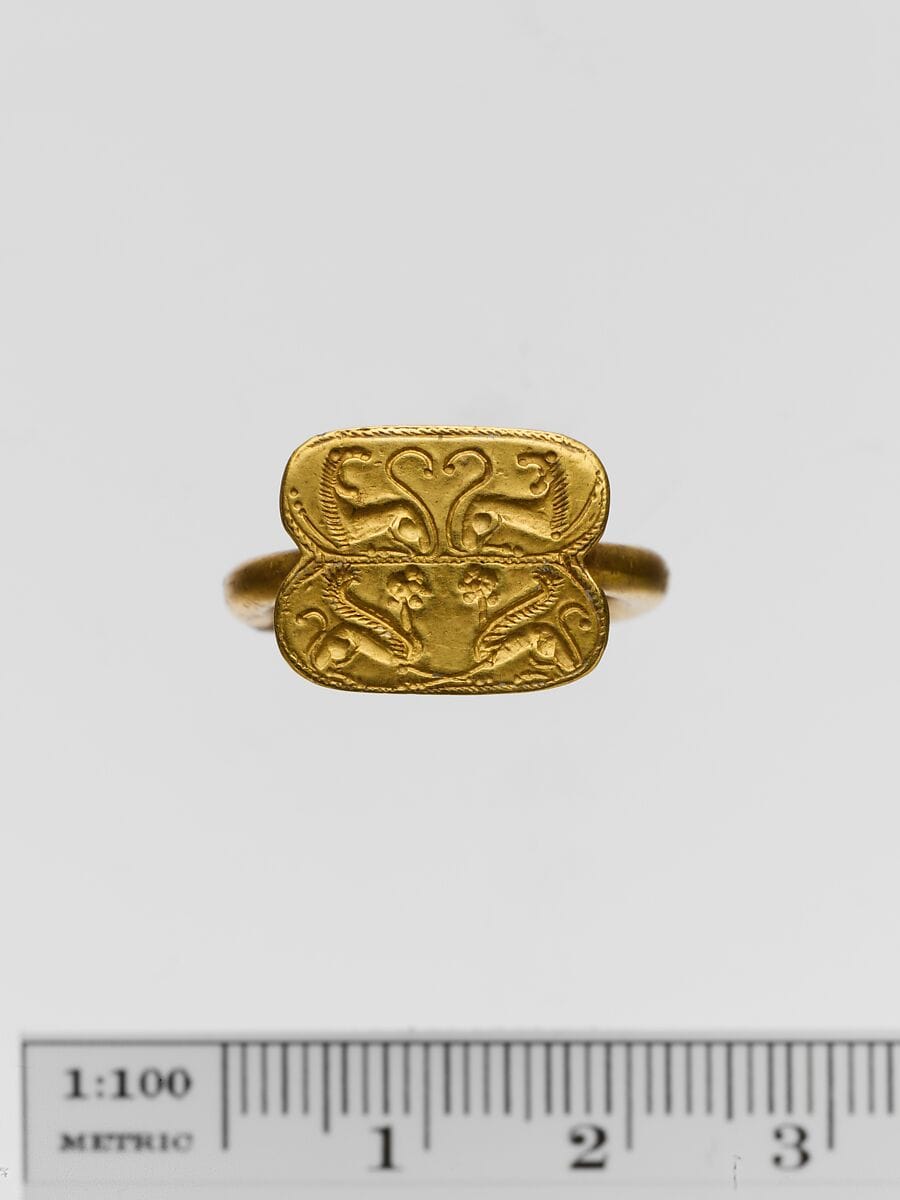
In gold, the earliest come from French Tomb 2 at Enkomi, in a Late Cypriot IIA context: two chest ornaments from the same mould show two sphinxes on either side of a tree with roots, and a gold ring shows a reclining "pharaonic" sphinx [3, p. 299]. The two sphinxes on the ornaments wear different headdresses, "an interesting and probably Cypriot idea, one which was to have a long life in Cyprus" [3, p. 299]. A gold ornament in the Cyprus Museum, 17.5 by 10 cm, has the same composition, a stylised plant flanked by a winged sphinx on each side, with punched rosettes [4, p. 176]. Later Late Cypriot goldsmiths also took over the Aegean sphinx, and only one Late Cypriot sphinx survives in ivory, on a fragmentary pyxis from Enkomi [3, p. 299].
The Archaic vase sphinx. Between the end of the Bronze Age and the Archaic period the thread breaks. Gjerstad was explicit: sphinxes "are known as ornamental motifs of gold and ivory objects from Late Cypriote, but there is no evidence of a continuous tradition of these ornaments from Late Cypriote to the Archaic period, when they appear on Cypriote pottery" [2]. The Archaic painters, in other words, borrowed the sphinx again. Gjerstad thought their sphinxes "rustic imitations of Oriental prototypes," and the details told him where from: "Some of the winged sphinxes have a conical helmet. They are dressed with aprons in front; the wings are straight, and are attached to the middle part of the body. This shows that the prototypes were Phoenician" [2]. He suggested the Cypro-Phoenician metal bowls as one route by which such images reached the potters [2]. On the Hubbard amphora the sphinx has "Syrian spiral hair" [2]; that vase is described in Free-Field Art.
The most complete Archaic statement of the old scheme is a Bichrome IV amphora in the Cyprus Museum (B2009), 47.5 cm high, of the seventh century BCE. Its two shoulder zones carry "two antithetic sphinxes on either side of a 'sacred tree' in the form of a stylised lotus flower" [5, p. 145]: the Bronze Age arrangement, rebuilt from new models (see Lotus Flowers). Karageorghis called the sphinx "a favoured pictorial motif in Cypro-Archaic vase-painting," Near Eastern in origin, while the meander below the sphinxes "points also to the Aegean as a source of inspiration" [5, p. 145]. In the Cypro-Classical period, Greek-type sphinxes join the painted repertoire under the influence of red-figure [2].
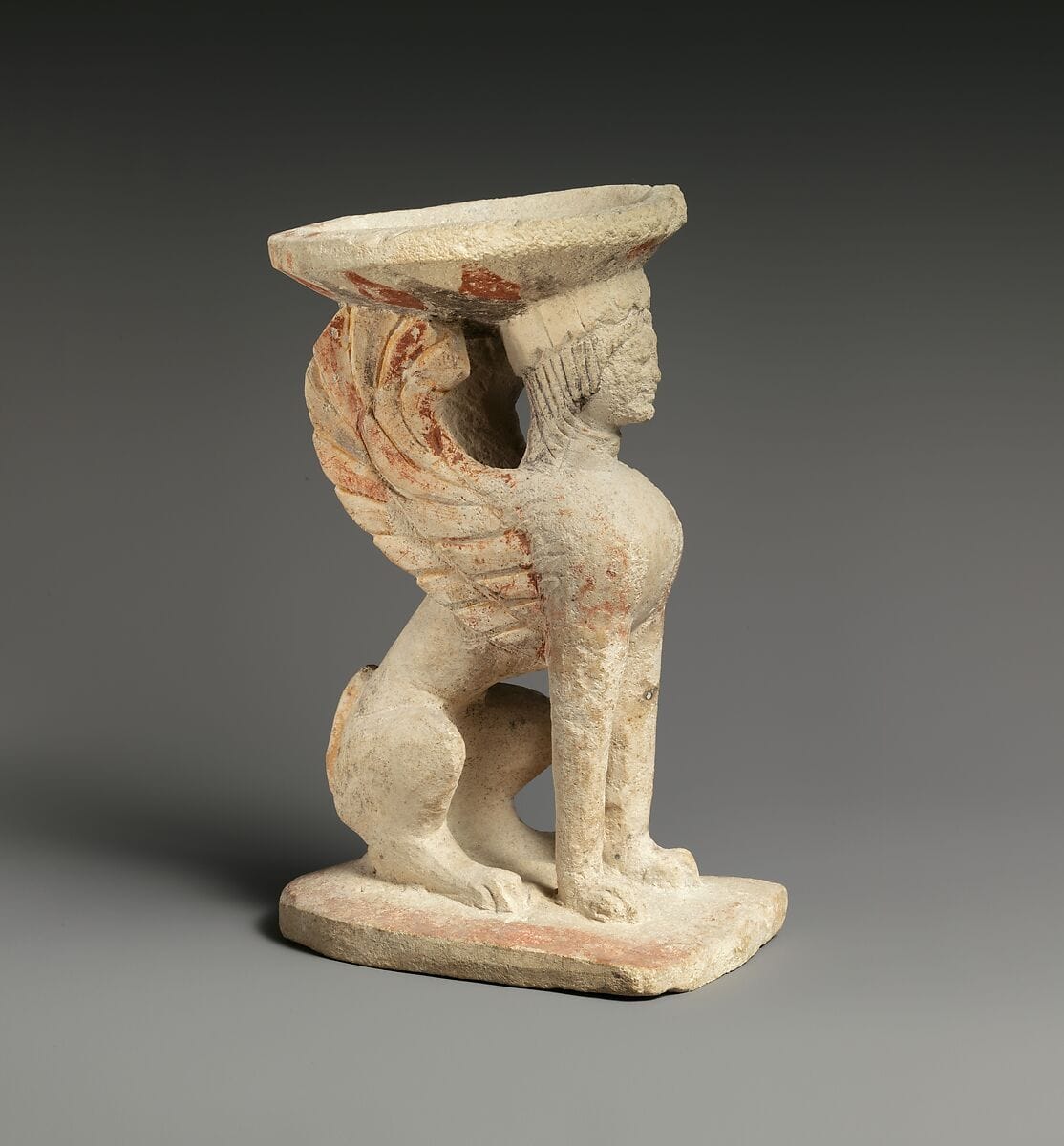
Royal and funerary sphinxes in stone. In sculpture the sphinx is often paired with the lion. The double Egyptian crown on the Golgoi finial was "a well-known royal symbol on Cyprus" [1, p. 272]. The Tamassos sphinx, 86 cm high (Cyprus Museum 1997/VII-15/3), wears the Egyptian double crown and royal headcloth and has upturned wings [6, p. 103]. Sphinxes also crowned grave stelai: the Met's 74.51.2855, of about 475 to 450 BCE, shows two antithetic sphinxes (catalogue page). They worked as supports too. A sphinx carrying a votive bowl, 74.51.2582, is said to come from the necropolis of Idalion, and the Met dates it to the late sixth or early fifth century BCE [1, p. 280] (catalogue page). A similar incense burner from Kythrea keeps much of its paint and is discussed in Limestone Polychromy. Cypriot sphinx statuettes travelled as well: Gjerstad listed Neo-Cypriote examples at Lindos, Vroulia and Delos [2].
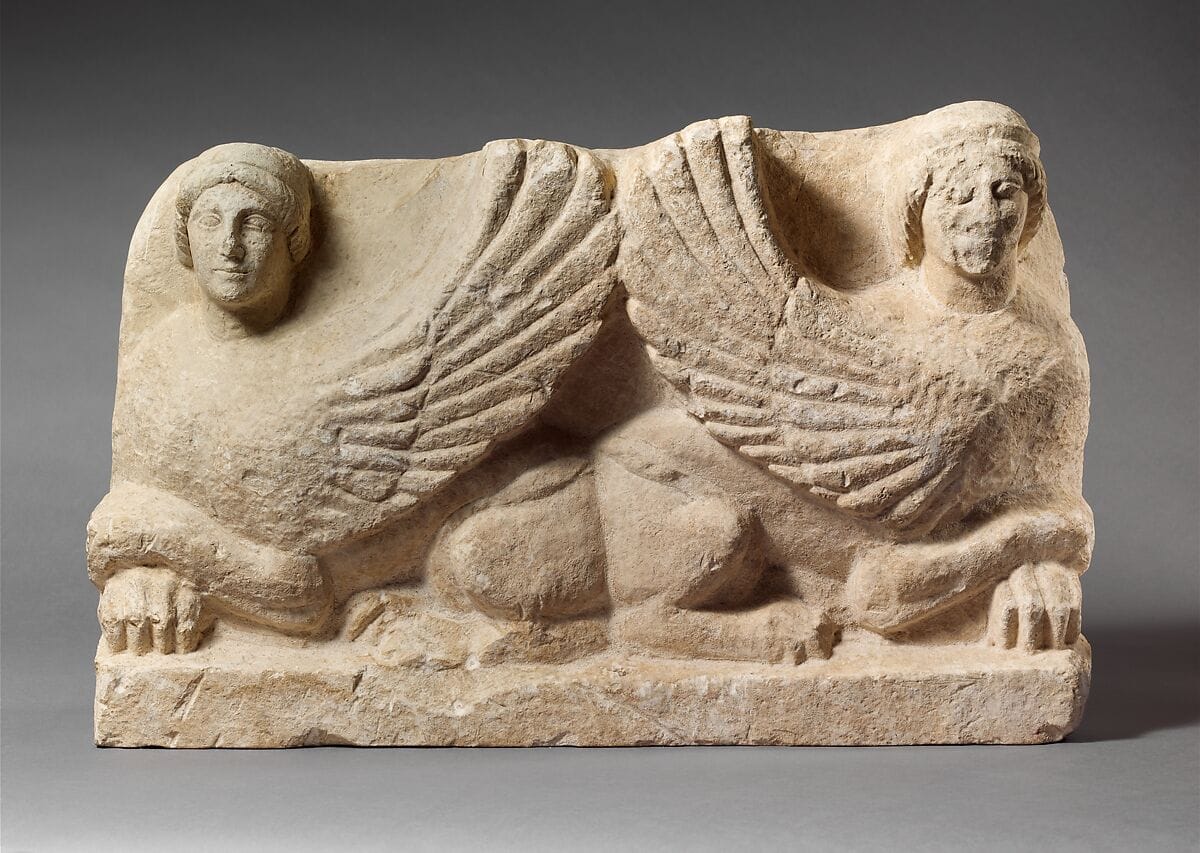
Griffins. The griffin is much rarer in Cyprus, and no Cypriot tradition of griffins on pottery is attested. It appears mainly on small, Egyptianising and Near Eastern objects: seals, rings and metal. A Cypro-Archaic scarab stamp seal in the Ashmolean, AN1891.636, is engraved with a seated griffin. Lion-griffins also turn up on the Oxus bracelets Gjerstad cited as parallels for Cypriot jewellery terminals [2].
Reading these creatures
The table below sets out where each creature appears, by period.
| Period | Lions | Sphinxes | Griffins |
|---|---|---|---|
| Late Cypriot II | Winged lions on seals | Seals; gold chest ornaments and ring (Enkomi) | Not attested in the works cited here |
| Cypro-Archaic | Tomb guardians (Tamassos); finials; master of lions; silver bowls | Bichrome IV and V vases; tomb guardians; finials | Seals (Ashmolean scarab) |
| Cypro-Classical | Herakles with lion; lion attacking bull on late Bichrome Red; gold terminals | Grave stelai; bowl supports; Greek-type sphinxes on pottery | Jewellery parallels only |
Three points recur in the scholarship. The first is borrowing: every one of these creatures came from Egypt, Syria, Phoenicia or (later) Greece, and Gjerstad and Karageorghis both read the painted sphinx's details as evidence of its source. The second is discontinuity: the Late Cypriot sphinx did not survive into the Iron Age, and the Archaic sphinx is a new import [2]. D'Albiac, by contrast, stresses a Cypriot habit that does persist, the paired sphinxes at the tree [3, p. 299]. The two views can sit together, since the scheme reappears on the Bichrome IV amphora B2009 with new models. The third is meaning: in stone, lion and sphinx belong to kings and graves [1, p. 272; 6, p. 103], while on pots they join the Cypro-Archaic painter's animal friezes. A caution applies throughout. Many of the sculptures come from Cesnola's excavations, whose findspots are uncertain [1, p. 272], so arguments about where lions stood are on firmer ground at Tamassos than at Golgoi.
In the catalogue
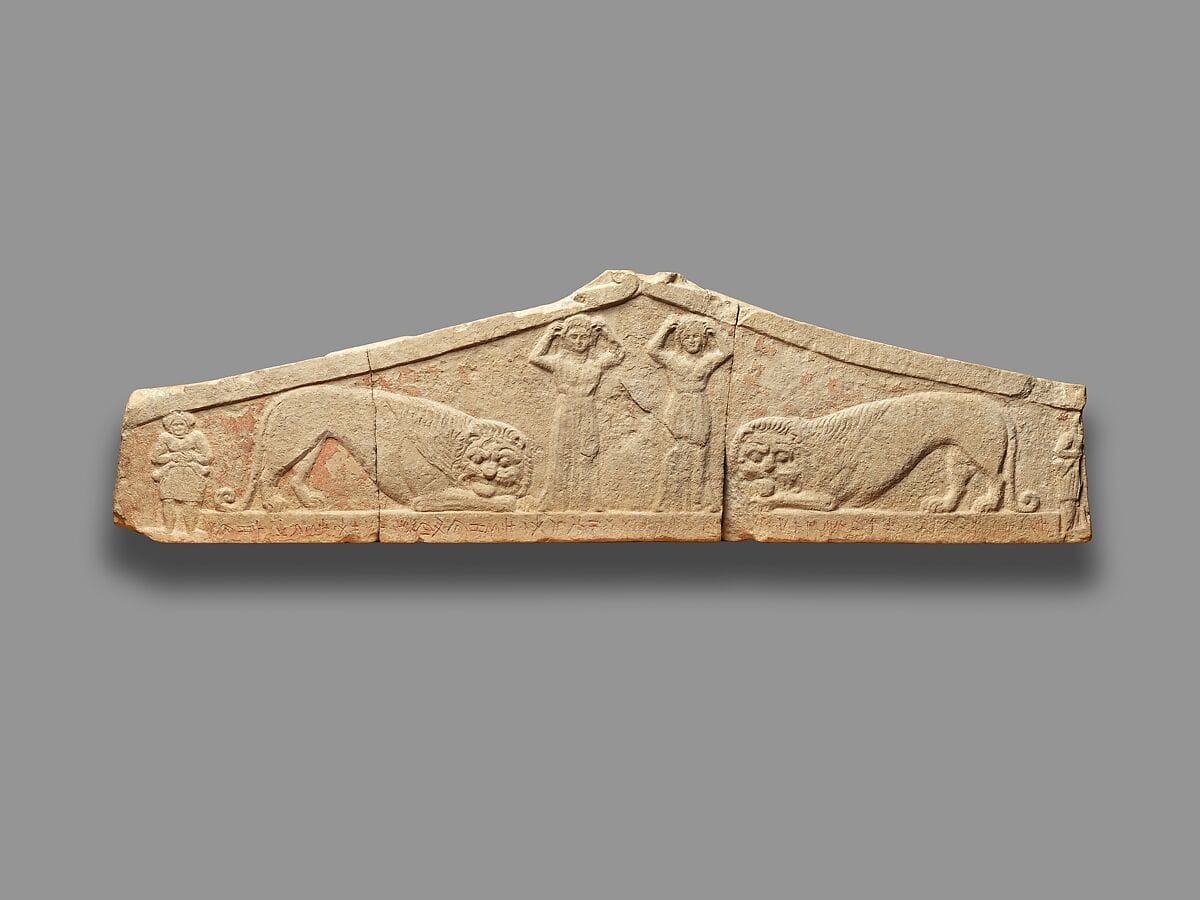
The site's catalogue holds about ninety objects tagged with lions and some sixty with sphinxes or griffins, nearly all from the Cesnola Collection at the Metropolitan Museum. Besides the pieces linked above, they include the silver bowl, a fragmentary limestone capital and several gold rings. See all lions in the catalogue, or see all sphinxes and griffins in the catalogue.
Objects on this page
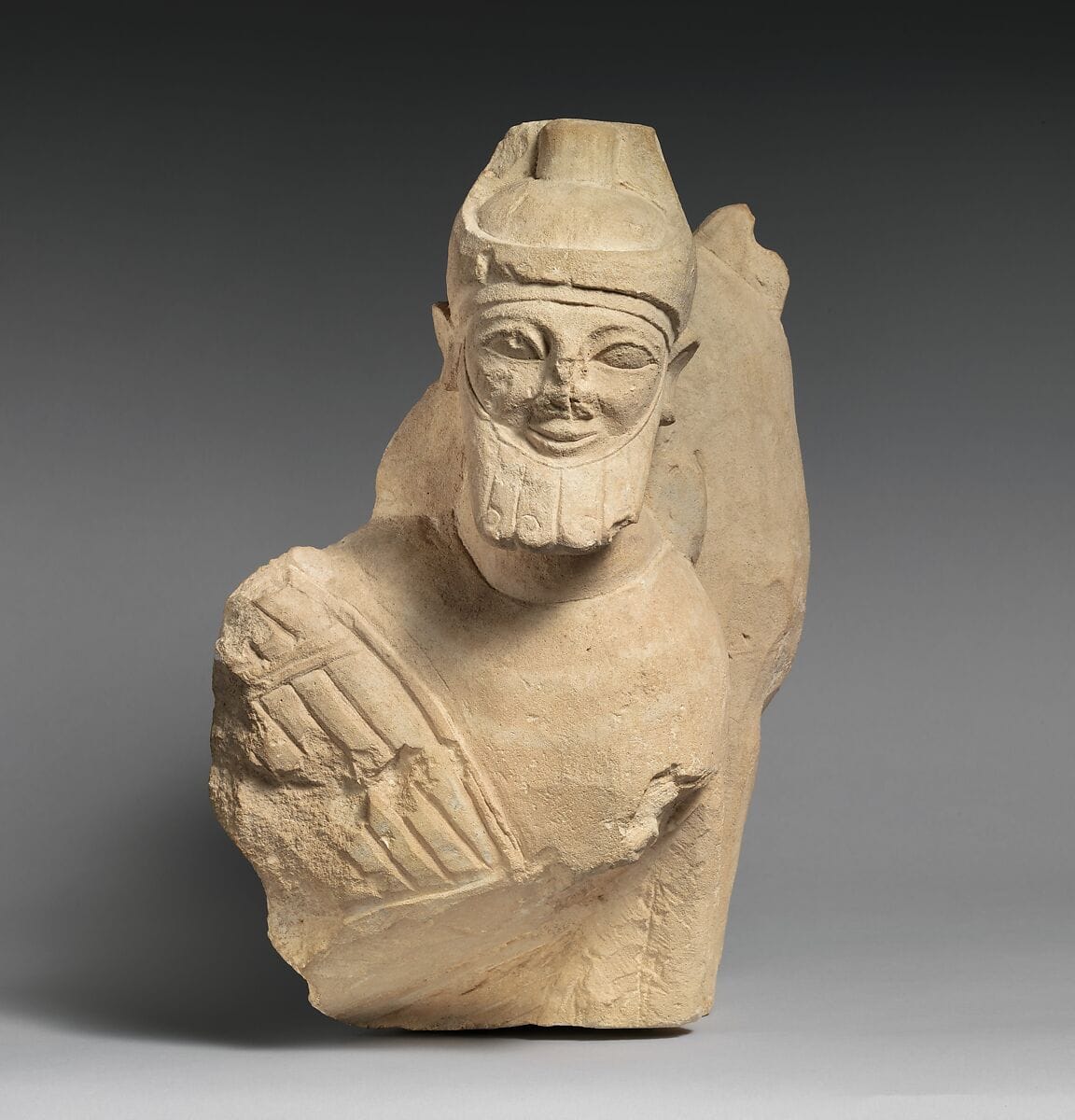 Limestone finial of a votive stele (?) with a lion and a male sphinxArchaic II · 575–525 BC
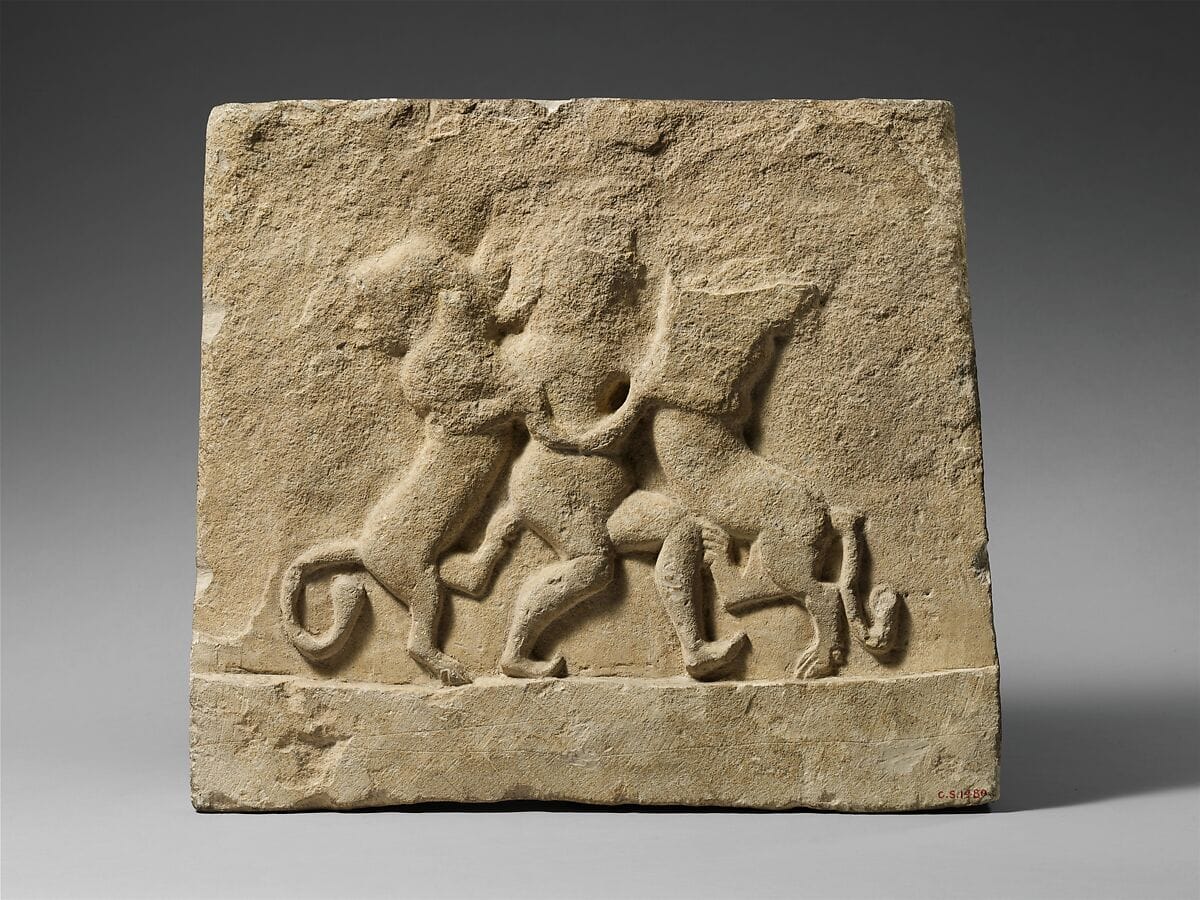 Limestone votive relief with a “master of lions”Archaic II · 550–501 BC
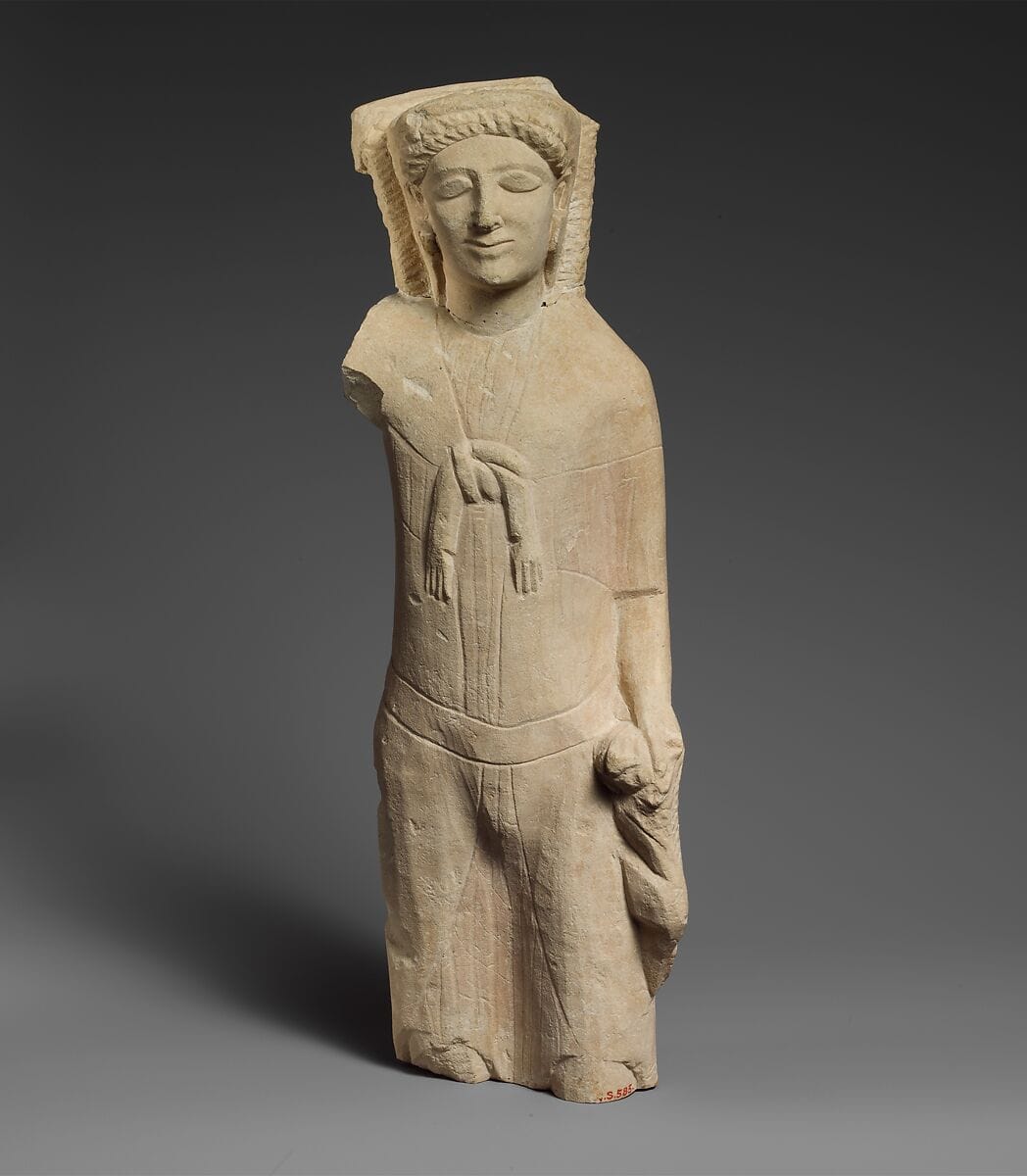 Limestone statuette of Herakles holding a lionClassical · 420–380 BC
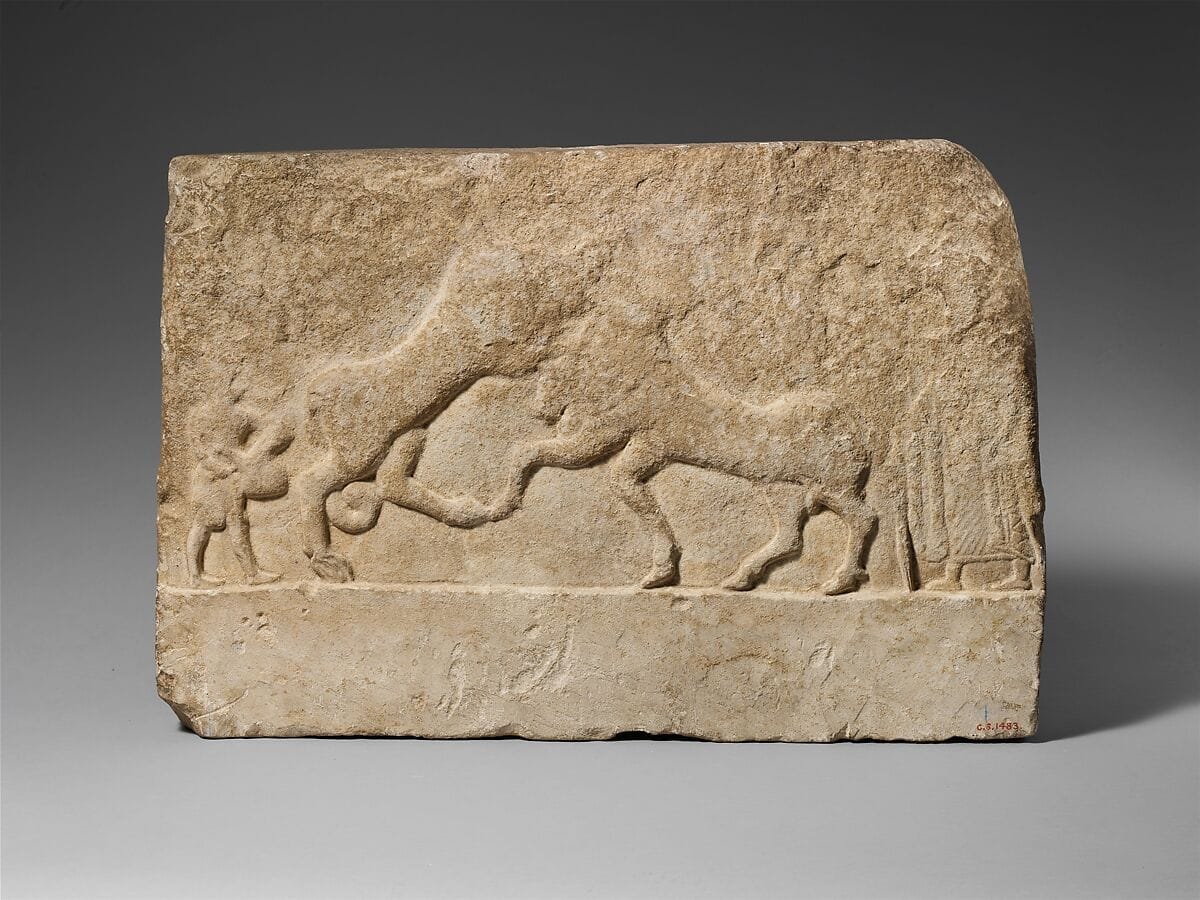 Limestone votive relief with a lion killing a bull and two human figuresArchaic II · 550–501 BC
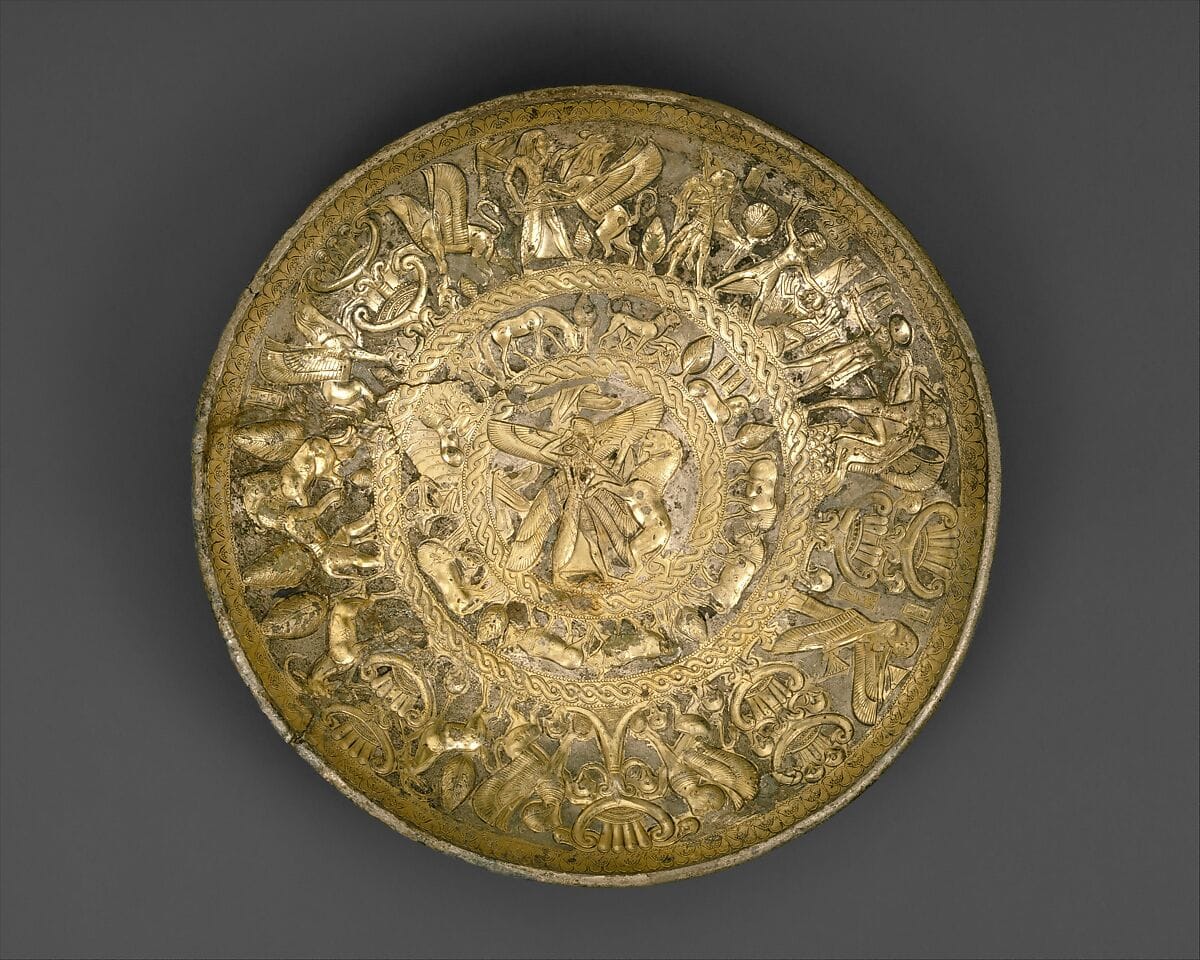 Silver-gilt bowlArchaic I · 725–675 BC
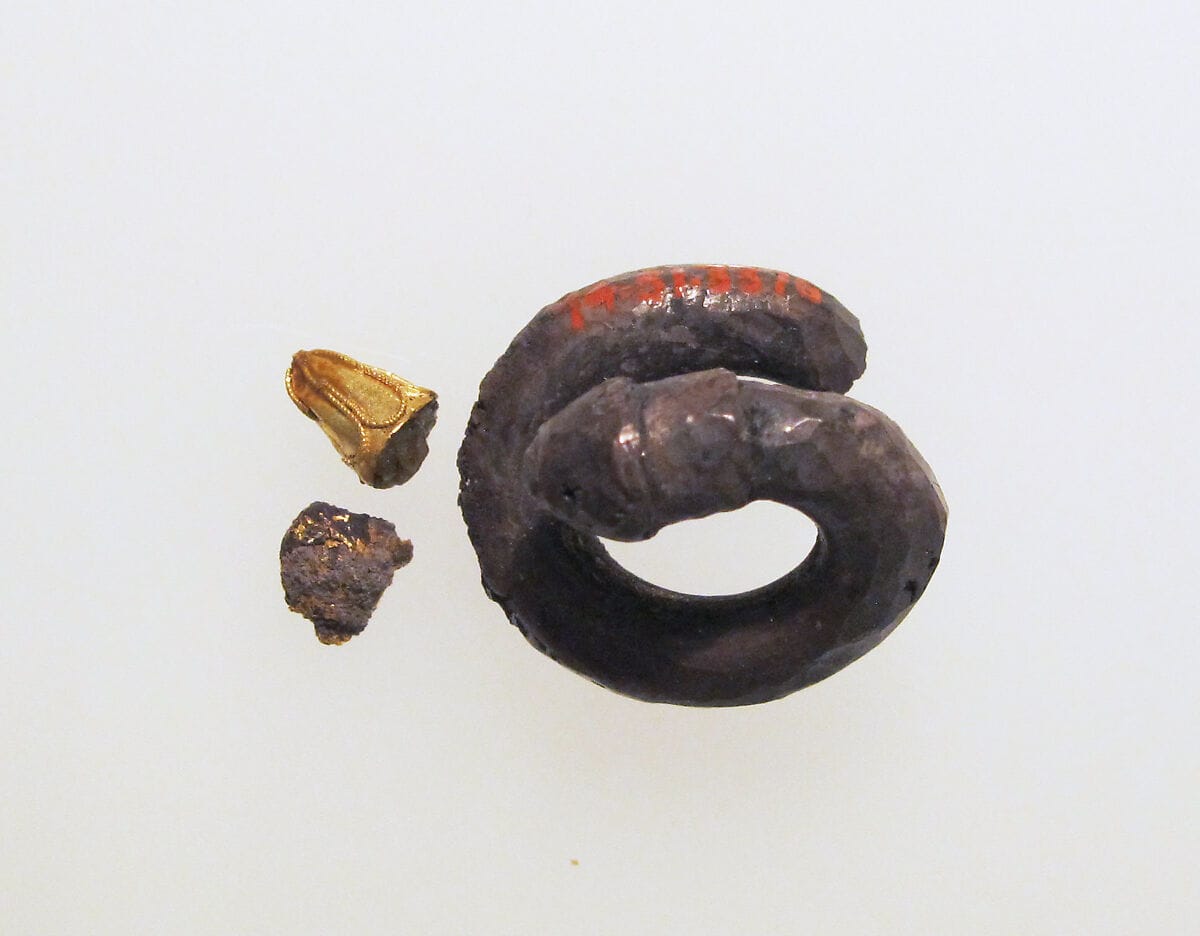 Earring, spiral with gold lion headClassical · 500–401 BC
- Limestone funerary stele with antithetical sphinxesClassical · 475–450 BC
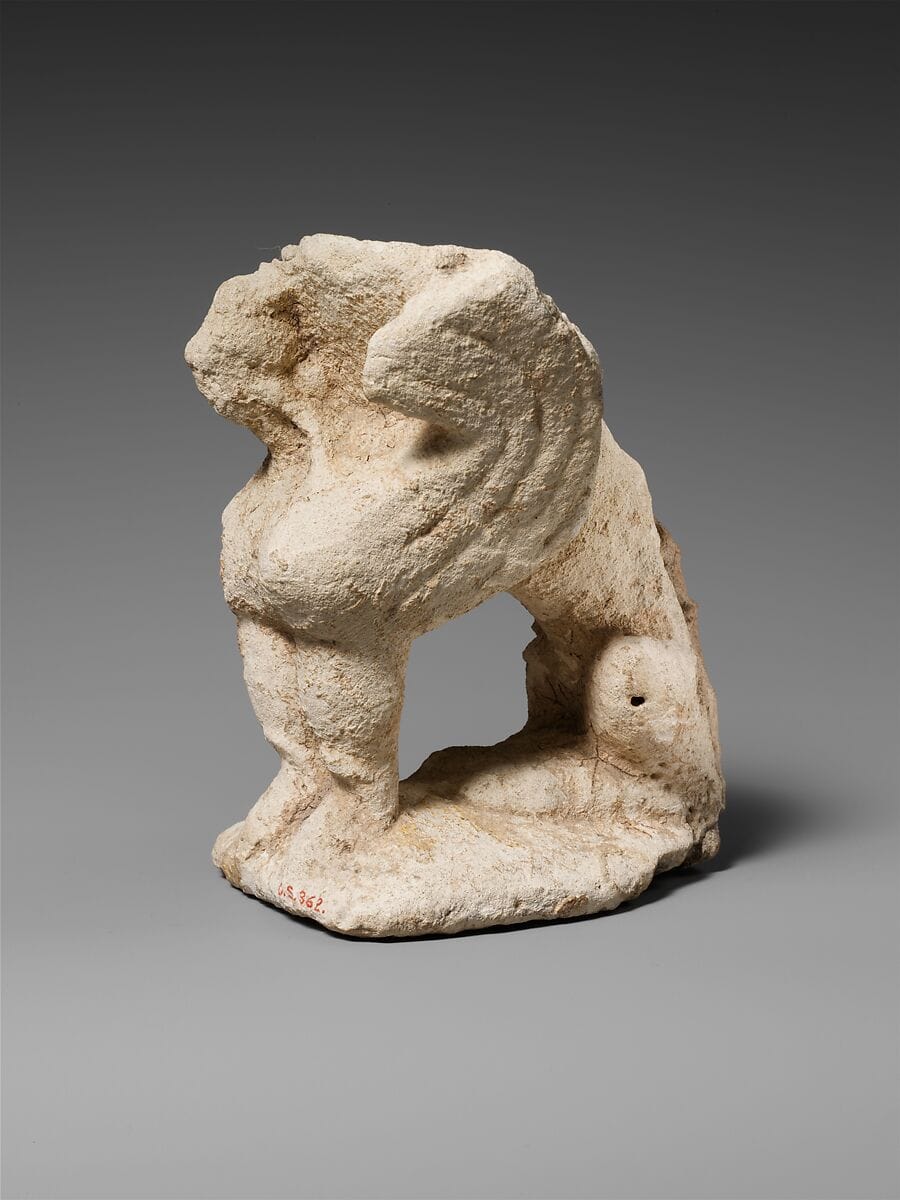 Limestone sphinx supporting a votive bowlArchaic II · 525–480 BC
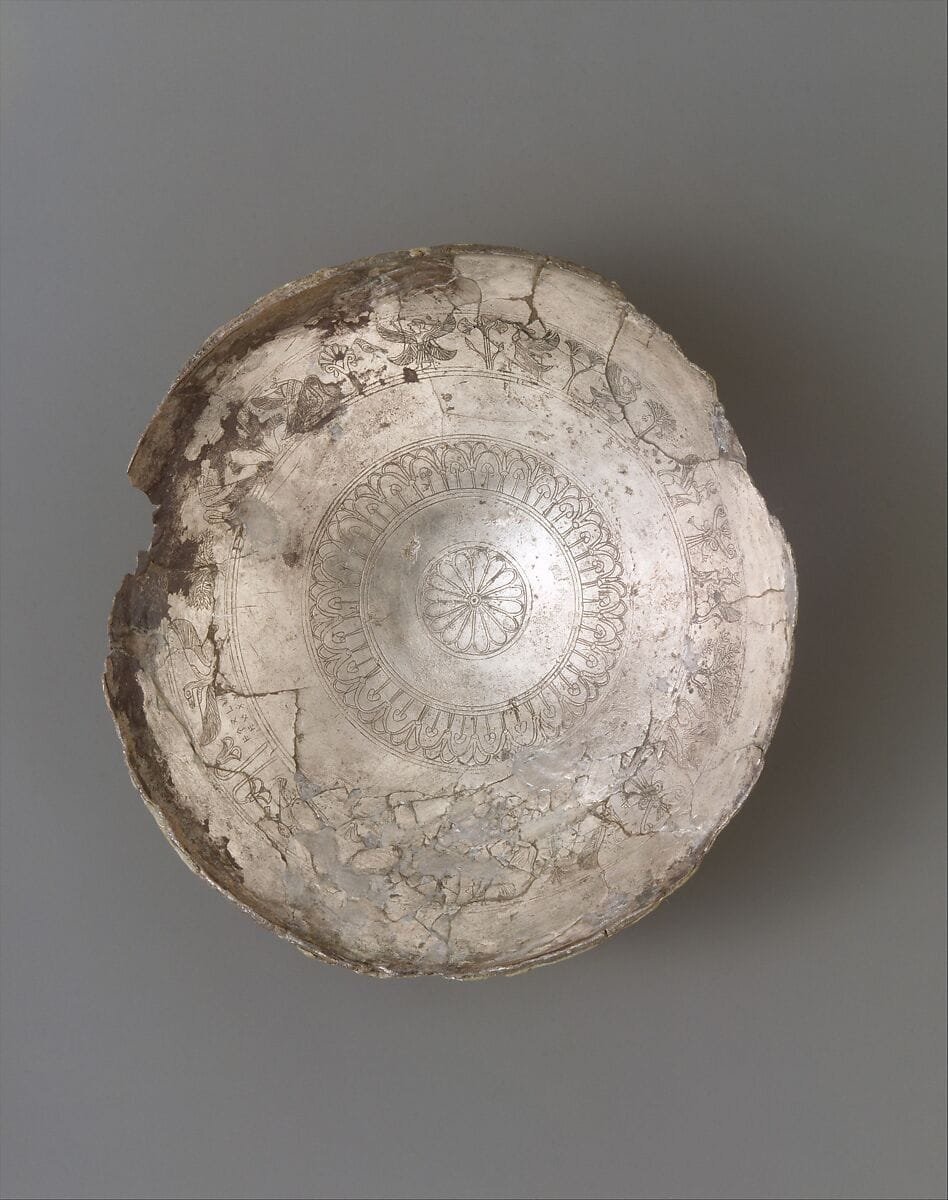 Silver bowlArchaic I · 675–625 BC
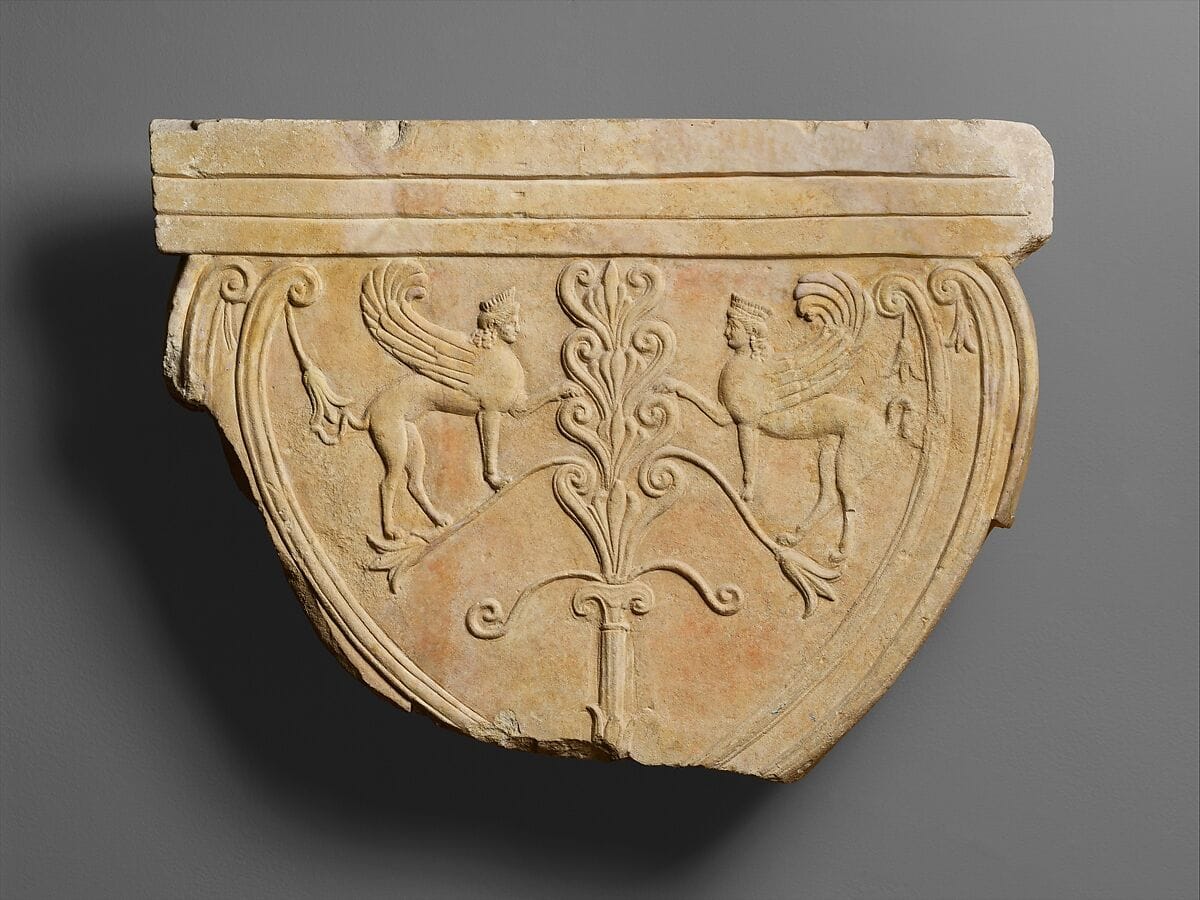 Fragmentary limestone Cypriot capitalClassical · 499–400 BC
In the catalogue
References
- 1.Hermary, A., & Mertens, J. R. (2014). The Cesnola Collection of Cypriot Art: Stone Sculpture. New York: The Metropolitan Museum of Art.
- 2.Gjerstad, E. (1948). The Swedish Cyprus Expedition, Vol. IV, Part 2: The Cypro-Geometric, Cypro-Archaic and Cypro-Classical Periods. Stockholm: The Swedish Cyprus Expedition.
- 3.D'Albiac, C. Some aspects of the sphinx in Cyprus: Status and character. In Afieroma ston Vaso Karagiorgi: Studies in Honour of Vassos Karageorghis. Nicosia.
- 4.Buchholz, H.-G., & Karageorghis, V. (1973). Prehistoric Greece and Cyprus: An Archaeological Handbook. London: Phaidon.
- 5.Karageorghis, V. Ancient Cyprus: 7000 Years of Art and Archaeology.
- 6.Halbertsma, R. B., & Pilides, D. (Eds.). (2019). Cyprus: A Dynamic Island. Leiden: Sidestone Press / Rijksmuseum van Oudheden.