
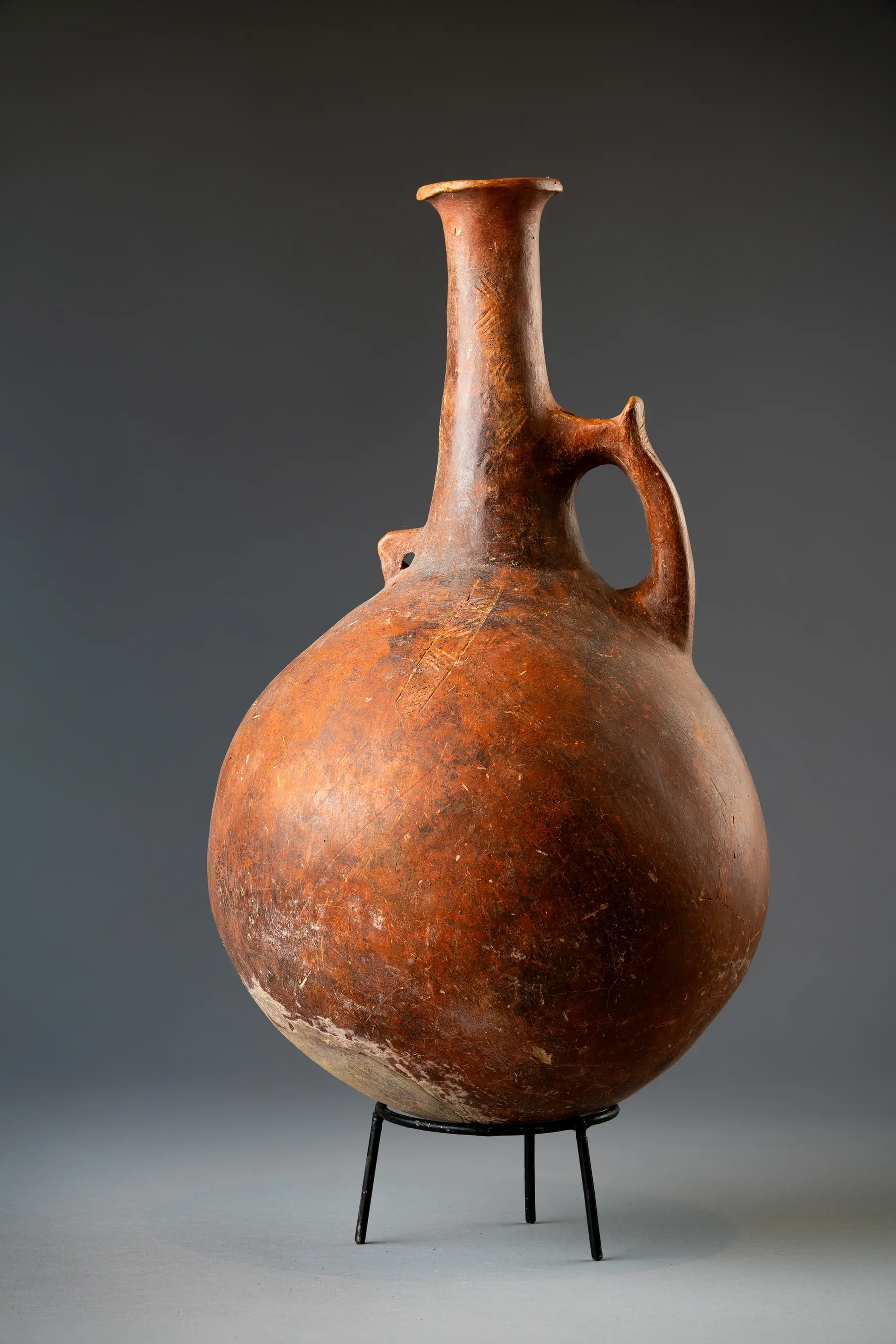
Early Bronze Age III
Large Red Polished Jug with Horned Handle and Pierced Lug
Large plain Red Polished jug with a spherical body, tall narrow neck, horned handle and pierced lug, fire-clouded on one side. Cyprus, c. 2100–1800 BCE.
Classification
- Object type
- Pottery vessel
- Shape
- Jug
- Decoration
- Undecorated
- Material
- Clay
- Place of production
- Cyprus
- Date
- 2100 - 1800 BC
Collection
Alexis Drakopoulos
Provenance
- 1965–2025, The Goodman Collection (acquired 1965–1969)
- 2025–present, Alexis Drakopoulos, London
Identifiers
- Inventory no.
- JUG-BA-006
Early Cypriot III to Middle Cypriot I/II, c. 2100–1800 BCE · Red Polished ware · Handmade
A large jug with a full, almost spherical body and a rounded base, carrying a tall, narrow cylindrical neck that opens into a flaring rim with a flattened lip. A thick strap handle leaves the neck about halfway up and drops to the shoulder; at its top it rises into a short upturned horn. Opposite, at the base of the neck, sits a small lug pierced horizontally. The surface is a reddish-brown slip, burnished to a soft sheen and scored by fine scratches and small chips. Faint, lightly incised herringbone strokes run down the neck, and a narrow ladder band descends over the shoulder, both much worn. One side of the lower body is clouded grey-black from the fire, and a pale lime crust clings to the other.
Commentary
This is a plain, large Red Polished jug of the kind that makes up much of the bulk of Early and Middle Cypriot tomb groups. It was built by hand without a wheel, slipped and burnished; the dark fire-cloud on the lower body shows that it was fired in an open or poorly controlled setting, where part of the pot lay in a reducing atmosphere. The round base belongs after the flat-based phases of the Early Cypriot period [1], and the proportions, with a globular body under a tall narrow neck, fit Red Polished III of Early Cypriot III and the Middle Cypriot period. Plain jugs changed slowly, so the date must be broad: c. 2100–1800 BCE, following the current radiocarbon framework [7]. The framework for classifying these vessels remains Stewart's corpus of Early Cypriot pottery [5].
Two details give the jug its character. The horned handle, a short spur rising from the top of the handle, is a recurrent feature of plain Red Polished jugs; a comparable plain jug with a horned handle from Kourion is in the Medelhavsmuseet in Stockholm (NM Ant 1580) [4]. The pierced lug at the base of the neck, set opposite the handle, probably took a cord for suspension or for tying down a stopper. Pierced lugs of this kind multiply in the north-western workshops of Deneia and Lapithos [6], but they occur widely and do not locate the piece. A plain Red Polished III jug of similar scale from Lapithos Tomb 308 (Medelhavsmuseet L.308:003) shows the same economy of decoration [3], and Morris illustrates a large plain Red Polished jug with lugs as an example of how much of the ware relied on form and burnish alone [2].
The faint incisions on the neck and shoulder deserve comment. They are shallow and uneven compared with the deep, white-filled incision of the decorated jugs, and may be a light sketch of ornament that was never completed or simply marks of use. Without close examination, the jug is best described as essentially undecorated.
Jugs of this size were storage and serving vessels for liquids in the household, and in the tomb they formed part of the equipment for the funeral and for the dead. We know of no contents analysis for jugs of this type.
References
- 1.Brown, A.C. and Catling, H.W. (1980) Ancient Cyprus. Oxford: Ashmolean Museum, p. 27.
- 2.Morris, D. (1985) The Art of Ancient Cyprus. Oxford: Phaidon, pp. 54–55, pl. 64c.
- 3.Medelhavsmuseet, Stockholm, L.308:003: plain Red Polished III jug, Lapithos Tomb 308 (Swedish Cyprus Expedition).
- 4.Medelhavsmuseet, Stockholm, NM Ant 1580: plain Red Polished jug with horned handle, Kourion.
- 5.Stewart, J.R. (1962) The Early Cypriote Bronze Age. Swedish Cyprus Expedition IV.1A. Lund.
- 6.Webb, J.M. (2010) 'The ceramic industry of Deneia: crafting community and place in Middle Bronze Age Cyprus', in Bolger, D. and Maguire, L.C. (eds) The Development of Pre-State Communities in the Ancient Near East: Studies in Honour of Edgar Peltenburg. BANEA 2. Oxford: Oxbow, pp. 173–174.
- 7.Manning, S.W. (2013) 'A new radiocarbon chronology for prehistoric and protohistoric Cyprus', in Knapp, A.B. The Archaeology of Cyprus. Cambridge: Cambridge University Press, pp. 485–533.
Corrections and additions
Do you know this object?
We are always looking for more of an object's history: who owned it, where it was sold or shown, and where it was published.
We would like to hear about
- Earlier owners, sales or exhibitions
- Publications that illustrate or mention it
- Where it is now, if it has moved
- Better photographs, or a close parallel
- A mistake in what we say about it
Messages are read by us alone and kept confidential, unless the law requires otherwise. Tell us if you would like to be thanked by name on the page.
Similar pieces
 Red Polished gourd jugAshmolean Museum
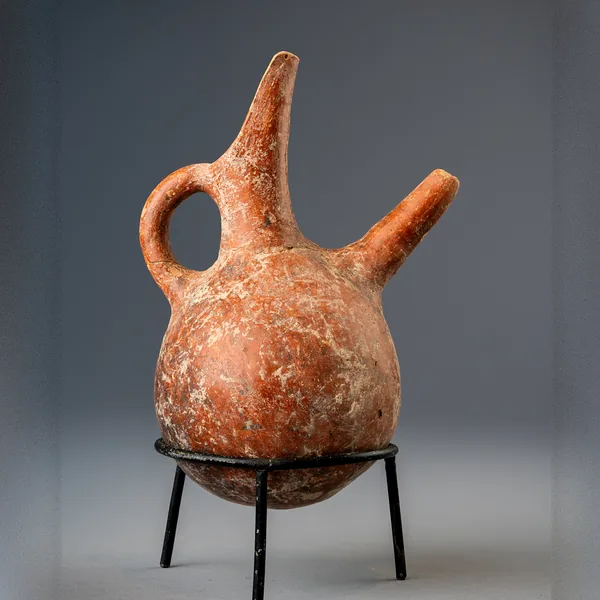 Red Polished Beak-Spouted Jug with Side-SpoutDrakopoulos Collection
 JugLiverpool Museum
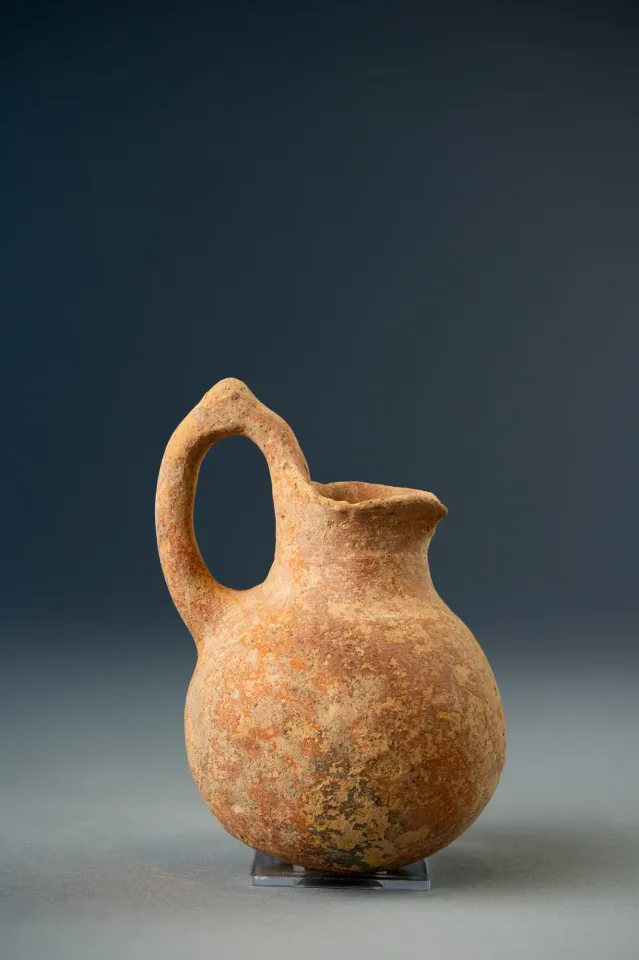 Red Polished Juglet with High-Swung HandleDrakopoulos Collection
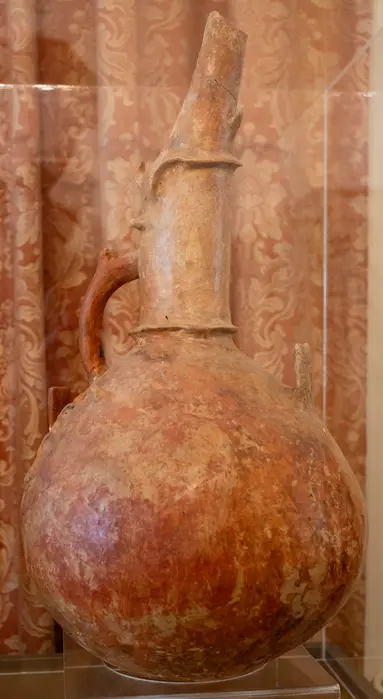 Large Red Polished FlagonPierides Museum, Larnaca
 Base Ring Bilbil Juglet with Funnel Mouth and Neck RidgeDrakopoulos Collection
 Cypriot Early Bronze Age Polished Red Ware PitcherCyprus Museum, Jacksonville
 Base Ring II Bilbil Juglet with White-Painted BandsDrakopoulos Collection
 Cypriot Early Bronze Age Polished Red Ware PitcherCyprus Museum, Jacksonville
 White Painted Juglet with Funnel Mouth and Side CirclesDrakopoulos Collection
 Red Polished JugletBritish Museum
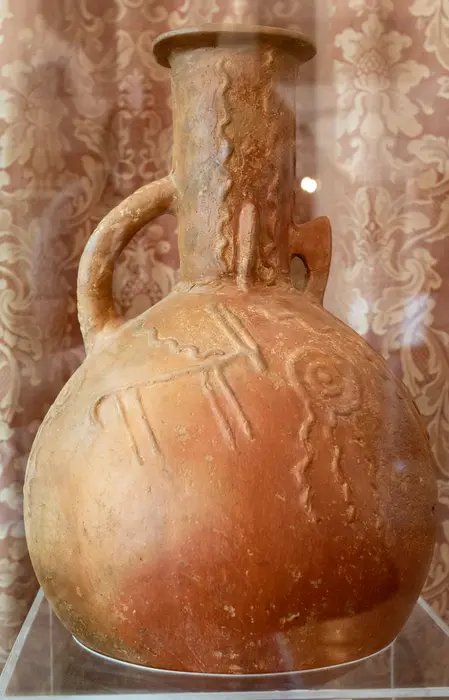 Large Red Polished FlagonPierides Museum, Larnaca
 Red Polished FlagonLarnaca Museum
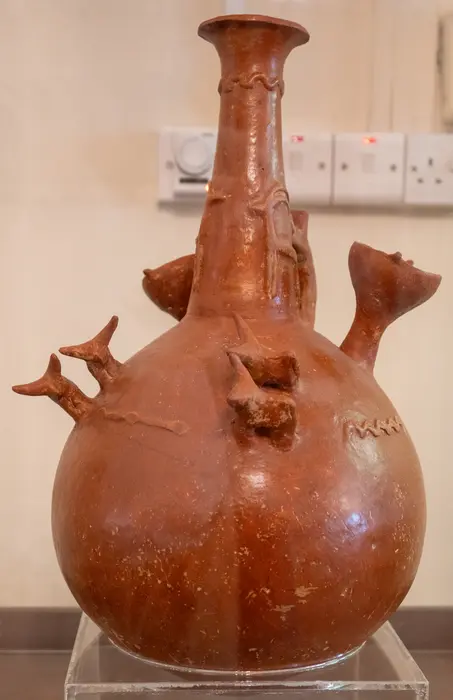 Large FlagonPierides Museum, Larnaca
 Body of Red Polished II oval jug with round baseLapithos-Vrysi tou Barba, SCE Tomb 311
 Red Polished II globular jug with tall neckMedelhavsmuseet (Museum of Mediterranean and Near Eastern Antiquities)
 Fragments of Red Polished II jugMedelhavsmuseet (Museum of Mediterranean and Near Eastern Antiquities)
 Reddish Slip JugletBritish Museum
 Red Polished I jugMedelhavsmuseet (Museum of Mediterranean and Near Eastern Antiquities)
 Monochrome jugEnkomi, SCE Tomb 19