
Middle Bronze Age I
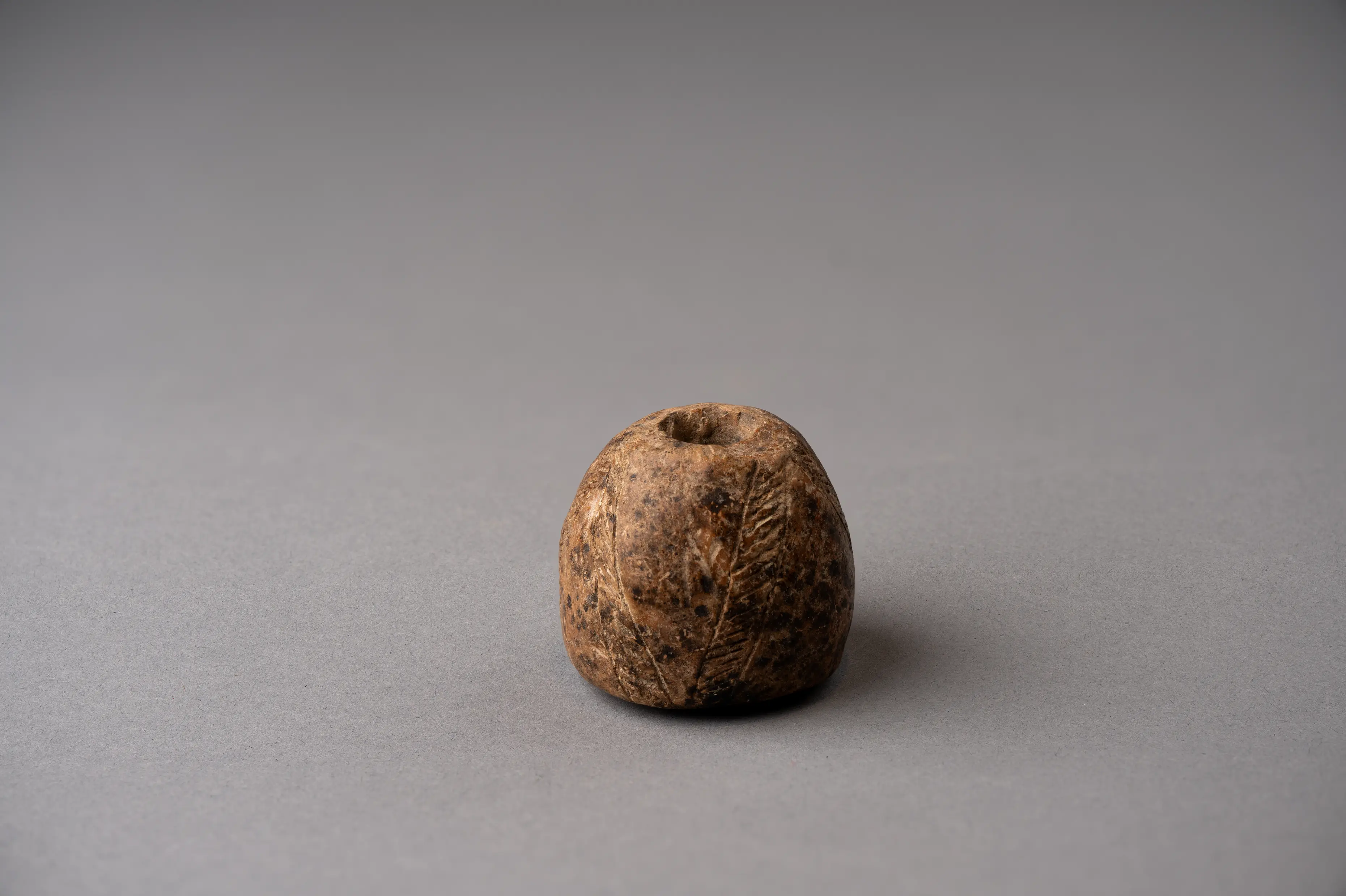
Spindle Whorl with Incised Herringbone Bands
Bell-shaped Bronze Age Cypriot spindle whorl with incised herringbone or feather bands on faceted sides, c. 2000–1725 BCE.
Date
2000 - 1725 BC
Accession No.
TOL-BA-001
Collection
Alexis Drakopoulos
Provenance
- 1965–1969, The Goodman Collection
- 2025–present, Alexis Drakopoulos, London
Early to Middle Cypriot, c. 2000–1725 BCE · Probably burnished clay (Black Polished or Red Polished ware), possibly stone · Handmade
A tall, bell-shaped spindle whorl, rising from a broad lower terminal to a rounded crown pierced by a wide central perforation. The sides fall into shallow vertical facets, and each facet carries an incised band: a single vertical stem with short oblique strokes set on either side, so that the bands read as herringbone or feathered leaves running from the rim of the perforation down to the base. Plain vertical lines separate some of the panels. The incisions look pale, possibly holding traces of white infill. The surface is smoothed and faintly lustrous, mottled mid-brown to dark brown and densely flecked with black spots. It is intact, with no visible chips on the photographed side.
Commentary
Terracotta spindle whorls first appear in Cyprus with the Philia facies around 2500 BCE, and the excavators at Sotira-Kaminoudhia considered it "certain" that modelled clay whorls were unknown on the island before then [2][1]. The class flourished from Early Cypriot III to Middle Cypriot II, and decorated examples belong mainly to those centuries; undecorated whorls tend to be later [1][3]. Most were made in the ordinary pottery fabrics of the day, Red Polished and, less often, Black Polished ware [1].
The shape here belongs to the conical-hemispherical family, and the decoration is the incised linear grammar of Red Polished pottery in miniature. The closest published parallel is a Black Polished whorl in the Cesnola Collection at the Metropolitan Museum of Art (74.51.915), conical-hemispherical and 3.2 cm high, with "five vertical bands containing oblique lines" filled with lime; it is dated to Middle Cypriot I–II, c. 1900–1725 BCE, and attributed on stylistic grounds to the north coast, around Lapithos or Vounous [1]. A Red Polished whorl in the same collection (74.51.912) has vertical lines flanked by rows of short strokes, a close relative of the stem-and-stroke bands seen here [1]. Among excavated pieces, the Sotira report notes a possible "feather" pattern on two of its whorls and compares the "leaf" pattern on one of them with a whorl from Lapithos Tomb 314B [2][6]. On that evidence a date between the end of the Early Cypriot period and Middle Cypriot II is the most likely, with a Middle Cypriot date slightly favoured by the Metropolitan parallel.
Cypriot whorls were used on low-whorl spindles, the broad terminal facing upward, and that terminal usually carries its own decoration [1][3]. The broad end of this piece has not been photographed, so its base scheme is unrecorded. Whorls were used for spinning wool and flax, and their weight governed the fineness of the thread. They occur both in houses and in tombs, where they seem to belong to a person's tool kit; we know of no evidence for the older idea that they were buried so that the dead could go on spinning. Without a weight for this piece nothing can be said about the thread it produced.
The open question is material. The dense black speckling and the slightly translucent look of the surface in the photograph could be firing mottling and manganese spotting on burnished clay, which is what the parallels would lead one to expect, but the piece also looks somewhat like a soft speckled stone. Stone whorls are rare before the Late Cypriot period, although the Cyprus Museum does hold an incised Early Cypriot steatite whorl (W 264) [4]. If this piece proves to be stone, its date and the combination of stone with Red Polished style decoration would need to be reconsidered. The Cypriot whorl typology is set out by Crewe [5].
References
- 1.Karageorghis, V. (2016) The Cesnola Collection of Cypriot Art: Terracottas. New York: The Metropolitan Museum of Art, pp. 33, 35 (Cat. 40, 47) and p. 254 (Commentary 2, Early–Late Cypriot Spindle-whorls).
- 2.Swiny, S., Rapp, G. and Herscher, E. (eds) (2003) Sotira Kaminoudhia: An Early Bronze Age Site in Cyprus (CAARI Monograph 4). Boston: American Schools of Oriental Research, p. 438.
- 3.Webb, J.M. (2002) New evidence for the origins of textile production in Bronze Age Cyprus. Antiquity 76, pp. 364–371.
- 4.Buchholz, H.-G. and Karageorghis, V. (1973) Prehistoric Greece and Cyprus: An Archaeological Handbook. London: Phaidon, p. 182, nos 1845–1849.
- 5.Crewe, L. (1998) Spindle Whorls: A Study of Form, Function and Decoration in Prehistoric Bronze Age Cyprus (SIMA-PB 149). Jonsered: Paul Åströms Förlag.
- 6.Stewart, J.R. (1962) The Swedish Cyprus Expedition IV.1A: The Early Bronze Age in Cyprus. Lund: Swedish Cyprus Expedition, fig. 95.
More from the Catalogue
Browse related objects
Axehead
Early Bronze Age I
Bronze rod tripod
Late Bronze Age III
Basalt tripod vessel or mortar
Bronze Age
Chlorite spindle whorl
Late Bronze Age III
Spoon probe
Bronze Age
Limestone saucer lamp
Classical
Terracotta conical-hemispherical spindle-whorl with flat base
Middle Bronze Age I
Needle
Bronze Age
Toilet box
Bronze Age
Bronze saucer-shaped lamp
Archaic II
Hinge
Bronze Age
Torch-holder
Classical
Terracotta saucer-shaped lamp
Classical
Bone spindle whorl
Late Bronze Age II
Limestone altar
Classical
Awl
Bronze Age
Shepherd's crook
Bronze Age
Copper alloy razor
Middle Bronze Age II