
Contents
Late Bronze Age Cyprus sent its copper overseas as cast slabs and counted that copper, along with silver, gold and tin, on hand-held balances. This entry covers both halves of that system: the ingots in which metal was stored and shipped, and the weights and scale pans with which it was measured. The mining, smelting and Alashiya trade behind the ingots are treated under copper metallurgy, and the cargoes of the great wrecks under seafaring and ships; here the emphasis falls on shape, weight and the act of weighing. The site's catalogue gathers the relevant objects under one heading: see all weights and ingots in the catalogue.
| Object | Form | Main date in Cyprus | Typical contexts |
|---|---|---|---|
| Oxhide ingot | Flat slab with four projecting corners | Late Cypriot, after c. 1400 BCE for Cypriot copper | Hoards, workshops, shipwrecks |
| Bun ingot | Plano-convex disc | Late Bronze Age | Shipwrecks, hoards |
| Miniature ingot | Small oxhide model, often inscribed | 12th century BCE (LC IIIA–B) | Enkomi, hoards, sanctuaries |
| Sphendonoid weight | Spindle shape with flat base and cut tips, usually hematite | Late Cypriot, rare after 1200 BCE | Tombs, buildings, hoards |
| Zoomorphic weight | Lead-filled bronze animal or head | Late Cypriot | Kalavasos, Hala Sultan Tekke |
| Scale pan | Thin bronze disc pierced for suspension | Late Cypriot | Tombs, foundry hoards |
Oxhide and bun ingots
Two ingot shapes dominate the Late Bronze Age record. The oxhide ingot is a flat slab with four projecting corners that serve as handles; the bun ingot is a plano-convex disc formed in the bottom of a furnace or crucible. The Uluburun ship, wrecked off southern Anatolia around 1300 BCE, carried 354 oxhide ingots and 121 intact bun ingots, close to 10 tonnes of copper, together with about a tonne of tin cast in the same shapes and others; nearly all its tin oxhide ingots had been cut into halves or quarters [2, p. 3]. Hauptmann, Maddin and Prange call copper oxhide and bun ingots the overwhelming bulk of metal traded in the period, found from the eastern Mediterranean to Sardinia, Anatolia, Bulgaria and southern Germany [2, p. 3].
A full-size example from Enkomi in the British Museum, museum record G_1897-0401-1535, dated Late Cypriot III (1200–1050 BCE), measures 70.5 by 41.5 cm, is 5.2 cm thick and weighs 36.92 kg; it carries an impressed mark of a semicircle enclosing a horizontal line crossed by two vertical strokes. The Cyprus Museum displays a copper ingot of the twelfth century BCE from the same Late Cypriot horizon.
.](https://cdn.ancientcyprus.com/single-artifacts/11.140.7.jpg)
The Metropolitan Museum's oxhide ingot 11.140.7 is a useful reminder of how little provenance many of these objects have. It is dated broadly to 1450–1050 BCE and is said to have come from Asia Minor; it was in the hands of I. Kallisperis in Athens until 1911. The museum's own label observes that, miniature votive ingots apart, very few ingots have been found on Cyprus itself, even though the island was the main copper producer of the period.
How the oxhide ingots were made is still argued over. Hauptmann and colleagues analysed 113 oxhide and 38 bun ingot samples and found sulphur consistently higher in the oxhide ingots, which they judged "hardly compatible" with the idea that oxhide ingots were remelted bun ingots [2, p. 15]. Gale and Stos-Gale, analysing cores from three Uluburun oxhide ingots and one bun ingot, found successive pours of different batches of metal in a single ingot, all from the same ore deposit [4]. Their lead isotope work matches oxhide ingots dated after about 1400 BCE, from sites across the Mediterranean, to the Apliki region of north-west Cyprus [4]. The earliest pillow-shaped ingots, found on Crete, are another matter: a 2024 study traces their copper to deposits in the South Urals, which overturns the assumption that the form was a Cypriot product from the start [5].
Weight, the talent and the myth of ox-money
The oxhide ingot is often described as weighing about a talent, and the Linear B tablets from Knossos lend the idea some support: tablets Oa 730, 733 and 734, earlier than 1400 BCE, record sixty ingots under an oxhide-ingot ideogram translated "talent", about 1,562 kg in all, an average of 26.03 kg each [3]. The surviving ingots do not cooperate. Michael Rice Jones, in a survey of the corpus, found that known examples weigh between about 16.6 and 39.5 kg and follow no standard weight or size; the suggestion that early ingots were cast to a 29 kg talent is not borne out by the finds from Hagia Triada, Uluburun or later deposits [3]. Their broad similarity may have allowed a rough estimate of value before anything was put on a balance.
The older theory that the shape copied a flayed ox hide, and that one ingot was worth one ox, is now discredited. Copper in that quantity was worth far more than an ox, and the earliest ingots lack the developed corner "legs" that make the resemblance [3]. The corners are best read as handles.
Miniature ingots and the Ingot God
Alongside the trade ingots, Cyprus produced small model oxhide ingots that had no practical use as stores of metal. Bernard Knapp's corpus listed fifteen, only six from secure Cypriot contexts; with additions from the Mathiati hoard and Alassa-Pano Mandilaris, all the dated examples but one belong to the twelfth century BCE (LC IIIA–B), the exception being a mixed LC IIC/IIIA deposit at Enkomi [6]. Ingot images on cylinder seals do not appear before LC IIA, and most are thirteenth century or later; the bronze stands showing figures carrying ingots belong to the late thirteenth and twelfth centuries [6].
Several miniature ingots carry writing. Three from Enkomi in the Cyprus Museum (inv. 1936/VI-19/1, 53.2 and 53.3) bear multi-sign Cypro-Minoan inscriptions, and a fourth a single sign [7]. The first sign on two of them matches a sign on two ring-stands from the sanctuary at Myrtou-Pigades, which Giumlia-Mair and colleagues took as indirect evidence that the miniature ingots were dedications; Ferrara and Bell stress that the reading and the exact function of the inscriptions remain controversial [7]. The Cyprus Museum also shows an inscribed ingot labelled as Cypro-Syllabic and dated to the Iron Age; given that the inscribed ingots published from Enkomi carry Cypro-Minoan signs, its label and date deserve a second look.
The best-known image of an ingot is the bronze Ingot God, found by Claude Schaeffer at Enkomi in 1963: an armed male figure standing on an oxhide-shaped base, which Schaeffer read in 1965 as the protector of the copper mines [6]. A female figure on an ingot, the Bomford statuette published by Hector Catling, has been argued to be his consort. George Papasavvas has shown that the Ingot God began as a striding figure of Near Eastern type and that the ingot base was cast on later, in LC III, which puts it in the same twelfth-century horizon as the other miniature ingots [6].
Balance weights and scale pans
The instruments of weighing appear in Cyprus earlier than the miniature ingots, and in a wider range of contexts. In Late Cypriot I tombs at Ayia Irini, Tomb 3 held two sets of eleven weights, a possible scale-pan fragment, two cylinder seals and three probable bronze styli; another tomb held seven weights and a bronze scale pan; Tomb 20 held three weights, fragments of scale pans and a cylinder seal [1]. Most Ayia Irini weights are of Syrian type and cut from hematite, though Tomb 11 contained limestone ones [1]. Jennifer Webb has argued that by LC I some individuals were already used to accurate weights and measures and to keeping records [1].
The fullest single set comes from Building III at Kalavasos-Ayios Dhimitrios, where a pit in room A219 held fourteen hematite and bronze weights with a hematite cylinder seal and Mycenaean (LH IIIB) pottery. Three are small hematite sphendonoids, three are cylindrical, and the rest are hollow bronze shapes filled with lead: three bull's heads, a human head, a wild boar, a cow, a lioness and possibly a duck. One cylindrical weight preserves the imprint of a textile, perhaps the linen bag the set was kept in [1]. At Hala Sultan Tekke-Vyzakia, weights include a bull's-head example and at least ten hematite sphendonoids [1]. The Uluburun ship carried 149 metal and stone weights together with scale pans and a boxwood and ivory writing board [1].
The commonest shape is the sphendonoid, named after the lead sling bullet: a spindle-shaped weight with a flat underside and cut-off tips. John Kroll notes that it is the most frequent form at Late Bronze Age Ugarit and Enkomi and in the Uluburun and Cape Gelidonya wrecks, used for the lower denominations, with domed weights second [9]. Maa-Palaeokastro, Kalavasos and Enkomi produced weights in local styles alongside sphendonoids that conform to a standard used from the Near East to the Aegean and beyond [1]. Marta Siennicka's study of weights from settlements, graves and hoards on the island concludes that Cypriots adopted Egyptian and Near Eastern weight systems and did not apply the Aegean one [8]. The basic Levantine unit, the shekel, fell between about 7.5 and 11.5 g [9].

The balances themselves survive mostly as pans. The British Museum holds a matched pair from the foundry hoard at Enkomi, 1897,0401.1529 and 1897,0401.1530, dated 1200–1050 BCE. Each is 23 cm across, hammered up from a flat cast disc, with a low plain rim and four holes in the base for wire suspension loops. The Cyprus Museum displays a bronze balance and a bronze weight without recorded findspots. An Egyptian painting in the tomb of Rekhmire shows the operation these objects served: five ring-shaped ingots in one pan, a domed weight and a bull's-head weight in the other, a third weight in the form of a hippopotamus in a basket, and a scribe recording the result [1].
Weighing into the Iron Age
Hematite sphendonoids become rare after 1200 BCE. Kroll knows of only two from post-Bronze Age Cyprus, both from Cypro-Geometric tombs at Palaepaphos-Skales, one closed no later than the mid-tenth century BCE and the other before the end of the tenth or very early ninth [9]. At Lefkandi on Euboea, the "Warrior Trader" of Tomb 79, buried in the second quarter of the ninth century, had sixteen stone weights that are near duplicates of common Late Bronze Age weights from Cyprus and the Levant, with traces of a balance and a Cypriot bronze cauldron used as his cremation urn [9]. See Cypro-Geometric period for the wider setting.
Small metal weights carried on. A bronze weight 1 cm across from Amathus, British Museum G_1969-0401-247, is dated only broadly between 750 and 50 BCE. From the same site come sixty corroded silver nuggets, some with edges like the better-preserved silver miniature "ingots" (1894,11-1.464) found with them; silver in this form only had value by weight. The later story of precious metals is told under metals beyond copper.
What weights and ingots do and do not show
Several common claims outrun the evidence. Oxhide ingots were not money in any strict sense, since their weights vary by more than a factor of two [3]. The talent they are said to represent is attested in Linear B accounts but not in the ingots themselves [3]. The earliest ingots of the form were not Cypriot, even if the later ones overwhelmingly were [4, 5]. Whether a single ingot was cast in one pour or several remains disputed [2, 4]. And a set of weights in a grave does not by itself prove that the dead person was a merchant: Knapp and Meyer point out that weights alone do not constitute evidence for merchants, and that the metrological systems they follow must be established first [1]. What the weights do show is that, from LC I onward, people on Cyprus were measuring metal against standards shared with Syria, the Levant and Egypt, and that the copper ingot, cut down to a few centimetres and inscribed, had also become an object of dedication. The wider Late Cypriot world is described under the Late Bronze Age and the trade in the copper kingdoms of ancient Cyprus.
A note on terms: the catalogue's weights also include a terracotta loom weight from the Ashmolean Museum. Loom weights tensioned the warp threads of a weaving loom and have nothing to do with balances; they belong with spindle whorls and textile tools.
Objects on this page
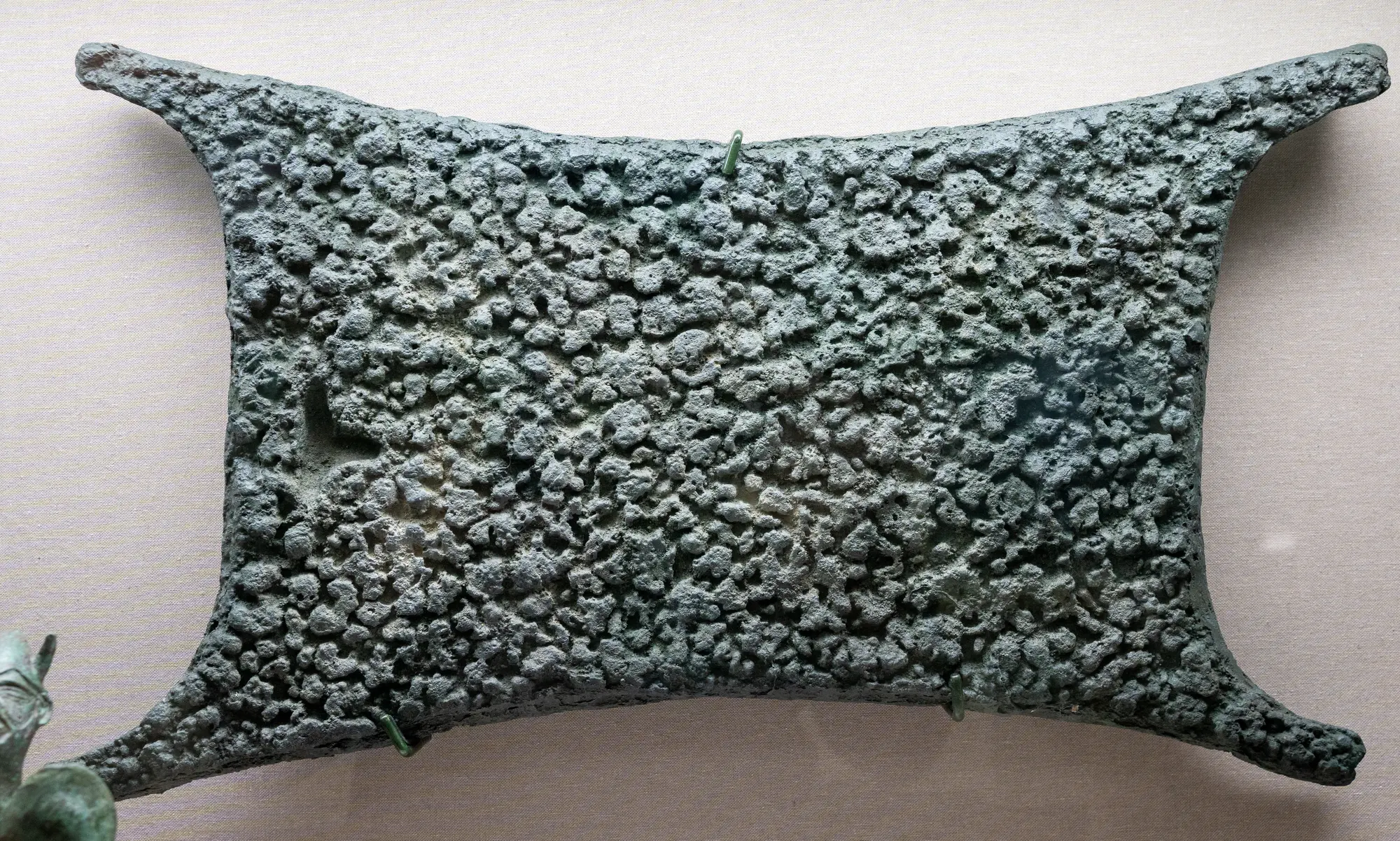 Copper IngotLate Bronze Age III · 1200–1100 BC
- Copper ingotLate Bronze Age II · 1450–1050 BC
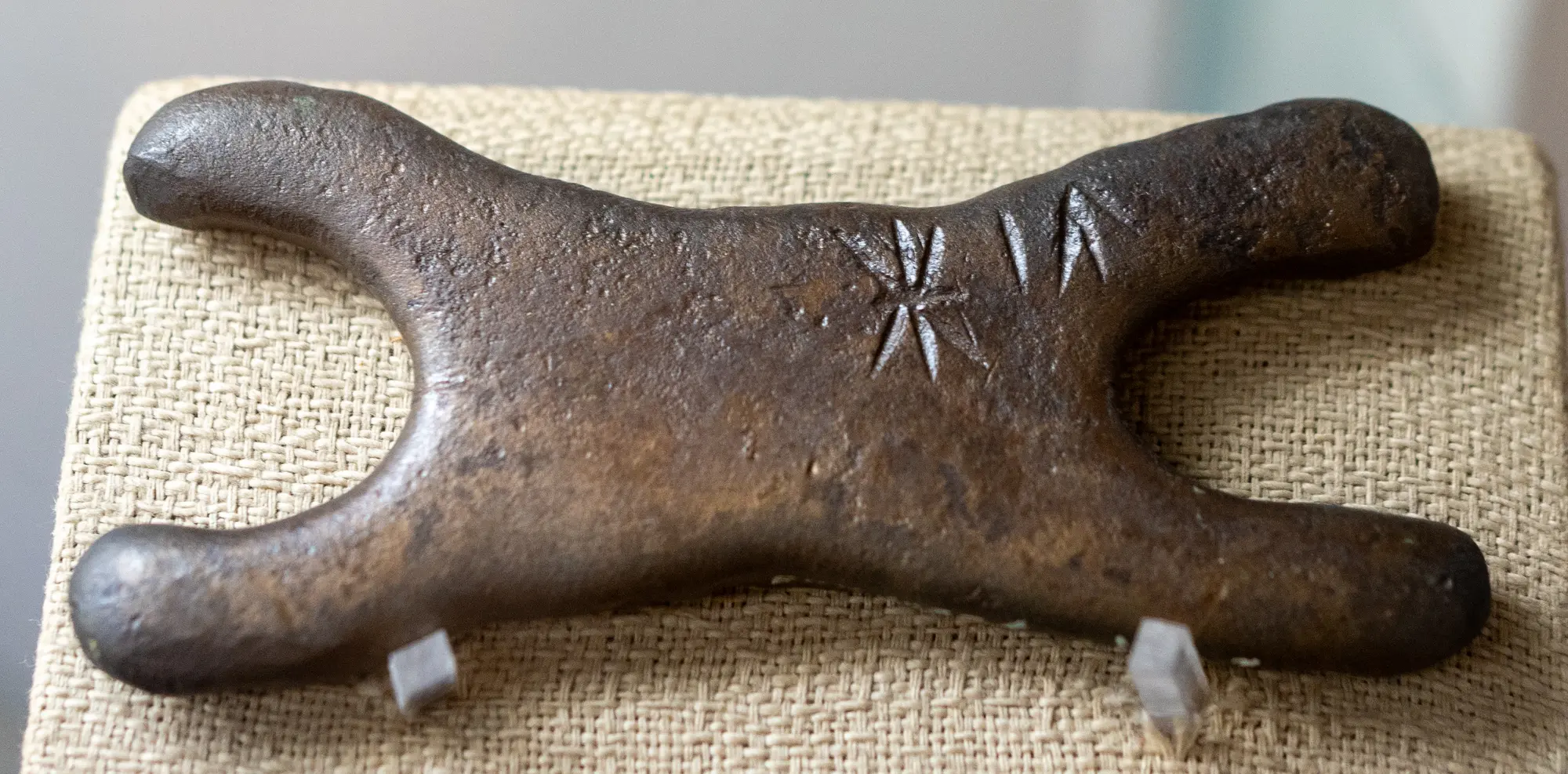 Cypro-Syllabic Script on IngotGeometric · 1050–600 BC
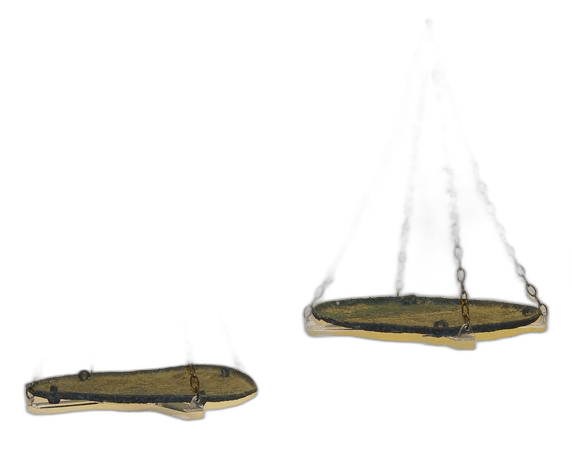 Bronze Scale PanLate Bronze Age III · 1200–1050 BC
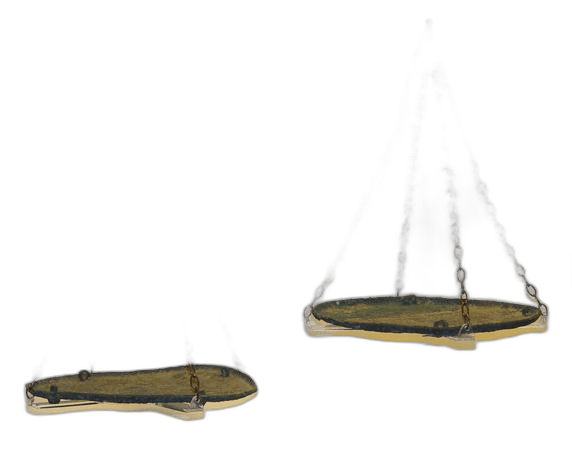 Bronze Scale PanLate Bronze Age III · 1200–1050 BC
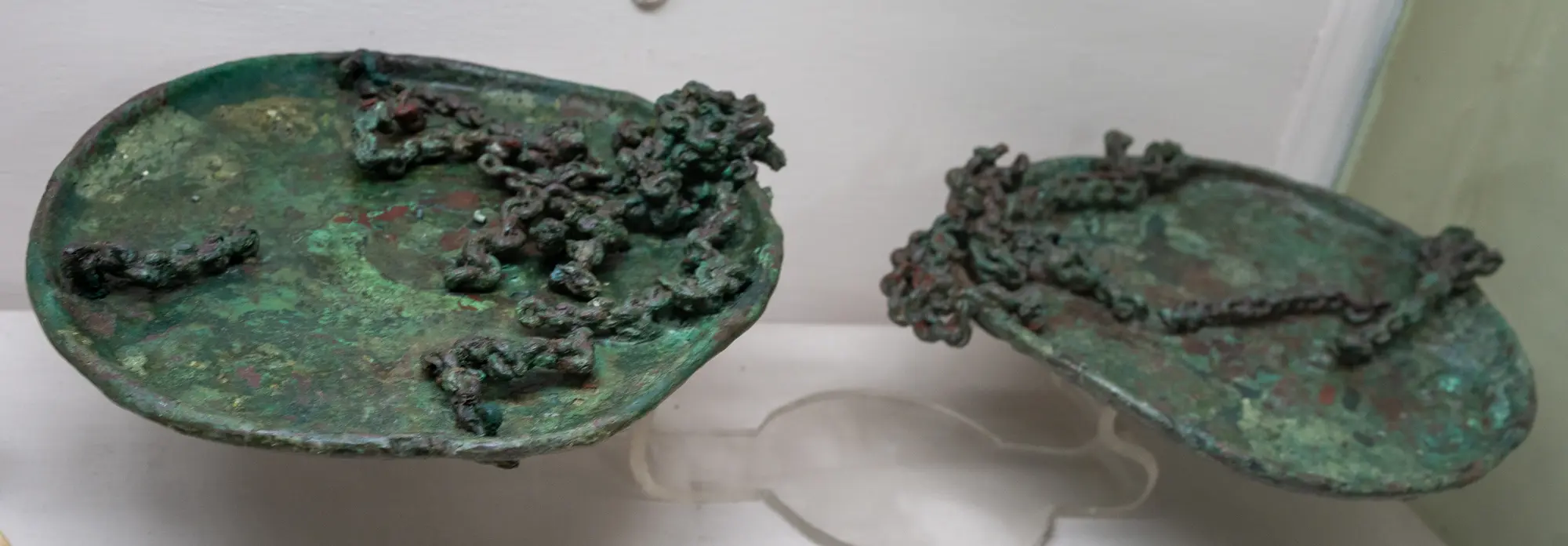 Bronze ScaleMiddle Bronze Age I · 2000–600 BC
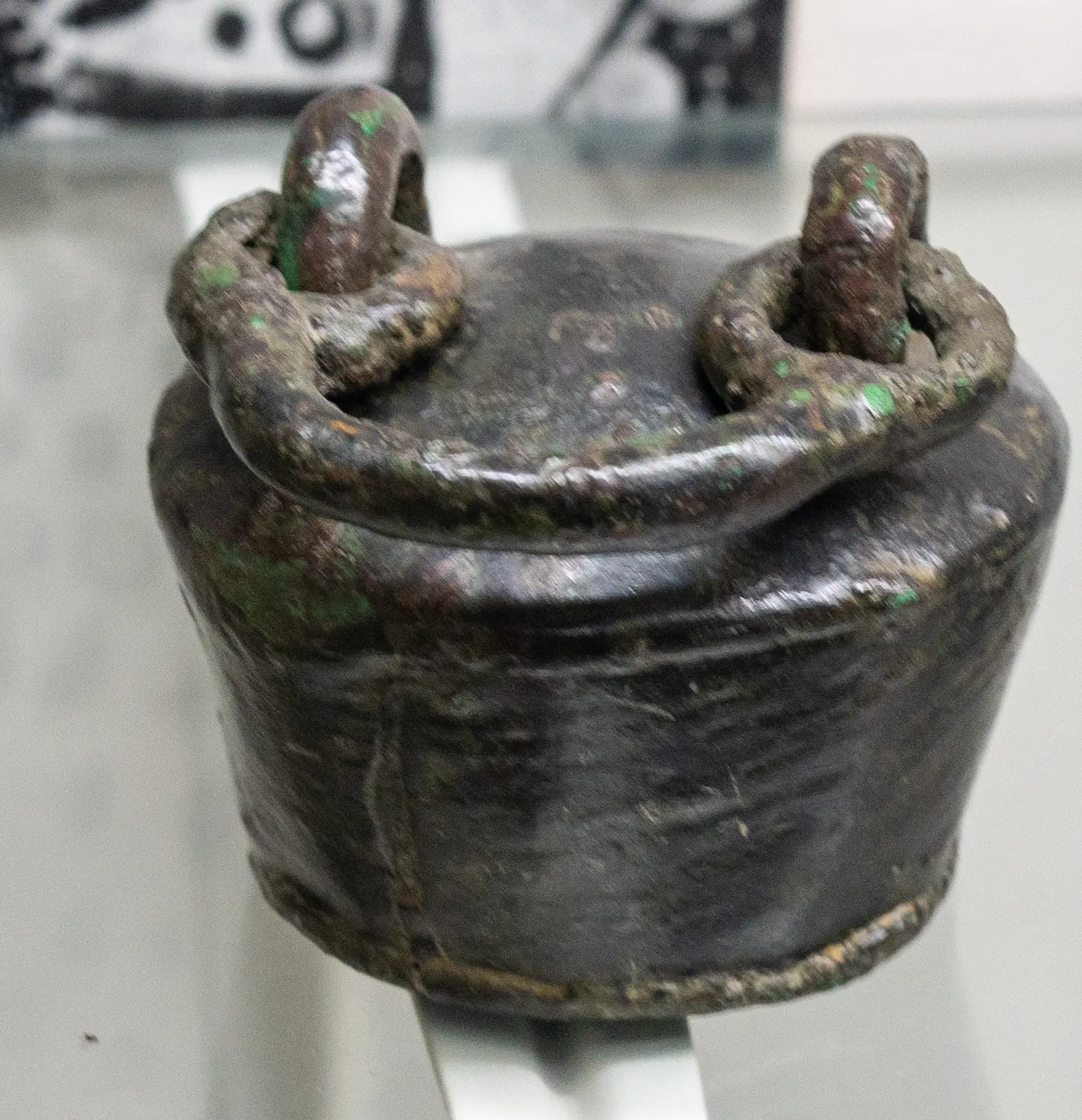 Bronze WeightMiddle Bronze Age I · 2000–1050 BC
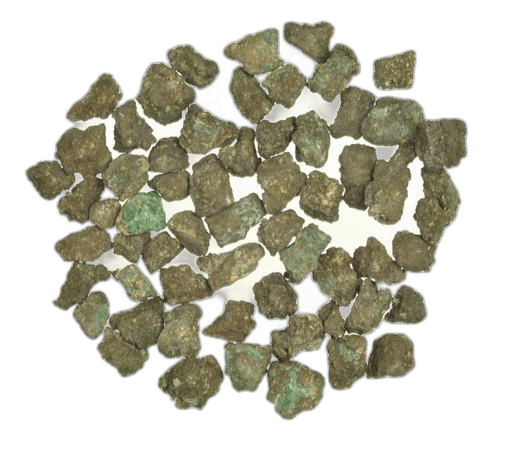 Corroded Silver NuggetsGeometric · 1050–475 BC
).webp) Terracotta Plummet, loom weightMiddle Bronze Age I · 2000–1650 BC
Terracotta Plummet, loom weightMiddle Bronze Age I · 2000–1650 BC
In the catalogue
References
- 1.Knapp, A. B., & Meyer, N. (2023). Merchants and mercantile society on Late Bronze Age Cyprus. American Journal of Archaeology, 127(3), 309–338. https://doi.org/10.1086/724597
- 2.Hauptmann, A., Maddin, R., & Prange, M. (2002). On the structure and composition of copper and tin ingots excavated from the shipwreck of Uluburun. Bulletin of the American Schools of Oriental Research, 328, 1–30.
- 3.Jones, M. R. (2007). Oxhide ingots, copper production, and the Mediterranean trade in copper and other metals in the Bronze Age (Master's thesis). Texas A&M University.
- 4.Gale, N. H., & Stos-Gale, Z. A. The role of the Apliki mine region in the post c. 1400 BC copper production and trade networks in Cyprus and in the wider Mediterranean. In V. Kassianidou & G. Papasavvas (Eds.), Eastern Mediterranean metallurgy and metalwork in the second millennium BC: A conference in honour of James D. Muhly. Oxbow.
- 5.Powell, W., Barjamovic, G., et al. (2024). Copper for the early oxhide ingots traced to the South Urals.
- 6.Spigelman, M. D. Copper and cult in Bronze Age Cyprus. In A. Georgiou (Ed.), Cyprus: An island culture. Society and social relations from the Bronze Age to the Venetian period (pp. 146 ff.). Oxbow.
- 7.Ferrara, S., & Bell, C. (2016). Tracing copper in the Cypro-Minoan script. Antiquity, 90(352), 1009–1021.
- 8.Siennicka, M. Merchants and balance weights on Late Bronze Age Cyprus [Conference abstract].
- 9.Kroll, J. H. (2008). Early Iron Age balance weights at Lefkandi, Euboea. Oxford Journal of Archaeology, 27(1), 37–48.